730
Automatic diacritization of Tunisian dialect text using Recurrent Neural
Network
Abir Masmoudi
MIRACL Laboratory University of Sfax [email protected]
Mariem Ellouze Khmekhem
MIRACL Laboratory University of Sfax [email protected]
Lamia Hadrich Belguith
MIRACL Laboratory University of Sfax [email protected]
Abstract
The absence of diacritical marks in the Arabic texts generally leads to morpholog-ical, syntactic and semantic ambiguities. This can be more blatant when one deals with under-resourced languages, such as the Tunisian dialect, which suffers from unavailability of basic tools and linguis-tic resources, like sufficient amount of cor-pora, multilingual dictionaries, morpho-logical and syntactic analyzers. Thus, this language processing faces greater chal-lenges due to the lack of these resources. The automatic diacritization of MSA text is one of the various complex problems that can be solved by deep neural net-works today. Since the Tunisian dialect is an under-resourced language of MSA and as there are a lot of resemblance between both languages, we suggest to investigate a recurrent neural network (RNN) for this dialect diacritization problem. This model will be compared to our previous models models CRF and SMT (24) based on the same dialect corpus. We can experimen-tally show that our model can achieve bet-ter outcomes (DER of 10.72%), as com-pared to the two models CRF (DER of 20.25%) and SMT (DER of 33.15%).
1 Introduction
Modern Standard Arabic (MSA) as well as Arabic dialects are usually written without diacritics(24). It is easy for native readers to infer correct pro-nunciation from undiacritized words not only from the context but also from their grammatical and lexical knowledge. However, this is not the case for children, new learners and non-native speak-ers as they dont have a good mastery of rich lan-guage derivations. Moreover, the absence of dia-critical marks leads to ambiguity that affects the
performance of NLP tools and tasks. This may generally bring a considerable awkward ambiguity at the data-processing level for NLP applications. Hence, we can notice that automatic diacritization has been shown to be useful for a variety of NLP applications, such as Automatic Speech Recogni-tion (ASR), Text-to-Speech (TTS), and Statistical Machine Translation (SMT)(24).
In this paper, we present our method to auto-matic dialectical Arabic diacritization. In fact, both previous experiences and works have shown that the use of Recurrent Neural Network (RNN) could give better results for such an MSA dia-critization system as compared to the other ap-proaches, like the Lexical Language Model (16), a hybrid approach combining statistical and rule-based techniques (28). For instance, the authors (1) demonstrated in their study that the RNN gave the least DER, compared to the other MSA dia-critization works.
Based on the huge similarity between MSA and Tunisian dialect, we decided to benefit from its advantages by testing the RNN performance in the automatic diacritization of Tunisian Arabic di-alects. To the best of our knowledge, it is the first work that investigates the RNN for the diacritiza-tion of the Tunisian dialect.
in the Tunisian dialect based on the final findings provided by various experiments.
This model will be compared to our previous CRF and SMT models (24) by utilizing the same training and testing corpus.
The remaining of this paper is structured as fol-lows: In Section 2 we describe the linguistic back-ground of the Tunisian dialect, we try to show the complexity of diacritization tasks based on exam-ples and we present the main level of diacritiza-tion. Section 3 introduces our proposed model and experiments. Section 4 provides an exhaustive ex-perimental evaluation that illustrates the efficiency and accuracy of our proposed method. Section 5 summarizes the key findings of the present work and highlights the major directions for future re-search.
2 Linguistic background
2.1 Tunisian dialect
The language situation in Tunisia is ”poly-glossic”, where distinct language varieties, such as the normative language (MSA) and the usual lan-guage (the Tunisian dialect) coexist (24).
As an official language, MSA is extensively present in multiple contexts, namely education, business, arts and literature, and social and legal written documents. However, the Tunisian dialect is the current mother tongue and the spoken lan-guage of all Tunisians from different origins and distinct social belongings. For this purpose, this dialect occupies a prominent linguistic importance in Tunisia.
Another salient feature of the Tunisian dialect is that it is strongly influenced by other foreign languages. In fact, it is the outcome of the in-teraction between Berber, Arabic and many other languages such as French, Italian, Turkish and Spanish. The manifestation of this interaction be-tween these languages is obvious in introducing borrowed words. As a result, the lexical register of the Tunisian dialect seems to be more open and contains a very rich vocabulary.
The Tunisian dialect has other specific aspects. Indeed, since this dialects spoken rather than writ-ten or taught at school, there is neither grammati-cal, nor any orthographical or syntactic rules to be followed.
2.2 Challenges in the absence of diacritization in Tunisian dialect
The absence of diacritics signs in the Tunisian di-alect texts often increases the morphological, syn-tactic and semantic ambiguity in the Tunisian di-alect. Some of them are presented as follows:
• Morphological ambiguity: The absence of the diacritical marks poses an important problem at the association of grammatical in-formation of the undiacritized word (24). For example, the word
I
. ªË
/lEb/ admits several possible words that correspond to different solutions at the grammatical labeling level. We can find the plural noun ”toys” and the verb ”play” in 3rd person masculine, singular of passive accomplishment.• Syntactic ambiguity:It should be noted that the ambiguities in the association of gram-matical information, related to the undiacritic words, pose difficulties in terms of syntactic analysis (24). For example, the undiacritic expression
ðQJ.ËA
« Y
J
ËñË@ I
.
J»
can admit twodifferent diacritization forms that are syntac-tically accepted.
– We find the diacritization form
ðQJ.ËA
« Y
J
ËñË@ I
.
J»
[The boy wrote on the desk] whose syntactic structure corresponds to a verbal sentence. – In addition, we find thediacritiza-tion form whose syntactic structure corresponds to a nominal sentence
ðQJ.ËA
« Y
J
ËñË@ I
.
J»
[The boy’s books are on the desk].• Semantic ambiguity:Tthe different diacriti-zation of a word can have different meanings, even if they belong to the same grammatical category. For example, among the possible dicaritization of the word
IKQ
¯
/qryt/ we find the following dicaritization:–
IKQ
¯
/qryt/ [I read]–
IKQ
¯
/qaryt/ [I taught].2.3 Diacritization level
The use of diacritic symbols in several instances is quite crucial in order to disambiguate homo-graphic words. Indeed, the level of diacritization refers to the number of diacritical marks presented on a word to avoid text ambiguity for human read-ers. There are four levels of possible diacritization.
• Full Diacritization: this is the case where each consonant is followed by a diacritic. This type of diacritization is used mainly in classical Arabic, especially in religion-related books and educational writings.
• Half Diacritization:the objective of this cat-egory is to add diacritics of a word except the letters that depend on the syntactic analysis of the word. Often, it is the before last letter that depends on syntactic analysis of a word but it is not always the case due to the use of suffixes.
• Partial Diacritization: is the case of adding only lexical vowels. The latter can be de-fined as the vowels with which the mean-ing of words changes. The goal of markmean-ing these vowels is to remove ambiguity from the meaning of words.
• No Diacritization: This level is completely underspecified. The script is subject to ambi-guity, especially with homographs (4).
3 Methodology and experiment step
In recent years, RNN has received a lot of inter-est in many NLP tasks of sequence transcription problems, such as speech recognition, handwrit-ing recognition and diacritics restoration. So, we select the RNN to evaluate its performance on the diacritization of the Tunisian dialect. In this work, we adopted the full diacritization level, at which all diacritics should be specified in a word.
3.1 Recurrent neural networks
RNN can be mapped from a sequence of input observations to a sequence of output labels. The mapping is defined by activation weights and a non-linear activation function as in a standard MLP. However, recurrent connections allow to ac-cess past activations. For an input sequence xT1, RNN computes the hidden sequence hT1 and the
output sequence y1T by performing the following operations fort= 1to T (13):
ht=H(Wxhxt+Whhht−1+bh) (1)
yt=Whyht+by (2)
where H is the hidden layer activation function,
Wxh is the weight matrix between input and the
hidden layer, Whh is the recurrent weight matrix
between the hidden layer and itself, Why is the weight matrix between the hidden and output lay-ers,bhandbyare the bias vectors of the hidden and
output layers, respectively. In a standard RNN, H is usually an element-wise application of sigmoid function. Such a network is usually trained using the back-propagation through time (BPTT) train-ing (27).
• Long short-term memory: LSTM
An alternative RNN called Long Short-Term Memory (LSTM) is introduced where the conven-tional neuron is replaced with a so-called memory cell controlled by input, output and forget gates in order to overcome the vanishing gradient prob-lem of traditional RNNs (12). In this case, H can be described by the following composite function (13):
it=σ(Wxixt+Whiht−1+Wcict−1+bi) (3)
ft=σ(Wxfxt+Whfht−1+Wcfct−1+bf) (4)
ct=ftct−1+it tanh(Wxcxt+Whcht−1+bc) (5)
ot=σ(Wxoxt+Whoht−1+Wcoct+bo) (6)
ht=ot tanh(ct) (7)
where theσis the sigmoid function. i,f,oand ccorrespond to, the input, forget, output gates and cell activation vectors respectively.
A BLSTM processes the input sequence in both directions with two sub-layers in order to account for the full input context. These two sub-layers compute forward and backward hidden sequences −
→
h, ←−h respectively, which are then combined to compute the output sequenceyas follows (13):
− →
ht=H(W
x−→hxt+W−→h−→h
− →
ht−1+b−→
h) (8)
←−
ht=H(W
x←−hxt+W←h−←−h
←−
ht−1+b←−
h) (9)
yt=W−→
hy
− →
ht+W←− hy
←−
ht+by (10)
3.2 Model architecture
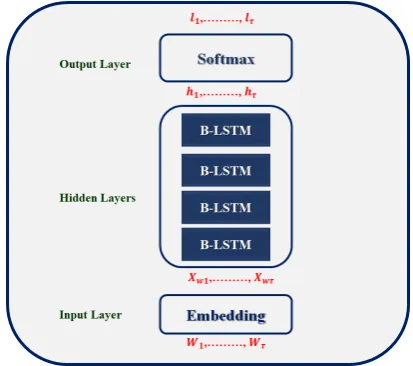
In our diacritization task, the basic idea is to at-tribute a corresponding diacritical label to each character. Hence, we apply RNN to model our se-quence data, where a sese-quence of characters con-stitutes the input and the probability distribution over diacritics forms the output. Schematically, our RNN structure is employed in this work as the following figure:
Figure 1: Architecture of our neural network
This can be statistically expressed in this way: Given that W = (w1...wT), w indicates a
se-quence of characters, where each character is re-lated to a label lt. In this respect, a label may
stand for 0, 1 or more diacritics. Furthermore, a real-valued vector xw is a representation of each character w in the alphabet.
We can state that our neural network consists of 3 layers, namely an input layer, a hidden layer
and an output layer. Each layer fulfils a particu-lar purpose. In what follows, we will explain the advantages of each layer.
• Input layer: This level consists in mapping the letter sequencewto a vector sequencex. We have checked and prepared data of our corpus. In combining the gemination mark with another diacritic, each character in the corpus has a label corresponding to 0,1 or 2 diacritics. Character embedding input, which is initialized randomly and updated during training, means that each character in the in-put sentence is represented by a vector ofd real numbers. It is worth pointing out that adding a linear projection after the input layer affects the learning of a new representation for the latter embedding.
• Hidden layer: This layer consists in map-ping the vector sequence x to a hidden se-quenceh. Several types of hidden layers have been used to choose the best performance and the best result in the automatic diacritization of the Tunisian dialect. Hence, these experi-ments were based on LSTM different layers ranging from one layer to multiple B-LSTM layers.
• Output layer: This last layer focuses on mapping each hidden vectorhtto a probabil-ity distribution over labelsl. In this layer, we use a softmax activation function to produce a probability distribution over output alpha-bet at each time step.
P(l|wt) = Pexp(yt[l]) l0exp(yt[l0])
(11)
whereyt = Whyht+by andyt[l]is thelth
element ofyt.
3.3 Experience
The network is trained using Gradient Descent optimizer with learning rate 0.0003 and a mini-batch size of 200. For dropout, a rate of 0.2 is used both on embedded inputs and after each type of hidden layers; either LSTM or B-LSTM. Weights are randomly-initialized with normal dis-tribution of zero mean and 0.1 standard deviation and weight updates after every batch. The loss function is the cross-entropy loss summed over all outputs. The GPU used is Nvidia GTX 580 that has 16 streaming multiprocessors and 1.5 GB of memory
4 Results and discussion
4.1 Evaluation Metric
In order to measure our model performance, an evaluation metric, known as Diacritic Error Rate (DER) is generally used. DER indicates how many letters have been incorrectly restored with their diacritics. The DER can be calculated as fol-lows (24):
DER= (1− |T S|)
|T G| ∗100 (12)
Where |T S| is the number of letters assigned correctly by the system, and |T G|is the number of diacritized letters in gold standard texts.
4.2 Datasets
This section shows a breakdown of different sizes of our data sets, which were gathered from various sources. So far, we have used four existent types of corpora for our teamwork.
• We made use of our TARIC corpus (Tunisian Arabic Railway Interaction Corpus) (24). The latter collected information about the Tunisian dialect used in a railway station. This corpus was recorded in the ticket offices of the Tunis railway station. We recorded conversations in which there was a request for information about the train schedules, fares, bookings, etc. This corpus consists of several dialogues; each dialogue is a com-plete interaction between a clerk and a client. All the words are written using the Arabic al-phabet with diacritics. The diacritics indicate how the word is pronounced. The same word can have more than one pronunciation.
• The second corpus is called STAC (Spo-ken Tunisian Arabic Corpus)(35). This
cor-pus is a representation of spontaneous dis-courses in Tunisian dialect. This dialect cor-pus of transcribed discourses deals with mul-tiple themes, such as social affairs, health, re-ligion, etc.
• We utilized another type of corpus that is the result of a conversion tool from Latin written texts (also called Arabizi) into Arabic scripts following the CODA conversion. The Ara-bizi corpus is collected from social media like Facebook, Twitter and SMS messaging (22).
• In order to solve the problem of the lack of re-sources for the Tunisian dialect, we have cho-sen to gather corpora from blog sites written in this dialect using Arabic alphabets (24). (For more details see (24))
As mentioned above, the Tunisian dialect dif-fers from MSA and it does not have a standard spelling because there are no academies of Arabic dialect. Thus, to obtain coherent learning data, it is necessary to utilize a standard spelling. Indeed, there are words with many forms. For example, the word
àñJ ¯P PP
/reservation/ can be writtenin four different ways:
àñJ ¯P P@P
,àñJ ¯P@ P@P
andàñJ ¯P QKP
.In this work, spelling transcription guidelines CODA (Tunisian Dialect writing convention), (36), were adopted. CODA is a conventional-ized orthography for Dialectal Arabic. In CODA, every word has a single orthographic representa-tion. It uses MSA-consistent and MSA-inspired orthographic decisions (rules, exceptions and ad hoc choices). CODA preserves, also, dialectal morphology and dialectal syntax. CODA is eas-ily learnable and readable. CODA has been de-signed for the Egyptian Dialect (11) as well as the Tunisian Dialect (36) and the Palestinian Levan-tine Dialect (20). For a full presentation of CODA and an explanation of its choices, see ((11), (36)).
The normalization step is essential because it presents a key point for the other steps of our method. Among the normalisation Tunisian Di-alect words we have:
• To define the future, we must follow the following form:
AK.
+ verb, for example:ú
æÖ
ß
AK.
.• To define the negation, we must follow the following form:
A
Ó
+ verb.Let’s remember that the Tunisian Dialect is characterized by the presence of foreign words, such as for instance: French, English, Spanish, Italian, etc. To transcribe these words, Arabic alphabets have been used. These foreign words have a unique form, for example:
PñKP
[Back],à@QK
[train]...At the end of this step, we obtain a standardized corpus. The figure 2 represents a corpus extract before the normalization step.
Figure 2: Corpus extract before the normalisation step
The figure 3 represents a corpus extract after the normalization step.
Figure 3: Corpus extract after the normalisation step
Since there are no automatic diacritization tools for the Tunisian dialect, and because the MSA tools are unable to treat this dialect due to the differences between the MSA and the Tunisian dialect, we were obliged to diacritize the corpus manually.
Below we provide the most important charac-teristics in Table 1.
Table 1: Characteristics of our corpus.
#statements #words TARIC 21,102 71,684 STAC 4,862 42,388 Arabizi 3,461 31,250 Blogs 1582 27,544 Total 31,007 172,866
We aimed to decently create training, develop-ment and test sets in order to judge our diacritiza-tion models. We outlined the available datasets for the language under investigation. We randomly selected 23,255 sentences for training, 1,550 for development and 6,202 for testing.
Table 2: Tunisian dialect diacritization corpus statistics.
Train Dev Test
#Statements 23,255 1,550 6,202
#words 129,649 8,643 34,574
#Letters 64,8247 43,216 172,867
4.3 Result
In this section, we present the evaluation outcome of our established diacritization models. We use DER as an evaluation metric. The adopted RNN has from 1 to 4 hidden layers, each with 250 neu-rons. This number is chosen after different exper-iments. We come up with the conclusion that a smaller number of neurons (less than 250) have an impact on accuracy rate and a greater number do not improve it in a significant way. Table 3 gives an overview of the RNN models outcomes in terms of diacritic error rate (DER).
Table 3: Diacritization Error Rate Summary for the Tunisian dialect RNN model
Model DER
LSTM 13.86%
B-LSTM 12.31% 2-layer B-LSTM 11.53% 3-layer B-LSTM 10.72% 4-layer B-LSTM 10.83%
Table 3 shows the effect of using LSTM and B-LSTM models, and the number of hidden lay-ers on the DER. According to this table, results show a DER of 13.56% for LSTM and 12.31% for B-LSTM. Based on the results of our RNN, we detected an enhancement of 1.55% in DER of the B-LSTM model as compared to LSTM model. This means that B-LSTM is more performant than LSTM.
Moreover, we noticed that increasing the num-ber of B-LSTM layers from one hidden layer to three layers improves accuracy. But, we ap-plied the 3-layer BLSTM because its accuracy is not only closer but also fasther than the 4-layer BLSTM. Indeed, the training time rises from 3:52 to 6:78 hours when the number of layers pro-gresses monotonically from 3 to 4 and the testing time icreases from 3.65 to 5.41 minutes. Hence,
the 3-layer B-LSTM configuration was adopted.
To conclude, a 3-layer BLSTM models achieved the best results.
4.4 Error Analysis
In order to reveal the weaknesses of our automatic diacritic restoration RNN models, we analyzed all errors that are mainly due to the following reasons:
• We noticed that these errors are due to the presence of foreign words in our corpus.
• Some error words with prefixes, or suffixes or both can be significantly perceived. It is hard to diacritize these complex words in a correct way, as the in flection diacritical mark is related to the last letter of the stem rather than to the last letter of the suffix.
• Errors due to form/spelling diacritization er-rors. Errors caused by ”Shadda” (consonant doubling), or Tanween (nunation). We per-ceived that restoring ”shadda” is harder than restoring the other diacritics.
• Errors due to missing and incorrect short vowels (i.e. lexical diacritics).
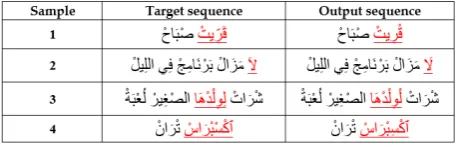
We have manually checked 150 error samples of our input RNN model. The following figure shows an example of 4 sample sequences that have errors. The words that have errors are underlined and in red.
Figure 4: Sample sequences with errors
In about 21% of the samples, we have remarked that the absence of ”shadda” in some words can lead to a semantic ambiguity of the verb. For in-stance, sample 1 shows that target verb
IK
Q
¯
[IDiacritization errors in test samples can cause about 4% of errors. For example, sample 2 dis-plays that the ”Fatha” in the word
B
was mistak-enly entered after the last letter rather than the first letter.Some error words with prefixes, suffixes or both can be significantly perceived, in about 41% of the samples. In another illustration, the error word in sample 3 has both the prefix ”la”
È
and thepro-noun suffix ”haA”
A
ë
.We also noticed a significant fraction of error words (34%) due to the presence of foreign words in our corpus as in sample 4..
4.5 Comparison with State-of-art Systems
In this section, we compare our proposed RNN model with two other models, namely SMT and a discriminative model as a sequence classification task based on CRFs (24). These two models were realized in our previous works in order to carry on the dialect restoration for the Tunisian dialect. To achieve this comparison, we employed the same dialectical corpus and evaluation metrics.
Concerning the first model, we regarded the di-acritization problem as a simplified phrase-based SMT task. The source language is the undiacritic text while the target language is the diacritic text. The basic idea of SMT is to analyze automatically existing human sentences called parallel corpus in order to build translation model. The alignment from words without diacritics to words with dia-critics is a monotonic mapping. To do this, we employed moses (21) a SMT tool.Word alignment was done with GIZA++ (25). We implemented a 5-gram language model using the SRILM toolkit (31). We decoded using Moses (21).
In the second model, we decided to get the diacritical marks restoration by focusing on dia-critization based on grammatical information. We intended to build dependency relations between words and ”POS” tags and to perceive their effects on word diacritizations. In fact, we proposed to scrutinize the integration of grammatical informa-tion ”POS” for the diacritizainforma-tion with the aid of Conditional Random Fields (CRF)(24).
The following table reviews the accuracy results to restore diacritics automatically from our
previ-ous published researches in the Tunisian dialect field.
Table 4: Diacritization results of related work (CRF and SMT models) and our RNN model
Model DER
3-layer B-LSTM 10.72%
CRF 20.25%
SMT 33.15%
As depicted in Table 4, our RNN model (3-layer B-LSTM) provides the best results(DER of 10.72%) compared to both SMT (DER of 33.15%) and CRF (DER of 20.25%) models.
5 Conclusion
The absence of short vowels gives rise to a great ambiguity which influences the results of such NLP applications. An outcome of this study was the development of RNN diacritic restoration model for Tunisian dialect. To the best of our knowledge, this is the first work that deals with the problem of Tunisian dialect diacritizers using RNN.
In order to choose the best configuration of the RNN network, we did several preliminary experi-ments with different training options. These op-tions concern the hidden layer where we tested the impact of the change of the neural network size and the topology on its performance. Sev-eral types of hidden layers are tested, ranging from one layer LSTM to multiple B-LSTM layers. The best accuracy is obtained when using the 3-layer B-LSTM model (DER of 10.72%). We com-pared our RNN diacritization model with two ma-jor models, namely a SMT and CRF models (24). These two models were realized in our previous works in order to carry on the dialect restoration for the Tunisian dialect. During this comparison, we employed the same dialectical corpus and eval-uation metrics. About 9.53% DER improvement of RNN model was achieved over the best reported CRF model.
accu-Investigation, Computational Linguistics and In-telligent Text Processing - 16th International Con-ference, CICLing 2015, Cairo, Egypt, p.608-619, (2015).
Masmoudi, A., Bougares,F., Ellouze, M., Esteve, Y., Belguith, L.: Automatic speech recognition system for Tunisian dialect. Language Resources and Evaluation 52(1): 249-267 (2018).
Masmoudi, A., Mdhaffer,S., Sellami, R. Belguith, L.: Automatic Diacritics Restoration for Tunisian Dialect. TALLIP2018: Transactions on Asian and Low-Resource Language Information Processing.
Och, F. and Ney, H. 2003. A Systematic Com-parison of Various Statistical Alignment Models. Computational Linguistics, 29(1):19–52.
Rashwan, M., Al Sallab, A., Raafat, H. and Rafea, A. Deep Learning Framework with Confused Sub Set Resolution Architecture for Automatic Arabic Diacritization. IEEE/ACM Transactions on Au-dio, Speech, and Language Processing, 2015.
Rumelhart, D., Hinton,G., and Williams, R. Learning representations by back-propagating er-rors, Nature, no. 323, pp. 533 536, 1986.
Said, A., El-Sharqwi, M., Chalabi, A , and Ka-mal, E. A hybrid approach for Arabic diacritiza-tion, Application of Natural Language to Informa-tion Systems, pp. 53-64, Jun 2013.
Shaalan, K., Abo Bakr, M. and Ziedan. I. 2009. A hybrid approach for building Arabic diacritizer. In Proceedings of the EACL 2009 Workshop on Computational Approaches to Semitic Languages.
Shaalan, K., Abo Bakr, H. and Ziedan. I. 2008. A statistical method for adding case ending diacrit-ics for Arabic text. In Proceedings of Language Engineering Conference.
Stolcke A. 2002. SRILM an Extensible Language Modeling Toolkit. Proceedings of ICSLP.
Zaghouani, W., Bouamor, H., Hawwari, A., Diab, M., Obeid, O., Ghoneim, M., Alqahtani, S and Oflazer, K. 2016. Guidelines and framework for a large-scale Arabic diacritized corpus. Proceed-ings of the Tenth International Conference on Lan-guage Resources and Evaluation (LREC 2016).
Zitouni, I., Sorensen, J. and Sarikaya, R. 2006. Maximum entropy based restoration of Arabic di-acritics. In Proceedings of the 21st International Conference on Computational Linguistics and the 44th annual meeting of the Association for Com-putational Linguistics.
Zitouni, I. and Sarikaya, R. 2009. Arabic Dia-critic Restoration Approach Based on Maximum Entropy Models. In Journal of Computer Speech and Language.
Zribi, I., Ellouze, M., Belguith, L.H. and Blache, P. 2015. Spoken Tunisian Arabic Corpus ”STAC”: Transcription and Annotation. Res. Comput. Sci. 90.