Scholarship@Western
Scholarship@Western
Electronic Thesis and Dissertation Repository
11-21-2014 12:00 AM
Dynamic Resource Management in Virtualized Data Centres
Dynamic Resource Management in Virtualized Data Centres
Gaston Keller
The University of Western Ontario
Supervisor Hanan Lutfiyya
The University of Western Ontario Graduate Program in Computer Science
A thesis submitted in partial fulfillment of the requirements for the degree in Doctor of Philosophy
© Gaston Keller 2014
Follow this and additional works at: https://ir.lib.uwo.ca/etd
Part of the Other Computer Sciences Commons
Recommended Citation Recommended Citation
Keller, Gaston, "Dynamic Resource Management in Virtualized Data Centres" (2014). Electronic Thesis and Dissertation Repository. 2539.
https://ir.lib.uwo.ca/etd/2539
This Dissertation/Thesis is brought to you for free and open access by Scholarship@Western. It has been accepted for inclusion in Electronic Thesis and Dissertation Repository by an authorized administrator of
DATA CENTRES
(Thesis format: Integrated Article)
by
Gast´on Keller
Graduate Program in Computer Science
A thesis submitted in partial fulfillment
of the requirements for the degree of
Doctor of Philosophy
The School of Graduate and Postdoctoral Studies
The University of Western Ontario
London, Ontario, Canada
c
In the last decade, Cloud Computing has become a disruptive force in the computing
land-scape, changing the way in which software is designed, deployed and used over the world. Its
adoption has been substantial and it is only expected to continue growing. The growth of this
new model is supported by the proliferation of large-scale data centres, built for the express
purpose of hosting cloud workloads. These data centres rely on systems virtualization to host
multiple workloads per physical server, thus increasing their infrastructures’ utilization and decreasing their power consumption. However, the owners of the cloud workloads expect their
applications’ demand to be satisfied at all times, and placing too many workloads in one
phys-ical server can risk meeting those service expectations. These and other management goals
make the task of managing a cloud-supporting data centre a complex challenge, but one that
needs to be addressed.
In this work, we address a few of the management challenges associated with dynamic
resource management in virtualized data centres. We investigate the application of First Fit
heuristics to the Virtual Machine Relocation problem (that is, the problem of migrating VMs
away from stressed or overloaded hosts) and the effect that different heuristics have, as reflected
in the performance metrics of the data centre. We also investigate how to pursue multiple goals in data centre management and propose a method to achieve precisely that by dynamically
switching management strategies at runtime according to data centre state. In order to improve
system scalability and decrease network management overhead, we propose architecting the
management system as a topology-aware hierarchy of managing elements, which limits the
flow of management data across the data centre. Finally, we address the challenge of managing
multi-VM applications with placement constraints in data centres, while still trying to achieve
high levels of resource utilization and client satisfaction.
Keywords: data center management, virtualized infrastructure management, cloud
man-agement, energy manman-agement, SLA manman-agement, application management.
Each chapter of this thesis corresponds to a research paper in which the candidate was
primary author. The candidate’s supervisor, Dr. Hanan Lutfiyya, appears as co-author in every paper to indicate her participation in the research project, providing guidance both with the
research itself and its write-up. Dr. Michael Bauer appears as co-author in some of the papers,
too, having had a similar supervisory role as that of Dr. Lutfiyya.
An Analysis of First Fit Heuristics for VM Relocation
This work was primarily authored by the candidate, who developed the research idea,
con-ducted the literature review, designed and implemented the proposed heuristics, designed and
performed the experiments, and wrote the paper. Fellow PhD Candidate Michael Tighe
con-tributed to the project providing feedback and assisting with experiment design and writing.
Switching Data Centre Management Strategies at Runtime
This work resulted from a collaboration between the candidate, fellow PhD Candidate Michael
Tighe, and former MSc student Graham Foster. The candidate designed and implemented the three single-goal management strategies, as well as the Distance to Goals (Goal-DSS)
meta-strategy. The candidate also contributed to the evaluation of the work and its write-up.
A Hierarchical, Topology-aware Approach to Dynamic VM Management
This work was primarily authored by the candidate, with assistance from fellow PhD Candidate
Michael Tighe, who provided invaluable feedback and proof-reading.
Dynamic Management of Multi-VM Applications with Constraints
The candidate is the primary author of this work.
The first and only chapter of the Appendix, titledDCSim, describes the simulation
frame-work of the same name that we developed over the years to evaluate algorithms and techniques
for managing virtualized data centres. The simulator was primarily developed by fellow PhD
Candidate Michael Tighe, with contributions from the candidate, mainly focused on the design
of the first iteration of the simulator, the organization of the data centre in clusters and racks, as
well as general design input throughout DCSim’s lifetime. The work presented in this chapter
is based on a publication co-authored by the candidate and expanded to cover the latest changes
to the simulator.
“Gratitude is not only the greatest of virtues, but the parent of all others.” – Marcus Tullius Cicero
I would like to acknowledge here those people that have earned my outmost gratitude in
these past years: my colleague and friend Michael Tighe, with whom I walked this arduous
road; my friend Andrew Delong, a dedicated and honorable researcher like I know no other; my partner and editor Alex “Julia” Pontefract, who often moderates my harsh words; my family, a continent away, but always present; and finally the “latinos”, my safety net away from home.
Abstract ii
Co-Authorship Statement iii
Acknowledgements iv
List of Figures ix
List of Tables x
1 Introduction 1
1.1 Virtual Machine Management . . . 4
1.2 Research Challenges . . . 6
1.2.1 Virtual Machine Relocation . . . 7
Formal Problem Definition . . . 7
1.2.2 Multi-goal Management Strategies . . . 9
1.2.3 Management Systems’ Architecture . . . 10
1.2.4 Multi-VM Application Management . . . 11
1.3 Thesis Outline . . . 12
2 An Analysis of First Fit Heuristics for VM Relocation 17 2.1 Related Work . . . 18
2.1.1 VM Placement . . . 18
2.1.2 VM Relocation . . . 19
2.1.3 Resource Reallocation . . . 20
2.2 VM Relocation . . . 20
2.2.1 Assumptions and Limitations . . . 20
2.2.2 Policies . . . 21
2.3 Evaluation . . . 24
2.3.1 Simulator Configuration . . . 24
2.3.4 Results and Discussion . . . 26
2.4 Conclusions and Future Work . . . 31
3 Switching Data Centre Management Strategies at Runtime 35 3.1 Related Work . . . 36
3.2 Management Strategies . . . 38
3.2.1 Terminology . . . 38
3.2.2 Host Classification . . . 39
3.2.3 Power and SLA Strategies . . . 40
VM Placement . . . 40
VM Relocation . . . 41
VM Consolidation . . . 43
3.2.4 Hybrid Strategy . . . 43
3.3 Dynamic Strategy Switching . . . 44
3.3.1 SP-DSS . . . 44
3.3.2 Goal-DSS . . . 45
3.3.3 Util-DSS . . . 46
3.4 Evaluation . . . 47
3.4.1 Strategy Evaluation and Comparison . . . 47
3.4.2 Experimental Setup . . . 48
3.4.3 Workload . . . 49
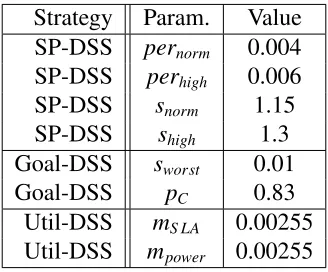
3.4.4 Strategy Switching Tuning Parameters . . . 50
3.4.5 Metrics . . . 50
3.4.6 Results and Discussion . . . 50
3.5 Conclusions and Future Work . . . 53
4 A Hierarchical, Topology-aware Approach to Dynamic VM Management 57 4.1 Related Work . . . 58
4.2 Hierarchical Management . . . 59
4.2.1 Data Centre Infrastructure . . . 59
4.2.2 System Architecture . . . 60
4.2.3 Monitoring Data, Aggregate Metrics and Status Updates . . . 60
4.3 Management Strategies and Policies . . . 61
4.3.1 Assumptions . . . 62
4.3.2 VM Placement . . . 62
4.4 Evaluation . . . 64
4.4.1 Experimental Setup . . . 65
4.4.2 Experimental Design . . . 66
4.4.3 Metrics . . . 67
4.4.4 Results and Discussion . . . 67
4.5 Conclusions and Future Work . . . 71
5 Dynamic Management of Multi-VM Applications with Constraints 75 5.1 Related Work . . . 76
5.2 Application Placement Constraints . . . 77
5.2.1 Application Templates . . . 79
5.2.2 Application Representation . . . 79
5.3 Management Strategies . . . 80
5.3.1 Data Centre Organization and System Architecture . . . 81
5.3.2 Management Strategy: Enforced Constraints (MS-EC) . . . 81
Placement . . . 82
Relocation . . . 83
Consolidation . . . 85
5.3.3 Management Strategy: Relaxed Constraints (MS-RC) . . . 85
5.4 Evaluation . . . 87
5.4.1 Experimental Setup . . . 87
5.4.2 Experimental Design . . . 89
5.4.3 Metrics . . . 90
5.4.4 Results and Discussion . . . 91
5.5 Conclusions and Future Work . . . 95
6 Conclusion 100 6.1 Discussion . . . 100
6.2 Limitations . . . 102
6.3 Future Work . . . 103
6.3.1 Hierarchical Management . . . 103
6.3.2 Placement Constraints . . . 104
6.3.3 Complementary Work . . . 105
6.3.4 New Approaches to VM Management . . . 105
6.4 Conclusion . . . 106
A.2 DCSim Architecture & Components . . . 110
A.2.1 Simulation Engine . . . 111
A.2.2 Events . . . 112
A.2.3 VMs, Hosts, Racks & Clusters . . . 112
VM . . . 113
Host . . . 113
Rack . . . 113
Cluster . . . 114
A.2.4 Data Centre Network . . . 114
A.2.5 Application Model . . . 114
A.2.6 Resource Managers & Scheduling . . . 116
A.2.7 Autonomic Managers & Policies . . . 116
A.2.8 Management Actions . . . 117
A.2.9 Metrics . . . 117
A.3 Configuring and Using DCSim . . . 118
A.3.1 Workloads . . . 118
A.3.2 Default Metrics . . . 118
A.3.3 Performing Experiments with DCSim . . . 120
A.3.4 Output & Logging . . . 120
A.3.5 Visualization Tool . . . 121
A.4 Evaluation . . . 121
A.4.1 Data Centre Infrastructure . . . 122
A.4.2 Management Systems - Common Elements . . . 122
A.4.3 Static Management System . . . 122
A.4.4 Dynamic Periodic Management System . . . 123
A.4.5 Dynamic Reactive Management System . . . 124
A.4.6 Experimental Setup and Design . . . 124
A.4.7 Results and Discussion . . . 125
A.5 Conclusions and Future Work . . . 126
Curriculum Vitae 129
2.1 Exp. 2 – 400 VMs . . . 29
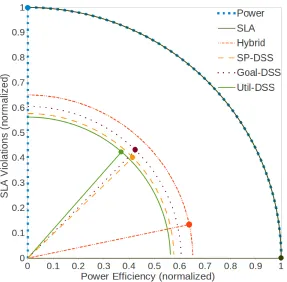
3.1 Strategy Scores . . . 51
4.1 Data Centre Organization . . . 59
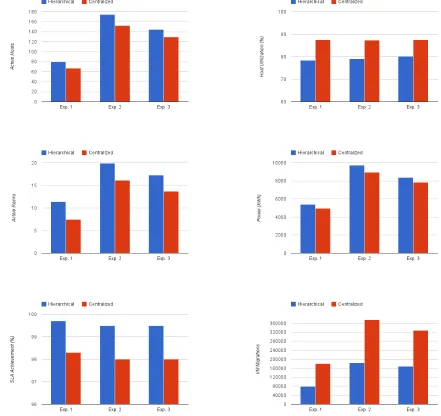
4.2 Hierarchical vs Centralized Results . . . 69
4.3 Exp. 3 – VM Migrations per Type . . . 70
5.1 Data Centre Infrastructure . . . 78
5.2 Application Templates . . . 79
5.3 Sample Application . . . 80
5.4 Exp. 2 – Single- and Multi-VM Applications . . . 94
A.1 Data Centre Model . . . 110
A.2 Application Model . . . 115
2.1 VM Relocation Policies . . . 23
2.2 Exp. 1 – 300 VMs . . . 27
2.3 Exp. 2 – 400 VMs . . . 27
2.4 Exp. 3 – 452 VMs . . . 27
2.5 Exp. 4 – 500 VMs . . . 28
3.1 DSS Tuning Parameters . . . 49
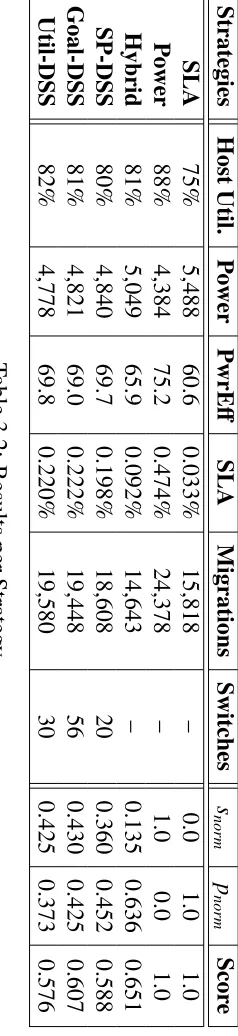
3.2 Results per Strategy . . . 52
4.1 Hierarchical vs Centralized Results . . . 68
5.1 Applications . . . 88
5.2 Exp. 1 – Multi-VM Applications . . . 92
5.3 Exp. 2 – Single- and Multi-VM Applications . . . 93
A.1 Management Systems Comparison . . . 126
Introduction
Computing today is in the midst of a paradigm shift. This shift is twofold: first, applications
are no longer developed to be installed on individual users’ computers, but to be installed on
remote servers and accessed through the Internet; and second, the remote servers hosting these
applications are typically not owned by the application providers themselves, but by data cen-tre1providers renting their computing infrastructure on a pay-per-usage basis. This paradigm,
known as Cloud Computing, has been widely adopted by the Information Technology (IT) world, and is expected to continue to grow in usage [1, 2, 3, 4]. For example, Cisco has
pre-dicted that by 2017 nearly two thirds of all workloads will be processed in the cloud [5].
Cloud Computing comes in three forms: Software as a Service (SaaS),Platform as a Ser-vice (PaaS), andInfrastructure as a Service (IaaS). In SaaS, the (application) client pays for the use of an application. Clients do not purchase a license and install the application, but rather
buy a subscription that enables them to access and use the application remotely through a web
browser. Continuous application execution (i.e., availability), configuration and maintenance
falls under the responsibility of the application provider, as well as the provision of any
ancil-lary services, such as billing and security. Some well known examples of SaaS are Salesforce [6], Google Apps [7] and Basecamp [8].
In the PaaS flavour of Cloud Computing, the traded resource is asoftware (or application) stack. This resource consists of a set of software subsystems or components needed to perform a task without further external dependencies. A classic example of such a resource is the
LAMP software stack, which consists of the GNU/Linux operating system, the Apache web
server, the MySQL database management system, and the PHP programming language, and
it is commonly used to deploy a web service. Examples of PaaS are Google App Engine [9],
Microsoft Azure [10] and dotCloud Platform [11].
1A data centre can be thought of, in essence, as a collection of physical servers connected through a high
speed, high bandwidth network.
Finally, in IaaS, clients rent computers – physical or virtual – and storage capacity from
infrastructure providers. These computers are bare platforms consisting of little more than an
operating system; clients have to build their desired software stack. In addition, clients are
responsible for their computers’ execution and maintenance, but in exchange for this increased level of responsibility they get more freedom and control over their platform than they would
otherwise get under PaaS. Common examples of IaaS are Amazon Web Services [12], Google
Compute Engine [9] and Microsoft Azure [10].
Regarding IaaS-type clouds, there exist three models to be aware of: public, privateand hybridclouds. This distinction does not respond to technical differences, but rather to business or functional ones; more specifically, to who has access to the cloud. A public cloud, for
ex-ample, can be accessed by the general public. That is, a company owns the cloud and provides
IaaS to the public. On the other hand, a private cloud can only be accessed by the company’s
employees. In this case, the cloud is for internal use only, not to be rented to the public. Lastly,
a hybrid cloud represents a compromise between the previous two models: the company owns
its own private cloud, but relies on public clouds for specific tasks or to handle unexpected increases in workload.
Our research focuses on the management of IaaS-type data centres (or clouds), either public or private. An IaaS-type data centre can be thought of, in essence, as a collection of physical
servers connected through a high speed, high bandwidth network. Though real data centres are
more complex than that, this simplified model will be used throughout this work.
Running a data centre incurs expenses (e.g., infrastructure acquisition, maintenance,
ad-ministration, utilities), of which power consumption is one of the highest; studies have shown
that data centres are high power consumers [13]. Given that physical servers are on average
poorly utilized [14] and that a typical physical server can consume 50% to 70% of its peak
power usage while idle [15], it is important for data centres to maximize their infrastructure’s
utilization, so as to make the most out of every powered on server and in doing so reduce power
consumption. Thus, maximizing resource utilization is one of the main goals of a data centre
management system.
One of the key features of Cloud Computing is the illusion of “infinite” resource
availabil-ity, which guarantees clients that their workloads will be able to scale as much as needed any time. Data centres achieve this illusion through the use ofvirtualization. System virtualization is a software technique that enables the simultaneous execution of multiple computer systems
in a single physical machine [16]. This feat is achieved by means of a hypervisor (or virtual
machine monitor), which is a layer of software that runs directly on hardware. The
hypervi-sor can create virtual machines (VM) within which operating systems can be installed, and
applications) in a non-virtualized environment. Virtual machines can be instantiated (and
de-stroyed) quickly, enabling applications running in the data centre to scale their size on-demand
(by adding or removing VMs) to meet their workloads’ needs. It is this ability to host
sev-eral computer systems per physical server paired with fast VM instantiation that enables data centres to simulate infinite resource capacity.
The use of virtualization results in an additional benefit: by co-locating multiple client
workloads per host, data centres are able to increase their resource utilization. Moreover, by
oversubscribing resources (i.e., promising more resources in total to the group of co-located VMs in a host than the host actually possesses), data centres can achieve a substantial increase
in resource utilization. This strategy, however, poses a problem. Given the dynamic nature of
workloads’ resource demand [17], tightly loading a host can be problematic: if at any time the
total resource demand of co-located VMs were to exceed the actual capacity of their host, one
or more VMs would have their resource requirements unfulfilled, thus causingService Level Agreement (SLA)2 violations. Since these violations usually have a penalty attached to them (i.e., a monetary compensation to be paid by the data centre provider to the workload owner),
it is important for data centres to minimize their occurrence. This requirement then defines
another main goal in data centre management: minimizing SLA violations.
There may be many other management goals to consider, such as minimizing VM
mi-grations or network overhead, as well as functional requirements for the management system
itself, such as the ability to adapt to changing data centre conditions, pursue multiple
manage-ment goals, or handle complex workload requiremanage-ments (e.g., placemanage-ment constraints, Quality of
Service objectives), and also non-functional requirements, such as scalability, fault tolerance,
and autonomy. This situation suggests that designing a management system for an IaaS-type
data centre is not trivial and, as we will discuss below, there are many research challenges that need to be addressed.
In the next section, we provide some background by discussing the concept of Virtual Machine Management (with respect to data centres) and the operations it comprehends. In Section 1.2, we present four open research challenges in the area of dynamic management of
virtualized data centres. Finally in Section 1.3, we present the research contributions of this
work and provide an outline for this manuscript.
2A contract between the workload owner and the data centre provider specifying the conditions upon which the
1.1
Virtual Machine Management
A VM is a software implementation of a physical computer within which a computer system
(i.e., operating system plus user space libraries and applications) can be deployed. VMs are
subject to basic management operations, such as creation, suspension and termination. VMs
can have their resource allocation modified dynamically, although the extent to which this
operation is supported varies between systems virtualization technologies. In addition, VMs
can belive migrated, that is, moved from one host to another (compatible) host, experiencing only minimal downtime in the process. These operations are consideredlow-levelmanagement operations.
VM management is typically associated with the execution of the followinghigh-level man-agement operations3:
1. VM Placement. When new application deployment requests arrive at the data centre, hosts must be selected to instantiate the VMs that compose the application.
2. VM Relocation.When a host is stressed (i.e., close to running out of spare resources to allocate to its VMs), one or more of its VMs must be (live) migrated away, so as to free
resources. For each VM migration, a physical server must be found to become the new
host of the migrated VM. We call this physical server thetargethost, while the stressed host is referred to assourcehost.
3. VM Consolidation. It is the process of relocating VMs in the data centre, so as to
concentrate workloads into as few hosts as possible.
The VM Placement operation consists of mapping a set of VMs that are currently not
instantiated in the data centre into a set of hosts. This can be done in several ways. The first
and most basic approach is to allocate to each VM enough resources to satisfy their hosted
workload’s peak demand4 and allocate those resources in an exclusive manner (i.e., resources
allocated to one VM are not shared with any other VM co-located in the same host). The
challenge of placing a VM would then be a matter of finding a host with enough spare resources
to satisfy the VM’s resource allocation (for peak demand). We will call this approachStatic Allocation Peak Demand. (The termstaticis used to indicate that the mapping of VMs to hosts never changes.)
The benefit of theStatic Allocation Peak Demandapproach is that it is simple and straight-forward, and that it satisfies the service guarantees in the workloads’ SLAs by allocating
3Though resource reallocation (at host-level) and VM replication (i.e., the instantiation of a copy of a given
VM) are sometimes brought under the umbrella of VM management, we will not consider them in this work.
enough resources for the workloads to meet their peak demand. However, it is easy to see
that this approach does not make for an efficient use of resources and can lead to high power
consumption. As an example, consider the following scenario: there are two servers with a
single quad-core CPU each and eight VMs to place, whose peak demand is one CPU core. According to this approach, we map four VMs into each server. Now, if the VMs are running
at peak demand, the servers will present a resource utilization of 100%. However, if we assume
an average demand of 50% for the VMs, which is considered to be a high average demand5,
the servers will only present a resource utilization of 50%. In other words, 50% of the
poten-tial of each server is wasted. A better placement would have seen all eight VMs mapped into
one of the servers, keeping the second server powered off(or suspended), thus reducing power
consumption.
An evident first improvement to the previous approach would then be to allocate VMs
with enough resources to satisfy their hosted workload’s average demand. However, if re-sources were allocated in an exclusive manner, the workloads would have their SLAs violated
whenever their resource demand exceeded 50%. Therefore, resources should be allocated in
a non-exclusive manner (i.e., resources areoversubscribed), meaning that workloads use only the amount of resources they need at each point in time, freeing the rest of their assigned (but
unused) allocation for other co-located VMs to use if their current demand exceeds their given
allocation. We will call this approachStatic Allocation Average Demand.
This approach will work well most of the time, with the low demand of one VM allowing
another VM to use resources in excess of its assigned allocation. This approach is more power
efficient thanStatic Allocation Peak Demandand likely satisfies the service guarantees in the workloads’ SLAs to a high degree. However, a high degree of satisfaction does not mean total
satisfaction, and the data centre would incur SLA penalties in those occasions in which service
guarantees are not met. As an example, consider the scenario described above, though now
all eight VMs are mapped into one server. This arrangement will work well as long as the
demand of each VM stays at or below 50%, or if any increase in resource demand is matched
by a corresponding decrease in resource demand of the same or greater magnitude. However,
the moment this equilibrium is broken, total demand (of the VMs) will exceed total available
capacity (of the host) and SLA violations will ensue.
There is therefore a need for an approach that maps VMs into hosts, leveraging resource
oversubscription and dynamic resource allocation to grant each VM the resources it needs at each point in time, and that is able to handle those instances in which the combined demand
of co-located VMs exceeds the resource capacity of the host – we refer to these instances as
stress situations. This latter problem could be dealt with by migrating one (or more) of the
located VMs to a different host, thus freeing resources in the stressed host (to be allocated to
the remaining VMs), and allowing the migrated VM(s) to continue running on their new host.
The migrations could be performed live (i.e., without stopping the VMs6), causing minimal downtime to the VMs’ workloads. We will call this approachDynamic Allocation, to indicate that the mapping of VMs to hosts can be modified at runtime.
The Dynamic Allocation approach includes then not only VM Placement, but also VM
Relocation. This approach addresses two challenges: first, selecting hosts in which to place
incoming VMs (i.e., VMs not yet instantiated in the data centre), and second, selecting VMs to
migrate away from stressed hosts and selecting targethosts in which to place those migrated VMs. In both situations, the set of available hosts includes hosts already loaded with VMs and
alsoemptyhosts (which may be powered on or not). This form of management provides much flexibility, but comes with an associated cost in terms of resource utilization overhead for the
hosts involved in VM migrations and service disruption for the migrated VMs.
One disadvantage of Dynamic Allocation as discussed so far is that by relocating VMs in response to stress situations, this approach spreads load across the data centre, resulting after
some time in servers hosting only a few VMs, thus lowering overall resource utilization. This
issue can be addressed by performing VM Consolidation as part of Dynamic Allocation. VM
Consolidation is a re-mapping process that aims to place all VMs in the data centre into as
few hosts as possible. This process has an associated cost in terms of VM migrations, but it
increases overall resource utilization and may empty hosts that can then be suspended (or
pow-ered off) to save power. In this way, Dynamic Allocation becomes a VM management approach
consisting of three processes: VM Placement, VM Relocation and VM Consolidation.
Given the nature of our target environment (i.e., an IaaS-type data centre), where the
num-ber of client workloads is constantly changing and so is the resource demand of the workloads themselves [17], we focus our research on dynamic approaches to VM management.
1.2
Research Challenges
In this section, we describe some of the open research challenges associated with dynamic VM management in data centres; namely,Virtual Machine Relocation(Section 1.2.1),Multi-goal Management Strategies (Section 1.2.2), Management Systems’ Architecture (Section 1.2.3), andMulti-VM Application Management(Section 1.2.4).
6VMs are actuallyfrozenfor a short period of time during live migration to complete the copy of the VMs’
1.2.1
Virtual Machine Relocation
In dynamic VM management, VMs are mapped and re-mapped into hosts according to current
data centre state. The VM Relocation operation is part of that process. The VM Relocation
problem can be summarized as follows: given a set of stressed hosts and a set of non-stressed
host, find a sequence of VM migrations from hosts in the first set into hosts in the second set,
so that the stress situations are terminated.
Formal Problem Definition
LetH = {h1, . . . ,hx}be a set of hosts andR= {cpu,mem,bw}be the set of resources available
in a host. For each host h ∈ H, Cr
h denotes the resource capacity of host h, that is, the total amount of resourcer∈Ravailable inh.
LetV ={v1, . . . ,vx}be a set of VMs. For each VMv∈V,Crvdenotes the resource needs of
VMv, andSr
v(t) denotes the resource usage of VMvat timet, so that:
0<Srv(t)≤Crv
VMs are mapped or placed into hosts, however, a VM can only be mapped into a single
host at any given time. We use the following formulas to express that:
pv,h(t)=
1 ifv∈V is mapped intoh∈Hat timet 0 otherwise
if∃hi ∈H: pv,hi(t)= 1⇒ ∀hj ∈H\hi pv,hj(t)= 0
There is an additional placement rule to prevent mapping more VMs into a host than the
host can sustain given its resource capacity. However, we first need to define how to calculate
the resource usage of a host,Sr
h(t), and its resource utilization,U r h(t):
Srh(t)= X v∈V
Srv(t)∗ pv,h(t)
Uhr(t)= Srh(t)
Cr h
, Urh(t)∈[0,1]
The placement rule mentioned above can now be expressed as follows:
∀h∈H :Shr(t)≤C r h
∀h∈H :Uhr(t)≤1
Hosts can be inactiveorsuspendedstate. Hosts in active state have at least one VM mapped into them; otherwise, they are suspended to conserve power.
activeh(t)=
1 ifNh(t)>0 0 otherwise
suspendedh(t)=¬activeh(t)
whereNh(t) denotes the number of VMs mapped into hosth∈Hat timet.
Active hosts are further classified as stressed ornon-stressed. A host is resource stressed (or in a resource stress situation) when the hosted VMs’ combined demand for that resource
reaches or exceeds the total capacity of the host. In this situation, the host is unable to satisfy the resource demand of the hosted VMs, negatively affecting their performance. A host with
enough resources to satisfy the VMs’ combined demand may still be considered stressed if
the utilization level is so high that the host is unable to accommodate any further increases in
the VMs’ resource demand. A resource utilization threshold τ ∈ [0,1] is used to determine whether a host is stressed or not.7
stressedh(t)=
1 ifUhr(t)≥τ
0 otherwise
non− stressedh(t)=activeh(t)∧ ¬stressedh(t)
VMs can be migrated (i.e., transferred) from one host to another. A VM migration m is denoted by the ternary<hi,v,hj >, wherehi,hj ∈ Handv∈V. hiis referred to as thesource host, pv,hi(t)=1, andhj is referred to as thetargethost, pv,hj(t+1)= 1.
The VM Relocation problem can be succinctly described as follows: given a set of stressed
hosts, a set of non-stressed hosts and a set of suspended hosts, find a set of VM migrations that
will terminate the stress situations. The problem can be formally described as finding a set of
VM migrationsM with the following property:
M ={m: pv,hi(t)=1∧stressedhi(t)∧pv,hj(t+1)=1∧ ¬stressedhi(t+1)∧ ¬stressedhj(t+1)}
7Threshold value would depend on the physical servers’ resource capacity and the data centre’s business
while at timet+1 all constraints previously defined are still satisfied.
The VM Relocation problem presents similarities with thebin packing problem8, which is known to be NP-hard [19]: there is a set of VMs with different resource needs (a set of items with their corresponding weights) that have to be mapped into non-stressed hosts (packed into bins) so as to maximize the overall resource utilization of the set of hosts (so as to minimize the number of bins used). Given this similarity and the fact that greedy heuristics for the bin packing problem are known to achieve near optimal solutions (one such heuristic beingFirst Fit Decreasing (FFD) [20, 21]), research has been conducted applying greedy heuristics for the bin packing problem to the VM Relocation problem. Most frequently, the heuristic used
is FFD. This heuristic sorts the items in the set in decreasing order by weight, and one by one
places each item in order into the first bin in which they fit. Applied to the VM Relocation
problem, this heuristic would minimize the number of active hosts in the data centre.
However, there is a problem with this approach. While the goal of the bin packing problem
is to place the items in the set into the least number of bins, the VM Relocation problem may
have other goals to consider (or even prioritize) other than minimizing the number of active
hosts; e.g., minimizing the number of SLA violations, or minimizing the number of migrations
needed to solve the problem. Therefore, a heuristic that works in one context may not perform
equally well in a different context.
It is important to determine whether the order in which heuristics for the VM Relocation
problem consider VMs and hosts for migration has any effect in the long-term management
goals of a data centre, as reflected in diverse metrics such as power consumption, SLA viola-tions, and number of migrations.
1.2.2
Multi-goal Management Strategies
The management operations introduced in Section 1.1 can be carried out in many ways. We
use the term management policy (or simply policy) to refer to any such implementation of a management operation. A management strategy is a set of policies that determines how each of the main management operations are carried out across the data centre. In this way, a
management strategy defines the behaviour of the data centre management system.
Management strategies are designed with a given purpose, a management goal to strive for.
This goal can be any number of things. The two most commonly studied goals in the
litera-ture are: (i) minimizing power consumption; and (ii) minimizing SLA violations. However, these two goals are often in conflict. In order to minimize power consumption, load has to be
consolidated into as few hosts as possible and every host without VMs assigned to it should
be powered offor suspended. This approach does save power, but results in active hosts with
high resource utilization, which increases the risk of having stress situations (as a consequence
of sudden increases in VMs’ resource demand), which may result in increased SLA violations.
Conversely, minimizing SLA violations requires load to be spread across the data centre, leav-ing active hosts with a significant amount of spare resources available to handle sudden spikes
in demand. This approach does minimize the risk of having stress situations (and thus SLA
violations), but it results in many hosts being active, thus increasing power consumption.
Designing a management strategy to achieve both of these goals is difficult, as improving
performance towards one goal typically results in degradation of performance towards the other
goal. Thus, the design of management strategies tends to focus on defining a single goal to pursue, or on defining several goals, but prioritizing them in such a way that one goal is
considered the primary goal and all others are considered secondary. Designing dual- or
multi-goal management strategies remains an open problem.
1.2.3
Management Systems’ Architecture
As mentioned before, a data centre can be thought of, in essence, as a collection of hosts
con-nected through a high-speed, high-bandwidth network. A management system is required to administer this infrastructure, mapping VMs to hosts and powering hosts on and offas needed.
The architecture of the management system determines important properties of the system,
such as scalability, quality of management decisions, and degree of management overhead.
Different architectures offer different trade-offs between these properties.
Centralized systems consist of a single, high-level manager governing over a collection of
low-level managers, each assigned a managed element. Low-level managers gather monitoring
data and send it to the central manager, which results in high bandwidth usage. The central manager has a global view of the system, thus being able to make management decisions that
span the whole data centre. However, this concentration of management power is also the
limiting factor on the scalability of the system.
Distributed systems, on the other hand, consist solely of a collection of low-level
man-agers, each making decisions for its corresponding managed element. There is little (if any)
information sharing between managers, so the data flow is minimal, but that also results in
managers having a very limited (or localized) view of the system. The level of independence of the managers provides unlimited scalability to the system.
Decentralized (or hierarchical) systems try to strike a balance between the previous two
architecture models, achieving better scalability than a centralized system, without having the
lowest level consists of managers assigned each to a managed element, and each level above
that consists of managers assigned responsibility over a disjointed subset of the managers in
the level below. Data is collected at every level of the hierarchy, but only a summary of the data
makes it to the next level up, reducing overall data flow. Managers possess data about every manager and managed element enclosed in their area, but not beyond it. This enables them
to make informed decisions concerning the data centre area under their control, and increases
scalability by decentralizing management responsibilities.
Choosing what architecture model to use when designing a data centre management
sys-tem is heavily influenced by the properties sought after in the management syssys-tem. In addition, since the architecture of the systems affects the design of management policies and strategies,
choosing a model requires careful consideration. Centralized systems (and centralized
algo-rithms) tend to be easier to design than distributed ones, and it is easier as well to analyze and
undestand their runtime behaviour, given that all management decisions have origin in a
sin-gle manager, are based on a global view of the system, and encompass the whole data centre.
However, given the large-scale of today’s data centres (scale that is only expected to grow),
systems’ scalability is becoming increasingly important [22].
1.2.4
Multi-VM Application Management
Today, most applications deployed in the Cloud consist of multiple components. These
com-ponents run in their own dedicated servers, but work together to provide a service. A prevalent
example of this type of applications is a multi-tier web application, consisting of Web,
Appli-cation and Database tiers, each tier hosted in a separate VM [23].
While managing single-VM applications in the data centre is a well-studied problem,
man-aging multi-VM applications is not. Multi-VM applications can sometimes have, in addition
to their basic resource requirements, a special set of requirements referred to as placement constraints. For example, an application may require some of its components to be co-located in the same host (or the same hardware rack or cluster) for performance reasons, while
an-other application may require its components to be placed far apart in the data centre for high
availability purposes.
These placement constraints significantly add to the complexity of VM management. Now,
the management system not only has to address the challenge of meeting each application’s
resource requirements, but it also has to be cognizant of the location of every component of a
1.3
Thesis Outline
In Chapter 2, we address the VM Relocation problem (Section 1.2.1). We hypothesize that the
order in which VMs and hosts are considered for migration has an impact on data centre
perfor-mance (as reflected by perforperfor-mance metrics such as power consumption and SLA violations),
which is relevant given that some outcomes may be more desirable than others depending on
data centres’ current state or business goals. We design and evaluate a set of First Fit-based policies for VM Relocation, which prioritize VMs and hosts in different ways. We present
simulation results showing that the policies achieve different levels of performance in various
metrics according to data centre state (i.e., load-level).
Chapter 3 focuses on the issue of Multi-goal Management Strategies (Section 1.2.2). In
or-der to pursue two opposing goals (namely, minimizing SLA violations and minimizing power
consumption) with one management strategy, we propose the use of ameta-strategy that dy-namically switches between two single-goal management strategies according to data centre
state. We hypothesize that this arrangement may achieve a better balance between the two
desired goals. We present three methods to dynamically switch management strategies, and
evaluate these methods through simulation. Results suggest that dynamic strategy switching
offers overall improved performance over single management strategies.
We address the issue of Management Systems’ Architecture (Section 1.2.3) in Chapter 4, by proposing a hierarchical, topology-aware management system for large-scale data
cen-tres. We leverage the topology of the data centre network to create a hierarchy of (autonomic)
managers. We define a set of aggregate metrics at various levels in the hierarchy to convey
system state information to higher management levels, and define managers’ responsibilities
and interactions – expressed in the form of management policies and strategies. By making the
hierarchy topology-aware, we limit the flow of management data across the data centre. We
hypothesize that this organization will result in a more efficient use of the data centre, greatly
reducing network traffic. The system is evaluated through simulation. The results confirm that
management data flow across the data centre is greatly reduced.
In Chapter 5, we present our work on Multi-VM Application Management (Section 1.2.4).
We propose two management strategies designed to manage multi-VM applications with place-ment constraints in data centres. These manageplace-ment strategies aim to increase infrastructure’s
utilization (and thus reduce power consumption) while at the same time minimizing SLA
vi-olations. While one of the management strategies enforces placement constraints at all times,
the other allows for a temporary violation of placement constraints. The two management
strategies are evaluated through simulation in multiple scenarios. Results suggest that both
while satisfying applications’ placement constraints, and that temporarily violating constraints
does not provide any advantage, though it does add cost (in terms of degradation of application
performance).
In Chapter 6, we present a discussion of our work, where we summarize our findings and consider their implication. We also enumerate a series of limitations that affect our work, and
suggest potential directions of future work. We end the chapter by stating our conclusions.
Finally in Appendix A, we present DCSim (Data Centre Simulator), a tool that we
devel-oped to simulate virtualized data centres operating as Infrastructure as a Service (IaaS) clouds.
The simulator is flexible and can be easily extended, enabling researchers to quickly evaluate
data centre management algorithms and techniques at a speed and scale not possible in real
environments. This tool is free and open source software (FOSS) and its code is available on
[1] “IT cloud services at the crossroads: How IaaS/PaaS/SaaS business models are evolving,”
International Data Corporation, Mar. 2013.
[2] “Forecast: Public cloud services, worldwide, 2012-2018, 1q14 update,” Gartner, Inc.,
Mar. 2014.
[3] “IBM global technology outlook: Cloud 2014: A more disruptive phase,” International
Business Machines Corp., 2014.
[4] “RightScale 2014 state of the cloud report,” RightScale, Inc., 2014.
[5] “Cisco global cloud index: Forecast and methodology, 2012-2017,” White Paper, Cisco,
2012.
[6] (2014) Salesforce.com. salesforce.com. [Online]. Available: http://www.salesforce.com/
[7] (2014) Google Apps for Business. Google Inc. [Online]. Available:
http://www.google.com/enterprise/apps/business/
[8] (2014) Basecamp. Basecamp, LLC. [Online]. Available: https://basecamp.com/
[9] (2014) Google App Engine. Google Inc. [Online]. Available:
https://cloud.google.com/products/app-engine/
[10] (2014) Microsoft Azure. Microsoft Corporation. [Online]. Available:
https://azure.microsoft.com/
[11] (2014) dotCloud Platform. cloudControl, Inc. [Online]. Available:
https://www.dotcloud.com/
[12] (2014) Amazon Web Services. Amazon.com, Inc. [Online]. Available:
http://aws.amazon.com/
[13] R. Brownet al., “Report to congress on server and data center energy efficiency: Public law 109-431,” 2008.
[14] M. Armbrust, A. Fox, R. Griffith, A. D. Joseph, R. Katz, A. Konwinski, G. Lee, D.
Pat-terson, A. Rabkin, I. Stoicaet al., “A view of cloud computing,”Communications of the ACM, vol. 53, no. 4, pp. 50–58, 2010.
[15] L. A. Barroso and U. Holzle, “The case for energy-proportional computing,”Computer, vol. 40, no. 12, pp. 33–37, 2007.
[16] J. E. Smith and R. Nair, “The architecture of virtual machines,”Computer, vol. 38, no. 5, pp. 32–38, 2005.
[17] N. Bobroff, A. Kochut, and K. Beaty, “Dynamic placement of virtual machines for
man-aging sla violations,” inIM Proceedings, 2007 IEEE/IFIP Int. Symp. on, 2007, pp. 119– 128.
[18] C. Hyser, B. Mckee, R. Gardner, and B. J. Watson, “Autonomic virtual machine
place-ment in the data center,” HP Laboratories, Tech. Rep. HPL-2007-189, Dec. 2007.
[19] M. Gabay and S. Zaourar, “Variable size vector bin packing heuristics - Application
to the machine reassignment problem,” 2013. [Online]. Available: https://
hal.archives-ouvertes.fr/hal-00868016
[20] M. Yue, “A simple proof of the inequality FFD (L) ≤ 11/9 OPT (L) + 1,
∀ L for the FFD bin-packing algorithm,” Acta Mathematicae Applicatae Sinica (English Series), vol. 7, pp. 321–331, 1991, 10.1007/BF02009683. [Online]. Available: http://dx.doi.org/10.1007/BF02009683
[21] G. D´osa, “The tight bound of first fit decreasing bin-packing algorithm is FFD
(I)≤11/9 OPT (I)+6/9,” in Combinatorics, Algorithms, Probabilistic and Experimental Methodologies, ser. Lecture Notes in Computer Science, B. Chen, M. Paterson, and G. Zhang, Eds. Springer Berlin/Heidelberg, 2007, vol. 4614, pp. 1–11, 10.1007/
978-3-540-74450-4 1. [Online]. Available: http://dx.doi.org/10.1007/978-3-540-74450-4 1
[22] H. Moens, J. Famaey, S. Latre, B. Dhoedt, and F. De Turck, “Design and evaluation of a
[23] (2014) AWS Reference Architectures. Amazon Web Services, Inc. [Online]. Available:
http://aws.amazon.com/architecture/
An Analysis of First Fit Heuristics for VM
Relocation
In dynamic VM management, VMs are mapped and re-mapped into hosts according to current
data centre state. The VM Relocation operation is part of that process and its responsibility
is to deal with stress situations. The VM Relocation problem can be summarized as follows: given a set of stressed hosts and a set of non-stressed host, find a sequence of VM migrations
from hosts in the first set into hosts in the second set, so that the stress situations are terminated.
The VM Relocation problem presents similarities with the bin packing problem1, which is
known to be NP-hard [3]. There is a set of VMs with varying resource demands (items with
their associated weights) that have to be mapped into hosts (packed into bins) in such a way
that the overall resource utilization is maximized (the number of bins used is minimized). It
has been shown that greedy heuristics for the bin packing problem have near optimal solutions,
one such heuristic beingFirst Fit Decreasing (FFD) [4, 5]. This heuristic consists of sorting the items in decreasing order by weight, and sequentially placing them into the first bin in which they fit. Applied in the context of virtualized data centres, this heuristic would result in
minimizing the number of active hosts.
However, while the goal of the bin packing problem is to place a set of items (VMs) in
the least number of bins (hosts), the VM Relocation problem may have additional goals for which to strive, such as minimizing the number of Service Level Agreement (SLA) violations
or minimizing the number of migrations used. These goals may even take priority over
maxi-mizing resource utilization, depending on the situation or the data centre’s business goals. For
that reason, an heuristic that works well under one situation or business strategy, may not work
well under a different situation.
0This chapter is based on work published in [1].
1Though differences exist that make VM Relocation more complex [2].
The order in which a heuristic for the VM Relocation problem considers VMs and hosts can
affect the final set of migrations produced. Therefore, different heuristics that prioritize VMs
and/or hosts based on different criteria may produce better assignments (and achieve better
long-term outcomes) when considering their particular goals, associated with the data centre’s management strategy.
In this work, we evaluate and compare a set of relocation policies, all variations on aFirst Fitheuristic [6], where the difference between policies lies in the order in which VMs and hosts are considered as migration candidates and migration targets, respectively.
The remainder of this chapter is organized as follows: Section 2.1 discusses related work
in the area, Section 2.2 describes our assumptions and the relocation policies designed, Section
2.3 presents experiments and results, and Section 2.4 presents conclusions and future work.
2.1
Related Work
The management of virtualized data centres presents several research challenges. The most
basic or fundamental of them are how to implement the core management operations of VM
Placement, VM Relocation and VM Consolidation (introduced in Section 1.1), and also how
to perform resource reallocation at host-level (that is, dynamically reallocating resources to the
VMs in a host, so as to meet their resource demand). In this section, we present some works in
the literature that address these problems.
2.1.1
VM Placement
The problem of mapping VMs into hosts is referred to in the literature as VM Placement, static
server consolidation, or simply resource allocation. Its difficulty resides in finding a mapping
that ensures individual VMs are allocated enough resources to satisfy their demand, while at
the same time maximizing resource utilization.
Bobroffet al. [7] implemented a First Fit Decreasing heuristic that periodically re-calculated
the mapping of a set of VMs into a set of empty hosts, based on the VMs’ forecasted demand.
Their goal was to minimize the average number of active hosts, while providing probabilistic
SLA guarantees for the VMs.
Cardosa et al. [8] developed a VM placement algorithm that leveraged the CPU
alloca-tion featuresmin , max , andshares present in modern hypervisors to negotiate the tradeoff between VMs’ performance (tied to CPU allocation) and overall power consumption.
Speitkamp and Bichler [9] proposed a static server consolidation approach that combined
LP-relaxation-based heuristic to optimally map VMs into hosts.
Stillwell et al. [10] worked on mapping a set of static workloads into hosts, optimizing
the VMs’ resource allocation for performance and fairness. They proposed and evaluated an extensive set of algorithms, finally identifying a vector (or multi-dimensional) bin packing
algorithm that achieved close to optimal solutions to the problem.
2.1.2
VM Relocation
The problem of determining which VM to migrate and to which host to migrate it when a
stress situation occurs has also been studied. Khanna et al. [11] addressed the VM
Reloca-tion problem by developing a mathematical optimizaReloca-tion model to select VMs and hosts for
migration. They implemented an heuristic that sorted VMs in increasing order by CPU and
memory utilization - to minimize migration costs - and sorted hosts in increasing order by residual capacity (i.e., available resources) - to maximize resource utilization. The authors did
not consider any additional sorting strategies, nor the impact of their heuristic in the number of
migrations issued.
Wood et al. [12] implemented in their management system Sandpiper a First Fit Decreasing
heuristic that sorted hosts in increasing order by resource utilization. Their goal was not,
however, to evaluate the efficiency of their heuristic, but to compare two mechanisms for VM
monitoring.
Gmach et al. [13] developed a fuzzy logic-based controller as part of their proposed man-agement system. The controller not only issued migrations when a host became stressed (VM
Relocation), but also when a host became underutilized (Dynamic Server Consolidation). The
target host for a migration was the least loaded host with enough resources to fit the VM.
How-ever, it was not clear how the VMs were selected for migration. The purpose of this work was
to present the management system as a whole, thus the controller was not described in detail.
Beloglazov and Buyya [14] proposed algorithms and heuristics to deal both with stressed
and underutilized hosts. In the case of stressed hosts, their algorithm selected for migration
the VMs with the least memory allocation and selected as many VMs as needed to bring the hosts’ CPU utilization down to an acceptable level. When hosts were underutilized, all their
VMs were selected for migration. The target host selection was based on a Best Fit Decreasing
heuristic: the migrating VMs were sorted in decreasing order by CPU utilization and placed
in the host that provided the least increase in power consumption due to the allocation of the
incoming VM. The use of a Best Fit approach makes target sorting strategies irrelevant at the
2.1.3
Resource Reallocation
On the topic of dynamic VM provisioning, Gmach et al. [15] developed and compared four different resource reallocation policies, with the goal of minimizing the number of active hosts
while providing Quality of Service to the VMs. The authors concluded that work-conserving
policies with dynamically set weights offered the best results.
Pokluda et al. [16] focused on dynamic memory management. They developed a
policy-based framework that would reallocate memory among the VMs co-located in a host to meet
the VMs’ changing demand. The system could also trigger VM migrations were the local
memory adjustments insufficient to deal with the stress situation.
2.2
VM Relocation
In this section we describe the assumptions and limitations we defined to work with the VM
Relocation problem (Subsection 2.2.1), and the relocation policies we designed to test our
hypothesis (Subsection 2.2.2).
2.2.1
Assumptions and Limitations
In order to limit the scope of the VM Relocation problem as defined in Section 1.2.1, we have
defined the following assumptions and limitations:
1. The set of physical servers is homogeneous (in terms of resource capacity and power
consumption).
2. Hosts’ utilization level calculation is based only on CPU utilization.
3. The virtual machines are independent from each other (i.e., no dependencies).
Item 1 proposes that all physical servers be homogeneous in terms of their resource capacity
and power consumption (effectively making all hosts equal under these two factors). Therefore,
when selecting source or target hosts, resource capacity (as in total number of CPU cores, total
memory, etc) and power consumption can be safely ignored in the decision process.
Item 2 proposes that CPU be the only resource considered when determining the utilization
level of a host. Therefore, whether a host is stressed or not will depend solely on its CPU
uti-lization level. A host could have all its memory allocated and in use, and still not be considered
stressed (i.e., memory stress is not considered a stress situation). Nonetheless, memory and
simply as a last minute check that the target host has enough resources to meet the needs of the
incoming VM. In this study, both memory and bandwidth will be constant and the same values
for all VMs, effectively reducing the number of dimensions in the problem.
Item 3 proposes that there be no dependencies between VMs. Dependencies may impose
restrictions of the form “virtual machine x must to be hosted together with virtual machine y” or“virtual machines x and y cannot be hosted in the same physical server (or even rack or cluster).” Removing these restrictions simplifies the problem by making it easier to select VMs to relocate and target hosts for those relocations.
Although these assumptions and limitations do simplify the VM Relocation problem, the
remaining problem is still challenging. Many factors still remain to be considered and
priori-tized when searching for relocations, such as size (CPU utilization level) of the VMs,
utiliza-tion level of the source and target hosts before and after relocautiliza-tion, relocautiliza-tion overhead on the
source and target hosts, number of concurrent relocations per host, and number of active hosts
in the data centre.
2.2.2
Policies
The relocation policies are based on a First Fit heuristic [6]. This heuristic consists of taking
the items that need to be placed, one at a time, and assigning them to the first bin in which they
fit. The relocation policies differ from each other in the order in which they consider the VMs
(items) and the target hosts (bins) for their migrations.
In order to distinguish between hosts, we use the active host classification introduced in
Section 1.2.1, though refined as follows. Active hosts are classified as stressed, partially-utilized orunderutilized, based on their resource utilization level. Two thresholds define the division between categories: stress and minU sage (high and low level thresholds, respec-tively). Since we only consider CPU to calculate the utilization level of a host (as per Item 2 in
Section 2.2.1), the thresholds are renamed as stressCPU andminU sageCPU. The categories are formalized as follows:
• Underutilized: hosts with CPU utilization in the range [0,minU sageCPU];
• Partially-utilized: hosts with CPU utilization in the range (minU sageCPU,stressCPU];
• Stressed: hosts with CPU utilization in the range (stressCPU,1].
Suspended hosts form a category of their own,Suspended.
The relocation policies have to find sets of VM relocations. Each relocation consists of
from among Stressed hosts, candidate VMs are selected from among the VMs hosted in the
selected source hosts, and target hosts are selected from among Suspended, Underutilized
andPartially-utilizedhosts.
1: classify hosts in categories 2: filter and sort source hosts 3: sort target hosts
4: foreach source hostdo
5: filter and sort candidate VMs 6: foreach candidate VMdo 7: foreach target hostdo 8: try to migrate VM to host 9: ifsuccessthen
10: record migration
11: move on to next source host
12: end if
13: end for
14: end for 15: end for
16: return list of migrations
Algorithm 1: First Fit heuristic.
As mentioned before, the relocation policies are based on a First Fit heuristic (see
Algo-rithm 1). The first step (line 1) in the heuristic classifies the hosts in their respective categories.
The second step (line 2) removes from among the source hosts those hosts that are currently
involved in relocations. Once the relocations are completed, the utilization level of the hosts
will change and the stress situations may cease to exist. If the stress situations persist, they will be addressed in the next cycle. The remaining hosts are then sorted in decreasing order by
CPU utilization. This sorting process is common to all policies (except Random, introduced below).
The third step (line 3) sorts the target hosts. We defined three different ways of combining
the categories from which a target host is to be selected:
1. Increasing: sort Partially-utilized and Underutilized hosts in increasing order by CPU
utilization. Consider Underutilized, Partially-utilized and Suspended hosts, in that order;
2. Decreasing: sort Partially-utilized and Underutilized hosts in decreasing order by CPU
utilization. Consider Partially-utilized, Underutilized and Suspended hosts, in that order;
3. Mixed: sort Partially-utilized hosts in increasing order by CPU utilization and
lized hosts in decreasing order by CPU utilization. Consider Partially-utilized,
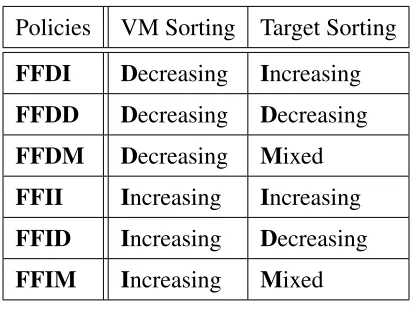
Policies VM Sorting Target Sorting
FFDI Decreasing Increasing
FFDD Decreasing Decreasing
FFDM Decreasing Mixed
FFII Increasing Increasing
FFID Increasing Decreasing
FFIM Increasing Mixed
Table 2.1: VM Relocation Policies
The fifth step (line 5) filters and sorts the VMs hosted in the selected source host. Only
VMs with equal or greater CPU load than the CPU load by which the host is stressed are considered as migration candidates. If no VM satisfies this criteria, all the VMs are considered.
This filtering is done to improve the chances of selecting for migration a VM that will bring
the source host’s utilization level below the stressCPU threshold. After filtering, the VMs are sorted in one of two ways:
1. Decreasing: sort VMs in decreasing order by CPU load;2
2. Increasing: sort VMs in increasing order by CPU load.
The eighth step (line 8) checks whether the selected target host has enough spare resources
to accept the migration of the selected candidate VM. If this check turns positive, the migration
is recorded (line 10) and the process moves on to the next source host (line 11). Be it noted
that at most one migration is issued for each source host.
By exhaustively combining the two sorting strategies for migration candidates and the three
sorting strategies for target hosts, we obtain six different relocation policies (shown in Table
2.1).
We implemented a seventh policy, Random, which randomizes the order in which source hosts, migration candidates and target hosts are considered. This policy was added as a
bench-mark.
A final note regarding host selection in these policies: a host cannot be selected both as
migration source and target. Hosts can be source for one migration at a time, but can be
target for several migrations concurrently (as long as they have enough resources to satisfy the
resource requirements of all incoming VMs).
2Be it noted that CPU load is not the same as CPU utilization. The first term refers to the actual number of
2.3
Evaluation
We used the simulation framework DCSim [17, 18] to conduct our experiments. Though
sim-ulations do not capture the whole complexity of real-world environments, they allow for repli-cable testing environments (very important when comparing algorithms), enable large-scale
experiments, and significantly reduce the real-time duration of experiments.
Subsection 2.3.1 discusses the configuration of the simulation environment, Subsection
2.3.2 describes the experiments’ design, Subsection 2.3.3 lists and explains the reported
met-rics, and Subsection 2.3.4 presents the results.
2.3.1
Simulator Configuration
DCSim (Data Centre Simulator) is an extensible data centre simulation framework, designed
to provide an easy framework for developing and experimenting with data centre management techniques and algorithms [18]. Several components in DCSim have to be extended or
imple-mented to evaluate alternative management policies. We worked with DCSim, version 12.01,
in these experiments.
In DCSim, a data centre has a VM Placement Policy to map VMs into hosts at creation
time, a VM Consolidation Policy to perform server consolidation, and a VM Relocation Policy
to relocate VMs away from stressed hosts.
In our experiments we use a simple VM Consolidation Policy that migrates VMs from
underutilized hosts to partially-utilized or higher-loaded underutilized hosts. The use of a
VM Consolidation policy was necessary to allow for stress situations to continue occurring
throughout the simulation. Any solution to the VM Relocation problem, by definition, attempts
to dissipate stress situations by migrating VMs away from stressed hosts. Unless the number of
hosts in the set is so small that VMs are simply migrated in circles, the VM Relocation policy
will unavoidably spread the load (VMs) across the data centre. Server consolidation policies exist to remedy this situation, and in this particular case, to better allow us to compare the VM
Relocation policies introduced in Section 2.2.2.
Policies are also used in DCSim to manage the allocation (and reallocation) of resources
among the hosted VMs. Static Resource Managers allocate resources to VMs upon placement
in the host and do not alter the allocation at any further point. Dynamic Resource Managers,
on the other hand, perform an initial allocation based on the resource request of the VMs and
then dynamically adjust the allocation to match the VMs’ resource utilization.
In our experiments, we use an oracle-like CPU Manager. This manager is a special kind of
dynamic CPU Manager with perfect knowledge about the VMs’ resource needs at any given
perform resource reallocation in real time to meet the resource needs of the VMs without
over-provisioning them. Also, the oracle nature of this manager helps us to prevent ineffective CPU
allocation policies from affecting (and obscuring) the results of the VM Relocation policies
under study.
2.3.2
Experimental Design
We designed four sets of seven experiments to evaluate the relocation policies. Every
exper-iment in a set used the same data centre configuration, but a different VM Relocation policy.
Each experiment lasted 10 simulation days and was repeated 5 times. Results were averaged.
For the first set of experiments, the data centre was configured with 100 hosts, and was set
to run the VM Relocation process every 10 minutes and the VM Consolidation process every
24 hours. The data centre hosted 300 VMs, initially provisioned to meet their peak demand.
(When provisioned for peak demand, a host can only fit 3 VMs, so 300 is the maximum number
of VMs that can be placed in this data centre.)
The second, third and fourth sets of experiments utilized the same data centre configuration, but hosted 400, 4523and 500 VMs, respectively, which were initially provisioned to meet their
average demand.
The hosts in these experiments had 4 CPU cores with 1000 CPU shares each (for a total of
4000 CPU shares per host) and 8GB of memory. Bandwidth and storage were not considered
in these experiments. Each host was restricted to at most two concurrent outgoing migrations.
The stressCPU threshold was set at 85% and theminU sageCPU threshold at 50%. There were 400 CPU shares reserved by the CPU Manager to cover migration overhead (200 shares * 2
concurrent migrations), thus effectively reducing the CPU shares available for allocation to
3600.
Each VM was attached to a separate instance of one of four Application Models, with an equal number of VMs attached to each type of model. All four Application Models worked in a
similar way, but used different workload traces as input. The first two used the ClarkNet HTTP
trace and the EPA HTTP trace available from the Internet Traffic Archive [19]. The second
two used the Google Cluster Data trace [20]. Google Cluster Data is divided into four job
types, from which we extracted the first two as individual workload traces. For each workload
trace, we used the total number of incoming requests in 100 second intervals as the workload
level, which was normalized to the range [0, 1]. Workload traces that were shorter than the
simulation time were looped, and each virtual machine started the trace at a randomly chosen
offset time value to differentiate them from each other. The virtual machines were placed in
3452 VMs were used instead of 450, so as to have an equal number of VMs associated to each of the four