A Simple Structure and Fast Dynamic Response for
Single-Phase Grid-Connected DG Systems
S.Poopathi
PG Student, M.E (Power Management), Regional centre of Anna University, Madurai
Abstract- This project presents a conventional control technique to regulate the active and reactive powers in single-phase systems to eliminate 90° phase-shift operation used in conventional methods and greatly improves the tracking speed of the responses. In this method directly acts on the instantaneous power and it eliminates the need for calculating dq components. In a single-phase system, the instantaneous power comprises a dc component and a double-frequency ac component as opposed to a three-phase balanced system where it only comprises a dc component. The proposed control system is successfully applied to a photovoltaic system and performance evaluation results using computer simulation.
Index terms- Distributed generation (DG), enhanced phase-locked loop (PLL), Instantaneous power control, photovoltaic, renewable energy, single -phase power control.
1 .Introduction
Distributed generatation (DG) systems have become considerably attractive due to several reasons. DG systems: 1) are often based on renewable energy resources such as sun, wind, and water and thus reduce the amount of greenhouse gasses and other air pollutants; 2) improve the reliability of the system against possible shortages of power and outages;3) provide a more economic solution for remote areas due to transmission costs; 4) reduce transmission system losses and upgrade rates; 5) can offer combined heat and power (CHP)solution to customers; and 6) reduce troublesome dependence on the ever-growing fossil fuel price.
The new method for controlling the exchange of power between a single-phase distributed generation system and the grid . The power electronic converters are widely used to interface the DGs with the utility grid . In a three-phase system, the active and reactive powers can be conveniently controlled using the concept of dq rotating synchronous reference frame. The dq components of the current signals are dc variables that are proportional to active/reactive powers.
Thus, simple proportional-integrating (PI) controllers accompanied with decoupling terms can be used to control those variables. The concept of
instantaneous power control has also been developed and extensively studied in the technical literature for three-phase systems. In single-phase applications, the current dq components can also be generated using aß-dq transformation where the same three-phase current control strategy can be applied. In these approaches, however, the ß component is not externally available
and needs to be synthesized using a 90◦phase-shift
system and the design, a linear counterpart is derived for the nonlinear component.
This reduces the system to an LTV system and
a complete stability analysis and design method is
presented for this system. The proposed method directly acts on the instantaneous power and it eliminates the need for calculating dq components. It, thus, obviates
the need for a 90◦ phase-shift operation. This eliminates
the aforementioned problems that are caused by the dynamics of such operation for the control system. Thus, a very fast and stable control operation is achieved despite the highly simple structure of the whole control loop.
II. Proposed Technique
In this section, the proposed instantaneous power controller structure is derived and presented. The derivation initially results in a nonlinear structure and then by some simplifications, an equivalent linear time varying (LTV) structure is developed that allows easier stability analysis and parameter design.
A. Derivation of the Controller Equations
The grid voltage is denoted by vg (t) and the grid current is𝑖𝑔(𝑡) .The grid current is controlled in such a way that the appropriate active P and reactive Q powers are injected to the grid. In a sinusoidal situation where
𝑣𝑔(𝑡) = 𝑣0cos(𝑡) and 𝑖𝑔(𝑡) =𝐼0 cos(𝜔𝑡 − ∅) the instantaneous power is 𝑃(𝑡) =𝑣𝑔 (𝑡)𝑖𝑔(𝑡)
=1
2𝑉0𝐼0cos𝜙[1 + cos(2𝜔𝑡)] + 1
2𝐼0sin𝜙sin(2𝜔𝑡)
= P[1 + cos(2𝜔𝑡)] +𝑄sin(2𝜔𝑡)... (1)
Where Ρ=1
2𝑉0𝐼0cos𝜙 and Q = 1
2𝑉0𝐼0sin𝜙
The instantaneous power comprises a dc component and a double-frequency component.
Assume that the commands for active and reactive powers are denoted by P *and Q*, respectively. Then, the
command for theinstantaneous power is givenby
𝔭∗(𝑡) =𝑝∗ [1+cos(2𝜔𝑡)] +𝑄∗ sin(2𝜔𝑡)... (2)
Define the cost function
𝐽�𝑖𝑔(𝑡)�= [𝑝∗(𝑡)− 𝑝(𝑡)]2= [𝑝∗(𝑡)− 𝑣
𝑔(𝑡)𝑖𝑔(𝑡)]2
Which is the instantaneous square error between the instantaneous power and its reference? The objective is to find an appropriate current 𝑖𝑔(𝑡)that minimizes J
[𝑖𝑔(𝑡)] for given values of 𝑣𝑡(t), P* and Q*. To address a solution to this problem, write the current as𝑖𝑔 (t) = 𝑖𝑔cos(𝜙𝑖)where 𝑖𝑔 and 𝜙𝑖 a r e to be found. The cost function will then be a function of smooth unknown variables 𝜃= (𝑖𝑔,𝜙𝑖). The gradient
descent method is used to derive the dynamics of according to
𝜃̇=−𝜇𝜕𝐽(𝑒)𝜕𝑒 ... (3) In which μ is a positive-definite 2 × 2matrix. Assuming a diagonal structure as μ = diag {μ1, μ2}, the resulted equations can be summarized as
𝚤̇g (𝑡) =𝜇1𝑒(𝑡)𝑣𝑔(𝑡) cos(∅𝑖)
∅̇I (t) = -𝜇2𝑒(𝑡) 𝑣𝑔(𝑡) sin(∅𝑖) +𝜔... (4)
Where 𝑒(𝑡) =𝑝∗(𝑡) =𝑝∗(𝑡)− 𝑣𝑔(𝑡)𝑖𝑔(𝑡)
Equation set (5) shows how the desired variables Ig
and Φi must be changed to ensure minimum error between the actual power and the desired power. There still remain two issues to be addressed: 1) the instantaneous power reference p*(t) must be synthesized from the active and reactive reference values𝑝∗𝑎𝑛𝑑𝑄∗) the system frequency ω must be available (assuming that it can have variations from the nominal value). The instantaneous power reference can be synthesized from (3) if the voltage phase-angle
∅𝑒=𝜔𝑡is available. To address both issues, PLL can
be employed on thevoltage signal to obtain the phase-angle and frequency. The most important advantage of the PLL, in this context, is its ability to is a control system that generates an output signal whose phase is related to the phase of an input "reference" signal. It is an electronic circuit consisting of a variable frequency oscillator and a phase detector eliminate the double- frequency harmonics in single-phase applications that makes it specifically attractive for grid-connected single-phase applications. Equations of the PLL are provided as follows:
𝑣𝑔(̇𝑡)= 𝜇3𝑒𝑣(𝑡) cos(∅𝑣) ∆𝜔̇(𝑡) =−𝜇4𝑒𝑣(𝑡) sin(∅𝑣)
∅𝑣̇ (t)=-𝜇4𝜇5𝑒𝑣(𝑡) sin(∅𝑣) +𝜔... (5)
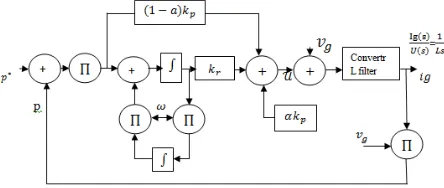
Where ev(t) = vg(t) – Vg cos(∅𝑣) and μ3 to μ5 are real positive numbers. The overall control structure consists of the dynamics represented by (5) and (6) whose block diagram is shown in Fig. 2. The instantaneous power controller structure is shown
Fig. 2. Block diagram of the loop connecting the DG to the grid through the converter.
In the fig 2 .The PLL estimates 𝜙𝑒 from the measured voltage signal. A simplified local stability analysis is the nonlinear equations (5) and (6) are presented .A based on the assumption that the current control is very fast and its dynamic is neglected.
IV. Linear Equivalence of the Proposed Control System without Current Control Loop:
Fig.3. Block diagram of the proposed simplified instantaneous power
Controller
Since the PLL tracks a sinusoidal input signal with no steady-state error, it can be concluded that the gain of the loop is infinity at the input frequency. This means that the loop gain from z to i*g is also infinity at this frequency similar to a conventional resonant controller of the form µs/s2+ω2
The idea of controlling the instantaneous power makes the current control redundant because the current control is automatically achieved when the instantaneous power is perfectly controlled. In the proposed, simplified structure of Fig. 5, the current control loop is removed and only the instantaneous power control loop exists. The stability analysis of the proposed simplified control loop of Fig. 5 is necessary since the loop components have changed and this will be performed in next section. However, to give more insight into the operation of the system of Fig. 5, the
following simple analysis is presented. Multiplying the signal p (t) with the normalized grid voltage cosωt results in
Pm(t) = p(𝑡) cos(𝜔𝑡)
=P (1 + cos2ωt) + cos(𝜔𝑡) + Qsin 2𝜔𝑡𝑐𝑜𝑠𝜔𝑡
=3
2 Pcosωt+ 1
2 Qsinωt+…. + 1
2 P cos3ωt+ 1 2 Q
sin3ωt+………... (6) Therefore
em(t) =[𝑝∗(𝑡)− 𝑝(𝑡) sin𝜔𝑡
=(𝑝∗− 𝑝)(1 + cos 2𝜔𝑡) cos𝜔𝑡+ … +. . . (𝑄∗− 𝑄) sin 2𝜔𝑡cos𝜔𝑡
=3
2(𝑝∗− 𝑝) cos𝜔𝑡+ 1
2(𝑄∗− 𝑄) sin𝜔𝑡+...+..
1
2(𝑃∗− 𝑃) cos𝜔𝑡+ 1
2(𝑄∗− 𝑄) sin 3𝜔𝑡.... (7)
The following points are observed form
1) The modulated error signal em (t) has two ac terms at fun- damental and at third harmonics; 2) The coefficients of both terms are related in the
sense that if one of the terms is controlled to zero the other one will also approach zero; 3) Since the sine and cosine functions are
orthogonal, if emis regulated to zero, all the terms will be regulated to zero;
4) by regulating em to zero, both active and reactive power components will be regulated to their reference values.
Thanks to the infinite gain of the resonant controller at the fundamental frequency, the signal em approaches to zero and the power control (as well as current control) is achieved.
V Stability Analysis of the Proposed System
The stability analysis of this section is performed for a converter with inductiveoutput filter. In a similarway, the method can be extended for other types of filter.
Fig. 6. Detailed control loop of the proposed system (without the
EPLL) for an L-type output filter.
state current feedback with gain kp as shown in Fig. 6 where the PLL is not depicted because it does not involve in the stability of the control loop. The constant a ∈ [01] does not have any impact on the closed-loop stability of the linearized system. It is used as an extra tuning gain in order to further adjust the speed with which the power commands are transferred to the output.2pThe state space equations of the closed-loop system (for a =1) can be written as
̇ 𝑥1=-𝜔𝑥2+𝑘𝑟cos𝜔𝑡(𝑝∗− 𝑝)
𝑥2=̇𝜔𝑥1
𝑥3=1𝐿𝑥1̇ −𝑘𝐿𝑝𝑥3... (8)
where 𝑥1 and 𝑥2are the state variables of the resonant controller and x3 is the grid current. This set of equations represents a LTV system with a time-varying reference input. The equation set (10) has a solution at
𝑥1(̇𝑡)=�𝐿2𝜔2𝑘𝑝2𝐼∗sin(𝜔𝑡 − ∅+𝛽)
𝑥2(̇𝑡)=-�𝐿2𝜔2𝑘𝑝2𝐼∗cos(𝜔𝑡 − ∅+𝛽)
𝑥3∗(𝑡) = 𝐼
𝑔∗sin(𝜔𝑡 − ∅)... (9)
Define the new set of variables as 𝑧=𝑥 − 𝑥∗
and derive the state space equations for z as 𝑥1∗̇ =−𝜔𝑥2∗
𝑥2̇ =𝜔𝑥̇ 1∗
̇ 𝑥3̇ =1𝐿𝑥1∗−𝑘𝐿𝑝𝑥3∗... (10)
The equation set (12) represents an LTV system with no reference input. Moreover, the state variables 𝑧have a dc nature as opposed to 𝑥 that are sinusoidal. The system equations shown in (12) can be represented as 𝑧̇ = 𝐴(𝑡)𝑧 where 𝐴(𝑡) is a time varying matrix. It can further be decomposed into
𝑧̇=𝐴0𝑧+𝑘𝑟𝐴1(𝑡)𝑧... (11) Where the matrices A0 and A1 are given by
𝐴0=�
0 −𝜔 0
𝜔 0 0
1
𝐿 0 −
𝑘𝑝
𝐿 �
𝐴1(𝑡) =−𝑉𝑔𝑐𝑜𝑠2𝜔𝑡 �
0 0 1 0 0 0
0 0 0�
Theorem C stated in Appendix C is used here to prove the stability of (14). The correspondence between the variables used in Theorem C and the aforementioned variables are summarized as:𝑥=𝑧,𝑓(𝑥) =𝐴0𝑥,𝑐=
𝑘𝑟,𝑔(𝑡,𝑥,𝜖) =𝐴1(𝑡)𝑥. In order to use this theorem, the
zero equilibrium point of the system
𝑥̇=𝑓(𝑥)must be exponentially stable. To satisfy this requirement, the matrix 𝐴0 is modified to
𝐴0=�
−2𝜁𝜔 −𝜔 0
𝜔 0 0
1
𝐿 0 −
𝑘𝑝 𝐿
�
This corresponds to a characteristic polynomial of s2+2£ws+w2 for the resonant controller where the value of ζ is a small positive number. This modification is
also justified from the fact that in implementations of
the resonant controller for practical applications it is required to add the damping factor ζ in the digital implementation due to numerical limitations. Having
applied this modification,A0 will be an exponentially
stable matrix, g is bounded and T-periodic, and thus the system of(11) holds all conditions of Theorem C. Existence, uniqueness, and exponential stability of a T-periodic solution for the system is then concluded from this theorem.
The constant £ defined in Theorem C is obtained from the continuity condition of the matrix ∂f/∂x at the origin. Since this matrix is constant for the system of (11), the constant becomes arbitrary and can have any large positive value. This results in that the existence, uniqueness, and exponential stability of the periodic solution is guaranteed for all positive values of the resonant controller gain kr.
D. Design of the Controller Gains for the System of Fig. 6
An alternative state space description for the system which is more suitable for design purposes, is given by
𝑥1=−𝜔𝑥2+𝑘𝑟̇cos𝜔𝑡(𝑝∗− 𝑝)
=-𝜔𝑥2− 𝑉𝑔𝑐𝑜𝑠2𝜔𝑡𝑥3+𝑝∗cos𝜔𝑡 𝑥2̇ =𝜔𝑥1
𝑥3̇=𝑘𝑟
𝐿𝑥1− 𝑘𝑝
𝐿 𝑥3... (12)
Assuming that 𝑥∗ is the steady-state solution and defining𝑧=𝑥 − 𝑥∗,, the equations for z are given as 𝑧1̇=-𝜔𝑥2− 𝑉𝑔𝑐𝑜𝑠2𝜔𝑡𝑧3
𝑧2=̇𝜔𝑧1
𝑧3=𝑘𝐿𝑟̇ 𝑧1−𝑘𝐿𝑝𝑧3... (13)
.
Since the 𝑧 variables have dc nature, the high-frequency term can be neglected for design purposes. Then, the (13) can be rewritten as
A and B are defined as
𝐴=�𝜔0 −𝜔0 00
0 0 0�
,𝐵=�
0 0 0 0 0 0 0 1𝐿 0�
Design of the state feedback gains can be done using different methods such as the Bode diagram, root-locus, and optimal control methods. In other words, the same current control design used in conventional methods can be employed to design the proposed controller’s gains.
VII. Simulation Result
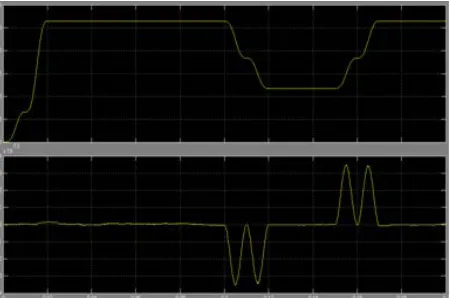
Performance of the proposed controller is evaluated in this section by computer simulations performed using MATLAB software. The power circuit 400-V dc link, connected to the grid through a full-bridge VSI and an
L-filter with L = 10 mH. The grid voltage rms value is
240 V and its frequency is 60 Hz. The inverter operates using unipolar PWM technique with a switching
frequency of 20 kHz that amounts to an actual value of 40 kHz seen by the filter.
The conventional method of Fig. 1(a) and the proposed method of Fig. 5 are implemented and compared. The PI controllers are set at Kp=0.5and Ki= 500. The resonant controller for the proposed method is designed using the optimal technique of in digital domain w ith a sampling frequency of 40 kHz synchronized with the switching frequency. Moreover.
The constant 𝛼 is selected as 0.5. For the conventional method, there is a tradeoff between the speed and the harmonic response
Fig 8 Simulink diagram of proposed without DG
Fig10 inject voltage and current in without DG
Fig11Real and Reactive power losses without
Fig12 performance of Injection voltage and current with DG
Fig13 Performance of VI characteristics of Photo voltaic
Fig14 Performance of PV characteristics of Photo voltaic
Fig 15 performance of reactive power compensation
VIII Conclusion
separately control active and reactive powers, the proposed controller directly acts on the instantaneous power signal. This eliminates the need for 90◦ph ase-shift operation used in conventional methods and thus, greatly improves the tracking speed of the responses. The proposed has a simple yet robust structure and can be further improved to compensate harmonics. The requirements of the stability of a second-order polynomial and the aforementioned discussion, show that the necessary and sufficient condition for the local stability of the system is that all five design parameters µ1to µ5re positive.
REFERENCES
[1] Abhijit Kulkarni, Student Member, IEEE, and Vinod John, Senior Member, IEEE,”Mitigation of lower order harmonics in a grid connected single phase PV inverter” IEEE Transactions on power electronics, VOL. 28, NO. 11, NOVEMBER 2013
[2] F. Blaabjerg, Z. Chen, and S. Kjaer, “Power electronics as efficient inter- face in dispersed power generation systems,” IEEE Trans. Power Electron., vol. 19, no. 5, pp. 1184–1194, Sep. 2004. [3] F. Katiraei, R. Iravani, N. Hatziargyriou, and A. Dimeas,
“Microgrids management,” IEEE Power Energy Mag., vol. 6, no. 3, pp. 54–65, May/Jun. 2008.
[4] E. Twining and D. Holmes, “Grid current regulation of a
three-phase voltage source inverter with an LCL input filter,” IEEE
Trans. Power Electron., vol. 18, no. 3, pp. 888–895, May 2003.
[5] F. Blaabjerg, R. Teodorescu, M. Liserre, and A. Timbus, “Overview of control and grid synchronization for distributed power generation systems,” IEEE Trans. Ind. Electron., vol. 53, no. 5, pp. 1398–1409, Oct. 2006.
[6] H. Akagi, E. Watanabe, and M. Aredes, Instantaneous Power Theory and Applications to Power Conditioning. New York: Wiley-IEEE Press, 2007.
[7] H. Akagi, Y. Kanazawa, and A. Nabae, “Instantaneous reactive power compensators comprising switching devices without energy storage components,” IEEE Trans. Ind. Appl, vol. IA-20, no. 3, pp. 625–630, May 1984.
[8] R. Kim, S. Choi, and I. Suh, “Instantaneous control of average power for grid tie inverter using single phase dq rotating frame with all pass
filter,” in Proc. 30th Annu. Conf. IEEE Ind. Electron. Soc.,
2004, vol. 1, pp. 274–279.
[9] M. Saito and N. Matsui, “Modeling and control strategy for a
singlephase PWM rectifier using a single-phase instantaneous active/reactive power theory,” in Proc. 25th IEEE Int. Telecommun. Energy Conf., 2003, pp. 573–578.
[10] R. Bojoi, L. Limongi, D. Roiu, and A. Tenconi, “Enhanced power quality control strategy for single-phase inverters in distributed generation systems,” IEEE Trans. Power Electron., vol. 26, no. 3, pp. 798–806, Mar. 2011.
[11] S. Dasgupta, S. Sahoo, and S. Panda, “Single-phase inverter control techniques for interfacing renewable energy sources with microgrid-part. I: Parallel-connected inverter topology with active
and reactive power flow control along with grid current shaping,
IEEE Trans. Power Electron., vol. 26, no. 3, pp. 717–731, Mar. 2011.
[12] R. Santos Filho, P. Seixas, P. Cortizo, and A. Souza, “Comparison of three single-phase PLL algorithms for UPS applications,” IEEE Trans. Ind. Electron., vol. 55, no. 8, pp. 2923–2932, Aug. 2008.
[13] S. Silva, B. Lopes, R. Campana, and W. Bosventura, “Performance evaluation of PLL algorithms for single-phase grid-connected systems,” in Proc. 39th IAS Annu. Meet. Conf. Record 2004 IEEE Ind. Appl. Conf., 2004, vol. 4, pp. 2259– 2263.
[14] M. Karimi-Ghartemani and M. R. Iravani, “A nonlinear adaptive
filter for on-line signal analysis in power systems:Applications,” IEEE Trans. Power Del., vol. 17, no. 1, pp. 617–622, 2002. [15] Y. Sato, T. Ishizuka, K. Nezu, and T. Kataoka, “A new control
strategy for voltage-type PWM rectifiers to realizezero steady -state control error in input current,” IEEE Trans. Ind. Appl., vol. 34, no. 3, pp. 480–486, May/Jun. 1998.
[1\6] D. Zmood and D. Holmes, “Stationary frame current regulation of PWM inverters with zero steady-state error,” IEEE Trans. Power Electron., vol. 18, no. 3, pp. 814–822, May 2003.
[16] R. Teodorescu, F. Blaabjerg, M. Liserre, and P. Loh,
“Proportionalresonant controllers and filters for grid-connected voltage-source converters,” in Proc. Electr. Power Appl., IEE Proc., 2006, vol. 153, no. 5, pp. 750–762.
[17] F. Iov, M. Ciobotaru, D. Sera, R. Teodorescu, and F. Blaabjerg, “Power electronics and control of renewable energy systems,” in Proc. 7th Int. Conf. Power Electron. Drive Syst., Nov. 2007, pp. P–6–P–28.
[18] R. B. F. Ciobotaru and M. Teodorescu, “Control of single-stage singlephase PV inverter,” in Proc. Eur. Conf. Power Electron. Appl., 2005, pp. P–1–P–10.
19] B. Bahrani, A. Rufer, S. Kenzelmann, and L. Lopes, “Vector control of single-phase voltage source converters based on fictive axis emulation,” IEEE Trans. Ind. Appl., vol. 47, no. 2, pp. 831– 840, Mar./Apr. 2011.
[20] M. Newman and D. Holmes, “Delta operator digital filters for
high performance inverter applications,” IEEE Trans. Power Electron., vol. 18, no. 1, pp. 447–454, Jan. 2003.
[21] S. Khajehoddin, M. Ghartemani, P. Jain, and A. Bakhshai, “Distributed power generation interface,” U.S. Patent 20 110 130 889, 2011.
[22] S. Khajehoddin, M. Karimi-Ghartemani, A. Bakhshai, and P. in, “A nonlinear approach to control instantaneous power for single-phase gridconnected photovoltaic systems,” in Proc. IEEE Energy Convers. Congr. Expo. IEEE, pp. 2206–2212.
ACKNOWLEDGEMENT