Volume 2007, Article ID 32503,16pages doi:10.1155/2007/32503
Research Article
Density-Based 3D Shape Descriptors
Ceyhun Burak Akg ¨ul,1, 2B ¨ulent Sankur,1Y ¨ucel Yemez,3and Francis Schmitt2
1Electrical and Electronics Engineering Department, Bo˘gazic¸i University, 34342 Bebek, Istanbul, Turkey 2GET-Telecom Paris, CNRS UMR 5141, 75634 Paris Cedex 13, France
3Computer Engineering Department, Koc¸ University, 34450 Sariyer, Istanbul, Turkey
Received 1 February 2006; Revised 14 July 2006; Accepted 10 September 2006
Recommended by Petros Daras
We propose a novel probabilistic framework for the extraction of density-based 3D shape descriptors using kernel density esti-mation. Our descriptors are derived from the probability density functions (pdf) of local surface features characterizing the 3D object geometry. Assuming that the shape of the 3D object is represented as a mesh consisting of triangles with arbitrary size and shape, we provide efficient means to approximate the moments of geometric features on a triangle basis. Our framework produces a number of 3D shape descriptors that prove to be quite discriminative in retrieval applications. We test our descriptors and com-pare them with several other histogram-based methods on two 3D model databases, Princeton Shape Benchmark and Sculpteur, which are fundamentally different in semantic content and mesh quality. Experimental results show that our methodology not only improves the performance of existing descriptors, but also provides a rigorous framework to advance and to test new ones.
Copyright © 2007 Ceyhun Burak Akg¨ul et al. This is an open access article distributed under the Creative Commons Attribution License, which permits unrestricted use, distribution, and reproduction in any medium, provided the original work is properly cited.
1. INTRODUCTION
The use of 3D models is becoming increasingly more com-monplace with their distribution on the Internet and with the availability of 3D scanners. Many fields are focused on 3D object models: computer graphics, computer-aided de-sign, medical imaging, molecular analysis, cultural heritage in virtual environments, movie industry, military target de-tection, or industrial quality control to name a few. Efficient organization and access to these databases demand effective tools for indexing, categorization, classification, and repre-sentation of 3D objects. All these database activities hinge on the development of 3D object similarity measures. There are two paradigms for 3D object database operations and design of similarity measures, namely, the feature vector approach and the nonfeature vector approach [1,2]. The feature vec-tor paradigm aims at obtaining numerical values of certain shape descriptors and measuring the distances between these vectors. A typical example of nonfeature-based approach is to describe the object as a graph and then use graph sim-ilarity metrics. In this work, we follow the feature vector paradigm, and furthermore we limit our scope to the sub-class of histogram-based descriptors.
Representations used for shape matching are often re-ferred to as 3D shape descriptors and they usually differ
substantially from those intended for 3D object rendering and visualization [3]. Shape descriptors aim at encoding ge-ometrical and topological properties of an object in a dis-criminative and compact manner. The diversity of shape de-scriptors range from 3D moments to shape distributions, from spherical harmonics to ray-based sampling, from point clouds to voxelized volume transforms [1, 2,4–7]. In this work, inspired from histogram-based 3D shape descriptors [8–12], we propose a density-based approach that applies to local geometrical features of arbitrary dimension. Our in-terest in histogram-based 3D shape descriptors stems from their generality and their simplicity. They are global descrip-tors based on sets of local measurements and they have been shown to be effective in classifying shapes into broad cate-gories [2]. Our objective is to show that, in addition to their categorization capability, they have also satisfactory retrieval performance.
surface may compensate for the nonuniform distribution of triangles, provided that a sizeable number of surface points is taken. Although the random sampling approach proves to be useful for computing histograms of scalar features [10], it is not practical in the multidimensional case due to the curse of dimensionality: the number of samples required to fill in the multivariate histogram bins increases exponentially as di-mensionality increases [13], resulting in a significant extra computational load which is not affordable for most applica-tions such as retrieval.
Our density-based framework makes a more effective use of each triangle and also takes care of the nonuniformity of their areas and orientations without resorting to expensive random sampling. First, we do not use samples but exploit the information in the whole triangle area using an integra-tion scheme, as described inSection 3.3. Second, we resort to nonparametric kernel density estimation (KDE) with rule-based bandwidth parameter assignment [13,14]. In other words, local geometric information emanating from each mesh triangle contributes to the geometric feature density by the intermediary of a kernel. Thus local evidences about surface shape are accumulated at targeted density points to result in a global shape description. Third, we use a Gaus-sian kernel. Since the GausGaus-sian density is completely deter-mined by its first two moments, we only need to estimate the mean and the variance of the feature for each triangle. For certain cases, these moments can be approximated very ac-curately by making use of the geometry of a triangle in 3D space. The choice of Gaussian kernel brings in the additional advantage of alleviating the computational burden of calcu-lating large sums of Gaussians, as occur in the proposed set of descriptors, by enabling the use of the efficient fast Gauss transform (FGT) [15, 16]. Thus the main contribution of our work is to propose an analytical framework for the ex-traction of 3D descriptors from local surface features that characterize the object geometry. This framework computes probability densities of local features instead of their conven-tional histograms. Here, we interpret histograms and densi-ties in a broad sense: any descriptor that uses an accumulator scheme of measured quantities qualifies as a histogram-based descriptor. As a byproduct, we also introduce some novel lo-cal features.
The rest of the paper is structured as follows. InSection 2, we provide an overview of histogram-based 3D shape de-scriptors.Section 3introduces the local geometric features we have considered and describes the KDE-based computa-tional framework. InSection 4, we illustrate the retrieval per-formance of our method in comparison to other equivalent or similar histogram-based descriptors [8–12]. In Section 5, we draw conclusions and discuss further directions in density-based 3D shape descriptors.
2. PREVIOUS WORK ON 3D SHAPE DESCRIPTORS
There are two main paradigms of 3D shape description, namely, graph-based and vector-based. Graph-based repre-sentations are more elaborate and complex, harder to ob-tain, but represent shape properties in a more faithful and
intuitive manner. Shock graphs [17], multiresolution Reeb graphs [6,18,19], and skeletal graphs [20] are methods that fall in this category. However, they do not generalize eas-ily and hence they are not very convenient to use in unsu-pervised learning, for example, to search for natural shape classes in a database. Vector-based representations, on the other hand, are more easily computed. Although they do not necessarily conduce to plausible topological visualizations, they can be naturally employed in both supervised and unsu-pervised classification tasks. Typical vector-based representa-tions are extended Gaussian images [8,9], cord and angle his-tograms [11], 3D shape histograms [21], spherical harmon-ics [7,22–24], and shape distributions [10]. In this work, we are exclusively interested in histogram-based 3D shape de-scriptors that constitute a particular branch of vector-based representations. In the following, we provide a brief overview of histogram-based descriptors. References [1,2,4] provide also excellent surveys.
In [11], Paquet and Rioux present cord and angle
his-tograms for matching 3D objects. A “cord,” which is
actu-ally a ray, joins the barycenter of the mesh with a trian-gle center. The histograms of the length and of the antrian-gles of these rays (with respect to a reference frame) are used as the 3D shape descriptors. Although automatic determi-nation of a canonical reference frame for 3D meshes is still not totally solved [7], the common practice is to obtain the eigendecomposition of the covariance matrix of the surface points. The covariance matrix itself can be computed using the mesh vertices, the triangle centers, or in a “continuous” way as described in [7]. The resulting eigenvectors, which are the orthogonal directions along which the mesh has maxi-mal spread, are taken as a reference frame. Notice that the eigendirections may not necessarily correspond to the “natu-ral” pose of the object; however, they can serve as a canonical reference frame. In conclusion, Paquet and Rioux [11] con-sider the shape descriptors consisting of the ray length and the relative ray angles with respect to the largest two eigen-vectors. One shortcoming of all such approaches that reduce the triangles to their center points is that they do not take into consideration the size and shape of the mesh triangles. First, because triangles of any size have equal weight in the final shape distribution; second, because the triangle shapes can be arbitrary, so that the center may not represent ade-quately the impact of the triangle on the shape distribution.
Table1: Invariance properties of histogram-based 3D shape descriptors.
Descriptor Translation
invariance
Rotation invariance
Scale invariance
Cord histogram[11] No Yes No
Angle histogram[11] No No Yes
D1-distribution[10] No Yes No
D2-distribution[10] Yes Yes No
Shape histogram (shells)[21] No Yes No
Shape histogram (sectors)[21] No No No
EGI[8] Yes No No
CEGI[9] No No No
3DHT[12] No No No
Ankerst et al. use shape histograms for the purpose of molecular surface analysis [21]. A shape histogram is defined by partitioning the 3D space into concentric shells and sec-tors around the center of mass of a 3D model. The histogram is constructed by accumulating the surface points in the bins (in the form of shells, sectors, or both) based on a nearest-neighbor rule. Ankerst et al. [21] illustrate the shortcomings of Euclidean distance to compare two shape histograms and make use of a Mahalanobis-like quadratic distance measure taking into account the distances between histogram bins.
Extended Gaussian images (EGI), introduced by Horn
[8], form another class of histogram-based 3D shape descrip-tors. An EGI consists of a spherical histogram with bins in-dexed by (θj,ϕk), where each bin corresponds to some quan-tum of the spherical azimuth and elevation angles (θ,ϕ) in the range 0≤θ <2πand 0≤ϕ < π. The histogram bins ac-cumulate the count of the spherical angles of the surface nor-mal per triangle, usually weighted by the triangle area. Kang and Ikeuchi have extended the EGI approach by considering the normal distances of the triangles to the origin [9]. Ac-cordingly, each histogram bin accumulates a complex num-ber whose magnitude and phase are the area of the triangle and its signed distance to the origin, respectively. The result-ing 3D shape descriptor is called complex extended Gaussian images (CEGI) [9].
In [12], Zaharia and Prˆeteux present the3D Hough
trans-form descriptor(3DHT) as a histogram constructed by
accu-mulating surface points over planes in 3D space. Each tri-angle of the mesh contributes to each plane with a weight equal to the projected area of the triangle on the plane but only if the scalar product between their normals is higher than a given threshold. Although we have not encountered in the literature a direct comparison between 3DHT and EGI, 3DHT can be considered as a generalized version of EGI, where concentric spherical shells of different radii are structed around the object’s center of mass. One can con-sequently conjecture that the 3DHT descriptor captures the shape information better than the EGI descriptor, as will be shown experimentally inSection 4.
An important property of a 3D shape descriptor is its invariance to similarity transformations, that is, translation (T), rotation (R), and scale (S) [1,2,4,7]. InTable 1, we
summarize invariance properties of the histogram-based shape descriptors discussed above.
3. THE PROPOSED FRAMEWORK FOR DENSITY-BASED DESCRIPTORS
3.1. Local geometric features
We assume that each 3D shape is represented as a triangu-lar mesh and that its center of mass coincides with the ori-gin of the coordinate system. In what follows, capital italic letterP stands for a point in 3D, a small case boldface let-ter p = (px,py,pz) for its vector representation, nP = (nP,x,nP,y,nP,z) for the unit surface normal vector atPwhen Pbelongs to a surfaceM ⊂R3, and·,·for the usual dot product.
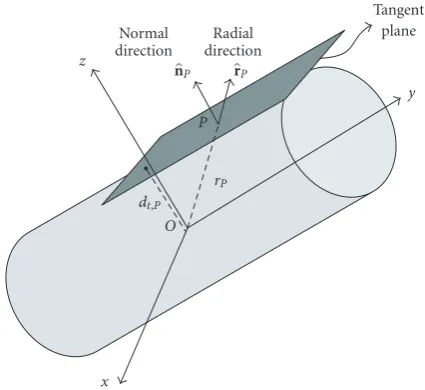
We define a local geometric feature as a mappingSfrom the points of a surfaceM⊂R3into ad-dimensional space, generally a subspace ofRd. Each dimension of this space cor-responds to a specific geometric property that can be calcu-lated at each point of the surface. For example, the distance of a surface point to the center of the 3D shape is a one-dimensional (d=1) geometric feature, while the mesh trian-gle normalnPis a three-dimensional feature vector (d=3). In this work, we consider three different multidimensional local geometric features that we describe in the sequel.
The radial featureSrat a pointPis a 4-tuple defined as
Sr(P)
rP,rP,x,rP,y,rP,z
with rP
p2
x+p2y+p2z,
rP,xpx rP ,
rP,ypy rP ,
rP,zpz rP.
(1)
z
x dt,P
O
nP
Normal direction
P
rP
y
rP
Radial direction
Tangent plane
Figure1: Radial and normal directions of a surface point.
The tangent plane-based featureStat a pointPis a 4-tuple
defined as
St(P)=
dt,P,nP,x,nP,y,nP,z
withdt,PrPrP,nP. (2)
Similar to theSrfeature,Sthas a magnitude componentdt,P, which stands for the distance of the tangent plane atPto the origin, and a direction componentnP=(nP,x,nP,y,nP,z) (see Figure 1). Thus, we may writeSt(P)=(dt,P,nP). The normal
nPis a unit norm vector by definition and lies on the unit sphere.
The cross-product featureScaims at encoding the
relation-ship between the former two features, namely, the radial fea-tureSr and the tangent plane-based featureSt. To this end, we defineScat a pointPas
Sc(P)
rP,cP,x,cP,y,cP,z
rP,cP
withcPrP×nP. (3)
In much the same way as inSr andSt,Sc is decoupled into a magnitude componentrP and a direction componentcP. Notice, however, thatcPis not a unit-norm vector unless the angle between the radial directionrPand the normal direc-tionnPisπ/2. BothrPandnP being unit norm vectors, the norm ofcPis lower than or equal to unity and it lies inside the unit ball.
The local geometric features presented above and their invariance properties are summarized inTable 2.
3.2. Kernel density estimation
Given a set of observations {sk}Kk=1 for a random variable (scalar or vector)S, the kernel approach to estimate the prob-ability density ofSis formulated in its most general form as
fS(s)= K
k=1
wkHk−1K
Hk−1s−sk
, (4)
Table2: Local geometric features and their invariance properties (assuming that the barycenter of the surfaceMis at the origin).
Feature Component-wise Overall invariance invariance
RadialSr MagnituderP: rotation None
DirectionrP: scale
Tangent planeSt Magnitudedt,P: rotation None
DirectionnP: scale
Cross-productSc MagnituderP: rotation None
DirectioncP: scale
whereK :Rd →Ris a kernel function,H
k is ad×d ma-trix composed of a set of design parameters calledbandwidth
parameters (smoothing parameters or scale parameters) for thekth observation, andwk is the importance weight asso-ciated with the kth observation. The contribution of each data pointsk to the density function fS(s) at a target point sis computed through the kernel functionKscaled by the matrix Hk and the weight wk. Thus KDE involves a data set {sk}Kk=1 with the associated set of importance weights {wk}Kk=1, the choice of a kernel functionK and the setting of bandwidth parameters{Hk}Kk=1.
We compute the probability density values of a certain local geometric featureSfrom a set of observations{sk}Kk=1. We assume that the 3D shape is represented as a triangular mesh consisting ofK triangles. Thus we can obtain an ob-servationsk from each of the triangles in the mesh, as will be explained in Section 3.3. Since, in general, the mesh is made up of nonuniformly sized triangles, the data should be weighted accordingly. A natural choice for the importance weight wk of a data pointsk is the ratio of thekth trian-gle area to the total surface area, yieldingKk=1wk =1. It is known that the particular functional form of the kernel does not significantly affect the accuracy of the estimator [14]. The Gaussian kernel has become a popular choice, first because it lends itself more easily to asymptotic error analysis [14]; and second, for the existence of efficient algorithms to cal-culate large sums of Gaussians, as the fast Gauss transform (FGT) already mentioned in the introduction [15,16]. Ac-tually, FGT is the dominant reason why we choose the Gaus-sian kernel since computational efficiency is an important re-quirement for 3D object retrieval [1,2] (seeSection 3.6for details).
The setting of the bandwidth parameters{Hk}Kk=1is crit-ical for an accurate kernel density estimation [14,25]. For the Gaussian kernel, the bandwidth matrix Hk simply corresponds to the feature covariance matrix. For set-ting/estimating the bandwidth parameters, there exist sev-eral guidelines and computational methods with varying complexity [14, 25]. We discuss different alternatives in
Section 3.4. The probability density function fS(s), when
O(origin) pA
A
y
e2=pC pA
C
P
x
B
e1=pB pA
p=pA+xe1+ye2
withx,y0 andx+y1
Figure2: A local basis for a triangle in 3D.
3.3. Feature calculation
Given a d-dimensional local feature S = (S1,. . .,Sd), the observationsk can be obtained from the mesh triangleTk by evaluating the value ofSat the barycenter of the trian-gle. However, the mesh triangles having in general arbitrary shapes, the feature value at the barycenter may not be the most representative one. The shape of the triangle should be in some way taken into account in order to reflect the local feature characteristics more faithfully. The expected value of the local featureE{S|T}over the triangleTis more infor-mative than the feature value only sampled at a single point, the barycenter of the triangle.
ConsiderTas an arbitrary triangle in 3D space with ver-ticesA,B, andCrepresented bypA,pB, andpC, respectively,
(seeFigure 2). By notinge1 = pB−pAande2 = pC−pA,
we can obtain a parametric representation for a pointP in-side the triangle T as p = pA+xe1+ ye2, where the two parameters x and y satisfy the constraints x,y ≥ 0 and x+ y ≤ 1. We assume that the point P is uniformly dis-tributed inside the triangle T. Thus, the expected value of the ith component of S, denoted by E{Si | T}, is given by
ESi|T
=
ΩSi(x,y)f(x,y)dx dy, i=1,. . .,d, (5)
whereSi(x,y) is the feature value at (x,y) and f(x,y) is the probability density function of the pair (x,y) over the do-main Ω = {(x,y) : x,y ≥ 0, x+ y ≤ 1}. Accordingly, f(x,y) = 2 when (x,y) ∈ Ω or zero otherwise. The in-tegration is performed over the domainΩ. To approximate (5), we apply Simpson’s 1/3 numerical integration formula [26]. We avoid the arbitrariness in vertex labeling by consid-ering the three permutations of the labelsA,B, andC. This yields us three approximations, which are in turn averaged to
yield
ESi|T
≈ 1 27 Si pA
+Si
pB
+Si
pC + 4 27 Si
pA+pB 2
+Si
pA+pC 2
+Si
pB+pC 2 + 4 27 Si
2pA+pB+pC 4
+Si
pA+ 2pB+pC 4
+Si
pA+pB+ 2pC 2
.
(6)
Equation (6) boils down to take a weighted average of feature values calculated at 9 points on the triangle.
3.4. Bandwidth selection
There are three levels of analysis at which the parameters in the bandwidth matrixHkinvolved in KDE can be chosen (see (4) inSection 3.2).
(1)Triangle level: this option allows a distinct bandwidth
parameter for each triangle in the mesh. In principle, this choice is very flexible since it does not make any assump-tions about the shape of the kernel function and hence about the shape of thekth triangle. In general, finding a KDE band-width matrix specific to each observation is a difficult prob-lem [25]. For the Gaussian kernel, however, estimation of the bandwidth matrixHk reduces to the estimation of the fea-ture covariance matrix. The moment formula in (5) and its numerical approximation in (6) can directly be used for mo-ments of any order. For example, the (i,j)th componenthi j ofHis computed by
hi j=
ΩSi(x,y)Sj(x,y)f(x,y)dx dy
−
ΩSi(x,y)f(x,y)dx dy
×
ΩSj(x,y)f(x,y)dx dy, i,j=1,. . .,d.
(7)
(2)Mesh level: the second option is to use a fixed
band-width matrix for all triangles in a given mesh, but diff er-ent bandwidths for different meshes. In this case, the band-width matrix for a given feature can be obtained from its observations using Scott’s rule of thumb [14]: HScott = (kw2
k)1/(d+4)C1/2, wheredis the dimension of the feature,
(a) (b)
Figure3: Distribution of target points over the unit-sphere, ob-tained by subdividing an octahedron once (left: 32 points) and twice (right: 128 points).
(3)Database level: in the last option, the bandwidth
pa-rameter is fixed for all triangles and meshes, that is,Hk=H. Setting the bandwidth at database level has the implicit effect of smoothing the resulting densities. In this case, we estimate the bandwidth parameters from a representative subset of the database by averaging the Scott bandwidth matrices over the selected meshes.
3.5. Choice of the targets
Targets are defined as the points at which the feature density functions are explicitly calculated. The density values com-puted at these targets constitute the 3D shape feature vec-tor. Selection of target points must result in parsimonious yet discriminative descriptors. For single-dimensional fea-tures, it suffices to uniformly sample the density function within its dynamic range. However, the multidimensional features,Sr,St, andSc, which consist of magnitude and di-rection components, require more attention. We denote the target size by Nmag for the magnitude component and by Ndirfor the direction component. The target points for these multidimensional features are then obtained by the Cartesian product of the two sets, yielding an overall target set size of N =Nmag×Ndir. The magnitude components ofSr andSt are uniformly quantized in the interval [0,rmax], while those ofSt in the [0,dt,max] interval. The setting ofrmaxanddt,max is discussed inSection 4.2. The direction components ofSr andStfeatures, namely,rPandnP, lie on the unit sphere. To complete the design of target points, following [12], we con-sider an octahedron circumscribed by the unit sphere and we subdivide each of its 8 triangles into four, twice, by radially projecting back the subdivided triangles to the surface of the sphere. As targets of the direction components ofSr andSt, we select the barycenters of the resulting 128 triangles, 16 per each of the 8 faces of the octahedron. This leads to a uniform partitioning of the sphere, as shown inFigure 3.
TheScfeature has a direction componentcPwith non-unit norm, which lies within the non-unit ball. For the target set of the direction componentcP, we thus similarly consider octa-hedra, but circumscribed by spheres of various radii. We take four such octahedra within spheres of radial length 0.25, 0.5, 0.75, and 1. We subdivide the two inner octahedra once, each
yielding 32 targets, and the two outer octahedra twice, each yielding 128 targets. This gives a total ofNdir=320 regularly spaced targets for thecP-component of theSc feature. The inner spheres have sparser targets to balance out the target densities of the outer spheres.
3.6. Computational complexity of KDE
The computational complexity of KDE using directly (4) is O(KN), whereK is the number of observations (the num-ber of triangles in our case) andN is the number of den-sity evaluation points, that is, targets. For applications such as content-based retrieval, the O(KN)-complexity is pro-hibitive. To give an example, on a Pentium 4 PC (2.4 GHz CPU, 2 GB RAM) and for a mesh of 130, 000 triangles, the direct evaluation of theSr-descriptor (1024-point pdf) takes 125 seconds. However, when the kernel function in (4) is chosen as Gaussian, we can use the fast Gauss transform (FGT) [15,16] to reduce the computational complexity by two orders of magnitude. For example, with FGT, the Sr -descriptor computation takes only 2.5 seconds. FGT is an ap-proximation scheme enabling the calculation of large sums of Gaussians within reasonable accuracy and reducing the com-plexity down toO(K+N). In our 3D shape description sys-tem, we have used an improved version of FGT implemented by Yang et al. [16].
For the sake of completeness, we provide the conceptual guidelines of the FGT algorithm (see [15,16] for mathemat-ical and implementation details). FGT is a special case of the more general fast multipole method [15], which trades offcomputational simplicity for acceptable loss of accuracy. The basic idea is to cluster the data points and target points using appropriate data structures and to replace the large sums with smaller ones that are equivalent up to a given precision. In the case of FGT, each exponential in the sum is shifted and expanded into a truncated Hermite series in O(K) operations. The gain in complexity is achieved by avoiding the computation of every Gaussian at every eval-uation point unlike the direct approach, which hasO(KN )-complexity. The accuracy can be controlled by the trunca-tion order. Truncated Hermite series are constructed about a small number of cluster centers formed by target points; the series are shifted to target cluster centers, and then eval-uated atNtargets inO(N) operations. Since the two sets of operations are disjoint, the total complexity of FGT becomes O(K+N).
3.7. Flow diagram of the algorithm
We summarize below the proposed algorithm to obtain a density-based 3D shape descriptor.
(1) For a chosen local featureS, specify a set of targetstn, n=1,. . .,N.
(2) Normalize the 3D triangular meshM =K
k=1Tk ac-cording to the invariance requirements ofS.
Local feature
S
Observations
sk K k=1
Targets tn N n=1
Feature calculation
Shape
descriptor fs=[fs(t1),. . .,fs(tN)] Storage
Estimated density values
fs(tn) N n=1
KDE
Bandwidth
H
Weights
wk K k=1
Triangular mesh
M=K k=1
Tk
Figure4: Flow diagram to compute a density-based 3D shape descriptor when the bandwidth is set at database level.
(4) Set the bandwidth parameters Hk according to the strategy chosen among the three options described in
Section 3.4.
(5) For each targettn,n=1,. . .,N, evaluate the local fea-ture density fS(tn), using (4).
(6) Store the resulting density values fS(tn) in the shape descriptorfS=[fS(t1),. . .,fS(tN)].
Note that the descriptors corresponding toLdifferent lo-cal featuresS1,. . .,SLcan be concatenated to obtain a com-bined descriptorfS1,...,SL =[fS1,. . .,fSL].Figure 4depicts the flow diagram of the algorithm when the bandwidth param-eters are set at database level. Alternatively, in the triangle or mesh level setting, a bandwidth matrix is to be computed for each triangle or for the entire mesh, respectively. Note that inFigure 4, we assume that the meshMhas already un-dergone a pose and/or scale normalization step depending on the missing invariance properties of the local featureS chosen.
4. EXPERIMENTAL RESULTS
In this section, we illustrate the performance of the proposed shape descriptors in 3D retrieval applications. When a query model is presented to the 3D object database, its descriptor is calculated and then compared to all the stored descriptors using a distance function. The outcome is a set of database models sorted in increasing distance. The models at the top of the list are expected to resemble the queried model more than those at the bottom of the list.
We have experimented on two different 3D model databases: the Princeton Shape Benchmark (PSB) [5] and the Sculpteur Database (SCUdb) [6,27]. Both databases consist of objects described as triangular meshes, though they differ substantially in terms of content and mesh quality. PSB is a publicly available database containing a total of 1814 synthe-sis models, categorized into general classes such as animals, humans, plants, household objects, tools, vehicles, buildings, and so forth. An important feature of the database is the availability of two equally sized sets. One of them is a training
set (90 classes) reserved for tuning the parameters involved in the computation of a particular shape descriptor, and the other for testing purposes (92 classes). By contrast, SCUdb is a private database containing over 800 models correspond-ing mostly to scanned archeological objects residcorrespond-ing in mu-seums [6,27]. Presently, 513 of the models are classified into 53 categories with comparable set populations, which in-clude utensils of ancient times (e.g., amphorae, vases, bottles, etc.), pavements, and artistic objects such as human statues (parts or as a whole), figurines, and moulds. The database has been augmented by artificially generated 3D objects such as spheres, tori, cubes, or cones in order to build a set of sim-ple well-controlled classes. The meshes in SCUdb are highly detailed and reliable in terms of connectivity and orientation of triangles. To give an idea of the significant differences be-tween PSB and SCUdb, we can quote average mesh resolu-tion figures. The average number of triangles in SCUdb and in PSB is 175250 and 7460, respectively, corresponding to a ratio of 23. In terms of vertices, SCUdb meshes contain 87670 vertices on the average while for PSB this number is 4220. Furthermore, the average triangular area relative to the total mesh area is 33 times smaller in SCUdb than in PSB.
4.1. Evaluation tools
The most commonly used statistics for measuring the per-formance of a shape descriptor in a content-based retrieval application are summarized below [5].
(i)Precision-recall curve
For a queryq that is a member of a certain class,Precision
(vertical axis) is the ratio of the relevant matchesKq(matches that are within the same class as the query) to the number of retrieved modelsKret, andRecall(horizontal axis) is the ratio of relevant matchesKqto the size of the query classCq:
Precision= Kq
Kret, Recall= Kq Cq.
(ii)Nearest neighbor (NN)
The percentage of the first-closest matches that belong to the query class.
(iii)First-tier and second-tier
First-tier (FT) is the recall when the number of retrieved models is the same as the size of the query class and second-tier (ST) is the recall when the number of retrieved models is two times the size of the query class.
(iv)E-measure
This is a composite measure of the precision and recall for a fixed number of retrieved models, for example, 32, based on the intuition that a user of a search engine is more in-terested in the first page of query results than in later pages. E-measure is given by
E= 2
1/precision + 1/recall. (9)
(v)Discounted cumulative gain
A statistic that weights correct results near the front of the list more than correct results later in the ranked list under the assumption that a user is less likely to consider elements near the end of the list. Specifically, the ranked list of retrieved objects is converted to a listL, where an elementLkhas value 1 if thekth object in the ranked list is in the same class as the query and otherwise has value 0. Discounted cumulative gain DCGkis then defined as
DCGk=
⎧ ⎪ ⎪ ⎨ ⎪ ⎪ ⎩
Lk, k=1,
DCGk−1+ Lk
log2(k), otherwise.
(10)
The final DCG score for a queryqis obtained fork=Kmax, whereKmax is the total number of objects in the database, and normalizing DCGKmax by the maximum possible DCG that would be achieved if the firstCqretrieved elements were in the class of the queryq(Cqis the size of the query class). Thus DCG reads as
DCG= DCGKmax
1 +Ck=2q 1/log2(k). (11)
(vi)Normalized DCG
This is a very useful statistic based on averaging DCG val-ues of a set of algorithms on a particular database. Normal-ized DCG (NDCG) gives the relative performance of an algo-rithm with respect to the other ones. A negative value means that the performance of the algorithm is below the average; similarly a positive value indicates above the average perfor-mance. Let DCG(A)be the DCG of a certain algorithmAand let DCG(avg)be the average DCG values of a series of algo-rithms on the same database, then NDCG for the algorithm
Table3: Histogram-based 3D shape descriptors and their sizes.
Descriptor Acronym SizeN
Cord and angle histograms[11] CAH 4×64=256
D1-distribution[10] D1 64
D2-distribution[10] D2 64
EGI[8] EGI 128
3DHT[12] 3DHT 8×128=1024
Ais defined as
NDCG(A)= DCG(A)
DCG(avg)−1. (12)
All these quantities are normalized within the range [0, 1] (except NDCG) and higher values reflect better performance. In order to give the overall performance of a shape descrip-tor on a database, the values of a statistic for each query are averaged to yield a single performance figure. The retrieval statistics presented in the sequel are obtained using the util-ity software included in PSB [5].
4.2. Retrieval experiments
In all of our retrieval experiments, we use the Minkowski-l1 distance measure to assess the similarity between descriptors since we have observed that this distance function gives bet-ter performance in most of the cases as compared to other distance measures such asl2or χ2. We apply the following normalization to all the meshes of the database to secure RST invariance of the features. For translation invariance, the object’s center of mass is translated to the origin. For scale invariance, the area-weighted average distance of sur-face points to the origin is set to unity. We have observed that, with this scaling operation, the frequency of the distance of a surface point to the mesh center exceeding 2 becomes neg-ligible. This allows us to set empirical upper limitsrmaxand dt,maxto the magnitude componentsrPanddt,P, respectively. Finally, to guarantee rotation and reflection invariance, we follow the “continuous” PCA approach of Vrani´c [7]. All the codes for our descriptors as well as for those proposed in the literature (cord and angle histograms [11], D1 and D2 shape distributions [10], EGI [8] and CEGI [9], 3DHT [12]) have been implemented in MATLAB 7.0 (R14) environment, us-ing C MEX external interface for time-consumus-ing jobs. For FGT, we have used the implementation provided by Yang et al. [16].
The acronyms of the descriptors we have experimented are listed in Tables3and4. They will subsequently be used in graph annotations. The details about descriptor sizes are given in the corresponding sections.
Table4: Density-based 3D shape descriptors and their sizes.
Descriptor Acronym SizeN
Radial(Sr)density Sr 8×128=1024
Tangent pl.(St)density St 8×128=1024
Cross-product(Sc)density Sc 8×320=2560
Normal(Sn)density Sn 128
Univ. dens. of Srcomponents [Sr1,Sr2,Sr3,Sr4] 4×64=256
Univ. dens. of Stcomponents [St1,St2,St3,St4] 4×64=256
Table5: DCG values for possible bandwidth selection strategies on PSB training meshes.
Bandwidth setting Sr St Sc
Triangle level 0.352 — —
Mesh level 0.511 0.514 0.499
Database level 0.541 0.567 0.543
separately be computed by univariate density estimation and then concatenated in a joint vector, as in the last two rows of
Table 4. LetA1,A2,. . .,ALdenoteLgeneric (one- or
multidi-mensional) features and letfA1,fA2,. . .,fAL denote the corre-sponding density-based descriptors withN1,N2,. . .,NL com-ponents, respectively, (Ni,i = 1,. . .,L corresponds to the number of target points on which the density of featureAi has been evaluated or equivalently to the size of the vector fAi). Square bracketing [A1,A2,. . .,AL] that appears in sub-sequent graphs and tables indicates the concatenation of the shape descriptors [fA1,fA2,. . .,fAL] resulting in a vector of size N1+N2+· · ·+NL. For notational simplicity, we will refer to the descriptorfA1consisting of the density vector as A1-descriptor; similarly, [A1, A2] will be the shorthand nota-tion for the descriptor [fA1,fA2]. Note finally that the generic featureAican be either a vector by construction or a scalar obtained by taking a component of some other multidimen-sional feature.
4.2.1. Impact of bandwidth selection
The KDE approach critically depends upon the judicious set-ting of the bandwidth parameters. We tested the triangle, mesh and database level alternatives presented inSection 3.4 on our multidimensional local features Sr,St, and Sc (the computationally expensive triangle-level setting was only tested forSr). Since we have observed that the off-diagonal terms of the bandwidth matrices are negligible as compared to the diagonal terms, we use only diagonal bandwidth ma-tricesH =diag(h1,. . .,hd). For the mesh level and database level, we apply the Scott’s rule-of-thumb. For the triangle level, we employ the KDE toolbox developed by Ihler [28] since the available FGT implementation does not allow a different bandwidth per triangle [16]. The KDE toolbox makes use of kd-trees and reduces the computational bur-den considerably, though not to the extent achieved by FGT.
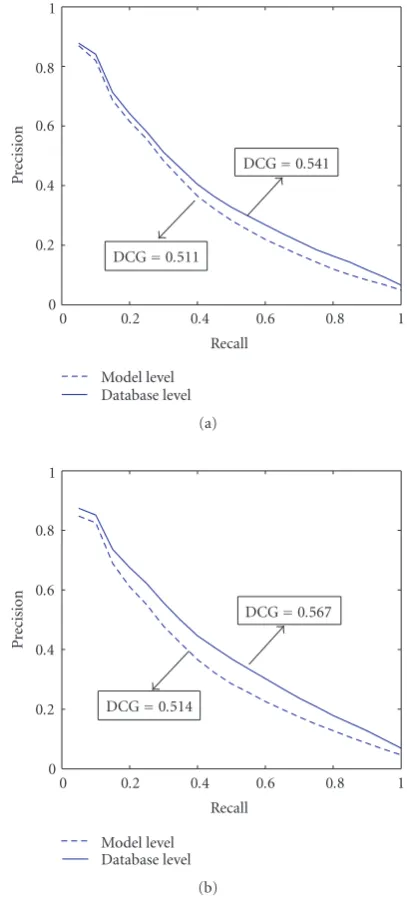
Table 5compares the DCG scores obtained with Sr, St, and
Sc-descriptors on the PSB training set.Figure 5 shows the precision-recall plots corresponding to mesh and database
0 0.2 0.4 0.6 0.8 1
0 0.2 0.4 0.6 0.8 1
Recall
P
recision DCG=0.541
DCG=0.511
Model level Database level
(a)
0 0.2 0.4 0.6 0.8 1
0 0.2 0.4 0.6 0.8 1
Recall
P
recision
DCG=0.567
DCG=0.514
Model level Database level
(b)
Figure5: Precision-recall curves with a bandwidth selection made at mesh level versus database level for Sr-descriptor (a) and St-descriptor (b) on PSB training set.
level settings for Sr and St-descriptors. We clearly observe that setting the bandwidthH at database level is more ad-vantageous as compared to triangle and mesh level settings. Any further results reported are therefore for the database level setting ofH. InTable 6, we provide the average Scott bandwidth values obtained from PSB training meshes forSr, St, andScfeatures.
4.2.2. Univariate versus multivariate density-based descriptors
Table6: The average Scott bandwidth obtained from the PSB train-ing meshes.
Descriptor h1 h2 h3 h4
Sr 0.20 0.35 0.25 0.15
St 0.20 0.25 0.25 0.30
Sc 0.20 0.15 0.25 0.25
descriptors can be compounded either by concatenating uni-variate descriptors or by multiuni-variate density estimation. One can conjecture that the multivariate descriptors, result-ing from the joint density functions of features, are richer in information content since component-wise dependencies are also taken into account. On the other hand, univariate den-sities are much simpler to estimate and do not incur into di-mensionality problems. In our experiments, each univariate density is evaluated at 64 target points. Accordingly, a 4-tuple concatenation, such as [Sr1,Sr2,Sr3,Sr4], results in a descrip-tor of sizeN=4×64=256. For multivariate density descrip-tors Sr and St, recall thatNdir =128 and for Sc,Ndir =320
(seeSection 3.5).Nmag being chosen equal to 8 in all cases,
the size of the Sr and St-descriptors isN =8×128=1024 and the size of the Sc-descriptor isN=8×320=2560.
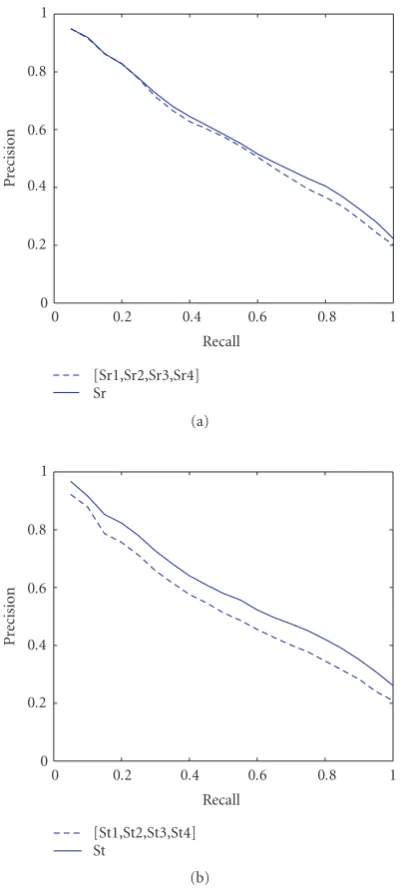
Fig-ures6and7withTable 7explicitly show that the
multivari-ate density-based descriptors are superior to the descriptors obtained by the concatenation of univariate densities for all feature types on both databases.
4.2.3. Comparison of density-based descriptors with their histogram-based peers
One of the motivations of this work is to show that a con-siderable improvement in the retrieval performance can be obtained by more rigorous and accurate computation of shape distributions as compared to more practical ad hoc histogram approaches. Notice that we interpret the term “histogram-based descriptor” for any count-and-accumulate type of procedure. This way we can refer to analogous de-scriptors in the literature as histogram-based whenever they count-and-accumulate local information to obtain a global shape descriptor [8–12].
An interesting case in point is Cord and Angle His-tograms (CAH) [11]. The features in CAH are identical to the individual scalar components rP,rP,x,rP,y, and rP,z of our Sr feature up to a parameterization. In [11], the authors consider the length of a cord (corresponding to rP) and the two angles between a cord and the first two principal directions (corresponding torP,xandrP,y). Notice that in our parameterization of Sr, we consider the Carte-sian coordinates rather than the angles. In order to com-pare with our [Sr1,Sr2,Sr3,Sr4]-descriptor, we implemented the CAH-descriptor by also considering the histogram of the angle with the third principal direction. The result-ing CAH-descriptor is thus the concatenation of one cord length and three angle histograms. Each histogram consist-ing of 64 bins leads to a descriptor of total size N = 4× 64 = 256. [Sr1,Sr2,Sr3,Sr4]-descriptor, again of size 256,
0 0.2 0.4 0.6 0.8 1
0 0.1 0.2 0.3 0.4 0.5 0.6 0.7 0.8 0.9 1
Recall
P
recision
[Sr1,Sr2,Sr3,Sr4] Sr
(a)
0 0.2 0.4 0.6 0.8 1
0 0.1 0.2 0.3 0.4 0.5 0.6 0.7 0.8 0.9 1
Recall
P
recision
[St1,St2,St3,St4] St
(b)
Figure6: Precision-recall curves for [Sr1,Sr2,Sr3,Sr4] versus Sr (a) and [St1,St2,St3,St4] versus St (b) on PSB.
0 0.2 0.4 0.6 0.8 1 0
0.2 0.4 0.6 0.8 1
Recall
P
recision
[Sr1,Sr2,Sr3,Sr4] Sr
(a)
0 0.2 0.4 0.6 0.8 1
0 0.2 0.4 0.6 0.8 1
Recall
P
recision
[St1,St2,St3,St4] St
(b)
Figure7: Precision-recall curves for [Sr1,Sr2,Sr3,Sr4] versus Sr (a) and [St1,St2,St3,St4] versus St on SCUdb (b).
of the Sr-descriptor is 0.533 on PSB and 0.708 on SCUdb, one more step of improvement as compared to the con-catenated univariate case [Sr1,Sr2,Sr3,Sr4] (DCG = 0.501 on PSB and DCG = 0.698 on SCUdb). Note that the per-formance improvement using our scheme is less impressive over SCUdb than over PSB. This can be explained by the fact that SCUdb meshes are much denser than PSB meshes in number of triangles. As the number of observations in-creases, the accuracies of the histogram method and KDE become comparable and both methods result in similar de-scriptors. This also indicates that the KDE methodology is especially appropriate for coarser mesh resolutions as in PSB.
A second instance of our framework outperforming its competitor is with the EGI-descriptor [2, 5, 8], which
Table7: Retrieval statistics for univariate and multivariate density-based descriptors.
Descriptor NN FT ST E DCG
PSB
[Sr1,Sr2,Sr3,Sr4] 0.436 0.222 0.306 0.180 0.501 Sr 0.499 0.260 0.343 0.201 0.533 [St1,St2,St3,St4] 0.451 0.250 0.348 0.202 0.533 St 0.523 0.267 0.364 0.210 0.543
SCUdb
[Sr1,Sr2,Sr3,Sr4] 0.701 0.430 0.555 0.314 0.698 Sr 0.745 0.452 0.568 0.323 0.709 [St1,St2,St3,St4] 0.632 0.400 0.520 0.298 0.662 St 0.754 0.473 0.575 0.324 0.712
consists of binning the surface normals. The density of our Sn(P)=nPfeature is equivalent to the EGI-descriptor. There can be different choices for binning surface normals, for ex-ample, by mapping the normal of a certain mesh triangle to the closest bin over the unit sphere and augmenting that bin by the relative area of the triangle. Such an approach requires a very densely discretized unit sphere and the resulting de-scriptor is not very efficient in terms of storage. In the present work, similarly to [12], we preferred the following imple-mentation for the EGI-descriptor. First, 128 unit norm vec-torsnbin,j, j=1,. . ., 128, are obtained as histogram bin cen-ters by octahedron subdivision, as described inSection 3.5. Then, the contribution of each triangleTk, k = 1,. . .,K, with normal vectornkto thenth bin center is computed as wk|nk,nbin,j|if|nk,nbin,j| ≥0.7 or otherwise as zero (re-call thatwkis the relative area of thekth triangle). The use of the absolute value is needed because some models as those in the PSB set cannot provide orientation information. The Sn-descriptor of the same size, that is, 128, achieves a superior DCG of 0.478 as compared to the DCG score of 0.438 for EGI on PSB (see Figure 9). For SCUdb, the DCG-performance differential is even more pronounced (DCG = 0.589 for Sn, DCG = 0.535 for EGI) noting that for low recall val-ues (recall< 0.2), the EGI-descriptor is better than Sn (see
Figure 9).
0 0.2 0.4 0.6 0.8 1 0
0.2 0.4 0.6 0.8 1
Recall
P
recision
DCG=0.434
DCG=0.501 DCG=0.533
CAH
[Sr1,Sr2,Sr3,Sr4] Sr
(a)
0 0.2 0.4 0.6 0.8 1
0 0.2 0.4 0.6 0.8 1
Recall
P
recision
DCG=0.698 DCG=0.681
DCG=0.708
CAH
[Sr1,Sr2,Sr3,Sr4] Sr
(b)
Figure8: Precision-recall curves for CAH, [Sr1,Sr2,Sr3,Sr4] (con-catenated) and Sr (joint) on PSB test set (a) and SCUdb (b).
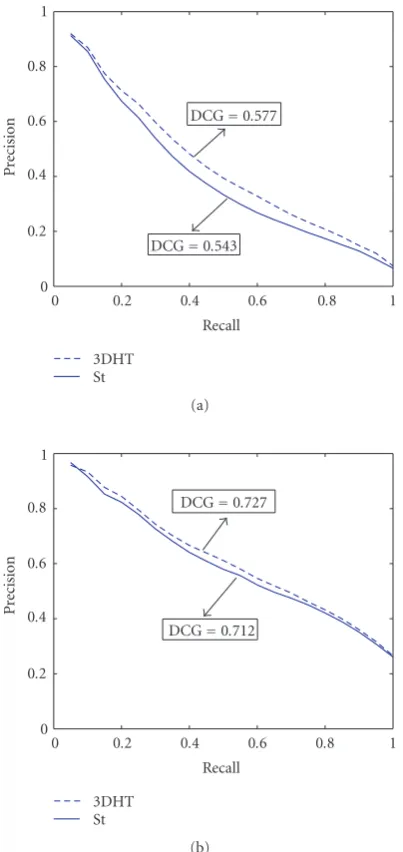
and then calculates the normal distance of the plane to the origin by|mk,nbin,j|. The resulting value is quantized to the closest dt,i, i = 1,. . .,Nmag, and then the bin corre-sponding to the plane Pi j is augmented bywk|nk,nbin,j| if|nk,nbin,j| ≥0.7 (the value of 0.7 is suggested by Zaharia and Prˆeteux [12] and we have also verified its performance-wise optimality). InFigure 10, we compare the St- and the 3DHT-descriptors in terms of precision-recall curves. On PSB, the St-descriptor yields a DCG of 0.543, a worse score against 0.577 of the 3DHT-descriptor. This can be attributed largely to the fact that the 3DHT-descriptor employs an im-plicit correction for normal orientations by the weighting schemewk|nk,nbin,j|according to which only normal di-rectionnkmatters but not its orientation. Our St-descriptor
0 0.2 0.4 0.6 0.8 1
0 0.2 0.4 0.6 0.8 1
Recall
P
recision
DCG=0.478
DCG=0.438
EGI Sn
(a)
0 0.2 0.4 0.6 0.8 1
0 0.2 0.4 0.6 0.8 1
Recall
P
recision
DCG=0.589
DCG=0.535
EGI Sn
(b)
Figure9: Precision-recall curves for EGI and Sn on PSB test set (a) and SCUdb (b).
does not make use of such a correction and considers the normal orientations as they are provided by the list of tri-angles in the mesh. Accordingly, we explain the negative performance gap between St and 3DHT by the fact that, on PSB meshes, information regarding normal orientations might be compromised. On the other hand, for SCUdb, the performance of St (DCG = 0.712) parallels that of 3DHT noting that 3DHT remains slightly better (DCG = 0.727).
4.2.4. General performance comparison
0 0.2 0.4 0.6 0.8 1 0
0.2 0.4 0.6 0.8 1
Recall
P
recision
DCG=0.577
DCG=0.543
3DHT St
(a)
0 0.2 0.4 0.6 0.8 1
0 0.2 0.4 0.6 0.8 1
Recall
P
recision
DCG=0.727
DCG=0.712
3DHT St
(b)
Figure10: Precision-recall curves for 3DHT and St on PSB test set (a) and SCUdb (b).
themselves and then with various other descriptors existing in the literature.
InTable 8, we see the competition within the Sr, St, and
Sc set and their various combinations. Since pairing the fea-tures results in higher dimensions (8 or 12) precluding mul-tivariate density estimation, we use concatenation of the 4-variate densities. It is interesting to observe that the pair-wise concatenations [Sr,St], [Sr,Sc], and [St,Sc] of size 2048, 3584 and 3584, respectively, increase the DCG and NN scores significantly. We can conclude that each local feature must be reporting aspects on the shape not covered by the re-maining ones, albeit their similarity. Furthermore, the triplet concatenation [Sr,St,Sc] of size 4608 boosts the DCG and NN performance further. We also note that, on a Pentium 4 PC (2.4 GHz CPU, 2 GB RAM), the [Sr,St,Sc]-descriptor can be computed in less than one second on the average over
PSB test set meshes, which indicates that our density-based descriptors are very time-efficient and suitable for practical online applications.
Table 9finally summarizes the experimental results
con-ducted to compare our density-based descriptors with other histogram-based descriptors. For both databases, PSB and SCUdb, the [Sr,St,Sc]-descriptor comes at the top in all per-formance fields. Furthermore, the second place is taken by a pairwise concatenation which is more storage-efficient and even more time-efficient than [Sr,St,Sc]: [Sr,St] for PSB and [St,Sc] for SCU.
The density-based framework does not only outperform histogram-based descriptors but also proves to be effective as compared to other more general state-of-the-art shape descriptors. In fact, based on the scores on PSB test set re-ported in [5], the [Sr,St,Sc]-descriptor has the highest DCG score among all other well-known 3D shape descriptors, as shown in Figure 11. Except for 3DHT [12] and CAH [11], all the descriptor scores shown inFigure 11are taken from [5]. We refer the reader to [5] for brief descriptions and acronyms of these descriptors. The [Sr,St,Sc]-descriptor has a DCG value of 0.607, while the next best descriptor radial-ized extent function (REXT) [7,24] has a DCG value of 0.601 [5]. Note also that the [Sr,St]-descriptor (DCG = 0.599) ranks third in the competition. The average REXT-descriptor size reported in [5] is 17.5 kilobytes, while for our [Sr,St,Sc]-descriptor this figure is 22 kilobytes. The average generation time for the REXT-descriptor is 2.2 seconds [5], while our [Sr,St,Sc]-descriptor can be computed in 0.9 seconds on the average on comparable hardware configurations.
5. CONCLUSION
We have proposed a novel methodology to obtain 3D shape descriptors and evaluated its impact in a retrieval scenario. We have shown that shape descriptors derived as kernel den-sity estimates of local surface features prove more advan-tageous compared to the count-and-accumulate-based his-togram descriptors. Firstly, one main advantage accrues from the fact that our descriptors are true probability density func-tions of geometrical quantities defined over the model sur-face. Secondly, our surface sampling is not as crude as just considering triangle barycenters or as profuse as random sampling, but judiciously chooses the triangle characteris-tics. Thirdly and most importantly, the KDE-based approach deals with multidimensional surface features as easily as with scalar features. The bandwidth parameters in KDE provide a more gracious control over finite sample-size and dimen-sionality problems, while with multivariate histograms one can only adjust the bin widths [13,14]. The local surface in-formation brought by multidimensional features proves to be more discriminating than scalar ones.
Table8: DCG and NN scores for the combination of density-based descriptors.
Sr St Sc [Sr,St] [Sr,Sc] [St,Sc] [Sr,St,Sc]
PSB DCG 0.533 0.543 0.533 0.599 0.579 0.585 0.607
NN 0.500 0.527 0.487 0.606 0.572 0.584 0.615
SCUdb DCG 0.708 0.712 0.732 0.731 0.742 0.744 0.746
NN 0.745 0.754 0.733 0.788 0.776 0.774 0.786
Table9: General performances of histogram and density-based descriptors.
Descriptor NN FT ST E DCG NDCG
PSB
[Sr,St,Sc] 0.615 0.339 0.434 0.251 0.607 0.214
[Sr,St] 0.606 0.333 0.423 0.245 0.599 0.199
3DHT 0.588 0.311 0.396 0.230 0.577 0.154
D2 0.363 0.168 0.245 0.145 0.448 −0.103
EGI 0.311 0.165 0.245 0.145 0.438 −0.124
CAH 0.332 0.159 0.229 0.137 0.433 −0.133
D1 0.256 0.119 0.185 0.107 0.397 −0.207
SCUdb
[Sr,St,Sc] 0.786 0.518 0.617 0.355 0.746 0.106
[St,Sc] 0.774 0.513 0.622 0.355 0.744 0.103
3DHT 0.778 0.485 0.603 0.336 0.727 0.079
CAH 0.678 0.427 0.536 0.309 0.681 0.010
D1 0.643 0.366 0.486 0.272 0.646 −0.042
D2 0.643 0.355 0.467 0.264 0.643 −0.048
EGI 0.489 0.252 0.349 0.203 0.535 −0.207
estimation but not to the extent to alter the density-based descriptor drastically. Furthermore, hidden triangles present in PSB remain in small proportion and SCUdb models are manifold and free of hidden triangles.
Our framework should be viewed as an application of kernel density estimation [13,14] with either variable (tri-angle or mesh levels) or fixed (database level) bandwidth parameters selection [25]. We have also demonstrated that density-based descriptors are much more discriminative in retrieval when the bandwidth parameters are set at database level as compared to mesh or triangle level setting. We think that the database level strategy smoothes out individ-ual shape details and emphasizes global shape properties as appropriate for object retrieval and classification tasks; while the other two options, especially the triangle level strategy, result in an overfitting of the feature density and hamper the descriptor’s discrimination ability. Furthermore, the compu-tational advantage of density-based descriptors enabled by FGT with a database-dependent bandwidth matrix is very promising for practical online applications.
When combined together, the multivariate density-based 3D shape descriptors introduced in this work outperform the existing histogram-based techniques in the literature. The retrieval competition took place on two databases, PSB and SCUdb, which are fundamentally different in semantic content and mesh quality. In addition, the performance ad-vantage of density-based descriptors over its competitors is not limited to histogram-based ones, as shown in the more
general comparison where our [Sr,St,Sc]-descriptor reaches the top position in the category of purely 3D descriptors reported in [5]. As a side remark, based on nearest-neighbor scores of our descriptors, we conjecture that they would also perform well in recognition applications.
Shells D2 CAH
EGI CEGISectors Voxel Secshell
EXT 3DHT SHD GEDT[Sr,St] REXT
[Sr,St,Sc]
0 0.1 0.2 0.3 0.4 0.5 0.6 0.7 0.8 0.9 1
DC
G
Descriptor
Figure11: Comparison of 3D shape descriptors on PSB test set. (Except CAH, 3DHT, and our descriptors, DCG values are taken from [5].)
the combination of the available features can be exploited, that is, how large the feature dimension of the multivariate densities can be.
ACKNOWLEDGMENTS
We thank the anonymous reviewers for their helpful com-ments and suggestions on the earlier version of the manu-script. This research was supported by BU Project 03A203 and TUBITAK Project 103E038.
REFERENCES
[1] B. Bustos, D. A. Keim, D. Saupe, T. Schreck, and D. V. Vrani´c, “Feature-based similarity search in 3D object databases,”ACM Computing Surveys, vol. 37, no. 4, pp. 345–387, 2005. [2] J. W. H. Tangelder and R. C. Veltkamp, “A survey of content
based 3D shape retrieval methods,” inProceedings of Interna-tional Conference on Shape Modeling and Applications (SMI ’04), pp. 145–156, Genova, Italy, June 2004.
[3] R. J. Campbell and P. J. Flynn, “A survey of free-form object representation and recognition techniques,”Computer Vision and Image Understanding, vol. 81, no. 2, pp. 166–210, 2001. [4] N. Iyer, S. Jayanti, K. Lou, Y. Kalyanaraman, and K. Ramani,
“Three-dimensional shape searching: state-of-the-art review and future trends,”Computer Aided Design, vol. 37, no. 5, pp. 509–530, 2005.
[5] P. Shilane, P. Min, M. Kazhdan, and T. Funkhouser, “The Princeton shape Benchmark,” inProceedings of International Conference on Shape Modeling and Applications (SMI ’04), pp. 167–178, Genova, Italy, June 2004.
[6] T. Tung,Indexation 3D de bases de donn´ees d’objets par graphes de Reeb am´elior´es, Ph.D. thesis, Ecole Nationale Sup´erieure des T´el´ecommunications (ENST), Paris, France, 2005.
[7] D. V. Vrani´c,3D model retrieval, Ph.D. thesis, University of Leipzig, Leipzig, Germany, 2004.
[8] B. K. P. Horn, “Extended Gaussian images,”Proceedings of the IEEE, vol. 72, no. 12, pp. 1671–1686, 1984.
[9] S. Kang and K. Ikeuchi, “The complex EGI: a new representa-tion for 3-D pose determinarepresenta-tion,”IEEE Transactions on Pattern Analysis and Machine Intelligence, vol. 15, no. 7, pp. 707–721, 1993.
[10] R. Osada, T. Funkhouser, B. Chazelle, and D. Dobkin, “Shape distributions,”ACM Transactions on Graphics, vol. 21, no. 4, pp. 807–832, 2002.
[11] E. Paquet and M. Rioux, “Nefertiti: a query by content soft-ware for three-dimensional models databases management,” inProceedings of the 1st International Conference on Recent Ad-vances in 3-D Digital Imaging and Modeling (3DIM ’97), pp. 345–352, Washington, DC, USA, May 1997.
[12] T. Zaharia and F. Prˆeteux, “Indexation de maillages 3D par descripteurs de forme,” inActes 13`eme Congr`es Francophone AFRIF-AFIA Reconnaissance des Formes et Intelligence Artifi-cielle (RFIA ’02), pp. 48–57, Angers, France, January 2002. [13] R. O. Duda, P. E. Hart, and D. G. Stork,Pattern Classification,
Wiley-Interscience, New York, NY, USA, 2000.
[14] W. H¨ardle, M. M¨uller, S. Sperlich, and A. Werwatz, Nonpara-metric and SemiparaNonpara-metric Models, Springer Series in Statis-tics, Springer, Heidelberg, Germany, 2004.
[15] L. Greengard and J. Strain, “The fast Gauss transform,”SIAM Journal on Scientific and Statistical Computing, vol. 12, no. 1, pp. 79–94, 1991.
[16] C. Yang, R. Duraiswami, N. A. Gumerov, and L. Davis, “Im-proved fast Gauss transform and efficient kernel density esti-mation,” inProceedings of the 9th IEEE International Confer-ence on Computer Vision (ICCV ’03), vol. 1, pp. 464–471, Nice, France, October 2003.
[17] K. Siddiqi, A. Shokoufandeh, S. J. Dickinson, and S. W. Zucker, “Shock graphs and shape matching,” inProceedings of the IEEE International Conference on Computer Vision (ICCV ’98), pp. 222–229, Bombay, India, January 1998.
[18] M. Hilaga, Y. Shinagawa, T. Kohmura, and T. L. Kunii, “Topol-ogy matching for fully automatic similarity estimation of 3D shapes,” inProceedings of the 28th Annual Conference on Com-puter Graphics and Interactive Techniques (SIGGRAPH ’01), pp. 203–212, Los Angeles, Calif, USA, August 2001.
[19] T. Tung and F. Schmitt, “The augmented multiresolution Reeb graph approach for content-based retrieval of 3D shapes,” In-ternational Journal of Shape Modeling, vol. 11, no. 1, pp. 91– 120, 2005.
[20] H. Sundar, D. Silver, N. Gagvani, and S. J. Dickinson, “Skeleton based shape matching and retrieval,” inProceedings of Inter-national Conference on Shape Modeling and Applications (SMI ’03), pp. 130–139, Seoul, Korea, May 2003.
spatial databases,” inProceedings of the 6th International Sym-posium on Advances in Spatial Databases (SSD ’99), vol. 1651 ofLecture Notes in Computer Science, pp. 207–226, Hong Kong, July 1999.
[22] T. Funkhouser, P. Min, M. Kazhdan, et al., “A search engine for 3D models,”ACM Transactions on Graphics, vol. 22, no. 1, pp. 83–105, 2003.
[23] M. Kazhdan, T. Funkhouser, and S. Rusinkiewicz, “Rotation invariant spherical harmonic representation of 3D shape de-scriptors,” inProceedings of the Eurographics/ACM SIGGRAPH Symposium on Geometry Processing (SGP ’03), pp. 156–164, Aachen, Germany, June 2003.
[24] D. V. Vrani´c, “An improvement of rotation invariant 3D-shape based on functions on concentric spheres,” inProceedings of the IEEE International Conference on Image Processing (ICIP ’03), vol. 3, pp. 757–760, Barcelona, Spain, September 2003. [25] D. Comaniciu, V. Ramesh, and P. Meer, “The variable
band-width mean shift and data-driven scale selection,” in Proceed-ings of the 8th International Conference on Computer Vision (ICCV ’01), vol. 1, pp. 438–445, Vancouver, BC, Canada, July 2001.
[26] W. H. Press, B. P. Flannery, and S. A. Teukolsky,Numerical Recipes in C: The Art of Scientific Computing, Cambridge Uni-versity Press, Cambridge, UK, 1992.
[27] S. Goodall, P. H. Lewis, K. Martinez, et al., “SCULPTEUR: multimedia retrieval for museums,” inProceedings of the Image and Video Retrieval: 3rd International Conference (CIVR ’04), vol. 3115 ofLecture Notes in Computer Science, pp. 638–646, Dublin, Ireland, July 2004.
[28] A. Ihler,Kernel density estimation toolbox for MATLAB (R13), 2003.
Ceyhun Burak Akg¨ul received the B.S. and M.S. degrees in electrical and elec-tronics engineering from Bo˘gazic¸i Univer-sity, Istanbul, in 2002 and 2004, respec-tively. He has been pursuing his Ph.D. degree jointly at Bo˘gazic¸i University and T´el´ecom Paris (Ecole Nationale Sup´erieure des T´el´ecommunications) since 2004. In the framework of his Ph.D. thesis, he is cur-rently working on 3D shape descriptors and
statistical similarity learning for object retrieval and classification. His main research interests are 2D/3D image analysis and statistical pattern recognition with applications on multimedia data.
B¨ulent Sankurreceived his B.S. degree in electrical engineering at Robert College, Is-tanbul, and completed his M.S. and Ph.D. degrees at Rensselaer Polytechnic Institute, NY, USA. He has been teaching at Bo˘gazic¸i University in the Department of Electric and Electronics Engineering. His research interests are in the areas of digital signal processing, image and video compression, biometry, cognition, and multimedia
sys-tems. He held visiting positions at University of Ottawa, Tech-nical University of Delft, and Ecole Nationale Sup´erieure des T´el´ecommunications, Paris. He was the Chairman of ICT96 (Inter-national Conference on Telecommunications) and of EUSIPCO05 (The European Conference on Signal Processing) as well as Techni-cal Chairman of ICASSP00.
Y¨ucel Yemezreceived the B.S. degree from Middle East Technical University, Ankara, Turkey, in 1989, and the M.S. and Ph.D. degrees from Bo˘gazic¸i University, Istanbul, Turkey, respectively, in 1992 and 1997, all in electrical engineering. From 1997 to 2000, he was a Postdoctoral Researcher in the Im-age and Signal Processing Department of T´el´ecom Paris (Ecole Nationale Sup´erieure des T´el´ecommunications). Currently, he is
an Assistant Professor of the Computer Engineering Department at Koc¸ University, Istanbul, Turkey. His current research is focused on various fields of computer vision and graphics.
Francis Schmitt received an Engineering degree from Ecole Centrale de Lyon, France, in 1973 and received a Ph.D. degree in ap-plied physics from the University Pierre et Marie Curie, Paris VI, France, in 1979. He has been a Member of T´el´ecom Paris (Ecole Nationale Sup´erieure des T´el´ecommunica-tions) since 1973. He is currently Full Pro-fessor at the Image and Signal Processing Department and Head of the image