Soil moisture estimation of drained peat area using TOPSAR data
MAZLAN HASHIM, PETER SIM HOCK SENG, WAN HAZLI WAN KADIR and 2NGAP DOLLAH SALAM
1
Department of Remote Sensing, Universiti Teknologi Malaysia 81310 Skudai, Johor Bahru, Malaysia
2
Soil Branch, Department of Agriculture, Kuching, Sarawak, Malaysia
Abstract. Three empirical and theoretical radar backscatter models were examined in this study to characterise radar backscatter of TOPSAR data over coastal lowland of Sadong Simunjan River Basin, Sarawak, Malaysia. The main objective of this paper is to analyse the relationship between radar backscatter of TOPSAR data to degree of wetness of drained peat-land. The analysis of these models were examined using varying terrain-and-sensor related parameters namely surface roughness, dielectric constant, incidence angle, polarization and frequency, respectively. The results of this study indicate good relationship between moisture content and radar backscatter (RMSE < 5.0) in empirical model. However, this relationship is found rather restricted in the theoretical models due to its sensitivity to very moist to wet nature of the study area.
I. Introduction
Peatland can be defined as an area where peat accumulates over time (hundreds or thousands of years) and where their formation varies at depths ranging between few cm to 12 m. Peat is an organic matter formed from roots, decaying plant residue and dead plants. The peat decomposition is very much dependent on the moisture content and the decomposition period varies with the rate of organic oxidation and reduction processes.
Completely decomposed peat will form peat substrate and in its natural condition consists of organic-rich materials (parts of plants) and water which is very favourable for selected hardy-crops such as oil palm and pineapple. Peatland with its organic soil content is known for its importance to wetland ecology and therefore need to be preserved.
There have been significant research efforts in the past two decades to develop remote sensing techniques to observe soil characterization from radar backscatter. Advances in active microwave remote sensing have demonstrated the ability to estimate soil moisture from radar backscatter in the surface layer under a variety of topographic and land cover conditions.
Radar backscatter particularly Synthetic Aperture Radar (SAR) data are dependent on several natural surface parameters such as dielectric constant (Dubois et al. 1995) and surface roughness (Evans et al. 1992). The large difference in dielectric constant between dry soil (typical dielectric constants of 2-3) and water (≈ 80), formed the basis for inferring soil moisture from radar data. In fact, several studies have demonstrated the relationship between the radar backscattering coefficient σo and the surface soil moisture content under varying terrain condition (Ulaby et al. 1982, Benallegue et al. 1995, Weimann et al. 1998 and Sano et al. 1998).
From the hydrological point of view soil moisture is a very important parameter in the semi and arid zones for many applications (Engman 1991). This might be one of the reasons for the many studies on estimating soil moisture using SAR in these regions. However, such studies have not been undertaken in the humid tropical regions such as Malaysia at least during the last decade. The all-weather penetration capability in SAR system offers an advantage for applications in tropical regions like Malaysia (lies at parallel 0 o -5 o N along the Equator) which has an average of more than 75% cloud cover throughout the year (Malaysian Meteorological service 2000).
One of the aims of this study is to examine whether there is a relationship between radar backscatter with degree of wetness of drained peatland in Malaysia.
2. Radar backscattering models
Three backscattering models used in this study are: (a) model developed by Dubois et al. (1995) hereafter referred to as Dubois model, (b) Integrated Equation Model (IEM) Fung et al. (1992), and (c) Oh model developed by Oh et al. (1992) hereafter referred to as Oh model. Brief descriptions of these models are given below.
1) Dubois Model: An empirical model describing the co-polarized backscatter coefficients of bare surface as a function of surface roughness, dielectric constant, incidence angle and frequency. The dielectric constant is the parameter sensitive to volumetric soil moisture. The HH and VV polarized backscattering cross-section σ°hh (power) and σ°vv (power) were empirically found by Dubois et al. (1995) to follow
these two relationships:
0.028 tan 1.4 0.7 5
5 . 1 75 . 2 o
hh 10 (ksSin )
Sin Cos
10 θλ
θ θ =
σ − ε θ
(1)
0.046 tan 3 1.1 0.7
3 35 . 2 o
vv 10 (ksSin )
Sin Cos
10 θ λ
θ θ =
σ − ε θ
(2)
where, θ is the incidence angle (radian), ε is the real part of the dielectric constant, s is the root mean square (RMS) height (in cm), k is the wave number (k = 2π/λ) and λ is the wavelength (in cm). These two relations are valid for frequencies varying between 1.5 and 11 GHz for surfaces with roughness ranging from 0.3 to 3 cm RMS height and for incidence angle between 30°and 60°. We calculated the backscatter coefficient (σ°) in units of decibel (dB), and can be converted to power using:
Power =10 dB/10
(3)
2) IEM Model: This is a theoretical model which describes the co-polarized backscatter coefficients of bare surface as a function of surface roughness, dielectric constant, incidence angle and frequency and this model is expressed by the following relationship (Fung et al. 1992):
(
2k ,0)
W ! n
| I | s ) s k 2 exp( 2 k
x ) n ( 2 n pp 1 n
n 2 2 2 z 2
o
pp = − −
σ
∑
∞=
where,
( )
pp n z 2 z 2 pp n z n pp F 2 k ) k s exp( f ) k 2 (I = − +
(5) θ − = ⊥ cos R 2
fhh and, = θ
cos R 2 fvv ||
(
)
⎥⎥⎥ ⎥ ⎥ ⎦ ⎤ ⎢ ⎢ ⎢ ⎢ ⎢ ⎣ ⎡ + ⎟ ⎠ ⎞ ⎜ ⎝ ⎛ ε − + − ⎟ ⎟ ⎠ ⎞ ⎜ ⎜ ⎝ ⎛ θ − ε θ ε − θ θ = 2 || 2 || 2 2 2 vv R 1 1 1 ) R 1 ( sin cos 1 cos sin 2 F (6) ⎥ ⎦ ⎤ ⎢ ⎣ ⎡ + ⎟ ⎠ ⎞ ⎜ ⎝ ⎛ ε − − θ θ= 2 ⊥ ⊥ 2
hh (1 R )
1 1 R 4 cos sin 2 F (7) θ − ε + θ ε θ − ε − θ ε = 2 2 || sin cos sin cos R (8) θ − ε + θ θ − ε − θ = ⊥ 2 2 sin cos sin cos R (9) where,
pp = hh or vv polarization
θ = incidence angle kz = k cosθ
kx = k sinθ
s = surface roughness (RMS)
ε = dielectric constants
R|| = Fresnel Reflectivity constant for vertical polarization.
R⊥ = Fresnel Reflectivity constant for horizontal polarization
W(n)(kx,ky) = surface roughness due to power of correlation for ρ(ζ, ξ) by Fourier transformation.
3) Oh Model : This is an empirical model, the radar backscatters are expressed in two components q and p as below.
q 0.23 o1/2[1 exp( ks)]
o vv o
hv = Γ − −
σ σ
=
2 3
/ 1 o
vv o
hh 1 2 .exp( ks)
p
o
⎥ ⎥ ⎦ ⎤ ⎢
⎢ ⎣ ⎡
− ⎟
⎠ ⎞ ⎜ ⎝ ⎛
π θ − = σ σ =
Γ
(11)
where,
s is surface roughness, ε is dielectric constant,
Γo is Fresnel Reflectivityfor surface at nadir point (see equations (10) and (11), and
θ is incidence angle (radians).
3. Materials and methods 3.1. Study area
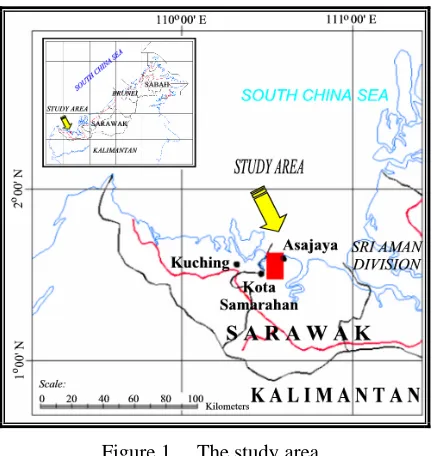
The study area is located at Sadong Simunjan River Basin, Kota Samarahan of Sarawak, Malaysia covering an area of 1702 km (5 km x 34 km), comprising partially-drained peatland, intended for large- scale agricultural plantation (Figure 1). The original vegetation found here are scarce, stunted and dwindling trees due to high water table and soil acidity (Lim 1992). It is also situated in one of the largest contiguous peatland remain in Malaysia with an approximate area of 1.6 million hectares.
3.2. SAR data
The TOPSAR data (L-band) used in this study were acquired as part of the PACRIM I campaign, a collaborative work between Southeast Asia, Australia and New Zealand with Jet Propulsion Laboratory (JPL) /NASA of USA. The data have already been corrected for slant-to-ground range and geometrically corrected to local mapping datum – the Timbilai Datum of the Borneo Rectified Skew Orthomorphic Projection System. The unsystematic errors that have not been taken into account were corrected in this study by image-to-map registration technique. A brief technical specification of the data is given in Table 1.
3.3. Ancillary information
Remote sensing is only capable of measuring the amount of radiance within the instantaneous field of view. This radiance is a mixture of different signals, one of which may be related to soil moisture. Therefore, in-situ ground measurements are necessary for establishing some relationship between soil moisture and observed radiance.
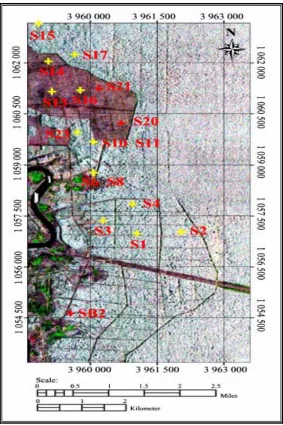
The ancillary information used in the study include the topographic map of the corresponding area (scale 1:50,000) and in-situ measurements carried out during the flight mission. Field surveys were conducted to gather samples for deriving information on the surface roughness, soil particle size, soil bulk density and soil moisture. In addition, the depth of water table was also determined.
Figure 1. The study area.
Table 1. Specification of AIRSAR data.
Parameter AIRSAR Band L (1.26 GHz, 23.0 cm) Mode TOPSAR
Altitude 8.382 km
Incidence angle 20° - 60° Polarization HH, VV and HV Resolution 10 m x 10 m Date of acquisition 25 Nov. 1996
3.3.1 Gravimetric observations
The oven-drying soil moisture technique is the standard for calibration of all other methods. The method involves obtaining a wet soil sample weight, Ww drying the sample at 100°C for 24 hours and
then obtaining the dry sample weight Wd. Then, with a measurement of the bulk density,Yd and the
density of water, Yw the volumetric water content can be found:
% 100 Y W
Y W M
w d
d w v=
(12) 3.3.2 Soil roughness measurements
3.3.3 Dielectric Constant
For the selected models examined, the critical input is the dielectric constant (ε). In this study, the approach by (Hallikainen et al. 1985) was adopted, where dielectric constant measurements for five different soil types at frequencies between 1.4 and 18 GHz were established. Based on these measurements, polynomial expressions can be derived relating the real and imaginary part of ε to the volumetric moisture content, Mv, and the percentage of sand and clay. These polynomial expressions are
of the following form:
(
) (
)
(
)
2v 2 1 0 v 2 1 0 2 1
0 a S a C b b S b Cm c c S c Cm
a + + + + + + + +
=
ε
(13) where, S is the percentage (by weight) of sand, C is percentage of clay, and ai, bi, ci are coefficients,
which dependent on frequency.
4. Data processing
4.1 Speckle Reduction
Speckles found in SAR data due to random multiplicative noise can be recognised by the random pattern and the noise levels that increase with average grey level of specified window area in an image (Lee 1986). Minimisation of speckle effects in SAR data were carried out using adaptive radar filters (Lopes et al. 1990). In this study, several radar adaptive filters and convolution filters were used, namely Lee, Frost, Gamma, Kuan, Local-Sigma, Low- Pass, Laplacian, Gaussian and Median. The results in this study indicate that Gaussian 7 x 7 filter is the best for this area, giving the best coefficient of variance test (Paudyal and Aschbacker 1993).
4.2 Extraction of Surface Roughness and Soil Moisture
The main processing carried out in this study was to extract surface roughness and soil moisture from radar backscatter of the TOPSAR data. In the first task, the surface roughness s or the RMS heights were computed using all the three backscatter models employing equations (1) and (2) for Dubois model and equations (10) and (11) for Oh model. In the case of IEM model which involves rigorous computations, a computer program developed by Fung et al. (1992) were used.
Apart from computed surface roughness (s), the same parameter was computed directly using TOPSAR data after it was pre-processed and converted into dB image. This is then known as s computation directly from the image.
In the second processing task, the soil moisture estimation was performed using the regression analysis approach with main input derived from radar backscatter parameters obtained in the first task rather than using image directly.
5. Results, analysis and discussion
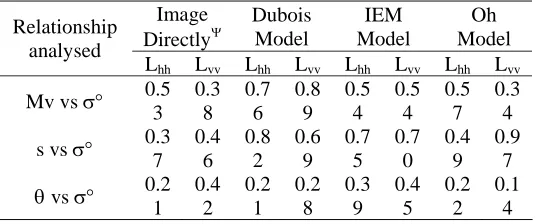
The derived surface roughness (s) from the respective models were compared with Mv obtained
from in-situ measurements by regression analysis and their respective relationship (based on r 2) are summarized in Table 4.
With regard to the Mv versus backscattering coefficients, the best relationship was obtained with
Table 2. Volumetric soil moisture and soil roughness for the test points. Sample Site Surface Roughness (s, cm) Correlation Length (l, cm)
Soil moisture (Mv, vol)
S8 0.333 31.589 0.53
S14 1.037 28.980 0.62
S16 1.580 31.946 0.63
S11 2.000 31.208 0.64
S13 0.445 28.496 0.68
S4 1.463 7.690 0.69
S15 1.746 23.754 0.70
S1 3.080 11.864 0.71
S10 1.511 33.166 0.72
S17 2.327 24.377 0.75
S3 0.935 2.696 0.76
S23 2.310 27.039 0.78
S2 2.994 13.845 0.87
Table 3. Volumetric soil moisture and soil roughness for the check points.
Sample Site Surface Roughness (s, cm) Correlation Length (l, cm)
Soil moisture (Mv, vol)
SB2 2.317 12.137 0.61
S6 0.706 29.875 0.63
S20 2.318 32.067 0.80
S21 2.283 27.105 0.70
S22 2.338 27.229 0.80
HH-Polarization: Mv =0.610σhh+45.99
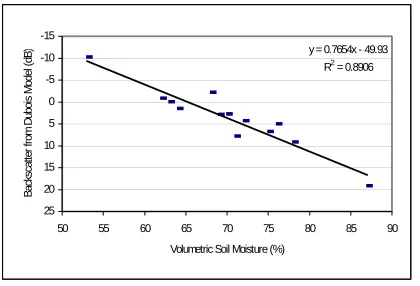
(14) VV-Polarization: Mv =0.765σvv −49.93
(15)
Table 4. Summary of the results of regression analysis.
Image DirectlyΨ Dubois Model IEM Model Oh Model Relationship analysed
Lhh Lvv Lhh Lvv Lhh Lvv Lhh Lvv
Mv vs σ° 0.5 3 0.3 8 0.7 6 0.8 9 0.5 4 0.5 4 0.5 7 0.3 4
s vs σ° 0.3 7 0.4 6 0.8 2 0.6 9 0.7 5 0.7 0 0.4 9 0.9 7
θ vs σ° 0.2
1 0.4 2 0.2 1 0.2 8 0.3 9 0.4 5 0.2 2 0.1 4
The best relationship of s and radar backscatter (σ°) was obtained with Dubois model (r2 =0.8) followed by IEM model (r2 =0.7) both in the HH polarizations. This shows that most other models have a weak relationship between incidence angle and backscatter. This is also exhibited by the r2 in the range of 0.1 to 0.4.
Of all the models analysed, Oh model was found to be the most inferior whilst, Dubois model exhibits the best correlation between s and Mv. IEM model fits has a moderate correlation. Next, the Mv
and s derived from the respective models were also analysed for RMS. This was achieved by comparing the respective values with the corresponding in-situ measurements (mutual test set), and the results obtained are summarized in Table 5. Again, Dubois model shows the best result with the best Mv
determined from Lhh whilst, the best s is obtained from Lvv. The RMSE obtained here are comparable to
the results obtained by (Dubois et al. 1995), around 4.2 %.
Table 5. Summary of RMSE of models examined.
Image DirectΨ
Dubois Model
IEM Model
Oh Modelτ
Lhh Lvv Lhh Lvv Lhh Lvv
Lh h
Lv v
Mv 7.9 7
9.7 4
4.4 1
3.2 5
8.2 7
8.5
9 - -
s 0.8 0
1.2 7
0.3 7
0.4 8
0.4 3
0.5
0 - -
Note: Ψ Refer to TOPSAR data and τ most inferior to count
y = 0.7654x - 49.93 R2 = 0.8906
-15 -10 -5 0 5 10 15 20 25
50 55 60 65 70 75 80 85 90 Volumetric Soil Moisture (%)
Ba
ckscat
te
r f
rom
Dubois M
odel (dB
)
Figure 3. Estimated σ°vv, calculated from Dubois
model
6. Conclusions
The results presented in this paper demonstrate that soil moisture can be estimated from SAR data, even in estimation of degree of wetness in the case of drained peatland in the humid tropics. This study also shows that there are restrictions in deriving the moisture content using the backscatter which is much dependent on the surface roughness by using the backscatter models. Of all the radar backscattering models (theoretical and empirical) examined, Dubois model is the best for TOPSAR data in this study. With TOPSAR data, soil moisture and surface roughness can best be estimated using Lhh and Lvv
(a) (b)
Figure 4 (a). Mv map derived from TOPSAR Lhh using Dubois model (1996) (extremely wet
day) and (b) Mv map derived from TOPSAR Lvv using Dubois model (1996).
References
BENALLEGUE, M., TACONET, O., VIDAL-MADJAR, D., and NORMAND, M., 1995, The use of radar backscattering signals for measuring soil moisture and surface roughness, Remote Sensing of Environment, 53, 61-68.
DUBOIS, P. C., ZYL, J. V. and ENGMAN, E. T., 1995, Measuring soil moisture with imaging radars, IEEE Transactions on Geoscience and Remote Sensing, GE-33(4), 915-926.
ENGMAN, E. T., 1991, Applications of microwave remote sensing of Soil Moisture for Water Resources and Agriculture, Remote Sensing of Environment, 35, 213-226, 1991.
FUNG, A. K., LI, Z., and CHAN, K. S., 1992, Backscatering from a randomly rough dielectric surface, IEEE Transactions on Geoscience and Remote Sensing. Vol. GE-30(2). 356-369.
HALLIKAINEN, M. T., ULABY, F. T., DOBSON, M. C., EL-RAYES, M. A., and WU, L. K., 1985, Microwave dielectric behaviour of wet soil – Part1: Empirical models and experimental observations, IEEE Transactions on Geoscience and Remote Sensing, Vol. GE-23(1). 25-34. JACKSON, T. J., and SCHMUGGE, T. J., 1986, Passive microwave remote sensing of soil moisture, In.
Advances in Hydroscience, edited by V. T., Chow (London: Academic Press Inc. Ltd.), pp. 123-157.
LEE, J. S., 1986, Speckle suppression and analysis for Synthetic Aperture Radar images, Optical Engineering, Vol. 25(5). 636-643.
LI, K. Y., JONG, R. D., and BOISVERT, J. B., 1997, Estimating soil moisture profiles in the root zone using intermittent remotely sensed surface moisture contents, International Symposium Geomatics In The Era of Radarsat, GER ’97. 2nd Edition. Ottawa, Canada. [CD-ROM]
LIM, E. T., 1992, Peat soil of Sarawak, Chemistry Division Agriculture Research Centre, Department of Agriculture, Sarawak.
LOPES, A., TOUZI, R., and NEZRY, E., 1990, Adaptive filters and scene heterogeneity, IEEE Transactions on Geoscience and Remote Sensing, Vol. GE-28(6). 992-1000.
MALAYSIAN METEOROLOGICAL SERVICE, 2000, Climate of Malaysia, Malaysia Meteorological Service Report.
OH, Y., SARABANDI, K., and ULABY, F. T., An empirical model and an inversion technique for radar scattering from bare soil surfaces, 1992, IEEE Transactions on Geoscience and Remote Sensing. Vol. GE-30(2). 370-381.
PAUDYAL, D. R., and ASCHBACTER, J., 1993, Evaluation and performance test of selected SAR speckle filter, The International Symposium Operationalisation Org. Remote Sensing, ITC Enschede, Nertherland.
SANO, E. E., MORAN, M. S., HUETE, A. R., AND MIURA, T., 1998, C-and Multiangle Ku-band Synthetic Aperture Radar data for bare soil moisture estimation in agricultural areas, Remote Sensing of Environment, 64, 77-90.
ULABY, F. T., ASLAM, A.., and DOBSON, M. C., 1982a, Effects of vegetation cover on the radar sensitivity to soil moisture, IEEE Transactions on Geoscience and Remote Sensing, Vol. GE-20(4). 476-481. 1982a.