Engine Conversion to CRDI Technology & Its
Application Strategy
S Karthik1, K Sairahul1, N Logesh1, K.Guru Prasad1, D.Gopinath2
U.G Student, Velammal Engineering College, Chennai, Tamilnadu, India1
Assistant Professor, Velammal Engineering College, Chennai, Tamilnadu, India2
ABSTRACT: BS3 & BS4 limits have become a major milestone for the current passenger car and commercial vehicle
industries in India. To comply with reduced emissions targets, a significant effort was required to minimize the cost, time and to improve steady state performance, emissions for the pollutants of CO, HC, PM & NOx. Rather developing a new engine with latest technology like CRDI, it is wise to convert the existing engine and calibrate the same for the required vehicle application.
The main challenge of converting the engine to superior technology like CRDI and its application strategy is explained in this technical presentation.
1. INTRODUCTION
In order to meet the future more stringent emission regulation and to improve the performance of diesel engine, the in-cylinder combustion process has been an area of constant research and development.
Engine test result shows the soot emission is sensitive to nozzle parameters such as the impingement point in the bowl and the number of nozzle holes. In diesel combustion the air fuel mixing and chemical kinetic efforts control the rate of soot formation. The combustion temperature and the presence of Oxygen create high NOX formation. Changes in injector protrusion can result in opposite smoke trends at different engine speed and load condition. The EGR (Exhaust gas recirculation and timing retardation may assist on NOX reduction.During combustion process, the rich mixture (i.e. lack of oxygen) creates incomplete combustion by products of UBHC, CO. Hence operating the engine with high air excess ratio may assist on CO, HC reduction.It is clear that each emission has close interaction with each other; reduction of one pollutant may have an adverse effect on other (another). Hence in this paper presentation, implementation of CRDI technology, Application strategy and achieving the Engine performance and Emission is detailed as case study.
II.CASE STUDY
III. OBJECTIVE
The aim and challenge is to identify the Common rail fuel system and ECU suitable for the engine. And calibrate the engine for current BS3 regulation with revised engineering performance targets.
Fig-2: Common rail technology
First commitment is to deliver great reliability, durability and cost-effectiveness solutions.
IV. PROCESS OF CONVERSION
3.1 Project need identification
First, the engineering specification, vehicle application, targets like performance, emission, BSFC, smoke, noise, etc are frozen.
3.2 Selection of hardware and software
Fig-3: Common rail system circuit
3.3 Selection of sensors and wiring harness
The common rail system consists of ECU, sensors and actuators. Sensor reads the engine signal and passes to the ECU for signal processing. In turn ECU commands the actuator to perform the desired function.
Sensors, wiring harness, actuators are selected based on the common rail system guidelines and ECU requirements.
3.4 Engine First firing
After successful integration of customised FIE system, ECU, wiring harness and sensors, Synchronization between crank and cam sensor was established.
Engine started with base dataset with a2l and hex file.
V. ENGINE CALIBRATION
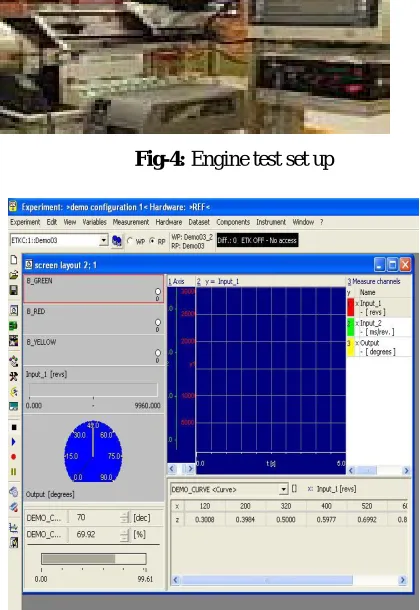
INCA is a calibration tool, which is designed to rapidly access, calibrate and store the ECU data and represent in graphical form in MDA.
Fig-4: Engine test set up
Figure 6: MDA SCREEN SHOT
4.2 Emission Test cycle
Developing correlation of smoke to particulate emission, it tends to keep the individual smoke units fixed on the ESC cycle as a target to meet PM.
Composite of PM
Figure 8: Composites of PM
4.4 Advanced Combustion
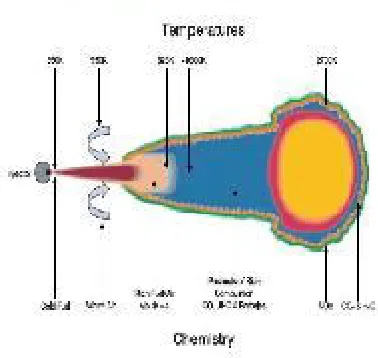
Advanced combustion system which is helping to reduces engine out emissions inside the combustion chamber.
The combustion system design process uses detailed computer simulation of the combustion event, allowing engineers to study the effects of changes to fuel injection system parameters and combustion chamber geometry. This process accelerates the development process and has allowed attaining low engine-out NOx and particulates.
Main injection timing, Pilot injection, Pilot injection separation, Post injection activation strategy, Rail pressure, etc are monitored through INCA.
4.5 Fuel economy benefit
The Common rail system uses electronic controlled diesel injection which gets ECU signal for energizing the solenoid for diesel injection. The duration of injection is depends upon the rate of energisation.
And during the deceleration, the intelligence of ECU, it cuts off the electrical supply to solenoid injector which in turn contributes to fuel economy improvements.
4.6 BS3 Achievements
Advanced combustion system and engineering approach on calibration brought BS3 success in first phase. The easy achievement of BS3 is due to High pressure injection and Pilot and Main injection strategies.
Advantages of Pilot injection will help on premixing of air and fuel mixture and makes it ready for ease of combustion; it reduces the ignition delay, Sudden Peak Pressure and reduces the knock and noise.
The Common Rail Diesel Injection has following flexibility,
CRS – Flexible injection system
Fig-10: CRDI–injection technology
Selection of pilot injection qty,
Software consists of A2L, HEX file, Data set.
Dataset is inbuilt with maps, curves and other measurement, calibration variables.
Engine First firing
ECU governor calibration
Optimizing the dataset with desired maps on test bed
Achieving the desired performance, emission targets
Engine certification
Engine integration on vehicle
Vehicle level calibration.
Vehicle dynamics optimisation
Engine, vehicle validation for climatic trials
Engine, vehicle durability
Emission robustness test
Dataset freezing
Engine / Vehicle SOP. (Start of Production)
ACKNOWLEDGMENT
The authors would like to express special thanks to HOD mechanical department and other professors for giving us a chance to present this paper in the technical conference.
Glossary
CRDI -Common-Rail Diesel Injection
BS3, BS4 - Bharat Stage 3, 4
EGR -Exhaust Gas Recirculation.
TDC -Top dead centre
CO -Carbon Monoxide
HC -Unburned hydrocarbon
NOx -Oxides of Nitrogen
PM -Particulate Matter,
VGT -Variable Geometry Turbocharger.
DPF -Diesel Particulate Filter
Exhaust After treatment: Any technology which treats emissions in the exhaust flow.
REFERENCES
1. Tow TC, Pierpont DA, Reitz RD. Reducing particulate and NOX emissions by using multiple injections in a heavy duty DI diesel engine. SAE paper 940897.