2043 | P a g e
“A Short Review on Cyclodextrin Inclusion Complexes:
Synthesis, Characterization and Their Applications”
Heena, Irshad Mohiuddin
1,Ashok Kumar Malik
2Department of Chemistry, Punjabi University, Patiala-147002
ABSTRACT
The supramolecular chemistry gives broad idea of intermolecular interactions where covalent bonds are not
likely to form between the interacting species. Thus, interactions have been performed by host-guest interaction.
Among the host molecule cyclodextrin seems to be the most promising to form the inclusion complexes with
various guest molecules with suitable polarity and dimensions. Among the various types of cyclodextrins, α- cyclodextrin is not suitable for many drugs and γ-cyclodextrin is expensive. Most suitable and widely used
cyclodextrin is β-cyclodextrin as it is readily available and the size of cavity is suitable for a wide range of guest
molecules. The reported behavior of inclusion complexes had been used to improve the aqueous solubility,
bioavailability, stability of unstable drugs, reduction of the unwanted side effects and smell or bad taste can also
be masked of a drug molecule. If a drug is hydrophilic, the dissolved drug molecule will not partition from the
aqueous exterior into a lipophilic bio membrane and then permeate the membrane. Screening approaches to
drug development have led to an increasing number of lipophilic water-insoluble drugs whose medical
usefulness is hampered by their insolubility in water.
Keywords: Inclusion Complex, β-Cyclodextrin, Superamolecular Chemistry.
I. INTRODUCTION
Cyclodextrins were first described by Villiers in 1891. Schardinger laid the foundation of the cyclodextrin
chemistry in 1903–1911 and identified both α- and β-cyclodextrin. Many drugs are able to form an inclusion
complex with CDs, being trapped entirely or at least partially into their slightly apolar cavities [1-3]. Such an
encapsulation affects many of the physiochemical properties of drugs such as its solubility, rate of dissociation
etc. CDs can increase the water solubility of some contaminations, reduce their toxicity and catalyze their
decomposition by forming inclusion complex [4, 5]. Although the interaction of host and guest molecules are
very important to study the inclusion complexes, but the methods to obtain the direct information are very rare.
In the solution phase, some information can be obtained by nuclear magnetic resonance (NMR) spectroscopy
[6]. In solid State, X-Ray single crystal analysis is a specific method in providing the information and gives
significant results [7]. Sometimes NMR cannot completely distinguish the complex signals and the results of
crystallographic studies are not being same as that in solution phase. In this type of a situation commonly
ab-initio and density functional theory (DFT) calculations are very much useful. However, the calculations of
inclusion complex are very difficult due to its large size and more number of atoms contained. The formation of
inclusion complex with a wide variety of guest molecules is one of the most interesting properties of CDs. There
are various methods available to synthesize the inclusion complex [8]. The schematic representation of
2044 | P a g e
Figure1: Schematic representations of β-cyclodextrin. The black and grey arrows point to primary and
secondary hydroxyl groups (Davis and Brewster 2004).
II. PREPARATION OF INCLUSION COMPLEXES
In the β conformation intramolecular hydrogen bonds appear between hydroxyl groups which prevent the
formation of hydrogen bond with surrounding molecules resulting in poor water solubility (Muller and Brauns
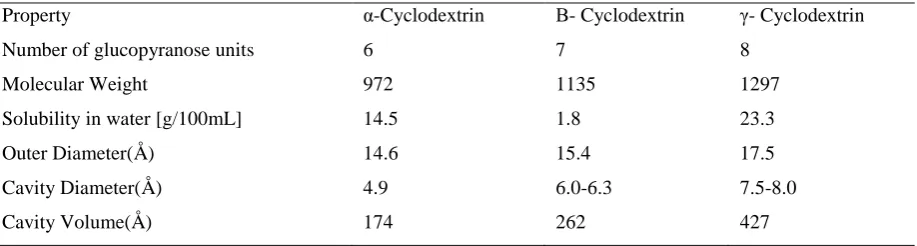
1986). Chemical Properties of cyclodextrin molecules are given in Table 1.
Table 1: Chemical Properties of cyclodextrin
Property α-Cyclodextrin Β- Cyclodextrin γ- Cyclodextrin
Number of glucopyranose units 6 7 8
Molecular Weight 972 1135 1297
Solubility in water [g/100mL] 14.5 1.8 23.3
Outer Diameter(Å) 14.6 15.4 17.5
Cavity Diameter(Å) 4.9 6.0-6.3 7.5-8.0
Cavity Volume(Å) 174 262 427
The great significance of CDs both in research and applications stands in their ability to selectively form
inclusion complexes with other molecules and ions (Dodziuk 2006). This formation of the inclusion complex is
the outcome of the equilibrium between the CD molecules, the free guest and the supramolecules of inclusion.
Figure 2 represents inclusion of a guest within a cyclodextrin host to form a complex.
Free guest + free CD CD/guest complex
2045 | P a g e
1.1 Approaches for making of Inclusion Complexes
(i) Physical blending method
A solid physical mixture of drug and CDs are prepared simply by mechanical trituration. In laboratory scale
CDs and drug are mixed together thoroughly by trituration in a mortar and passes through appropriate sieve to
get the desired particle size in the final product. In industry scale, the preparation of physical mixtures is based
on extensive blending of the drug with CDs in a rapid mass granulator usually for 30 minutes. These powdered
physical mixtures are then stored in the room at controlled temperatures and humidity conditions [9].
(ii) Kneading method
This method is based on impregnating the CDs with little amount of water or hydro alcoholic solutions to be
converted into a paste. The drug is then added to the above paste and kneaded for a specified time. The kneaded
mixture is then dried and passed through a sieve if required [10]. Parik et al. [11] have reported the dissolution
enhancement of nimesulide using complexation method. In laboratory scale kneading can be achieved by using
a mortar and pestle [12-14].
(iii) Co-precipitation technique
This method involves the co-precipitation of drug and CDs in a complex. In this method, required amount of
drug is added to the solution of CDs. The system is kept under magnetic agitation with controlled process
parameters and the content is protected from the light. The formed precipitate is separated by vacuum filtration
and dried at room temperature in order to avoid the loss of the structure water from the inclusion complex.
Moyano et al. [15] have studied the solid-state characterization and dissolution characteristics of
gliclazide-β-cyclodextrin inclusion complexes. This technique leaves a drug-CD solution in very close conditions to the
saturation and through abrupt changes of temperature with addition of organic solvents.
(iv) Solution/solvent evaporation method
This method involves dissolving of the drug and CDs separately in to two mutually miscible solvents, mixing of
both solutions to get molecular dispersion of drug and complexing agents and finally evaporating the solvent
under vacuum to obtain solid powdered inclusion compound. Generally, the aqueous solution of CDs is simply
added to the alcoholic solution of drugs. The resulting mixture is stirred for 24 hours and evaporated under
vacuum at 45 ºC. The dried mass was pulverized and passed through a sieve.
(v) Neutralization precipitation method
This method is based on the precipitation of inclusion compounds by neutralization technique and consists of
dissolving the drug in alkaline solutions like sodium/ammonium hydroxide and mixing with an aqueous solution
of CDs. The resultant clear solution is then neutralized under agitation using hydrochloric acid solution till
reaching the equivalence point. A white precipitate is being formed at this moment, corresponding to the
formation of the inclusion compound. This precipitate is filtered and dried. Doijad et al. [16] have studied the
enhancement of solubility of piroxicam by complexation with β-cyclodextrin.
(vi) Milling/Co-grinding technique
A solid binary inclusion compounds can be prepared by grinding and milling of the drug and CDs with the help
of mechanical devices. Drug and CDs are mixed intimately and the physical mixture is introduced in an
oscillatory mill and grinded for suitable time. Alternatively, the ball milling process can also be utilized for
2046 | P a g e
speed for a predetermined time, and then it is unloaded, sieved through a 60-mesh sieve. This technique issuperior to other approaches from economic as well as environmental stand point in that unlike similar methods
it does not require any toxic organic solvents [17].
(vii) Atomization/Spray drying method
Spray-drying is a common technique used in pharmaceuticals to produce a dry powder from a liquid phase.
Another application is its use as a preservation method, increasing the storage stability due to the water
elimination [18]. This method represents one of the most employed methods to produce the inclusion complex
starting from a solution. The mixture pass to a fast elimination system propitiate solvent and shows a high
efficiency in forming complex. Besides, the product obtained by this method yield the particles in the controlled
manner which in turn improves the dissolution rate of drug in complex form. Vozone et al. [19] have developed
complexation of budesonide in cyclodextrins and particle aerodynamic characterization of the complex solid
form for dry powder Inhalation.
(viii) Lyophilization/ Freeze drying technique
In order to get a porous, amorphous powder with high degree of interaction between drug & CD,
lyophilization/freeze drying technique is considered as a suitable [20]. In this technique, the solvent system from
the solution is eliminated through a primary freezing and subsequent drying of the solution containing both drug
and CD at reduced pressure. Thermolabile substances can be successfully made into complex form by this
method. The limitations of this technique are long time process and yield poor flowing powdered product.
(ix) Microwave irradiation method
This technique involves the microwave irradiation reaction between drug and complexing agent using a
microwave oven. The drug and CD in definite molar ratio are dissolved in a mixture of water and organic
solvent in a specified proportion into a round bottom flask. The mixture is reacted for short time of about one to
two minutes at 60 ºC in the microwave oven. After the reaction completes, adequate amount of solvent mixture
is added to the above reaction mixture to remove the residual, uncomplexed free drug and CD. The precipitate
so obtained is separated using whatman filter paper, and dried in vacuum oven at 40 ºC for 48 hrs. Deshmukh et
al. [21] have developed inclusion complexes of ziprasidone hydrochloride with β-cyclodextrin and
hydroxypropyl β-cyclodextrin to design the fast dissolving formulation using various superdisintegrants.
Microwave irradiation method is a novel method for industrial scale preparation due to its major advantage of
shorter reaction time and higher yield of the product [22].
(x) Supercritical antisolvent technique
This method was introduced in the late 1980s [23]. Since the first experiences of Hannoy et al in 1879, a
number of techniques have been developed and patented in the field of supercritical fluid-assisted particle
design. In the supercritical fluid antisolvent technique, carbon dioxide is used as anti-solvent for the solute but
as a solvent with respect to the organic solvent. The use of supercritical carbon dioxide is advantageous as its
low critical temperature and pressure makes it attractive for processing heat-labile pharmaceuticals.
Supercritical particle generation processes are new and efficient route for improving bioavailability of
2047 | P a g e
1.2 Methods for investigating the inclusion complexes
The complexation depends largely on the dimensions of the cyclodextrins and the particular sterical
arrangement of the functional groups of the molecules, which leads to a relatively hydrophilic outside and a
hydrophobic inside cavity of the molecule. Inclusion complexes formed between the guest and cyclodextrin
molecules can be characterized both in the solid and solution state by the following techniques:
(A) Inclusion complexation in the solid state characterized by
(i) Thermo-analytical methods
Thermo-analytical methods [9, 25-28] determine whether the guest substance undergoes some change before the
thermal degradation of cyclodextrin. The change of the guest substance may be melting, evaporation,
decomposition, oxidation or polymorphic transition. The change of the guest substance indicates the complex
formation. The effect of cyclodextrins on the thermogram obtained by DTA and DSC were observed for
broadening, shifting and appearance of new peaks or disappearance of certain peaks. Changes in the weight loss
were evaluated to provide supporting evidence for the formation of inclusion complexes. The nature of the drug
and cyclodextrins used and method of preparation of complex have been found to influence the above finding
considerably. If the interaction between the drug and the excipient is weak, the shift in the endothermic peak is
very small.
(ii) Scanning Electron Microscopy (SEM)
Scanning Electron Microscopy [27, 29,30] is used to study the microscopic aspects of the raw material
(cyclodextrin and the guest substances, respectively) and the product obtained by co-precipitation/evaporation
[10, 31,32].The difference in crystallization state of the raw material and the product seen under electron
microscope indicates the formation of the inclusion complexes. SEM analysis is performed to investigate the
morphologies of pure drug and carriers and their combinations.
(iii) X-ray diffractiometry analysis
Powder X-ray diffractiometry [9,26] may be used to detect inclusion complexation in the solid state. When the
guest molecules are liquid since liquid have no diffraction pattern of their own, then the diffraction pattern of a
newly formed substance clearly differs from that of uncomplexed cyclodextrin. This difference of diffraction
pattern indicates the complex formation [10, 33,34]. When the guest compound is a solid substance, a
comparison has to be made between the diffractogram of the assumed complex and that of the mechanical
mixture of the guest and cyclodextrin molecules [32]. Comparison of the diffractogram is only possible if the
cyclodextrin as well as the guest molecules are treated under identical conditions as that of the assumed complex
because cyclodextrin inclusion complex preparation processes such as freeze drying and grinding, may change
the crystallinity of the pure substances and this may lead to different diffraction patterns [27, 35].
(iv) Infra-Red (IR) spectroscopy
Infra-Red spectroscopy is used to estimate the interaction between cyclodextrin and the guest molecules in the
solid state [27,28]. Cyclodextrin bands often change only slightly upon complex formation and if the fraction of
the guest molecules encapsulated in the complex is less than 25%, bands which could be assigned to the
included part of the guest molecules are easily masked by the bands of the spectrum of cyclodextrin
[25,34,36-38]. Infra-red spectral studies give information regarding the involvement of hydrogen in various functional
2048 | P a g e
band caused by stretching vibration of the group involved in the formation of the hydrogen bonds. Hydrogenbond at the hydroxyl group causes the largest shift of the stretching vibration band. It has been observed that
cleavage of the hydrogen bonding due to inclusion complexation results in the shift of absorbance bands to
higher frequency.
(B) Inclusion complexation in solution state characterized by
(i) Nuclear Magnetic Resonance (NMR) spectroscopy
The most direct evidence for the inclusion of a guest into a cyclodextrin cavity in solution is obtained by 1H
NMR spectroscopy [28,34]. 1H NMR may also be used to determine the direction of penetration of guest
molecules into the cyclodextrin cavity [37,38].The H-3 and H-5 atoms of cyclodextrin, which are directed
towards the interior of the cyclodextrin will show a significant up field shift if inclusion does indeed occur and
the H-1, H-2 and H-4 atoms, located on the exterior of the cavity will show only marginal upfield shifts. The
spectrum of the guest molecule may also be changed upon inclusion complex formation [39-42]. A similar
method to investigate inclusion complex formation is 13C-NMR spectroscopy [43]. It is often used to gain
insight into the inclusion modes of inclusion complexes in aqueous solution. The cyclodextrin induced change
in the 13C chemical shift result predominantly from the electrical environment effect of the cyclodextrin cavity
and in general 13C inclusion shift may be mainly divided into hydrophobic and van der Waals interaction shifts
[40].
(ii) Electron Spin Resonance (ESR)
Electron Spin Resonance [44] is a useful method to investigate inclusion complexation with radicals in aqueous
solutions. The hyperfine coupling constant of radicals is known to be sensitive to the polarity of the medium. If
the hyperfine coupling constant alters, the movement of a radical to an environment less polar than water is
indicated and confirms the inclusion complex formation.
(iii) Ultraviolet/Visible (UV/VIS) Spectroscopy
The complexation causes a change in the absorption spectrum of a guest molecule [9,28,45]. During the
spectral changes, the chromophore of the guest is transferred from an aqueous medium to the non-polar
cyclodextrin. These changes must be due to a perturbation of the electronic energy levels of the guest caused
either by direct interaction with the cyclodextrin, by the exclusion of solvating water molecules or by a
combination of these two effects [36]. Small shifts are observed on the UV spectra of the included guests, the
method is often used to detect inclusion complexation [46-48]. Hypsochromic or bathochromic shift or increase
in the absorptivity without change in the λmax has been considered as evidence for interaction between
cyclodextrin and the drug in the formation of the complex.
(iv) Fluorescence Spectroscopy
When fluorescent molecules in aqueous solution are included in cyclodextrins, fluorescence spectra may be
influenced which indicates the formation of inclusion complexes [47]. The inclusion complex formation
generally leads to the change of excitation and emission wavelength of the drug [49]. The effect of inclusion
between 1,8-dihydroxyanthraquinone with α-CD, β-CD and γ-CD on the fluorescence spectra of the drug was
studied which indicates that the inclusion complex formation leads to the change of excitation and emission
wavelength of the drug. A red shift from 571 to 595 nm of the emission band was observed along with an
2049 | P a g e
bond formation [47]. The fluorescence emission spectra confirmed that the solubility of the complex formedusing β-CD and γ-CD was more than that of plain drug. Binding of the chromophore in a monomeric form with β-CD and γ-CD was also confirmed. The spectral change was maximum in γ-CD, less in β-CD and none in α-CD indicating that the substrate was included inside the cavity completely in case of γ-α-CD due to larger cavity
size, and partly into the β-CD cavity and no inclusion in case of α-CD [49].
1.3 Chemistry of Inclusion Complex
The field of "inclusion complex" holds considerable promise in the study of reactivities of guest molecules and
the way in which this reactivity is governed by the environment. Based on size selective complexation
properties of CDs, the better the fit of guest molecules inside the cavity, the more stable the complex will be.
The stability of the complex is inversely proportional to the polarity of the guest molecule [50,51]. Several
hypotheses have been proposed for the driving forces for the CD inclusion complexation, including Vander
Waals interactions, hydrogen bonding between the polar functional groups of the guest molecules, the hydroxyl
groups of CDs, release of high-energy water in the cavity in the complex formation, hydrophobic interactions
between the hydrophobic moiety of the guest molecules or the CD cavity and release of strain energy in the ring
frame of the cyclodextrin. Among those forces, hydrophobic interactions are frequently considered as the main
driving force for the complexation in aqueous media between hosts containing hydrophobic (apolar) cavities and
non polar guest molecules. New cyclodextrin-based technologies are constantly being developed and, thus, 100
years after their discovery cyclodextrins are still regarded as novel excipients of unexplored potential.
1.4 Pharmaceutical applications of inclusion complex
CDs and their derivatives have received a lot of attention in the field of pharma sciences for the past few years.
Many articles have already been published regarding the interaction of host-guest moiety and increased number
of reviews have been dedicated to their application in pharmaceutical sciences [52-54]. CDs and their
derivatives have well-known effects on drug solubility and dissolution, bioavailability, safety and stability, and
their applications in different areas of drug delivery have been also reported. However, the cavity size of β-CD
depends upon the complexation of guest with host molecule many physiochemical properties have been
changed.
CDs have mainly been used as complexing agents to increase the aqueous solubility of poorly water-soluble
drugs and to increase their bioavailability and stability. In addition, CDs have been used to reduce or prevent
gastrointestinal or ocular irritation, reduce or eliminate unpleasant smells or tastes, prevent drug or
drug-additive interactions, or even to convert oils and liquid drugs into microcrystalline or amorphous powders.
(i) Enhancement of solubility
CDs increase the aqueous solubility of many poorly soluble drugs by forming inclusion complexes with their
apolar molecules or functional groups. The resulting complex hides most of the hydrophobic functionality in
the interior cavity of the CD while the hydrophilic hydroxyl groups on the external surface remain exposed to
the environment. The net effect is that a water-soluble CD drug complex is formed [55].
(ii) Enhancement of bioavailability
When poor bioavailability is due to low solubility, CDs are of extreme value. Preconditions for the absorption
of an orally administered drug are its release from the formulation in dissolved form. When drug is complexed
2050 | P a g e
by CD complexation also improves their percutaneous or rectal absorption. In addition to improvingsolubility, CDs also prevent crystallization of active ingredients by complexing individual drug molecules so
that they can no longer self-assemble into a crystal lattice [56].
(iii) Improvement of stability
CD complexation is of immense application in improving the chemical, physical and thermal stability of
drugs. For an active molecule to degrade upon exposure to oxygen, water, radiation or heat, chemical
reactions must take place. When a molecule is entrapped within the CD cavity, it is difficult for the reactants
to diffuse into the cavity and react with the protected guest [57].
(iv) Preventionof incompatibility
Drugs are often incompatible with each other or with other inactive ingredients present in a formulation.
Encapsulating one of the incompatible ingredients within a CD molecule stabilizes the formulation by
physically separating the components in order to prevent drug-drug or drug-additive interaction [58].
(v) Odor and taste masking
Unpleasant odor and bitter taste of drugs can be masked by complexation with CDs. Molecules or functional
groups that cause unpleasant tastes or odors can be hidden from the sensory receptors by encapsulating them
within the CD cavity. The resulting complexes have no or little taste or odor and are much more acceptable to
the patient.
Of course pharmacy is not the only field in which cyclodextrin have found so much applications. In the field of
analytical chemistry, cosmetics, agriculture, biochemical and food industry CDs have prooved their usefulness
too. In the analytical chemistry cyclodextrins and inclusion complexes can be used in high pressure liquid
chromatography (HPLC), gas chromatography, spectroscopy and electrophoresis. Cyclodextrin complexation
have been successfully applied to rapid analysis of various drugs by HPLC.
III. CONCLUSION
A survey of literature related to use of cyclodextrin molecule for obtaining inclusion complex with various
practically insoluble available drugs was conducted in order to characterize their formation by various
techniques in solid state and solution phase or to study their applicability in the field of pharmaceutical sciences
and analytical sciences. CDs have mainly been used as complexing agents to increase the aqueous solubility of
poorly water-soluble drugs, and to increase their stability and bio-availability. In addition, they can be used to
reduce or prevent gastro-intestinal or ocular irritation, eliminate unpleasant smells or tastes, prevent drug-drug
or drug-additive interactions, or even to convert oils and liquid drugs into micro crystalline or amorphous
powders. Literature revealed that inclusion complex synthesis is based on size selective complexation properties
of CDs, the better the fit of guest molecules inside the cavity, the more will be the stability which is inversely
proportional to polarity of guest molecule. Complexation of cyclodextrin molecule with various drugs is applied
2051 | P a g e
REFERENCES
[1.] E. H. Santos, J. A. Kamimura, L. E., Hill, and C. L. Gomes, Characterization of carvacrol
beta-cyclodextrin inclusion complexes as delivery systems for antibacterial and antioxidant applications.
LWT-Food Science and Technology, 60(1), 2015,583-592.
[2.] R. Yang, J.B. Chen, C.F. Xiao, Z.C. Liu, Z.Y. Gao, S.J. Yan, J.H. Zhang, H.B. Zhang, and J. Lin,
Inclusion complex of GA-13316 with β-cyclodextrin: Preparation, characterization, molecular modeling,
and in vitro evaluation. Carbohydrate polymers, 111, 2014, 655-662.
[3.] B. Liu, W. Li, J. Zhao, Y. Liu, X. Zhu, and G. Liang, Physicochemical characterisation of the
supramolecular structure of luteolin/cyclodextrin inclusion complex. Food chemistry, 141(2),
2013,900-906.
[4.] L. Bardi, A.Mattei, S. Steffan, and M. Marzona. Hydrocarbon degradation by a soil microbial population
with β-cyclodextrin as surfactant to enhance bioavailability. Enzyme Microb Technol, 27(9),
2000,709-713.
[5.] M. Kamiya, K. Kameyama, and S. Ishiwata, Effects of cyclodextrins on photodegradation of
organophosphorus pesticides in humic water. Chemosphere, 42(3), 2001 ,251-255.
[6.] H.J. Schneider, F. Hacket, V. Rüdiger, and H. Ikeda. NMR studies of cyclodextrins and cyclodextrin
complexes. Chem. Rev, 98(5), 1998, 1755-1786.
[7.] K. Harata. Structural aspects of stereodifferentiation in the solid state. Chem. rev, 98(5), 1998,1803-1828.
[8.] B.K. Tiwary et al., preparation and spectroscopic characterization of inclusion complex of
2-phenyl-4h-benzo [d][1, 3] oxazin-4-one and β-cyclodextrin.
[9.] A. H. Al‐Marzouqi, I. Shehatta, B. Jobe, and A. Dowaidar, Phase solubility and inclusion complex of
itraconazole with β‐cyclodextrin using supercritical carbon dioxide. J pharma sci, 95(2), 2006, 292-304.
[10.] S. Baboota, M. Dhaliwal, and K. Kohli,. Physicochemical characterization, in vitro dissolution behavior,
and pharmacodynamic studies of rofecoxib-cyclodextrin inclusion compounds. Preparation and properties
of rofecoxib hydroxypropyl β-cyclodextrin inclusion complex: A technical note. AAPS
PharmSciTech, 6(1), E83-E90 2005.
[11.] M. Rahman, A. B. R. Khalipha, M. A. Azad, S. Hossain, and S. Haque, Methods of Solubility and
Dissolution Enhancement for Poorly Water Soluble Drugs: A Review. World J Pharmacy Pharma
Sci, 3(5), 2014,107-130.
[12.] C. M. Fernandes, and F. J. B. Veiga, Effect of the Hydrophobic Nature of Triacetyl-β-cyclodextrin on the
Complexation with Nicardipine Hydrochloride: Physicochemical and Dissolution Properties of the
Kneaded and Spray-dried Complexes. Chem. Pharma. bull, 50(12), 2002, 1597-1602.
[13.] M. Cirri, C. Rangoni, F. Maestrelli, G. Corti, and P. Mura, Development of fast-dissolving tablets of
flurbiprofen-cyclodextrin complexes. Drug Dev Ind pharm, 31(7), 2005,697-707.
[14.] M. S. Cunha-Filho, B. Dacunha-Marinho, J. J. Torres-Labandeira, R. Martínez-Pacheco, and M. Landin,
Characterization of β-lapachone and methylated β-cyclodextrin solid-state systems. Aaps Pharm Sci
2052 | P a g e
[15.] J. R. Moyano, M. J. Arias-Blanco, J. M. Gines, and F. Giordano, Solid-state characterization anddissolution characteristics of gliclazide-β-cyclodextrin inclusion complexes. Int. j. pharm, 148(2),
1997,211-217.
[16.] R. C. Doijad, M. M., Kanakal, and F. V. Manvi, Effect of processing variables on dissolution and
solubility of piroxicam: Hydroxypropyl-cyclodextrin inclusion complexes. Indian J. Pharm. Sci, 69(2),
2007, 323.
[17.] H. Friedrich, A. Nada, and R. Bodmeier, Solid state and dissolution rate characterization of co-ground
mixtures of nifedipine and hydrophilic carriers. Drug Dev Ind pharm, 31(8), 2005, 719-728.
[18.] J. Broadhead, S. E. Rouan, and C. T. Rhodes, Dry-powder inhalers: evaluation of testing methodology and
effect of inhaler design. Pharm Acta Helv, 70(2), 1995, 125-131.
[19.] C. M. Vozone, and H. M. C. Marques, Complexation of budesonide in cyclodextrins and particle
aerodynamic characterization of the complex solid form for dry powder inhalation. J Inc Phenom Macro
Chem, 44(1), 2002, 111-116.
[20.] F. Cao, J. Guo, and Q. Ping, The physicochemical characteristics of freeze-dried scutellarin-cyclodextrin
tetracomponent complexes. Drug Dev Ind pharm, 31(8), 2005,747-756.
[21.] S. S. Deshmukh, V. V. Potnis, D. B. Shelar, and P. R. Mahaparale, Studies on Inclusion Complexes of
Ziprasidone Hydrochloride with beta Cyclodextrin and Hydroxypropyl beta Cyclodextrin. INDIAN
DRUGS-BOMBAY-, 44(9), 2007,677.
[22.] X. Wen, F. Tan, Z. Jing, and Z. Liu, Preparation and study the 1: 2 inclusion complex of carvedilol with
β-cyclodextrin. J Pharma Biomedical Ana, 34(3), 2004, 517-523.
[23.] G. Muhrer, U. Meier, F. Fusaro, S. Albano, and M. Mazzotti, Use of compressed gas precipitation to
enhance the dissolution behavior of a poorly water-soluble drug: generation of drug microparticles and
drug–polymer solid dispersions, Int j pharm, 308, 2006, 69-83.
[24.] J. Fages, H. Lochard, J. J. Letourneau, M. Sauceau, and E. Rodier, Particle generation for pharmaceutical
applications using supercritical fluid technology. Powder Technol, 141(3), 2004, 219-226.
[25.] D. E. N. Duchěne, C. Vaution, and F. Glomot, Cyclodextrins, their value in pharmaceutical
technology. Drug Dev Ind pharm, 12(11-13), 1986, 2193-2215.
[26.] L. Wang, X. Jiang, W. Xu, and C. Li, Complexation of tanshinone IIA with
2-hydroxypropyl-β-cyclodextrin: effect on aqueous solubility, dissolution rate, and intestinal absorption behavior in rats. Int j
pharm, 341(1), 2007,58-67.
[27.] P. T. Tayade, and P. R. Vavia, Inclusion complexes of Ketoprofen with beta-cyclodextrins: Oral
pharmacokinetics of Ketoprofen in human. Indian J. Pharm. Sci, 68(2) 2006.
[28.] G. S. Jadhav, and P. R. Vavia, Physicochemical, in silico and in vivo evaluation of a
danazol–β-cyclodextrin complex. Int j pharm, 352(1), 2008, 5-16.
[29.] H. Chen, J. Gao, F. Wang, and W. Liang, Preparation, characterization and pharmacokinetics of
liposomes-encapsulated cyclodextrins inclusion complexes for hydrophobic drugs. Drug deliv, 14(4),
2007,201-208.
[30.] S. Scalia, R. Tursilli, N. Sala, and V. Iannuccelli, Encapsulation in lipospheres of the complex between
2053 | P a g e
[31.] H. M. C. Marques, J. Hadgraft, I. W. Kellaway, and G. Taylor, Studies of cyclodextrin inclusioncomplexes. IV. The pulmonary absorption of salbutamol from a complex with
2-hydroxypropyl-β-cyclodextrin in rabbits. Int j of pharm, 77(2-3), 1991,303-307.
[32.] J. Manosroi, M. G. Apriyani, K. Foe, and A. Manosroi, Enhancement of the release of azelaic acid through
the synthetic membranes by inclusion complex formation with hydroxypropyl-β-cyclodextrin. Int j
pharm, 293(1), 2005, 235-240.
[33.] P. S. Lee, et al., Physicochemical characteristics and bioavailability of a novel intestinal metabolite of
ginseng saponin (IH901) complexed with β-cyclodextrin. Int j pharm, 316(1), 2006, 29-36.
[34.] V. R. Sinha, R. Anitha, S. Ghosh, A. Nanda, and R. Kumria, Complexation of celecoxib with
β‐cyclodextrin: Characterization of the interaction in solution and in solid state. J pharma sci, 94(3),
2005,676-687.
[35.] J. C. Guilleux, K. N. Barnouin, and D. A. Lerner, Towards a quantitative determination of retinoids
complexed to cyclodextrin: the diphenyl polyene model. Anal. Chim. acta, 292(1-2), 1994,141-149.
[36.] K. Uekama, T. Fujinaga, F. Hirayama, M. Otagiri, and M. Yamasaki, Inclusi on complexations of steroid
hormones with cyclodextrins in water and in solid phase. Int j pharm, 10(1), 1982,1-15.
[37.] K. Uekama, et al., Improvement of the oral bioavailability of digitalis glycosides by cyclodextrin
complexation. J pharma sci, 72(11), 1983,1338-1341.
[38.] B. P. Rao, S. Sarasija, and C. Narendra, Physicochemical Characterization of
Hydroxypropyl-beta-Cyclodextrin Complexes of Rifampicin for Improved Anti-Tubercular Activity and Stability. Indian
drugs-bombay, 43(8), 2006, 679.
[39.] L. S. Ribeiro, A. C. Falcão, J. A. Patrício, D. C. Ferreira, and F. J. Veiga, Cyclodextrin multicomponent
complexation and controlled release delivery strategies to optimize the oral bioavailability of
vinpocetine. J pharma sci, 96(8), 2007, 2018-2028.
[40.] M. S. Duan, N. Zhao, Í. B. Össurardóttir, T. Thorsteinsson, and T. Loftsson, Cyclodextrin solubilization of
the antibacterial agents triclosan and triclocarban: formation of aggregates and higher-order complexes. Int
j pharm, 297(1), 2005,213-222.
[41.] M. Fukuda, D. A. Miller, N. A. Peppas, and J. W. McGinity, Influence of sulfobutyl ether β-cyclodextrin
(Captisol®) on the dissolution properties of a poorly soluble drug from extrudates prepared by hot-melt
extrusion. Int j pharm, 350(1),2008,188-196.
[42.] L. Ribeiro, R. A. Carvalho, D. C. Ferreira, and F. J. Veiga, Multicomponent complex formation between
vinpocetine, cyclodextrins, tartaric acid and water-soluble polymers monitored by NMR and solubility
studies. Eur. J. pharma sci, 24(1),2005,1-13.
[43.] S. Z. Lin, D. Wouessidjewe, M. C. Poelman, and D. Duchêne, Indomethacin and cyclodextrin
complexes. Int j pharm, 69(3), 1991,211-219.
[44.] O. Bekers, E. V. Uijtendaal, J. H. Beijnen, A. Bult, and W. J. M. Underberg, Cyclodextrins in the
pharmaceutical field. Drug Dev Ind pharm, 17(11), 1991,1503-1549.
[45.] I. Oh, M. Y. Lee, S. C. Shin, and I. Park, Spectroscopic characterization of
2054 | P a g e
[46.] K. Uekama, S. Narisawa, F. Hirayama, and M. Otagiri, Improvement of dissolution and absorptioncharacteristics of benzodiazepines by cyclodextrin complexation. Int j pharm, 16(3), 1983,327-338.
[47.] G. Smulevich, A. Feis, G. Mazzi, and F. F. Vincieri, Inclusion complex formation of 1,
8‐dihydroxyanthraquinone with cyclodextrins in aqueous solution and in solid state. J pharm sci, 77(6),
1988,523-526.
[48.] X. Tian-xiang, and B. D. Anderson, Inclusion complexes of purine nucleosides with cyclodextrins: II.
Investigation of inclusion complex geometry and cavity microenvironment. Int j pharm, 59(1), 1990,
45-55.
[49.] K. S. Aithal, N. Udupa, and K. K. Sreenivasan, Physicochemical properties of drug-cyclodextrin
complexes. Indian drugs, 32(7), 1995,293-305.
[50.] S. F. Alshahateet, S. A. Al-Trawneh, W. A. Al-Zereini, and S. S. Al-Sarhan, Green Synthesis, Crystal
Structure and Bioactivity of C-(p-substituted phenyl) calix [4] resorcinarenes-DMSO Inclusion
Complexes. J. Chem, 9, 2014, 170-186.
[51.] B. N. Rao, N. J. Turro, and V. Ramamurthy, Modification of chemical reactivity via inclusion complex
formation: photochemistry of dibenzyl ketones and benzyl phenylacetates. J Org Chem,
51(4),1986,460-464.
[52.] N. Funasaki, S. Ishikawa, and S. Neya, Advances in physical chemistry and pharmaceutical applications of
cyclodextrins. Pure Appl Chem, 80(7), 2008, 1511-1524.
[53.] T. Loftsson, and D. Duchêne, Cyclodextrins and their pharmaceutical applications. Int j pharm, 329(1),
2007,1-11.
[54.] A. E. Radi, and S. Eissa, Electrochemical study of indapamide and its complexation with β-cyclodextrin. J
Inc Phenom Macro Chem, 71(1-2), 2011,95-102.
[55.] H. A. Archontaki, M. V. Vertzoni, and M. H. Athanassiou-Malaki, Study on the inclusion complexes of
bromazepam with β-and β-hydroxypropyl-cyclodextrins. J Pharm Biomed Ana, 28(3), 2002, 761-769.
[56.] H. Arima, K. Yunomae, K. Miyake, T. Irie, F. Hirayama, and K. Uekama, Comparative studies of the
enhancing effects of cyclodextrins on the solubility and oral bioavailability of tacrolimus in rats. J pharm
sci, 90(6), 2001,690-701.
[57.] H. Arima, T. Miyaji, T. Irie, F. Hirayama, and K. Uekama, Enhancing effect of
hydroxypropyl-β-cyclodextrin on cutaneous penetration and activation of ethyl 4-biphenylyl acetate in hairless mouse
skin. Eur j pharm sci, 6(1), 1998,53-59.
[58.] M. J. Arias, M. J. Arias-Blanco, J. R. Moyano, P. Munoz, J. M. Ginés, A. Justo, and F. Giordano, Study of