Recent CMS results on soft and small-x QCD
physics
Rajat Gupta1 on behalf of the CMS Collaboration 1Panjab University, Chandigarh, India
Abstract. We present latest results of soft and small-x QCD measurements with the CMS experiment, such as minimum bias/underlying event physics, and studies on forward jet production.
1.1 Introduction
Quantum chromodynamics (QCD), the theory of strong nuclear interactions, is undoubtedly a very rich and successful theory. There are interesting phenomena in nuclear interactions which have yet to be seen, phenomena that are ultimately related to the properties of color confinement and asymptotic freedom of the strong interactions. These effects can take place in special corners of phase space accessible at the Large Hadron Collider (LHC). More concretely, it is not clear whether a gluon-gluon recombination mechanism takes place at low values of the fraction of the nucleon momentum x carried by its partonic constituents. Said mechanism is believed to slow down the rapid growth of the nucleon’s structure function at very small values of x.
On the other hand, we have to refine our understanding of the underlying dynamics in low momentum exchange processes in hadronic collisions. The description of these effects rely on phenomenological models, whose parameters are tuned based on fits to data. Dedicated measurements provide valuable inputs for Monte Carlo event generators, which are of great importance for precision measurements of Standard Model processes and searches for New Physics at the LHC.
In this context, we briefly discuss the following recent results by the CMS experiment [1]:
• Measurement of the inelastic proton-proton cross section at √s=13 TeV [2];
• Measurement of charged particle spectra in minimum-bias events from proton– proton collisions at √s=13 TeV [3];
• Femtoscopic Bose-Einstein Correlations of charged hadrons in proton-proton collisions at √s=13 TeV [4];
• Measurement of light-by-light scattering in ultraperipheral PbPb collisions at √sNN= 5.02 TeV [5];
• Exclusive 𝜌𝜌(770)𝑜𝑜 photoproduction in ultra-peripheral pPb collisions at √sNN=5.02 TeV with the CMS experiment [6];
• Measurement of the underlying event activity in inclusive Z boson production in proton-proton collisions at at √s=13 TeV [8];
• Constraints on the double-parton scattering cross section from same-sign W boson pair production in proton-proton collisions at √s=8 TeV [9];
• Measurement of double parton scattering in same-sign WW production in p-p collisions at √s=13 TeV with the CMS experiment [10].
1.2 Measurement of the inelastic proton-proton cross section at √s=13 TeV
The total proton-proton (p-p) cross section can be identified as the sum of two terms: the elastic scattering contribution and the inelastic scattering contribution. The latter can be further factorised into four independent processes: the single diffractive (SD), the double diffractive (DD), the central diffractive (CD) and the non-diffractive (ND) components. At the LHC energy scale, about 20 % of the scattering processes count as elastic and the remaining 80 % can be addressed as inelastic interactions.
The CMS experiment measured the inelastic p-p cross section at a centre of mass energy of √s = 13 TeV based on events with energy deposits in the forward calorimeter, which cover pseudorapidities of -6.6 < η < -3.0 and 3 < η < 5.2. Defining Mx and My as the masses of the
diffractive dissociation systems at negative and positive pseudorapidities respectively, the fiducial cross section is measured in a phase space region corresponding to Mx < 4.1 GeV
and My < 13 GeV. In other terms 𝜉𝜉𝑥𝑥=𝑀𝑀𝑥𝑥
2
𝑠𝑠 and 𝜉𝜉𝑦𝑦= 𝑀𝑀𝑦𝑦2
𝑠𝑠 and thus 𝜉𝜉= max (𝜉𝜉𝑥𝑥,𝜉𝜉𝑦𝑦). The cross section is then calculated as 𝜎𝜎=𝑁𝑁𝑖𝑖𝑖𝑖𝑖𝑖�1−𝑏𝑏𝜉𝜉�
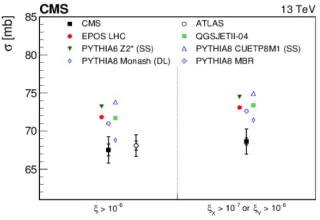
𝜖𝜖𝜉𝜉𝐿𝐿 where Nint is the number of interactions, 𝜖𝜖𝜉𝜉 is the efficiency defined as the fraction of selected stable-particle events that fulfill the detector-level offline selection criteria, and the contamination 𝑏𝑏𝜉𝜉 is the fraction of events selected at detector level that are not part of the considered stable-particle phase space domain. The CMS experimental results are reported in Fig. 1 for two different phase space domains, compared to ATLAS results and many Monte Carlo predictions.
Fig. 1. Proton-proton inelastic cross section at √s=13 TeV in two phase space regions, where 𝜉𝜉=𝑀𝑀2/𝑠𝑠,
compared to different models and to the ATLAS result [2].
An inelastic cross section of 67.5 ± 0.8 (syst) ± 1.6 (lumi) mb is obtained for 𝜉𝜉=𝑀𝑀2/𝑠𝑠 > 10-6 (corresponding to M > 13 GeV), with M the larger of Mx and My. This result
is consistent with a previous measurement in the same phase space. In addition, an inelastic cross section of 68.6 ± 0.5 (syst) ± 1.6 (lumi) mb is obtained in the enlarged phase space 𝜉𝜉x
> 10-7 and/or 𝜉𝜉 > 10-6 (corresponding to Mx > 4.1 GeV and/or My > 13 GeV). The measured
between the two sets of measurements is dominated by the contribution from low-mass diffractive processes, the data-model discrepancies observed here suggest a theoretical underestimation of the cross section for such events.
1.2 Measurement of charged particle spectra in minimum-bias events from proton–proton collisions at √s=13 TeV
Particle production without any selection bias arising from the requirement of the presence of a hard scattering process is known as minimum bias (MB). The bulk of these events occur at low momentum exchanges between the interacting partons inside the hadrons, where diffractive scattering or multiple partonic interactions (MPI) play a significant role.
One can characterize MB events by means of charged particle distributions. Charged particle distributions are measured for charged particles with pT > 0.5 GeV and |η| < 2.4 for
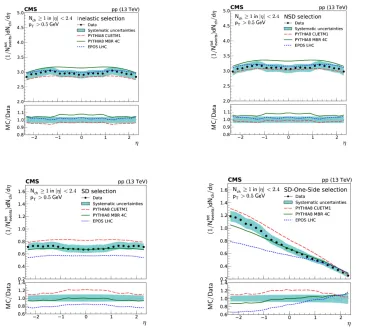
events collected with the CMS MB trigger. The measured distributions are presented for different event data samples based on the calorimeter activity in the forward region by requiring the presence of at least one tower with energy above 5 GeV in the acceptance region 3 < |η| < 5, and in some cases with a veto condition for towers less than a given threshold value. The different event classes are as non-single diffractive enriched sample (NSD-enhanced) when there is calorimeter activity in both sides, as single diffractive enriched (SD-enhanced) when there is calorimeter activity on one side and a veto on the opposite side, and as inelastic when there is calorimeter activity on at least one side of CMS. The distribution labelled as SD-One-Side enhanced sample corresponds to the symmetrized distribution constructed from the SD-minus and SD-plus enhanced samples.
The normalized particle distribution is measured as a function of the charged particle pseudorapidity for the three different selections (see Fig. 2). The results are unfolded to particle level. PYTHIA8 CUETM1, PYTHIA8 MBR 4C and EPOS LHC results are compared to the data. PYTHIA8 MBR 4C describes reasonably well the data for the SD-enhanced samples, but overestimates the yield in central pseudorapidities for the diffractive samples. PYTHIA8 CUETM1 and EPOS LHC give a fair description for the non-diffractive samples, but they are off w.r.t. data for the SD-enhanced selection.
1.3 Femtoscopic Bose-Einstein Correlations of charged hadrons in proton-proton collisions at √s=13 TeV
Femtoscopic Bose-Einstein correlations (BEC) can be used to probe the size and shape of the particle emitting region in high energy collisions. These femtoscopic techniques are employed to characterize the emission region at the freeze-out stage of the evolving system. Three analysis methods, each with a different dependence on MC simulations, were used to generate correlation functions. These three methods are Double Ratio (DR) technique, Cluster subtraction (CS) technique and Hybrid Cluster Subtraction (HCS) technique. The value of length of homogeneity Rinv and correlation intensity 𝜆𝜆 obtained with each of three
Fig. 2. Normalized differential charged particle multiplicity distributions as a function of pseudorapidity for the different sample selections. The error band represents the total systematic uncertainty [3].
value with increasing <𝑁𝑁𝑡𝑡𝑡𝑡𝑡𝑡𝑡𝑡𝑡𝑡𝑠𝑠>. The lengths of homogeneity tend to decrease when increasing 𝑘𝑘𝑇𝑇, more so at lower multiplicity. This behaviour is compatible with an emitting source that was expanding prior to decoupling. The correlation intensity λ also decreases with increasing values of 𝑘𝑘𝑇𝑇, with a more pronounced slope than that for 𝑅𝑅𝑜𝑜𝑜𝑜𝑖𝑖.
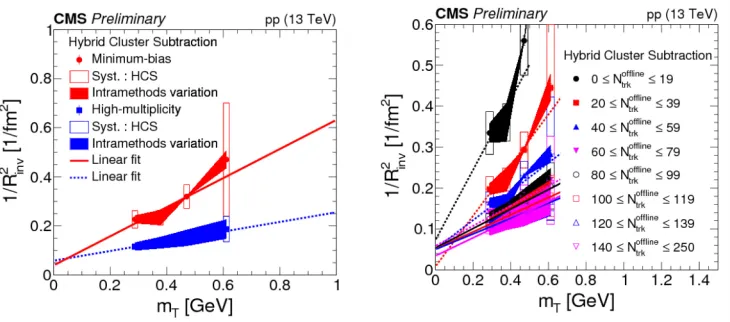
Finally, in hydrodynamic models, valuable information about the collective transverse expansion of the system (transverse flow) can be obtained from the slope of a linear fit to
1/𝑅𝑅𝑜𝑜𝑜𝑜𝑖𝑖2 versus the transverse mass, 𝑚𝑚𝑇𝑇= �𝑚𝑚𝜋𝜋2+ <𝑘𝑘𝑇𝑇 >2 (where 𝑚𝑚𝜋𝜋 is the pion mass). In addition, the value of 1/𝑅𝑅𝑜𝑜𝑜𝑜𝑖𝑖2 at 𝑚𝑚𝑇𝑇= 0 reflects the final-state geometrical size of the source. Fig. 4 shows 1/𝑅𝑅𝑜𝑜𝑜𝑜𝑖𝑖2 versus 𝑚𝑚𝑇𝑇 for a variety of multiplicity ranges. The left plot shows that the expansion in the low multiplicity region is faster than in the high multiplicity region. The corresponding geometrical sizes are 𝑅𝑅𝐺𝐺𝑀𝑀𝑀𝑀= 5.1 ± 0.4 (𝑠𝑠𝑠𝑠𝑠𝑠𝑠𝑠. ) fm and 𝑅𝑅𝐺𝐺𝐻𝐻𝑀𝑀= 4,2 ±
additional constrains for future attempts using hydrodynamical models and/or the CGC framework to explain the entire range of similarities between high multiplicity pp and heavy ion interactions.
Fig. 3. Results for 𝑅𝑅𝑜𝑜𝑜𝑜𝑖𝑖as a function of multiplicity and 𝑘𝑘𝑇𝑇. In the left plot, statistical and systematical uncertainties are represented by internal and external error bars, respectively. In the right plot, statistical and systematic uncertainties are shown as error bars and open boxes, respectively [4].
Fig. 4. 1/𝑅𝑅𝑜𝑜𝑜𝑜𝑖𝑖2 as a function of 𝑚𝑚𝑇𝑇= �𝑚𝑚𝜋𝜋2+ <𝑘𝑘𝑇𝑇>2 for the HCS method. The MB range corresponds to 0 ≤ 𝑁𝑁𝑡𝑡𝑡𝑡𝑡𝑡𝑜𝑜𝑜𝑜𝑜𝑜𝑜𝑜𝑜𝑜𝑜𝑜𝑜𝑜≤79 and the HM one, to 80 ≤ 𝑁𝑁𝑡𝑡𝑡𝑡𝑡𝑡𝑜𝑜𝑜𝑜𝑜𝑜𝑜𝑜𝑜𝑜𝑜𝑜𝑜𝑜≤250. Statistical uncertainties are represented by error bars, systematic uncertainties related to the HCS method are shown as open boxes and the relative uncertainties from the intramethods variation are represented by the shaded bands. Only statistical uncertainties are considered in all the fits [4].
1.4 Measurement of light-by-light scattering in ultraperipheral PbPb collisions at √sNN = 5.02 TeV
A measurement of light-by-light scattering (LbL), 𝛾𝛾𝛾𝛾 → 𝛾𝛾𝛾𝛾, in ultraperipeheral PbPb collisions at √𝑠𝑠= 5.02 TeV. Diphotons are required to have transverse energy 𝐸𝐸𝑇𝑇𝛾𝛾> 2 GeV, pseudorapidity �𝜂𝜂𝛾𝛾�< 2.4, invariant mass 𝑚𝑚𝛾𝛾𝛾𝛾 > 5 GeV, transverse momentum 𝑝𝑝
GeV, and acoplanarity 𝐴𝐴𝜙𝜙=�1−𝛥𝛥𝜙𝜙 𝛾𝛾𝛾𝛾
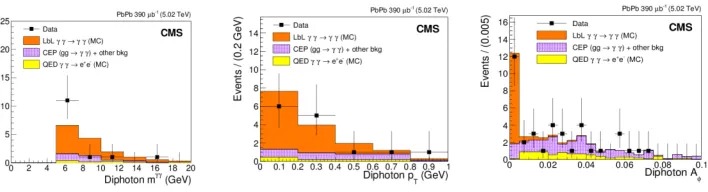
𝜋𝜋 �< 0.01. Only 14 LbL events are observed after all selection criteria applied. MADGRAPH v5 Monte Carlo (MC) event generator including the modifications given in [11,12] is used to generate the LbL signal. Fig. 5 shows the comparison of the simulated and measured distributions of diphoton invariant mass 𝑚𝑚𝛾𝛾𝛾𝛾, diphoton transverse momentum 𝑝𝑝𝑇𝑇, and the diphoton acoplanarity 𝐴𝐴𝜙𝜙. Measured yields as well as kinematic distributions are found to be in good agreement with the combination of the LbL scattering signal plus QED 𝑒𝑒+𝑒𝑒− and CEP+other background expectations. Evidence of LbL scattering is observed with a signal significance of 4.1 standard deviation (4.4 standard deviations expected). Cross section of the measured fiducial LbL scattering,
𝜎𝜎𝑜𝑜𝑜𝑜𝑓𝑓(𝛾𝛾𝛾𝛾 → 𝛾𝛾𝛾𝛾) = 120 ± 46 (𝑠𝑠𝑠𝑠𝑠𝑠𝑠𝑠) ± 28 (𝑠𝑠𝑠𝑠𝑠𝑠𝑠𝑠) ± 4 (𝑠𝑠ℎ𝑒𝑒𝑒𝑒) nb, is found to be consistent with the standard model prediction.
Fig. 5. Distributions of diphoton invariant mass 𝑚𝑚𝛾𝛾𝛾𝛾(left), transverse momentum 𝑝𝑝
𝑇𝑇 (middle), and acoplanarity 𝐴𝐴𝜙𝜙(right) [5].
1.5 Exclusive ρ(770)0 photoproduction in ultra-peripheral pPb collisions
at √sNN=5.02 TeV with the CMS experiment
A first measurement of exclusive 𝜌𝜌(770)𝑜𝑜 photoproduction, 𝛾𝛾𝑝𝑝 → 𝜌𝜌(770)𝜊𝜊𝑝𝑝, in ultra-peripheral pPb collisions at √𝑠𝑠𝑁𝑁𝑁𝑁= 5.02 TeV has been performed with the CMS experiment. In this analysis, the cross section of exclusive photoproduction of 𝜌𝜌(770)𝑜𝑜 meson in the 𝜋𝜋+𝜋𝜋−decay channel is measured as a function of the photon-photon centre-of-mass energy (𝑊𝑊𝛾𝛾𝛾𝛾) and the squared four-momentum transfer at the proton vertex (|𝑠𝑠|≈ 𝑝𝑝𝑇𝑇2). In order to simulate exclusive 𝜌𝜌(770)𝜊𝜊 → 𝜋𝜋+𝜋𝜋−photoproduction decay, the STARLIGHT (version 2.2.0) MC event generator is utilized. Exclusive 𝜌𝜌(770)𝜊𝜊 photoproduction cross section as a function of 𝑊𝑊𝛾𝛾𝛾𝛾 and |𝑠𝑠| in the rapidity interval 1.2 < 𝑠𝑠𝜋𝜋+𝜋𝜋−< 0 is shown in Fig. 6. The results are compared to fixed target and HERA (H1 and ZEUS) experiments. Both CMS data and the earlier ones show a good agreement with the theoretically inspired fits.
1.6 Underlying Event Measurements
Fig. 5. Differential cross section for exclusive 𝜌𝜌(770)𝜊𝜊 photoproduction as a function of 𝑊𝑊
𝛾𝛾𝛾𝛾 (left) and
|𝑠𝑠| in the rapidity interval 1.2 < 𝑠𝑠𝜋𝜋+𝜋𝜋−< 0 (right) [6].
Fig. 6 shows the azimuthal plane region segmentations once the leading object is identified and defining |𝛥𝛥𝛥𝛥| as the relative azimuthal distance between a charged particle and the leading object:
• Towards: |𝛥𝛥𝛥𝛥| < 60o
• Transverse: 60o < |𝛥𝛥𝛥𝛥| < 120o • Away: |𝛥𝛥𝛥𝛥| > 120o
Two kinds of analyses done within the CMS Collaboration are presented and the main difference between the two is the choice of the leading object.
Fig. 6. The azimuthal plane sections in the UE studies. The different regions are identified starting from the identification of the leading object of the event.
1.6.1 Study of the underlying event in top quark pair production at 13 TeV
efficiency and small contamination from objects not associated with t quark decays, e.g., jets from ISR.
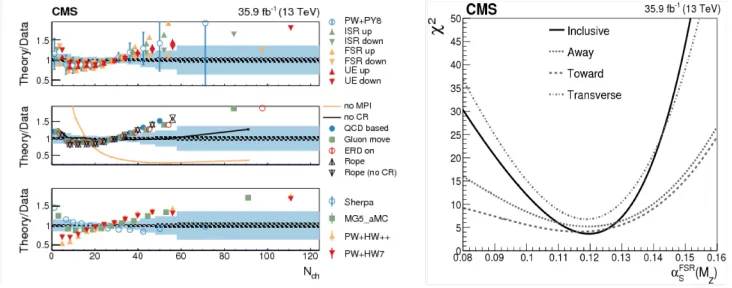
Various characteristics, such as the multiplicity of the selected charged particles, the flux of momentum, and the topology or shape of the event have different sensitivity to the modeling of the recoil, the contribution from MPI and CR, and other parameters, and hence used to characterize UE activity. Fig. 7 (left) shows the normalized differential cross section measured as function of Nch. The majority of the distributions analyzed indicate a fair
agreement between the data and the POWHEG + PYTHIA8 setup with the CUETP8M2T4 tune, but disfavour the setups in which MPI and CR are switched off, or in which 𝛼𝛼𝑠𝑠𝐹𝐹𝐹𝐹𝐹𝐹 (𝑀𝑀
𝑍𝑍) is increased. The data also disfavour the default configurations in HERWIG++, HERWIG7, and SHERPA. It has been furthermore verified that, as expected, the choice of the next-to-leading order matrix-element generator does not impact significantly the expected characteristics of the UE by comparing predictions from POWHEG and MADGRAPH5_aMC@NLO, both interfaced with PYTHIA8. The sensitivity of these results to the choice of 𝛼𝛼𝑠𝑠𝐹𝐹𝐹𝐹𝐹𝐹(𝑀𝑀𝑍𝑍) in the parton shower is tested by performing a scan of the 𝜒𝜒2 value as a function of 𝛼𝛼𝑠𝑠𝐼𝐼𝐹𝐹𝐹𝐹(𝑀𝑀
𝑍𝑍) or 𝛼𝛼𝑠𝑠𝐹𝐹𝐹𝐹𝐹𝐹(𝑀𝑀𝑍𝑍) as shown in Fig. 7 (right). A value of 𝛼𝛼𝑠𝑠𝐹𝐹𝐹𝐹𝐹𝐹(𝑀𝑀𝑍𝑍) =
0.120 ± 0.006 is obtained, which is lower than the one assumed in the Monash tune and used in the CUETP8M2T4 tune. The new CMS default tune CP5 uses 𝛼𝛼𝑠𝑠𝐹𝐹𝐹𝐹𝐹𝐹(𝑀𝑀𝑍𝑍) = 𝛼𝛼𝑠𝑠𝐼𝐼𝐹𝐹𝐹𝐹(𝑀𝑀𝑍𝑍) = 0.118 [13].
Fig. 7. The normalized differential cross section as a function of Nch compared to predictions of
different models (left), scan of the 𝜒𝜒2 as a function of the value of 𝛼𝛼𝑠𝑠𝐹𝐹𝐹𝐹𝐹𝐹 (𝑀𝑀𝑍𝑍) employed in PW+P8 simulation [7].
1.6.2 Measurement of the underlying event activity in inclusive Z boson production in proton-proton collisions at at √s=13 TeV
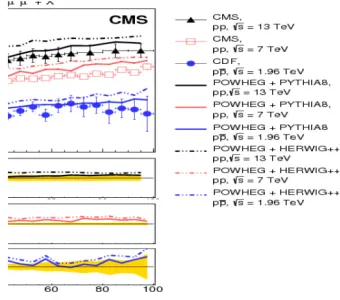
simulation in transverse region. POWHEG + HERWIG++ with tune EE5C overestimates UE activity by 10-15% in all regions, POWHEG + PYTHIA8 with CUETP8M1 tune describes the data within 5%, whereas MADGRAPH + PYTHIA8 with CUETP8M1 tune gives the best description. Fig. 8 (right) shows the UE activity as a function of 𝑝𝑝𝑇𝑇𝜇𝜇𝜇𝜇 at the centre-of-mass energy of 1.96, 7 and 13 TeV in transverse region. POWHEG + HERWIG++ overestimates data by 40% at 1.96 TeV and upto 10% at 13 TeV, whereas POWHEG + PYTHIA8 describes data within 10% at 1.96 TeV to 5% at 13 TeV.
Fig. 7. Comparison of UE activity measured at √𝑠𝑠= 13 TeV compared with several MC predictions (left) and Comparison of UE activity measured at √𝑠𝑠= 13 TeV with the measurements at 7 TeV [14] and 1.96 TeV [15], by the CMS and CDF experiments for particle density in the transverse region as a function of 𝑝𝑝𝑇𝑇𝜇𝜇𝜇𝜇 [8].
1.6 Double Parton Scattering Measurements
The study of DPS processes provides valuable information on the transverse distribution of partons in the proton and on the parton correlations in the hadronic wave function. Study of the same-sign WW production via DPS, from p-p collisions at √𝑠𝑠= 8 and 13 TeV at integrated luminosity of 19.7 fb-1 and 35.9 fb-1 respectively. The study is performed using
same-sign W boson pair final state, with each boson decaying leptonically. In order to enhance the sensitivity, the 𝜇𝜇±𝜇𝜇± final state is combined with the 𝑒𝑒±𝜇𝜇± channel. A
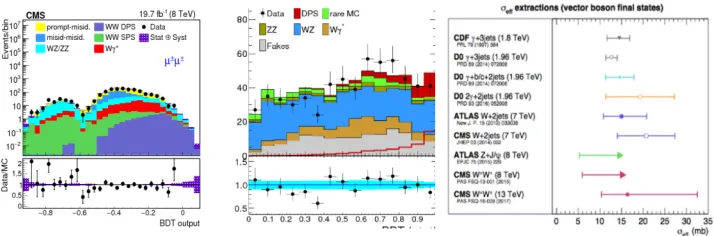
multivariate analysis has been performed in order to enhance the signal sensitivity; a limit on the DPS yield, along with corresponding 𝜎𝜎𝑜𝑜𝑜𝑜𝑜𝑜, has been estimated. Figure 8 shows the distribution of the BDT classifier in 𝜇𝜇±𝜇𝜇± channel at 8 (left) and 13 TeV (middle)
respectively. At 8 TeV, although no direct measurements of DPS yield are made with current statistics, exclusion limit on DPS signal strength was set. BDT response shape gives the limit estimation, excluding at 95% CLs a signal strength r > 1.897 (28 DPS events), with an expected exclusion of r > 2.01 (30 DPS events), which means an upper limit on 𝜎𝜎𝑊𝑊𝑊𝑊𝐷𝐷𝐷𝐷𝐹𝐹< 1.12 pb at 95% of confidence level. Considering the two scattering to be independent and no correlation between interacting partons, the lower limit on 𝜎𝜎𝑜𝑜𝑜𝑜𝑜𝑜 can be written as, 𝜎𝜎𝑜𝑜𝑜𝑜𝑜𝑜 >
5.91 mb. At 13 TeV, the expected cross section and significance from PYTHIA8 was 1.64 pb and 3.27𝜎𝜎 respectively, but the measured cross section is below the expected value at
effective cross section including final stated with photons, vector bososns and jets are summarized in Fig. 8 (right).
Fig. 7. Final BDT classifier output with all background estimations in place for 𝜇𝜇±𝜇𝜇± channel at 8
(left) [9] and 13 TeV (middle) [10], Right: comparison of extracted 𝜎𝜎𝑜𝑜𝑜𝑜𝑜𝑜 using various processes at the previous experiments and CMS measurements [10].
References
1. CMS Collaboration, JINST 3 S8004 (2008)
2. CMS Collaboration, JHEP 07 (2018) 161, doi: 10.1007/JHEP07(2018)161
3. CMS Collaboration, Eur. Phys. J. C (2018) 78: 697, doi: 10.1140/epjc/s10052-018-6144-y
4. CMS Collaboration, CMS-PAS-FSQ-15-009 (2018). http://cds.cern.ch/record/2318575 5. CMS Collaboration, CMS-FSQ-16-012, CERN-EP-2018-271, Submitted to Phys. Lett.
B. (2018). [arXiv:1810.04602]
6. CMS Collaboration, CMS-PAS-FSQ-16-007 (2018). http://cds.cern.ch/record/2636688 7. CMS Collaboration, CMS-TOP-17-015, CERN-EP-2018-271, Submitted to EPJC.
(2018). [arXiv:1807.02810v1]
8. CMS Collaboration, JHEP 07 (2018) 032, doi: 10.1007/JHEP07(2018)032 9. CMS Collaboration, JHEP 02 (2018) 032, doi: 10.1007/JHEP02(2018)032
10. CMS Collaboration, CMS-PAS-FSQ-16-009 (2018). https://cds.cern.ch/record/2257583 11. D. d’Enterria and G. G. da Silveira, Phys. Rev. Lett. 111 (2013) 080405, doi:
10.1103/PhysRevLett.111.080405 [Erratum: doi: 10.1103/PhysRevLett.116.129901] 12. D. d’Enterria and J.-P. Lansberg, Phys. Rev. D 81 (2010) 014004, doi:
10.1103/PhysRevD.81.014004
13. CMS Collaboration, CMS-PAS-GEN-17-001 (2018). http://cds.cern.ch/record/2636284 14. CMS Collaboration, Eur. Phys. J. C (2012) 72: 2080, doi:
10.1140/epjc/s10052-012-2080-4