Clinical Ophthalmology
Transition to a novel advanced integrated
vitrectomy platform: comparison of the surgical
impact of moving from the Accurus vitrectomy
platform to the Constellation Vision System
for microincisional vitrectomy surgery
Timothy G Murray1,2
Andrew J Layton3
Kuo B Tong3
Michael Gittelman2
Azeema Latiff1,2
Daniel Gologorsky 2
Michael M Vigoda2
1Murray Ocular Oncology and
Retina, Miami, FL, USA; 2Bascom
Palmer Eye Institute, Anne Bates Leach Eye Hospital, Departments of Ophthalmology, Anesthesiology and Radiation Oncology, University of Miami Miller School of Medicine, Miami, FL, USA; 3Quorum Consulting,
San Francisco, CA, USA
Correspondence: Timothy G Murray Murray Ocular Oncology and Retina, 6705 Red Road, Suite 412, Miami, FL 33143, USA
Tel +1 305 487 7470 Fax +1 786 567 4380 Email [email protected]
Background: Microincisional vitrectomy surgery (MIVS) is the current standard surgical
approach for pars plana vitrectomy. Historically, the most common surgical platform for vitrec-tomy surgery, since its introduction in 1997, has been the Accurus vitrecvitrec-tomy system. Recent introduction of the next generation of vitrectomy platforms has generated concerns associated with transitioning to new technology in the operating room environment. This study compared, in a matched fashion, surgical use of the Accurus vitrectomy system and the next generation Constellation Vision System to evaluate surgical efficiencies, complications, and user percep-tions of this transition.
Methods: Electronic health records were abstracted as a hospital quality assurance activity and
included all vitreoretinal surgical procedures at the Bascom Palmer Eye Institute, Anne Bates Leach Eye Hospital, during two discrete 12-month time periods. These two periods reflected dedicated usage of the Accurus (June 2008–May 2009) and Constellation Vision (July 2009– June 2010) systems. Data were limited to a single surgeon and evaluated for operating room (OR) total time usage/day, OR case time/case, and OR surgical time/case. Further analysis evaluated all patients undergoing combined MIVS and clear cornea phacoemulsification/intraocular lens (IOL) implantation during each individual time period to determine the impact of the instrumentation on these parameters. All records were evaluated for intraoperative complications.
Results: Five hundred and fourteen eligible patients underwent MIVS during the 2-year study
windows, with 281 patients undergoing surgery with the Accurus system and 233 patients under-going surgery with the Constellation system. Combined MIVS and phacoemulsification with IOL implantation was performed 141 times during this period with the Accurus and 158 times during the second study period with the Constellation. Total number of patients operated per day increased from 7.55 with Accurus to 8.53 with Constellation. Surgical room time decreased from 56 minutes with Accurus to 52 minutes with Constellation, and procedure time decreased
from 35 minutes with Accurus to 31 minutes with Constellation (P , 0.004). Combined MIVS/
phacoemulsification surgery saw similar declines in surgical room time and procedure time
(P , 0.001). Subset analysis of procedures limited by case number per day (eg, four cases/day,
five cases/day, six cases/day, and seven or more cases/day) showed similar outcomes with a decrease in surgical room time and procedure time. No increases in surgery-related complica-tions were noted by quality assurance review during these time periods.
Discussion: Transitioning to advanced surgical technology is a complex issue for the surgeon,
the hospital team, and the hospital administration. This study documents improvement in three
Dove
press
O R I G I n A L R E S E A R C H
open access to scientific and medical research
Open Access Full Text Article
Clinical Ophthalmology downloaded from https://www.dovepress.com/ by 118.70.13.36 on 21-Aug-2020
For personal use only.
Number of times this article has been viewed
This article was published in the following Dove Press journal: Clinical Ophthalmology
significant measures of surgical efficiency: operative number of patients per day, operative room time, and surgical procedure time that reflect the positive impact of the novel, combined, integrated, posterior and anterior, ophthalmologic surgical platform of the Constel-lation Vision System. These data are imperative to evaluate the impact of transition from one surgical platform to another. During this transition, hospital quality assurance review and surgeon evaluation of operative complications showed no increased concerns for the shift from the Accurus to the Constellation Vision System surgical platform. Further, both operative staff and surgeons felt that the transition to the Constellation was not associated with increases in difficulty with setup, turnover, or use and that the Constellation decreased safety concerns for surgical usage. Ultimately, in this case, new technology benefited the surgeon, the patient, and the hospital.
Keywords: MIVS, vitrectomy, new technology
Rapid advances in surgical technology have occurred since the first automated vitrectomy was performed by Machemer in 1971.1,2 From 1971 until 2012, instruments have moved
from separate systems for vitrectomy cutting, illumination, air/fluid exchange, silicone oil injection, automated scissors/ forceps, and operative laser photocoagulation toward inte-grated platforms that include multiple technologies.3–5
A major advance in technology occurred with the intro-duction of the Accurus-integrated platform in 1997 (Alcon Surgical, Fort Worth, TX, USA). This platform achieved enhanced vitrectomy cutter performance, improved surgical fluidics, automated silicone oil infusion, and incorporated a posterior segment fragmatome and an anterior segment phacoemulsification capability. The Accurus platform rapidly became the standard within the United States and internationally.
By 2008 the Accurus platform was present in over 90% of ophthalmologic operating rooms in the United States, including both hospital and ambulatory care surgical centers. The Accurus platform was characterized by an advanced cut-ter design, increased cutting rates to 2500 cuts per minute, gas-forced fluid infusion, dual halogen light sources, and software parameters that were established to maximize cutter efficiency at very high cut rates.
At the Bascom Palmer Eye Institute, Anne Bates Leach Eye Hospital (BPEI/ABLEH), the Accurus platform became the standard vitrectomy console from 1997 to 2008. The Vitreoretinal Surgical Service at the BPEI had extensive interest in improving surgical platforms and techniques for vitreoretinal surgery and actively pursued evaluation and acquisition of the next generation vitrectomy platform.
The Constellation Vision System (Alcon Surgical) was defined by a marked advance in cutter probe design specifi-cally for micro-incisional vitrectomy surgery (MIVS), incor-porating 23- and 25-gauge vitrectomy, markedly increased cutting rates to 5000 cuts per minute (enabled by elimination of spring technology to re-open the cutter after closure); integrated quadruple xenon light sources; had radiofrequency identification (RFID) recognition technology for identifying
the cutter, light pipe, and endolaser probes; improved cassette design to eliminate loss of infusion fluidics; integrated a 532 nm solid state disc laser; and had torsional anterior seg-ment phacoemulsification.
This next generation platform addressed many concerns for instrument limitation and fluidic compromise associated with very high cut rates, while incorporating features that had previously required independent stand-alone systems for use in complex vitrectomy surgery. Further, specific attention was given to the enhanced safety features and targeted platform improvements that were designed to increase operating room efficiency while improving patient safety; these were attractive to our hospital teams and hospital administration.
Prior to evaluation in this study, a transition period was established to educate our hospital teams, place the Constel-lation, establish a disposable supply support, and assist our vitreoretinal surgeons. This transition period utilized heavy educational support from the Alcon surgical support team and from in-house vitreoretinal surgeons aimed at supporting our hospital teams, with strong focus on our OR scrub teams and our OR circulating nursing teams.
This study was a follow-up to a pre-implementation review document that hypothesized reduction in OR turnover times that would enable increased surgical volume per vitreoretinal surgical room per day. In this study we compared two time periods: one in which the Accurus platform was utilized exclusively and one in which the Constellation platform was utilized exclusively. We evaluated a 12-month time period to better minimize potential case mix bias or transition bias and to capture a significant case volume for analysis. Use of the University of Miami electronic health record enabled broad data capture for evaluation of case volume per day, surgical room time per case, and surgical procedure time per case. Data sets were evaluated blinded to the platform utilized for both the Accurus and Constellation Vision System. These data provide a foundation for evaluating the selection of novel surgical sys-tems for the ophthalmic hospital or ambulatory surgical center and delineate the impact of transition for critical technology required for vitrectomy surgery in the 21st century.
Dovepress
Murray et al
Clinical Ophthalmology downloaded from https://www.dovepress.com/ by 118.70.13.36 on 21-Aug-2020
Methods
A data extract from the BPEI/ABLEH electronic health record system, satisfying internal review board requirements, was obtained for all surgeries performed by a single surgeon (TGM) during two time periods established through the hos-pital quality assurance program. The first time period, repre-senting usage of the Accurus platform, was from June 2008 through May 2009. The second time period, representing usage of the Constellation platform, was from July 2009 through June 2010.
The patient’s electronic health records were then matched to BPEI’s billing system to extract the current procedural terminology (CPT) codes for each patient encounter. The two databases were then combined to form one de-identified analytic dataset. The dataset included the following variables: claim number, date of service, CPT codes, attending physi-cian, operating room number, unique patient identifier, patient operating room in-time, surgery start time, surgery end time, patient operating room out-time.
The operative time data was manually entered into the patient electronic health record by the nursing staff on the service date as part of their standard operating procedures. Total room time was calculated by subtracting the in-room time from the out-room time. Total surgery time was calcu-lated by subtracting the surgery start time from the surgery end time. Total surgical day time was calculated from the first time in the OR to the last time in the OR for the entire surgical day.
We eliminated procedures that could not be performed on the two platforms, such as primary scleral buckle, enucle-ation, or examination under anesthesia. To enhance the evalu-ation, we evaluated all surgical dates and then surgical dates with four, five, six, or greater then/equal to seven cases per day. Finally, we eliminated cases that did not include MIVS surgery on the surgical day evaluated, such as primary scleral buckle, enucleation, or examination under anesthesia.
To evaluate the changes in efficiency between the two platforms, we analyzed three metrics: case volume by analyz-ing patient volume per day, patient throughput by analyzanalyz-ing the operating room time, and intra-operative time by analyz-ing procedure time.
A subset analysis was performed on combination MIVS and phacoemulsification surgeries. Combination surgeries were defined as surgeries with both an anterior segment and a posterior segment procedure coded on the same claim.
We evaluated risk management reporting to detect any increase in operative complications, instrument concerns, or reported surgical delays. We did not measure the profitability
or profit margin between the two time periods. Based on the staffing model at BPEI, it was determined that staffing levels and staff hours remained consistent between the two time periods and did not affect any change in throughput efficiency.
Statistical analysis utilized a paired t-test (Student’s paired t-test, SAS v9.3; SAS, Cary, NC, USA). Statistical significance was established as a P-value less than 0.05 for the comparative analysis.
Results
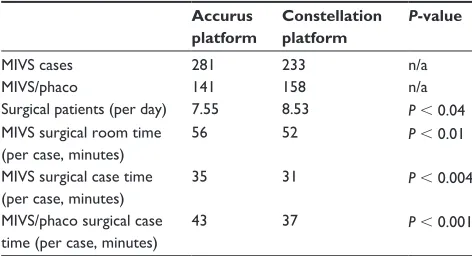
A total of 514 eligible patients identified by evaluation of the surgical electronic health records were included in this analysis. In the first 12-month study period (Accurus surgi-cal system), 281 patients underwent vitrectomy surgery with 141 patients undergoing combined pars plana vitrectomy and phacoemulsification/IOL implantation. In the second 12-month study period (Constellation Vision System), 233 patients underwent vitrectomy surgery with 158 patients undergoing combined pars plana vitrectomy and torsional phacoemulsification/IOL implantation (Table 1).
Evaluation of surgical efficiencies documented an increase from an average of 7.5 cases per day during the Accurus time period to 8.5 cases per day during the Constellation Vision System time period. During these study windows, overall surgical time per day decreased during the Constellation Vision System time period (Table 1).
Operating room case times averaged 58 minutes during the Accurus time period and decreased to 52 minutes during the Constellation Vision System time period. Operating room
Table 1 Overall efficiency review comparing the Accurus to the
Constellation surgical platform
Accurus platform
Constellation platform
P-value
MIVS cases 281 233 n/a
MIVS/phaco 141 158 n/a
Surgical patients (per day) 7.55 8.53 P, 0.04 MIVS surgical room time
(per case, minutes)
56 52 P, 0.01
MIVS surgical case time (per case, minutes)
35 31 P, 0.004
MIVS/phaco surgical case time (per case, minutes)
43 37 P, 0.001
Notes: Statistically significant increase in number of cases per day (surgical patients), decrease in surgical room time, and decrease in surgical procedure time (surgical case time). Combined MIVS and phacoemulsification with IOL implantation showed greatest improvement in time reduction for Constellation compared with Accurus across the entire 2-year cohorts. note sample size of 514 MIVS cases and 299 combined MIVS/phacoemulsification cases accrued over two 1-year windows. Abbreviations: MIVS, microincisional vitrectomy surgery; IOL, intraocular lens; Phaco, phacoemulsification.
Dovepress Transition to a novel advanced integrated vitrectomy platform
Clinical Ophthalmology downloaded from https://www.dovepress.com/ by 118.70.13.36 on 21-Aug-2020
Tab
le 2
Comparison of Accurus and Constellation surgical platforms by procedure time and room time (in minutes) for all cases performed with at least seven cases per day
Surgical volume: seven or more patients per day OR 5 and 6, at least seven patients/day,
±
2 standard deviation from mean room and procedure time
Minimum 15 minute procedure time Equipment
OR num
N claims
N patients
N days
Claims per day Patients per day
Calc room time (H:MM)
Calc procedure time (H:MM)
Min
Median
Max
Mean
Min
Median
Max
Mean
Accurus
5
123
110
29
4.24
3.79
0:27
0:56
1:37
0:57
0:15
0:36
1:18
0:36
6
126
120
29
4.34
4.14
0:30
0:56
1:40
0:58
0:15
0:31
1:14
0:36
All
249
219
29
8.59
7.55
0:27
0:56
1:40
0:58
0:15
0:35
1:18
0:36
Constellation
5
87
84
19
4.58
4.42
0:28
0:48
1:17
0:51
0:15
0:30
0:57
0:31
6
86
85
19
4.53
4.47
0:31
0:53
1:31
0:54
0:15
0:33
1:03
0:34
All
173
162
19
9.11
8.53
0:28
0:52
1:31
0:52
0:15
0:31
1:03
0:32
Notes:
Data
presented
include
number
of
patients,
patients
per
day,
room
time,
and
procedure
time.
Times
are
reported
as
minimum,
median,
maximum,
and
mean
time
for
operating
rooms
5
and
6
and
as
combined
(all).
The
comparison
by case number per day was to evaluate the impact of high surgical numbers per day on overall efficiency in the operating room. Abbreviation:
OR, operating room.
surgical times averaged 36 minutes during the Accurus time period and decreased to 31 minutes during the Constellation Vision System time period (P , 0.004) (Tables 1–5).
Finally, operating room surgical times for combined pars plana vitrectomy and phacoemulsification with IOL implan-tation averaged 43 minutes during the Accurus time period and decreased to 37 minutes during the Constellation Vision System time period (P , 0.001) (Tables 1, 6–9).
Ongoing surgical documentation of intra-operative and postoperative complications noted stable complication pro-files as previously reported.
To determine the potential impact of case volume on efficiency evaluation, we correlated all cases and then inde-pendently evaluated datasets with cutoffs of at least four, five, six, or greater than/equal to seven cases per day. This analysis showed no statistically significant increased effi-ciency but clearly suggested a trend to increased effieffi-ciency with increasing case volume. Clear positive impacts were seen for each case volume noting a benefit even for surgical volumes as low as four cases per day (unreported analysis of a second data set documented improved efficiencies with case volumes averaging approximately two cases per day) (Tables 2–5).
Statistical analysis noted statistically significant improve-ments in efficiencies for operative time with both decreased procedure and room time associated with transition to the Constellation Vision System (P , 0.0004). Additionally, for combined MIVS pars plana vitrectomy and torsional phacoemulsification/IOL implantation, a marked decrease in both procedure and room time were documented (P , 0.0001) (Tables 6–9).
Discussion
Vitreoretinal surgical advances have been rapid since the first automated vitrectomy surgical units were developed four decades ago.6–12 During this period, marked improvements
in instrument design contributed to significant increases in patient safety and improved surgical outcomes. Initially, Machemer and others focused on multifunction single-port instrumentation, but instrument design continuously evolved toward smaller instrument sizes and integrated multiport pars plana vitrectomy surgery.1,13–15
Further modifications, from Machemer’s initial vit-rectomy system1 continued to decrease instrument size,
ultimately achieving a standard instrument approach with 20-gauge instruments placed through the sclera in a three-port pars plana vitrectomy approach whereby one three-port was utilized for infusion, one port for illumination, and one port
Dovepress
Murray et al
Clinical Ophthalmology downloaded from https://www.dovepress.com/ by 118.70.13.36 on 21-Aug-2020
Tab
le 3
Comparison of Accurus and Constellation surgical platforms by procedure time and room time (in minutes) for all cases performed regardless of number of cases per day
Surgical volume: all days OR 5 and 6, all days,
±
2 standard deviations from mean room and procedure time
Minimum 15 minute procedure time Equipment
OR Num
N claims
N patients
N days
Claims per day Patients per day
Calc room time (H:MM)
Calc procedure time (H:MM)
Min Median Max Mean Min Median Max Mean Accurus 5 162 145 47 3.45 3.09 0:27 0:54 1:49 0:57 0:15 0:35 1:21 0:36 6 163 154 47 3.47 3.28 0:30 0:58 1:47 0:59 0:15 0:35 1:19 0:37 All 325 281 49 6.63 5.73 0:27 0:57 1:49 0:58 0:15 0:35 1:21 0:37 Constellation 5 130 121 39 3.33 3.10 0:28 0:52 1:27 0:52 0:15 0:31 1:12 0:33 6 129 127 38 3.39 3.34 0:31 0:53 1:37 0:54 0:15 0:31 1:12 0:33 All 259 233 39 6.64 5.97 0:28 0:53 1:37 0:53 0:15 0:31 1:12 0:33 Notes: Data presented include number of patients, patients per day, room time, and procedure time. Times are reported as minimum, median, maximum, and mean time for operating rooms 5 and 6 and as combined (all). The comparison
by all case number per day was to evaluate the overall impact on efficiency in the operating room. Abbreviation:
OR, operating room.
Tab
le 4
Comparison of Accurus and Constellation surgical platforms by procedure time and room time (in minutes) for all cases performed with at least four cases per day
Surgical volume: at least 4 patients per day OR room 5 and 6, at least 4 patients/day,
±
2 std dev from mean room and procedure time
Minimum 15 minute procedure time Equipment OR room num
N claims
N patients
N days
Claims per day Patients per day
Calc room time (H:MM)
Calc procedure time (H:MM)
Min Median Max Mean Min Median Max Mean Accurus 5 155 139 43 3.60 3.23 0:27 0:54 1:37 0:57 0:15 0:35 1:18 0:36 6 157 149 42 3.74 3.55 0:30 0:58 1:40 0:59 0:15 0:35 1:14 0:36 All 312 270 43 7.26 6.28 0:27 0:56 1:40 0:58 0:15 0:35 1:18 0:36 Constellation 5 133 123 36 3.69 3.42 0:28 0:53 1:56 0:55 0:15 0:31 1:26 0:35 6 128 126 36 3.56 3.50 0:31 0:54 1:49 0:56 0:15 0:33 1:28 0:35 All 261 236 36 7.25 6.56 0:28 0:53 1:56 0:55 0:15 0:32 1:28 0:35 Notes: Data presented include number of patients, patients per day, room time, and procedure time. Times are reported as minimum, median, maximum, and mean time for operating rooms 5 and 6 and as combined (all). The comparison
by case number per day was to evaluate the impact of lower surgical numbers per day on overall efficiency in the operating room. Abbreviation:
OR, operating room.
Dovepress Transition to a novel advanced integrated vitrectomy platform
Clinical Ophthalmology downloaded from https://www.dovepress.com/ by 118.70.13.36 on 21-Aug-2020
Tab
le 5
Comparison of Accurus and Constellation surgical platforms by procedure time and room time (in minutes) for all cases
Accurus versus Constellation Vision System: room time and procedure time (minutes) t-test procedure Variable
Equipment
N
Lower CL mean
Mean
Upper CL mean Lower CL Std dev
Std dev
Upper CL Std dev
Std err
Min
Max
Statistics Procedure time minutes
Accurus
249
34.148
35.916
37.683
13.019
14.163
15.53
0.8976
15
78
Procedure time minutes
Constellation
173
30.727
32.422
34.117
10.216
11.294
12.628
0.8586
15
63
Procedure time minutes
Diff (1–2)
0.952
3.4937
6.0354
12.238
13.064
14.012
1.2931
Room time minutes
Accurus
249
55.664
57.783
59.902
15.604
16.975
18.613
1.0758
27
100
Room time minutes
Constellation
173
50.371
52.341
54.311
11.873
13.126
14.676
0.9979
28
91
Room time minutes
Diff (1–2)
2.4237
5.4421
8.4605
14.533
15.515
16.64
1.5356
Variable
Method
Variances
DF
t
-value
Pr
.
|t|
t
-tests Procedure time minutes
Pooled
Equal
420
2.70
0.0072
Procedure time minutes
Satterthwaite
Unequal
412
2.81
0.0051
Room time minutes
Pooled
Equal
420
3.54
0.0004
Room time minutes
Satterthwaite
Unequal
415
3.71
0.0002
Variable
Method
Num DF
Den DF
F value
Pr
.
F
Equality of variances Procedure time minutes
Folded F
248
172
1.57
0.0016
Room time minutes
Folded F
248
172
1.67
0.0003
Notes:
Statistical
evaluation
using
Student’s
t
-test
with
evaluation
of
equality
of
variance.
Note
Constellation
procedure
and
room
times
both
show
a
statistically
significant
reduction
with
an
average
reduction
of
approximately
5
minutes
(
P
,
0.007 and
P
,
0.0004) per procedure and per case.
Abbreviations:
CL, confidence level; std dev, standard deviation; std err, standard error; Pr, probability.
Dovepress
Murray et al
Clinical Ophthalmology downloaded from https://www.dovepress.com/ by 118.70.13.36 on 21-Aug-2020
Tab le 6 Comparison of Accurus and Constellation surgical platforms for combined microincisional vitrectomy surgery with phacoemulsification and IOL implantation for all cases
performed with at least seven cases per day Murray combined surgery: subset of at least 7 patients per day Murray combined surgery summary Anterior: 66820–66986 Posterior: 67015–67113, not 67028 and 67107 OR room 5 and 6, at least 7 patients/day,
±
2 std dev from mean room and procedure time
Minimum 15 minute procedure time Equipment OR room num
N claims
N patients
N days
Claims per day Patients per day
Calc room time (H:MM)
Calc procedure time (H:MM)
Min Median Max Mean Min Median Max Mean Accurus 5 60 59 29 2.07 2.03 0:47 1:06 1:32 1:06 0:24 0:42 1:01 0:43 6 52 51 28 1.86 1.82 0:37 1:09 1:40 1:09 0:26 0:43 1:14 0:44 All 112 108 29 3.86 3.72 0:37 1:07 1:40 1:07 0:24 0:43 1:14 0:43 Constellation 5 57 56 18 3.17 3.11 0:36 0:56 1:17 0:56 0:23 0:35 0:57 0:36 6 62 62 19 3.26 3.26 0:37 0:56 1:31 0:58 0:20 0:38 1:00 0:37 All 119 114 19 6.26 6.00 0:36 0:56 1:31 0:57 0:20 0:35 1:00 0:37 Notes: Data presented include number of patients, patients per day, room time, and procedure time. Times are reported as minimum, median, maximum, and mean time for operating rooms 5 and 6 and as combined (all). The comparison
by case number per day was to evaluate the impact of higher surgical numbers per day on overall efficiency in the operating room. Abbreviations:
OR, Operating room; IOL, intraocular lens.
Tab le 7 Comparison of Accurus and Constellation surgical platforms for combined microincisional vitrectomy surgery with phacoemulsification and IOL implantation for all cases
performed Combined surgery summary: all days OR room 5 and 6, all patients/day,
±
2 std dev from mean room and procedure time
Minimum 15 minute procedure time Equipment OR room num
N claims
N patients
N days
Claims per day Patients per day
Calc room time (H:MM)
Calc procedure time (H:MM)
Min Median Max Mean Min Median Max Mean Accurus 5 74 73 40 1.85 1.83 0:46 1:06 1:49 1:06 0:24 0:42 1:15 0:43 6 71 70 40 1.78 1.75 0:37 1:09 1:40 1:09 0:26 0:45 1:14 0:45 All 145 141 44 3.30 3.20 0:37 1:07 1:49 1:07 0:24 0:44 1:15 0:44 Constellation 5 80 78 34 2.35 2.29 0:36 0:58 1:23 0:58 0:20 0:35 1:02 0:37 6 86 86 34 2.53 2.53 0:37 0:56 1:32 0:58 0:20 0:36 1:00 0:37 All 166 158 37 4.49 4.27 0:36 0:57 1:32 0:58 0:20 0:35 1:02 0:37 Notes: Data presented include number of patients, patients per day, room time, and procedure time. Times are reported as minimum, median, maximum, and mean time for operating rooms 5 and 6 and as combined (all). The comparison
by all cases per day was to eliminate selection bias on evaluation of operating room efficiency. Abbreviations:
OR, Operating room; IOL, intraocular lens.
Dovepress Transition to a novel advanced integrated vitrectomy platform
Clinical Ophthalmology downloaded from https://www.dovepress.com/ by 118.70.13.36 on 21-Aug-2020
Tab
le
8
Compar
ison
of
Accurus
and
Constellation
surgical
platforms
for
combined
microincisional
vitrectomy
surgery
with
phacoemulsification
and
IOL
implantation
for
all
cases
performed with at least four cases per day Combined surgery summary: at least 4 patients per day OR room 5 and 6, at least 4 patients/day,
±
2 std dev from mean room and procedure time
Minimum 15 minute procedure time Equipment OR room num
N claims
N patients
N days
Claims per day Patients per day
Calc room time (H:MM)
Calc procedure time (H:MM)
Min
Median
Max
Mean
Min
Median
Max
Mean
Accurus
5
71
70
38
1.87
1.84
0:46
1:06
1:32
1:05
0:24
0:42
1:01
0:43
6
69
68
38
1.82
1.79
0:37
1:09
1:40
1:08
0:26
0:45
1:14
0:45
All
140
136
41
3.41
3.32
0:37
1:07
1:40
1:07
0:24
0:44
1:14
0:44
Constellation
5
80
78
34
2.35
2.29
0:36
0:58
1:56
0:58
0:20
0:35
1:19
0:37
6
86
86
34
2.53
2.53
0:37
0:56
1:45
0:59
0:20
0:36
1:00
0:37
All
166
157
36
4.61
4.36
0:36
0:57
1:56
0:58
0:20
0:35
1:19
0:37
Notes:
Data
presented
include
number
of
patients,
patients
per
day,
room
time,
and
procedure
time.
Times
are
reported
as
minimum,
median,
maximum,
and
mean
time
for
operating
rooms
5
and
6
and
as
combined
(all).
The
comparison
by case number per day was to evaluate the impact of lower surgical numbers per day on overall efficiency in the operating room. Abbreviations:
OR, Operating room; IOL, intraocular lens.
for the cutter/forceps/scissors. Seeking smaller wounds, more rapid wound healing, and elimination of transscleral repeti-tive instrument passage led to smaller gauge instruments that incorporated transconjunctival/transscleral trocars focused on 23-gauge and 25-gauge surgical instruments.16–20 This MIVS
approach has rapidly become the current standard with a transition from 20-gauge sutured sclerotomies to 23-gauge and 25-gauge trocared instrument approaches not requiring suture closure. Currently, 27-gauge (and smaller) instruments are available and in design.
A major impetus for the development of a novel, advanced, integrated platform design has been the surgical requirements of increased cutting rates, improved intraocular fluidics, enhanced lighting, and deliverable endolaser. This shift to small gauge surgery, along with the interest in an integrated platform, necessitated the design and development of a novel next-generation surgical platform. This ideal platform would incorporate very high speed cutting, stable real-time evalua-tion of intraocular fluidics, markedly improved illuminaevalua-tion sources, capacity for delivery of high centistoke liquids, microvolume deliveries, and integrated laser technology.21–37
These characteristics define the minimal surgical requirements for an integrated platform designed for the 21st century.
Additionally, this study took place during the transition from 20-gauge pars plana vitrectomy to 23/25-gauge MIVS. This surgical platform transition recognized the initial concerns for increased risk of endophthalmitis, choroidal detachment, iatrogenic retinal tear and/or detachment, or postoperative hypotony associated with microincisional vitrectomy.38–42 Focused investigation and training on wound
construction and surgical technique were instrumental in the use of transconjunctival, trocared, nonsutured pars plana vitrectomy in the surgical care of our patients. Fortunately, these concerns have been alleviated by clinical reviews that have not noted increased complication profiles with micro-incisional vitrectomy.43
In this study, we evaluated the “real world” surgical per-formance of the platform that has been the “gold standard” in vitreoretinal surgical systems, the Accurus platform, and contrasted that performance with the next generation vit-reoretinal platform, the Constellation Vision System.44–48 This
comparison utilized standard metrics incorporated within the BPEI/ABLEH surgical electronic medical record to determine case volume per room per day, operating room time per case, and surgical time per case along with total operating time per room per day. These metrics allow a standardized comparison of technologies but require evaluation after a transition window when each technology has achieved a steady implementation
Dovepress
Murray et al
Clinical Ophthalmology downloaded from https://www.dovepress.com/ by 118.70.13.36 on 21-Aug-2020
Tab
le
9
Compar
ison
of
Accurus
and
Constellation
surgical
platforms
by
procedure
time
and
room
time
(in
minutes)
for
combined
microincisional
vitrectomy
and
phacoemulsification
with IOL implantation Accurus versus Constellation Vision System Combined MIVS and phacoemulsification Procedure time and room time (minutes) t-test procedure Variable
Equipment
N
Lower CL Mean
Mean
Upper CL Mean Lower CL std dev
Std dev
Upper CL std dev
Std err
Min
Max
Statistics Procedure time minutes
Accurus
112
41.471
43.339
45.208
8.8203
9.978
11.488
0.9428
24
74
Procedure time minutes
Constellation
119
35.041
36.773
38.505
8.4632
9.5407
10.935
0.8746
20
60
Procedure time minutes
Diff (1–2)
4.0357
6.5662
9.0967
8.9376
9.7551
10.738
1.2843
Room time minutes
Accurus
112
64.746
67.205
69.665
11.611
13.135
15.123
1.2411
37
100
Room time minutes
Constellation
119
55.09
57.126
59.162
9.9497
11.216
12.855
1.0282
36
91
Room time minutes
Diff (1–2)
6.9187
10.079
13.24
11.163
12.184
13.412
1.604
Variable
Method
Variances
DF
t
-value
Pr
.
|t|
t
-test Procedure time minutes
Pooled
Equal
229
5.11
,
0.0001
Procedure time minutes
Satterthwaite
Unequal
226
5.11
,
0.0001
Room time minutes
Pooled
Equal
229
6.28
,
0.0001
Room time minutes
Satterthwaite
Unequal
219
6.25
,
0.0001
Variable
Method
Num DF
Den DF
F-value
Pr
.
F
Equality of variances Procedure time minutes
Folded F
111
118
1.09
0.6310
Room time minutes
Folded F
111
118
1.37
0.0917
Notes:
Statistical
evaluation
using
Student’s
t
-test
with
evaluation
of
equality
of
variance.
Note
Constellation
procedure
and
room
times
both
show
a
statistically
significant
reduction
with
an
average
reduction
of
approximately
7
minutes
(
P
,
0.0001) and 10 minutes (
P
,
0.0001) per procedure and per case.
Abbreviations:
IOL, intraocular lens; MIVS, microincisional vitrectomy surgery; CL, confidence level; std dev, standard deviation; std err, standard error.
Dovepress Transition to a novel advanced integrated vitrectomy platform
Clinical Ophthalmology downloaded from https://www.dovepress.com/ by 118.70.13.36 on 21-Aug-2020
state of usage. Further, evaluation of a large time frame coupled with high surgical numbers, as in this study, eliminates many potential biases to evaluation of the utility of new technology, such as the Constellation Vision System.
This study documents the increased efficiency of the Constellation platform relative to the prior standard Accu-rus system. The Constellation achieved increased patient surgical cases per day by decreasing both operative case time and room time. This increase is related to an integrated design that facilitates case turnover, vitrectomy instrument and cassette setup (and particularly combined vitrectomy/ phacoemulsification instrument setup), and enhancements with integrated instrument recognition technology, prepopu-lated user settings, surgeon-controlled endolaser parameters, and rapid priming associated with improved fluidics. These platform design changes clearly target improvements for the surgeon, the OR team, and the patient.
Ultimately, the decision to transition from existing tech-nology to new techtech-nology should focus first on enhanced patient care, including patient safety, improved anatomic outcomes, improved visual outcomes, and translation to a better quality of life.
Disclosure
The authors report no relevant financial conflicts of interest in this work. Dr Murray consults for Thrombogenics and Alcon.
References
1. Machemer R, Buettner H, Norton EW, Parel JM. Vitrectomy: a pars plana approach. Trans Am Acad Ophthalmol Otolaryngol. 1971;75(4):813–820.
2. Norton EW, Machemer R. New approach to the treatment of selected retinal detachments secondary to vitreous loss at cataract surgery. Am J Ophthalmol. 1971;72(4):705–707.
3. Chang S. Intraocular gases. In: Ryan S, Glaser BM, editors. Retina. 2nd ed. St Louis: Mosby; 1994.
4. Abrams GW, Azen SP, McCuen BW II, et al. Vitrectomy with silicone oil or long-acting gas in eyes with severe proliferative vitreoretinopathy: results of additional and long term follow-up. Silicone Study Report #11. Arch Ophthalmol. 1997;115:335–344.
5. Chang S. Vitrectomy. In: Duker J, Yanoff MA, editors. Ophthalmology. London: Mosby; 2008.
6. Koenig SB, Mieler WF, Han DP, et al. Combined phacoemulsification, pars plana vitrectomy, and posterior chamber intraocular lens insertion. Arch Ophthalmol. 1992;110:1101–1104.
7. Thompson JT, de Bustros S, Michels RG, et al. Results and prognostic factors in vitrectomy for diabetic vitreous hemorrhage. Arch Ophthalmol 1987;105:191–195.
8. Chang S, Lincoff H, Zimmerman NJ, et al. Giant retinal tears: surgical techniques and results using perfluorocarbon liquids. Arch Ophthalmol. 1989;107:761–766.
9. Gardner T, Blankenship GW. Proliferative diabetic retinopathy: principles and techniques of surgical treatment. In: Ryan S, Glaser BM, editors. Retina. 3rd ed. St Louis: Mosby; 2012.
10. Coll GE, Chang S, Sun J, et al. Perfluorocarbon liquid in the management of retinal detachment with proliferative vitreoretinopathy. Ophthalmol-ogy. 1994;102:630–638.
11. Melberg NS, Thomas MA, Dickinson JD, et al. Surgical removal of subfovealchoroidal neovascularization: ingrowth site as a predictor of visual outcome. Retina. 1996;16:190–195.
12. Sjaarda RN, Michels RG. Macular Pucker. In: Ryan S, Glaser BM, editors. Retina. 3rd ed. St Louis: Mosby; 2012.
13. Freeman W, Macular Hole Study Group. Vitrectomy for the treatment of full-thickness stage 3 or stage 4 macular holes: results of a multicentered randomized clinical trial. Arch Ophthalmol. 1997;115:11–21. 14. Borne MJ, Tasman W, Regillo C, et al. Outcomes of vitrectomy for
retained lens fragments. Ophthalmology. 1996;103:971–976. 15. Scott IU, Flynn HW, Lai M, Chang S, Azen SP: First operation anatomic
success and other predictors of postoperative vision after complex retinal detachment repair with vitrectomy and silicone oil tamponade. Am J Ophthalmol. 2000;130:745–750.
16. Ibarra MS, Hermel M, Prenner JL, Hassan TS. Longer-term outcomes of transconjunctival sutureless 25-gauge vitrectomy. Am J Ophthalmol. 2005;139:831–836.
17. Lakhanpal RR, Humayun MS, de Juan E Jr, et al. Outcomes of 140 consecutive cases of 25-gauge transconjunctival surgery for posterior segment disease. Ophthalmology. 2005;112:817–824. 18. Oshima Y, Ohji M, Tano Y. Surgical outcomes of 25-gauge
transcon-junctivalvitrectomy combined with cataract surgery for vitreoretinal diseases. Ann Acad Med Singapore. 2006;35:175–180.
19. Kadonosono K, Yamakawa T, Uchino E, et al. Comparison of visual function after epiretinal membrane removal by 20- gauge and 25-gauge vitrectomy. Am J Ophthalmol. 2006;142:513–515.
20. Fine HF, Iranmanesh R, Iturralde D, Spaide RF. Outcomes of 77 consecutive cases of 23-gauge transconjunctival vitrectomy surgery for posterior segment disease. Ophthalmology. 2007;114: 1197–1200.
21. Shimada H, Nakashizuka H, Hattori T, Mori R, et al. Incidence of endophthalmitis after 20- and 25-gauge vitrectomy: Causes and prevention. Ophthalmology. 2008;15:2215–2220.
22. Shinoda H, Shinoda K, Satofuka S, et al. Visual recovery after vitrectomy for macular hole using 25-gauge instruments. Acta Ophthalmol. 2008;86:151–155.
23. Bamonte G, Mura M, Tan HS. Hypotony after 25-gauge vitrectomy. Am J Ophthalmol. 2010;151:(1):156–160.
24. Fujii GY, de Juan E Jr, Humayun MS, et al. Initial experience using the transconjunctival sutureless vitrectomy system for vitreoretinal surgery. Ophthalmology. 2002;109:1814–1820.
25. Fujii GY, De Juan E Jr, Humayun MS, et al. A new 25-gauge instru-ment system for transconjunctival sutureless vitrectomy surgery. Ophthalmology. 2002;109:1807–1812.
26. Nam Y, Chung H, Lee JY, Kim JG, Yoon YH. Comparison of 25- and 23-gauge sutureless microincision vitrectomy surgery in the treatment of various vitreoretinal diseases. Eye. 2010;24:191.
27. Eckardt C. Transconjunctival sutureless 23-gauge vitrectomy. Retina. 2005;25:208–211.
28. Okamoto F, Okamoto C, Sakata N, et al. Changes in corneal topog-raphy after 25-gauge transconjunctival sutureless vitrectomy versus after 20-gauge standard vitrectomy. Ophthalmology. 2007;114: 2138–2141.
29. Kadonosono K, Yamakawa T, Uchino E, et al. Comparison of visual function after epiretinal membrane removal by 20- gauge and 25-gauge vitrectomy. Am J Ophthalmol. 2006;142:513–515.
30. Shinoda H, Shinoda K, Satofuka S, et al. Visual recovery after vitrec-tomy for macular hole using 25-gauge instruments. Acta Ophthalmol. 2008;86:151–155.
31. Chang SE, Kim KH, Kang SW. Retinal breaks associated with the induction of posterior vitreous detachment. Am J Ophthalmol. 2009;147(6):1012–1016.
32. Tan HS, Mura M, de Smet MD. Iatrogenic retinal breaks in 25-gauge macular surgery. Am J Ophthalmol. 2009;148(3):427–430.
Dovepress
Murray et al
Clinical Ophthalmology downloaded from https://www.dovepress.com/ by 118.70.13.36 on 21-Aug-2020
Clinical Ophthalmology
Publish your work in this journal
Submit your manuscript here: http://www.dovepress.com/clinical-ophthalmology-journal Clinical Ophthalmology is an international, peer-reviewed journal covering all subspecialties within ophthalmology. Key topics include: Optometry; Visual science; Pharmacology and drug therapy in eye diseases; Basic Sciences; Primary and Secondary eye care; Patient Safety and Quality of Care Improvements. This journal is indexed on
PubMed Central and CAS, and is the official journal of The Society of Clinical Ophthalmology (SCO). The manuscript management system is completely online and includes a very quick and fair peer-review system, which is all easy to use. Visit http://www.dovepress.com/ testimonials.php to read real quotes from published authors. 33. Oshima Y, Shima C, Wakabayashi T, et al. Microincision vitrectomy
surgery and intravitreal bevacizumab as a surgical adjunct to treat diabetic traction retinal detachment. Ophthalmology. 2009;116(5): 927–938.
34. Rizzo S. Comparative study between standard 25-gauge vitrectomy systems and new ultra-high speed 25-gauge system with duty cycle control in the treatment of various vitreoretinal diseases. Paper presented at: Vail Vitrectomy 2010; March 13–17, 2010; Vail, CO.
35. Rizzo S, Genovesi–Ebert F, Murri S, et al. 25-gauge, sutureless vit-rectomy and standard 20-gauge pars plana vitvit-rectomy in idiopathic epiretinal membrane surgery: a comparative pilot study. Graefes Arch Clin Exp Ophthalmol. 2006;244(4):472–479.
36. Chen E. 25-Gauge transconjunctival sutureless vitrectomy. Curr Opin Ophthalmol. 2007;18(3):188–193.
37. Kellner L, Wimpissinger B, Stolba U, et al. 25-gauge vs 20-gauge system for pars plana vitrectomy: a prospective randomized clinical trial. Br J Ophthalmol. 2007;91(7):945–948.
38. Kunimoto DY, Kaiser RS. Incidence of endophthalmitis after 20- and 25-gauge vitrectomy. Ophthalmology. 2007;114(12):2133–2137. 39. Scott IU, Flynn HW Jr, Dev S, et al. Endophthalmitis after 25-gauge
and 20-gauge pars plana vitrectomy: incidence and outcomes. Retina. 2008;28(1):138–142.
40. Taban M, Sharma S, Ventura AA, Kaiser PK. Evaluation of wound closure in oblique 23- gauge sutureless sclerotomies with Visante optical coherence tomography. Am J Ophthalmol. 2009;147(1):101–107.
41. Taban M, Ventura AA, Sharma S, Kaiser PK. Dynamic evaluation of sutureless vitrectomy wounds: an optical coherence tomography and histopathology study. Ophthalmology. 2008;115(12):2221–2228. 42. Martidis A, Chang TS. Sutureless 25-gauge vitrectomy: risky or
rewarding? Ophthalmology. 2007;114(12):2131–2132.
43. Kaiser RS, Prenner J, Scott IU, et al. The Microsurgical Safety Task Force: evolving guidelines for minimizing the risk of endophthalmitis associated with microincisional vitrectomy surgery. Retina. 2010;30(4): 692–699.
44. Parke DW 3rd, Sisk RA, Houston SK, Murray TG. Ocular hypertension after intravitreal triamcinolone with vitrectomy and phacoemulsification. Clin Ophthalmol. 2012;6:925–631.
45. Murray TG, Tornambe P, Dugel P, Tong KB. Evaluation of economic efficiencies in clinical retina practice: activity-based cost analysis and modeling to determine impacts of changes in patient management. Clin Ophthalmol. 2011;5:913–925. Epub July 12, 2011.
46. Sisk RA, Berrocal AM, Feuer WJ, Murray TG. Visual and anatomic outcomes with or without surgery in persistent fetal vasculature. Ophthalmology. 2010;117(11):2178–2183.
47. Sisk RA, Murray TG. Combined phacoemulsification and sutureless 23-gauge pars plana vitrectomy for complex vitreoretinal diseases. Br J Ophthalmol. 2010;94(8):1028–1032.
48. Hartley KL, Smiddy WE, Flynn HW Jr, Murray TG. Pars plana vit-rectomy with internal limiting membrane peeling for diabetic macular edema. Retina. 2008;28(3):410–419.
Dovepress
Dove
press
Transition to a novel advanced integrated vitrectomy platform
Clinical Ophthalmology downloaded from https://www.dovepress.com/ by 118.70.13.36 on 21-Aug-2020