ISSN(Online): 2319-8753 ISSN (Print) : 2347-6710
I
nternational
J
ournal of
I
nnovative
R
esearch in
S
cience,
E
ngineering and
T
echnology
(A High Impact Factor, Monthly Peer Reviewed Journal)
Vol. 5, Issue 2, February 2016
Experimental Investigation and Modeling
using Soft Computing Techniques to Predict
Weld Height in MIG Welding
Tejas Patel1, Saurin Sheth2, Pathik Patel3, Purvi Chauhan4
Department of Mechatronics Engineering, G.H.Patel College of Engineering & Technology, V.V.Nagar, Gujarat,
India1,2,3
Assistant Professor, Department of Production Engineering, BVM Engineering College, V.V.Nagar, Gujarat, India4
ABSTRACT: Hardfacing operation is required in dual plate check valve manufacturing to create proper metal to metal seal. Metal Inert Gas (MIG) Welding process has been used for hardfacing. Welding input parameters plays a vital role for determining the weld quality. In hardfacing process weld bead geometry plays significant role. This paper shows the effect MIG welding process parameters on weld height. The input parameters taken under investigation are welding current, welding speed and gas flow rate. To predict Weld Height Fuzzy Logic based model is prepared using fuzzy expert rules, triangular membership function and centroid area method for defuzzyfication process using MATLAB fuzzy logic tool box. An attempt is made to relate statistical technique and computational technique to model the predicted response. The results obtained by Fuzzy, ANN and Regression are compared with experimental data to identify the best modelling technique among them.
KEYWORDS: Hardfacing;MIG Welding;Modelling;Fuzzy
I. INTRODUCTION
MIG welding is a welding process in which an electric arc forms between a consumable wire electrode and the work piece metal, which heats the work piece metal, causing them to melt and join. The arc is shielded from the atmosphere by a shielding gas. The MIG welding process variables mainly affect the geometry of the weld bead such as the penetration, bead reinforcement, bead width and the deposition rate as shown in fig. 1. The various parameters of MIG welding process are Welding Current, Travel Speed, Type of Shielding Gas, Wire Electrode Size, Welding Voltage, Electrode Extension, Weld Joint Position, Electrode Angle and Shielding Gas flow rate [1,2].
(a) (b)
Fig 1. (a) MIG welding process diagram; (b) Weld bead geometry.
ISSN(Online): 2319-8753 ISSN (Print) : 2347-6710
I
nternational
J
ournal of
I
nnovative
R
esearch in
S
cience,
E
ngineering and
T
echnology
(A High Impact Factor, Monthly Peer Reviewed Journal)
Vol. 5, Issue 2, February 2016
laser cutting of glass fibre reinforced plastic composite material has been done and Regression as well as ANN models were developed [8]. Regression, ANN and Fuzzy models to predict kerfwidth in laser cutting of glass fibre reinforced plastic composite material was developed [10]. They found the accuracy of models for prediction of kerfwidth more than 95 %. Effects of input parameters on Material Removal Rate in Flashing Operation has been studied [11]. Fuzzy Logic based model has developed to predict MRR in flashing operation [12]. Defects in hardfacing operation for dual plate check valve manufacturing was studied [13]. Effect of various flashing parameters on Spread was studied [14]. As investigated the microstructure and properties of hardfacing coatings produced using SAW [15]. Parametric effect on hardfacing operation on Mild Steel have been studied [17]. Wear characteristics of hardfacing alloy have been studied [18].
II. MATERIALSANDMETHODS
WCB material is the most widely used in valve manufacturing so the specimens of WCB as a base metal were taken for experimentation having the size of 100 mm X 100 mm X 10 mm. The lay of welding on the surface guides the weld bead geometry. Weld bead samples are cut after each weld bead at 15mm rests. The transverse face of the samples are surface-ground and the specimens are further polished by velvet cloth in a polishing machine. The polished specimens once cleaning with alcohol are macro-etched using 2 % Nital (98 % nitric acid + 2 % alcohol) solution to expose the geometry of the weld bead [5].For experimentation the input parameters were welding current, welding speed and gas flow rate and the response was weld Height.
III.EXPERIMENTATION
Table 1 indicates the levels of factor with respect to various treatment combinations according to design of experiments [6] and Table 2 indicates responses. According to recorded data Fuzzy Logic based model has been developed.
Table 1
Factors Coded
factors Low Level (-) High Level (+)
Welding Current (Amp) A 150 250
Welding speed ( mm/min) B 50 60
Gas Flow Rate (LPM) C 8 16
Table 2 Treatment
Combination
Coded Factors Weld Height
Total
A B C Replicate 1 Replicate 2
1 - - - 3.1 3.3 6.4
a + - - 3.5 3.9 7.4
b - + - 2.4 2.1 4.5
ab + + - 3.1 2.5 5.6
c - - + 3.0 3.1 6.1
ac + - + 3.3 3.7 7.0
bc - + + 3.2 3.2 6.4
ISSN(Online): 2319-8753 ISSN (Print) : 2347-6710
I
nternational
J
ournal of
I
nnovative
R
esearch in
S
cience,
E
ngineering and
T
echnology
(A High Impact Factor, Monthly Peer Reviewed Journal)
Vol. 5, Issue 2, February 2016
IV.FUZZYLOGICMODEL
Fuzzy Logic (FL) is a common element of Expert System with an increasing rate of interest and widely used over the past few years due to its successful applications in many control and prediction systems. It suits very well in defining the relationship between inputs and desired outputs of a system, where its extra ordinary controlling and reasoning capability made its way to the application of many complex industrial systems. Fuzzy system consists few inputs, output(s), set of predefined rules and a defuzzification method with respect to the selected fuzzy inference system [7, 10].
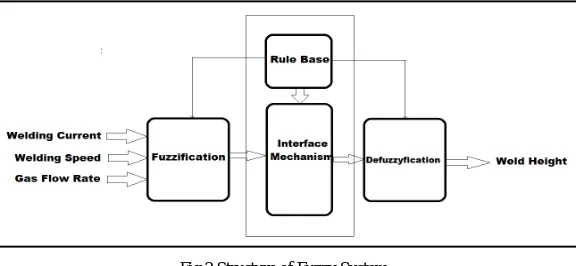
Fuzzy logic is one of the soft computing techniques that play a foremost role in input-output matrix association modelling. Fuzzy logic is chosen to calculate weld height based on the input variables due to nonlinear circumstance in welding process [3]. Fig. 2 shows the structure of fuzzy system in which the welding current, welding speed and gas flow rate are input parameters and weld height as response. Fuzzy logic system involves of fuzzyfication, fuzzy rule, interference mechanism and defuzzyfication as shown in Fig. 3 [4].
Fig 2 Structure of Fuzzy System
Triangular-shaped built-in membership function is engaged to describe the fuzzy sets for input variables and also for response. Fig. 3(a), 3(b) and 3(c) shows membership functions for input variable (Welding current, welding Speed and Gas Flow rate) and fig. 3(d) shows membership functions for response (Weld Height).
(a) (b)
ISSN(Online): 2319-8753 ISSN (Print) : 2347-6710
I
nternational
J
ournal of
I
nnovative
R
esearch in
S
cience,
E
ngineering and
T
echnology
(A High Impact Factor, Monthly Peer Reviewed Journal)
Vol. 5, Issue 2, February 2016
(e)
Fig. 3 Membership Functions and Fuzzy Rules
(a) (b)
(c) (d)
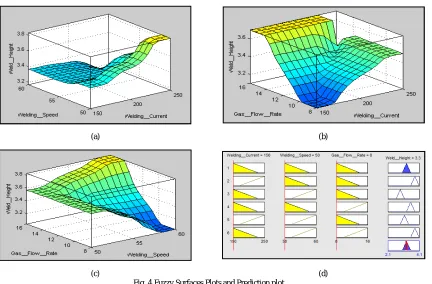
Fig. 4 Fuzzy Surfaces Plots and Prediction plot
The relation between Input and output parameters were employed in form of fuzzy rules. Total 8 fuzzy rules were created on the basis of actual experimental results recorded according possible combination of input parameter levels. The created fuzzy rules are shown in fig. 3e.
Defuzzyfication is the transformation of the fuzzy quantity to real value, just as fuzzyfication is the conversion of a real value to a fuzzy quantity. In this model, centroid of area (COA) defuzzyfication method is recycled due to its wide approval and ability in giving more precise result compared to other methods [8]. Fig. 4 (a), 4(b) and 4(c) shows fuzzy surfaces between the welding current, welding speed, gas flow rate and weld height. Fig. 4(e) shows the prediction of Weld Height at all parameters at high level.
V. RESULTSANDDISCUSSION
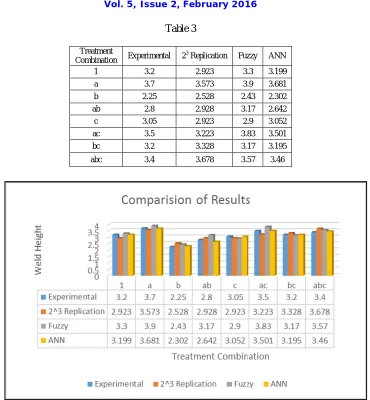
Table 3 shows the experimental and predicted results using fuzzy logic, 23 replication method and ANN modelling
techniques and fig. 5 shows the comparison. Here results of 23 replication and ANN model were taken from the
ISSN(Online): 2319-8753 ISSN (Print) : 2347-6710
I
nternational
J
ournal of
I
nnovative
R
esearch in
S
cience,
E
ngineering and
T
echnology
(A High Impact Factor, Monthly Peer Reviewed Journal)
Vol. 5, Issue 2, February 2016
Table 3
Treatment
Combination Experimental 2
3 Replication Fuzzy ANN
1 3.2 2.923 3.3 3.199
a 3.7 3.573 3.9 3.681
b 2.25 2.528 2.43 2.302
ab 2.8 2.928 3.17 2.642
c 3.05 2.923 2.9 3.052
ac 3.5 3.223 3.83 3.501
bc 3.2 3.328 3.17 3.195
abc 3.4 3.678 3.57 3.46
Fig. 5 Comparision of Results
VI. CONCLUSION
Here a fuzzy logic based model to predict weld height in MIG welding operation has been developed. The predicted values and experimental results were shown in table 3. Here the average percentage error in predicted results by 23, Fuzzy Logic and ANN are 7.38%, 6.25% and 1.31%. After comparing the simulated data with experimental data, the ANN model shows better agreement for predicting Weld Height for the given range of input parameters. This result indicates that the developed model can be used in future to predict weld height within the range of input parameters.In future other modelling techniques like ANFIS and Genetic Algorithm can be used to check the validity of different models.
REFERENCES
[1] Guidelines for Gas Metal Arc Welding (GMAW), www.MillerWelds.com [2] AN INTRODUCTION TO MIG WELDING, www.weldabillity.com
[3] Ahmed, A. D., Sayuti, M. andHamdi, M., “A Fuzzy Logic Based Model to Predict Surface Roughness of A Machined Surface in Glass Milling Operation Using CBN Grinding Tool”, World Academy of Science, Engineering and Technology, pp. 587-593, 2012.
ISSN(Online): 2319-8753 ISSN (Print) : 2347-6710
I
nternational
J
ournal of
I
nnovative
R
esearch in
S
cience,
E
ngineering and
T
echnology
(A High Impact Factor, Monthly Peer Reviewed Journal)
Vol. 5, Issue 2, February 2016
[5] Patel, T., Sheth, S., Modi, B. S. and Patel, P.,“Experimental investigation and forecast of weld penetration in MIG welding process on WCB Material”, Proceeding of the International Conference on Advances in Production and Industrial Engineering, 2015, DOI: 10.13140/RG.2.1.3550.4163, pp. 186-191.
[6] Patel, T., Sheth, S., Modi, B. S. and Patel, P.,“Experimental Investigation And Comparison of Regression Model and Artificial Neural Network to Predict Weld Height in MIG Welding for Dual Plate Check Valve”,International conference on ADVANCES IN MATERIALS AND PRODUCT DESIGN AMPD 2015, 2015, DOI: 10.13140/RG.2.1.3501.6002/1.
[7] Sheth, S., Modi, B. S., Patel, T. and George, P. M.,“A Fuzzy Logic Based Model to Predict Weld Width–A Case Study of Hard Facing Process Using MIG Welding on Dual Plate Check Valve”, Applied Mechanics and Materials, Vol. 592, pp. 8-12, 2014, DOI: 10.4028/www.scientific.net/AMM 592-594.8.
[8] Patel, P., Modi, B. S., Sheth, S. and Patel, T.,“Experimental Analysis and Prediction of Kerfwidth in Laser Cutting of Glass Fibre Reinforced Plastic Composite Material”, Proceedings of International Conference on Advances in Materials, Manufacturing and Applications (AMMA 2015), 2015.
[9] Douglas C. Montgomery, “Design and Analysis of Experiments”, 7th Edition, John Wiley & Sons, 2009.
[10] Patel, P.,Modi, B. S., Sheth, S. andPatel, T.,“Experimental Investigation, Modelling and Comparison of Kerfwidth in Laser Cutting of GFRP”. Bonfring International Journal of Industrial Engineering and Management Science, Vol. 5, No. 2, pp. 55-62, 2015.
[11] Patel, P. J., Sheth, S. and Chauhan, P., “Effect of various parameters on material removal rate in flashing operation of precision steel ball manufacturing process”, 1st International and 16th National Conference on Machines and Mechanisms (iNaCoMM2013), pp. 332-338, 2013. [12] Sheth, S., Modi, B. S., George, P. M. and Patel, P. J.,“A fuzzy logic based model to predict MRR in flashing operation of precision steel ball
manufacturing process”, Procedia Materials Science 5, pp. 1837-1845, 2014.
[13] Patel, T., Sheth, S. and George, P. M.,“Investigation for defects in hardfacing operation as a part of dual plate check valve manufacturing-A review”. International Journal of Management, IT and Engineering, 3(4), pp.359-367, 2013.
[14] Patel, P., J., Sheth, S. and Chauhan, P.,“Effect of various parameters on spread in flashing operation of precision steel ball manufacturing process”, Procedia Materials Sciencevol. 5, pp. 2224-2232, 2014.
[15] Zahiri, R., Sundaramoorthy, R., and Subramanian, C.,“Hardfacing using ferro-alloy powdermixtures by submerged arc welding, Surface & Coatings Technology” vol. 260,pp. 220–229, 2014.
[16] Sheth, S., Modi, B. S., Patel, T. and George, P. M.,“Experimental Investigation and Comparison of Various Modeling Techniques for Prediction of Weld Width in MIG Welding for Dual Plate Check Valve”. 4th Nirma University International Conference on Engineering (NUiCONE 2013) 2013.
[17] Sagar, A. and Purohit, G., “Some Studies on Mig Hardfacing Of Mild Steel Components”, International Journal of Engineering Research and Development, Vol 4, Issue 8, pp. 42-56, 2012.
[18] Venkatesha, B., Srikera, K. and Prabhakar, V., “Wear characteristics of hardfacing alloys: state-of-the-art”, 2nd International Conference on Nanomaterials and Technologies, Procedia Materials Science,vol. 10,pp. 527-532, 2015.
[19] Sheth, S. and George, P. M.,“Experimental Investigation and Fuzzy Modelling of Flatness and Surface Roughness for WCB Material Using Face Milling Operation”, CAD/CAM, Robotics and Factories of the Future, pp. 769-777. Springer India, 2015.
![Table 1 indicates the levels of factor with respect to various treatment combinations according to design of experiments [6] and Table 2 indicates responses](https://thumb-us.123doks.com/thumbv2/123dok_us/1654042.1207278/2.595.155.441.488.755/indicates-respect-treatment-combinations-according-experiments-indicates-responses.webp)