DOI: 10.1534/genetics.109.113506
Evolutionary and Functional Properties of a Two-Locus
b
-Globin
Polymorphism in Indian House Mice
Amy M. Runck,* Roy E. Weber,
†Angela Fago
†and Jay F. Storz*
,1*School of Biological Sciences, University of Nebraska, Lincoln, Nebraska 68588 and†Zoophysiology, Department of Biological Sciences, Aarhus University, DK-8000, Aarhus C, Denmark
Manuscript received December 21, 2009 Accepted for publication January 19, 2010
ABSTRACT
Electrophoretic surveys of hemoglobin (Hb) polymorphism in house mice from South Asia and the Middle East have revealed that two alternativeb-globin haplotypes,Hbbdand Hbbp, are often present at intermediate frequencies in geographically disparate populations. Both haplotypes harbor two functionally distinctb-globin paralogs, HBB-T1 (which encodes theb-chain subunits of the major Hb isoform) and HBB-T2 (which encodes the b-chains of the minor Hb isoform). TheHbbd andHbbphaplotypes share identical HBB-T1 alleles, but products of the alternative HBB-T2 alleles (dminor and pminor) are distinguished by two amino acid substitutions. To investigate the possible adaptive significance of the Hbbd/Hbbppolymorphism we conducted a population genetic analysis of the duplicatedb-globin genes of Indian house mice (Mus castaneus) in conjunction with experimental studies of Hb function in inbred strains of mice that carry the alternativeHbbdandHbbphaplotypes. The main objectives of this study were (i) to characterize patterns of nucleotide polymorphism and linkage disequilibrium in the duplicatedb-globin genes ofM. castaneus, (ii) to test the hypothesis that theHbbdandHbbphaplotypes are maintained as a balanced polymorphism, and (iii) to assess whether allelic differences in the alternative minor Hb isoforms (dminor and pminor) are associated with different O2-binding properties. A multilocus analysis of polymorphism and divergence revealed that levels of diversity at the HBB-T2 gene exceeded neutral expectations, and reconstructed haplotype networks for bothb-globin paralogs revealed extensive allele sharing with several other closely related species of Mus. However, despite this suggestive evidence for balancing selection, O2-equilibrium curves revealed no discernible functional differences between red cell lysates containing thedminorandpminorHb isoforms. If the dminorandpminoralleles are maintained as a balanced polymorphism, our results indicate that the associated fitness variance is not directly related to respiratory functions of Hb.
B
ALANCING selection at a particular locus is expected to produce elevated levels of nucleotide diversity and linkage disequilibrium (LD) due to the partitioning of sequence variation between unusually long-lived allele classes (Hudson and Kaplan 1988;Charlesworth et al. 2003; Charlesworth 2006).
Although elevated levels of nucleotide polymorphism at a particular gene may provide suggestive evidence for a history of balancing selection, conclusive inferences regarding the selective maintenance of allelic poly-morphism ultimately require experimental evidence that the alternative alleles are functionally distinct. The well-characterized b-globin polymorphism in house mice (genus Mus) represents a system where it is possible to integrate evolutionary and functional approaches to evaluate the role of balancing selection in maintaining protein polymorphism.
The two tandemly duplicatedb-globin genes of house mice, HBB-T1 and HBB-T2, encode the b-chain sub-units of adult hemoglobin (Hb) and are separated by
12–15 kb on chromosome 7 (Hoffmannet al. 2008;
Figure 1). Five main classes ofb-globin haplotypes have been characterized in natural populations of house mice:Hbbd
,Hbbp ,Hbbs
,Hbbw1
, andHbbw2
(Satoet al.2008;
Runcket al.2009). Electrophoretic surveys ofb-globin
polymorphism in natural populations of Mus musculus
andM. domesticushave revealed that theHbbdand Hbbs haplotypes are consistently present at intermediate frequencies in population samples from across the species’ range, a pattern that is not paralleled at other unlinked autosomal genes (Petras 1967; Selander et al. 1969a,b; Selander and Yang 1969; Berry and
Murphy 1970; Wheeler and Selander 1972; Myers
1974; Berry and Jakobson 1975; Berry and Peters
1975, 1977, 1981; Berryet al.1978; Sage1981; Petras
and Topping1983; Sageet al.1986). This striking
uni-formity of two-locus haplotype frequencies has led a number of authors to conclude that the polymorphism may be maintained by some form of balancing selection Sequence data from this article have been deposited in GenBank
under accession nos. GU057161–GU057256.
1Corresponding author:School of Biological Sciences, 320A Manter Hall,
University of Nebraska, Lincoln NE 68588. E-mail: [email protected]
(reviewed by Berry 1978). More recently, surveys of
nucleotide variation at the twob-globin paralogs have revealed patterns consistent with the idea that theHbbd and Hbbs haplotypes are maintained as a balanced polymorphism. First, high levels of silent site polymor-phism at the HBB-T1 and HBB-T2 genes ofM. domesticus
exceeded neutral expectations on the basis of levels of interspecific divergence (Storzet al.2007). Second, the Hbbd
and Hbbs
haplotypes are shared among multiple Eurasian species in the subgenus Mus, indicating that the time to the most recent common ancestor of the two haplotypes may predate multiple speciation events (Runck et al. 2009). However, transpecific
polymor-phism appears to be relatively common in house mice due to incomplete lineage sorting and introgressive hybridization (e.g., Salcedoet al. 2007; Geraldeset al.
2008). Thus, central assumptions of standard neutrality tests may often be violated, making it especially impor-tant to use direct, experimental approaches to test hypotheses about balancing selection.
The Hbbd haplotype harbors two distinct b-globin paralogs that are distinguished from one another by 9 amino acid substitutions. The more highly expressed HBB-T1 gene encodes theb-chain subunits of the major Hb isoform (isoHb), dmajor, whereas HBB-T2 encodes theb-chains of the minor isoHb,dminor(Huttonet al. 1962; Gilman1972, 1974; Whitney1977). In contrast
to the two divergent b-globin paralogs on the Hbbd haplotype, the Hbbs haplotype harbors two b-globin paralogs that are identical in sequence due to a history of HBB-T1/HBB-T2 gene conversion (Erhart et al.
1985; Storz et al.2007). Consequently, mice that are
homozygous for theHbbshaplotype synthesize a single
b-chain isoHb during postnatal life. TheHbbdandHbbs haplotypes are distinguished by 3 amino acid substitu-tions at HBB-T1 and 11 amino acid substitusubstitu-tions at HBB-T2 (Erhartet al.1985; Storzet al.2007). One of
the most salient differences betweenHbbd
andHbbs is thatb-chain products of HBB-T1 and HBB-T2 on the
Hbbd
haplotype (dmajoranddminor, respectively) contain a derived cysteine residue at site 13, which appears to play an important role in intraerythrocyte glutathione me-tabolism and nitric oxide meme-tabolism (Miranda2000;
Giustariniet al.2006; Hempeet al.2007).
A polymorphism involving theHbbd and
Hbbp haplo-types has been documented in house mice from South Asia and the Middle East (Minezawaet al.1979; Ritte
and Neufeld1982; Miyashitaet al.1985; Kawashima et al. 1995), which exhibits some similarities to theHbbd/ Hbbspolymorphism in house mice from Europe and the Americas. Similar to the pattern described for theHbbd/ Hbbs
polymorphism, theHbbd
andHbbp
haplotypes are present at intermediate frequencies in geographically disparate population samples from across the range of the Asian house mouseM. castaneus (Miyashitaet al.
1985; Kawashimaet al.1995). As in the case with the Hbbd
haplotype, the HBB-T1 and HBB-T2 paralogs on
theHbbphaplotype encode theb-chain subunits of the major and minor isoHbs (pmajor and pminor), respec-tively. The Hbbd and Hbbp haplotypes share identical HBB-T1 sequences (dmajor ¼ pmajor), but they are distinguished by two amino acid substitutions at HBB-T2: 22Glu/Ala and 23Val/Ile (dminor/pminor, in both cases). The sequence identity between HBB-T1 alleles on theHbbd
andHbbp
haplotypes reflects the fact thatHbbp
is a recombinant chromosome that was pro-duced by intergenic crossing over between Hbbd
and
Hbbw1
parental chromosomes (Uedaet al. 1999; Sato et al.2008; Runcket al. 2009). Consequently,Hbbpcarries
an HBB-T1 allele derived from Hbbd and an HBB-T2 allele derived fromHbbw1. In contrast to the structural differences between products of Hbbd and
Hbbs in M. domesticus and M. musculus, the b-chain isoHbs pro-duced byHbbdandHbbpdo not differ in cysteine content. If there is some functionally significant difference between theb-chain isoHbs produced by theHbbdand Hbbphaplotypes it must be related to the two amino acid differences that distinguish the minor isoHbs, dminor andpminor.
To investigate the possible adaptive significance of the Hbbd
/Hbbp
polymorphism we conducted a popula-tion genetic analysis of the HBB-T1 and HBB-T2 genes in a natural population ofM. castaneusfrom northern India. In conjunction with this evolutionary analysis of sequence variation, we also conducted an experimental study of Hb function in inbred strains of mice that carry each of the alternative two-locus b-globin haplotypes. The main objectives of this study were (i) to characterize patterns of nucleotide polymorphism and LD in the duplicatedb-globin genes ofM. castaneus, (ii) to test the hypothesis that the Hbbd and Hbbp haplotypes are maintained as a balanced polymorphism, and (iii) to assess whether allelic differences in the alternative minor isoHbs (dminor and pminor) are associated with different O2-binding properties.
MATERIALS AND METHODS
Samples for the population genetic analysis:Our survey of nucleotide variation at the HBB-T1 and HBB-T2 genes was based on a total of 24 M. castaneus specimens that were collected by B. Harr in northern India [for details, see Baines
and Harr(2007) and Geraldeset al.(2008)]. The mice used
in our survey were collected from four closely situated lo-calities within a 130 km radius that spanned the border between the Indian states of Himachal Pradesh and Uttarak-hand. Mice from the Indian subcontinent have been referred to asM. bactrianusby some authors (see Boursotet al. 1993).
Following Baines and Harr (2007) and Geraldes et al.
(2008), we refer to the specimens from northern India as M. castaneus.
PCR, cloning, and sequencing: Genomic DNA was
the full sample of mice (48 experimentally phased sequences per gene, 96 sequences total). We therefore obtained com-plete diploid genotypes for both HBB paralogs in each mouse, and we were able to determine the exact haplotype phase of all heterozygous sites. Amplification of the complete coding regions of HBB-T1 and HBB-T2 followed established protocols (Runcket al. 2009). For HBB-T1, the sequenced fragment was
1809 bp in length, including 329 bp of 59flanking sequence and 276 bp of 39 flanking sequence. For HBB-T2, the se-quenced fragment was 1793 bp, including 338 bp of 59 flanking sequence and 300 bp of 39flanking sequence. PCR products were cloned into pCR4-TOPO vector following the manufacturer’s protocols (Invitrogen, Carlsbad, CA). For each species, we sequenced a total of 8–10 colonies per gene using the vector primers T3 and T7 (54° annealing). Automated DNA sequencing was performed on an ABI 3730 capillary sequencer using Big Dye chemistry (Applied Biosystems, Foster City, CA). Sequences were deposited in GenBank under the accession numbers GU057161–GU057256.
Analysis of DNA sequence variation:HBB-T1 and HBB-T2 sequences were aligned and assembled into contigs using ClustalX (Thompson et al. 1997) and Sequencher (Gene
Codes, Ann Arbor, MI). For the purpose of reconstructing the evolutionary history of the HBB-T1 and HBB-T2 sequences from Indian M. castaneus, and to test for evidence of trans-pecific polymorphism, we reconstructed haplotype networks that included previously published sequence data from the orthologousb-globin genes of four additional species of Mus (M. domesticus,M. macedonicus,M. musculus, andM. spicilegus) and an additional M. castaneus specimen from Thailand (Storz et al. 2007; Runck et al. 2009). M. castaneus, M.
domesticus,M. macedonicus,M. musculus, andM. spicilegusare each known to carry theHbbdhaplotype, andM. castaneusand M. musculus are also known to carry the Hbbp haplotype (Runck et al. 2009). Haplotype networks were constructed
using equally weighted characters in the program NETWORK v4.5.1 (www.fluxus-engineering.com). To ensure that a full median network was calculated, we set the weighted genetic distance measure (e) to equal the maximum number of pairwise differences between haplotypes at each paralog (e¼
10 for HBB-T1 ande¼11 for HBB-T2). We used the maximum parsimony option to remove unnecessary median vectors in the full median network (Polzinand Daneschmand2003).
After binning HBB-T1 and HBB-T2 amino acid sequences into discrete allele classes, we calculated Weir and Cockerham’s
(1984) estimator of the inbreeding coefficient, F. To assess whether observed genotype frequencies deviated from Hardy– Weinberg equilibrium we used the exact test of Guo and
Thompson(1992). We used a similar Markov-chain contingency
table method to test the null hypothesis that genotypes at one
b-globin gene were independent of genotypes at the other gene. Summary statistics of nucleotide polymorphism and LD were computed with the programs SITES (Heyand Wakeley
1997) and DnaSP v5 (Libradoand Rozas 2009). To detect
intragenic recombination within each of the two b-globin paralogs, we used the four-gamete test of Hudsonand Kaplan
(1985) to estimateRM, the minimum number of recombina-tion events in the history of the sample. We computed two different measures of DNA sequence variation: nucleotide diversity,p(the average number of pairwise differences be-tween sequences) and Watterson’s (1975) estimator of the
scaled mutation rate, uW (4Nu, where N is the effective population size anduis the mutation rate per nucleotide). We used variation at coding and noncoding sites to compute Hey and Wakeley’s (1997) estimator of the population
recombination rate,g. We used the method of Betra´ net al.
(1997) to test for evidence of gene conversion between the two
b-globin paralogs.
As a measure of LD between pairs of nucleotide poly-morphisms, we used the squared allele-frequency correlation, r2, and we used Fisher’s exact test to determine the probability of obtaining estimates of LD that were more extreme than the observed values under the null hypothesis of linkage equilib-rium. The analysis was based on biallelic nucleotide poly-morphisms where the minor allele was present at least twice in the sample. We used nonlinear regression to model the decay of intragenic LD as a function of physical distance under a model of recombination–drift equilibrium that incorporated mutation (Hill and Weir 1988). Specifically, we used a
nonlinear regression model based on the Gauss–Newton algorithm, as implemented in the nls function of the R statistical computing package (www.r-project.org). To summa-rize the effects of recombination on intragenic LD, we also computed the ZZtest statistic of Rozaset al.(2001), which
measures the difference between the average r2 between adjacent nucleotide polymorphisms and the average of pair-wiser2values across the entire gene. To compute confidence intervals of theZZtest statistic we conducted 10,000 coalescent simulations (with no recombination) that were conditioned on the observed number of segregating sites.
Using data on silent site polymorphism at both b-globin paralogs, we conducted neutrality tests on the basis of two different summary statistics: Tajima’s (1989) D, which
pro-vides a measure of the site-frequency distribution, and Kelly’s
(1997)ZnS, which provides a measure of intralocus LD. We obtained critical values for each test statistic by conducting coalescent simulations as described above.
To assess whether relative levels of polymorphism and divergence deviated from neutral expectations, we conducted a multilocus Hudson–Kreitman–Aguade´ (HKA) test (Hudson
et al. 1987). The analysis included polymorphism data from the HBB-T1 and HBB-T2 genes in addition to previously published data from 8 loci that were sequenced in the same panel of IndianM. castaneusspecimens (Geraldeset al.2008).
The set of effectively unlinked reference loci included four autosomal genes (Chrng, Med19, Prpf3, and Clcn6), two X-linked genes (G6pdxandOcr1), one Y-linked gene (Jarid 1d), and the mtDNA control region. For each of the 10 loci we used orthologous sequences fromM. caroli(Geraldeset al.2008;
Runcket al.2009) to estimate locus-specific values ofD
xy, the average pairwise sequence divergence between species (Nei
and Kumar2000). Since the 59end of theM. caroliHBB-T1
gene has experienced a history of gene conversion by HBB-T2 (Runcket al.2009), we treated the 624-bp conversion tract as
missing data. Thus, for the HBB-T1 gene, our estimate of net divergence betweenM. castaneusandM. caroliwas based on 1369 bp of orthologous sequence that spanned intron 2, exon 3, and the 39-UTR. For the mtDNA control region, the estimate of net sequence divergence betweenM. castaneusandM. caroli was corrected for multiple hits (see Geraldeset al.2008). We
jointly estimated neutral parameters from all 10 loci to ob-tain expected values for the HKA test, and we then used the resultant estimates to conduct coalescent simulations us-ing the HKA program (http://genfaculty.rutgers.edu/hey/ software).
Experimental analysis of Hb function: To test for func-tional differences between the b-chain isoHbs produced by theHbbdhaplotype (d
Hemolysates were prepared according to standard methods and were stripped of organic phosphates and other ionic co-factors as described previously (Storzet al.2009). The isoHb
composition of hemolysates from each mouse strain was confirmed by using thin-layer isoelectric focusing (PhastSys-tem, GE Healthcare Biosciences, Piscataway, NJ). Using a modified diffusion chamber, O2 equilibria of Hb solutions were measured in 10 mmHEPES buffer, pH 7.4, at constant
temperature, 37°. The met-Hb enzymatic reducing system of Hayashiet al.(1973) was used to prevent oxidation of ferrous
heme. Changes in the absorbance of Hb solutions were recorded in conjunction with stepwise changes in the partial pressure of O2 [PO2] inside the chamber (prepared using cascaded Wo¨sthoff gas-mixing pumps; Weber 1981, 1992;
Weberet al.2004). Values of P
50(the PO2at 50% oxygenation of the heme groups) andn50(Hill’s cooperativity coefficient at P50) were interpolated from linear Hill plots (log ([OxyHb]/[Hb])vs.log PO2). TheP50values for the stripped (i.e., cofactor-free) hemolysates provide an inverse measure of the intrinsic Hb–O2binding affinities of the major and minor isoHbs occurring in their natural relative concentrations. To test for differences in cofactor sensitivity between thed- and p-type Hbs, we measured O2-equilibrium curves for each sample in the absence of allosteric cofactors (stripped hemo-lysates), in the presence of 2,3-diphosphoglycerate (DPG), in the presence of Clions (added as potassium chloride, KCl),
and in the presence of both cofactors [(Cl), 0.10 m;
(NaHEPES), 0.1m; DPG/Hb tetramer ratio, 2.0; (Heme),
0.16 mm].
RESULTS
Genetic variation: Our survey of nucleotide poly-morphism in the HBB-T1 and HBB-T2 genes revealed that Indian house mice segregate two main b-globin haplotypes that appear to be referable toHbbdand
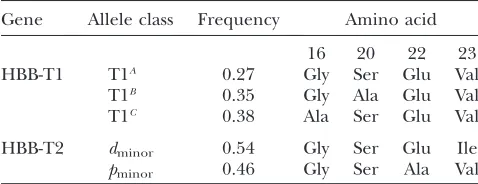
Hbbp. The survey of nucleotide polymorphism at HBB-T1 revealed the presence of three distinct allele classes that were present at roughly equal frequencies (Table 1). Allele classes T1A, T1B, and T1Cwere defined by the following two-site amino acid combinations at residue positions 16 and 20: T1A¼
Gly-Ser, T1B¼
Gly-Ala, and T1C ¼
Ala-Ser. The amino acid sequence of the T1A allele is identical to the canonical dmajor and pmajor
b-globin sequences that were originally characterized in the BALB/c and AU/SsJ inbred strains, respectively (Gilman1972, 1974; Erhartet al. 1985). The T1Band
T1C
alleles differ from the canonical dmajor/pmajor se-quence by single amino acid substitutions. The survey of nucleotide variation at HBB-T2 revealed the presence of two distinct allele classes, referable to dminor and
pminor, that were also present at roughly equal fre-quencies (Table 1). The HBB-T2 allele classes were distinguished by the following two-site amino acid combinations at residue positions 22 and 23:dminor ¼ Glu-Ile and pminor ¼Ala-Val. Relative to the expected genotype frequencies at Hardy–Weinberg equilibrium, both b-globin genes exhibited a highly significant deficit of heterozygotes (HBB-T1: F ¼ 0.573, P , 0.0001; HBB-T2:F¼0.676,P¼0.0011). A more detailed inspection of genotype frequencies revealed that the observed heterozygote deficits were mainly attributable
to population structure. Although thedminorandpminor alleles were present at respective frequencies of 0.54 and 0.46 in the pooled sample, the three more northern samples from Himachal Pradesh were enriched for
pminor (frequency¼0.86, n¼11 mice) and the more southern sample from Uttarakhand was enriched for
dminor(frequency¼0.88,n¼13 mice).
Both HBB-T1 and HBB-T2 exhibited high levels of nucleotide diversity at silent sites (p¼0.0051 and 0.0110, respectively; Table 2). The estimates ofuWfor the HBB-T1 and HBB-T2 genes (uW ¼ 0.0071 and 0.0148, re-spectively; Table 2) exceeded the upper range of values for the seven unlinked nuclear loci that were sequenced in the same panel of mice (uW¼0.0014–0.0062, where values for the X- and Y-linked loci were multiplied by 4/3 and 4, respectively, to account for differences in effective population size; Geraldes et al.2008). The multilocus
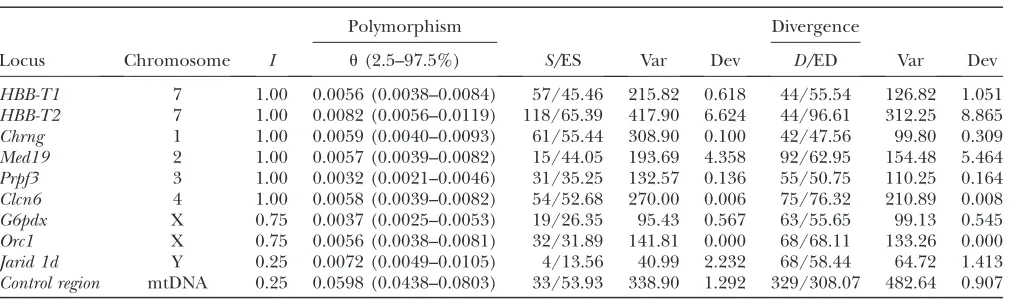
HKA test was highly significant due to a higher-than-expected level of polymorphism at the HBB-T2 gene (xd.f.2 ¼9¼ 34.661,P ¼0.00007; Table 3). The test also remained highly significant when the analysis was re-stricted to the six autosomal loci (xd.f.2 ¼5¼22.644,P¼ 0.00030). The HBB-T1 and HBB-T2 genes both ex-hibited an excess of low-frequency polymorphisms, as indicated by negative values for Tajima’sD, but the skews in the site-frequency distributions were not statistically significant in either case (Table 2).
Levels and patterns of LD: In addition to the departure from Hardy–Weinberg genotype frequencies, we also observed a highly nonrandom association between genotypes at each of the two b-globin genes (xd.f.2 ¼2 ¼ 19.807, P , 0.0001). This high level of intergenic LD is partly attributable to population structure, as the difference in allele frequencies be-tween the northern and southern collection localities augments the covariance in allele frequencies between the twob-globin genes. At the HBB-T1 gene, Fisher’s exact test revealed significant LD between 189 of 703 pairwise comparisons (56 of which remained statistically significant after Bonferroni correction), and at the HBB-T2 gene, significant LD was observed between 563 of 2485 such comparisons (304 of which remained significant after Bonferroni correction). Neither of the twob-globin genes exhibited an excess of intragenic LD,
TABLE 1
Amino acid variation among HBB-T1 and HBB-T2 alleles in Indian house mice
Gene Allele class Frequency Amino acid
16 20 22 23
HBB-T1 T1A 0.27 Gly Ser Glu Val
T1B 0.35 Gly Ala Glu Val
T1C 0.38 Ala Ser Glu Val
HBB-T2 dminor 0.54 Gly Ser Glu Ile
as indicated by nonsignificant ZnS values (Table 2). HBB-T1 and HBB-T2 both showed evidence for a history of intragenic recombination (Rm ¼ 5 and 8, respec-tively), and we detected no evidence for interparalog gene conversion.
To assess whether the elevated polymorphism at HBB-T1 and HBB-T2 could plausibly be explained by the effects of balancing selection at a linked locus, we measured rates of decay of intralocus LD at each of the twob-globin genes. The rationale is that if LD decays to near background levels within each individual gene, then the observed allelic dimorphism at the HBB-T1 and HBB-T2 genes cannot be ascribed to the effects of selection at a linked locus. At both b-globin genes, mean r2 declined to ,0.1 within 200 bp (Figure 2). Although a relatively small number of nonrandom associations persisted for site pairs separated by up to 1.5 kb, it is clear that LD does not extend very far into flanking chromosomal regions. Consistent with these results, estimated values of the ZZ test statistic were significantly positive for both HBB-T1 and HBB-T2
(Table 2), indicating that intragenic recombination has played an important role in randomizing pairwise associations between polymorphisms within each gene.
Evolutionary relationships among house mouse
b-globin sequences: The minimum spanning network of HBB-T1 coding sequences revealed that many of the HBB-T1 alleles fromM. castaneuswere more similar to alleles from M. domesticus than they were to other HBB-T1 alleles from M. castaneus (Figure 3A). The
Hbbw1and
Hbbw2alleles of
M. musculus(Kawashimaet al.
1991; Satoet al.2008) were the most distantly related
sequences in the network of HBB-T1 alleles. Relative to HBB-T1, we observed an even greater degree of trans-pecific polymorphism at the HBB-T2 gene. Thedminor alleles fromM. castaneuswere far more closely related to
dminor alleles from M. domesticus, M. macedonicus, M.
musculus, and M. spicilegus than they were to pminor alleles from M. castaneus (Figure 3B). Even within the
dminor allele class, many dminor sequences from M.
castaneus were more similar to those of M. domesticus
TABLE 2
Summary of nucleotide polymorphism and linkage disequilibrium at the HBB-T1 and HBB-T2 genes of Indian house mice
Gene
Allele class
Length
(bp) N S H HD p(silent) uw(silent) Tajima’sD k Rm g/bp ZnS ZZ
HBB-T1 All 1815 48 61 24 0.946 0.00505 0.00708 0.887 10.17 5 0.00975 0.0936 0.1587* T1A 1816 13 9 5 0.628 0.00112 0.00160 1.188 2.03
T1B 1816 17 10 7 0.816 0.00156 0.00163 0.148 2.83 T1C 1814 18 44 12 0.954 0.00485 0.00673 1.141 8.98
HBB-T2 All 1802 48 125 35 0.986 0.01101 0.01475 0.8377 21.38 8 0.01052 0.0739 0.1093*
dminor 1804 26 78 18 0.966 0.00692 0.01060 1.348 12.53
pminor 1803 22 50 17 0.978 0.00440 0.00761 1.664 7.76
*P,0.05.N, sampled chromosomes;S, total number of segregating sites;H, number of haplotypes;HD,haplotype diversity; and
k, average number of nucleotide differences between sequences.
TABLE 3
Multilocus HKA test involving the HBB-T1 and HBB-T2 genes and eight reference loci
Polymorphism Divergence
Locus Chromosome I u(2.5–97.5%) S/ES Var Dev D/ED Var Dev
HBB-T1 7 1.00 0.0056 (0.0038–0.0084) 57/45.46 215.82 0.618 44/55.54 126.82 1.051
HBB-T2 7 1.00 0.0082 (0.0056–0.0119) 118/65.39 417.90 6.624 44/96.61 312.25 8.865
Chrng 1 1.00 0.0059 (0.0040–0.0093) 61/55.44 308.90 0.100 42/47.56 99.80 0.309
Med19 2 1.00 0.0057 (0.0039–0.0082) 15/44.05 193.69 4.358 92/62.95 154.48 5.464
Prpf3 3 1.00 0.0032 (0.0021–0.0046) 31/35.25 132.57 0.136 55/50.75 110.25 0.164
Clcn6 4 1.00 0.0058 (0.0039–0.0082) 54/52.68 270.00 0.006 75/76.32 210.89 0.008
G6pdx X 0.75 0.0037 (0.0025–0.0053) 19/26.35 95.43 0.567 63/55.65 99.13 0.545
Orc1 X 0.75 0.0056 (0.0038–0.0081) 32/31.89 141.81 0.000 68/68.11 133.26 0.000
Jarid 1d Y 0.25 0.0072 (0.0049–0.0105) 4/13.56 40.99 2.232 68/58.44 64.72 1.413
Control region mtDNA 0.25 0.0598 (0.0438–0.0803) 33/53.93 338.90 1.292 329/308.07 482.64 0.907
and M. musculus than they were to other conspecific
dminorsequences.
Functional properties of house mouse Hbs: To test for functional differences between the minorb-chain isoHbs produced by theHbbd
haplotype (dminor) and the
Hbbp
haplotype (pminor), we compared O2-binding properties of hemolysates from the BALB/c and MSM/s inbred strains. Hb–O2affinity is modulated by various allosteric cofactors, particularly protons (re-sponsible for the Bohr effect) and organic and in-organic anions, such as DPG and Clions (Weberand
Fago 2004; Storz and Moriyama 2008). In the red
blood cells of most mammalian species, the binding of these effectors stabilize the low-affinity, deoxygenated ‘‘tense state’’ conformation of the Hb tetramer relative to the oxygenated ‘‘relaxed state,’’ thereby decreasing Hb–O2affinity. Thus, even if thedminorandpminorHbs exhibit similar intrinsic O2-binding affinities, differ-ences in their cofactor sensitivities could still account for significant differences in blood–O2affinity.
The comparison between hemolysates containing the
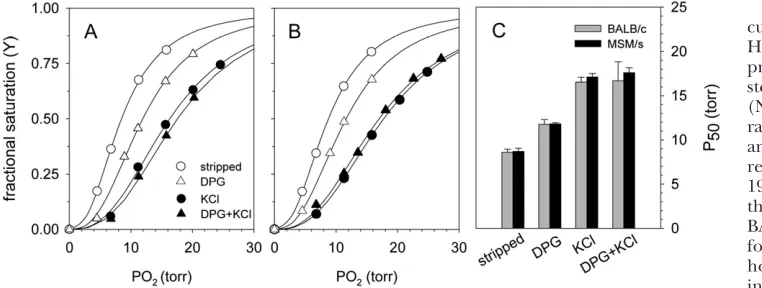
dminorandpminor isoHbs revealed no significant differ-ence in O2-binding properties (Figure 4). Across all treatments, the O2-affinities and cooperativity coeffi-cients were nearly identical (Table 4). In summary, the O2-binding measurements revealed no discernible dif-ferences in the respiratory functions ofdminorandpminor isoHbs under physiological conditions.
DISCUSSION
Consistent with the results of electrophoretic surveys of house mice from other localities in South Asia (Miyashita et al. 1985; Kawashima et al. 1995), our
survey of nucleotide polymorphism in the HBB-T1 and HBB-T2 genes revealed that Indian M. castaneus
segregate two mainb-globin haplotypes that are
refer-able to Hbbd and Hbbp. Remarkably, many of the HBB-T1 and HBB-T2 alleles that we recovered in our sample of Indian M. castaneus were shared by other species of Mus. The transpecific polymorphism was especially pervasive at the HBB-T2 gene, as identical
dminorandpminoralleles were shared among represen-tatives of M. castaneus, M. domesticus,M. macedonicus, and M. spicilegus. A lesser degree of shared polymor-phism amongM. castaneusand M. domesticuswas also documented at several of the other unlinked reference loci (Geraldeset al.2008), which appears to reflect the
combined effects of unsorted ancestral polymorphism and introgressive hybridization. Hybridization between
Figure 1.—Genomic
structure of the b-globin gene family of the house mouse (BALB/c strain) on chromosome 7.
Figure 2.—Rates of decay of gametic linkage
M. castaneus and M. musculus has been documented in northern China and in Japan (Bonhomme et al.
1989; Boursotet al.1993), and hybridization between M. castaneusand M. domesticushas been documented in California (Orthet al.1998). At least in the case of M. castaneus,M. domesticus, andM. musculus, which are thought to have diverged from one another 350,000– 900,000 years ago (She et al. 1990; Boursot et al.
1996; Suzukiet al. 2004; Salcedoet al. 2007; Tucker
2007; Geraldeset al. 2008), retained ancestral
poly-morphism and introgressive hybridization appear to be sufficiently common that shared polymorphism can often be explained without invoking balancing selection.
Functional properties of BALB/c and MSM/s hemoglobins: We detected no differences in the O2 equilibria of hemolysates from BALB/c (containing the
dminorisoHb) and MSM/s (containing thepminorisoHb) under physiological conditions. This indicates that struc-tural differences in the products ofdminorandpminordo not have any significant effects on blood–O2transport. As shown in Figure 4 and Table 4, Hbs from BALB/c and MSM/s showed no physiologically significant differ-ences in O2affinity (P50) or cooperativity (n50) under identical buffer conditions. As previously observed for Hbs of the deer mouse,Peromyscus maniculatus (Storz et al.2009), Hb–O2affinity was not markedly reduced in the presence of DPG alone (DlogP50(DPG-stripped)¼0.15
Figure3.—Median joining network showing relationships amongb-globin coding sequences fromM. castaneusand four other
species of Mus that are known to segregate theHbbdandHbbphaplotypes (M. domesticus,M. macedonicus,M. musculus, andM. spic-ilegus). Haplotype networks for the HBB-T1 and HBB-T2 paralogs are shown in A and B, respectively. The size of each circle is proportional to the corresponding haplotype frequency. Inferred intermediate haplotypes are shown as black circles on branches connecting observed haplotypes. Branches between haplotypes indicate one mutational step, and tick marks denote additional steps. Amino acid changes in HBB-T1 sequences are shown in relation to the canonicaldmajor/pmajorsequence from the BALB/c and MSM/s inbred strains, and amino acid changes in HBB-T2 are shown in relation to the canonicaldminorsequence from BALB/c. The three allele classes at HBB-T1 are indicated in A. The black line in B separates haplotypes that are referable to thedminorand
and 0.13 in BALB/c and MSM/s, respectively; Table 4). The magnitude of the DPG effect in the house mouse Hbs was similar to that observed in lowland deer mice (DlogP50(DPG-stripped) ¼ 0.09–0.14), and is indicative of weak DPG binding to the tense-state deoxyHb structure. In contrast to the relatively weak DPG effect, the effect of Cl ions was much more pronounced
(DlogP50(KCl-stripped) ¼ 0.29 and 0.31 in BALB/c and MSM/s, respectively; Table 4), which may be attribut-able to the presence of one or more distinct Clbinding
sites in the tense-state quaternary structure.
Reconciling the results of neutrality tests and functional tests:A number of studies have documented patterns of DNA sequence variation that provide sug-gestive evidence for the maintenance of protein poly-morphism by balancing selection (e.g., Filatov and
Charlesworth 1999; Cork and Purugganan 2002;
Tianet al. 2002; Baysalet al. 2007; Fergusonet al. 2008;
Fumagalliet al. 2009). However, there are very few case
studies where indirect, statistical evidence for balancing selection has been combined with documented func-tional differences between alternative alleles (for one notable exception involving house mice, see Johnsen et al. 2009). Our combined evolutionary and functional analysis of the two-locus b-globin polymorphism in Indian house mice revealed seemingly contradictory results. The population genetic analysis revealed excess levels of polymorphism at HBB-T2 that could not be reconciled with the expectations of a neutral equilib-rium model, and yet the analysis of protein function revealed no discernible physiological differences be-tweendminorandpminorisoHbs. There is clearly no basis for fitness variation among genotypes if the products of alternative alleles are functionally identical.
One possible explanation for the discrepancy is that results of the HKA test reflect a violation of model assumptions related to demographic history or popula-tion structure. Since the ratio of intraspecific poly-morphism to between-species divergence can be inflated by population structure (Wakeley 2000),
results of the HKA test may be biased if the test is applied to a set of loci that are characterized by different levels of population structure (Ingvarsson2004). This
may be a common problem in studies of house mice, since natural populations often show evidence of historical admixture and levels of introgression are highly variable among different genomic regions (e.g., Payseuret al.2004; Geraldeset al.2008; Teeteret al.
2008, 2010). Another possibility is that the elevated polymorphism that we observe at the b-globin genes reflects the effects of diversity-enhancing selection at one or more linked loci. We cannot rule out this possibility, but given the observed decay of intragenic LD at each of the twob-globin genes (Figure 3), it does not seem plausible that levels of diversity could be affected by associative overdominance or some other
Figure 4.—O2-equilibrium
curves of stripped house mouse Hbs at pH 7.40 and 37° in the presence and absence of allo-steric cofactors [(Cl), 0.10 m;
(NaHEPES), 0.1m; DPG/Hb
tet-ramer ratio, 2.0; (Heme), 0.16 mm]
and in the presence of the met-Hb reductase system (Hayashiet al.
1973). Representative curves for the Hbs from two inbred strains, BALB/c (which is homozygous for Hbbd) and MSM/s (which is homozygous forHbbp), are shown in A and B, respectively. C shows mean values (6SEM) ofP50(n¼ 3) measured under the above conditions and indicates that theb-chain isoHbs produced by theHbbdhaplotype and theHbbp hap-lotype do not differ in intrinsic O2affinity (as revealed by the comparison of stripped Hbs) or in sensitivity of Hb–O2to the presence of allosteric cofactors such as DPG or Clions.
TABLE 4
O2binding properties (mean6SEM,n¼3) of stripped
hemolysates from the BALB/c and MSM/s inbred strains (which are homozygous for theHbbdandHbbpb-globin
haplotypes, respectively)
Strain
(b-haplotype) Conditions P50(torr) n50
BALB/c (Hbbd) Stripped 8.4460.09 2.4660.05 DPG 11.8860.17 2.6560.09 KCl 16.2760.30 2.6860.12 DPG1KCl 17.5360.27 2.7860.13 MSM/s (Hbbp) Stripped 8.7660.04 2.4060.02 DPG 11.6460.07 2.5060.04 KCl 17.7460.06 2.6760.02 DPG1KCl 17.0360.27 2.5660.09
P50andn50values indicate the O2tensions and cooperativ-ity coefficients at half-saturation, respectively. O2 equilibria were measured in 0.1 m HEPES buffer at pH 7.40, 37°, in
the absence of allosteric cofactors (stripped hemolysates), in the presence of DPG alone, in the presence of KCl alone, and in the presence of both cofactors [(Cl), 0.10m; DPG/Hb
form of diversity-enhancing selection at a linked locus. If the unusual patterns of variation at theb-globin genes of Indian house mice can be explained by admixture or other complexities of population structure, then we should expect that surveys of additional autosomal genes will uncover similar examples of allelic dimor-phism and allele sharing between M. castaneus and other closely related species.
Finally, it is also possible that the b-globin polymor-phism in M. castaneus is maintained by balancing selection, but that the adaptive variation in protein function is not directly related to blood–O2 transport. In contrast to the allelic differences in cysteine content that distinguish products ofHbbdand
Hbbsin
M. domesticus
and M. musculus, amino acid differences between the
dminorandpminorisoHbs ofM. castaneushave no effect on the metabolism of thiol reactants or intraerythrocytic redox balance (which can affect aspects of the host immune response to pathogenic infection). Nonethe-less, we cannot rule out the possibility that theb-globin polymorphism in M. castaneus affects some unknown biochemical function, especially in light of recent dis-coveries concerning the expression of globin chain monomers in nonerythroid cells (e.g., Liu et al. 1999;
Manserghet al. 2008; Nishi et al. 2008; Biagioliet al.
2009; Richteret al. 2009; Schelshornet al. 2009). In
light of our experimental results, we conclude that amino acid differences between products of the dminor and
pminor alleles are functionally inconsequential with re-gard to the respiratory physiology of house mice. If the
dminor and pminor alleles are maintained as a balanced polymorphism in M. castaneus, either directly or in-directly, the associated variance in fitness appears to be unrelated to respiratory functions of Hb.
We thank B. Harr for sharing tissue samples, and we thank A. Geraldes and M. Nachman for shipping samples and sharing sequence data. We also thank M.-B. Hemmingsen for valuable assistance in the lab. Finally, we are grateful to A. Geraldes, M. Nachman, and two anonymous reviewers for helpful comments that improved the manuscript. This work was funded by a National Science Foundation fellowship in Bioinformatics to A.M.R. (0630779), grants to J.F.S. from the National Science Foundation and the Nebraska Research Council, and grants to J.F.S., R.E.W., and A.F. from the National Institutes of Health/National Heart, Lung, and Blood Institute.
LITERATURE CITED
Baines, J. F., and B. Harr, 2007 Reduced X-linked diversity in
de-rived populations of house mice. Genetics175:1911–1921. Baysal, B., E. Lawrenceand R. Ferrell, 2007 Sequence variation
in human succinate dehydrogenase genes: evidence for long-term balancing selection on SDHA. BMC Biol.5:12.
Berry, R., and M. Jakobson, 1975 Ecological genetics of an island
population of the house mouse. J. Zool.173:341–354. Berry, R., and H. Murphy, 1970 The biochemical genetics of an
island population of the house mouse. Proc. R. Soc. Lond. Ser. B176:87–103.
Berry, R., and J. Peters, 1975 Macquarie Island house mice: a
ge-netical isolate on a sub-Antarctic island. J. Zool.176:375–389. Berry, R., and J. Peters, 1977 Heterogeneous heterozygosities in
Mus musculuspopulations. Proc. R. Soc. Lond. Ser. B197:485–503.
Berry, R., and J. Peters, 1981 Allozymic variation in house mouse
populations, pp. 242–253 inMammalian Population Genetics, edited by M. Smithand J. Joule. University of Georgia Press, Athens,
Georgia.
Berry, R., J. Petersand R. VanAarde, 1978 Sub-antarctic house
mice: colonization, survival, and selection. J. Zool. 184:127– 141.
Berry, R. J., 1978 Genetic variation in wild house mice: where
nat-ural selection and history meet. Am. Sci.66:52–60.
Betra´ n, E., J. Rozas, A. Navarroand A. Barbadilla, 1997 The
es-timation of the number and the length distribution of gene con-version tracts from population DNA sequence data. Genetics146:
89–99.
Biagioli, M., M. Pinto, D. Cesselli, M. Zaninello, D. Lazarevic
et al., 2009 Unexpected expression of alpha- and beta-globin in mesencephalic dopaminergic neurons and glial cells. Proc. Natl. Acad. Sci. USA106:15454–15459.
Bonhomme, F., N. Miyashita, P. Boursot, J. Catalan and
K. Moriwaki, 1989 Genetical variation and polyphyletic
origin in JapaneseMus musculus.Heredity63:299–308. Boursot, P., J. Auffray, J. Britton-Davidian and F. Bonhomme,
1993 The evolution of house mice. Ann. Rev. Ecol. Syst.24:
119–152.
Boursot, P., W. Din, R. Anand, D. Darviche, B. Dod et al.,
1996 Origin and radiation of the house mouse: mitochondrial DNA phylogeny. J. Evol. Biol.9:391–415.
Charlesworth, B., D. Charlesworthand N. Barton, 2003 The
effects of genetic and geographic structure on neutral varation. Ann. Rev. Ecol. Evol. Syst.34:99–125.
Charlesworth, D., 2006 Balancing selection and its effects on
se-quences in nearby genome regions. PLoS Genet.2:e64. Cork, J., and M. Purugganan, 2002 High-diversity genes in the
Arabidopsis genome. Genetics170:1897–1911.
Erhart, M. A., K. S. Simonsand S. Weaver, 1985 Evolution of the
mouseb-globin gene: a recent gene conversion in the Hbbs
hap-lotypes. Mol. Biol. Evol.2:304–320.
Ferguson, W., S. Dvora, J. Gallo, A. Orth and S. Boissinot,
2008 Long-term balancing selection at the West-Nile virus resis-tance gene,Oas1b, maintains trans-specific polymorphisms in the house mouse. Mol. Biol. Evol.25:1609–1618.
Filatov, D., and D. Charlesworth, 1999 DNA polymorphism,
haplotype structure and balancing selection in the Leavenwor-thia PgiC locus. Genetics153:1423–1434.
Fumagalli, M., R. Cagliani, U. Pozzoli, S. Riva, G. P. Comiet al.,
2009 Widespread balancing selection and pathogen-driven se-lection at blood group antigen genes. Genome Res.19:199–212. Geraldes, A., Basset, B. Bigson, K. Smith, B. Harr et al.,
2008 Inferring the history of speciation in house mice from au-tosomal, X-linked, Y-linked, and mitochondrial genes. Mol. Ecol.
17:5349–5363.
Gilman, J. G., 1972 Hemoglobin b-chain structural variation in
mice: evolutionary and functional implications. Science 178:
873–874.
Gilman, J. G., 1974 Rodent hemoglobin structure: a comparison of
several species of mice. Ann. N. Y. Acad. Sci.241:416–433. Giustarini, D., I. Dalle-Donne, E. Cavarra, S. Fineschi,
G. Lungarellaet al., 2006 Metabolism of oxidants by blood
from different mouse strains. Biochem. Pharmacol.71:1753– 1764.
Guo, S., and E. Thompson, 1992 Performing the exact test of
Hardy-Weinberg proportion for multiple alleles. Biometrics48:
361–372.
Hayashi, A., T. Suzukiand M. Shin, 1973 An enzymatic reduction
system for metmyoglobin and methemoglobin, and its applica-tion to funcapplica-tional studies of oxygen carriers. Biochim. Biophys. Acta310:309–316.
Hempe, J. M., J. Ory-Ascaniand D. Hsia, 2007 Genetic variation in
mouse beta globin cysteine content modifies glutathione metab-olism: implications for the use of mouse models. Exp. Biol. Med.
232:437–444.
Hey, J., and J. Wakeley, 1997 A coalescent estimator of the
popu-lation recombination rate. Genetics145:833–846.
Hill, W. G., and B. Weir, 1988 Variances and covariances of
Hoffmann, F. G., J. C. Opazoand J. F. Storz, 2008 New genes
orig-inated via multiple recombinational pathways in the b-globin gene family of rodents. Mol. Biol. Evol.25:2589–2600. Hudson, R. R., and N. L. Kaplan, 1985 Statistical properties of the
number of recombination events in the history of a sample of DNA sequences. Genetics111:147–164.
Hudson, R., and N. Kaplan, 1988 The coalescent process in models
with selection and recombination. Genetics120:831–840. Hudson, R., M. Kreitmanand M. Aguade´, 1987 A test of neutral
molecular evolution based on nucleotide data. Genetics 116:
153–159.
Hutton, J., J. Bishop, R. Schweetand E. Russell, 1962 Hemoglobin
inheritance in inbred mouse strains, II. Genetic studies. Proc. Natl. Acad. Sci. USA48:1718–1724.
Ingvarsson, P. K., 2004 Population subdivision and the
Hudson-Kreitman-Aguade test: testing for deviations from the neutral model in organelle genomes. Genet. Res.83:31–39.
Johnsen, J. M., M. Teschke, P. Pavlidis, B. M. McGee, D. Tautzet al.,
2009 Selection oncis-regulatory variation atB4galnt2and its in-fluence on von Willebrand factor in house mice. Mol. Biol. Evol.
26:567–578.
Kawashima, T., N. Miyashita, C.-H. Wang, X.-Q. He, M.-L. Jinet al.,
1991 A new haplotype of theb-globin gene complex,Hbbw1, in
Chinese wild mice. Jpn. J. Genet.66:491–500.
Kawashima, T., N. Miyashita, K. Tsuchiya, H. Li, F. S. Wanget al.,
1995 Geographical-distribution of the Hbb haplotypes in the Mus musculussubspecies in Eastern Asia. Jpn. J. Genet.70:17–23. Kelly, J. K., 1997 A test of neutrality based on interlocus
associa-tions. Genetics146:1197–1206.
Librado, P., and J. Rozas, 2009 DnaSP v5: a software for
compre-hensive analysis of DNA polymorphism data. Bioinformatics
25:1451–1452.
Liu, L., M. Zengand J. S. Stamler, 1999 Hemoglobin induction in
mouse macrophages. Proc. Natl. Acad. Sci. USA96:6643–6647. Mansergh, F. C., S. M. Hunter, J. C. Geatrell, M. Jarrin, K. Powell
et al., 2008 Developmentally regulated expression of hemoglobin subunits in avascular tissues. Int. J. Dev. Biol.52:873–886. Minezawa, M., K. Moriwakiand K. Kondo, 1979 Geographical
dis-tribution of Hbbpallele in the Japanese wild mouse,Mus musculus
molossinus.Jpn. J. Genet.54:166–173.
Miranda, J., 2000 Highly reactive cysteine residues in rodent
hemo-globins. Biochem. Biophys. Res. Commun.275:517–523. Miyashita, N., K. Moriwaki, M. Minezawa, H. Yonekawa,
F. Bonhommeet al., 1985 Allelic constitution of the hemoglobin
bchain in wild populations of the house mouse,Mus musculus. Biochem. Genet.23:975–986.
Myers, J., 1974 Genetic and social structure of feral house mouse
populations on Grizzly Island, California. Ecology55:747–759. Nei, M., and S. Kumar, 2000 Molecular Evolution and Phylogenetics.
Oxford University Press, New York.
Nishi, H., R. Inagi, H. Kato, M. Tanemoto, I. Kojima et al.,
2008 Hemoglobin is expressed by mesangial cells and reduces oxidant stress. J. Am. Soc. Nephrol.19:1500–1508.
Orth, A., T. Adama, W. Dinand F. Bonhomme, 1998 Hybridation
naturelle entre deux sous-espe`ces de souris domestique, Mus musculus domesticusetMus musculus castaneus, pre`s du lac Casitas (Californie). Genome41:104–110.
Payseur, B. A., J. G. Krenzand M. W. Nachman, 2004 Differential
patterns of introgression across the X chromosome in a hybrid zone between two species of house mice. Evolution58:2064–2078. Petras, M., 1967 Studies of natural populations ofMus.I.
Biochem-ical polymorphisms and their bearing on breeding structure. Evolution21:259–274.
Petras, M., and J. Topping, 1983 The maintenance of
polymor-phisms at two loci in house mouse (Mus musculus) populations. Can. J. Genet. Cytol.25:190–201.
Polzin, T., and S. Daneschmand, 2003 On Steiner trees and
min-imum spanning trees in hypergraphs. Oper. Res. Lett.31:12–20. Richter, F., B. H. Meurers, C. N. Zhu, V. P. Medvedevaand M. F.
Chesselet, 2009 Neurons express hemoglobin alpha- and
beta-chains in rat and human brains. J. Comp. Neurol. 515:
538–547.
Ritte, U., and E. Neufeld, 1982 East Asian hemoglobin type
(Hbbp) in wild populations of the house mouse in Israel.
Bio-chem. Genet.5/6:475–481.
Rozas, J., M. Gullaud, G. Blandinand M. Aguade´, 2001 DNA
var-iation at therp49gene region ofDrosophila simulans: evolutionary inferences from an unusual haplotype structure. Genetics158:
1147–1155.
Runck, A. M., H. Moriyamaand J. F. Storz, 2009 Evolution of
du-plicatedb-globin genes and the structural basis of hemoglobin isoform differentiation inMus.Mol. Biol. Evol.26:2521–2532. Sage, R., 1981 Wild mice, pp. 39–90 inThe Mouse in Biomedical
Re-search: History, Genetics, and Wild Mice, edited by H. Foster,
J. Smalland J. Fox. Academic Press, New York.
Sage, R., J. B. I. Whitneyand A. Wilson, 1986 Genetic analysis of a
hybrid zone betweendomesticusandmusculusmice (Mus musculus complex): hemoglobin polymorphisms. Curr. Top. Microbiol.
127:75–85.
Salcedo, T., A. Geraldesand M. W. Nachman, 2007 Nucleotide
variation in wild and inbred mice. Genetics177:2277–2291. Sato, J. J., A. Shinohara, N. Miyashita, C. Koshimoto, K. Tsuchiya
et al., 2008 Discovery of a new HBB haplotype w2 in a wild-derived house mouse, Mus musculus. Mamm. Genome 19:
155–162.
Schelshorn, D. W., A. Schneider, W. Kuschinsky, D. Weber, C.
Krugeret al., 2009 Expression of hemoglobin in rodent
neu-rons. J. Cerebr. Blood F. Met.29:585–595.
Selander, R., and S. Yang, 1969 Protein polymorphism and genic
heterozygosity in a wild population of the house mouse. Genetics
63:653–667.
Selander, R., W. Huntand S. Yang, 1969a Protein polymorphism
and genic heterozygosity in two European subspecies of the house mouse. Evolution23:379–390.
Selander, R., S. Yangand W. Hunt, 1969b Polymorphisms in
es-terases and hemoglobin in wild populations of the house mouse (Mus musculus). Univ. Texas. Publ.6918:271–338.
She, J., F. Bonhomme, P. Boursot, L. Thaler and F. Catzeflis,
1990 Molecular phylogenies in the genusMus: comparative analysis of electrophoretic, scnDNA hybridization, and mtDNA RFLP data. Biol. J. Linn. Soc.41:83–103.
Storz, J. F., and H. Moriyama, 2008 Mechanisms of hemoglobin
adaptation to high-altitude hypoxia. High Alt. Med. Biol. 9:
148–157.
Storz, J. F., M. Baze, J. Waite, F. G. Hoffmann, J. C. Opazoet al.,
2007 Complex signatures of selection and gene conversion in the duplicated globin genes of house mice. Genetics177:481–500. Storz, J. F., A. M. Runck, S. J. Sabatino, J. K. Kelly, N. Ferrand
et al., 2009 Evolutionary and functional insights into the mech-anism underlying high-altitude adaptation of deer mouse hemo-globin. Proc. Natl. Acad. Sci. USA106:14450–14455.
Suzuki, H., T. Shimada, M. Terashima, K. Tsuchiyaand K. Aplin,
2004 Temporal, spatial, and ecological modes of evolution of EurasianMusbased on mitochondrial and nuclear gene sequen-ces. Mol. Phylogenet. Evol.33:626–646.
Tajima, F., 1989 Statistical method for testing the neutral mutation
hypothesis by DNA polymorphism. Genetics122:585–595. Teeter, K. C., B. A. Payseur, L. W. Harris, M. A. Bakewell, L. M.
Thibodeau et al., 2008 Genome-wide patterns of gene flow
across a house mouse hybrid zone. Genome Res.18:67–76. Teeter, K. C., L. M. Thibodeau, Z. Gompert, C. A. Buerkle, M. W.
Nachmanet al., 2010 The variable genomic architecture of
iso-lation between hybridizing species of house mouse. Evolution54:
472–485.
Thompson, J., T. Gibso, F. Plewniak, F. Jeanmougin and D.
Higgins, 1997 The CLUSTAL_X windows interface: flexible
strategies for multiple sequence alignment aided by quality anal-ysis tools. Nucleic Acids Res.25:4876–4882.
Tian, D., H. Araki, E. Stahl, J. Bergelson and M. Kreitman,
2002 Signature of balancing selection inArabadopsis.Proc. Natl. Acad. Sci. USA99:11525–11530.
Tucker, P. K., 2007 Systematics of the genusMus, pp. 13–23 inThe
Mouse in Biochemical Research, edited by J. Fox, C. Newcomer,
A. Smith, S. Barthold, F. Quimbyet al.Elsevier Press, Boston.
Ueda, Y., N. Miyashita, K. Imai, Y. Yamaguchi, K. Takamuraet al.,
1999 Nucleotide sequences of the mouse globinbgene cDNAs in a wild derived new haplotype Hbbw1. Mamm. Genome10:879–
882.
Wakeley, J., 2000 The effects of subdivision on the genetic
Watterson, E., 1975 On the number of segregating sites in
genet-ical models without recombination. Theor. Popul. Biol.7:256– 276.
Weber, R. E., 1981 Cationic control of oxygen affinity in lungworm
erythocruorin. Nature292:386–387.
Weber, R. E., 1992 Use of ionic and zwitterionic (Tris/BisTris and
Hepes) buffers in studies on hemoglobin function. J. Appl. Physiol.
72:1611–1615.
Weber, R. E., and A. Fago, 2004 Functional adaptation and its
mo-lecular basis in vertebrate hemoglobins, neuroglobins and cyto-globins. Resp. Physiol. Neurobi.144:141–159.
Weber, R. E., W. Voelter, A. Fago, H. Echner, E. Campanellaet al.,
2004 Modulation of red cell glycolysis: interaction between
ver-tebrate hemoglobins and cytoplasmic domains of band 3 red cell membrane proteins. Am. J. Physiol.287:R454–R464.
Weir, B., and C. Cockerham, 1984 EstimatingF-statistics for the
analysis of population structure. Evolution38:1358–1370. Wheeler, L., and R. Selander, 1972 Genetic variation in
popula-tions of the house mouse,Mus musculus, in the Hawaiian Islands. Univ. Texas Publ.7213:269–296.
Whitney, J. B. I., 1977 Differential control of the synthesis of two
hemoglobin beta chains in normal mice. Cell12:863–871.