NOVEL SEGMENTATION METHOD FOR CLASSIFICATION OF RGB IMAGE AT OBJECT DETECTION ANALYSIS
Shahin Shafei
Department of Electrical Engineering, Mahabad Branch, Islamic Azad University, Mahabad, Iran Tohid Sedghi
Department of Electrical Engineering, Mahabad Branch, Islamic Azad University, Mahabad, Iran
ABSTRACT
We introduce a new object detection method which has been obtained as main contribution of this paper and a new feature extraction based on wavelet analysis is presented. Image retrieval based
on region is one of the most promising and active research directions in recent years. As literature prove that region segmentation will produce better results. Human visual perception is more
effective than any machine vision systems for extracting semantic information from image; hitherto no specific system has been suggested with the ability of extracting object individually. In this paper Expectation Maximization is applied on RGB image to classify the objects and then feature
extraction method is used for generating new features. The method is compared with some techniques and our proposed method has lots of superiority to previously techniques such as
accuracy and good precision.
Keywords: CBIR, Feature extraction, Image enhancement, Machine vision.
INTRODUCTION
Content based image retrieval, the problem of finding images from data base according to their
content, has been the subject of a significant amount of research previously. In this paper Expectation Maximization (EM) algorithm is utilized to segment image into different regions. A new image representation which provides a transformation from the raw pixel data to a small set of
image regions which are coherent in color and texture space is presented. In addition the EM algorithm performs automatic segmentation based on image features (Gustavo et al., 2007). EM
iteratively models the joint distribution of color and texture with a mixture of Gaussians. The resulting pixel cluster memberships provide a segmentation of the image. After the image is
segmented into regions, system select the region where contain main object. More over a description of chosen region, based on novel feature extraction is produced (Sedghi et al., 2010).
Journal of Asian Scientific Research
The other option of the proposed system is that the user can access the regions directly in order to
see the segmentation of the query image and specify which aspects of the image are important to the query. The deficiency of traditional retrieval systems is due to either both image representation and method of accessing those representations to find images, while users generally want to find
images containing particular objects (Li et al., 2000; Chen and Wang, 2002 ). Most existing image retrieval systems represent images based only on their low-level features, with little regard for the
spatial organization of those features. Systems based on user querying are often unintuitive and offer little help in understanding why certain images were returned and how to refine the query. Often the user knows only that he has submitted a query for, say, a horse and retrieved very few
pictures of horses in return. For general image collections, there are currently no systems that can automatically classify images or recognize the objects they contain. In particular, this paper
demonstrates how the segmentation and new feature extraction can considerably enhance object based retrieval system.
MATERIAL AND METHODS
The EM algorithm is used for finding maximum likelihood parameter estimates when there is missing or incomplete data (Gustavo et al., 2007). In our case, the missing data is the region to
which the points in the feature space belong. We estimate values to fill in for the incomplete data (the “E-Step”), compute the maximum likelihood parameter estimates using this data (the “M-Step”), and repeat until a suitable stopping criterion is reached. Based on essence of EM algorithm we can segment each image to different parts. Simulation and Figure1, show Gaussian functions will produce the best result to extract the main object of image. After extracting object we apply a
novel textural feature extraction method based on multi-dimensional wavelet (MDW). MDW is fully studied in (Chen and Wang, 2002 ), (Rui-zhe et al., 2009), (Hirremath and Pujari, 2008),
(Kingsbury, 2001). For feature extraction method, In this work, we use MDW transform
coefficients as the texture features. A brief description about the MDW transform is given here. More explanations can be found in (Huang and Dai, 2003). The basic functions of MDW transform
are orthogonal and can be computed faster than the Gabor and wavelet filters. The main advantage of the MDW transform (Rajavel, 2010) over the complex wavelet transform is that the MDW transform is completely shift and rotation invariant, while complex wavelets are approximately
shift invariant. Further MDW transform generate different separate sub-bands for each of positive and negative orientations. Moreover, the conventional separable real wavelet suffers from the lack
of shift invariance, provides just three orientations, has a poor directional selectivity, and also cannot distinguish between 45 and -45 directions. In addition, the extra redundancy of the MDW transform allows a significant reduction of aliasing terms which causes to be shift invariant.
Translation results in large changes of the coefficients phases, but the magnitudes (and hence energies) are much more stable. By using even and odd filters alternately in MDW transformation,
Fig-1. Result of Object extraction using EM Algorithm for different Gaussian functions
The MDW transform is proposed for a more symmetrical Fourier analysis which is expressed in a symmetric form between the function of a real variable and its transform. The MDW expands a
function in terms of real sine and cosine terms, whereas the Fourier transform expands in to complex exponentials. The two dimensional discrete MDW transform pair is given by the
following equations: 1 0 1 0
)
2
2
(
)
,
(
)
,
(
M m N nN
nl
M
mk
cas
n
m
g
l
k
H
1
0
,
1
0
k
M
l
N
(1)1 0 1 0
)
2
2
(
)
.
(
1
)
,
(
M k N lN
nl
M
mk
cas
l
k
H
MN
n
m
g
1
0
,
1
0
m
M
n
N
(2)Where
)
sin(
)
cos(
))
(
cas
(3)The above equations show that the MDW transform exhibits a self-inverse property, i.e. direct and
inverse transformations use the same formulation. As a consequence, both the MDW and inverse MDW can be computed using the same algorithm. Let G(k,l) be the two dimensional Fourier
)
,
(
2
1
)
,
(
2
1
)
,
(
k
l
j
G
k
l
j
G
k
l
H
(4)
The Fourier transform of a real function is Hermitian, i.e.
G
(
k
,
l
)
G
*(
k
,
l
)
hence)]
,
(
[
Im
)]
,
(
[
Re
)
,
(
k
l
al
G
k
l
ag
G
k
l
H
If the Function g is Centro-symmetric, i.e.)
,
(
)
,
(
x
y
g
x
y
g
, then the MDW transform is equivalent to the Fourier transform (Millane,1994). But this is not a case in the real world images. In this study, all tiles of query and target images are decomposed into several sub-bands using MDW transform. We explain the feature extraction algorithm below.
Decompose all of tiles of the image into directional sub-bands using MDW transform. Do for i=1: number of tiles
Do for j=1: number of scales (in this work j=20)
Collect directional sub-band coefficients
dir
s (dir
s is20
20
)Compute E and of
dir
s as the featuresCollect tile feature
F
i (F
i is1
40
)Collect feature vector W (W is
1
360
)The energy and standard deviation are computed for each sub-band of MDW transform of each tile
separately. The energy (
E
l) and standard deviation ( l) of the l th sub-band of each tile of imageis obtained as follows:
M
i N
j l
i
W
i
j
MN
E
1 1 2)
.
(
1
(5) M i N j l ll
W
i
j
MN
1 12
)
,
(
1
(6)where
W
l(
i
,
j
)
is the lth sub-band value of MDW transform,M
N
is the size of each sub-bandwhich is considered
20
20
in our experiments, and l is the mean value of the lth sub-band.Our main feature vector is constructed using the features of different tiles of image. A
sub-feature vector for the kth tile of the regioned image is constructed using lks and
E
lks of L]
,...,
,
,
,...,
,
[
1k 2k Lk 1k 2k Lk kE
E
E
f
(7)
The dimension of the feature vector will be 2L, so for L=20 used in this work, each tile of image has a feature vector of size 40 elements. Next, we assign different weights for each of
sub-feature vectors (i.e. each tile). It is observed that the larger tiles are assigned larger weights. Finally, we combine the 9 weighted vectors of 9 regions as a vector shown in the following:
F = (1/16)
f
1 + (1/8)f
2 + (1/16)f
3 + (1/8)f
4 + (1/4)f
5 + (1/8)f
6 + (1/16)f
7+ (1/8)
f
8 + (1/16)f
9 (8)ANALYSIS
To demonstrate the efficiency of system, sub set of Corel date base containing 600 image (grouped
into six classes each consisting of 100 images) was used for query images in a simulated analysis.
For experimentation, the images have been categorized into six classes. For each class, the
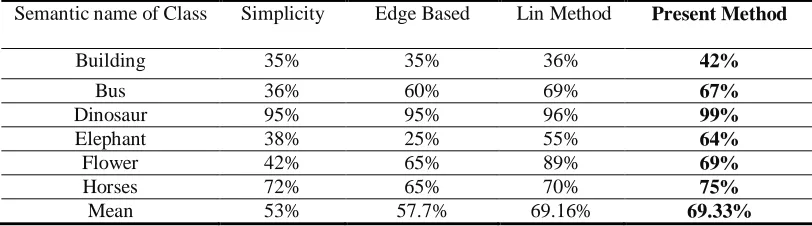
performance is evaluated, as a percentage of the correct number of returned images and is presented in Table 1. Average precision in present method significantly is better than simplicity
and edge based methods in all categories. Comparison between present method and Horng Lin method demonstrate to some extend same results and average precision at four categories from six increased. Main advantage of present system is computation complexity which is the least one
among different methods. Tables 2 demonstrate Comparison of accuracy (ACC %) of retrieved image. Fig 2 display image retrieval of different category of Image set for a query image.
Table-1. Comparison of average precision (%) with proposed method and other standard retrieval systems (Kingsbury, 2001), (Li et al., 2000), (Rubner et al., 1997) when 100 image returned
Semantic name of Class Simplicity Edge Based Lin Method Present Method
Building 35% 35% 36% 42%
Bus 36% 60% 69% 67%
Dinosaur 95% 95% 96% 99%
Elephant 38% 25% 55% 64%
Flower 42% 65% 89% 69%
Horses 72% 65% 70% 75%
Table-2. Comparison of accuracy (ACC%) of retrieved image on Image set.
Fig-2. Result of image retrieval for different category of Image set for a supposed query image.
Returned Image 1 2 5 10 20 30 50 100
Simplicity 60.3 62.2 78.1 79.5 82.2 85.4 88.0 90.7
Edge Based 62.4 70.7 79.0 84.0 87.7 90.2 92.3 94.6
Lin 85.5 90.5 93.6 95.1 96.7 97.7 98.9 99.2
CONCLUSION
Presented is a full-automatic tool for object-based content retrieval through the structure of EM algorithm and spectral analysis. Novel features extraction based on MDW has been introduced.
Subsequently, statistical information from MDW descriptors are retrieved and matched accordingly. The use of defined objects rather than the entire image leads to increase the flexibility of the system, it make simple to search for an object in an already prepared different kind of
objects. Object-based image retrieval is not limited by the averaging properties associated with analyzing the entire image and can use local properties.
REFERENCE
Chen, Y. and J.Z. Wang, 2002 A region-based fuzzy feature matching approach to content-based image retrieval. IEEE Trans. on PAMI, 24(9): 1252-1267.
Gustavo, C., B.C. Antoni, J.M. Pedro and V. Nuno, 2007. Supervised learning of semantic classes for image annotation and retrieval. IEEE TRANSACTIONS ON PATTERN ANALYSIS AND MACHINE INTELLIGENCE, 29(3).
Hirremath, P.S. and J. Pujari, 2008. Content based image retrieval based on texture and shape features using image and its complement. In Proc. of IJCSS, 2.
Huang, P.W. and S.K. Dai, 2003. Image retrieval by texture similarity. Pattern Recognition, 36(665-679).
Kingsbury, N., 2001. Complex wavelets for shift invariant analysis and filtering of signals. J.Appl.Comput.HarmonicAnal, 10(3): 234-253.
Millane, R.P., 1994. Analytic properties of the hartley transform and their implications. Proc. IEEE: 413-428.
Rajavel, P., 2010. Directional hartley transform and content based image retrieval. Signal Processing, 90: 1267-1278.
Rubner, Y., L.J. Guibas and C. Tomasi, 1997. The earth mover’s distance, multi-dimensional scaling, and color-based image retrieval. In Proc. of DARPA Image Understanding Workshop: 661-668.
Rui-zhe, Z., Y. Jia-zheng, H. Jing-hua, W. Yu-jian and B. Hong, 2009. A novel generalized svm algorithm with application to region-based image retrieval. In Proc. of International Forum on Information Technology and Applications: 280-283.