IJEDR1602133
International Journal of Engineering Development and Research (www.ijedr.org)756
Optimization of process parameter for tensile strength
and hardness of S.S 304 by TIG welding
Vijay Gohel1, Jatin Makwana2, Riteshkumar Ranjan3
PG Student, Ipcowala Institute of Engg. & Tech, Dharmaj, Gujarat, India1
Assistant Professor, Mechanical Engineering Department, Ipcowala Institute of Engg. & Tech, Dharmaj, Gujarat, India2 Assistant professor, Mechanical Engineering Department, Ipcowala Institute of Engg. & Tech, Dharmaj, Gujarat, India3 ________________________________________________________________________________________________________
Abstract - Tungsten inert gas welding (TIG) is a high quality welding process commonly used to join plates of higher thickness in load bearing components. This process provide a purer and cleaner high volume weldments. The main purpose of present work is to investigate and correlated the relationship between various parameters and hardness and tensile strength of single square butt joint and predicting weld bead qualities before applying to the actual joining of metal by welding. Changing different welding parameters like effect of Gas flow, voltage and welding current on the tensile strength of the weld joint has been investigated of weld joint. Hardness value of the welded zone has been measured at the cross section to understand the change in mechanical property of the welded zone. In the study which parameter is most effectively effect the weld strength. Weld strength varies under various conditions. By using Taguchi and ANNOVA technique an optimal solution is find out, which provides us an optimal results of the varying condition.
Keywords - TIGWelding, hardness Test, Tensile Test, Stainless Steel-304, Minitab, Taguchi, ANNOVA.
________________________________________________________________________________________________________ I. INTRODUCTION
Modern welding technology started just before the end of 19th century with the development of methods for a generating high temperature in localized zone. Welding generally requires a heat source to produce a high temperature zone to melt raw material, though it is possible to weld two metal pieces without much increasing temperature. As the demand for welding new materials and larger thickness components increase, mere gas flame welding, which was first known to the welding engineer, is no longer satisfactory and improved such as metal inert gas welding, tungsten inert gas welding, electron and laser beam welding have been developed [1].Welding is the process of joining two pieces of metal by creating a strong metallurgical bond between them by heating or pressure or both. A welded joint is obtained when two clean surfaces are brought into contact with each other and either pressure or heat, or both are applied to obtain a bond. The tendency of atoms to bond is the fundamental basis of welding. The basic equipment for TIG welding comprises a power source, a welding torch, a supply of an inert shield gas, a supply of filler wire and perhaps a water cooling system. Type 304: The most common austenitic grades, containing approximately 18% chromium and 8%nickel[3]. It is used for chemical processing equipment, for food, dairy, and beverage industries, for heat exchangers, and for the milder chemicals. As the stainless steel is classified in different categories like austenitic, ferritic, martenstic etc., from this we have chosen austenitic stainless steel (304) because of its low cost, easy availability in the market. The problem that has faced the manufacturer is the control of the process input parameters to obtain a good welded joint with the required weld quality. Traditionally, it has been necessary to study the weld input parameters for welded [2]
II. LITERATURE REVIEW
Ajit Khatteret al[3] Investigate properties of the welded joints are affected by a large number of welding parameters. Properties include Tensile strength, Impact force, Hardness etc. Weld strength varies under various conditions. By using Taguchi and ANNOVA technique an optimal solution is find out, which provides us an optimal results of the varying condition. A. Kumaret
al[4] Optimization of pulsed TIG welding process parameters on mechanical properties of AA 5456 Aluminum alloy weldments.
IJEDR1602133
International Journal of Engineering Development and Research (www.ijedr.org)757
from the Taguchi method are insensitive to the variation of environmental conditions and other noise factor. To solve this task, the Taguchi method uses a special design of orthogonal arrays to study the entire process parameter space with a small number of experiments only[6].1.WORK MATERIAL
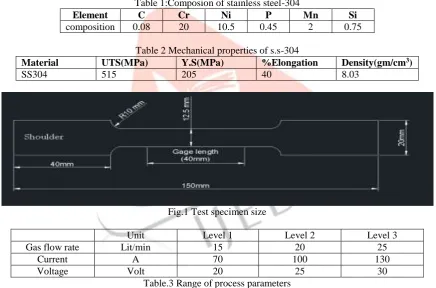
The work material used for present work is austenitic stainless steel 304 the dimensions of the work piece length 150 mm, width 20mm, thickness 3 mm. Argon is used as a shielding gas. The specimen welded by TIG welding as per the standard of ASTM A240.
Table 1:Composion of stainless steel-304
Element C Cr Ni P Mn Si
composition 0.08 20 10.5 0.45 2 0.75
Table 2 Mechanical properties of s.s-304
Material UTS(MPa) Y.S(MPa) %Elongation Density(gm/cm3)
SS304 515 205 40 8.03
Fig.1 Test specimen size
Unit Level 1 Level 2 Level 3
Gas flow rate Lit/min 15 20 25
Current A 70 100 130
Voltage Volt 20 25 30
Table.3 Range of process parameters 2.Tig welding machine
IJEDR1602133
International Journal of Engineering Development and Research (www.ijedr.org)758
Fig.2 Tig welding machine3.Testing machine
In this experimental work, it has been investigated on tensile strength and hardness by varying various process parameters like voltage, current and gas flow rate. There are following performance characteristics investigated.
1.Tensile test 2. Hardness test
Fig.3 UTM machine Fig.4 Vicker hardness test machine 4.L27 TAGUCHI ORTHOGONAL ARRAY
The number of parameters and the number of levels, the proper orthogonal array can be selected. Using the array selector table and the name of the appropriate array can be found by looking at the column and row corresponding to the number of parameters and number of levels. In the present study, three 3-level process parameters i.e. welding current, welding voltage and gas flow rate are considered. The values of the welding process parameters are listed in Table 3.
Sr. No. Gas flow rate
[lit./min]
Current [A]
Voltage [Volt]
Tensile strength[MPa]
Hardness [HV]
1 15 70 20 585 180
2 15 70 25 581 178
3 15 70 30 578 174
4 15 100 20 589 186
5 15 100 25 594 183
6 15 100 30 589 180
7 15 130 20 622 194
8 15 130 25 609 190
9 15 130 30 596 189
10 20 70 20 593 193
11 20 70 25 587 190
12 20 70 30 582 189
13 20 100 20 612 196
IJEDR1602133
International Journal of Engineering Development and Research (www.ijedr.org)759
Table.4 L27 Orthogonal array experiment resultIV. EXPERIMENT RESULT 1.ANALYSIS OF VARIANCE
Analysis of variance (ANOVA) is a statistical model which can be used for find out effect of independent parameter on single dependent parameter and also it can be use full to find out the significant machining parameters and the percentage contribution of each parameter. MINITAB16 statistical software used to analyze the ANOVA analysis for Tensile strength and Hardness.
Table 5.Analysis of Variance for Tensile strength Welding
parameter
Degree of freedom
Sum of squares
Mean squares F P(%)
Gas flow rate 2 1395.85 687.93 32.68 22.07
Current 2 3699.19 1849.59 86.59 58.49
Voltage 2 801.19 400.59 18.75 12.67
Error 20 427.19 21.36 6.75
Total 26 6323.41 100
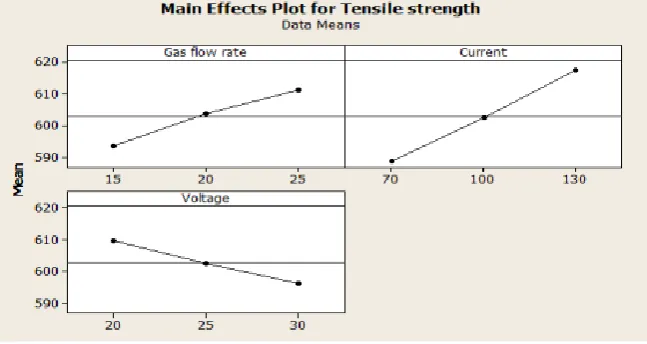
The percentage contribution of welding current is 58.49%, Gas flow rate 22.07% and voltage 12.67% and the Error is 6.75 %. It can be found that the Current is the most significant welding parameters for affecting the Tensile strength.
Fig.5 Effect of control factor on Tensile strength
From the fig.5,it has been conclude that the optimum combination of each process parameter for higher Tensile strength is meeting at high Gas flow rate, high welding current and low Voltage.
Table 6 Analysis of Variance for Hardness Welding
parameter
Degree of freedom
Sum of squares
Mean squares F P(%)
Gas flow rate 2 2270.52 1135.26 275.15 73.92
Current 2 555.85 277.93 67.36 18.09
Voltage 2 162.30 81.15 19.67 5.28
Error 20 82.52 4.13 2.68
Total 26 3071.19 100
IJEDR1602133
International Journal of Engineering Development and Research (www.ijedr.org)760
Fig.6 Effect of control factor on HardnessFrom the fig.6 it has been conclude that the optimum combination of each process parameter for high hardness value is meeting at high Gas flow rate, high welding current and low Voltage.
V. CONCLUSION
Optimum parameter setting for Tensile strength is obtained at current of 130 amps, 20 volt, and 25-litre/min-gas flow and for Hardness optimum parameter is obtained at current of 130 amps, 20 volt, and 25-litre/min-gas flow.
From the ANOVA it is conclude that the welding current is most significant parameter for Tensile strength which contributes 58.49% and Gas flow rate is most significant parameter for Hardness which contributes 73.92%.
VI. ACKNOWLEDGEMENT
I would like to acknowledge with much appreciation the crucial role of Mr. Jatin Makwana and Mr. Riteshkumar Ranjan. For their valuable comments, sharing their time and knowledge on the research carried out during this project. I would also like to thank to Abg engineering works Pvt .Ltd. for help and support regarding to project work
REFERENCES
[1] R k.Jain welding technology, 3rd addition 2012, New age international publication. [2] Welding Handbook, Volume 2, Welding Processes, Eighth edition, AWS.
[3] Ajit Khatter, Pawan Kumar, Manish Kumar Optimization of Process Parameter in TIG Welding Using Taguchi of Stainless Steel-304. ijrmet vol. 4, issue 1-nov 2013 april 2014. International Journal of research In Mechanical engineering & technology [4] A. Kumar, S. Sundarrajan .Optimization of pulsed TIG welding process parameters on mechanical properties of AA 5456 Aluminum alloy weldments. Materials and Design journal homepage.
[5]Wang Rui, Liang Zhenxin, Zhang Jianxun .Experimental Investigation on Out-of-Plane Distortion of Aluminum Alloy 5A12 in TIG Welding. Rare Metal Materials and Engineering, 2008, 37(7): 1264126
[6] Shekhar Rajendra Gulwade R.R.Arakerimath, Parameter Optimization of Tig Welding Using Austenitic Stainless Steel, International Journal of Innovative and Emerging Research in Engineering Volume 2, Special Issue 1 MEPCON 2015
[7] S. P. Gadewar, Peravali Swaminadhan, m. g. Harkare. experimental investigations of weld characteristics for a single pass TIG welding with ss304 / International Journal of Engineering Science and Technology Vol. 2(8), 2010, 3676-3686.
[8] Dongjie Li, Shanping Lu Wenchao Dong, Dianzhong Li, YiyiLi. Study of the law between the weld pool shape variations parameters under two TIG processes. Journal of MaterialsProcessingTechnology212 (2012) 128–136
[9]He Lin, Liu Ying, Li Jun Li Binghong .Microstructure and Mechanical Properties for TIG Welding Joint of High Boron Fe-Ti-B Alloy.Rare Metal Materials and Engineering, 2014, 43(2): 0283-0286.
[10] Ramesh Kumar Buddu, N. Chauhan, P.M. Raole. Mechanical properties and microstructural investigations of TIG welded 40 mm and 60 mm thick SS 316L samples for fusion reactor vacuum vessel applications. Fusion Engineering and Design89(2014)3149–3158.