University of South Carolina
Scholar Commons
Theses and Dissertations
2015
Antecedents of Adolescents' Hope: Personality,
Parental Attachment, and Stressful Life Events
Kristin L. OtisUniversity of South Carolina - Columbia
Follow this and additional works at:https://scholarcommons.sc.edu/etd Part of theSchool Psychology Commons
This Open Access Thesis is brought to you by Scholar Commons. It has been accepted for inclusion in Theses and Dissertations by an authorized administrator of Scholar Commons. For more information, please [email protected].
Recommended Citation
ANTECEDENTS OF ADOLESCENTS’ HOPE: PERSONALITY, PARENTAL ATTACHMENT, AND STRESSFUL LIFE EVENTS
by Kristin L. Otis Bachelor of Arts University of Georgia, 2011
Submitted in Partial Fulfillment of the Requirements For the Degree of Master of Arts in
School Psychology College of Arts and Sciences University of South Carolina
2015 Accepted by:
E. Scott Huebner, Director of Thesis Kimberly J. Hills, Reader
A
BSTRACTIn the past decade, psychology has concentrated on the importance of identifying
T
ABLE OFC
ONTENTSABSTRACT ... iii
LIST OF TABLES ...v
CHAPTER 1: INTRODUCTION ...1
CHAPTER 2: HOPE...4
2.1 RELATED CONSTRUCTS ...6
2.2 CONSEQUENCES OF HOPE ...9
2.3 ORIGINS OF HOPE ...13
CHAPTER 3: RATIONALE FOR STUDY ...22
CHAPTER 4: METHOD ...25
CHAPTER 5: RESULTS ...30
CHAPTER 6: DISCUSSION ...41
L
IST OFT
ABLESTable 5.1 Descriptive Statistics of the Sample ...36 Table 5.2 Descriptive Statistics for Variables ...37 Table 5.3 Intercorrelations Among all Variables ...38 Table 5.4 Hierarchical Regression Analyses: Demographics, Personality, Parental
CHAPTER 1
I
NTRODUCTIONHistory of Positive Psychology
Previously, psychology has focused largely on the diagnosis and treatment of pathologies or diseases (Sheldon & King, 2001). Researchers have concentrated on the absence or presence of psychopathology whenever considering an individual’s mental health issues. With this perspective, psychologists have been interested in intervening or fixing deficits that were already present in an individual. This deficit approach to mental health has been considered inadequate in the recent decades. As early as 1958, Jahoda stated that the absence of psychopathology did not reflect optimal mental health. She proposed that positive psychological indicators be incorporated in psychological assessments as a means to grasp a more complete picture of an individual’s mental “health”. Additionally, Sheldon and King (2001) stated that the deficit-focused perspective may limit or lead to negative biases in psychologists’ understanding of total human functioning. These arguments exemplify the move towards emphasizing positive psychological aspects in individuals when considering one’s level of functioning. Rather than solely concentrating on maladaptive factors that cause individuals to suffer, the main focus of positive
possesses some of these positive indicators in addition to the absence of
psychopathology. Snyder and colleagues (2000) have argued that hope should be one of these positive indicators.
History of Hope
Though in the present day, hope is considered to be a positive attribute, prior to the 1960’s it was viewed as a negative concept. Both Sophocles and Nietzche portrayed hope as a human weakness that only prolonged suffering (Snyder, 2000). Similarly, Plato criticized individuals who listened to the voice of hope, calling them “foolish
CHAPTER 2
H
OPESnyder’s Hope Theory
Snyder has defined hope as the complex system of thoughts and perceptions involving one’s personally valued goals, one’s perceived ability to generate strategies to achieve the desired goals, and one’s perceived ability or motivation to carry out said strategies
(Snyder, Harris, Anderson, Holleran, Irving, Sigmon, et al., 1991). This theory places emphasis on the cognitive nature of hope, which is driven by evaluation and self-awareness (Blake & Norton, 2014). Hope is most often conceptualized as a somewhat trait-like or relatively stable characteristic that is displayed across multiple goal contexts and thus is considered a psychological strength (Valle, Huebner, & Suldo 2006).
Nevertheless, some researchers have studied a goal-specific hope or a “state” hope that is directly related to explicit goals (Snyder, 2000; Snyder, Lopez, Shorey, Rand, &
Feldman, 2003). Trait hope is thought to influence specific goal attainment indirectly by goal-specific hope (Feldman, Rand, & Kahle-Wrobleski, 2009; Snyder, Shorey,
develop solutions to reach his/her goal (Snyder, 2000). Once a person has completed a goal, whether it results in failure or success, the outcome influences future goal
attainment and impacts one’s agency and pathways. Successful goal pursuit often leads to the experience of positive emotions (Farran, Herth, & Popovich, 1995). It is believed that in order for individuals to flourish they must possess positive goal-directed thoughts otherwise known as hope (Esteves, Scoloveno, Mahat, Yarcheski, & Scoloveno, 2013; Snyder, et al., 2002). According to Shorey and colleagues (2003), if children learn to be more hopeful, they will be more likely to set goals and work actively towards the achievement of those goals.
Hope has been conceptualized differently in a few distinctive theories. For example, Hinds (1984) characterized hope as one higher-order construct that spanned across four lower-order levels: forced effort, personal possibilities, expectation of a better tomorrow, and the anticipation of a personal future. This theory specifically addressed the level of functioning of hope in adolescents, with the higher levels indicating higher functioning. In 1985, Dufault and Martocchio reframed hope as a multidimensional process rather than a one-dimensional construct. Furthermore, they argued that hope prompts one’s confidence in attaining one’s future goals.
component, “pathways thinking” involves an individual’s perceived ability to generate strategies to attain his/her personally valued goals (Snyder, 2000). This concept has also been called the “way” portion of hope, representing the specific strategies to carry out a goal. Each component of hope is vital for goal pursuit, but neither component is sufficient alone to successfully achieve one’s goals, as it is believed that without agency, the
pathways are useless. The reverse is also believed to be true, without strategies or
pathways to complete a goal, the motivation to do so may be futile (Snyder, et al., 2003). Agency and pathways thinking are directly related to how individuals ultimately behave to move towards their goals (Snyder, 2000). Snyder’s hope theory is based on the notion that individuals are goal-directed (Snyder, 1996). According to Snyder, in order to possess hope, an individual must first have personally valued, achievable goals. These goals must neither be 100% guaranteed nor have a 0% chance of succeeding. A goal that is guaranteed to occur does not require hope, and one that has no chance of happening would be a waste of hope (Snyder, 2000).
2.1 RELATED CONSTRUCTS
Hope has been connected to several similar but separate positive indicators of well-being; these related concepts include self-efficacy, optimism, and divergent thinking (Snyder, et al., 2002; Tennen, Affleck, & Tennen, 2002). Studies have shown that hope is
sufficiently distinct to be studied independently (Snyder, et al., 2002). It is important to differentiate hope from these other constructs, in order to illustrate the unique
significance of hope for an individual.
perform and make an impact on certain events in their life (Bandura, 1997). Both
concepts are goal directed, but differ contextually. Self-efficacy theory is examined in the context of specific situations while hope is viewed as a more general individual
difference characteristic. Individuals may feel efficacious about specific goals or situations but hope is more general and applies across situations (Snyder, et al., 2002). Another distinction is that hope theory places more emphasis on the goals (Snyder, 2000). Self-efficacy theory addresses individuals’ outcome expectancy, which is analogous to pathways thought, and efficacy expectancy, which is analogous to agency thoughts (Snyder, 2000). Additionally, self-efficacy theory emphasizes individuals’ efficacy expectations as more important than outcome expectations. Hope theory on the other hand, values agency and pathways as equally important concepts (Snyder, et al., 2002). Moreover, both the “will” and “way” components of hope have been shown to provide unique variance above and beyond self-efficacy when predicting individual’s well-being (Magaletta & Oliver, 1999).
cognitive-motivational construct that applies across the various areas in the individual’s life. Unlike hope, optimism does not include individuals’ pathways that may lead to those positive outcomes. Optimism and hope have demonstrated similar correlates such as problem-solving, life satisfaction and positive social relationships (Bailey, Eng, Frisch, & Snyder, 2007; Magaletta & Oliver, 1999; Peterson & Seligman, 2004). However, hope demonstrates predictive abilities above and beyond those of optimism. After controlling for optimism, hope was found to predict levels of various indicators such as problem-focused coping, mental health outcomes, and academic achievement for graduate and undergraduate students (Magaletta & Oliver, 1999; Rand, et al, 2011; Snyder, et al, 199). Hope theory proposes that the goals themselves do not produce behaviors, but rather that the individual’s beliefs about her or his capabilities of devising and implementing goal-focused strategies are what produce an individual’s goal-directed behaviors (Snyder, et al., 2002).
2.2 CONSEQUENCES OF HOPE
Early research on hope focused on the presumed consequences of individual differences in hope. Past research has demonstrated that there are various important consequences or benefits associated with hope in children and adolescents, including positive physical and mental health, positive interpersonal relationships, and academic success (Marques & Lopez, 2014). Subsequent research has been devoted to examining the origins of
individual differences in hope including personality variables, interpersonal relationship variables (e.g., parent-child interactions), and demographic variables such as children’s age, gender, race, and socioeconomic status (SES). The following section will provide a review of the existing research.
Physical and Mental Health
In regard to physical and mental health, hope has been shown to be a positive factor in various populations such as students, clinical populations, healthcare workers, and parents (Dufault & Martocchio, 1985; Faso, Neal-Beevers, & Carlson, 2013; Kylma, Duggleby, Cooper, & Molander, 2009). As early as the 1960’s, physicians began to see hope as a vital aspect to healing or recuperation (Snyder, 2000). Hope has been viewed as a positive indicator for both the caretakers, as well as the individuals with disabilities. Faso and colleagues (2013) found for parents with children with autism spectrum
context, hope was vital for individuals in both living and dying, not only for the patients, but also for their caregivers. These results may illustrate a moderation effect of hope on stressful life events by affecting the coping skills that one selects. For example,
individuals who were recently disabled were more likely to exhibit depressive and other psychological impairments if they reported low levels of hope (Elliott, Witty, Herrick, & Hoffman, 1991).
Moreover, hope has been shown to be an essential factor in the positive mental health of youth in particular (Marques, Lopez, & Mitchell, 2013; Snyder et al., 2003). For example, Snyder (2000) demonstrated that overall psychological well-being and hope were positively correlated for adolescents and adults. Marques and colleagues (2009) also demonstrated that hope was positively correlated with life satisfaction and positive mental health for Portuguese adolescents. Additionally, Marques and colleagues (2011) found that through a hope intervention, increases in hope corresponded with increases in life satisfaction. Similarly, Valle and colleagues (2006) found that high reports of hope correlated with high levels of life satisfaction for American adolescents. Finally, Marques and colleagues (2013) found that hope predicted global life satisfaction in Portuguese adolescents up to a year later. The relationship between hope and physical health in youth has not been investigated as thoroughly as in relation to mental health. However, in a longitudinal study with adolescents, Carvajal (2011) found that hope in combination with optimism, promoted health-related behaviors including healthy eating and increased physical activity.
depressive and anxious symptoms in college students and school-aged children (Alarcon et al., 2013; Shorey, Snyder, Yang, & Lewin, 2003; Snyder, Hoza, Pelham, Rapoff, Ware, Danovsky, et al., 1997). Individuals with lower levels of hope have been shown to
react to stressful situations with maladaptive coping mechanisms. For example, in middle and high school students, lower levels of hope were also found to predict higher levels of internalizing behaviors one year later, although higher levels of hope served as a buffer against subsequent increases in internalizing behaviors (Valle et al., 2006). College students with lower levels of hope also utilized more avoidance coping strategies and maladaptive studying skills when faced with academic problems (Chang, 1998;
Onwuegbuzie, 1998). Similarly, studies have shown that low hope adolescents are more likely to engage in risky behaviors, such as smoking and substance abuse in comparison to their peers who reported higher levels of hope (Carvajal, Chair, Nash, & Evans, 1998; Wilson, Boyce, Battistich, & Selvin, 2005). These results suggest that lower levels of hope may play a role in elevating the negative effects of stressful life events.
Interpersonal Relationships
Academics
For years, researchers have argued that academic achievement and school success depend on much more than an individual’s intelligence (Day et al., 2010). One of those
significant determinants of academic success appears to be hope. For example,
individuals with higher levels of hope demonstrate a higher likelihood of graduating from college (Snyder et al., 2002). Based on the review of the literature, Marques and Lopez (2014) argue that hopeful students do better in school and in life in comparison to their less hopeful peers.
Several studies have found a positive correlation between levels of hope and grade point average for students in middle school, high school, college, and graduate school (Curry, Snyder, Cook, Ruby, & Rehm, 1997; Gilman, 2006; Rand et al., 2011; Snyder et al., 2002). Studies have shown that in comparison to their more hopeful peers, low hope college and graduate school students report more academic and test anxiety, lower academic self-efficacy and academic satisfaction, and utilize more maladaptive study habits including procrastination (Alexander & Onwuegbuzie, 2007; Chang, 1998; Onwuegbuzie, 1998; Snyder et al., 2002; Snyder, et al., 2003). The literature illustrates the importance of hope for college-aged and graduate-level students, but there is a
paucity of research examining hope’s relationship with academic performance in younger students.
However, the current research does suggest that this is a significant relationship between hope and academic success in adolescence. For example Marques and
higher scores on standardized testing in comparison to less hopeful students.
Furthermore, Adelabu (2008) found that hope predicts academic achievement in middle and high school students. A longitudinal study found that among college students in the United Kingdom, hope predicted GPA above and beyond past academic achievement, intelligence, and personality (Day et al., 2010). Conti (2000) theorized this association may be due to the fact that higher hope individuals are better able to clearly conceptualize and identify their goals and are more intrinsically motivated; thus they perform better in academic settings. Marques, Lopez, and Pais-Ribeiro (2011) argue that individuals with higher hope possess the ability to think in a goal-directed manner; thus increasing hope leads to more goal-direct behavior.
The above studies demonstrate the substantial relation of hope to a variety of important life outcomes. As evidenced by this review of past literature, hope is an
important construct in regard to the well-being of adults and youth. Thus it is important to understand how individuals initially establish and develop individual differences in hopeful thinking.
2.3 ORIGINS OF HOPE
The majority of the ideas behind the antecedents of hope are derived from Snyder’s initial theory (Peterson & Seligman, 2004). Along with his hope theory, Snyder (2000)
identifying personal goals and pathways towards them. Subsequently, toddlers are able to differentiate themselves from others and begin to recognize themselves as instigators of actions, and thus develop perceptions of capabilities, or agency. Throughout the process during which a child develops the cognitive abilities to possess hope, Snyder argued that the home environment, which includes both the family relationships such as the
caregiver-child attachment and experiences such as stressful life events, are separately but concurrently facilitative in the initial development of hope (Blake & Norton, 2014; Snyder, 2000). Hope is initially influenced by the home environment and then later reinforced through social and other learning experiences. Individuals’ hopeful thinking develops and becomes increasingly complex at each developmental period: preschool, childhood, and adolescence (Snyder, 2000). Several studies have illustrated a positive relationship between social support or the “availability of a socially supportive network” and hope demonstrating that social support is an important variable when examining hope (e.g., Esteves et al., 2013). In fact, Snyder (1997) argues that perceptions of positive social support are vital to hopeful thinking. Social support is thought be partially developed through the initial parent-child relationship.
Snyder (1994) has also explored experiences that may destroy or inhibit hope development in individuals such as neglect, inconsistent parenting, parental loss, etc. He argued that these significant events early in life (i.e. in the first eighteen years) are crucial to one’s trajectory of hope development. According to Snyder (2000) the initial
overarching contributing factor in an individual’s hope development is the home environment, which he delineates as the familial interactions, relationships and
home environment is affected by the family relationship and interactions, especially the presence or absence of a positive child-caregiver attachment. For example, individuals who recalled having parents who rejected and criticized them as a child perceived social situations more negatively (Batgos & Leadbeater, 1994). Also incorporated into his idea of the home environment is the experience of stressful life events. On this note, Hinton-Nelson, Roberts, and Snyder (1996) also found that children who were victims of or had witnessed interpersonal violence, reported lower levels of hope than did children who had not encountered interpersonal violence
Similar to Bowlby’s attachment theory (1980), Snyder’s hope theory emphasizes the caregiver-child bond as a key component to positive hope development. This bond should foster the development of a child’s agency and pathways thinking. Infants often adopt the behavioral patterns of their caregiver, therefore a caregiver should play the role of a coach by demonstrating positive behaviors and beliefs, while also allowing the child to experience successes and failures on their own (Bowlby, 1980; Shorey, Snyder, Rand, Hockemeyer, & Feldman, 2002). Through these interactions, infants begin to cultivate their own “internal working models”. These models represent individuals’ mental symbols of oneself, caregivers, and one’s environment (Bowlby, 1980). The absence of such a positive caregiver bond or the presence of a negative or emotionally unattached bond is hypothesized to impede the progression of positive hope development (Rieger, 1993; Snyder, 2000).
thought to be relatively stable across time, affecting future adult relationships (Hazan & Shaver, 1990). Due to the relative stability of this construct, it is acceptable to measure respective parental attachment in adolescences and adults (Parker, 1994)
Though the complete theory remains untested, there have been a handful of studies, which have endorsed key components of Snyder’s hope origin theory. Numerous studies have shown that parental attachment plays a meaningful role individuals’ hope in a variety of situations, illustrating a significant relationship between secure attachment and positive hope development (Blake & Norton, 2014; Jiang, Hills, & Huebner, 2013; Shorey, et al., 2003). Additionally, though not studied as extensively as parental attachment, research has demonstrated a significant inverse relation between the
experience of stressful life events and hope (Snyder, 2005; Valle, et al., 2006). In regards to attachment style, Shorey and colleagues (2003) found that undergraduates between the ages 18-30 with higher levels of hope report positive attachments with caregivers.
Similarly, Simmons and colleagues (2003) found that home healthcare nurses who reported secure attachment styles were more likely to be hopeful. Furthermore, Shorey and colleagues found that for college students, hope functioned as a partial mediator between attachment styles and individuals’ mental health and well-being. Additionally, hope was found to mediate the relationship between parental attachment and life
positively correlated with those who reported secure attachment styles, and negatively correlated with self-reported anxious and avoidant attachment styles in individuals ranging from middle school students to adults from diverse samples of individuals from the United States, Israel, Singapore, and Turkey.
The second antecedent cited in Snyder’s hope theory (2000) is the experience of stressful life events. This component has not been investigated as much as the parental attachment component. Life events are incidents that may an impact on one’s everyday functioning and may represent a significant or major point in his/her life (Compas, 1987). Others have also argued that stressful events may impede on an individual’s hope
development and may affect the levels of hope one reports (Snyder, 2005). These life events, both positive and negative, have been shown to have an effect on both adult’s and adolescent’s subjective well-being or life satisfaction (Ash & Huebner, 2001; Headey & Wearing, 1989). These events can be categorized as normative and non-normative, the former life events are experiences that most people will encounter at least once within their lifetime. The latter group of events can also be referred to as stressful life events. Examples of a non-normative, stressful life event are the loss of a loved one, a serious injury or illness of oneself or a loved one (Schwarzer & Luszcynska, 2013). These events are ones that do not occur very often for individuals and tend to have a negative or detrimental effect on individuals especially if the individual does not possess adequate personal and external resources to successfully cope with the situation at hand. For example, Johnson and colleagues (2012) found that for children and adolescents between the ages 9-16, the experience of one or more stressful life events was positively
school students, hope moderated the relationship between stressful life events and life satisfaction. They postulated that this relationship may be explained through the ways of affecting one’s coping strategies. Specifically they found that individuals with low hope demonstrated more internalizing disorders when faced with more stressful life events, but this was not the case for those with high hope.
Valle et al. explains this relationship by those with higher levels of hope also demonstrate more resilience when faced with stressful or aversive situations. Thus, when faced with a stressful situation, a high hope individual has more “pathways” to resolve or cope with the situation. Children cannot be sheltered away from experiencing stressful life events, such as an unexpected death of a loved one, but by equipping them with positive coping strategies or hope, the children may be able to resolve and recuperate at a much faster and more adaptive manner (Valle et al., 2006). Hope enables individuals to approach problems from an optimistic framework, which allows them to concentrate on success or resolution rather than the stress or possibility of failure (Conti, 2000; Snyder, 1997). The directionality and impact of the relations between stressful life events and hope has not been fully explored; thus there needs to be more research examining this relationship.
Though Snyder’s theory expands upon the impact of one’s home environment, namely parental attachment and stressful life events, as key etiological factors in the development of hope, this theory does little to account for other variables (e.g.,
Demographics
Findings regarding the associations between hope and demographics variables such as age, race, gender, and socioeconomic status (SES), have been mixed. While some studies have found no significant differences between age groups (Day & Padilla-Walker, 2009; Valle, Huebner, & Suldo, 2004), Marques and Lopez (2014) found that hope declines from late childhood to adolescence (from 10 to 17 years of age) in Portuguese children. Furthermore, Venning and colleagues (2009) found that the two components of hope, agency and pathways, demonstrate different age-related changes throughout adolescence. Specifically, agency significantly increased each year between ages 13-16, while
Snyder and colleagues repeatedly found gender as non-significantly related to hope (Snyder, et al., 2003; 2005). However, more recently, Venning and colleagues (2010) found significant difference between gender and pathways trajectory throughout adolescence. Lastly, studies have not demonstrated any significant relations between family income and socioeconomic status with hope (Snyder, 2005). Researchers postulate that as long as the child is given sufficient care, the socio-economic status of the family does not have a significant impact on hope (Snyder, 2005). Overall, the studies that have demonstrated significant demographic relations with hope have only demonstrated small effect sizes, indicating that though the differences may be clinically significant, they are small, and may not be practically meaningful. However, the general lack of consensus on the relation between key demographic variables and hope illustrates that more research is needed to understand the associations with hope.
Personality
CHAPTER 3
R
ATIONALE FORS
TUDYIn comparison to studies of the outcomes or correlates of individual differences in hope, the review of the literature suggests that less attention has been given to the origins or antecedents of hope development. This lack of attention is particularly noteworthy with respect to studies of children and adolescents. In this study, I focused on early
adolescence because it is a critical time of important transitional events, developmental and cognitive changes, and thus high-risk period for the development of emotional and behavioral problems (Cicchetti, & Rogosch, 2002). Additionally, some research suggests that early adolescents show significant declines in hope levels (Marques & Lopez, 2014) relative to childhood and later adolescence.
Furthermore, consistent with Snyder’s (date) theory, the extant research has focused on possible environmental antecedents of adolescents’ hope differences,
especially parent attachment relationships and stressful life events. There has been little, if any research conducted examining the impact of individual difference variables on adolescents’ hope, including major personality variables, such as extraversion and neuroticism. Given that prior research suggests that personality differences relate to hope development of individuals, research investigating the roles of environmental and
adolescents, including personality variables, ongoing parent attachment relations, and recent major stressful life events. Attachment theories have alluded to the idea that individuals possess genetic dispositions or temperaments that can influence the initial child-caregiver attachments (Bowlby, 1980). Similarly, studies have found moderate correlations between personality traits, neuroticism, extraversion, and conscientiousness and hope, but these studies have been limited to high school and college students
(Halama et al., 2007; 2010). Furthermore, although research has examined the effects of hope in relation to the experience of stressful life events, there have been few studies investigating the impact of major, stressful life events on the development of hope in early adolescents. Thus, this study sought to extend beyond Snyder’s theory to explore a more comprehensive model of hope development in youth.
Research Questions
The purpose of this study was to investigate the nature and magnitude of the relations between individual differences in early adolescents’ hope and key potential determinants, specifically, parental attachment, stressful life events, and the personality variables of extraversion and neuroticism among. Based on Snyder’s theory, I predicted that parent attachment would relate positively to hope. Furthermore, I predicted that the occurrence of stressful life events would relate negatively to hope. I also predicted that the quality of parental attachment and the occurrence of stressful life events would independently predict hope (i.e. showing unique variance in predicting hope, after controlling for
conceptualized to be somewhat biologically based, would predict hope, after controlling for demographic effects. Using hierarchical multiple regression analyses, in which variables were entered on the basis of temporal precedence (after controlling for significant demographic effects), I also predicted that environmental variables (parent attachment and recent major life stress respectively) would contribute significant variance to the prediction of adolescents’ hopes scores above and beyond the effects of the
CHAPTER 4
M
ETHODParticipants
This study used an extant dataset that has been reported on previously (Lyons, Huebner, & Hills, in press); however, these analyses are new. The data were collected by school administrators and teachers from one middle school in a southeastern US state as part of a school-wide survey of students’ perceptions of school climate and student well-being. The original data consisted of 662 students, from which 15 students were deleted from the analyses due to more than 80% of missingness of responses to the questionnaire items. Sixth seventh, and eighth grade students in the general education classrooms were included in the survey.
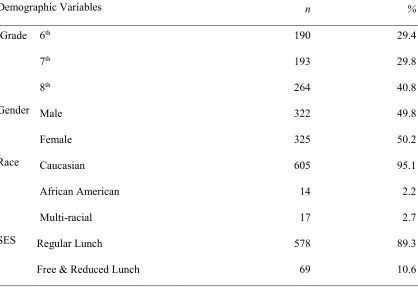
Demographic information is summarized in Table 1. Due to variability in missingness, students who responded less than 80% on all relevant scales were
considered not valid and were not included in the analysis. Six-hundred and forty-seven students completed the questionnaire. All students were in the 6th (29%), 7th (30%), or 8th (41%) grades. Approximately 50% of the participants were female, the vast majority of the participants reported as non-Hispanic (99%) and Caucasian (94%). A smaller
demonstrated that 2%of students received reduced lunch and 9% of students received free lunch. The remaining 89% of students indicated that they paid for regular lunch.
Procedures
Approval from the university and the school district institutional review boards was received. Assent forms were sent home to all students’ parents, allowing them to opt out of the survey if desired. Teachers administered the student surveys to groups of students during their respective homeroom class periods. Additional measures were included in the questionnaire but were not included in these analyses. All students in regular classes in the middle school were included in the data collection; however, students in self-contained special education classrooms were excluded. The questionnaires were de-identified before they were received by the researchers.
Measures
Children’s Hope Scale.(CHS: Snyder, Hoza, Pelham, Rapoff, Ware, Danovksy, et al., 1997). The CHS was used to measure student’s perceptions regarding their ability to formulate pathways to achieve their goals and their motivation to carry out said goals. The CHS is a 6-item measure that assesses the two facets of hope: agency and pathways thinking with three items devoted to each facet. Items are answered on a 6-point Likert scale, ranging from 1-none of the time, to 6-all of the time. Items assessing student’s agency are similar to “I think the things I have done in the past will help me in the
not meant to be measured separately (1996). Thus, this study examines hope as a collective construct rather than the two separate components of agency and pathways thinking. Past research with this measure has demonstrated internal consistency levels ranging from .72 and .86 and test-retest reliability from 1-week to 1-month to range from .71 to .73 respectively (Snyder, 1996). Internal consistency for hope for this study was (α = .88).
Stressful Life Events Scale.Student’s experience of stressful life events was measured by using the Stressful Life Events Scale (SLES: Johnson & McCutcheon, 1980). This scale includes a total of 28 items that refer to controllable but stressful life events, and 18 items that refer to uncontrollable and stressful life events. This study included 16 items assessing the uncontrollable stressful life events items rather than the entire measure. School personnel removed two items from the measure due to their sensitive nature. This was selected based on time constraints as well as for research of interest. For each item, students were instructed to indicate whether they HAVE or HAVE NOT experienced the stressful life event within the past 12 months. Example items include death of a family member, parents divorced, and change in parents’ financial status (Johnson &
McCutcheon, 1980). The items were summed to create a composite score reflecting the frequency of occurrence of recent stressful life events. No internal consistency estimates s were calculated for this study due to the nature of the scale, with each item representing an independent experience (Streiner, 2003).
Inventory of Parent and Peer Attachment. (IPPA, Armsden & Greenberg, 1987).
adolescents’ perceptions of their relationships with their parents and close friends, including both negative and positive components. The scale consists of 75 items, 25 items for each category (mother, father, peers). Each scale identifies an overall attachment score, which is divided into three themes: the degree of mutual trust, the quality of communication, and the extent of anger and alienation. For the purpose of this study, only the parental attachment items were used, assessing both maternal and paternal attachment. Additionally, because of time constraints, only 13 items were selected from the original 25 items. This abbreviated scale has been used in previous studies (Elmore & Huebner, 2010; Jiang, Huebner, & Hills, 2013). Because of the limited items, only the overall attachment score was calculated. The students are asked to indicate whether they are answering the items for their biological, step, adopted, foster, or other for both mother and father sections. Items were answered on a 5-point Likert scale, ranging from
Abbreviated Junior Eysenck Personality Questionnaire Revised. (JEPQR-A, Francis,
1996). In order to assess students’ personality traits, the Abbreviated Junior Eysenck Personality Questionnaire was administered. The Eysenck personality questionnaire assesses three personality traits including Extraversion, Neuroticism, and Psychoticism. For the purposes of this study, only the extraversion and neuroticism traits were included in the questionnaire. The Extraversion composite consisted of 6 items, while the
CHAPTER 5
R
ESULTSBefore conducting analyses, the data were assessed for possible violations of model assumptions. This examination revealed the percentage of data that were missing; missingness of scales ranged from 0% to 26%. Cohen and colleagues (2003) argue that missing data within this range can influence the results by way of standard errors and significance. Thus, missing data were handled by conducting multiple imputation using R 2.10.1. Forty additional datasets were run in order to achieve the most realistic dataset.
Descriptive Statistics
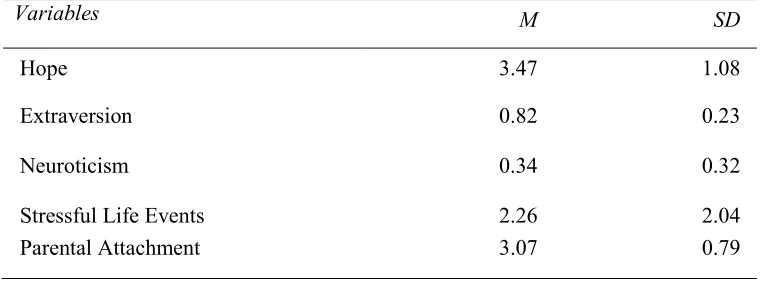
Descriptive statistics are presented in Tables 5.1 and 5.2. The mean for hope was 3.47 (SD = 1.08). This response falls within the “some of the time” response for hope (range 1-6). This mean found in this population is slightly lower than the results of past studies with middle school students (M=3.73; Marques, et al., 2011). The mean for stressful life events was 2.26 (SD= 2.04); this number is out of 16 items presented. The mean of parental attachment was 3.07 (SD = 0.79), this falls within the “sometimes true” response with mother and father parental attachment (range 1-6) and is slightly lower than results of past studies (M=3.77; Jiang, et al., 2013). The mean for neuroticism was 0.34 (SD = 0.32), which is comparable to past studies (M=0.31; Lyons, Huebner, Hills, &
Four one-way ANOVAs were conducted to test for differences in hope related to each demographic variable: grade, gender, race, and SES. For those demographic
variables that demonstrated significance, Tukey HSD tests were conducted to determine which groups where significantly different from each other. The demographic variables of race and gender did not demonstrate a significant relationship to hope.
However, mean differences were found for students’ grade levels, F(2, 644) = 13.18, p <.01. Specifically, Tukey HSD tests showed that students in grade 6 (M = 3.74, SD = 0.96) indicated significantly higher hope scores in comparison to those in grades 7 (p <.01) & 8 (p <0.1) (M = 3.20, SD = 1.10, p <.01; M = 3.42, SD = 1.09, p <.01), while grades 7th and 8th did not differ significantly from each other.
Additionally, mean differences on hope scores related to students’ SES levels were observed, F(2, 644) = 5.38, p <.01. Tukey HSD tests showed that who received regular lunch (M = 3.49, SD = 1.07) demonstrated significantly higher hope scores in comparison to those who received free lunch (M = 3.13, SD = 1.06) p <.05), while reduced lunch (M = 2.74, SD = 0.92) did not differ significantly from free nor regular lunches. The significance of these results may be due to an unequal sample size difference between the groups.
Correlation Analyses
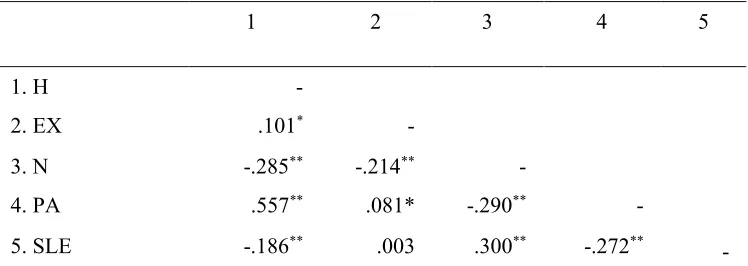
.01), and small correlations with personality variables, extraversion (r = .10, p < .01) and neuroticism (r = -.29, p < .01). The only non-significant correlation found was for the relationship between extraversion and stressful life events.
Multiple Regression Analyses
To test the first three research questions, hierarchical regression analyses were run to assess the relation of each variable with hope, when controlling for statistically significant demographic variables, specifically grade and SES. To answer the first question, the relationship between parental attachment and hope was evaluated, this relationship proved to be positive, β = .55, R2 = .31, F(3,643) = 99.64, p < .001. To answer the second question, the relationship between stressful life events and hope was evaluated, this relationship proved to be negative, β = -.19, R2 = .05, F(3,643) = 13.64, p < .001. To answer both parts of the third question, the relationship between extraversion and neuroticism and hope were independently evaluated. Extraversion proved to have a unique and positive relationship with hope, β = .09, R2 = .03, F(3,643) = 7.59, p < .001, while neuroticism had a unique and a negative relationship with hope, β = -.28, R2 = .10, F(3,643) = 24.80, p < .001.
variables of extraversion and neuroticism were entered in Step 2, parental attachment was entered in Step 3, and the stressful life events variable was entered in Step 4. The
variables were entered on the basis of presumed temporal order from the most temporally precedent variables (i.e., biologically-based personality variables followed by the parent attachment relationship) to the variables closest in time (i.e., recent stressful life events). This order allowed for the assessment of the amount of variance that was accounted for by each determinant, while controlling for the each presumed temporally precedent variable.
The results of the hierarchical regression indicated that these four sets of variables together explained 33% of the variance of hope R2 =.33, F(6,640)=53.38, p <.001. The first step of the regression, which included grade and lunch explained 2% of the variance, R2 = .02, F(2, 644) = 8.51, p < .001. The second step of the regression, which included extraversion and neuroticism, accounted for an additional 8% of explained variance, this
change in explained variance was significant, ∆R2 = .08, ∆F(4, 642) = 28.35, p < .001. The third step of the regression, which included parental attachment explained an
additional 23% of variance, which was significant, ∆R2 = .23, ∆F(5, 641) = 219.99, p <
.001. The fourth and final step of the regression, which included stressful life events
demographic variables, personality variables, and parent attachment variable. The results are illustrated in Table 5.4.
Lastly, to assess the fifth research question, multiple regression analyses were used to test whether neuroticism plays a moderating role between stressful life events and hope. Moderation was evaluated according to the Baron and Kenny approach (1986). The overall regression model was significant, R2 = .11, F(5, 641) = 16.70, p < .01.
Multicollinearity diagnostics were assessed to ensure that the variables stressful life events and neuroticism were not significantly correlated with each other. All diagnostics were within an acceptable range (i.e. .82 to .99). All variables indicated VIFs within an acceptable range, (i.e. 1.0 to 1.3). Stressful Life events and neuroticism variables were centered as recommended by Aiken and West (1991). Refer to Table 5.3 for correlations among variables.
In the first step, two demographic variables were included, grade and SES, which accounted for a significant amount of variance in hope, R2 = .02, F(2, 644) = 8.51, p < .001. Though statistically significant in the first two steps, in the final model, SES no longer significantly predicted hope above and beyond the other variables; however, grade remained a significant predictor in the final model, β = -.12, p < .01.
In the second step, stressful life events were entered which accounted for a
In the third step, neuroticism was entered which accounted for a significant
amount of additional variance, ∆R2 = .06, ∆F(4, 642) = 40.97, p < .001. In the final
model, neuroticism accounted for a significant amount of variance in hope, β = -.25, p < .001.
In the final step of the regression analysis, an interaction term between
neuroticism and stressful life events was created. This interaction term did not account
for a significant proportion of the variance in hope, ∆R2 = .00, ∆F(5, 641) = .04, p = .85. Thus, neuroticism did not moderate the effects of stressful life events on early
Table 5.1: Descriptive Statistics of the Sample
Demographic Variables n %
Grade 6th 190 29.4
7th 193 29.8
8th 264 40.8
Gender Male Female
322 325
49.8 50.2 Race Caucasian
African American Multi-racial
605 14 17
95.1 2.2 2.7 SES Regular Lunch
Free & Reduced Lunch
578 69
Table 5.2: Descriptive Statistics for Variables
Variables M SD
Hope 3.47 1.08
Extraversion 0.82 0.23
Neuroticism 0.34 0.32
Table 5.3: Intercorrelations Among all Variables
1 2 3 4 5
1. H -
2. EX .101* -
3. N -.285** -.214** -
4. PA .557** .081* -.290** -
5. SLE -.186** .003 .300** -.272**
-
Note. H: Hope; EX: extraversion; N: Neuroticism; PA: Parental Attachment; SLE: Stressful Life Events
3
9
Table 5.4: Hierarchical Regression Analyses: Demographics, Personality, Parental Attachment, and Stressful Life Events
Step 1 Step 2 Step 3 Step 4
Variable B SE β B SE β B SE β B SE β
Grade .151 .050 -.12** -.163 .049 -.126** -.049 .043 -.038 -.049 .043 -.038
Lunch -.219 .072 -.12** -.160 .069 -.087* -.132 .060 -.072* -.132 .061 -.072*
Extraversion .160 .178 .034 .134 .154 .029 0.01 0.26 .000
Neuroticism -.929 .131 -.274** -.424 .118 -.125** -.424 2.06 .121**
Parental Attachment .754 .051 .508** -.424 .121 -.125**
Stressful Life Events .000 .017 .000
R2 .023
8.511**
.099
28.354**
.328
219.986**
.327
0.000
F for change in R2
4
0
Table 5.5: Hierarchical Regression Analyses: Neuroticism and Stressful Life Events
Step 1 Step 2 Step 3 Step 4
Variable B SE β B SE β B SE β B SE β
Grade -.151 .050 -.12** -.165 .049 -.128** -.181 .049 -.140** -.181 .049 -.140**
Lunch -.219 .072 -.12** -.162 .069 -.088* -.126 .070 -.069 -.126 .070 -.068
Neuroticism -.954 .128 -.281** -.846 .132 -.249** -.848 .133 -.250**
Stressful Life Events -.055 .019 -.115** -.057 .021 -.118**
Interaction .010 .052 .008
R2 .023
8.505**
.087
43.037**
.095
9.985**
.094
0.010
F for change in R2
Note. Neuroticism and Stressful Life Events were centered at their means.
CHAPTER 6
D
ISCUSSIONAlthough a substantial body of research on hope in youth has accumulated, the vast majority of hope research has conceptualized hope as a predictor variable, concentrating on elucidating the outcomes associated with individual differences in hope. This study aimed to further investigate the antecedents of individual differences in hope; those outlined in Snyder’s hope theory, parental attachment and stressful life events, as well as major personality variables. Data were collected from one middle school from a
southeastern state in the United States. Several research questions were addressed including ones examining the relations between hope and individual and environmental antecedent variables. This study adds to the hope literature by examining personality as a possible antecedent variable in relation to the development of hope. Though Snyder’s origins of hope theory alluded to the importance of personality variables, there has been a paucity of research examining whether major personality variables contribute to
unique contribution to the hope literature by exploring a more comprehensive model of the origins of hope development in youth. The data of the current study supported the first hypothesis of a positive relationship between parental attachment and hope when controlling for demographics. This finding concurs with past research (Blake & Norton, 2014; Jiang, et al., 2013; Shorey, et al., 2003), including Snyder’s (1994)
conceptualization of hope origins. The consensus of results in the literature and the current study suggests that positive parental attachment is positively correlated with positive hope development in early adolescents.
The data also support the second hypothesis of a negative relationship between stressful life events and hope when controlling for demographics. This finding concurs with Snyder’s theory of the impact of stressful life events on hope development. While this finding is congruent with past literature (Valle, et al., 2006, Johnson, et al., 2012), the size of the relationship, though small, is larger than expected. This finding may
demonstrate the importance of stressful life events in an early adolescents’ hope development. Further research in this area appears warranted. Examining acute vs. chronic life events may present more information for the specific effects of stressful life events on one’s hope. However, according to the results of the current study, acute stressful life events did not uniquely predict hope above and beyond parental attachment and personality variables. These results may suggest that the association between
The results of the study support my initial hypothesis of relationships between the personality variables of extraversion and neuroticism and hope in early adolescents. As illustrated in the results, extraversion demonstrated a positive relationship with hope, albeit small. This finding is congruent with past research, which also found a positive relationship with extraversion and hope in Slovakian adolescents (Halama, 2010). However, when including neuroticism, stressful life events, and parental attachment, extraversion did not uniquely predict hope. Conversely, neuroticism showed a negative relationship with hope and uniquely explained hope above and beyond demographic variables, and continued to explain unique variance after adding extraversion, parent attachment and stressful life events into the analysis. This finding is consistent with past research, which also found a negative relationship with neuroticism and hope in
Slovakian adolescents (Halama, 2010). The data suggest that the propensity to experience negative emotions, (i.e., higher levels of neuroticism), may effect an individual’s ability to develop and maintain positive hope levels, more so than extraversion personality levels. Contrary to expectations, the data did not support the final hypothesis regarding neuroticism’s moderating effect between stressful life events and hope. Direct effects are nevertheless present—demonstrating that neuroticism influences hope across all levels of stressful life events. Thus, an adolescents’ level of neuroticism does not further explain the relationship between stressful life events and hope.
Although using only cross-sectional data, parent attachment and stressful life events can be assumed to be temporally precedent to current hope. Because of the temporal precedence of parental attachment, the data may suggest that parental
until further longitudinal research is conducted, causal inferences should be interpreted with caution. Additionally the large amount of variance in hope that is explained by parental attachment further demonstrates the importance of parents as one variable to consider in regards to intervening upon and promoting hope in children. Further practical implications will be discussed in the following sections.
Implications for Professionals
Beyond providing information regarding research in hope development, the results of this current study may have important implications for practice. Marques and colleagues (2011) have demonstrated positive results from implementing hope interventions within the school. Within this intervention and other similar school-based hope interventions, children are taught to identify goals, numerous pathways, and maintain goal pursuit in the face of barriers. As a result of the five-week intervention, Marques and colleagues found that children in the intervention group demonstrated higher levels of self-reported hope, life satisfaction, and self-worth in comparison to those in the control group. This
intervention promises positive outcomes and improvements of hope in school-aged children (e.g. Snyder, et al., 2002); however, academic achievement was not significantly influenced. This may be due to the relatively short five-week period of the intervention. To build upon current school-based hope interventions, the results of this study,
particularly the strong relation between parental attachment and positive hope
intervention strategies involving parent-child relations may provide a more powerful approach to enhance hope in this age group.
Future Directions for Research
Although this study contributes to the hope literature, there is still more research in this field that needs to be done. Future research should continue to expand on the results of this study by further investigating multiple determinants of hope among youth in general, and early adolescents in particular. Firstly, studies should aim to collect data from more diverse samples of individuals to be able to generalize the findings further. Additionally, future studies should aim to collect data from multiple time points to conduct longitudinal research. Such longitudinal should be better able to clarify the directionality of the
relations among the variables of interest. Future research should also examine other possible antecedent variables that may influence children’s hope development beyond Snyder’s original hope theory. Lastly, future research regarding hope interventions, including developing more comprehensive intervention programs that address individual and environmental (e.g., parent-child interactions) components may be beneficial.
Limitations
Additionally, these analyses were cross-sectional. It should be noted, though, that the variables of parental attachment, personality, and prior stressful life events can all be considered to temporally precedent in relation to hope, thus providing some preliminary confidence in conclusions about the directionality of the relations among the variables.
R
EFERENCESAdelabu, D. H. (2008). Future time perspective, hope, and ethnic identity among African American adolescents. Urban Education, 43, 347-360.
Aiken, L. S., & West, S. G. (1991). Multiple regression: Testing and interpreting interactions. Thousand Oaks, CA: Sage.
Alarcon, G. M., Bowling, N. A., & Khazon, S. (2013). Great expectations: A meta- analytic examination of optimism and hope. Personality and Individual Differences, 54, 821-827.
Alexander, E. S., & Onwuegbuzie, A. J. (2007). Academic procrastination and the role of hope as a coping strategy. Personality and Individual Differences, 42, 1301-1310. Armsden, G. C., and Greenberg, M. T. (1987). The inventory of parent and peer
attachment: Relationships to well-being in adolescence. Journal of Youth and Adolescence, 16, 427-454.
Ash, C., & Huebner, E. S. (2001). Environmental events and life satisfaction reports of adolescents: A test of cognitive mediation. School Psychology International, 22, 320-336
Bailey, T. C., Eng, W., Frisch, M. B., & Snyder, C. R. (2007). Hope and optimism as related to life satisfaction. Journal of Positive Psychology: Dedicated to furthering research and promoting good practice, 2, 168-175.
Hope and social support in the psychological adjustment of pediatric burn survivors and matched controls. Children’s Health Care, 27, 15–30.
Baron, R. M. & Kenny, D. A. (1986). Moderator‐mediator variables distinction in social
psychological research: Conceptual, strategic, and statistical considerations. Journal of Personality and Social Psychology, 51, 1173–1182.
Batgos, J., & Leadbeater, B. J. (1994). Parental attachment, peer relations, and dysphoria in adolescence. In M. B. Sperling & W. H. Berman (Eds.), Attachment in adults: Clinical and developmental perspectives (155-178). New York: Guilford.
Blake, J., & Norton, C. L. (2014). Examining the relationship between hope and attachment: A meta-analysis. Psychology, 5, 556-565.
http://dx.doi.org/10.4236/psych.2014.56065
Bowlby, J. (1980). Loss, sadness and depression: Volume 3. New York: Basic Books. Bronk, K. C., Hill, P. L., Lapsley, D. K., Talib, T. L., & Finch, H. (2009). Purpose, hope,
and life satisfaction in three age groups. The Journal of Positive Psychology, 4, 500-510.
Callahan, B. M. (2000). Ethnicity and hope in children. Unpublished dissertation,
University of Kansas, Lawrence.
Carvajal, S. C. (2011). Global positive expectancies in adolescence and health-related
behaviours: Longitudinal models of latent growth and cross-lagged effects.
Psychology & Health, 27, 916-937.
Chang, E. C. (1998). Hope, problem-solving ability, and coping in a college student population: Some implications for theory and practice. Journal of Clinical Psychology, 54, 953-962.
Chang, E. C., & Banks, K. H. (2007). The color and texture of hope: Some preliminary findings and implications for hope theory and counseling among diverse
racial/ethnic groups. Cultural Diversity and Ethnic Minority Psychology, 13(2), 94-103.
Cicchetti, D., & Rogosch, F. A. (2002). A developmental psychopathology perspective on adolescence. Journal of Consulting and Clinical Psychology, 70, 6-20. Cohen, J. (1988). Statistical power analysis for the behavioral sciences, second edition.
Lawrence Erlbaum Associates.
Cohen, J., Cohen, P., West, S. G., & Aiken, L. S. (2003). Applied Multiple Regression/Correlation Analysis for the Behavioral Sciences, 3rd edition. Mahwah, N.J.: Lawrence Erlbaum
Compas, B. E. (1987). Stress and life events during childhood and adolescence. Clinical Psychology Review, 7, 275-302.
Conti, R. (2000). College goals: Do self-determined and carefully considered goals predict intrinsic motivation, academic performance, and adjustment during the first semester? Social Psychology of Education, 4, 189–211.
Curry, L. A., Snyder, C. R., Cook, D. L., Ruby, B. C., & Rehm, M. (1997). Role of hope in academic and sport achievement. Journal of Personality and Social
Psychology, 73, 1257–1267.
objective academic achievement above intelligence, personality, and previous academic achievement. Journal of Research in Personality, 44, 550-553. Day, R. D., & Padilla-Walker, L. M. (2009). Mother and father connectedness and
involvement during early adolescence. Journal of Family Psychology, 23, 900– 904.
Dufault, K., & Martocchio, B. C. (1985). Hope: Its spheres and dimensions. Nursing Clinics of North America, 20, 379–391.
Elliott, T., Witty, T., Herrick, S., & Hoffman, J. (1991). Negotiating reality after physical loss: Hope, depression, and disability. Journal of Personality and Social
Psychology, 61, 608-613.
Esteves, M., Scoloveno, R. L., Mahat, G., Yarcheski, A., & Scoloveno M. A. (2013). An integrative review of adolescent hope. Journal of Pediatric Nursing, 28, 105-113. Eysenck. H. J.. & Eysenck, S. B. G. (1975). Manual ofthe Eysenck Personality
Questionnaire. London: Hodder & Stoughton.
Farran. C.J, Herth.K.A, Popovich.J.M. (1995). Hope and Hopelessness: Critical Clinical Constructs, London, Sage.
Faso, D. J., Neal-Beevers, A. R., & Carlson, C. L. (2013). Vicarious futurity, hope, and well-being in parents of children with autism spectrum disorder. Research in Autism Spectrum Disorders, 7, 288-297.
Feldman, D. B., Rand, K. L., & Kahle-Wrobleski, K. (2009). Hope and goal attainment: Testing a basic prediction of hope theory. Journal of Social and Clinical
Psychology, 28, 479-497.
Franklin, B. (1758). “Poor Richards Almanac.” Retrieved February 12 2015 from Wikiquote.com; http://en.wikiquote.org/wiki/Poor_Richard's_Almanack Francis, L. J. (1996). The development of an abbreviated form of the revised junior
Eysenck personality questionnaire (JEPQR-A) among 13–15 year olds. Personality and Individual Differences, 21, 835–844.
Gilman, R., Dooley, J., & Florell, D. (2006). Relative levels of hope and their relationship with academic and psychological indicators among adolescents. Journal of Social and Clinical Psychology, 25, 166-178.
Hazan, C., & Shaver, P. R. (1990). Love and work: An attachment-theoretical perspective. Journal of Personality and Social Psychology, 59, 270-280
Halama, P. (2010). Hope as a mediator between personality traits and life satisfaction. Studia Psychologica, 52, 309-314.
Halama, P., & Dedova, M. (2007). Meaning in life and hope as predictors of positive mental health: Do they explain residual variance not predicted by personality traits? Studia Psychologica, 49, 191-200.
Headey, B.W. & Wearing, A.J. (1989). Personality, life events and subjective well-being: Toward a dynamic equilibrium model, Journal of Personality and Social
Psychology, 57,731-39.
Orthopsychiatry, 66, 346–353.
Jahoda, M. (1958). Current concepts of positive mental health. New York, NY: Basic Books.
Jiang, X., Huebner, E. S., & Hills, K. J. (2013). Parent attachment and early adolescents’ life satisfaction: The mediating effect of hope. Psychology in the Schools, 50, 340-352.
Johnson, J. H., & McCutcheon, S. (1980). Assessing life stress in older children and adolescents: Preliminary findings with the Life Events Checklist. In I. G. Sarason, & C. D. Spielberger (Eds.), Stress and Anxiety (pp. 111–125). Washington, DC: Hemisphere Press.
Johnson, D. P., Whisman, M. A., Corley, R. P., Hewitt, J. K., & Rhee, S. H. (2012). Association between depressive symptoms and negative dependent life events from late childhood to adolescence. Abnormal Child Psychology, 40, 1385-1400. Kylma, J., Duggleby, W., Cooper, D., & Molander, G. (2009). Hope in palliative care:
An integrative review. Palliative & Supportive Care, 7, 365–377.
Lazarus R. S. (1991). Emotion and adaptation. New York: Oxford University Press.
Lyons, M.D., Huenber, E.S., & Hills, K.J. (In Press) Relations among personality
characteristic, environmental evenets, coping behavior and adolescents’ life
satisfaction. Journal of Happiness Studies. DOI: 10.1007/s10902-015-9630-z
Lyons, M. D., Huebner, E. S., Hills, K. J., & Shinkareva, S. V. (2012). Dual-factor model of mental health: Further study of the determinants of group differences.
Canadian Journal of School Psychology, 27, 183-196.
relations with self-efficacy, optimism, and general well-being. Journal of Clinical Psychology, 55, 539-551.
Marques, S. C., & Lopez, S. J. (2014). The promotion of hope in children and youth. In Fava, G. A., & Ruini, C. (Eds), Increasing psychological well-being in clinical and educational settings, New York: Springer.
Marques, S. C., Lopez, S. J., & Mitchell, J. (2013). The role of hope, spirituality and religious practice in adolescents’ life satisfaction: Longitudinal findings. Journal of Happiness Studies, 14, 251-261.
Marques, S. C., Lopez, S. J., & Pais-Ribeiro, J. L. (2011). “Building hope for the future”: A program to foster strengths in middle-school students. Journal of Happiness Studies, 12, 139-152.
Marques, S. C., Pais-Ribeiro, J. L., & Lopez, S. J. (2009). Validation of a portuguese version of the children hope scale. School Psychology International, 30, 538-551. Marques, S. C., Pais-Ribeiro, J. L., & Lopez, S. J. (2011). The role of positive
psychology constructs in predicting mental health and academic achievement in children and adolescents: A two-year longitudinal study. Journal of Happiness Studies, 12, 1049-1062.
Onwuegbuzie, A. J. (1998). Role of hope in predicting anxiety about statistics. Psychological Reports, 82, 1315-1320.
Parker, G. (1994). Parental bonding and depressive disorders. In M. B. Sperling & W. H. Berman (Eds.), Attachment in adults: Clinical and developmental perspectives, New York: Guilford
orientation]. Character strength and virtues: A handbook and classification. Washington, WA: American Psychological Association/Oxford University Press. Raja, S. N., McGee, R., & Stanton, W. R. (1992). Perceived attachments to parents and
peers and psychological well-being in adolescence. Journal of Youth and Adolescence, 21, 471-485.
Rand, K. L., Martin, A. D., & Shea, A. M. (2011). Hope, but not optimism, predicts academic performance of law students beyond previous academic achievement. Journal of Research in Personality, 45, 683-686.
Rieger, E. (1993). Correlates of adult hope, including high- and low-hope adults’ recollections of parents. Psychology honors thesis, Departments of Psychology, University of Kansas Lawrence.
Roy, A. (2012). The short-form of the revised junior Eysenck personality questionnaire: A Bengali edition. Industrial Psychiatry Journal, 21, 115-118.
Schwarzer, R., & Luszczynska, A. (2013). Stressful Life Events. In A. Nezu, C. Nezu, P. Geller, I. Weiner (Eds.), Handbook of Psychology (pp. 29-56). Hoboken, NJ: John Wiley & Sons Inc.
Seligman, M.E.P., & Csikszentmihalyi, M. (2000). Positive psychology: An introduction. American Psychologist, 55, 5-14.
Sheldon, K. M., & King, L. (2001). Why positive psychology is necessary. American Psychologist, 56, 216-217.
Shorey, H. S., Snyder, C. R., Rand, K. L., Hockemeyer, J. R., & Feldman, D. B. (2002). Somewhere over the rainbow: Hope theory weathers its first decade.
Shorey, H. S., Snyder, C. R., Yang, X., & Lewin, M. R. (2003). The role of hope as a mediator in recollected parenting, adult attachment, and mental health. Journal of Social and Clinical Psychology, 22, 685-715
Simmons, B. L., Nelson, D. L., & Quick, J. C. (2003). Health for the hopeful: A study of
attachment behavior in home healthcare nurses. International Journal of Stress
Management, 10, 361–375.
Snyder, C. R. (1996). Updating the legend of pandora: What ever happened to hope
(and hopelessness)?. Psyccritiques, 41, 552-553.
Snyder, C. R. (Ed.). (2000). Handbook of hope: Theory, measures, and applications. San Diego, CA: Academic Press.
Snyder, C. R. (2005). Measuring hope in children. In Moore, K. A., & Lippman, L. H. (Eds.), What do children need to flourish? Conceptualizing and measuring indicators of positive development, 61-73. New York, NY: Springer.
Snyder, C. R., Cheavens, J., & Sympson, S. C. (1997). Hope: An individual motive for social commerce. Group Dynamics: Theory, Research, and Practice, 1, 107–118. Snyder, C. R., Harris, C., Anderson, J. R., Holleran, S. A., Irving, L. M., Sigmon, S.
T….Harney, P. (1991). The will and the ways: Development and validation of an individual-differences measure of hope. Journal of Personality and Social Psychology, 60, 570–585.
Snyder, C. R., Hoza, B., Pelham, W. E., Rapoff, M., Ware, L., Danovsky, M., et al.
(1997). The development and validation of the Children’s Hope Scale. Journal of
Pediatric Psychology, 22, 399–421.
theory, measurements, and applications to school psychology. School Psychology Quarterly, 18, 122-139.
Snyder, C. R., McDermott, D., Cook, W., & Rapoff, M. (2002). Hope for the journey: Helping children through the good times and xx (revised edition). Clinton
Corners, NY: Percheron Press.
Snyder, C. R., Shorey, H. S., Cheavens, J., Pulvers, K. M., Adams III, V. H., & Wiklund, C. (2002). Hope and academic success in college. Journal of Educational
Psychology, 94, 820-826.
Streiner, D. L. (2003). Being inconsistent about consistency: When coefficient alpha does and does not matter. Journal of Personality Assessment, 80, 217–222.
Tennen, H., Affleck, G., & Tennen, R. (2002). Clipped feathers: The theory and measurement of hope. Psychological Inquiry, 13, 311-317.
Tillich, P. (1965). The right to hope. University of Chicago Magazine, 58, 16-22. Updegraff, J. A., & Taylor, S, E. (2000). From vulnerability to growth: Positive and
negative effects of stressful life events. Loss and trauma: General and close relationship perspectives, 25, 3-28.
Valle, M. F., Huebner, E. S., & Suldo, S. M. (2004). Further validation of the Children’s
Hope Scale.Journal of Psychoeducational Assessment, 22, 320 – 337.
Valle, M. F., Huebner, E. S., & Suldo, S. M. (2006). An analysis of hope as a psychological strength. Journal of School Psychology, 44, 393-406.