IJEDR1503053 International Journal of Engineering Development and Research (www.ijedr.org) 1
Content Based Image Retrieval using HSV color
space and Hadamard Transform
1Disha Bawa, 2Cherry Goyal
Doaba Institute of Engineering and Technology Kharar (Punjab), India
________________________________________________________________________________________________________
Abstract - In the past, information can be collected from newspapers, books and journals. With the development of computer, more and more information has been converted to computer readable formats. Big archives of films, music, images, satellite pictures, books, newspapers, and magazines have been made accessible for computer users. People access this huge amount of information with the help of internet. Furthermore, the rapid growth of the World Wide Web has led to the formation of a very large but disorganized, publicly available image collection. Contrastingly, the issue arises when such huge amount of information is available for particular topic specially for digital images. It becomes more difficult to retrieve accurate and relevant images from large data collection. Sometimes, users are not able to retrieve the images they actually require and end up getting what they do not require exactly. Thus, there is great interest to find the efficient information retrieval systems from digital image collections from the last decade.
Index Terms - Component, formatting, style, styling, insert.
________________________________________________________________________________________________________
I. INTRODUCTION
Image retrieval on the basis of image features, textures and color has become one of the most researched areas in the field of computer vision. The major utilization of all the techniques used to retrieve images based on content relies on how well the features are being extracted. With advances in feature extraction methods, the field is getting more and more sophisticated. This
work also present one such research in the area of content based image retrieval using hybrid feature extraction techniques. In the past, information can be collected from newspapers, books and journals. With the development of computer, more and
more information has been converted to computer readable formats. Big archives of films, music, images, satellite pictures, books, newspapers, and magazines have been made accessible for computer users. People access this huge amount of information with the help of internet. Furthermore, the rapid growth of the World Wide Web has led to the formation of a very large but disorganized, publicly available image collection. Contrastingly, the issue arises when such huge amount of information is available for particular topic specially for digital images.
1.2 Text-based and Content-based Image Retrieval
In text-based image retrieval, images are labeled or indexed using keywords, subject headings or codes. These keywords become the criteria to search and retrieve images. Text-based is not standardized system because different users use different keywords to search according to their knowledge and understanding. Furthermore, it is not possible to annotate complicated features of an image. Text-Based Image Retrieval requires humans to describe each image manually. Manual annotation of images by human requires large amount of time. This is impractical for very large databases, or for images that are generated automatically, e.g. from surveillance cameras. It is also not possible for the images which use different synonyms in their descriptions.
Content-based image retrieval has been developed to solve the problems associated with text-based image retrieval .The image retrieval is based on content of the image rather than keyword. The content –based image retrieval works directly with image content rather than text annotations. The word "content" might refer to shapes, colors, textures, or some information which can be inherited from the picture itself. CBIR is valuable because founds that rely surely on metadata have dependent on fixed quality and completeness.
1.3Fields of Application
There is a great use of content-based image retrieval in applications such as fashion, graphic designers, medical diagnosis, geographical information, publishing and advertising, crime prevention, etc. Various regional and national newspaper publishers need to maintain their libraries of multiple photographs, or use them on the Reuters, Press Association and other agencies. Electronic techniques of access and storage are showing along with developments and designs in automated techniques of production of the newspaper, that greatly improve the accuracy and speed of the retrieval process.
IJEDR1503053 International Journal of Engineering Development and Research (www.ijedr.org) 2 CBIR systems are available, and several search engines are tied with CBIR facilities, example Alta Vista, Google and Yahoo. To record the finished projects photos are used in architecture, including exterior and interior shots of creating as well specific features of design.
1.4 Principle of CBIR
Content of images is used to represent and access the images in content-based image retrieval systems. A basic content-based image retrieval system is divided into off-line feature extraction and on-line feature extraction. Framework for content-based image retrieval is illustrated in Figure 1.1. In off-line feature extraction, the system extracts visual features such as color, shape, texture, and spatial information etc of each image in the database and stores them in a different database within the system called a feature database. The size of the feature data is very small as compared to the image data.
Figure 1.1: A Conceptual Framework for Content-Based Image Retrieval
1.5 Feature Extraction
Feature Extraction is a method of extracting useful information from an image. This information is used to uniquely identify an image. Similar kind of images has similar signatures. In the figure given below, it is seen that the texture and the white color of the building are the properties of the image. Furthermore, the size of the objects in the image can be taken into the consideration.
1.5.1 Color
It has been observed in real life that humans commonly distinguish things based on their color. This is the reason that color is mostly used to differentiate images in content-based image retrieval. Color is the feature which makes the object identification process very simple and is stable against direction variations, size of image and background complexity. To extract the color features from the content of an image, a proper color space and an effective color descriptor have to be determined. The color space is used for the specification of the colors.
There are various color spaces developed such as RGB, HSV, CIE L*a*b, and CIE L*u*v for different requirements and different purposes. The RGB color space easily understood with think about it as soon "all possible colors" which can be created from three colors for green, red and blue. Suppose there are three lights shining together onto white wall: one green light, one red light and one blue light, each one with dimmer switches. If red light is on only, the wall will display red. If only green light is on, then wall will show green. If the combination of green and red light is on, the wall will display yellow. Slow the red light as well the wall will become show more yellow-green. Slow the green instead, then the wall will display become orange.
1.5.2 Shape
Shape from an image is quite a powerful representation as it characterizes the geometry of the object. The object's shape plays a critical role in searching for similar image objects (e.g. texts or trademarks in binary images or specific boundaries of target objects in aerial or space images, etc.). In a specific, picture regions are obtained by an object to be founded in an order to define the shape, and known segmentation methods combine with low-level color detection and region-growing of texture features or merge and split processes. After dividing the objects, their shapes have to be described, indexed, and compared.
IJEDR1503053 International Journal of Engineering Development and Research (www.ijedr.org) 3 There is no appropriate definition of texture in the field of image processing. The reason for available texture definitions that are based on the features extracted from the image and texture analysis methods. For the people, the texture correlates to a spatially repetitive, specific, structure of the planes are surfaces formed by repetition a specific element or numerous elements in individual relative spatial positions. Normally, the repetition includes nearer orientation, variations of scale or optical and geometric features of the elements.
II.LITERATURE SURVEY
Amanatiadis, A., et al.(2011): In[1] "Evaluation of shape descriptors for shape-based image retrieval." author proposed an evaluation of MPEG-7 size descriptors the effectiveness of Fourier descriptors and Zernike moments that was confirmed with experimental conclusion. In the scale space curvature descriptor performs the evaluated size and shape descriptors when it has compared with the Core Experiment of MPEG-7. In these spectral transforms and descriptors based moments, like FD and Zernike moments are proved to the good choices for normal shape applications. During the mentioned descriptors which are the most crucial shape descriptors, that haven’t evaluated opposite to the each other. The comparison results and retrieval performance are discussed. Moreover, their complexity in terms of amount which is required retrieval computational cost and coefficient is present.
Cerra, Daniele, and Mihai Datcu (2012): In [2] "A fast compression-based similarity measure with applications to content-based image retrieval." author proposed a compression-content-based measure, the (FCD) Fast Compressing of Distance that associate the correctness of NCD by the decreased complexity of PRDC. In an initial offline step, the pictures are quantized in a specific color space or changed into the strings, after the changed to reserve textural information in process; representative, subsequently dictionaries are expressed from an each object. There are some similarities in b/w different images which are calculated by the comparing with an each couple of dictionaries.
Guang-Hai Liu, Jing-YuYang (2012): In [3]“Content-based image retrieval using color difference histogram” authors proposed a method color difference histograms which count the uniform color difference between two points under different backgrounds with regard to colors and edge orientations in L*a*b* color space.Experimental results demonstrate that it is much more efficient than MPEG-7 edge histogram descriptors, color auto correlograms and multi-texton histograms. It has a strong discriminative power using the color, texture and shape features while accounting for spatial layout.
Harshada Anand Khutwad, Prof.Mr.Ravindra JinaDatta Vaidya (2013): In [4] “CONTENT BASED IMAGE RETRIEVAL” author proposed the color is mostly extensive used visual for image retrieval. The 3D color values make its decrementation potentiality higher to the one dimensional gray color values of picture. Before choosing a fixed color space, color description have determined first. Returning pictures are based on the color similarity which is adopted by computing color value histogram for an each picture which identifies the size and proportion of pixels. The mean 1st order, the variance second order and skewness is a third order color moments that must have proved to be effective and efficient in displaying color distributions of pictures. Texture is an intuitive and vastly used but there has no specific definition.
Jun Yue, Zhenbo Li , Lu Liu , and Zetian Fu(2011) :- In [5]“Content-based image retrieval using color and texture fused features” author proposed the common feature of low-level including reflecting texture, color, salient and shape points in picture. Due to the effectiveness, robustness, low storage merit advantages and implementation simplicity. Color contains the most effective and useful feature or all CBIR systems take colors. CIE or HSV Lab and LUV gaps are used to display color combination of RGB space. Normally, the division of color was displayed by color formed and histograms in the images’ of feature vectors.
Lin, Chuen-Horng, Rong-Tai Chen, and Yung-Kuan Chan (2009) :- In [6]"A smart content-based image retrieval system based on color and texture feature." Author proposed that a better picture recognition effect that can be get with multiple features used, but this is not true. However, all features are not useful for picture recognition. But Ill characteristics are interfering into signals that create a drop in color recognition rate, specifically it effects on the ill features that effective ones. The features can be useful to manage the retrieval of picture with huge featured area. Although, all individual ill characteristics can be searched into distinct cartoon images, image data, texture images, natural images, gray texture images, colorized and categorized images.
Liu, Guang-Hai, et al. (2011) :- In [7]"Image retrieval based on micro-structure descriptor." Author proposed that human visual attention can increase with a process of interactions competing among neurons that choose a few elements of suppresses and attention of irrelevant materials. The close relationships are human attention system and down-level visual characteristics, and however the search to use the visual mechanism for picture retrieval is a crucial now challenging problem. In order to release the features through simulating texture, visual procedures and shape features, integrate color and image color of layout information as entire for picture retrieval.
IJEDR1503053 International Journal of Engineering Development and Research (www.ijedr.org) 4 data and information. It is more helpful information and works as an vital role in picture understanding and analysis. Although, for your knowledge, several articles had been distributed on how to run the uniform color difference between edge orientations and colors to picture retrieval and display.
Manimala Singha, K.Hemachandran (2012): In [9]“Content Based Image retrieval using Color and Texture” authors described a process of getting specific images from a huge collection of DB on the basis of color, texture features. This method defines the Wavelet Based Color Histogram Image Retrieval technique. The color and texture features are expressed through color histogram and wavelet transformation and combination of some powerful features for translation and scaling of objects in a picture. It has demonstrated a fast retrieval method on a WANG picture database including 1000 general color images. More so, some other computational tips are effectively decreased with the usage of Wavelet transformation.
Murala, Subrahmanyam, R. P. Maheshwari, and R. Balasubramanian (2012):- In[10] "Local tetra patterns: a new feature descriptor for content-based image retrieval." author proposed that texture analysis has become more useful and broadly used in pattern recognition and computer vision software applications causing its potential in exploring the prominent characteristics. The performance enhancement can be attained by calculating the thresholds while using genetic algorithm for CBIR application. It is a branch of texture optimization and analysis that has been attracted wide attention from the industries has used the discrete transform for texture classification.
Ritendra Datta, Jia Li, and James Z. Wang(2008): In [11] “Content-Based Image Retrieval - Approaches and Trends of the New Age” author proposed the featured shape with images, reliability segmentation was critical that the shape approximates are hugely meaningless. Even then the normal problem of these segmentation in context of human being perception is large from being resolved, some interesting newest directions, most crucial segmentation on the Normalized Cuts criteria. It based on the spectral clustering, that has been expressed to textur picture segmentation with using cues of texture and contour differences.
Singha, M., K. Hemachandran, and A. Paul (2012):- In [12]"Content-based image retrieval using the combination of the fast wavelet transformation and the color histogram." author proposed that color feature is most important attribute of picture retrieval, because it’s fast and an easy computation. Color is also responsive feature that runs as a vital role in picture matching. The expressing of image feature from digital picture, that depend on the color and it display in digital images. The color histogram is used as color feature explanation for picture retrieval. The genuine idea, to get the CH for returns comes from Ballard and Swain, who realized the energy to identify the color or an object. The CH has merits involving less complexity of the computation and an estimate invariance of rotation, translation, and scale, but it didn’t get the information of pixels to other images.
III. PROPOSED WORK
Content based image retrieval consists of four main steps. First, the database is taken which consists of different images. The images are pre-processed to make them in the form that can be input to the feature extractor. Then the features are extracted using HSV-HDWT technique and are stored as feature vectors as a feature dataset. Then these feature vectors are compared using similarity measure with the features of the image given by the user. Further performance evaluation of each of the technique is done on the basis of performance metric discussed in the next section. The process to be followed is shown in Figure 3.1 below.
3.2.1Database Details:
The COREL database is taken for implementation process of image retrieval. The database consists of natural images such as images of mountains, animals, flowers. We are checking the performance of feature extraction technique for three cases. In each case no of images in the database are different: 300 images, 500 images and 1000 images. There are ten categories of images in each database. In database with 300 images there are 30 images in each class. The number of images present in each class of 500 images is 50 images and 100 images in each class of 1000 images database. The images are different in size. First the images are converted into 256 X 256 pixels. The size reduction of images is done using
.
3.2.2 Feature Extraction:
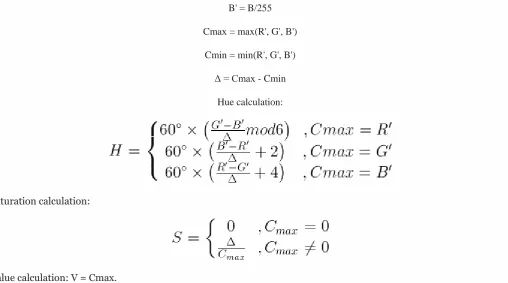
After the creation of database, each of the images is input to the feature extraction step. Features are extracted using HSV for color and HDWT method for texture. The feature vectors are then stored in the database and compared for matching results with the feature vector the query image. The feature vectors are the unique identity of the image. The algorithm steps to extract the features are as below.
The R, G, B values are divided by 255 to change the range from 0..255 to 0..1:
R' = R/255
IJEDR1503053 International Journal of Engineering Development and Research (www.ijedr.org) 5 B' = B/255
Cmax = max(R', G', B')
Cmin = min(R', G', B')
Δ = Cmax - Cmin
Hue calculation:
Saturation calculation:
Value calculation: V = Cmax.
To implement HSV HDWT algorithm, MATLAB 8.1.0 is used. Image processing toolbox with certain MATLAB functions is used. The flowchart of the method is shown in Figure 3.2.
Figure 3.2: Feature extraction process
3.2.3 Retrieval Process:
For matching images in the dataset with the query image, Eucledian distance is used. The query image is the image which is taken from any class of the taken database. It is considered that lesser the distance calculated between the query image and database image, more will be the matching between the images. The matching images are shown by using graphical user interface created in MATLAB 8.1.0.
IV RESULTS
Query Image
Histogram based on HSV
AutoCorrelogram
Hadamard Discrete Wavelet Transform Color Moment
Eucledian Distance for similarity measure between
images
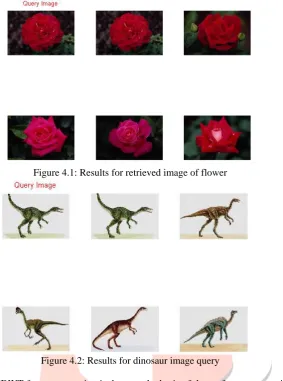
IJEDR1503053 International Journal of Engineering Development and Research (www.ijedr.org) 6 Figure 4.1: Results for retrieved image of flower
Figure 4.2: Results for dinosaur image query
Performance analysis of HSV-HDWT feature extraction is done on the basis of the performance metrics: precision, recall. These metrics when used tells us about the performance of the content based image retrieval. The metrics are explained in next section.
4.1 Performance Metrics
The following performance metrics are considered in analyzing the performance of content-based image retrieval
(i) Precision: Precision is used for evaluation of most CBIR systems. Precision is the fraction of returned images that are relevant to the query image. If we denote T as the set of returned images and R as the set of all images relevant to the query image, then precision is given by:
|T ∩ R|
Precision = ———— (3.1) | T |
(ii) Recall: Recall is the fraction of returned relevant images with respect to the total number of relevant images in the dataset.
|T ∩ R|
Recall=———— (3.2) | R |
IJEDR1503053 International Journal of Engineering Development and Research (www.ijedr.org) 7 Figure: 4.3 Comparison of Precision and Recall value for the proposed method.
V. CONCLUSIONS AND FUTURE SCOPE
The obtained results showed using RGB color space and Hadamard transform in DWT that there could be improvement in the performance of image retrieval in the three datasets. Other than that, the HDWT method reduced the size of storage space and feature vectors and therefore reduced the computation time extremely in high level of HDWT and provided better performance. Although the algorithm provides an effective retrieval of images, the processing time for the complete process is high. Hence, the future work can be focused on decreasing the processing time for the feature extraction so that the complete process is fast enough for real time application.
REFERENCES
[1] Amanatiadis, A., et al. "Evaluation of shape descriptors for shape-based image retrieval." Image Processing, IET 5.5 (2011): 493-499.
[2] Cerra, Daniele, and Mihai Datcu. "A fast compression-based similarity measure with applications to content-based image retrieval." Journal of Visual Communication and Image Representation 23.2 (2012): 293-302.
[3] Guang-Hai Liu, Jing-YuYang, “Content-based image retrieval using color difference histogram”, in Journal of Pattern Recognition, 2012, Page(s).188-198.
[4] Harshada Anand Khutwad, Prof.Mr.Ravindra JinaDatta Vaidya. “CONTENT BASED IMAGE RETRIEVAL”, in International Journal of Image Processing and Vision Sciences, Volume 2, 2013, page(s).19-24.
[5] Jun Yue, Zhenbo Li , Lu Liu , and Zetian Fu, “Content-based image retrieval using color and texture fused features”, in Science Direct Journal of Mathematical and Computer Modeling, 2011,Page(s).1121-1127.
[6] Lin, Chuen-Horng, Rong-Tai Chen, and Yung-Kuan Chan. "A smart content-based image retrieval system based on color and texture feature." Image and Vision Computing 27.6 (2009): 658-665.
[7] Liu, Guang-Hai, et al. "Image retrieval based on micro-structure descriptor." Pattern Recognition 44.9 (2011): 2123-2133. [8] Liu, Guang-Hai, and Jing-Yu Yang. "Content-based image retrieval using color difference histogram." Pattern Recognition
46.1 (2013): 188-198.
[9] Manimala Singha, K.Hemachandran, “Content-based image retrieval using the combination”, in IET Image Processing, Volume 6, 2011, Page(s).1221-1226.
[10] Murala, Subrahmanyam, R. P. Maheshwari, and R. Balasubramanian. "Local tetra patterns: a new feature descriptor for content-based image retrieval." Image Processing, IEEE Transactions on 21.5 (2012): 2874-2886.
[11] Ritendra Datta, Jia Li, and James Z. Wang, “Content-Based Image Retrieval - Approaches and Trends of the New Age”, in
ACM Computing Surveys, Volume 40, 2008, Page(s).253-262.