www.ijiset.com
Theoretical Analysis on the Viscoplastic
Buckling of Local Sharp-notched SUS304
Stainless Steel Tubes under Cyclic Bending
Kuo-Long Lee1, and Wen-Fung Pan2
1
Department of Innovative Design and Entrepreneurship Management, Far East University, Tainan 744, Taiwan
2
Department of engineering Science, National Cheng Kung University, Tainan 701, Taiwan
Abstract
In this paper, the theoretical analysis for simulating the buckling of local sharp-notched SUS304 stainless steel tubes with different notch depths subjected to cyclic bending at different curvature rates is presented. Experimental data of tubes with notch depths varying from 0.2 mm to 1.0 mm were considered. Three different curvature rates, 0.0035, 0.035 and 0.35 m-1s-1, were used in the experimental test [1]. The experimental controlled curvature-number of bending cycles required to ignite buckling relationships on a log-log scale demonstrated that for a fixed curvature rate, five almost parallel lines corresponding to five different notch depths were observed. In addition, the slopes of the parallel lines for three different curvature rates were almost the same. Finally, the empirical formulation proposed by Kyriakides and Shaw [2] was modified for simulating the aforementioned relationships. It was found that the experimental and analytical data agreed well.
Keywords: Local Sharp-Notched SUS304 Stainless Steel
Tubes, Notch Depths, Curvature Rates, Cyclic Bending, Controlled Curvature, Number of Bending Cycles Required to Ignite Buckling.
1. Introduction
In 1998, Pan’s research team started, experimentally and theoretically, to explore different kinds of tubes subjected to monotonic bending or cyclic bending given different loading and geometry conditions. For example, Pan and Her [3] experimentally investigated the viscoplastic failure of SUS304 stainless steel tubes subjected to cyclic bending. To simulate the relationship between the cyclic controlled curvature and the number of bending cycles required to yield buckling, an empirical form was introduced by them.Lee et al. [4] studied the influence of the Do/t ratio on the response and stability of
circular tubes subjected to symmetrical cyclic bending. Diverse Diameter-to-thickness ratios of SUS304 stainless steel tubes were investigated and an empirical form was suggested for describing the correlation between the cyclic controlled curvature and number of bending cycles required to generate buckling. Lee et al. [5] inspected the cyclic bending stability of 316L stainless steel
tubes. The endochronic constitutive model combined with the principle of virtual work was employed to predict the moment-curvature and ovalization-moment-curvature relationships. In addition, Chang and Pan [6] also conducted experiments through which circular tubes’ degradation and stability for different outer diameters were investigated. They discovered that the curve of the ovalization vs. number of bending cycles could be separated into initial, secondary and tertiary stages.
Tubes are typically used in harsh environments, which may corrode the surfaces and create notches. Notched tubes should exhibit responses and collapse mechanisms different from their smooth-surfaced counterparts. From 2010, Pan’s research group started experimental and theoretical investigations on the response of sharp-notched tubes under cyclic bending. Lee et al. [7] experimentally examined the change in ovalization along with the number of bending cycles for sharp-notched circular tubes subjected to cyclic bending. Three stages (initial, secondary, and tertiary) were clearly observed from the curve of ovalization versus the number of bending cycles. Later, Lee[8] investigated the behavior and failure of sharp-notched SUS304 stainless steel tubes subjected to cyclic bending. Asymmetry, ratcheting, and increasing ovalization-curvature curves were discovered. In addition, Lee et al. [9] experimentally examined the viscoplastic buckling of sharp-notched SUS304 stainless steel circular tubes under cyclic bending, and changes in both the notch depth and curvature rate were examined. Observations of a certain curvature rate revealed that the cyclic-controlled curvature and the number of bending cycles required to yield buckling relationships at a log-log scale exhibited parallel lines for every notch depth.
Fig. 1 A schematic drawing of a circumferential sharp notch.
In this paper, the theoretical analysis for simulating the buckling of local sharp-notched SUS304 stainless steel tubes with different notch depths subjected to cyclic bending at different curvature rates is presented. Experimental data tested by Lee et al. [1] were compared with the theoretical analysis. The empirical formulation proposed by Kyriakides and Shaw [2] was modified for simulating the aforementioned relationships. Good agreement between the experimental and theoretical results has been achieved.
2. Experiments
2.1 Experimental Devices
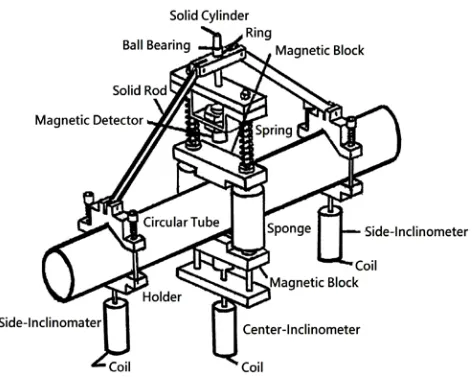
Fig. 2 schematically shows the experiment executed by a specially built tube-bending machine. This facility was set up to conduct monotonic, reverse, and cyclic bending tests. A detailed explanation of the experimental facility can be found in many papers (e.g., Pan and Her [3], Lee et al. [4]). Pan et al. [10] designed a new light-weight apparatus to measure the curvature and ovalization of the tube shown in Fig. 3. Two side-inclinometers in the apparatus were used to detect the angle variation of tubes during cyclic bending. The amount of curvature can be determined by a simple calculation according to angle changes.
Fig. 2 A schematic drawing of the tube-bending machine.
Fig. 3 A schematic drawing of the curvature-ovalization measurement apparatus.
2.2 Material and Specimens
The circular tubes used in this study were made of SUS304 stainless steel. The ultimate stress, 0.2% strain offset the yield stress and the percent elongation are 626 MPa, 296 MPa and 35%, respectively. The raw smooth SUS304 stainless steel tube had an outside diameter Do of 36.6 mm and wall-thickness t of
1.5 mm. The raw tubes were machined on the outside surface to obtain the desired local notch depth (a) of 0.2, 0.4, 0.6, 0.8 and 1.0 mm. Fig. 4 shows a schematic drawing of the local sharp-notched tube.
Fig. 4 A schematic drawing of a local sharp-notched tube with a notch depth of a.
2.3 Test Procedures
www.ijiset.com
3. Experimental and Theoretical Results
The experimental data of cyclic curvature (κc) versus the number
of bending cycles required to ignite buckling (Nb), for local
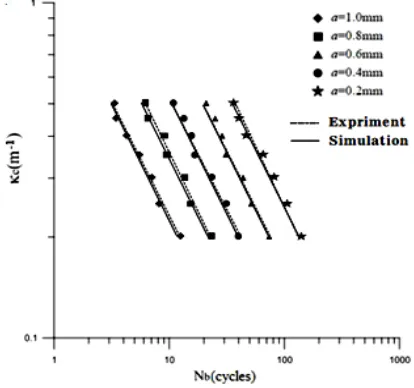
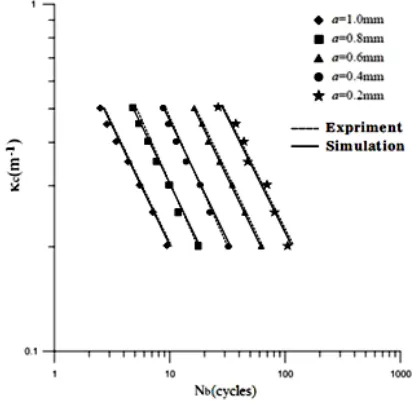
sharp-notched SUS304 stainless steel tubes submitted to cyclic bending with a = 0.2, 0.4, 0.6, 0.8, and 1.0 mm at κ = 0.0035, 0.035 and 0.35 m-1s-1, respectively, is illustrated in Figs. 5-7 [1]. For a fixed κc and a, a larger κ causes a lower Nb. Next, Figs.
5-7 show the same data of Figs. 8-10 plotted on the log-log scale in dot lines. Note that the dot lines were least square fits of the data. It can be seen that for a fixed κ, five almost parallel dot lines corresponding to five different a. In addition, the slopes of the parallel dot lines for three different κ are almost the same.
Fig. 5 Experimental controlled curvature (κc) - number of bending cycles required to ignite buckling (Nb) curves for local sharp-notched SUS304 stainless steel tubes with a = 0.2, 0.4, 0.6, 0.8, and 1.0 mm under cyclic
bending at κ = 0.0035 m-1s-1.
Fig. 6 Experimental controlled curvature (κc) - number of bending cycles required to ignite buckling (Nb) curves for local sharp-notched SUS304 stainless steel tubes with a = 0.2, 0.4, 0.6, 0.8, and 1.0 mm under cyclic
bending at κ = 0.035 m-1s-1.
Fig. 7 Experimental controlled curvature (κc) - number of bending cycles required to ignite buckling (Nb) curves for local sharp-notched SUS304 stainless steel tubes with a = 0.2, 0.4, 0.6, 0.8, and 1.0 mm under cyclic
bending at κ = 0.35 m-1s-1.
In 1987, Kyriakides and Shaw [2] proposed an empirical form of the relationship between κc and Nb to be
κc = C (Nb)
-α
(1) or
log κc = log C – α log Nb (2)
where C and α are the material parameters. The quantity C is the value of κc by letting Nb = 1, and the quantity α is the slope of
the line in the log-log plot. In our study, due to same slope for every a at different κ in all log κc-log Nb relationships, the
magnitude of α was determined to be 0.69.
Fig. 8 Experimental and simulated controlled curvature (κc) - number of bending cycles required to ignite buckling (Nb) curves for local sharp-notched SUS304 stainless steel tubes with a = 0.2, 0.4, 0.6, 0.8, and 1.0
Fig. 9 Experimental and simulated controlled curvature (κc) - number of bending cycles required to ignite buckling (Nb) curves for local sharp-notched SUS304 stainless steel tubes with a = 0.2, 0.4, 0.6, 0.8, and 1.0
mm under cyclic bending at κ = 0.035 m-1s-1 on a log-log scale.
Fig. 10 Experimental and simulated controlled curvature (κc) - number of bending cycles required to ignite buckling (Nb) curves for local sharp-notched SUS304 stainless steel tubes with a = 0.2, 0.4, 0.6, 0.8, and 1.0
mm under cyclic bending at κ = 0.35 m-1s-1 on a log-log scale.
Based on the experimental data in Figs. 8-10, five values of C were obtained for a = 0.2, 0.4, 0.6, 0.8, and 1.0 mm at κ = 0.0035, 0.035, and 0.35 m-1s-1 from Eq. (2), as shown in Table 1. For the curvature rate effect of smooth SUS304 stainless steel tubes, an empirical form of C was proposed by Pan and Her [3] to be 2 o . 1 o κ κ log C C C + =
, (3)
where Co and C1 are the material parameters, κo is the lowest
curvature rate and κ is the other curvature rate. Lee et al. [11] has investigated the effect of a on κc-Nb relationship and
proposed the formulation of C to be
logC = c1
t
a + c2
(4) or
2 1 t c
c
10
C +
= a , (5)
where c1 and c2 are material parameters.
For considering both a and κ effects, a simple linear combination of Eqs. (3) and (5) was proposed to be
2 o . c c t c κ κ log 10 C 3 2 1 = + + a
, (6)
where c3 is material parameter. For smooth tubes, the magnitude
of a is equal to 0. Thus, the value of
10
c2is equal to Co and C1 is
equal to c3, Eq. (6) is equal to Eq. (3). Next, by letting κ = κo,
the second term of Eq. (6) is equal to zero. Thus, Eq. (6) is the same as Eq. (5).
Table 1: Experimental magnitudes of C for every a at different κ
a = 0.2 mm
a = 0.4 mm
a = 0.6 mm
a = 0.8 mm
a = 1.0 mm
κ = 0.0035
m-1s-1 5.75 4.08 2.51 1.81 1.17 κ = 0.035
m-1s-1 5.72 4.04 2.74 1.79 1.14 κ = 0.35
m-1s-1 5.25 3.54 2.29 1.51 1.01
In our study, parameters c1, c2 and c3 in Eq. (6) were determined
by the following steps. First step, by letting κ = 0.0035 m-1s-1 which is equal to the lowest curvature rate κo, Eq. (6) is then
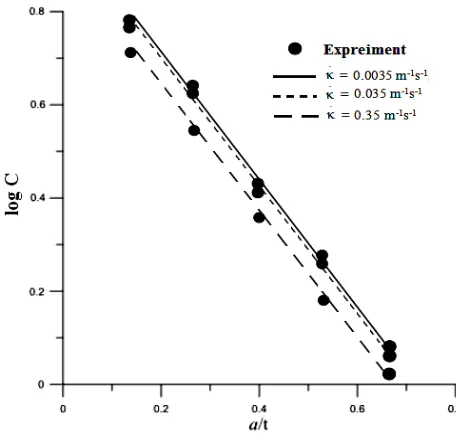
equal to Eq. (4). From the experimental data for the relationship between logC and a/t in Fig. 11, the straight line is obtained by the least square method. Thus, parameters c1 and c2 in Eq. (4)
can be obtained to be -1.13 and 0.91, respectively. Second step, according to the variation of logC and a/t for κ = 0.035 and 0.35 m-1s-1 in Fig. 11, the value of c3 is adjusted to fit the
experimental data. Thus, the parameter of c3 can be obtained to
be -0.11. Figs. 8-10 depict the simulated controlled curvature (κc) - number of bending cycles required to ignite buckling (Nb)
www.ijiset.com
Fig. 11 Relationship between log C and a/t for κ = 0.0035, 0.035 and 0.35 m-1s-1.
4. Conclusion
The theoretical simulation of the collapse of local sharp-notched SUS304 stainless steel tubes with different a submitted to cyclic bending at different
κ
are discussed in this study. The formula, Eq. (1), suggested by Kyriakides and Shaw [2] was modified to simulate the correlation between κc and Nb for localsharp-notched SUS304 stainless steel tubes with different a submitted to cyclic bending at different κ. Due to same slope for every a at different κ in all log κc-log Nb relationships, the magnitude of α
was determined to be 0.69. In this study, for considering both a and κ effects, a simple linear combination of the parameter C was proposed in Eq. (6). It can be observed that the simulations by Eqs. (1) and (6) are in good correlation with the experimental results [1] as shown in Figs. 8-10.
Acknowledgment
The work presented was carried out with the support of the National Science Council under grant MOST 103-2221-E-006-041. Its support is gratefully acknowledged.
References
[1] K. L. Lee, Y. A. Chen and W. F. Pan, “Experimental study on the viscoplastic response and buckling of local sharp-notched SUS304 stainless steel tubes under cyclic bending,” Int. J. Eng. Tech., Vol. 5, No. 1, 2019, pp. 129-138.
[2] S. Kyriakides and P. K. Shaw, “Inelastic buckling of tubes under cyclic loads,” J. Pres. Ves. Tech., Vol. 109, No. 2, 1987, pp. 169-178.
[3] W. F. Pan and Y. S. Her, “Viscoplastic collapse of thin-walled tubes under cyclic bending,” J. Eng. Mat. Tech., Vol. 120, No. 4, 1998, pp. 287-290.
[4] K. L. Lee, W. F. Pan and J. N. Kuo, “The influence of the diameter-to-thickness ratio on the stability of circular tubes under cyclic bending,” Int. J. Solids Struct., Vol. 38, No. 14, 2001, pp. 2401-2413.
[5] K. L. Lee, R. F. Shie and K. H. Chang, “Experimental and theoretical investigation of the response and collapse of 316L stainless steel tubes subjected to cyclic bending,” JSME Int. J., Ser. A, Vol. 48, No. 3, 2005, pp. 155-162. [6] K. H. Chang and W. F. Pan, “Buckling life estimation of
circular tubes under cyclic bending,” Int. J. Solids Struct., Vol. 46, No. 2, 2009, pp. 254-270.
[7] K. L. Lee, C. Y. Hung and W. F. Pan, “Variation of ovalization for sharp-notched circular tubes under cyclic bending,” J. Mech., Vol. 26, No. 3, 2010, pp. 403- 411. [8] K. L. Lee, “Mechanical behavior and buckling failure of
sharp-notched circular tubes under cyclic bending,” Struct. Eng. Mech., Vol. 34, No. 3, 2010, pp. 367-376.
[9] K. L. Lee, C. M. Hsu and W. F. Pan, “Viscoplastic collapse of sharp-notched circular tubes under cyclic bending,” Acta Mech. Solida Sinica, Vol. 26, No. 6, 2013, pp. 629-641. [10] W. F. Pan, T. R. Wang and C. M. Hsu, “A
curvature-ovalization measurement apparatus for circular tubes under cyclic bending,” Exp. Mech., Vol. 38, No. 2, 1998, pp. 99-102.
[11] K. L. Lee, C. H. Meng and W. F. Pan, “The influence of notch depth on the response of local sharp-notched circular tubes under cyclic bending,” J. Appl. Math. Phy., Vol. 2, No. 6, 2014, pp. 335-341.
Kuo-Long Lee received the Ph.D. degree in Dept. of Engineering Science from National Cheng Kung University in Taiwan in 2000. Currently working as Prof. in Dept. of Innovative Design and Entrepreneurship from Far East University in Taiwan.