Encryption Algorithm for Cloud Computing
Ankita Nandgaonkar1, Prof. Pallavi Kulkarni2
1,2Computer Engineering, Mumbai University, India
Abstract— Cloud computing is the next big thing after internet in the field of Information technology. It is an Internet-based computing technology, in which software, Shared recourses and information are provided to consumers and devices on-demand, and as per user’s requirement on a pay per use model. Even though the cloud continues to grow in popularity, Usability and respectability, Problems with data protection and data privacy and other Security issues play a major setback in the field of Cloud Computing. Privacy and security are the key issue for cloud storage. Encryption is a well known technology for protecting sensitive data .This paper proposes a combined approach of Identity based and attribute based access policy for encryption technique of cloud storage which can be implementable on cloud platform. The report analyses the feasibility of the applying encryption algorithm for data security and privacy in cloud Storage with other existing algorithms.
Keywords— Cloud Storage, Cipher text, encryption, access control, attribute-based encryption, constant ciphertext length,decryption, Cryptography.
I. INTRODUCTION A. Cloud computing
Cloud Computing is the ability to access a pool of computing resources owned and maintained by a other trusted party via the Internet. It is a way of delivering computing resources based on existing technologies such as server virtualization. The “cloud” is composed of hardware, storage, networks, interfaces, and services which provide the way through which users can access the infrastructures, computing power, applications, and services on demand which are independent of locations. Cloud computing involves the transfer, storage, and processing of information on the „providers‟ infrastructure, which is not included in the „customers‟ control policy.
Cloud computing has attracted widespread attention and support in many fields. In the cloud computing environment, many services such as resource renting, application hosting, and service outsourcing are the
on-demand service in the IT field. .e.g. Amazon‟sEC2,
Amazon‟s S3, Google App Engine and Microsoft‟s Azure
etc. Cloud computing can provide flexible computing capabilities, reduce costs and capital expenditures and charge according to usage.The concept Cloud Computing is linked closely with those of Information as a Service (IaaS), Platform as a Service (PaaS), Software as a Service (SaaS)[1]. Here comes the first benefit of the Cloud Computing i.e. it reduces the cost of hardware that could have been used at user end. As there is no need to store
data at user‟s end because it is already at some other
location. So instead of buying the infrastructure required to
run the processes and Save bulk of data which. You are just renting the assets according to your requirements.
The similar idea is for all cloud networks [2]. It uses remote services through a network using various resources. It is basically meant to give maximum with the minimum resources i.e. the user is having the minimum hardware requirement but can use the maximum capability of computing. This is possible only through this technology which requires and utilizes its resources.
In cloud computing, users store their data files in cloud servers. Thus, it is crucial to prevent unauthorized access to these resources and realize secure resource sharing. In traditional access control methods, we generally assume data owners and the storage server are in the same secure domain and the server is fully trusted. However, in the cloud computing environment, cloud service providers can be attacked by malicious attackers. These attacks may leak the confidential information of users for commercial interests as the data owners commonly store decrypted data in cloud servers. How to realize access control to the encrypted data and ensure the confidentiality of data files of users in an untrusted cloud environment are the major problems. Moreover, since the number of users is large in a cloud computing environment, how to realize scalable, flexible and fine-grained access control is strongly desired in the service-oriented cloud computing model.
B.Data storage in cloud computing
Cloud storage means "the storage of data online on the cloud" wherein a company's data is stored in and accessible from multiple distributed and connected resources that comprise a cloud.
Cloud storage can provide the benefits of greater accessibility and reliability; rapid deployment; strong protection for backup, archival and disaster, recovery purposes; and lower overall storage costs as a result of not having to purchase, manage and maintain expensive hardware. But, cloud storage does have the security and compliance concerns [2].
II. LITERATURE SURVEY
A. Attribute-based Access Control with Constant-size Ciphertext in Cloud Computing:
Approach:
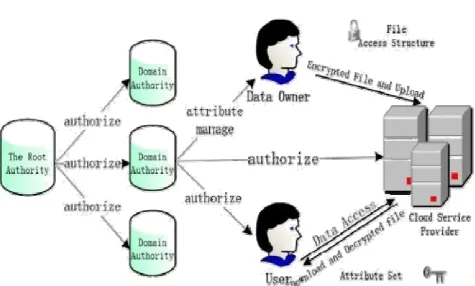
CP-ABE consists of four polynomial time algorithms: The data owner first encrypts the data file using asymmetric key DEK and then encrypts DEK by using the proposed scheme with a specific access control policy. The data owner uploads the final ciphertext and stores it in the cloud servers. Whether a user can access and de-crypt the data file depends on how to obtain the symmetric key, which is decided by the user‟s set of access attributes.
This algorithm contains 4 sub algorithms.
1.Setup: This algorithm takes as input the initial
information such as security parameter and attribute
universe description, and outputs a public key PK and
master secret key MK.
2.Encrypt: This algorithm takes as input a public key PK
, a message M and an access structure , , and outputs a
ciphertext CT .
3.KeyGen : This takes as input MK and, and outputs a
secret key SK, with An attribute set for a user.
4.Decrypt :This algorithm takes as input PK, a secret key SK and CT , and outputs a message
M if and only if the set of attributes satisfies an access structure t , is associated with the ciphertext.
How they achieved constant size cipher text policy In order to ensure the confidentiality and integrity of the data, owners of data will store the encrypted data files in the cloud and realize access control to the files bacon trolling the decryption ability of users. The complexity of the CP-ABE algorithm means it is not suitable to encrypt large data files. Therefore, we first encrypt the data file using a symmetric data encryption key DEK and get the same ciphertext of data files as [10]. Then we encrypt DEK using the CP-ABE algorithm with constant-size ciphertext and obtain the ciphertext of DEK. Therefore, users can access the data file by decrypting the ciphertext of DEK and the ciphertext of the data file in turn [6].
Fig. 1 :Structure of File storage
.Pros and cons of this approach: Pros:
1. Hierarchical attribute based system
2. Risk factor minimized
3. Attribute based access control 4. Efficient
5. Less Cost
6. Less burden on single authority
Cons:
1. High complexity because of bilinear pairing evaluation
2. Constant size cipher text so more burden
3. Not practical because of constant size cipher text
policy.
4. Exponential operation required for constant size cipher
text operation.
B. Two-Factor Data Security Protection Mechanism For Cloud Storage System
This algorithm allows a sender to send an encrypted message to a receiver through a cloud storage server. The sender only needs to know the identity of the receiver but no other information (such as its public key or its certificate). The receiver needs to possess two things in order to decrypt the cipher text. The first thing is his/her secret key stored in the computer. The second thing is a unique personal security device which connects to the computer. It is impossible to decrypt the cipher text without either piece.
Approach:
The encryption process is executed twice. First encrypt the plaintext corresponding to the public key or identity of the user. Then encrypt it again corresponding to the public key or serial number of the security device. For the decryption stage, the security device first decrypts once. The partially decrypted ciphertext is then passed to the computer which uses the user secret key to further decrypt it. Without either part (user secret key or security device) one cannot decrypt the ciphertext. If the user has lost his security device, then his/her corresponding ciphertext in the cloud cannot be decrypted forever! That is, the approach cannot support security device update/ revocability.
Real world implemented example: At AT&T labs, in a druva system, a message is first encrypted under a user key k1, and next uploaded to a cloud server. The user key k1 is further encrypted by another user key k2, and stored in the server as well. The key k2 is held by the user. When retrieving the message, the user needs to use k2 to recover k1 which is further used to recover m. It is undeniable that this message-key encrypt mechanism is much better than the mode only using a single key to encrypt an outsourced data, and storing the ciphertext along with the key in the server. Nevertheless, this mechanism suffers from a potential risk in practice. Once the user loses the key k2, all data of the user stored in the cloud cannot be retrieved. The lack of revocability for encryption factor limits the flexibility of the system [7].
Pros and cons Pros:
1. High level Security
2. Double encryption Cons:
Cons:
1. Revocability difficult
2. Cost more
C. Shared authority based privacy preserving authentication protocol
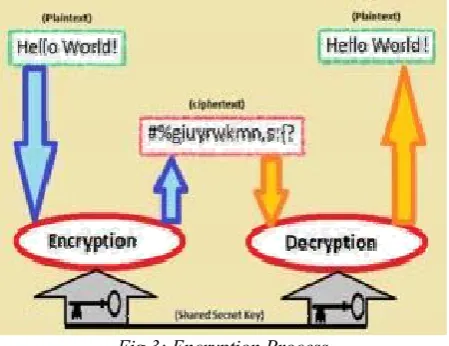
The proposed system has a shared authority based privacy-preserving authentication protocol (SAPA) to address above privacy issue
Fig 3: Encryption Process
The main goals are as follows.
1) Identify a new privacy challenge in cloud storage, and address a subtle privacy issue during a user challenging the cloud server for data sharing, in which the challenged request itself cannot reveal the user‟s privacy no matter whether or not it can obtain the access authority.
2) Authentication protocol to enhance a user‟s access
request related privacy, and the shared access authority is achieved by anonymous access request matching mechanism.
3) Apply cipher text-policy attribute based access control to realize that a user can reliably access its own data fields, and adopt the proxy re-encryption to provide temp authorized data sharing among multiple users.
Approach:
A shared authority based privacy preserving authentication protocol (SAPA) for the cloud data storage, which realizes authentication and authorization without compromising a user‟s private information.
{Ua, Ub} respectively generate the session identifiers {sidUa , sidUb }, extract the identity tokens {TUa , TUb}, and transmits
{sidUa ∥ TUa , sidUb ∥ TUa } to S as an access query to initiate a new session. Accordingly, we take the
interactions of Ua and
S as an example to introduce the following authentication
msk = (_; g). Thereinto, S randomly chooses _ ∈ Zq, and computes gi = gαi and hi = hαi−1 (i = {1; :::; n} ∈ Z∗ ). S
randomly chooses _ ∈ {0; 1}∗ , and extracts Ua‟s access
authority policy PUa = [pij ]n×m (pij ∈ {0; 1}), and Ua are assigned with the access authority on its own data fields
DUa within PUa ‟s permission. S further defines a
polynomial FSa (x; PUa ) according to PUa and TUa . S computes a set of values {MSa0, MSa1, {MSa2i},
MSa3, MSa4} to establish the ciphertext CSa = {MSa1; {MSa2i};MSa3;MSa4}, and transmits sidSa
Authentication: The ciphertext-policy attribute based
access control and bilinear pairings are introduced for identification between Uθ and S, and only the legal user can derive the ciphertexts. Additionally, Uθ checks the re-computed ciphertexts according to the proxy re-encryption, which realizes flexible data sharing instead of publishing the interactive users‟ secret keys.
• Data Anonymity: The pseudonym PIDU are hidden
with hash function so that other entities cannot derives the real values by inverse operations. Hence, an adversary cannot recognize the data, even if the adversary intercepts the transmitted data, it will not decode the full-fledged cryptographic algorithms. • User Privacy: The access request pointer (e.g., RUx
U_ ) is wrapped along with H(sidS∥ PIDU_ ) for
privately informing S about Uθ‟s access desires. Only if both users are interested to communicate with each other, S will establish the re-encryption key kU_ to
realize authority sharing between Ua and Ub.
Otherwise, S will temporarily reserve the desired
access requests for a certain period of time, and cannot accurately determine which user is actively interested in the other user‟s data fields.
• Forward Security: The dual session identifiers {sidS , sidU} and pseudorandom numbers are introduced.
Pros and cons of this approach: Pros:
1. More security
2. Works fine with untrusted cloud server
3. Attribute based access request
4. flexible
Cons:
1. More space overhead
2. High complexity
III. PROPOSED SYSTEM
I am combining various approaches of encryption algorithm so that we can achieve security with flexibility.
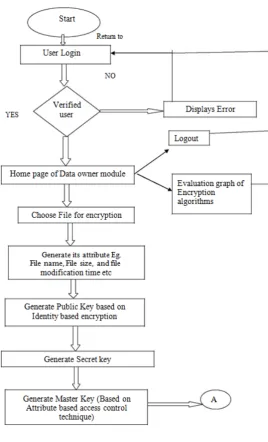
Access control policy will be based on number of attributes but the size of cipher text will be varying. By using public key which is Role based encryption and master key generation is used for attribute based access control. So while encryption, using random attributes of files some unique master key will be generated.
I have tried to combine Identity based encryption and attribute based encryption to generate secret key which will act as a private key for a user.
I am using 16 bit key format so it will be difficult to crack for stranger.
Encrypted file will be saved at specified path , as well original file will also get save so we can achieve safe and backup kind of thing .
Limitations of proposed system:
It can work fine with text , pdf file ,word file .
This encryption method is not applicable for image or media file.
User has to remember key which is of 16 bit.
Space overhead because of original and encrypted copy will be saved in desktop before sending it to server.
Because of attribute based encryption, time linearly depends on number of attributes selected for generation of master key.
IV. IMPLEMENTATION
Modules:
1. Owner
2. User
3. Access Control
4. Cloud Service Provider
5. Encryption & Decryption
6. File Download
7. Trusted Third Party
A. System Configuration :-H/W System Configuration:-
Processor -Pentium 3rd generation
Speed -1.1 GHz
RAM -256 MB (min)
Hard Disk -20 GB
Floppy Drive -1.44 MB
Key Board -Standard Windows Keyboard
Mouse - Two or Three Button Mouse
Monitor -SVGA
S/W System Configuration:-
Operating System :Windows95/98/2000/XP
Application Server : Tomcat5.0/6.X
Front End : HTML, Java, JSP
Scripts : JavaScript.
Server side Script : Java Server Pages.
Database :My sql
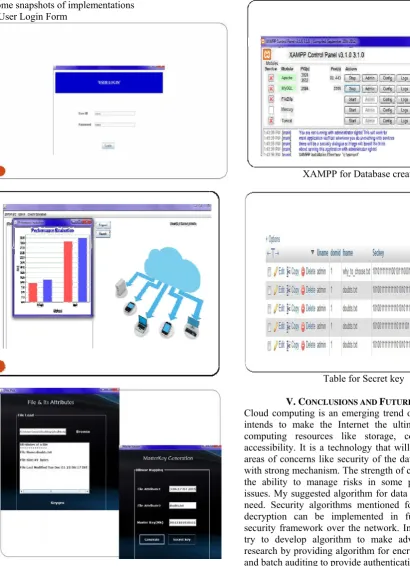
Some snapshots of implementations User Login Form
XAMPP for Database creation
Table for Secret key
V. CONCLUSIONS AND FUTURE WORK
Below Matrix presents Performance Comparison of different approaches based on various parameters which that approach fulfils.
Parameter
Attribute based access control with constant cipher
text
Two factor data security protection mechanism
Shared authority based
privacy preserving protocol Proposed System
Platform Cloud computing Cloud computing Cloud computing Cloud computing
Key Size Constant(16 bit) Variable Variable Constant
Scalability Scalable Scalable Scalable scalable
Security Level Secured Very high High high
Access Control Policy
Hierarchical based(Inheritance of
authorization) Distributed Third party authorization scheme Hierarchical
Scheme of working
Constant Bilinear Pairing for
constant size cipher Text Identity based double encryptionmechanism is used.
Data authorization, Preservation, Proxy re encryption is achieved
.
Re encryption Technique used.
Overhead Reduced space storage Extra running time for securitydevice recognition More Space overhead
Revocation
Method Not used. Allows revocability of device Not used Not used
Cost Less Moderate More Less
Computational
complexity Polynomial Less More Less
REFERENCES
[1] H. Takabi, J.B.D. Joshi, and G-J. Ahn, “Security and Privacy Challenges in Cloud Computing Environments,” IEEE Security & Privacy, vol. 8, no. 6, 2010.
[2] R. Buyya, C. S. Yeo, and S. Venugopal, Market oriented cloud
computing: vision, hype, and reality, for delivering IT services as computing utilities, Proc. 10th IEEE International Conference on High Performance Computing and Communications.
[3] Rohit Bhadauria and Sugata Sanyal, A Survey on Security Issues in Cloud Computing and Associated Mitigation Techniques. International Journal of Computer Applications, Volume 47- Number 18, June 2012, On page(s): 47-66.
[4] Zhidong Shen, Li Li , Fei Yan, Xiaoping Wu , Cloud Computing System Based on Trusted Computing Platform, International Conference on Intelligent Computation Technology and Automation, Volume 1, May 2010, On page(s): 942-945.
[5] Wei Teng,Geng Yang,Member, IEEE,Yang Xiang,SeniorMember, IEEE, Ting Zhang and Dongyang Wang “Attribute-based Access Control with Constant-size Ciphertext in Cloud Computing”, IEEE TRANSACTIONS ONCOMPUTERS, VOL. 6, NO. 1, JANUARY 2014
[6] Kan Yang, Student Member, IEEE, and Xiaohua Jia, Fellow, IEEE “Expressive, Efficient, and Revocable Data Access Control for Multi-Authority Cloud Storage”, IEEE TRANSACTIONS ON PARALLEL AND DISTRIBUTED SYSTEMS, VOL. 25, NO. 7, JULY 2014
[7] Joseph K. Liu, Kaitai Liang_, Willy Susilo, Jianghua Liu, Yang Xiang “Two-Factor Data Security Protection Mechanism for Cloud Storage System” IEEE Transactions on Computers ,2015.