SIGNAL PROCESSING FOR ROBUST SPEECH RECOGNITION
Fu-Hua Liu, Pedro J. Moreno, Richard M. Stem, Alejandro Acero
Department of Electrical and Computer Engineering
School of Computer Science
Carnegie Mellon University
Pittsburgh, PA 15213
ABSTRACT
This paper describes a series of ceps~al-based compensation pro- cedures that render the SPHINX-II system more robust with respect to acoustical environment. The first algorithm, phone- dependent cepstral compensation, is similar in concept to the pre- viously-described MFCDCN method, except that cepstral com- pensation vectors are selected according to the current phonetic hypothesis, rather than on the basis of SNR or VQ codeword iden- tity. We also describe two procedures to accomplish adaptation of the VQ codebook for new environments, as well as the use of reduced-bandwidth f~equency analysis to process telephone-band- width speech. Use of the various compensation algorithms in con- sort produces a reduction of error rates for SPHINX-II by as much as 40 percent relative to the rate achieved with eepstral mean nor- realization alone, in both development test sets and in the context of the 1993 ARPA CSR evaluations.
1. INTRODUCTION
A continuing problem with current speech recognition technology is that of lack of robustness with respect to environmental variabil- ity. For example, the use of microphones other than the ARPA standard Sennheiser HM--414 "close-talking" headset (CLSTLK) severely degrades the performance of systems like the original SPHINX system, even in a relatively quiet office environment
[e.g.
1,2]. Applications such as speech recognition in automobiles, over telephones, on a factory floor, or outdoors demand an even greater degree of environmental robustness.In this paper we describe and compare the performance of a series of cepstrum-based procedures that enable the CMU SPHINX-II [8] speech recognition system to maintain a high level of recogni- tion accuracy over a wide variety of acoustical environments. We also discuss the aspects of these algorithms that appear to have contributed most significantly to the success of the SPHINX-II system in the 1993 ARPA CSR evaluations for microphone inde- pendence (Spoke 5) and calibrated noise sources (Spoke 8).
In previous years we described the performance of cepstral map- ping procedures such as the CDCN algorithm, which is effective but fairly computationally costly [2]. More recently we discussed the use of eepstral highpass-filtering algorithms [such as the popu- lax RASTA and cepstral-mean-normalization algorithms (CMN) [6]. These algorithms are very simple to implement but somewhat limited in effectiveness, and CMN is now part of baseline process- ing for the CMU and many other systems.
In this paper we describe several new procedures that when used in consort can provide as much as an additional 40 percent improvement over baseline processing with CMN. These tech- niques include:
• Phone-dependent cepstral compensation
• Environmental interpolation of compensation vectors • Codebook adaptation
• Reduced-band analysis for telephone-bandwidth speech. • Silence codebook adaptation
In Sec. 2 we describe these compensation procedures in detail, and we examine their effect on recognition accuracy in Secs. 3 and 4.
2. ENVIRONMENTAL COMPENSATION
ALGORITHMS
We begin this section by reviewing the previously-described MFCDCN algorithm, which is the basis for most of the new pro- cedures discussed. We then discuss blind environment selection and environmental interpolation as they apply to MFCDCN. The complementary procedures of phone-dependent cepstral normal- ization and codebook adaptation are described. We close this sec- tion with brief description of reduced-bandwidth analysis and silence-codebook adaptation, which are very beneficial in pro- cessing telephone-bandwidth speech and speech recorded in the presence of strong background noise, respectively.
2.1. Multiple Fixed Codeword-Dependent
Cepstral Normalization (MFCDCN)
Multiple fixed codeword-dependent cepstral normalization
(MFCDCN) provides additive cepstral compensation vectors that depend on signal-to-noise ratio (SNR) and that also vary from codeword to codeword of the vector-quantized (VQ) representa- tion of the incoming speech at each SNR [6]. At low SNRs these vectors primarily compensate for effects of additive noise. At higher SNRs, the algorithm compensates for linear filtering, while at intermediate SNRs, they compensate for both of these effects. Environmental independence is provided by computing compen- sation vectors for a number of different environments and select- ing the compensation environment that results in minimal residual VQ distortion.ftt = z t + r [ k t, l r e] where kt, I t , t, and e are the VQ code- word index, instantaneous frame SNR, time frame index and the index of the chosen environment, respectively, and ~t, zt, and r are the compensated (transformed) data, original data and compensa- tion vectors, respectively.
2.2. Blind Environment Selection
In several of the c o m p e n s a t i o n procedures used, i n c l u d i n g MFCDCN, one of a set of environments must be selected as part of the compensation process. We considered three procedures for environment selection in our experiments.
The first procedure, referred to as selection by compensation,
applies compensation vectors from each possible environment successively to the incoming test utterance. The environment e is chosen that minimizes the average residual VQ distortion over the entire utterance. In the second approach, referred to as environ- merit-specific VQ, environment-specific cookbooks are generated from the original uncompensated speech. By vector quantizing the test data using each environment-specific codebook in turn, the environment with the minimum VQ distortion is chosen. The third procedure, referred to as Gaassian environment classifier, models each environment with mixtures of Gaussian densities. Environ- ment selection is accomplished so that the test data has the highest probability from the corresponding classifier. ~ latter approach is similar to one proposed previously by BBN [7].
All three methods produce similar speech recognition accuracy.
2.3. Interpolated FCDCN (IFCDCN)
In cases where the testing environment does not closely resemble any of the particular environment used to develop compensation parameters for MFCDCN, interpolating the compensation vectors of several environments can be more helpful than using compensa- tion vectors from a single (incorrect) e n v i r o n m e n t . As in MFCDCN, compensation vectors used in the interpolated f i x e d c o d e w o r d - d e p e n d e n t c e p s t r a l n o r m a l i z a t i o n a l g o r i t h m (IFCDCN) are precomputed for environments in the training data- base in the estimation phase. Compensation vectors for new envi- ronments are obtained by linear interpolation of several of the MFCDCN compensation vectors:
? [ k , l ] =
~E~=lfe"
r t k , l, elwhere ?[k, I] , t[k,l,e], andre are the estimated compensation vectors, the environment-specific compensation vector for the e th environment, and the weighting factor for the e th environment, respectively.
The weighting factors for each environment are also based on residual VQ distortion:
p (el ~
exp{De~
(202) }
f " -
-
where O is the codebook standard deviation using speech from the CLSTLK microphone, ~ represents the testing utterance, and Dj
331
and D e are the residual VQ distortions of the j4h and e th environ- ments. We have generally used a value of 3 for E.
2.4. Phone-Dependent Cepstral Normalization
(PDCN)
In this section we discuss an approach to environmental compen- sation in which additive cepstral compensation vectors are selected according to the current phoneme hypothesis in the search process, rather than according to physical parameters such as SNR or VQ eodeword identity. Since this phoneme-based approach relies on information from the acoustic-phonetic and language models to determine the compensation vectors, it can be referred to as a "back-end" compensation procedures, while other approaches such as MFCDCN which work independently of the decoder can be regarded as "front-end" compensation schemes.
E s t i m a t i o n o f P D C N c o m p e n s a t i o n Vectors. In the current implementation of p h o n e - d e p e n d e n t cepstral normalization
(PDCN), we develop compensation vectors that are specific to individual phonetical events, using a base phone set of 51 pho- nemes, including silence but excluding other types of non-lexical events. This is accomplished by running the decoder in supervised mode using CLSTLK data and correction transcriptions. All CLSTLK utterances are divided into phonetic segments. For every phonetic label, a difference vector is computed by accumulating the cepstral difference between the CLSTLK training data, xp and its noisy counterpart, z r Compensation vectors are computed by averaging the corresponding difference vector as follows,
e
[p] =ZAu=
IEt= I (xt-zt)
S(ft-')
lit__
is(/t-p)
whereft is the phoneme for frame t, p the phoneme index and T u
length of the uth utterance out of A sentences.
Compensation of PDCN in Recognition. The SPHINX-H system uses the senone [4,8], a generalized state-based probability density function, as the basic unit to compute the likelihood from acousti- cal models. The probability density function for senone s in frame t for the cepstral vector z t of incoming speech can be expressed as
=
where m t stands for the index of the best B Gaussian mixtures of and are the cor- senone s for cepstra vector zt, and
J.l.rat, Omt ,
Wra tth •
responding mean, standard deviation, and weight for the m t nux-
ture of senone s. Multiple compensated cepslxal vectors are formed in PDCN by adding various compensation vectors to incoming cepstra, ftt.p(t ) , where Rt. p = z t + c [ p ] on a frame-by-frame basis for the presumed phoneme index, p.
calculated by the presumed phonetic identity that corresponds to a given senone. Using this approach, the senone probability in PDCN is re-written as
Pr(tt.p[
s) = znBt=
1Wnff(It,
p;~n,
On,
)
where n t is the index of the best B Gaussian mixtures for senone
s at frame t with respect to the PDCN-normalized ceprtral vector ~t,p, for the corresponding phonetic labelp for senone s.
Interpellated PDCN (IPDCN). PDCN, like SDCN and FCDCN [3,6], assumes the existence of a database of utterances recorded in stereo) in the training and testing environments. In situations where no data from any particular testing environment is available for estimation, IPDCN is desirable. Based on an ensemble of pre- computed PDCN compensation vectors, IPDCN applies to the incoming utterance an interpolation of compensation vectors from several of the closest environments (IPDCN). The interpolation is performed in the same way that it was for IFCDCN. In the current implementation, we use the 3 closest environments with the best 4 Ganssian mixtures in interpolation.
2 , 5 . C o d e b o o k A d a p t a t i o n ( D C C A a n d
BWCA)
A vector quantization (VQ) codebook, which is a set of mean vec- tors and/or co-variance matrices of cepstral representations, also exhibits some fundamental differences when mismatches are encountered between training and testing environments [7]. This suggests that when such mismatches exist, the codebook can be "tuned" to better characterize the cepstral space of testing data. In this section, we propose two different implementations of such codebook adaptation.
Dual-Channel Codebook Adaptation (DCCA).
Dual-Channel
Codebook Adaptation (DCCA)
exploits the existence of speech that is simultaneously recorded using the CLSTLK microphone and a number of secondary microphones. From the viewpoint of front-end compensation, the senone probability density function can be expressed as the Gaussian mixtureB B
Pst = k ~= lWkN(it;~k'°k) = k ~= 1WkN(Zt+Szt;~tk'°k)
where k, z t, 8z t , Jt t, ~t k, o k are the mixture index among top B mixtures, noisy observation vector, compensation vector, compen- sated vector, mean vector for the k th mixture, and variance, respec- tively. The senone probability density function is re-written as
Pst = ZkB= l WkN(Zt;Ilk
k, O k + 8 0 k)
= ZkB= l WkN<Z::
where 8 g t and 8 o k are deviations from cepstral space of target noisy environment to that of the reference training environment for means and variance in the corresponding Gaussian mixtures.
In implementing DCCA, VQ encoding is performed on speech from the CLSTLK microphone processed with CMN. The output VQ labels are shared by the CLSTLK data and the corresponding data in the secondary (or target) environment. For each subspace in the CLSTLK training environment, we generate the corresponding means and variances for the target environment. Thus, a one-to- one mapping between the means and variances of the cepstral space of the CLSTLK training condition and that of the target con- dition is established.
Recognition is accomplished by shifting the means of the Gauss- ian mixtures according to the relationships
B B
=
wkN(',+s':.k, ok)=
Pat
k = l k f lBaum-Welch Codebook Adaptation (BWCA). There are many applications in which stereo data simuRaneously recorded in the CLSTLK and target environments are unavailable. In these cir- cumstances, transformations can be developed between environ- ments using the contents of the adaptation utterances using the Baum-Welch algorithm.
In Bantu-Welch codebook adaptation, mean vectors and covari- ance matrices, along with senones, are re-estimated and updated using the Bantu-Welch algorithm [5] during each iteration of train- ing process. To compensate for the effect of changes in acoustical environments, the Baum-Welch approach is used to transform the means and covariances toward the cepstral space of the target test- ing environments. This is exactly like normal training, except that only a few adaptation utterances are available, and that number of free parameters to be estimated
(i.e. the
means and variances of the VQ codewords) is very small.2 . 6 . R e d u c e d B a n d w i d t h A n a l y s i s f o r T e l e - p h o n e S p e e c h
The conventional SPHINX-II system uses signal processing that extracts Mel-frequency cepstral coefficients (MFCC) over an anal- ysis range of 130 to 6800 Hz. This choice of analysis bandwidth is appropriate when the system processes speech recorded through goed-quality microphones such as the CLSTLK microphone. Nev- ertheless, when speech is recorded from telephone lines, previous research at CMU [9] indicates that error rates are sharply decreased when the analysis bandwidth is reduced. This is accom- plished by performing the normal DFT analysis with the normal 16,000-Hz sampling rate, but only retaining DFT coefficients after the triangular frequency smothing from center frequencies of 200 to 3700 Hz. Reduced-bandwidth MFCC coefficients are obtained by performing the discrete-cosine transform only on these fre- quency-weighted D F r coefficients.
To determine whether or not speech from an unknown environ- ment is of telephone nature, we use the
Gaussian environment
classifier
approach, as described in Sec. 2.2. Two VQ codebooks are used, one for telephone speech using a wideband front-end analysis and another for non-telephone speech. The speech was classified to maximize environmental likelihood.2 . 7 . S i l e n c e c o d e b o o k a d a p t a t i o n
vide only partial recovery. Most of these techniques assume cer- tain statistical features for the noise (such as stationarity at the sentence level), that are not valid. The SPHINX-l/recognition system still produces a large number of insertion errors in difficult recognition environments, such as those used in the 1993 CSR Spoke 8 evaluation, even when cepstral compensation is used. We have found that the use of
silence codebook adaptation
(SCA) helps reduce insertion rates in these circumstances by providing better discrimination between speech and speech-like noises.In SCA processing, the HMM parameters (codebook means, vari- ances, and probabilities) are updated for the silence and noise seg- ments by exposure to lraining data from a corpus that more closely approximates the testing environment than speech from the CLSTLK microphone. If not enough data are available, an update of the cepstral means only is performed. Further details on how this procedure was implemented for the 1993 CSR Spoke 8 evalu- ation are provided in Sec. 4.2
3.
P E R F O R M A N C E OF A L G O R I T H M S IN
DEVELOPMENTAL TESTING
In this and the following section we describe the results of a series of experiments that compare the recognition accuracy of the vari- ous algorithms described in Sec. 2 using the ARPA CSR Wall Street Journal task. The 7000 WSJ0 utterances recorded using the CLSTLK microphone were used for the training corpus, and in most cases the system was tested using the 330 utterances from secondary microphones in the 1992 evaluation test set. This test set has a closed vocabulary of 5000 words.
Two implementations of the SPHINX recognition system were used in these evaluations. For most of the development work and for the official 1993 CSR evaluations for Spoke 5 and Spoke 8, a smaller and faster version of SPHINX-II was used than the imple- mentation used for the official ATIS and CSR Hub evaluations. We refer to the faster system as SPHINX-IIa in this paper. SPHINX-Ha differs from SPHINX-II in two ways: it uses a big- ram grammar (rather than a trigram grammar) and it uses only one codebook (rather than 27 phone-dependent codebooks). Spoke 5 and selected other test sets were subsequently re-evaluated using a versions of SPHINX-II that was very similar to the one used in the ATIS and CSR Hub evaluations.
3.1. Comparison of MFCDCN, IFCDCN,
PDCN, and IPDCN
[image:4.612.330.559.45.319.2]We first consider the relative performance of the MFCDCN, IFCDCN, PDCN, and IPDCN algorithms, which were evaluated using the training and test sets described above. Recognition accu- racy using these algorithms is compared to the baseline perfor- mance, which was obtained using conventional Mel-cepstrum based signal processing in conjunction with cepstral man normal- ization (CMN).
Table 1 compares word error rates obtained using various process- ing schemes along with the corresponding reduction of word error rates with the respect to the baseline with CMN. Compensation vectors used for these comparisons were developed from training data that include the testing environments. Table 2 summarizes similar results that were obtained when the actual testing environ- ment was excluded from the set of data used to develop the com- pensation vectors.
COMPENSATION CLSTLK OTHER A L G O R I T H M mle m l c s CMN (baseline) 7.6 21.4 CMN+MFCDCN 7.6 14.5 CMN+IFCDCN 7.8 15.1 CMN+PDCN 7.9 16.9 CMN+MFCDCN+PDCN 7.6 12.8
Table 1: Word error rates obtained on the secondary-talc data from the 1992 WSJ evaluation test using CMN, MFCDCN, and PDCN with and without environment interpolation.
COMPENSATION A L G O R I T H M CMN (baseline) CMN+MFCDCN CMN+MFCDCN+PDCN
CMN+IFCDCN CMN+IFCDCN+IPDCN
CLSTLK OTHER mle mles
7.6 21.4 7.6 16.1 7.6 14.8 7.6 15.6 7.6 13.5
Table 2: Word error rates obtained using CMN, MFCDCN, and PDCN as in Table 1, but with the testing environments excluded from the corpus used to develop compensation vectors.
The results of Table 1 indicate that PDCN when applied in isola- tion provides a recognition error rate that is not as good as that obtained using MFCDCN. Nevertheless, the effects of PDCN and MFCDCN are complementary in that the use of the two algorithms in combination provides a lower error rate than was observed with either algorithm applied by itself. The results in Table 2 demon- strate that the use of environment interpolation is helpful when the testing environment is not included in the set used to develop com- pensation vectors. Environmental interpolation degrades perfor- mance slightly, however, when the actual testing environment was observed in developing the compensation vectors.
3.2. Performance of Codebook Adaptation
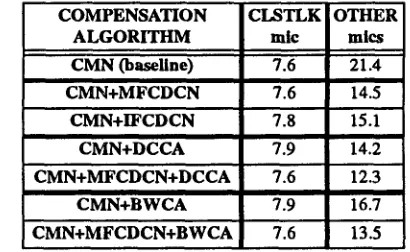
Table 3 compares word error rates obtained with the DCCA and BWCA as described in Sec. 2.5 with error rates obtained with CMN and MFCDCN. The Bantu-Welch codebook adaptation was implemented with four iterations of re-estimation, re-estimating the codebook means only. (Means and variances were re-estimated in a pilot experiment, but with no improvement in performance.)
COMPENSATION CLSTLK OTHER A L G O R I T H M mle mics CMN (baseline) 7.6 21.4 CMN+MFCDCN 7.6 14.5 CMN+IFCDCN 7.8 15.1 CMN+DCCA 7.9 14.2 CMN+MFCDCN+DCCA 7.6 12.3 CMN+BWCA 7.9 16.7 CMN+MFCDCN+BWCA 7.6 13.5
Table 3: Comparison of error rates obtained using codebook adaptation with and without MFCDCN.
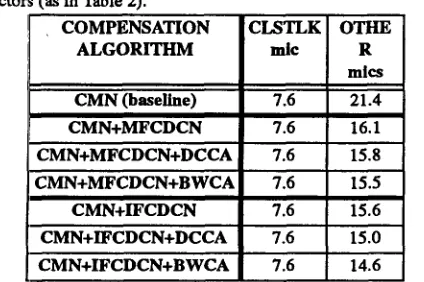
[image:4.612.340.545.534.660.2]Table 4 provides similar comparisons, but with the testing envi- ronments excluded from the corpus used to develop compensation vectors (as in Table 2).
COMPENSATION CLSTLK OTHE A L G O R I T H M mie R
mlcs CMN (baseline) 7.6 21.4 CMN+MFCDCN 7.6 16.1 CMN+MFCDCN+DCCA I 7.6 15.8 CMN+MFCDCN+BWCA 7.6 15.5 CMN+IFCDCN 7.6 15.6 CMN+IFCDCN+DCCA 7.6 15.0 CMN+IFCDCN+BWCA [ 7.6 14.6
Table ,l: Word error rates as in Table 3, but with the testing envi- ronments excluded from the corpus used to develop the compen-
The results of Tables 3 and 4 indicate that the effectiveness of codebook adaptation used in isolation to reduce error rate is about equal to that of MFCDCN. Once again, the use of environmental interpolation is helpful in cases in which the testing environment was not used to develop compensation vectors.
3.3. Reduced-bandwidth Processing for Tele-
phone
Speech
Table 5 compares error rates obtained using conventional signal processing versus reduced-bandwidth analysis for the telephone- microphone subset of the development set, and for the remaining microphones.
PROCESSING NON-TELEPHONE TELEPHONE BANDWIDTH I m l c s m i c s Full bandwidth 11.2 39.0 Reduced bandwidth I 22.3 15.5
Table 5: Word error rates obtained using conventional and reduced-bandwidth analysis for the 1992 WSJ test set.
It can be seen in Table 5 that the use of a reduced analysis band- width dramatically improves recognition error rate when the sys- tem is trained with h i g h - q u a l i t y speech and tested u s i n g telephone-bandwidth speech.
In an unofficial evaluation we applied reduced-bandwidth analysis to the telephone speech data of Spoke 6 (known-microphone adap- tation) from the 1993 ARPA CSR evaluation. Using a version of SPHINX-II trained with only the 7000 sentences of the WSJ0 cor- pus, we observed an error rate for the test set of 13.4%. This results compares favorably with results reported by other sites using systems that were trained with both the WSJ0 snd WSJ1 corpora.
4. PERFORMANCE USING THE 1993 CSR
EVALUATION DATA
We summarize in this section the results of experiments using the 1993 ARPA CSR WSJ test set, including official results obtained using SPHINX-Ha and subsequent evaluations with SPHINX-II.
4 . 1 . S p o k e 5 : M i c r o p h o n e I n d e p e n d e n c e
The testing data for Spoke 5 were samples of speech from 10 microphones that had never been used previously in ARPA evalua- tions. One of the microphones is a telephone handset and another is a speakerphone.
The evaluation system for Spoke 5 first performs a crude environ- mental classification using the Gaussian environment classifier, b l i n d l y separating incoming speech into utterances that are assumed to be recorded either from wideband microphones or tele- phone-bandwidth microphones and channels. Speech that is assumed to be recorded from a full-bandwidth microphone is pro- cessed using a combination of IFCDCN and IPDCN, interpolating over the closest three environments for IFCDCN and over the best four environments for IPDCN. Speech that is believed to be recorded through a telephone channel is processed using a combi- nation of narrow-band processing as described in Sec. 2.6 and MFCDCN. The systems were trained using the CLSTLK micro- phone.
CONDI- TION
PO C1 C2 C3
TESTING COMPEN- SPHX-IIa SPHX-H M I C SATION 11/93 12/93 Other ON 15.6 10.4
OFF ! 21.3 16.8 Other
cLSTLK ON 10.0 6.6 CLSTLK OFF
I
10.1 6.5Table 6: Comparison of word error rates for Spoke 5 using two different recognition systems, SPHINX-Ha and SPHINX-If.
Recognition error rates on the 5000-word $5 task are summarized in Table 6. The results for SPHINX-Ha are the official evaluation results. The test data were re-run in 12/93 using a version of SPHINX-II that was very similar to that used for the Hub evalua- tion. Although this evaluation was "unofficial", it was performed without any further algorithm development or exposure to the test set after the official evaluation. We note that the baseline system (without "compensation") already includes CMN.
[image:5.612.327.566.328.414.2] [image:5.612.59.296.398.455.2]environmental compensation does not depend on how powerful a recognition system is used.
4.2. Spoke 8: Calibrated Noise Sources
Spoke 8 considers the performance of speech recognition systems in the presence of background interference consisting of speech from AM-radio talk shows or various types of music at 3 different SNRs, 0, 10 and 20 dB. The speech is simultaneously collected using two microphones, the CLSTLK microphone and a desktop Audio-Technica microphone with known acoustical characteris- tics. The 0-dB and 10-dB conditions are more difficult than the acoustical environment of Spoke 5, because the background signal for both the AM-radio and music conditions is frequently speech- like, and because it is highly non-stationary. SNRs are measured at the input to the Audio-Technica microphone
The evaluation system used a combination of t w o algorithms for
environmental robustness, MFCDCN, and silence codebook adap- tation (SCA). New silence codebooks were created using an i m p l e m e n t a t i o n o f B a u m - W e l c h c o d e b o o k a d a p t a t i o n , as described in Sec. 2.5. Two ceps~al codebooks were developed for SPHINX-IIa, with one codebook representing the noise and silence HMMs, and the other codebook representing the other phones. The normal Baum-Welch re-estimation formulas were used updating only the means for the noise and silence HMMs.
NOISE TYPE
Music
A M radio
SNR (dB)
0
10
20
0
10
20
CONDITIONS (% e r r o r rate)
P0 C1 C2 C3
58.7 77.9 17.7 16.9
19.5 32.2 14.8 12.0
14.8 15.0 14.3 11.5
75.5 86.7 29.1 25.9
25.5 36.9 15.4 12.1
15.8 16.6 15.4 12.4
Table 7: Word error rates for Spoke 8 evaluation using SPHINX-Ha. The evaluation system included MFCDCN and SCA. The Audio-Technica is used as the secondary microphone.
The reduced-performance SPHINX-IIa system was used as in Spoke 5, except that two cepstral codebooks were needed to implement silence codebook adaptation, one to model the noise and silence segments, and the other to model the remaining pho- nemes. Four codebooks were developed to model silence seg- ments for different combinations of SNR and background noise, and the codebook used to provide silence compensation was cho- sen blindly on the basis of minimizing residual VQ distortion. System parameters were chosen that optimize performance for the 10-dB SNR. Results for Spoke 8 are summarized in Table 7. By comparing the C2 and C3 results using the CLSTLK microphone with the P0 and S1 results using the Audio-Technica mic, we note that very little degradation is observed in the 20-dB condition but that recognition accuracy is quite low for the 0-riB condition, even when the signal is compensated. The use of MFCDCN and SCA improves recognition accuracy by 35.0 percent overall, and the ratio of overaU error rates for the C2 and P0 conditions is 1.49, as in Spoke 5. As expected, the AM-radio interference was more dif- ficult to cope with than the musical interference at all SNRs, pre- sumably because it is more speech-like.
5. SUMMARY AND CONCLUSIONS
In this paper we describe a number of procedures that improve the recognition accuracy of the SPHINX-II system in unknown acous- tical environments. We found that the use of MFCDFN and phone- dependent cepstral normalization reduces the error rate by 40 per- cent compared to that obtained with CMN alone. The use of Baum-Welch codebook adaptation with MFCDCN reduces the error rate by 37 percent compared to that obtained with CMN alone. The use of reduced-frequency processing reduces error rates for telephone-bandwidth speech by 58 percent compared to the rate observed for conventional signal processing. The performance of these systems for the 1993 CSR Spoke 5 and Spoke 8 evalua- tious is described.
ACKNOWLEDGMENTS
This research was sponsored by the Department of the Navy, Naval Research Laboratory under Grant No. N00014-93-1-2005. The views and conclusions contained in this document are those of the authors and should not be interpreted as representing the offi- cial pericles, either expressed or implied, of the U.S. Government. We thank Raj Reddy, Mei-Yuh Hwang, and the rest of the speech group for their contributions to this work, and Yoshiaki Ohshima in particular for seminal discussions on reduced-bandwidth fre- quency analysis.
REFERENCES
1. Juang, B.-H., "Speech Recognition in Adverse Environ-
ments",
Computer Speech and Language,
5:275-294, 1991.2. Acero, A.,
Acoustical and Etwironmental Robustness in Auto-
matic SPeech Recognition,
Kluwer Academic Publishers, Bos- ton, MA, 1993.3. Lin, F.H., Acero, A., and Stern, R.M., "Effective Joint Com- pensation of Speech for the Effects of AddRive Noise and Lin- ear Filtering",
ICASSP-92,
pp. 865-868, March 1992.4. Hwang, M.Y.,
Subphonetic Acoustic Modeling for Speaker-
Independent Continuous Speech Recognition,
Ph.D. Thesis, Carnegie Mellon University, 1993.5. Huang, X.D., Ariki, Y., and Jack, M.,
Hidden Marker Models
for Speech Recognition,
Edinburgh University Press, Edin- burgh, U.IC, 1990.6. Liu, F.H., Stern, R.M., Huang, X.D., and Acero A., "Efficient
Cepstral Normalization for Robust Speech Recognition,"
Pro-
ceedings of ARPA Speech and Natural Language Workshop,
pp. 69-74, Princeton, March 1993.
7. Schwartz, R., Anestesakos, T., Kubala, E, Makhoul, J., Nguyen, L., and Zavaliagkos, G., "Comparative Experiments
on Large Vocabulary Speech Recognition",
Prec. ARPA
Human Language Technology Workshop,
March, 1993.8. Huang, X., AUeva, F., Hen, H., Hwang, M., Lee, IC, and Rosenfeld, R., "The SPHINX-II Speech Recognition System:
An Overview",
Computer Speech and Language,
2:137-148,1993.
9. Moreno, P. J., and Stern, R. M., "Sources of Degradation of
Speech Recognition in the Telephone Network",
ICASSP-94,
April, 1994.
[image:6.612.70.282.313.441.2]