A d a p t i n g a s y n o n y m d a t a b a s e to s p e c i f i c d o m a i n s
D a v i d e T u r c a t o F r e d P o p o w i c h J a n i n e T o o l eD a n P a s s D e v l a n N i c h o l s o n G o r d o n T i s h e r gavagai Technology Inc.
P.O. 374, 3495 Ca~abie Street, Vancouver, British Columbia, V5Z 4R3, C a n a d a and
N a t u r a l L a n g u a g e Laboratory, School of C o m p u t i n g Science, Simon Fraser U n i v e r s i t y 8888 U n i v e r s i t y Drive, Burnaby, British Columbia, V5A 1S6, C a n a d a
{turk, popowich ,toole, lass, devl an, gt i
sher}@{gavagai, net, as, sfu. ca}
A b s t r a c t
This paper describes a method for adapting a general purpose synonym database, like WordNet, to a spe- cific domain, where only a sub- set of the synonymy relations de- fined in the general database hold. The method adopts an eliminative approach, based on incrementally pruning the original database. The method is based on a preliminary manual pruning phase and an algo- rithm for automatically pruning the database. This method has been im- plemented and used for an Informa- tion Retrieval system in the aviation domain.
1 I n t r o d u c t i o n
Synonyms can be an important resource for Information Retrieval (IR) applications, and attempts have been made at using them to expand query terms (Voorhees, 1998). In expanding query terms, overgeneration is as much of a problem as incompleteness or lack of synonym resources. Precision can dramat- ically drop because of false hits due to in- correct synonymy relations. This problem is particularly felt when IR is applied to docu- ments in specific technical domains. In such cases, the synonymy relations that hold in the specific domain are only a restricted portion of the synonymy relations holding for a given language at large. For instance, a set of syn- onyms like
(1)
{cocaine, cocain, coke, snow, C}
valid for English, would be detrimental in a specific domain like weather reports, where both
snow and C (for Celsius)
occur very fre- quently, but never as synonyms of each other. We describe a method for creating a do- main specific synonym database from a gen- eral purpose one. We use WordNet (Fell- baum, 1998) as our initial database, and we draw evidence from a domain specific corpus about what synonymy relations hold in the domain.Our task has obvious relations to word sense disambiguation (Sanderson, 1997) (Lea- cock et al., 1998), since both tasks are based on identifying senses of ambiguous words in a text. However, the two tasks are quite dis- tinct. In word sense disambiguation, a set of candidate senses for a given word is checked against each occurrence of the relevant word in a text, and a single candidate sense is se- lected for each occurrence of the word. In our synonym specialization task a set of candidate senses for a given word is checked against an entire corpus, and a subset of candidate senses is selected. Although the latter task could be reduced to the former (by disambiguating all occurrences of a word in a test and taking the union of the selected senses), alternative approaches could also be used. In a specific domain, where words can be expected to be monosemous to a large extent, synonym prun- ing can be an effective alternative (or a com- plement) to word sense disambiguation.
Assuming t h a t a specific domain corresponds to a single SFC (or a restricted set of SFCs, at most), t h e difference between SFC as- signment and our task is t h a t t h e former assigns one of m a n y possible values to a given synset (one of all possible SFCs), while t h e latter assigns one of two possible values (the words belongs or does not belong to the SFC representing the domain). In o t h e r words, SFC assignment is a classification task, while ours can be seen as either a filtering or ranking task.
Adopting a filtering/ranking perspective makes a p p a r e n t t h a t the s y n o n y m pruning task can also be seen as an eliminative pro- cess, and as such it can be performed incre- mentally. In the following section we will show how such characteristics have been ex- ploited in performing t h e task.
In section 2 we describe t h e pruning methodology, while section 3 provides a prac- tical example from a specific domain. Con- clusions are offered in section 4.
2 M e t h o d o l o g y
2.1 O u t l i n e
T h e s y n o n y m pruning task aims at improv- ing both the accuracy and t h e speed of a syn- o n y m database. In order to set the terms of the problem, we find it useful to partition the set of s y n o n y m y relations defined in WordNet into t h r e e classes:
. Relations irrelevant to t h e specific do- main (e.g. relations involving words t h a t seldom or never appear in t h e specific do- main)
. Relations t h a t are relevant but incorrect in t h e specific domain (e.g. t h e syn- o n y m y of two words t h a t do appear in the specific domain, but are only s y n o n y m s in a sense irrelevant to t h e specific do- main);
3. Relations t h a t are relevant and correct in t h e specific domain.
T h e creation of a domain specific database aims at removing relations in the first two
classes (to improve speed and accuracy, re- spectively) and including only relations in t h e third class.
The overall goal of t h e described m e t h o d is to inspect all s y n o n y m y relations in Word- Net and classify each of t h e m into one of t h e three aforementioned classes. We define a
s y n o n y m y relation as a binary relation be- tween two s y n o n y m t e r m s (with respect to • a particular sense). Therefore, a W o r d N e t synset containing n t e r m s defines ~ 1 1 k syn- o n y m relations. T h e assignment of a syn- o n y m y relation to a class is based on evidence drawn from a domain specific corpus. We use a tagged and lemmatized corpus for this pur- pose. Accordingly, all frequencies used in t h e rest of the paper are to be intended as fre- quencies of ( l e m m a , tag) pairs.
T h e pruning process is carried o u t in t h r e e steps: (i) manual pruning; (ii) a u t o m a t i c pruning; (iii) optimization. T h e first two steps focus on incrementally eliminating in- correct synonyms, while the third step focuses on removing irrelevant synonyms. T h e t h r e e steps are described in t h e following sections.
2.2 M a n u a l p r u n i n g
the noun
approach
(2) a.
{approach, approach path, glide
path, glide slope}
(the final path followed by an air- craft as it is landing)
b.
{approach, approach shot}
(a relatively short golf shot in- tended to p u t the ball onto the putting green)c.
{access, approach}
(a way of entering or leaving)
it would be easy to judge the first and second senses respectively relevant and irrelevant to the aviation domain, b u t the evaluation of the third sense would be fuzzier.
The combination of the two remarks above induced us to consider a manual pruning phase for the terms of highest 'weight' as a good investment of human effort, in terms of rate between the achieved increase in preci- sion and the a m o u n t of work involved. A second reason for performing an initial man- ual pruning is t h a t its o u t c o m e can be used as a reliable test set against which a u t o m a t i c pruning algorithms can be tested.
Based on such considerations, we included a manual phase in the pruning process, consist- ing of two steps: (i) the ranking of s y n o n y m y relations in terms of their weight in the spe- cific domain; (ii) the actual evaluation of the correctness of the top ranking s y n o n y m y re- lation, by human evaluators.
2 . 2 . 1 R a n k i n g o f s y n o n y m y r e l a t i o n s The goal of ranking s y n o n y m y relations is to associate them with a score that estimates how often a s y n o n y m y relation is likely to be used in the specific domain. The input d a t a b a s e is sorted by the assigned scores, and the top ranking words are checked for manual pruning. Only terms appearing in the domain specific corpus are considered at this stage. In this way the benefit of manual pruning is maximized. Ranking is based on three sorting criteria, listed below in order of priority.
C r i t e r i o n 1. Since a term that does ap- pear in the domain corpus must have at least one valid sense in the specific domain, words
with only one sense are not good candidates for pruning (under the assumption of com- pleteness of the s y n o n y m d a t a b a s e ) . There- fore .polysemous terms are prioritized over monosemous terms.
C r i t e r i o n 2. The second and third sort- ing criteria axe similar, the only difference be- ing t h a t the second criterion assumes the ex- istence of some inventory of relevant queries (a t e r m list, a collection of previous queries, etc.), ff such an inventory is not available, the second sorting criterion can be omitted. If the inventory is available, it is used to check which s y n o n y m y relations are actually to be used in queries to the domain corpus. Given a pair
(ti,tj)
of s y n o n y m terms, a score (which we namescoreCQ) is assigned to their s y n o n y m y
relation, according to the following formula:(3)
scoreCQij =
(fcorpusi * fqueryj) +
(fcorpusj • fqueryi)
where
fcorpusn
andfqueryn
are, respec- tively, the frequencies of a term in the domain corpus and in the inventory of query terms. The above formula aims at estimating how often a given s y n o n y m y relation is likely to be actually used. In particular, each half of the formula estimates how often a given term in t h e corpus is likely to be matched as a syn- onym of a given term in a query. Consider, e.g., the following situation (taken form the aviation domain discussed in section 3.1):(4)
fcorpuSsnow
= 3042f querysnow = 2
fcorpusc
= 9168f queryc = 0
It is estimated t h a t C would be matched 18336 times as a s y n o n y m for
snow
(i.e 9168 * 2), whilesnow
would never be matched as a s y n o n y m for C, because C never occurs as a query term. ThereforescoreCQs,~ow,c
is 18336 (i.e. 18336 + 0).Table 1: Frequencies of sample synset terms.
j
fcorpusj
fqueryj
cocaine
1
0
cocain
0
0
coke
8
0
C 9168 0
(5)
scorePolyCQ i,~ =
E{scoreCQi,~lj ~ s A i ¢ j }
E.g., i f ,5' is the synset in (1), then
scorePolyCQs~ow,s
is "the sum ofscoreCQsnow,coc~ine,
scoreCQsnow,eocain,
scoreCQsnow,eoke
andscoreCQ,no~o,c.
Given the d a t a in Table 1 (taken again from our aviation domain) the followingscoreCQ
would result:(6)
scoreCQsnow,cocaine -~ 2scoreCQsnow,cocain = 0
scoreCQs~ow,cok~
= 16scoreCQsno~o,c
= 18336Therefore,
scorePolyCQsnow,s
would equal 18354.The final score assigned to each polysemous term tl is the highest
scorePolyCQi,s.
Forsnow,
which has the following three senses(7)
a.
{cocaine, cocaine, coke, C, snow}
(a narcotic (alkaloid) extracted from coca leaves)b. {snow}
(a layer of snowflakes (white crys- tals of frozen water) covering the ground)
c.
{snow, snowfall}
(precipitation falling from clouds in the form of ice crystals)
the highest score would be the one computed above.
C r i t e r i o n 3. The third criterion assigns a score in terms of domain corpus frequency alone. It is used to further rank terms t h a t do not occur in the query term inventory (or when no query term inventory is available). It is computed in the same way as the previous
score, with the only difference t h a t a value of 1 is conventionally assumed for
fquery
(the frequency of a term in the inventory of query terms).2.2.2 C o r r e c t n e s s e v a l u a t i o n
All the synsets containing the top rank- ing terms, according to the hierarchy of crite- ria described above, are manuMly checked for pruning. For each term, all the synsets con- taining the term are clustered together and presented to a human operator, who exam- ines each
(term, synset)
pair and answers the question: does the term belong to the synset in the specific domain? Evidence about the answer is drawn from relevant examples auto- matically extracted from the domain specific corpus. E.g., following up on our example in the previous section, the operator would be presented with the wordsnow
associated with each of the synsets in (7) and would have to provide a yes/no answer for each of them. In the specific case, the answer would be likely to be 'no' for (7a) and 'yes' for (75) and (7c). The evaluator is presented with all the synsets involving a relevant term (even those t h a t did not rank high in terms ofscorePoIyCQ)
in order to apply a contrastive approach. It might well be the case that the correct sense for a given term is one for which the term has no synonyms at all (e.g. 7b in the example), therefore all synsets for a given term need to be presented to the evaiuator in order to make an informed choice. The evaluator provides a yes/no answer for all the(term, synset)
he/she is presented with (with some exceptions, as explained in section 3.1).2.3 A u t o m a t i c p r u n i n g
The automatic pruning task is analogous to manual pruning in two respects: (i) its in- put is the set of synonymy relations involving WordNet polysemous words appearing in the domain specific corpus; (ii) it is performed by examining all
(term, synset)
input pairs and answering the question: does the term belong to the synset in the specific domain? How- ever, while the manual pruning task was re- garded as a filtering task, where a human eval-uator assigns a boolean value to each pruning candidate, t h e a u t o m a t i c pruning task can be more conveniently regarded as a ranking task, where all t h e pruning candidates are as- signed a score, measuring how appropriate a given sense is for a given word, in the do- main at hand. The actual pruning is left as a subsequent step. Different pruning thresh- olds can be applied to t h e ranked list, based on different considerations (e.g. depending on w h e t h e r a stronger emphasis is put on the pre- cision or the recall of t h e resulting database). The score is based on the frequencies of both words in the synset (except t h e word under consideration) and words in t h e sense gloss. We also remove from t h e gloss all words be- longing to a stoplist (a stoplist provided with WordNet was used for this purpose). T h e fol- lowing scoring formula is used:
(8)
(average_synset_frequeney/
synset_cardinality k) .4-
(average_gloss_frequency~
gloss_cardinality t:)
Note t h a t t h e synset cardinality does not include the word under consideration, reflect- ing the fact t h e word's frequency is not used in calculating the score. Therefore a synset only containing the word under consideration and no s y n o n y m s is assigned cardinality 0.
The goal is to identify
(term, sense)
pairs not pertaining to the domain. For this rea- son we tend to assign high scores to candi- dates for which we do not have enough evi- dence about their inappropriateness. This is why average frequencies are divided by some factor which is function of the number of av- eraged frequencies, in order to increase the Scores based on little evidence (i.e. fewer av- eraged numbers). In the sample application described in section 3 the value of k was set to 2. For analogous reasons, we convention- ally assign a very high score to candidates for which we have no evidence (i.e. no words in both t h e synset and the gloss). If either the synset or the gloss is empty, we conventionally double the score for the gloss or the synset, respectively. We note at this point t h a t our final ranking list are sorted in reverse orderwith respect to the assigned scores, since we are focusing on removing incorrect items. A t t h e top of t h e list are t h e items t h a t receive t h e lowest score, i.e. t h a t are more likely to be incorrect
(term, sense)
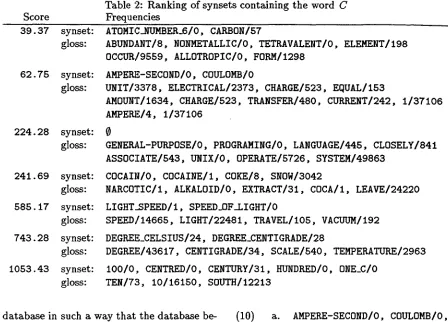
associations for our domain (thus being t h e best candidates to be pruned out).Table 2 shows the ranking of t h e senses for the word C in t h e aviation domain. In the table, each term is followed by its corpus frequency, separated by a slash. From each synset the word C itself has been removed, as well as the gloss words found in t h e stop list. Therefore, the table only contains t h e words t h a t contribute to the calculation of t h e sense's score. E.g. t h e score for the first sense in the list is obtained from the following ex- pression:
(9)
((0 + 57)/2/22) +( ( 8 + 0 + 0 + 1 9 8 + 9 5 5 9 + 0 + 1 2 9 8 ) / 7 / 7 2 )
The third sense in t h e list exemplifies t h e case of an e m p t y synset (i.e. a synset orig- inally containing only the word u n d e r con- sideration). In this case t h e score obtained from the gloss is doubled. Note t h a t t h e ob- viously incorrect sense of C as a narcotic is in the middle of the list. This is due to a tag- ging problem, as the word
leaves
in t h e gloss was tagged as verb instead of noun. Therefore it was assigned a very high frequency, as t h e verbleave,
unlike the nounleaf,
is very com- mon in the aviation domain. The last sense in the list also requires a brief explanation. The original word in t h e gloss was10S.
How- ever, the pre-processor t h a t was used before tagging the glosses recognized S as an abbre- viation forSouth
and expanded the t e r m ac- cordingly. It so happens t h a t both words10
and
South
are very frequent in the aviationcorpus we used, therefore t h e sense was as- signed a high score.
2.4 O p t i m i z a t i o n
Score
Table 2: Ranking of synsets containing the word C Frequencies
3 9 . 3 7
6 2 . 7 5
224.28
synset: gloss:
synset: gloss:
synset: gloss:
2 4 1 . 6 9 synset: gloss: 5 8 5 . 1 7 synset:
gloss: 7 4 3 . 2 8 synset:
gloss: 1053.43 synset:
gloss:
ATOMIC_NUMBEK_6/O, CAKBON/57
ABUNDANT/8, NONMETALLIC/O, TETRAVALENT/O, ELEMENT/198
0CCUR/9559, ALLOTROPIC/O, FOKM/1298
AMPEre-SECOND/O,
COULOMB/O
UNIT/3378, ELECTRICAL/2373, CHARGE/523, EQUAL/153
AMOUNT/1634, CHARGE/523, TKANSFEK/480, CUKKENT/242, 1/37106
AMPEre/4, 1/37106
0
GENEKAL-PUKPOSE/O, PROGRAMING/O, LANGUAGE/445, CLOSELY/841
ASSOCIATE/543, UNIX/O, OPEKATE/5726, SYSTEM/49863
COCAIN/O,
COCAINE/i,
COKE/8, SNOW/3042
NARCOTIC/i, ALKALOID/O, EXTKACT/31, COCA/I, LEAVE/24220
LIGHT_SPEED/I, SPEED_OF_LIGHT/O
SPEED/14665, LIGHT/22481, TRAVEL/f05, VACUUM/192
DEGREE_CELSIUS/24, DEGREEiENTIGRADE/28
DEGKEE/43617, CENTIGRADE/34, SCALE/540, TEMPERATURE/2963
I00/0, CENTRED/O, CENTUKY/31, HUNDRED/O, ONE_C/O
TEN/Z3, 10/16150, SOUTH/12213
database in such a way t h a t the database be- havior remains unchanged. Two operations are performed at t h e stage: (i) a simple rel-
e v a n c e t e s t to remove irrelevant terms (i.e.
terms not pertaining to the domain at hand); (ii) a redundancy check, to remove informa- tion t h a t , although perhaps relevant, does not affect t h e database behavior.
2.4.1 R e l e v a n c e t e s t
Terms not appearing in the domain cor- pus are considered not relevant to the spe- cific domain and removed from the synonym database. T h e rationale underlying this step is to remove from t h e synonym database syn- onymy relations t h a t are never going to be used in t h e specific domain. In this way the ef- ficiency of the module can be increased, by re- ducing t h e size of the database and the num- ber of searches performed (synonyms t h a t are known to never appear are not searched for), without affecting the system's matching at- curacy. E.g., the synset in (10a) would be reduced to the synset in (10b).
(10)
a.AMPERE-SECOND/O, COULOMB/O,
C/9168
b.
C/9168
2.4.2 R e d u n d a n c y c h e c k
The final step is the removal of r e d u n d a n t synsets, possibly as a consequence of the pre- vious pruning steps. Specifically, the follow- ing synsets are removed:
• Synsets containing a single term (al- though t h e associated sense might be a valid one for t h a t term, in t h e specific domain).
• Duplicate synsets, i.e. identical (in terms of synset elements) to some other synset not being removed (the choice of t h e only synset to be preserved is arbitrary).
E.g., the synset in (10b) would be finMly removed at this stage.
3 S a m p l e a p p l i c a t i o n
[image:6.596.114.562.63.385.2]Safety Information System (ASRS) corpus ( h ' e t p : / / a s r s . a r c . n a s a . g o v / ) as our avia- tion specific corpus. The resulting domain- specific d a t a b a s e is being used in an IR ap- plication t h a t retrieves documents relevant to user defined queries, expressed as phrase patterns, and identifies portions of text t h a t are instances of t h e relevant phrase patterns. T h e application makes use of Natural Lan- guage Processing (NLP) techniques (tagging and partial parsing) to a n n o t a t e documents. User defined queries are matched against such a n n o t a t e d corpora. Synonyms are used to expand occurrences of specific words in such queries. In the following two sections we de- scribe how the pruning process was performed and provide some results.
3.1 A d a p t i n g W o r d n e t t o t h e a v i a t i o n d o m a i n
A vocabulary of relevant query terms was m a d e available by a user of our IR applica- tion and was used in our ranking of s y n o n y m y relations. Manual pruning was performed on the 1000 top ranking terms, with which 6565 synsets were associated overall. The manual pruning task was split between two h u m a n evaluators. The evaluators were programmers m e m b e r s of our staff. T h e y were English na- tive speakers who had acquaintance with our IR application and with the goals of the man- ual pruning process, but no specific training or background on lexicographic or WordNet- related tasks. For each of the 1000 terms, the evaluators were provided with a sample of 100 (at most) sentences where the rele- vant word occurred in the ASRS corpus. 100 of the 1000 manually checked clusters (i.e. groups of synsets referring to t h e same head term) were s u b m i t t e d to both evaluators (576 synsets overall), in order to check the rate of agreement of their evaluations. The eval- uators were allowed to leave synsets unan- swered, when the synsets only contained the head t e r m (and at least one other synset in the cluster had been deemed correct). Leav- ing out the cases when one or both evalua- tors skipped t h e answer, there remained 418 synsets for which both answered. There was
agreement in 315 cases (75%) and disagree- ment in 103 cases (25%). A sample of senses on which the evaluators disagreed is shown in (11). In each case, the t e r m being evaluated is the first in the synset.
(11)
a.
{about, around}
(in the area or vicinity)
b.
{accept, admit, take, take on}
(admit into a group or c o m m u - nity)
c.
{accept, consent, go for}
(give an affirmative reply to)d.
{accept, swallow}
(tolerate or a c c o m m o d a t e oneself
to)
e.
{accept, take}
(be designed to hold or take)
f.
{accomplished, effected, estab-
lished}
(settled securely and uncondi- tionally)
g.
{acknowledge, know, recognize}
(discern)h.
{act, cognitive operation, cogni-
tive process, operation, process}
(the performance of some com- posite cognitive activity)i.
{act, act as, play}
(pretend to have certain qualities or state of mind)
j.
{action, activeness, activity}
(the state of being active)k.
{action, activity, natural action,
natural process}
(a process existing in or produced by n a t u r e (rather t h a n by t h e in- tent of h u m a n beings))
by a sample of occurrences), one c o m m o n sit- uation m a y have been t h a t a sense did oc- cur, but very rarely. Therefore, t h e evaluators m a y have applied different criteria in judging how m a n y occurrences were needed to deem a sense correct. This discrepancy, of course, m a y c o m p o u n d with t h e fact t h a t the differ- ences a m o n g W o r d N e t senses can sometimes be very subtle.
A u t o m a t i c pruning was performed on t h e entire W o r d N e t database, regardless of w h e t h e r candidates had already been manu- ally checked or not. This was done for test- i n g purposes, in order to check t h e results of a u t o m a t i c pruning against t h e test set ob- tained from manual pruning. Besides asso- ciating ASRS frequencies with all words in synsets and glosses, we also c o m p u t e d fre- quencies for collocations (i.e. multi-word terms) appearing in synsets. T h e input to a u t o m a t i c pruning was constituted by 10352 polysemous t e r m s appearing at least once in ASRS t h e corpus. Such t e r m s correspond to 37494
(term, synset)
pairs. Therefore, the latter was the actual n u m b e r of pruning can- didates t h a t were ranked.The check of WordNet senses against ASRS senses was only done unidirectionally, i.e. we only checked w h e t h e r W o r d N e t senses were a t t e s t e d in ASRS. Although it would be interesting to see how often the appropri- ate, domain-specific senses were absent from WordNet, no check of this kind was done. We took the simplifying assumption t h a t Word- Net be complete, thus aiming at assigning at least one W o r d N e t sense to each t e r m t h a t appeared in both WordNet and ASRS.
3.2 R e s u l t s
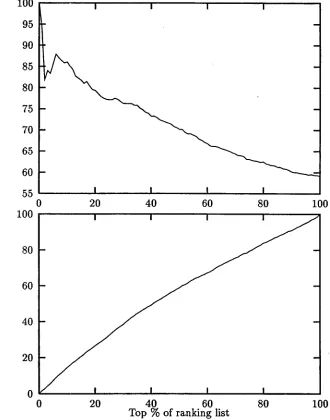
In order to test the a u t o m a t i c pruning per- formance, we ran the ranking procedure on a test set taken from t h e m a n u a l l y checked files. This file had been set a p a r t and had n o t been used in t h e preliminary tests on the a u t o m a t i c pruning algorithm. T h e test set included 350 clusters, comprising 2300 candi- dates. 1643 candidates were actually assigned an evaluation during manual pruning. These were used for t h e test. We e x t r a c t e d the 1643
relevant items from o u r ranking list, then we incrementally c o m p u t e d precision and recall in t e r m s of t h e items t h a t had been manually checked by our h u m a n evaluators. T h e re- sults are shown in figure 1. As an example of how this figure can be interpreted, taking into consideration t h e t o p 20% of t h e ranking list (along the X axis), an 80% precision (Y axis) means t h a t 80% of t h e items encountered so far had been removed in m a n u a l pruning; a 27% recall (Y axis) m e a n s t h a t 27% of t h e overall manually removed items have been en- countered so far.
The a u t o m a t i c pruning t a s k was intention- ally framed as a ranking problem, in order to leave open t h e issue of w h a t pruning threshold would be optimal. This same approach was taken in the IR application in which t h e prun- ing procedure was embedded. Users are given the option to set their own pruning threshold (depending on w h e t h e r t h e y focus more on precision or recall), by setting a value spec- ifying w h a t precision t h e y require. P r u n i n g is performed on t h e t o p section of t h e rank- ing list t h a t guarantees the required precision, according to t h e correlation between precision and a m o u n t of pruning shown in figure 1.
Table 3: WordNet optimization results. DB Synsets Word-senses Full WN 99,642 174,008 Reduced WN 9,441 23,368
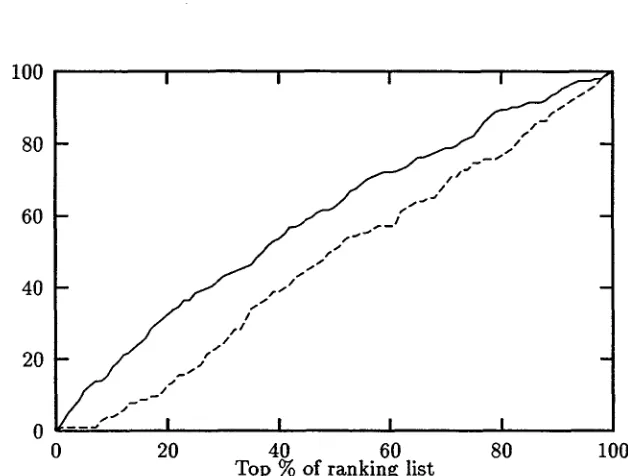
ted line).
Finally, table 3 shows the result of applying the described optimization techniques alone, i.e. without any prior pruning, with respect to the ASRS corpus. The table shows how many synsets and how many word-senses are contained in the full Wordnet database and in its optimized version. Note t h a t such reduc- tion does not involve any loss of accuracy.
4 C o n c l u s i o n s
There is a need for automatically or semi- automatically adapting NLP components to specific domain, if such components are to be effectively used in IR applications without in- volving labor-intensive manual adaptation. A key part of adapting NLP components to spe- cific domains is the adaptation of their lexical and terminological resources. It may often be the case t h a t a consistent section of a general purpose terminological resource is irrelevant to a specific domain, thus involving an unnec- essary amount of ambiguity t h a t affects both the accuracy and efficiency of the overall NLP component. In this paper we have proposed a method for adapting a general purpose syn- onym database to a specific domain.
Evaluating the performance of the pro- posed pruning method is not a straightfor- ward task, since there are no other results available on a similar task, to the best of our knowledge. However, a comparison between the results of manual and automatic pruning provides some useful hints. In particular:
• The discrepancy between the evaluation of human operators shows that the t a s k is elusive even for humans (the value of the agreement evaluation statistic n for our human evaluators was 0.5);
• however, the correlation between the level of confidence of human evaluations and scores assigned by the automatic
pruning procedure shows t h a t the auto- matic pruning algorithm captures some significant aspect of the problem.
Although there is probably room for im- proving the automatic pruning performance, the preliminary results show t h a t the current approach is pointing in the right direction.
R e f e r e n c e s
Christiane Fellbaum, editor. 1998. Wordnet: An Electronic Lexical Database. MIT Press Books.
Claudia Leacock, Martin Chodorow, and George A. Miller. 1998. Using corpus statistics and WordNet relations for sense identification.
Computational Linguistics, 24(1):147-165.
Bernardo Magnini and Gabriela Cavaglih. 2000. Integrating Subject Field Codes into WordNet. In Maria Gavrilidou, George Carayannis, Stella Markantonatou, Stelios Piperidis, and Gregory Stainhaouer, editors, Proceedings of the Sec- ond International Conference on Language Re- sources and Evaluation (LREC-PO00), pages 1413-1418, Athens, Greece.
Mark Sanderson. 1997. Word Sense Disambigua- tion and Information Retrieval. Ph.D. thesis, Department of Computing Science at the Uni- versity of Glasgow, Glasgow G12. Technical Report (TR-1997-7).
Ellen M. Voorhees. 1998. Using WordNet for text retrieval. In Fellbaum (Fellbaum, 1998), chap- ter 12, pages 285-303.
~2
~9
100 i I I I
95
90
85
+° i
75
70
65
60
55
0
100
80
60
40
20
0 I I I I
0 20 40 60 80 100
T o p % o f ranking list
F i g u r e 1: Precision and recall o f a u t o m a t i c p r u n i n g
[image:10.596.181.511.156.576.2]~9
cg
100
80
60
40
20
I I I I t--'-/
-- _ t / f j" _
-- r l j - -
/ J _
;
_
--J" I I I I
0 20 40 60 80 100
Top % of ranking list
Figure 2: A recall comparison for different confidence rates
[image:11.596.160.474.227.465.2]