A Unified Representation for Morphological, Syntactic, Semantic, and
Referential Annotations
Erhard W. Hinrichs, Sandra Kübler, Karin Naumann
SfS-CL, University of Tübingen Wilhelmstr. 19
72074 Tübingen, Germany
{eh,kuebler,knaumann}@sfs.uni-tuebingen.de
Abstract
This paper reports on the SYN-RA (SYNtax-based Reference Annotation) project, an on-going project of annotating German newspaper texts with referential relations. The project has developed an in-ventory of anaphoric and coreference rela-tions for German in the context of a uni-fied, XML-based annotation scheme for combining morphological, syntactic, se-mantic, and anaphoric information. The paper discusses how this unified annota-tion scheme relates to other formats cur-rently discussed in the literature, in par-ticular the annotation graph model of Bird and Liberman (2001) and the pie-in-the-sky scheme for semantic annotation.
1 Introduction
The purpose of this paper is threefold: (i) it dis-cusses an annotation scheme for referential relations for German that is significantly broader in scope than existing schemes for the same task and lan-guage and that also goes beyond the inventory of anaphoric relations included in the pie-in-the-sky
sample feature structures1, (ii) it presents a unified,
XML-based annotation scheme for combining mor-phological, syntactic, semantic, and anaphoric infor-mation, and (iii) it discusses how this unified anno-tation scheme relates to other formats currently dis-cussed in the literature, in particular the annotation
1See e.g. nlp.cs.nyu.edu/meyers/pie-in-the-sky/
analysis5.
graph model of Bird and Liberman (2001) and the
pie-in-the-sky scheme for semantic annotation2.
2 Referential Relations
This section introduces the inventory of referential relations adopted in the SYN-RA project. We define
referential relations as a cover-term for all
contex-tually dependent reference relations. The inventory of such relations adopted for SYN-RA is inspired by the annotation scheme first developed in the MATE project (Davies et al., 1998). However, it takes a cautious approach in that it only adopts those refer-ential relations from MATE for which the develop-ers of MATE report a sufficiently high level of inter-annotator agreement (Poesio et al., 1999).
SYN-RA currently uses the following subset of relations: coreferential, anaphoric, cataphoric,
bound, split antecedent, instance, and expletive. The
potential markables are definite NPs, personal pro-nouns, relative, reflexive, and reciprocal propro-nouns, demonstrative, indefinite and possessive pronouns.
There is a second research effort under way at the European Media Laboratory Heidelberg, which also annotates German text corpora and dialog data with referential relations. Since their corpora are not pub-licly available, it is difficult to verify their inventory of referential relations. Kouchnir (2003) has used their data and describes the relations anaphoric,
coreferential, bridging, and none.
Following van Deemter and Kibble (2000), we define a coreference relation to hold between two
2See nlp.cs.nyu.edu/meyers/pie-in-the-sky/
pie-in-the-sky-descript.html.
NPs just in case they refer to the same extra-linguistic referent in the real world. In the following example, a coreference relation exists between the noun phrases [1] and [2], and an anaphoric relation between the noun phrase [2] and the personal pro-noun [3]. Since pro-noun phrases [1] and [2] are corefer-ential, all three NPs belong to the same coreference chain. In keeping with the MUC-6 annotation
stan-dard3, we establish the anaphoric relations of a
pro-noun only to its most recently mentioned antecedent.
(1) [1 Der
’The new chairman of the union of educators
and scholars is called Ulli Thöne. He was
elected yesterday with 217 of 355 votes.’
Cataphoric relations hold between a preceding
pronoun and a following antecedent within the same sentence, even if this antecedent has already been mentioned within the preceding text. An example for a cataphoric relation is shown in (2).
(2) Vier
’They have already been in Berlin for four weeks, the 200 Albanians from Kosovo.’
The relation bound holds between anaphoric ex-pressions and quantified noun phrases as their an-tecedents (see example (3)).
(3) [Niemandem]
in front of [sich]
’Nobody has trouble imagining the picture.’
3See www.cs.nyu.edu/cs/faculty/grishman/
COtask21.book_1.html.
The split antecedent relation holds between co-ordinate NPs/plural pronouns and pronouns/definite NPs referring to one member of the plural expres-sion. In example (4), the indefinite pronoun beide enters into two split antecedent relations, with noun phrases 1 and 2.
(4) Aber for some minutes
etwas
’But suddenly, there is a completely implausi-ble and grotesque phone call from the detective to the mother of the victim, they both cry at each other for several minutes, ...’
An instance relation exists between a preced-ing/following pronoun and its NP antecedent when the pronoun refers to a particular instantiation of the class identified by the NP.
(5) Die
double full-back formation beibringe.
teaches.
In sentence (5), the relation between the two bracketed NPs is an example of such an instance re-lation since the second NP is a particular instantia-tion of the referent denoted by the first NP.
A third person singular neuter pronoun es is marked as expletive if it has no proper antecedent. This is the case for presentational es in example (6), impersonal passive as in example (7), or es as sub-ject for verbs without an agent as in example (8).
(6) [1 Es] It
zeichnet sich emerges
die the
konkrete concrete
Möglichkeit possibility ab.
verb part.
’The concrete possibility emerges.’
(7) [Es] There
wird is
bis zum until the
Morgen morning
getanzt. danced.
’People are dancing until morning.’
(8) [Es] It
steht stands
schlecht bad
um for
ihn. him.
’He is in a bad way.’
Apart from expletive uses of es and anaphoric uses with an NP antecedent, the pronoun es can also be used in cases of event anaphora as in sentence (9). Here es refers to the event of Jochen’s win-ning the lottery. Currently, the annotation in SYN-RA is restricted to NP anaphora and therefore event anaphors such as in sentence (9) remain unannotated for anaphora.
(9) Jochen Jochen
hat has
im in the
Lotto lottery
gewonnen. won.
Aber But
er he weiss
knows es it
noch yet
nicht. not.
’Jochen has won the lottery. But he does not know it yet.’
The annotation of such relations is performed manually with the annotation tool MMAX (Müller and Strube, 2003). Its graphical user interface al-lows for easy selection of the relevant markables and the accompanying relation between the contextually dependent expression and its antecedent.
3 Automatic Extraction of Markables and of Semantic Information
Annotation of referential relations involves two main tasks: the identification of markables, i.e., identifying the class of expressions that can enter into referential relations, and the identification of the particular referential relations that two or more ex-pressions enter into. Identification of markables re-quires at least partial syntactic annotation of the text. If referential relations need to be annotated from plain text, then markables must be identified semi-automatically from the output of a chunker or full parser, if available, or otherwise completely
man-ually. However, in each of these two scenarios,
identification of markables is a time-consuming pro-cess. In case of semi-automatic annotation, the ef-fort required depends on the quality of the parser, but will require at least some amount of manual post-correction of the parser output.
Identification of markables is considerably easier for treebank data since treebanks already provide the necessary syntactic information. For German, there are currently two large-scale treebanks available: the NEGRA/TIGER (Brants et al., 2002) treebank and the Tübingen treebanks for spoken and written Ger-man (StegGer-mann et al., 2000; Telljohann et al., 2003). All the treebanks were annotated with the help of the annotation tool Annotate (Plaehn, 1998). The tree-bank annotations are available in the Annotate ex-port format (Brants, 1997) and in an XML format.
The SYN-RA project is based on the Tübingen treebank of written German (TüBa-D/Z). This tree-bank uses as its data source a collection of articles of the German daily newspaper taz (die tageszeitung). The treebank currently comprises appr. 15 000 tences, with a new release of 7 000 additional sen-tences scheduled for June of this year.
or-Ihre
500 501 502 503 504 505 506 507
508 509 510 511 512
513 514
515 516
517 518
SIMPX
Figure 1: A sample tree from the TüBa/D-Z treebank.
der regularities among different clause types of Ger-man and which are widely accepted among descrip-tive linguists of German (cf. e.g. (Drach, 1937;
Höhle, 1986)). The TüBa-D/Z annotation relies
on a context-free backbone (i.e. proper trees with-out crossing branches) of phrase structure combined with edge labels that specify the grammatical func-tion of the phrase in quesfunc-tion.
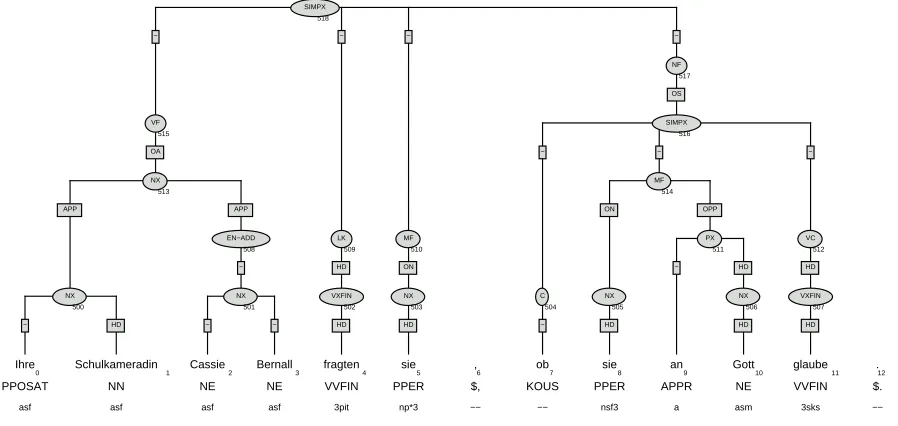
Figure 1 shows an example tree from the TüBa-D/Z treebank for sentence (10). The sentence is di-vided into two clauses (SIMPX), and each clause is subdivided into topological fields. The main clause is made up of the following fields: VF (mnemonic for: Vorfeld – ’initial field’) contains the sentence-initial, topicalized constituent. LK (for: linke
Satz-klammer – ’left sentence bracket’) is occupied by the
finite verb. MF (for: Mittelfeld – ’middle field’) con-tains adjuncts and complements of the main verb. NF (for: Nachfeld – ’final field’) contains extra-posed material – in this case an indirect yes/no ques-tion. The subordinate clause is again divided into three topological fields: C (for: Komplementierer – ’complementizer’), MF, and VC (for:
Verbalkomp-lex – verbal compVerbalkomp-lex). Edge labels are rendered in boxes and indicate grammatical functions. The sentence-initial NX (for: noun phrase) is marked as OA (for: accusative complement), the pronouns sie in the main and subordinate clause as ON (for:
nom-inative complement).
’They asked their fellow student Cassie Bernall whether she believes in God.’
Topological field information and grammatical function information is crucial for anaphora resolu-tion since binding-theory constraints crucially rely on sentence-structure (if the binding theory princi-ples are stated configurationally (Chomsky, 1981)) or on argument-obliqueness (if the binding theory principles are stated in terms of argument structure, as in (Pollard and Sag, 1994)). In the case at hand, the subject pronoun of the main clause, sie, can-not be anaphorically related to the object NP Ihre
Schulkameradin Cassie Bernall since they are
encoded on the edge labels. Most published compu-tational algorithms of anaphora resolution, including (Hobbs, 1978; Lappin and Leass, 1994; Ingria and Stallard, 1989), rely on such binding-constraint fil-ters to minimize the set of potential antecedents for pronouns and reflexives.
As already pointed out, the sample sentence con-tains four markables: one possessive pronoun Ihre, two occurrences of the pronoun sie and one complex NP Ihre Schulkameradin Cassie Bernall. The latter NP is a good example of SYN-RA’s longest-match principle for identifying markables. In case of com-plex NPs, the entire NP counts as a markable, but so do its subconstituents – in the case at hand, par-ticularly the possessive pronoun ihre. All of this in-formation can be directly derived from the treebank account. Compared to other annotation efforts for German where markables have to be chosen manu-ally (Müller and Strube, 2003), manual annotation in the SYN-RA project can, thus, be restricted to the selection of the appropriate referential relations be-tween referentially dependent expressions and their nominal antecedents.
4 The Unified, XML-based Annotation Scheme
The annotation of referential expressions is em-bedded in a unified format which also contains morphological, syntactic, and semantic information. The annotation scheme is represented in XML, the widely acknowledged standard for exchanging data, which guarantees portability and re-usability of the
data. Each sentence, as well as all words and
all nodes in the syntactic structure, are assigned a unique ID. These IDs are used in the annotation of referential relations. The annotation of the treebank sentence 11976 (cf. example (10)) is shown in Fig-ure 2.
The sentence number is encoded as the ID of the sentence. The first word, Ihre, has an anaphoric rela-tion to a noun phrase in the previous sentence. This relation is marked in the element anaphora, which gives the antecedent as node 517 of sentence 11975, i.e. the previous sentence. The other two anaphoric relations are sentence-internal, the first personal pro-noun sie having Ihre (id: s11976w0) as antecedent, the second one the noun phrase Ihre Schulfreundin
Cassie Bernall (id: s11976n513). The annotation of
the first personal pronoun is an example for the an-notation of an anaphoric chain. Ihre and sie belong to the same chain. However, in order to facilitate the extraction of direct relations, such chains are repre-sented in a way that each anaphoric expression refers to the last occurrence of an antecedent.
The SYN-RA scheme is very similar to the
MUC-6 coreference annotation scheme4 but it is
more powerful in two respects: As described above, the inventory is not restricted to coreference and anaphoric relations, it also covers e.g. instance rela-tions or split antecedent relarela-tions. The latter relation is also the reason for encoding the relational infor-mation as XML elements, and not as attributes of a word or a node. If an anaphor enters into a split antecedent relation, it has more than one distinct an-tecedent. In this case, the element anaphora has two (or more) relations. Such an example is graphically displayed for sentence (4) in Figure 3. The rele-vant XML representation of the complex entry for the word beide is shown in Figure 4.
5 Related Work
This section discusses how the unified SYN-RA an-notation scheme relates to other formats currently discussed in the literature, in particular the
pie-in-the-sky scheme for semantic annotation5 and the
annotation graph model of (Bird and Liberman, 2001). While these two annotation schemes are by no means the only contenders for corpus annotation standards in the literature, they are certainly among the most ambitious and promising.
While the pie-in-the-sky scheme is clearly still under development, the following characteristics and goals can already be gleaned from its web-page and the annotation examples presented there: The annotation is feature-structure-based and incor-porates various levels of linguistic annotation, in particular a PROPBANK style predicate-argument structure, dependency style syntactic information, as well as morpho-syntactic and word class
infor-mation. All this information is rooted in the
at-tributes needed for predicate-argument assignment,
4See www.cs.nyu.edu/cs/faculty/grishman/
COtask21.book_1.html.
5See nlp.cs.nyu.edu/meyers/pie-in-the-sky/
<sentence id="s11976">
<node id="s11976n518" cat="SIMPX" func="--" parent="0"> <node id="s11976n515" cat="VF" func="-">
<node id="s11976n513" cat="NX" func="OA"> <node id="s11976n500" cat="NX" func="APP">
<word id="s11976w0" form="Ihre" pos="PPOSAT" morph="asf" func="-"> <anaphora>
<relation type="ana" antecedent="s11975n517"/> </anaphora> </word>
<word id="s11976w1" form="Schulkameradin" pos="NN" morph="asf" func="HD"/> </node>
<node id="s11976n508" cat="EN-ADD" func="APP"> <node id="s11976n501" cat="NX" func="-">
<word id="s11976w2" form="Cassie" pos="NE" morph="asf" func="-"/> <word id="s11976w3" form="Bernall" pos="NE" morph="asf" func="-"/> </node> </node> </node> </node>
<node id="s11976n509" cat="LK" func="-"> <node id="s11976n502" cat="VXFIN" func="HD">
<word id="s11976w4" form="fragten" pos="VVFIN" morph="3pit" func="HD"/> </node> </node>
<node id="s11976n510" cat="MF" func="-"> <node id="s11976n503" cat="NX" func="ON">
<word id="s11976w5" form="sie" pos="PPER" morph="np*3" func="HD"> <anaphora>
<relation type="ana" antecedent="s11976w1"/> </anaphora> </word> </node> </node>
<word id="s11976w6" form="," pos="$," morph="--" func="--" parent="0"/> <node id="s11976n517" cat="NF" func="-">
<node id="s11976n516" cat="SIMPX" func="OS"> <node id="s11976n504" cat="C" func="-">
<word id="s11976w7" form="ob" pos="KOUS" morph="--" func="-"/> </node>
<node id="s11976n514" cat="MF" func="-"> <node id="s11976n505" cat="NX" func="ON">
<word id="s11976w8" form="sie" pos="PPER" morph="nsf3" func="HD"> <anaphora>
<relation type="ana" antecedent="s11976n513"/> </anophora> </word> </node>
<node id="s11976n511" cat="PX" func="OPP" comment="">
<word id="s11976w9" form="an" pos="APPR" morph="a" func="-"/> <node id="s11976n506" cat="NX" func="HD">
<word id="s11976w10" form="Gott" pos="NE" morph="asm" func="HD"/> </node> </node> </node>
<node id="s11976n512" cat="VC" func="-"> <node id="s11976n507" cat="VXFIN" func="HD">
<word id="s11976w11" form="glaube" pos="VVFIN" morph="3sks" func="HD"/> </node> </node> </node> </node> </node>
<word form="." pos="$." morph="--" func="--" parent="0"/> </sentence>
NP NP
Aber plötzlich gibt es da einen ... Anruf des Detektiven bei der Mutter ..., beide weinen sich minutenlang etwas vor...
split
split
Figure 3: The annotation of the split antecedent relation in sentence (4). For representational reasons, the sentence is shortened and only relevant information is displayed. Syntactic boundaries are shown as dotted lines, anaphoric relations as black lines.
<word id="s3426w20" form="beide" pos="PIS" morph="np*" func="HD"> <anaphora>
<relation type="split" antecedent="s3426n507"/> <relation type="split" antecedent="s3426n526"/> </anaphora>
</word>
Figure 4: The XML representation of the encoding of split antecedents for the word beide in sentence (4). A graphical representation of the relation is shown in Figure 3. The antecedent "s3426n507" refers to the first NP, "s3426n526" to the second one in Figure 3.
with syntactic and morpho-syntactic information distributed among the corresponding elements in the predicate-argument structure representation. Ac-cordingly, semantic representations provide the or-ganizing principle while morpho-syntactic and syn-tactic information play a subordinated role.
The SYN-RA annotation scheme resembles the pie-in-the-sky scheme in that it also uses one level of representation, in this case hierarchical syntac-tic structure, as the organizing principle and treats referential relations, grammatical function informa-tion, and morpho-syntactic annotation as subordi-nated types of information. More generally, the pie-in-the-sky and the SYN-RA representations offer a particular view of the annotation, each with its own “perspective”: semantics-based (pie-in-the-sky) and syntax-based (SYN-RA).
By contrast, Bird and Liberman’s (2001) anno-tation graphs are intended as a graph-based, multi-layered annotation scheme where each level of lin-guistic annotation is treated equally, as an indepen-dent layer. The graph-based annotation model is powerful enough to also allow groupings of discon-tinuous constituents and other non-adjacent
linguis-tic phenomena, without having to rearrange the lin-ear order of the input. In both respects, their annota-tion model is maximally general.
6 Future Directions
In the previous section we have compared two perspective-dependent annotation schemes that use a particular level of linguistic annotation as their pri-mary organizing principle and have contrasted them with the perspective-independent annotation-graph
model. We believe that both types of
represen-tation models have their independent justification. Perspective-based representations, such as SYN-RA and pie-in-the-sky, are well-justified for
partic-ular application scenarios. For example, for text
and machine-learning approaches to computational anaphora resolution. More generally, perspective-based representations are highly task-dependent. It would be misguided to consider them as ideal,
task-independent annotation standards. If one wants
to establish a task-independent annotation standard, then a perspective-independent annotation scheme such as the annotation graph model looks like a promising direction for future research. In particu-lar, such research should focus on techniques that al-low for easy conversion of perspective-independent representations to task-dependent views of the rele-vant linguistic information.
References
Steven Bird and Mark Liberman. 2001. A formal frame-work for linguistic annotation. Speech Communica-tion, 33(1,2):23–60.
Sabine Brants, Stefanie Dipper, Silvia Hansen, Wolf-gang Lezius, and George Smith. 2002. The TIGER treebank. In Erhard Hinrichs and Kiril Simov, edi-tors, Proceedings of the First Workshop on Treebanks and Linguistic Theories (TLT 2002), pages 24–41, So-zopol, Bulgaria.
Thorsten Brants, 1997. The NeGra Export Format for Annotated Corpora. Universität des Saarlandes, Com-putational Linguistics, Saarbrücken, Germany.
Noam Chomsky. 1981. Lectures on Government and Binding. Foris, Dordrecht.
Sarah Davies, Massimo Poesio, Florence Bruneseaux, and Laurent Romary, 1998. Annotating Coreference in Dialogues: Proposal for a Scheme for MATE. MATE.
Kees van Deemter and Rodger Kibble. 2000. On core-ferring: Coreference in MUC and related annotation schemes. Computational Linguistics, 26(2):629–637.
Erich Drach. 1937. Grundgedanken der Deutschen Satz-lehre. Diesterweg, Frankfurt/M.
Jerry R. Hobbs. 1978. Resolving pronoun references. Lingua, 44:311–338.
Tilman Höhle. 1986. Der Begriff "Mittelfeld", An-merkungen über die Theorie der topologischen Felder. In Akten des Siebten Internationalen Germanistenkon-gresses 1985, pages 329–340, Göttingen, Germany.
Robert J. P. Ingria and David Stallard. 1989. A compu-tational mechanism for pronominal reference. In Pro-ceedings of the 27th Conference of the Association for Computational Linguistics, pages 262–271, Vancou-ver, Canada.
Beata Kouchnir. 2003. A machine learning approach to German pronoun resolution. Master’s thesis, School of Informatics, University of Edinburgh.
Shalom Lappin and Herbert Leass. 1994. An algorithm for pronominal anaphora resolution. Computational Linguistics, 20(4):535–561.
Christoph Müller and Michael Strube. 2003. Multi-level annotation in MMAX. In Proceedings of the 4th SIG-dial Workshop on Discourse and Dialogue, Sapporo, Japan.
Oliver Plaehn, 1998. Annotate Bedienungsanleitung. Universität des Saarlandes, Sonderforschungsbereich 378, Projekt C3, Saarbrücken, Germany, April.
Massimo Poesio, Florence Bruneseaux, and Laurent Ro-mary. 1999. The MATE meta-scheme for coreference in dialogues in multiple languages. In Proceedings of the ACL Workshop on Standards for Discourse Tag-ging, pages 65–74.
Carl Pollard and Ivan Sag. 1994. Head-Driven Phrase Structure Grammar. Studies in Contemporary Lin-guistics. University of Chicago Press, Chicago, IL.
Rosmary Stegmann, Heike Telljohann, and Erhard W. Hinrichs. 2000. Stylebook for the German Treebank inVERBMOBIL. Technical Report 239, Verbmobil.