Original Research Article
A study on complementary feeding practices among mothers
in urban and rural areas
Sandhya Rani Javalkar
1*, Radha Y. Aras
2INTRODUCTION
Adequate nutrition during infancy and early childhood is essential to ensure the growth, health, and development of children to their full potential.1 Complementary feeding process starts when breast milk alone is no longer sufficient to meet the nutritional requirements of infants, and therefore other foods and liquids are needed, along with breast milk. The age group for complementary feeding is 6 to 24 months of age, even though breastfeeding may continue beyond two years.2 Complementary foods need to be nutritionally adequate,
safe, and appropriately fed in order to meet the young child’s energy and nutrient needs. However, complementary feeding is often fraught with problems, with foods being too dilute, not fed often enough or in too small amounts, or replacing breast milk while being of an inferior quality.1
Children have the right to adequate nutrition and access to safe and nutritious food, and both are essential for fulfilling their right to the highest attainable standard of health. Malnutrition has been responsible, directly or indirectly, for 60% of the 10.9 million deaths annually ABSTRACT
Background: Adequate nutrition during infancy and early childhood is essential to ensure the growth, health, and development of children to their full potential. Complementary feeding is a process starting when breast milk alone is no longer sufficient to meet the nutritional requirements of infants, and therefore other foods and liquids are needed, along with breast milk. The objective was to study complementary feeding practices and the various factors influencing them in urban and rural areas.
Methods: A community based cross sectional study was conducted in Urban and Rural area of Mangalore Taluk. Data was collected by interview method among 408 mothers using a predesigned pretested questionnaire, information regarding demographic profile, socio-economic status, complementary feeding practices, etc was collected.
Results: As many as 186 (45.3%) i.e., 129/186 (69.3%) mothers in the rural area and 57/186 (30.6%) mothers in urban area started complementary feeds at the age of 6 months. The most common food preferred as complementary food was combination of rice and dal together. The number of meals per day given to the child varied from 2-4/day. The number of snacks given per day to the child varied from 1-4 /day; commonly preferred snacks were Biscuits both in urban and rural areas Bottle feeding was practiced by 181 (44.4%) of the mothers, that included 113/181 (62.4%) from rural area and 68/181 (37.5%) from urban area.
Conclusions: Poor complementary feeding practices were observed both in rural and urban areas. Family member’s advice, poor knowledge and influence of baby food marketing strategies have resulted in inappropriate practices.
Keywords: Feeding practices, Complementary feeding, Bottle feeding
Department of Community Medicine, 1JJM Medical College, Davangere, 2Yenepoya Medical College, Mangalore Karnataka, India
Received: 12 January 2018
Accepted: 10 February 2018
*Correspondence:
Dr. Sandhya Rani Javalkar,
E-mail: [email protected]
Copyright: © the author(s), publisher and licensee Medip Academy. This is an open-access article distributed under the terms of the Creative Commons Attribution Non-Commercial License, which permits unrestricted non-commercial use, distribution, and reproduction in any medium, provided the original work is properly cited.
among children under five. Well over two-thirds of these deaths, which are often associated with inappropriate feeding practices, occur during the first year of life.3
Mothers, have the right to decide how to feed their children, and to full information and appropriate conditions that will enable them to carry out their decisions. These rights are not yet realized in many environments.3 Complementary Feeding practices are further being influenced by various factors like mother’s education, her socio-economic status, locality-urban or rural, her access to information regarding complementary feeding, feeding taboos and so on.4
The young child complementary feeding practices vary in urban and rural areas based on various factors.4 hence this study was conducted to study complementary feeding practices and the various factors influencing them in urban and rural areas.
METHODS
A community based cross sectional study was conducted among mothers of the children aged 12 months – 36 months, for a period of 1 year (October 2014- October 2015) in Urban and Rural field practice area of Department of Community Medicine, Yenepoya Medical Colleges in Mangalore Taluk. Institutional Ethics Committee approval was taken before commencement of the study. Written informed consent was taken from study participants.
Sample size was calculated using WHO methodology of Lot Quality Assurance Sampling, considering desired level of confidence interval as 95% and desired level of accuracy as 5%, the initial sample size is 384.5 The starting point of the study was anganwadi centre (ICDS block). There are 227 Anganwadi centre in urban Mangalore area and 447 anganwadis in rural Mangalore area.6 10% of the anganwadi centres were selected based on accessibility in the defined study area. Thus total number of lots was 68 (23±45). Initial sample size is 384, and there are 68 lots. Hence each lot sample size is 384/68=5.64 that is 6 mothers from each lot were selected by simple random method. Thus total number of mothers (study participants) would be 68×6=408. Thus the revised sample size became 408.
Data was collected by personal interview using a predesigned pretested questionnaire. The information regarding demographic profile, socio-economic status, complementary practices, etc was collected. Data was compiled in an Excel worksheet and Statistical Package for Social Sciences (SPSS) version 16.0 was used to analyze the data. Descriptive statistics were reported as mean (standard deviation) for continuous variables, Frequencies (Percentage) for categorical variables. Relevant statistical tests were applied. Chi square test, P Value less than 0.05 was considered statistically significant.
RESULTS
In the present study, the mean age among the study population was 25.95±3.67 years. As many as 202 (49.5%) mothers were Hindus and 177 (43.4%) were Muslims and 29 (7.1%) belonged to Christian and other religion. As discussed in the methodology 270 (66.2%) belonged to rural area and 138(33.8%) belonged to urban area. There were 143 (35.1%) women educated till secondary school, with only 21 (5.1%) illiterate. Majority of the women 319 (78.2%) were housewives and only 89 (21.8%) of them were employed and contributing to the family income among them majority 54 (60.6%) of them being daily wage workers. The mean per capita income of these families, per month Rs 3013.44±1386.8 Majority i.e., 342 (83.8%) of them belonged to socio-economic class II and III, according to Modified B G Prasad’s Socio Economic Classification. Majority of the mothers 273 (66.9%) belonged to nuclear families, 75 (18.4%) belonged to joint families, and only 18 (4.5%) belonging to Three generation family.
As many as 186 (45.3%) i.e., 129/186 (69.3%) mothers in the rural area and 57/186 (30.6%) mothers in urban area started complementary feeds at the age of 6 months. Mothers (35.2%) started complementary feeds before 6 months of age as advised by their Family members/ Friends 65 (45.3%), followed by 51 (35.6%) of them believed that breast milk alone may not be sufficient for the child. Among mothers (19.2%) who initiated complementary feeding beyond 6 months, most common reason was that the mother thought breast milk is enough to meet the child needs.
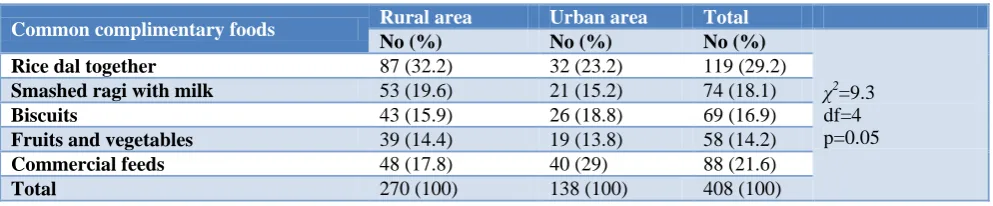
Table 1: Distribution of study participants according to common complementary foods.
Common complimentary foods Rural area Urban area Total
No (%) No (%) No (%)
χ2
=9.3 df=4 p=0.05
Rice dal together 87 (32.2) 32 (23.2) 119 (29.2)
Smashed ragi with milk 53 (19.6) 21 (15.2) 74 (18.1)
Biscuits 43 (15.9) 26 (18.8) 69 (16.9)
Fruits and vegetables 39 (14.4) 19 (13.8) 58 (14.2)
Commercial feeds 48 (17.8) 40 (29) 88 (21.6)
Table 2: Distribution of study participants according to number of meals per day.
Number of meals/perday (6-8months)
Rural area Urban area Total
No (%) No (%) No (%)
χ2
=1.22 df=2 p=0.54
2 172 (63.7) 91 (65.9) 263 (64.4)
3 67 (24.8) 36 (26.1) 103 (25.2)
4 31 (11.5) 11 (8.0) 42 (10.2)
Total 270 (100) 138 (100) 408 (100)
Number of meals/ per day(>8 months)
χ2=8.13 df=2 p=0.017
2 45 (16.7) 25 (18.1) 70 (17.1)
3 150 (55.6) 92 (66.7) 242 (59.3)
4 75 (27.8) 21 (15.2) 96 (23.6)
Total 270 (100) 138 (100) 408 (100)
Table 3: Distribution of study participants according to number of snacks given per day.
Number of snacks/ per day (6-8 months) Rural area Urban area Total
No (%) No (%) No (%)
χ2
=1.98 df=2 p=0.37
1 25 (9.3) 19 (13.8) 44 (10.7)
2 193 (71.5) 95 (68.8) 288 (70.6)
3 52 (19.3) 24 (17.4) 76 (18.7)
Total 270 (100) 138 (100) 408 (100)
Number of snacks/ per day (>8 months)
χ2
=4.69 df=3 p=0.19
1 20 (7.4) 16 (11.6) 36 (8.8)
2 162 (60.0) 80 (58) 242 (59.3)
3 65 (24.1) 25 (18.1) 90 (22.0)
4 23 (8.5) 17 (12.3) 40 (9.8)
Total 270 (100) 138 (100) 408 (100)
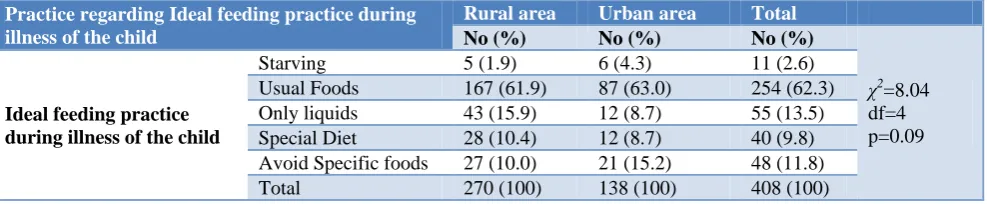
Table 4:Distribution of participants according to practice regarding Ideal feeding practice during illness of the child (n=408).
Practice regarding Ideal feeding practice during illness of the child
Rural area Urban area Total
No (%) No (%) No (%)
χ2
=8.04 df=4 p=0.09
Ideal feeding practice during illness of the child
Starving 5 (1.9) 6 (4.3) 11 (2.6) Usual Foods 167 (61.9) 87 (63.0) 254 (62.3) Only liquids 43 (15.9) 12 (8.7) 55 (13.5) Special Diet 28 (10.4) 12 (8.7) 40 (9.8) Avoid Specific foods 27 (10.0) 21 (15.2) 48 (11.8) Total 270 (100) 138 (100) 408 (100)
The most common food preferred as complementary food was combination of rice and dal together 119 (29.2%), where as many as 88 (21.6%) mothers preferred commercial foods, i.e., 48/88 (54.5%) rural and 40/88 (45.5%) urban mothers. The difference in common complementary feeds among urban and rural mothers was observed to be statistical significant p=0.05.
The number of meals per day given to the child varied from 2-4/day, both in urban and rural area. The difference in number of meals given per day (>8 months) among urban and rural mothers was observed to be statistical significant p=0.017. A majority of urban mothers (52%) gave combination of more than two foods as meal to their infants compared to rural mothers (38%) who preferred only cereal based foods as meal.
The number of snacks given per day to the child varied from 1-4 /day; commonly preferred snacks were Biscuits both in urban and rural areas
Majority of the mothers of the rural 167/254 (65.7%) and urban 87/254 (34.2%) areas practiced of giving usual foods even during illness of the child. Only 11(2.6%) of the mothers had practiced starving during the period of illness that included 5/11 (45.5%) mothers of the rural area and 6/11 (54.5%) mothers of the urban area.
Statistical association found between socio demographic variables and initiation of complementary feeding was not significant in the rural area. However, in the urban area, socio economic status had significant association (p<0.05).
DISCUSSION
In this study, the mean age being 25.9±3.67 years, with a range of 18 to 35 years. Similarly, in studies conducted by Sujatha et al and Mondal T et al the range was 16-37 and 17-35 years respectively.7,8 In the present study, 54.4% Hindus, 43.4% Muslims and 7.1% other religion mothers participated. Other Indian studies also reported majority Hindu mothers 72.50% and 84.04%.9,10 This study reported 5.1% of mothers were illiterate, a study conducted by Khan et al showed that 37% of the mothers were illiterate.11 Majority of the women 78.2% in this study were housewives and 21.8% of them contributing to the family income; 50.7% of mothers belonged to socio-economic class II, according to Modified B G Prasads Socio Economic Classification. Similarly a study done by Roy et al 69.10% mothers were housewives.9 Studies having similar classification reported 67% mothers belonged to class V socio-economic status and 46.5% belonged to class II socio-economic status respectively.10,12 The studies done by Gupta et al and Mondal at al showed that 70% and 79% mothers lived in nuclear family respectively, which was similar to this study finding i.e., 66.9%. Majority of the participants 61% were married during the age of 20-24 years.12,8 Where as in a study reported by Madhu et al 69% of them were married at before 19 years.13
As many as 186 (45.3%) i.e., 129/186 (69.3%) mothers in the rural area and 57/186 (30.6%) mothers in urban area started complementary feeds at the age of 6 months. Mothers (35.2%) started complementary feeds before 6 months of age; most common reason for starting the complementary feeds before 6 months of age was advice by family members/friends followed by belief that breast milk alone is not sufficient for the child. And most common reason for starting the complementary feeds after 6 months of age was that mothers (19%) thought breast milk is sufficient followed by baby refusing to take other feeds. In the urban and rural areas of Bihar a study was carried out by Yadav et al and it was seen that 17.70% urban and 13.10% rural mothers started complementary foods before 6 months of age, reason for early weaning being mothers felt that breast milk was not sufficient.14 Another study done by Aggarwal et al showed that only 17.50% mothers had started complementary feeds at 6 months of age and most
common reason for delayed weaning being unsuccessful attempt as child used to vomit 52%.15
In this study the most common complementary food given first was rice and dal cooked together by 29.2% mothers followed by readymade baby feeds 20%. The difference in common complementary feeds among urban and rural mothers was observed to be statistical significant p=0.05. Mothers preferred the complementary foods depending on the affordability and availability factors. According to a study reported by Madhu et al, the most common weaning food preferred was cows milk followed by soft cooked rice.13 Another study done in the urban and rural areas of Bihar by Yadav et al and was seen that the most common food given first as weaning food both in urban as well as rural area was rice.14 The practice of giving marketed commercial foods ranged from 5.9% to 80% in various Indian studies.14-16
The number of meals per day given to the child varied from 2-4/day, both in urban and rural area. The difference in number of meals given per day (>8 months) among urban and rural mothers was observed to be statistical significant p=0.017. A majority of urban mothers (52%) gave combination of more than two foods as meal to their infants compared to rural mothers (38%) who preferred only cereal based foods as meal. The number of snacks given per day to the child varied from 1-4 /day; commonly preferred snacks were Biscuits both in urban and rural areas. Similar finding was observed in a study conducted by Ashwini et al, majority of mothers in rural area gave only cereal based foods for meals and biscuits were most commonly given as snacks between meals.4
In this study 44.4% of the mothers practiced bottle feeding that included 42% of rural and 50% urban mothers. In a study conducted by Garg et al 48% of the infants were bottle fed.17 This increase in the percentage of bottle feeding may be due to influence of marketing strategies and commercialization of baby foods. Majority of the mothers of the rural 167/254 (65.7%) and urban 87/254 (34.2%) areas practiced of giving usual foods even during illness of the child, unlike the findings reported by a study conducted by Ashwini et al, that majority of urban as well as rural mothers had reduced the amount of food given during illness which is not desirable.4
The limitations of this study were that the participants included were mothers of children upto 36 months, their responses may have been subjected to recall bias and it was not feasible to assess information on exact quantities of food consumed by the child.
CONCLUSION
Family member’s advice, poor knowledge and influence of baby food marketing strategies have resulted in inappropriate practices. Education campaigns related to feeding practices should not only include dos and don’ts to mothers but also to family members who are decision makers like mother-in–law or elderly person in the family. AWW, ASHA, health workers, medical officers, NGOs and other local leaders must be encouraged to take an active part in such campaigns.
ACKNOWLEDGEMENTS
The authors would like to thank all the participants for their contributions to the study and are immensely grateful for the constant support and guidance from the Department of Community Medicine, Yenepoya Medical College.
Funding: No funding sources Conflict of interest: None declared
Ethical approval: The study was approved by the Institutional Ethics Committee of Yenepoya Medical College, YUEC201/5/12/2013
REFERENCES
1. WHO. Infant and young child feeding Model Chapter for textbooks for medical students and allied health professionals. Geneva, World Health Organization, 2009. Available at: http://www.who. int/nutrition/publications/infantfeeding/9789241597 494/en. Accessed on 12 January 2018.
2. WHO. Global Consultation on Complementary Feeding. Guiding principles for complementary feeding of the breastfed child. 2001: 10-13.
3. WHO/UNICEF. Global strategy for infant and young child feeding. Geneva, World Health Organization, 2003. Available at: http://www.who. int/child_adolescent_health/documents/9241562218 /en/index.html. Accessed on 12 January 2018. 4. Ashwini S, Katti SM, Mallapur MD. Comparison of
complementary feeding practices among urban and rural mothers: A cross-sectional study. Al Ameen J Med Sci. 2014;7(4):257-64.
5. Lanata CF, Black RE. Lot quality assurance sampling techniques in health surveys in developing countries: advantages and current constraints. World health statistics quarterly. Rapport trimestriel de statistiques sanitaires mondiales. 1990;44(3):133-9. 6. Government of Karnataka, Department of Women
and Child Development. Available at http://202.138.101.21/dwcd/index.php?option=com _students&view=list&layout=resultpage&id=Daksh ina+Kannada&Itemid=131&lang=en. Accessed on 10 December 2017.
7. Sujatha P, Prasad KVS. Knowledge of infant feeding practices among mothers delivered in a tertiary care hospital, Kakinada, East Godavari district, Andhra Pradesh, India. Int J Interdisciplinary Multidiscipl Studies. 2015:2(4):45-9.
8. Mondal TK, Sarkar AP, Shivam S, Thakur RP. Assessment of infant and young child feeding practice among tribal women in Bhatar block of Burdwan district in West Bengal, India. Int J Med Sci Public Health. 2014;3:324-6.
9. Roy S, Dasgupta A, Pal B. Feeding practices of children in an urban slum of Kolkata. Indian journal of community medicine: official publication of Indian Assoc Preventive Soc Med. 2009;34(4):362. 10. Khanna A, Kadeangadi DM, Mallapur MD. Infant
And Young Child Feeding Practices In Rural Belgaum: A Descriptive Study. Global J Med Pub Health. 2014;2(6):1-6.
11. Khan AM, Kayina P, Agrawal P, Gupta A, Kannan AT. A study on infant and young child feeding practices among mothers attending an urban health center in East Delhi. Indian J Pub Health. 2012;56(4):301.
12. Gupta P, Srivastava VK, Kumar V, Jain S, Masood J, Ahmad N, Srivastava JP. Newborn care practices in urban slums of Lucknow city, UP. Indian journal of community medicine: official publication of Indian Association of Preventive & Social Medicine. 2010;35(1):82.
13. Madhu K, Chowdary S, Masthi R. Breast feeding practices and newborn care in rural areas: a descriptive cross-sectional study. Indian journal of community medicine: official publication of Indian Assoc Preventive Soc Med. 2009;34(3):243. 14. Yadav RJ, Singh P. Knowledge attitude and
practices of mothers about breast-feeding in Bihar. Indian j comm med. 2004;29(3):3.
15. Aggarwal A, Verma S, Faridi MMA et al. Complementary feeding – Reasons for Inappropriateness in Timing, Quantity and Consistency. Indian J Pediatrics. 2005;75:49–53. 16. Parekh C, Bavdekar S, Shaharao V. Study of Infant
Feeding Practices: Factors Associated with Faulty Feeding. J Trop Pediatrics. 2004;50(5):306–8. 17. Garg M, Hasan M, Kapur D. Infant and Young
Child Feeding (IYCF) practices in Udupi district, Karnataka. J Nutrition Res. 2015;3(1):38-44.