Original Research Article
Quality of life in HIV patients and coping strategies adopted by them:
a cross sectional study done in an anti-retroviral therapy centre, Mysore
Tanisha Negi
1*, Syed Yunus Zama
2, Dushyanth P.
3INTRODUCTION
HIV has affected more than 70 millions of people since the beginning.1 Out of 36.9 million infected people living across the globe, India hosts 2.1 million of them standing the 3rd largest HIV infected country.2 Karnataka is among top 7 states in India with the highest HIV prevalence.3
For patients who are motivated to take therapy and who have access to lifelong treatment, AIDS-related illnesses are no longer the primary threat but a novel chronic disease that for many will span several decades of life.4 The AIDS epidemic has often been associated with severe negative public reactions to people who are assumed to be infected by HIV.5 Diagnosis of HIV is traumatic and every patient has to cope with both the disease and accompanying stress in the form of
ABSTRACT
Background: HIV today is one of the worst pandemic diseases. Unlike terminal illnesses, HIV patients have to live for decades with the disease, which now shifts the interest to the quality of their life. The present study was planned, considering a necessity to inquire about the quality of life of patients taking Antiretroviral therapy in Mysore, various coping strategies prevalent among them and correlation between the two.
Methods: This cross sectional study was done on 150 adults coming for anti retroviral therapy (ART), diagnosed with HIV at least 6 months back. ART centre was approached with required permissions. After explaining the study purpose, data was collected on paper with due consent from patients. Standard WHO QOL BREF and COPE carver Bref were used as questionnaire instruments. Analysis was done using SPSS software and Pearson’s correlation was used.
Results: Analysis revealed that the most affected domain in quality of life was social domain with mean=11.75±2.12 (4-20 scale) and least affected was environmental with mean14.49±0.849. Self distraction was coping strategy of the highest prevalence (mean=4.98) having no correlation with QOL. Active coping showed positive correlation under all domains while behavioural disengagement and substance abuse had significant negative correlation overall (p value<0.001).
Conclusions: Our study underlined a gap in Social domain of selected HIV affected population. Self distraction was the most preferred style of coping and humour was found to be least adopted method. Active coping had linear relationship all the 4 domains whereas behavioural disengagement showed significant lowering in QOL as a whole.
Keywords: HIV, Quality of life, Coping, Correlation, Karnataka
1
MysoreMedical College and Research Institute, Mysore, Karnataka, India
2
Department of Community Medicine, Mysore Medical College and Research Institute, Mysore, Karnataka, India
3
National Tuberculosis Institute, Bellary Road, Guttahalli, Bangalore, Karnataka, India
Received: 07 June 2019
Accepted: 18 July 2019
*Correspondence:
Dr. Tanisha Negi,
E-mail: [email protected]
Copyright: © the author(s), publisher and licensee Medip Academy. This is an open-access article distributed under the terms of the Creative Commons Attribution Non-Commercial License, which permits unrestricted non-commercial use, distribution, and reproduction in any medium, provided the original work is properly cited.
biological, psychological and social problem.6 Coping deficits can have further deteriorating effects including depression and low psychological well-being of the whole affected community in turn. Coping styles greatly influence the psychological impact of HIV Infection.7 It is therefore a need of the hour to evaluate what types of methods are being used by the patients and compare the efficiency of the same. A number of studies have been done on QOL related to HIV, but there is a dearth of information about coping methods and its impact on QOL in this geographical area. This type of study will address the lacunae in existing interventions as well as pave our way for innovative strategies.
METHODS
This descriptive cross sectional study was done from 18th July to 14th September 2017.
Study population
This study was designed focussing on adults living with HIV AIDS in Mysore District of Karnataka, and had been taking medication from ART centre, Mysore for at least past 6 months after both pre-test and post-test counselling.
Inclusion criteria
Inclusion criteria were Consented patients, seropositive for last 6 months, able to speak and understand the local languages, above the age of 18 years and coming for ART treatment regularly were chosen.
Exclusion criteria
Exclusion criteria were patients with grade 4 infections, unwilling, with low cognitive ability, and below 18 years.
Sample size
The mean and standard deviation of quality of life as reported by Nojami et al was used.8
The formula used for calculating sample size is as follows:
where: n=sample size; Z=level of significance; s=standard deviation; d=allowable error values: Z=1.96, S=6.2, d =1, n ~ 147-taken as 150.
Study design
Appropriate permissions from the Institutional Ethical committee and ART centre Medical Officer were taken. ART centre of tertiary healthcare level, KR Hospital
Mysore was approached. Patients were selected by a random sampling technique who met the inclusion criteria. The researcher then established a good rapport with the client and purpose of the study was explained to the patients along with the risks and benefits involved, providing a secure and quiet place considering the time of their comfort. After obtaining the consent, left thumb impression was taken as their approval. Demographic information was recorded. Administration of the questionnaire was done by face to face discussion with effective communication skills in the language of their choice which were Kannada or Hindi.
According to the structured schedule, each patient was interviewed for 20-30 minutes.
Study tools
Responses were noted using following standard questionnaires:
WHO QOL BREF was used for assessing quality of life. There are 26 questions with scores 1 to 5, reversal of scoring was done for negative answers according to standard guidelines. Data was compiled into 4 Standard domains having Physical, Psychological, Social and Environment components. Domain scores then were converted to the standard 4-20 scoring. Only Transformed Domains were taken for statistical analysis.9
Brief COPE which is multidimensional inventory consisting of 28 questions having standard scores from 1 to 4. 28 questions were then converted to 14 coping domains by adding 2 responses each according to the guidelines. Mean of each domain was considered for analysis.10
Statistical analysis
Data obtained from the survey was entered to Microsoft excel. The SPSS 20 software was used for the analysis of the data. Independent sample t-test and one way ANOVA was used to analyse the scores. Pearson’s correlation was used.
RESULTS
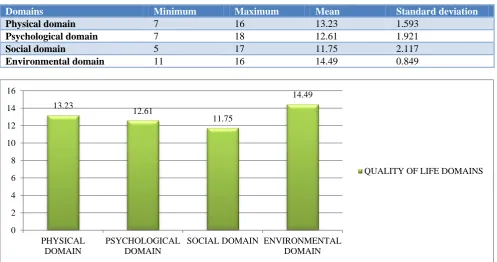
QOL was assessed in 4 broad domains. Environmental domain had maximum score among all 4 domains; (mean=14.49; SD 0.849) and Social Domain was found to have the least score of mean=11.75, SD 2.117 (Table 1, Figure 1)
CD4 count showed strong positive correlation with physical (correlation coefficient=0.59) and psychological domain (correlation coefficient=0.356) both with p value<0.001.
Table 1: WHO QOL BREF questionnarie domain scores.
Domains Minimum Maximum Mean Standard deviation
Physical domain 7 16 13.23 1.593
Psychological domain 7 18 12.61 1.921
Social domain 5 17 11.75 2.117
Environmental domain 11 16 14.49 0.849
Figure 1: Quality of life domains.
Table 2: Brief cope questionnaire domain results.
Coping domains Minimum Maximum Mean Std. deviation
Self distraction 2 8 4.98 1.463
Active coping 2 7 4.00 0.969
Denial 2 6 2.75 1.011
Substance use 2 8 2.75 1.100
Emotional support 2 8 4.00 1.232
Instrumental support 2 8 4.15 1.640
Behavioural disengagement 2 8 3.99 0.882
Venting 2 7 4.24 0.910
Positive reframing 2 7 3.46 1.008
Planning 2 6 3.77 1.504
Humour 2 6 2.12 0.578
Acceptance 2 6 3.28 0.942
Religion 2 8 4.89 1.511
Self blame 2 8 3.09 1.172
There was no significant difference in the QOL among males and females.
Compliance to ART showed better results in physical,
psychological and environmental domain (p
value>0.007).
Family type and QOL had no significant relation. However, married subjects showed positive correlation
with social domain (mean=12.33; SD=1.86; p
value<0.001 and f value=19.09, one way ANOVA was used for analysis).
13.23
12.61
11.75
14.49
0 2 4 6 8 10 12 14 16
PHYSICAL DOMAIN
PSYCHOLOGICAL DOMAIN
SOCIAL DOMAIN ENVIRONMENTAL DOMAIN
While exploring prevalent coping measures in our study population, we found self distraction stood on top (mean=4.98) followed by religion and spirituality
(mean=4.89). The least popular was humour with mean= 2.12 (Table 2, Figure 2).
Figure 2: Prevalent coping methods.
Table 3: Correlation between QOL and coping domains.
WHO BREF QOL domains
Coping domains
Domain 1 Domain 2 Domain 3 Domain 4
Correlation coefficient
P value
Correlation coefficient
P value
Correlation coefficient
P value
Correlation coefficient
P value
Self distraction -0.11 0.17 0.081 0.32 0.009 0.91 0.138 0.09
Active Coping 0.395 <0.001 0.22 0.007 0.23 0.004 0.17 0.03
Denial -0.072 0.37 -0.12 0.12 -0.001 0.98 0.04 0.60
Substance use -0.197 0.01 -0.19 0.02 -0.11 0.178 -0.20 0.01
Emotional support 0.318 <0.001 0.193 0.018 0.275 <0.001 0.10 0.18
Instrumental
support 0.126 0.12 0.082 0.36 0.277 <0.001 0.016 0.8
Behavioural
disengagement -0.552 <0.001 -0.35 <0.001 -0.24 0.002 -0.36 <0.001
Venting 0.26 <0.001 0.143 0.08 0.087 0.29 0.15 0.06
Positive reframing 0.261 <0.001 0.19 0.01 0.20 0.01 0.16 0.05
Planning 0.157 0.05 0.1 0.22 0.125 0.127 0.07 0.37
Humor 0.08 0.29 0.15 0.06 0.16 0.04 0.09 0.22
Acceptance 0.09 0.26 0.002 0.98 0.12 0.125 0.08 0.32
Religion 0.322 <0.001 0.196 0.01 0.04 0.62 0.13 0.11
Self blame -0.33 <0.001 -0.303 <0.001 -0.102 0.21 -0.10 0.19
Impact of various coping styles with 4 different domains when analysed individually (Table 2), suggested Physical
Domain had a strong positive correlation with Active coping (correlation coefficient=0.395), along with 0
1 2 3 4 5
religion, emotional support, venting, positive reframing; (all with p<0.001), on the other hand, physical domain had negative correlation with Behavioural disengagement and self-blame (i.e., -0.552, -0.33 respectively and p≤0.001 for both).
Psychological domain significantly responded with an improvement when Active coping, Emotional support and Religion were chosen to cope (correlation coefficients >0.19; p<0.001) Self-blame had a strong negative correlation with psychological domain (correlation coefficient=-0.303; p<0.001)
Social domain responded well with Instrumental support
and Emotional support equally; (correlation
coefficient=0.277; p≤0.001) along with Active coping (correlation coefficient=0.23; p=0.004), Positive reframing (correlation coefficient=0.20; p=0.01) and Humour (correlation coefficient=0.16; p=0.04). Only Behavioural disengagement (correlation coefficient=-0.24; p value=0.002) had a significant negative impact on social aspect.
Environmental domain showed an elevated score with Active coping (correlation coefficient=0.17; p value=0.03) and Positive reframing (correlation coefficient=0.16; p value= 0.05) were opted. While Behavioural disengagement (correlation coefficient=-0.36; p value≤0.001) and Substance use (correlation coefficient=-0.20; p value=0.01) showed in its lowering with negative impact (Table 3).
DISCUSSION
Our analysis showed sequentially increasing scores in Psychological, Physical and Environmental domain respectively, but the domain with lowest scoring was Social, which varied from the results of a study proving physical health as the most lowered domain.7 We found that environmental domain had maximum score, implying that services and accessibility to the patients is at par with their needs. It is supported by a report from Madras where environmental domain had highest QOL score of the four domains.11
There was significant improvement in Physical as well as Psychological domains with higher CD4 count. Similar to the study done in the same area, compliance to ART resulted in positive influence on Physical, Psychological and Environmental Domains.12 High level of CD4 count and good ART adherence also had positive effects on QOL in People Living With HIV AIDS in Zhejiang province of China.13 This signifies the universal role of CD4 count in improving QOL among the affected population in general.
There was a nil significant difference in life quality of separate genders in over all four domains. This differs from study done in Manipal, where out of the four domains, it was seen that though women had almost same
mean score as that of men with respect to physical and psychological domain, but had a significantly lower mean score in social and environmental domains.14
We significantly found that social domain was better in the married subjects, a similar study found influence on physical domain, psychological domain and general quality of life in addition to social domain.15 HIV being mostly the disease of reproductive age, existence of a life partner is noteworthy when it comes to their overall wellbeing.
Commonly adopted coping style was self distraction, differing with a finding, where problem focused coping strategy was high and acceptance was used as the most common coping style among HIV affected.16 Positive reframing and planning was a moderately adopted method among our population in contrast to a report stating, their subjects rarely used active coping of positive reframing and planning.17
We explored that active coping elevated scores in all 4 domains of QOL and behavioural disengagement deteriorated the condition in general. Physical domain had significant positive correlation with active coping, venting, emotional support, planning, positive reframing and religion. Behavioural disengagement and self-blame had negative impact. This denotes, a person’s positive and planning mindset together with emotional support can enhance the quality in physical aspect.
Along with active coping, emotional support and religion also elevated psychological status, while substance abuse, behavioural disengagement and self-blame lowered the domain scores significantly. Researchers found that emotional support improves psychological health. Complementing this finding one study also proves that spirituality reflects positive emotions and improves life quality.18 In support, one more study concluded that religious commitment plays a role in enhancing illness prevention, coping with illness, and recovery.19
Active coping, emotional support, positive reframing, instrumental support and humour made the social aspect of subjects better. Interestingly while other domains were almost unaffected by humour, social domain was made better. Environmental domain levelled up in those who were active and had positive reframing attitude. This suggests active people could get most out of the facilities available. On the other hand behavioural disengagement and substance abuse could have abstained from rendering the benefits of resources and facilities made available to them.
CONCLUSION
services provided to them and their ability to access. Assessment of prevalent coping strategies revealed self distraction as the most adopted strategy, while humour was found to be the least employed one. Outcome of our study indicates a call for novel strategies to improve the social domain. Results recommend that active coping has the likelihood of being an efficient strategy, which should be given importance in HIV counselling. Behavioural disengagement must be reduced to minimum in these subjects.
Limitations
This study was limited by not evaluating effect of socioeconomic status on QOL. There is a need for further research on the role of education level and different family types in influencing the coping methods.
ACKNOWLEDGEMENTS
Authors acknowledge the Indian Council of Medical Research (ICMR), New Delhi, India, for providing Short Term Research Studentship (STS) to the first author.
Funding: No funding sources Conflict of interest: None declared
Ethical approval: The study was approved by the Institutional Ethics Committee
REFERENCES
1. World Health Observatory data, World Health Organisation. Available at: http://www.who.int >gho>hiv. Accessed on 25th May 2019.
2. Global HIV and AIDS statistics- 2018 fact sheet. Available at: https://www.unaids.org. Accessed on 14th May 2019.
3. India HIV Estimations 2015 Technical report. Available at: http://www.naco.gov.in. Accessed on 25th May 2019.
4. Deeksha SG, Lewin SR, Havlir DV. The end of AIDS: HIV infection as a chronic disease. Lancet. 2013;382:1525–33.
5. Live and let live: Acceptance of people living with HIV/AIDS in an era where stigma discrimination persists. ICMR bulletin November December 2002;32:11-12.
6. Rani A, Batra P.Ways of coping strategies in HIV/AIDS patients. Indian J Health Well Being. 2015;6:249-53.
7. Kohli R, Sane S, Ghate M, Paranjape R. Coping strategies of HIV-positive individuals and its
correlation with quality of life in Pune, India. Int Soc Work. 2016;59:256–67.
8. Nojami M, Aubary K, Ranjbar M. Health related quality of life in patients with HIV/AIDS. Arch Iran Med. 2008;11:608‑12.
9. orld ealth rgani ation. ivision of ental ealth. ( 1 ) . WHOQOL-BREF : introduction, administration, scoring and generic version of the assessment : field trial version, December 1996. Available at: http://www.who.int/iris/handle/ 10665/63529. Accessed on 25th May 2019.
10. Carver CS. Int J Behav Med.1997;4:92. Available at: https://doi.org/10.1207/s15327558ijbm0401_6. Accessed on 25th May 2019.
11. Nirmal B, Divya KR, Durairaj VS, Venkateshwaran K. Quality of life in hiv patients a cross sectional study in south india. Indian J Sex Trans Dis. 2008;29:15-17.
12. Gowda S, Channabasappa AN, Dhar M, Krishna D.
Quality of life in HIV/AIDS patients in relation to CD4 count: A cross-sectional study in Mysore district. Int J Health Allied Sci. 2012;1:263-7. 13. Liping M, Peng X, Haijiang L, Lahong J, Fan L.
Quality of Life of People Living with HIV/AIDS: A Cross-Sectional Study in Zhejiang Province, China PLoS ONE 2015;10(8):e0135705.
14. Sudhir N, Deepa K, Ashok NC. Gender
Differentials in Quality of Life Domains of Persons Living with HIV/AIDS: A cross sectional study in South India. Int J Health Sci Res. 2014;4:1-6.
15. Osamika BE, Mayungbo OA. Stages of HIV/AIDS,
Marital Status and Perceived Quality Of Life, Asian J Multidis Stud. 2017;5:1-11.
16. Sreelekshmi R. Anxiety and coping mechanisms among HIV positive patients SJMCH Banglore : Manipal J Nurs Health Sci. 2015;1;91-5.
17. Salma K. Depression and coping mechanism among HIV/AIDS patients under anti-retroviral therapy. Indian J Soc Psych. 2016;32:149-53.
18. Vaillant GE. Positive Emotions, Spirituality and the Practice of Psychiatry. Mens Sana Monographs. 2008;6:48–62.
19. Matthews DA, McCullough ME, Larson DB, Koenig HG, Swyers JP, Milano MG. Religious Commitment and Health Status. Archives of family Medicine. 1998;7:118.