Thesis by A. D. Varvatsis
In Partial Fulfillment of the Requirements
For the Degree of Doctor of Philosophy
California Institute of Technology Pasadena, California
1968
ACKNOWLEDGMENTS
The author is grateful to Professor C. H. Papas for his continued guidance and encouragement during the course of this
work. Special thanks are due to Dr. H. Hodara, Mr. Tom McGill Jr. for many helpful discussions, and Mr. P. Marmarelis for assistance
The present work deals with the problem of the interaction of the electromagnetic radiation with a statistical distribution of non-magnetic dielectric particles immersed in an infinite homogeneous isotropic, non-magnetic medium. The wavelength of the incident radiation can be less, equal or greater than the linear dimension of a particle. The distance between any two particles is several wave-lengths. A single particle in the a.bsence of the others is assumed to scatter like a Rayleigh-Gans particle, i.e. interaction between the volume elements (self-interaction) is neglected~ The interaction of the particles is taken into account (multiple scattering) and conditions are set up for the case of a lossless medium which guarantee that the multiple scattering c0ntribution is more important than the self-interaction one. These conditions relate the wavelength A. and the linear dimensions of a particle a and of the region occupied by the particles D. It is found that fo·r constant A./ a, D is proportional to A. and that J
.6x
I
,
where.6x
is the difference in the dielectricsusceptibilities between particle and medium, has to lie within a certain range.
The total scattering field is obtained as a series the several terms of which represent the corre1>ponding multiple scattering orders.
their Stokes parameters add.
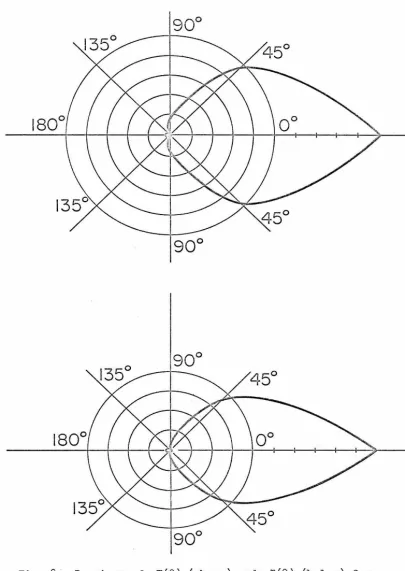
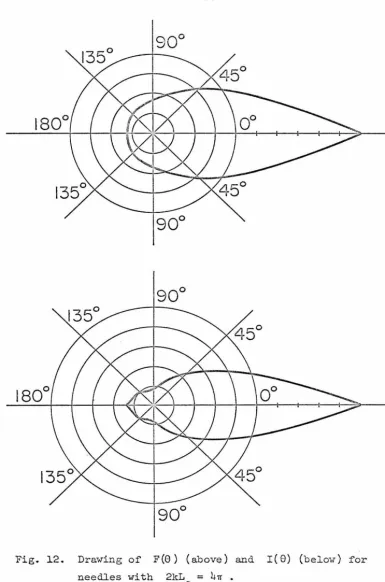
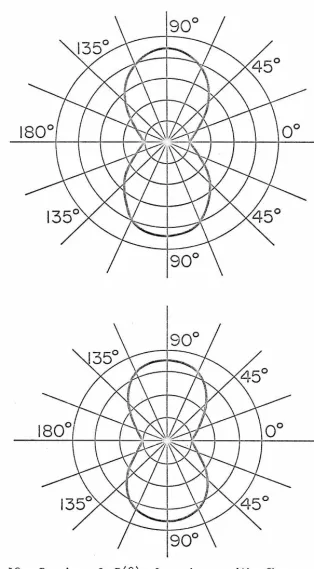
The second and third order intensity terms are explicitly com-puted. The method used suggests a general approach for computing any order. It is found that in general the first order scattering intensity pattern {or phase function} peaks in the forward direction 9
= O.
The second order tends to smooth out the pattern giving a maximum in thea
= 'IT /2 direction and minima in thea
= 0 ,a
= 'IT directions. This ceases to be true if ka {where k = 21T/A.) becomes large {> 20). For large ka the forward direction is further enhanced.Similar features are expected from the higher orders even though the critical value of ka may increase with the order.
The first order polarization of the scattered wave is deter-mined. The ensemble average of the Stokes parameters of the
scattered wave is explicitly computed for the second order. A similar method can be applied for any order. It is found that the polarization of the scattered wave depends on the polarization of the incident wave. If the latter is elliptically polarized then the first order scattered wave
is elliptically polarized' but in the
a
= 'IT/2 direction is linearly polar-ized. If the incident wave is circularly polarized the first orderscattered wave is elliptically polarized except for the directions 9
=
rr/2 {linearly polarized) and 8 = 0, 'IT {circularly polarized). The handedness of the 9=
0 wave is the same as that of the incident whereas theelliptically polarized for any 0 no matter what the incident wave is. However, the handedness of the total scattered wave is not altered by the second order. Higher orders have similar effects as the second order.
If the medium is lossy the general approach employed for the
lossless case is still valid. Only the algebra increases in complexity. It is found that the results of the lossless case are insensitive in the first order of k. D where k. = imaginary part of the wave vector
im im
k and D a linear characteristic dimens~on of the region occupied by the particles. Thus moderately extended regions and small losses make (k. D)2
<<
1 and the lossy character of the medium does notim
alter the results of the lossless case. In general the presence of
PART I II III IV
v
VIVII
TABLE OF CONTENTS
INTRODUCTION
FORMULATION OF THE PROBLEM 2. 1 Scattering From a ,Single Particle
2. 2 Scattering From a Collection of Particles FIRST ORDER SCATTERING
3. 1 Intensity of the Scattered Wave 3. 2 Polarization of the Scattered Wave SECOND ORDER SCATTERING
4. 1 Intensity of the Scattered Wave 4. 2 Polarization of the Scattered Wave THIRD ORDER SCATTERING
5. 1 Intensity of the Scattered Wave SPECIAL EXAMPLES
6.
1 First Order6. 1. 1 Two Point Scatterers 6. 1. 2 A Collection of Spheres 6. 1. 3 Needle -like Particles
6. 1. 4 Particles Possessing an Axis of Revolution PAGE 1 5 5 11
29
29
40 44 44 S2 56 5667
67
69
7179
85 6. 2 Second Order. General Remarks. Spheres. 90PART
APPENDICES
P AGE 105 A. The Integral Equation of the Scattering Problem 105
B. The Euler Angles 108
C. Polarization Ellipse. Stokes Parameters. 112
D. Random Sums 115
E. Algebraic and Integral Computations REFERENCES
I . INTRODUCTION
When one computes the scattered wave, due to the illumination
of a collection of particles, ignoring the interaction of the particles
one talks about single scattering. Multiple scattering involves the interaction of the particles.
The first sound attempts to attack the multiple scattering prob-lem are due to Arthur Schuster (1905) who formulated a probprob-lem in
radiative transfer to explain the appearance of absorption and emission
lines in stellar spectra, and to Karl Schwarzschild (1906) who intro-duced and developed the concept of radiative equilibrium in stellar
atmospheres. However, a systematic treatment of the multiple
scatter-ing problem was first given by W. Hartel (9) in 1941. His method is based on determining successive angular intensity distributions for
each successive order of scattering. His theory is applicable to the
case of a medium densely packed with scatterers. This approach has
been recently followed by D. H. Woodward (11) who has assumed that the
scatterers are Mie spheres with a radius large compared to the wave-length. The theory introduced by Hartel, however, does not involve the
polarization of the scattered wave. Such a scalar theory is never
reliable according to Chandrasekhar (8). But Woodward (11) has extended Hartel's theory to include polarization effects.
Another difficulty which also applies to some other theories is the following: One usually starts with the law of single scattering by
talks about the Mie or Rayleigh etc. laws of scattering. Now in a
dense medium every point (small region) is a scatterer. The
inter-action of the scatterers is by far different from the interaction of a
plane wave with a single scatterer. We then understand that when
multiple scattering is taken into account one cannot assume that every
point scatters according to a specified law based on the illumination
of a single scatterer by a plane wave. Therefore, the Hartel theory
cannot use the single scattering theories mentioned above.
In 1945 S. Chandrasekhar (8) developed in a systematic and
mathematically rigorous way the problem of Radiative Transfer. His
equation of transfer is a continuity equation for a 4-dimensional vector
with components the 4 Stokes parameters of the scattered wave. The
radiative transfer theories are best suited to problems such as
scatter-ing by planetary atmospheres, radiative equilibrium of a stellar
atmosphere and other related problems. Like the Hartel theory, the
Radiative Transfer Theories (R. T. T.) assume a medium densely
packed with scatterers. Therefore these theories cannot be based
upon single scattering theories such as Mie's etc. Another frequent
assumption of the R. T .-T. is that the scatterers behave like small
dipoles. If higher moments are taken into account (10) or one
con-siders particles of a shape other than spherical the computations get
pretty complicated.
The theories mentioned above or related ones cannot deal with
the problem of the interaction of a plane wave with a collection of
different from spherical. A rigorous theory for such a situation seems infinitely complicated. If one introduces the element of randomness in the position and orientation of the particles things look brighter. Even so an exact treatment is practically impossible.
The first order scattering or single scattering can be done exactly only when one knows how to find the scattering law for a single particle of a given shape. This is not known in general. A considerable simplification takes place if the single scattering is of the Rayleigh-Gans type, i.e. if the interaction of the volume elements {self-inter-action) is neglected. If one wants to find the effect of the multiple scattering for such particles one must make sure that the multiple scattering contribution is more important than the self-interaction contribution.
Our theory is an approximate one and deals with the following problem. Consider a collection of non-magnetic dielectric particles of any shape immersed in a homogeneous isotropic non-magnetic medium of infinite extent. We will assume that the particles have random position and orientation. The particles are of the Rayleigh-Gans type and are several wavelengths apart. This last assumption is made to simplify the computations.
Consider now a plane wave illuminating the particles. We want to compute the scattered field. The scattered field will be characterized by the four Stokes parameters. The averaging over the random positions
and orientations of the particles will be an ensemble average.
several terms of which represent the corresponding orders of scatter-ing. Thus the first term is a single scattering or first order scatter-ing. The second term is a multiple scattering of the first order or a second order scattering, i.e. the additional current induced within any particle is due to currents inside all other particles induced by the incident field only. The third order involves current due to the second order fields etc.
II. FORMULATION OF THE PROBLEM
2.1. Scattering From a Single Particle
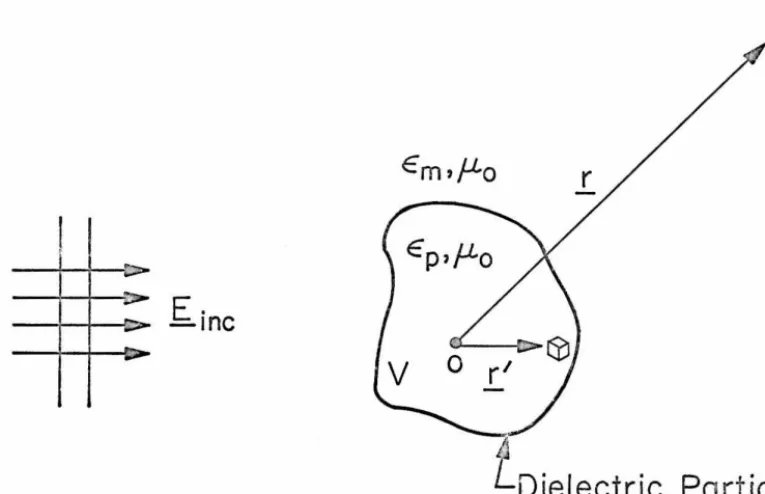
Consider the scattering of a plane wave by a single dielectric
particle (see figure 1). The particle has constitutive parameters E , p
which can be complex, and µ. = µ. = magnetic permeability of vacuum.
p 0
The surrounding medium is infinite, homogeneous, isotropic with
con-stitutive parameters E , complex in general, and µ. = µ. • If we call
m m o
the incident electric field E. and the scattered one E then it can
-inc - s c
·be shown (see Appendix A) that:
Esc(.E) =
w~.6xS!:'(.!i_!
1
)
• E(_E') dV'c
-v
(2.1.1)
where E(r) =total field at r
=
E. (r)+ E
(r),.6x
=
X - X =- - - -inc - - s c - m p
E - € E - € .
1 1 ik
I
r - r 'I
( m o)
-
( p o )=
-
(
€ - € ) , I'( r; r r)= (
u+
-2'V
'V
)
e 4I
- - tI
Eo Eo Eo m P = - - = k
rr_E-.!
where u
=
= unit dyadic=
e e+
.e e+ e e
, k=
wVµ. E •-~x -y-y -z-z o m
2. 1. 1 can be solved by an iteration method. Thus the first
order approximation is obtained by replacing E(r') by E. (r'): - - i n c
-(2.1. 2)
The second order approximation replaces E(_E ') in ( 2. 1. 1) by
E { r ') = E. ( r ')
+ E[
1] ( r 1 ) :-p
Em,flo
I
>
>
--
~inc
-~
Loielectric
Particle
Fig. 1. A dielectric particle i l lu.rninated by a plane wave
E.
P
is the observation point.~
dV"
f
dV'=
E[ 1](r}+
E(Z} (r}- S C - - SC - (2.1.3}
It is now easy to see that in general we must have:
E[n](r}
=
E( 1 } (r}+
E(Z} (r}+ ••• +
E(n- 1 } (r}+
E(n} (r} (2. 1. 4}- s c - - s c - - s c - - s c - s c
-with
E[O]
=
E. (r}-sc inc
-• {Srcr
=
2;r3} •••{Sr
=
er 1;r ) • E. (r } dV }-n- -n -inc -n n
v
v
(2.1.5}
The first order approximation E[i] (r}
=
E(i}(r} is called the Born- s c - s c
-approximation. From. 2.1. 5 we see that the nth order in the series
believe that for sufficiently small
i
.tix
I the Born approximation isvalid. However, this is not true as the following analysis shows:
Let's compare E(i} to E(Z}, i.e. let's estimate the absolute value - SC - S C
of the fields. We are usually interested in the far zone values (see
Appendix A}
=
w2. .tixS
I'(r;r'} • E. (r'} dV'2. _ - - inc
-c
-v
2.
s
ikr - ike • r 1W e r
E l.k. r
1
::::: -
.tix
(u - e e ) - - e - - • e - dV'2.
=
- r - r 4irr - oc
v
"k "k I
w2.
= -
-.tix
2. 1 rs
-1 e • r "k1
e - r - i • r
(e Xe X E ) - - e e -
-- r -- r --o 4irr dV' (2.. 1. 6)
c
v
dV" dV'
S
e iklE'-..!:"1 E i·k·.r"dV" dV' • _,,4-ir'""'l_r....,,-_-r ... "...,.I - o e
-v
S
e ik IE' - ..!: II I• E
-o
v
4Ir' - r" I
1T -
-ik• r II
e - - dV" dV' (2..1.7}
If we assume that k is real then
Is
e-ik~r·E.'
e -ik·r' - dV'I
<
v
S
I
e -ike • r' . - r -e
1~·
..!: ,I
dV'=
V p=
volume of dielectric particle. If k isv
not real then by writing k
=
- r k + ik.- 1
we get I=
I
S
e-ik~r·.E'ei~·..!:'
dV'I
v
S
k.e •r' -k.•r'< e i-r - e - i - dV'. Assuming that E.
-inc travels in the z direction V
s
ki(~r
-~z)
• ..!: 'we have I :S e dV'.
v
In the present work we deal with lossy media with k. of the order
l
1 -1
of (1...;.
20)m or less. Therefore in view of the small dimensions of k. (e - e ) • r 1
the particle (< 10 µ) we understand that e 1 - r -z ~ 1 and I
::=
V • ThusNext we estimate
I
E(2)j:
- s c2 2
jE(2)
I
<
(~
jllx1)
- s c 2
c
l
ikr
I
s -
ike • r '_e__ e - r - (u + _1_ V''V'')
4rrr
=
k2v
S
iklr'-r11I
.
11• E e - -
e
1~·
.E.
dV 11 dV' - o 4rr l.E' - ..!: III
v
p
(2. 1. 8)
2 2
l
ikrI
s
s
ikI
r 1- r"
I
.
11<(~It::.
J
)
_e_ lu+-1 V''V'')•E e - -e1~·r
dV11jdV'2 X 4irr
=
k2 - o 4irjr1-r11 j-For estimation purposes we may write \71
,.., _!_ e ' 1· e
k - r • • •
( 2 ) 2 . 2\ ikr
IS
Ir
ikj_!:'-..!:"lIEsc j< (:2 j.6x I) e4irr 21Eoj
J
e4irl!..'-..!:"Iv
v
e1"k - • E. II dV" dV'
I
To estimate the integral
S
I r•=r" I dV" we choose a sphericalv
-particle of radius a and· we measure ..!:' •..!:" from the center. Then
the integral is the electric potential of a uniform spherical charge
distribution with p = 1 in electrostatic units. evaluated at r' lying
within the sphere. The result is well known:
and
Finally
v
2
~Va ·
p
2 2
I
ikrI
jE(2) I<
(w
2 l.6x 1) IE Iv a
2
~
4
-sc - o p irr
c
If we now compare l E ( 1 ) I given by 2. 1 • 8 and
-sc
2. 1. 9 we understand that
(2. 1. 9)
j E(2)
I
given by- sc .
Condition 2.1.10 further guarantees that
jE~~
j<<
jE~~-
1)
j as wecan show, therefore the Born approximation is valid only if 2. 1. 1 O
is satisfied. This condition has been discussed and derived in a
different way by Van de Hulst (2).
2. 2. Scattering From a Collection of Particles
If the scattered electric field by the ith particle (E., µ ) is
l 0
i
called E (r) then the total scattered field is s c
-N
Es c (_!:)
=
l
E~c
(_!:) i=1where N is the number of particles that do the scattering.
where
If we apply 2. 1.1 for the ith particle we have:
Ei (r)
- s c -
=
w~
c 6x.Sr{r;r.)•E{r.) l = - - 1 - - 1 dV. lv.
lN
E{r.)
=
E. {r.)+ \
Ej {r.) - -1 -inc -1L
- s c -1j=1
(2. 2. 1)
{2. 2. 2)
To be able to write down a series expansion for the total scattered field
as we did in section 2. 1 for a single particle we work as follows:
First we write down the formula for the scattered field by the / h
. 1 h" h. d . "d h .th . 1
part1c e w ic in uces a current lns1 e t e i partlc e. According
to 2. 1. 1 we have:
Ej {r.) -sc - 1
=
w22
6x .
S
T{r.;r.)•E'{r.) dV.J = - 1 -J - -J J
c
v.
J
where
E(r.) = E. (r.) - -J -inc -J
k
E (r.) - s c -J
Next we compute Ek (r.) using 2.1.1 once more. - s c -J
where
k w2
s
E (r.)
= -
2 .6xk T(r.;rk)• E(rk) dVk - s c -3 c = -J - --vk
E(!k)
=
Einc(,Ek)+
l
E!c(!k)1
1
Again we use 2.1.1 to compute Esc(,Ek) etc.
(2. 2. 4)
We are now in a position to obtain the series expansion for
N
E (r)
= \
E i (r). The first order term is obtained from 2. 2. 2 if -sc -6
s c-i=!
we replace E(r.) by E. (r.), i.e. - - i -inc - i
and
E[i]i
=
w2
.6X.
S
I'(r;r.)• E. (r.) dV.=
E(i)i(r) - s c c 2 i - - - i -inc - i - i s c-v.
i
w
2
2 .6x.
S
I'(r;r.)• E. (r.) dV. c i = - - i -inc - i iv.
iThe next approximation replaces E(r.) by E. (r.)
+
- - i -inc -i(2. 2. 5)
N
\ E(i)j(r.),
Li
- S C -Jj=1
E[2] i(r} = w
2 2
6x
.
s
T(r;r.}o E. (r.) dV. - s c - c i = - - 1 -1nc-1 iv.
l
2 2 ~
+
(w
2) 6X.
S
T(r; r.)• {· \ 6X. Sr(r. ;r.) • E. (r .)dV .}dv. c l = - -1!.;
.
J = -1 -J -inc -J J lv
.
J·=1v.
l J
(2. 2. 6) N
E~~
(E) =l
E~~]
i(E)i= 1
N
l
[2]°
To get the third order order E(r.) is replaced by E. (r.)+
E 1(r.)- - 1 -inc - 1 - s c - 1
j= 1
i.e.
• E. -inc -(rk) dVk ] dV.} dV. J
l
= E(i)i(r)
+
E(2)i(r)+
E(3)i(r) - s c - - s c - . s c-(2. 2. 7)
N
E[ 3] (r)
= )
E[ 3] \r) - s c - L.J scIt is clear now how to obtain the
N
th
n order.
replace E(r.} by E. {r.)
+ \
E[n-1] j(r.}. i.e.- - 1 -inc - 1
6
-sc - 1j=1
We have to
2 N
+~
eix.S
r(r;r.>·I
E[n.-1Jj(r.) dV. 2 l - - - 1 - s c - 1 lc - .
v.
J=1l
=
E(1)i(r)+
E( 2)i(r)+ •••
-sc - -sc -
+
-sc E(n-1)i(r) -+
- s c -E(n)i(r)The several terms in the series expansion have a simple
physical explanation which goes as follows:
(2. 2. 8)
The first order scattered field E(1) (r) is due to currents induced by
S C
-the incident field only, i.e. ignoring interaction of -the volume elements
within a particle or of the particles.
The second order scattered field E(2)(r) is due to currents induced by
sc
-the first order scattered field E{1)(r), i.e. a first order interaction
S C
-between volume elements and particles is taken into account.
There-fore, the field E(2) (r) is due to a multiple scattering. sc
-The third order E(3) {r) is due to currents induced by the second order
S C
-E(2)(r) etc. All the terms E{n){r) with. n
>
1 are multiple scattering-sc - sc
-terms.
Next the following observation should be made.
for example (see 2. 2. 6)
Consider E(2)i
E{2)i
= (
2. 2 N .w
2) 6 X .
S T(
r; r.) • { \ 6 X .ST(
r.; r.) • E. ( r.) d V. } d V. - s c c 1= -
- 1 ,{...; J=
- 1 -J -inc -J J iv.
J=iv.
l J
=
(w~)
2{6x.)
2
Sr(r;r.)·ST{r.;r!)•E.
(r!)dV~
dV. c l = - - 1 = - 1 - 1 -inc - 1 i iv.
v.
l l
+ (
w~
·
)
2
{6x
.)sT{r;r.)· { \ 6x .s
I'(r.;r.)c i
= -
- 1L
J=
-1 -Jv.
j=f:iv.
l J
• E. {r.) dV. } dV.
-inc -J J i {2. 2. 9)
The first term involves the interaction of the volume elements of the
ith particle which would exist even if all the other particles were
absent, whereas the second term describes an interaction between the
ith particle and all the others.
If we recall the results of section 2. 1 we recognize that the
first term is just E{2){r) in 2o 1. 3o This is a self-field because it
S C
-involves interaction within the particle itself. As we shall later see
the second term in 2. 2. 9 will depend on the density of the particles
whereas the first does not. It is not obvious a priori which term is
the most important. Of course they are both of order {6X) 2 if the
x.
's are comparable but this is not the whole story as we saw in1
section 2. 1. In the present work we will neglect self fields; therefore,
we should find out under what conditions the self-field terms are
negligible compared to terms due to the interaction of the particleso
from interactions within the particles but depending on the presence
of the other particles whereas the first term in 2. 2. 9 does not. Such
terms exist in the higher order terms. Consider for example E(3)(r).
s c
-If we assume for simplicity that N
=
2 we can write 2. 2. 7 as:• E. (r") dV" ldv' } dV
-me 1 1 J 1 1
(2.2.10}
The first term in 2·. 2.10 would exist even in the absence of particle
second term depends on the presence of particle no. 2. Thus
w~
t:ix2 \ !::'<.E.i;.E.2)·Einc(!.2) dV2 is the first order scattered field duec
j
-v2
to particle no. 2. This field induces a current within no. 1. The current produces a field which in turn induces a current within no. 1 again. This last interaction is a self-interaction depending on the presence of no. 2. The third term is not of similar nature. Thus
2 ,...
W I
z
t:ix 1 \ .!:'<.E. 2;.E.1)·Einc<.E.1 ) dV 1 is a first order field due to no. 1.c j
-v1
inducing a current within no. 2. This current produces a field which causes a current within no. 1. There is no self-interaction even though no. 1 affects itself through no. 2. The fourth term includes such an interaction, i.e. the field produced by no. 2 induces a current within no. 2 which in turn produces a field acting on no. 1.
We thus see that E{3)
=
E(3) 1+
E(3) 2 consists of 2 X 2 X 2=
8 -sc -sc -scterms with only two terms without self-interaction. For any N the
terms without self-interaction are N(N - 1)(N - 1), i.e.
l
a i l bijl
cjk i j:Fi k:Fj whereas the self-interaction terms are N3 - N(N - 1) (N - 1)=
N3 - N(N2 - 2N
+
1) = 2N2 - NFor N
>
3Without: With:
N3 - 2N2
+
N = N out 2N2 - N=
Nw
N t
>
N • Thus as N gets high, whereas the volumeOU W
largest self-interaction term, i.e. E(2) in 2. 1. 3 smaller than any -sc
arbitrary order term E(n) in 2. 2. 8 if we exclude self-interaction -sc
terms. This seems adequate for a theory which neglects self-interaction but it is not. To see this recall the series expansion 2. 1. 4 for the scattered field by a single particle in the absence of the others. If we want the intensity pattern of the scattered field we have to compute the far zone Poynting vector
Thus
S
=
S r-r eS ,..,
j
E 12 =j
E( 1)+
E(2)+ • • •
j
2r -sc -sc -sc
The scattering is not incoherent, i.e.
The terms have been arranged in orde:i,- of magnitude.
(2. 2.11)
Now if we consider the collection of the particles and neglect the self-interaction terms we can show (see Appendix D) that
<
s
r >,..,<IE
-sc 12>=<l
-sc E(1)+
-sc E(2)+
•
• •
12)(2.2.12)
randomness in the position and orientation of the particles.
Therefore what we want is to make sure that any term in 2. 2. 12 is larger than ZN Re E(1) • E(Z) >'.c. The multiplication by N is due to
- s c -sc
the assumption of randomness which make the intensities from the several particles add.
We thus have to find the conditions under which
(IE~~l
2>1
.
>>2NRe(E~~·E~~*).
c2.2.13)collection single
of particles particle
We have already estimated
IE~~)
I
and jE~~
j for the scattering by a single particle (see 2. 1. 8 and 2. 1.9}.
Thus we can write2NRe /E( 1 }.E( 2}).
~SC - S C . l singe particle
(2. 2. 14) if loss es are neglected. Notice that due to interference the left-hand side is usually much smaller than the right-hand side.
As we will show later in this work we get the following result for the average jE(n} j 2 if losses are neglected:
- s c
= I
EI
2 ( w 2j
.6 XI)
2n ( - 1 ) 2 N ( N .)n-1(_Q_
.)n- 1F~
-1o c2 47Tr V
32 7T2
for n':/: 1 (2. 2. 15a}
and
(2 .•
z
.
15b)circularly polarized incident wave. Here V is the volume occupied by the particles. D is a linear dimension of V. F
1 is a function of ka of the order
V~
and K1• K2 are given by certain integral ex-pressions which will be later derived. One can see almost by inspec-tion but numerical results for the special case of a collecinspec-tion of
spheres also confirm that K
1,K2 are approximately one order greater than
v
2 if ka is not too large. The maximum value of F(8) isp
If self-interaction is to be neglected then all multiple scattering terms should be greater than the dominant sel;f-interaction contribution. From 2. 2.14 and 2. 2. 15a we get
On the other hand the series (
I
Esc 12)=
l (
IE;~)
12) must n"d . h (
I
Es(nc-1) 12)/(I
Es(nc)12)
<<
1. converge rap1 ly, l . e. we must aveachieve the corresponding conditions we have to notice the following fact. F(8) varies significantly with 8 only when ka is relatively large. In general F(8) is obtained through an averaging procedure and therefore no zeros exist. For the special case of a collection of
To
spheres no averaging takes place and F(e) varies significantly even if ka is not large, i.e. ka::::: 1. On the other hand F(8) has a number
of zeros provided 2 ka
>
4. 5. When F(8)=
0 then ( /E~~
J 2) is.
( I
E(sic) 12) l. szero, but the multiple scattering is non-zero, l . e.
should really involve terms with n > 2. One should therefore include the condition
(IE~~
12>/<
IE~~
12)<<
1 only when it makes sense.As we said before in general F(S) has no zeros and unless we
choose ka large F(S) does not vary significantly. For estimation purposes we can write F(S) ;S
V~
and demand(2.2.17)
as we can easily get from 2. 2. 15a and 2. 2. 1 Sb.
For the ratios with n > 2 we can easily find that 2. 2. 1 7 must
be satisfied.
We can immediately see that 2.2.16 is 11hostile" to 2.2.17. Thus 2. 2. 16 requires high frequencies, high number density whereas
2. 2.17 requires exactly the opposite. The anomaly gets worse as n
increases. Usually however the rapid convergence of the series
( JEsc 12) =
L
(IE~~)
12) guarantees that even a few terms will given
an accurate scattering intensity.
We can summarize the· previous discussion as follows. Con-dition 2. 2. 16 requires that
(IE~~)
J 2) >> N 2Re~~~)E~~>~)
.single particle whereas 2. 2. 1 7 requires
<
IE(i) 12) >>(E(2) 12) >> •• • >>( - s c - s c IE- s c (n) 12) >>N2Re(E(1)E(2)>!~)
- s c - s c single . particleWe thus see that ( IE(1) 12) >>N2Re(E(1)E(2)>!'\ .
1 or if we recall - s c - s c - s c
J
sing eparticle
that( jE(i)l 2 ) =NIE( 1 ) 12.
- s c - s c single we get (1E( 1 ) 12)- s c . s.p. >>2Re (E(i)E( 2 )'!<\ . - S C - S C /s.p.
particle
or
I
E(1 )I
>>I
E(2)I
This is, however, condition 2.1. 10. Thus - s c s.p. - s c s.p.2.1.10 is compatible with the pair 2.2.16 and 2.2.17. As a matter of
fact we can immediately get 2. 1. 10 if we write 2. 2. 16 for n = 2 and combine it with 2. 2. 1 7:
2
w2
l
.6x I
a2<<
1 • cTo see how 2. 2.16 and 2. 2.17 work we transform them as
follows: The number density
~
can be expressed as 13 where
(a +d)
d is an average closest distance between two neighboring particles. This is so because N is approximately equal to N
3 • Here we
(a +d)
should notice that 2. 2. 15 has been derived under the assumption that
the particles are. of such size and so far apart that they only see the
far zone field of any particle. This means that r >> r 1
and kr >> 1
in the expression for I'(_E;_E1
} (see Appendix A).
=
21Tr 21Tr Now k r = - - = - - n
}... }...o m
where n
m is the index of refraction of the medium. Therefore we have the following conditions:
A.o
r >> 2irn m
or
Ao a+ d >>
2'Tl'n m
and a+ d >>a
If we call a+ d = ma then we m ust require that m >> 1 and
Ao A Ao
m>>
2'Tl'n m a If ~ n > 2rra then m>> 21Tn a implies m>> 1 •
m m
Ao A
i.e. m >> 21Tan suffices. If however
2
<
21Ta m >> 1 does. nm m
Consider now 2. 2. 16 for n = 2. We will therefore assume that the self-interaction contribution is smaller than the 2nd order multiple
scattering term which is also greater than the 3rd order term in 2. 2.12.
Thus in the present case we will neglect multiple scattering terms
·higher than the second and also self-interaction terms. If we assume the ratio of two successive terms in 2. 2. 12 equal to 10 and the ratio of
the 2nd order multiple scattering intensity to the dominant self-inter
-action term in 2. 2. 11 also equal to 10 then we make a mistake of the
order of 1%. Under the previous assumptions 2.2. 16 and 2. 2.17 give:
2
w
I
AI
N~
10 v2 a-2 > 10- 2
L}x
v
2c 321T p ·
If we take into account that V p;:::: a3,
~;::::
; 3 m a transformed into the following:2
I
I
w D a 1!::.X c2 3271'2 m3 >
(2. 2.16a)
(2. 2. 17a)
or
3
~<-1_
3 - 100
m
(. D
)-1
3 -1
- - m a
321T2
(2.2.16b)
(2. 2. 17b)
We now understand that if A 2: B and A :S C then C > B, i.e. from
2. 2.16b and 2. 2. 17b:
(2. 2. 18)
i) Assume 21Ta
>
A. /n , i.e. a o m>
A. o /21Tn m • Then we must choosem
>>
1. If we set m=
15 thena :S 9 X 10'""9 D (m
=
15) (2.2.19)We usually require A.
0 to be in the visible range, i.e.
A.
0
=
4 X10⁻⁵
cm ••• 7 X 10 -5 cm
If we write a
=
nA. /n o m where n is some number greater than 1 /2-rr.then D must satisfy the following inequality:
n 4 4 7 4 1
D >
U-
(
"9
X 10 cm •••"9
X 10 cm) (n >2,,., m
=
15)m
If for example we choose n/n
=
1/4, i.e. a/A.=
1/4 then1 4 7 4
D > {
9
X 1 0 cm • • •3b
X 10 cm) {m=
15)or if n/nm = 5, i.e. a/'11.
0 = 5 then
D :;:::: {
~
X 105 cm • • • 4 X 10 5 cm) {m=
15)If we do not specify A
0 we can easily get:
a 6 Ao
n>
9
10 =p{ka) 18'ITTlm
{p > 1} {2. 2. 21 a)
Thus if A
0 is constant D increases as ka or a/A increases.
ii) Next asswne 2'lTa
<
A= A /n • Then we should have m>> A /2iran •o m o m
To comply with case i) we choose m such that ma= 15/k or
m = 15 /ka. We can now easily get
or
7 A
D=p1.7X10 ___2._
{ka)2 nm
Thus if a/A
0 = 1/10 and A0 = 4 X
10-5
with n ~ 1 we get
m
3
D > 1. 7 X 10 cm = 17 m
(2. 2. 21 b)
We observe from 2. 2. 21 b that for A
0 constant D increases as ka or
a/A decreases.
This seems paradoxical since everyone knows that as a/A gets
very small the self-interaction contribution becomes negligible and
therefore 11
the multiple scattering should dominate. 11
However, one
(a/~)
6whereas the 2nd order multiple scattering like
(a/~)
8, i.e. goes to zero faster. Thus D has to increase to fortify the multiple scattering since N/V is constant for the case a<
~/2rr. We thus conclude that the minimum D for constant ~ corresponds to ka = 1.Once we specify a and ~o
= 2rrc/w or better their ratio, as
we show below, we can immediately find the range ofj .6x
I
for which conditions 2. 2.16 and 2. 2. 17 are satisfied. We start from 2. 2.18, i.e.D 2 3
- - =
p 10 m a 321/(p > 1)
and conditions 2. 2.16b and 2. 2.17b give:
J.6 x
I
J
.6 x
I
i.e.
2
(
·
~o·)
1 -2 1 3 -1 10-2>
2rr -p 10 -m a 3- m a
=
-p--. 2 nm (ka)2
.
~
2 1 /2 - 2 2<
(~·)
1 10 -2(_1_ ·) a-3/2m3/2= 10 nm 2rr p-:r7Z
m a 3=172
p (k ) 2 a2 n
m (ka)2
(2. 2. 22)
If ka is large j
.6 x
J has to be small whereas a small ka can makeJ.6xJ
of the order unity or larger. Is 2.2.22 the final range ofj.6xJ?
2 How about condition w
2 j
.6
X J a 2<<
1 or j
.6
X /<<
n~/(ka)
2?
c2. 2. 1 7a as follows:
we understand that
or
, 2 .)2 N D 2 2
t
~
J.6x
I - -
10v
\ c2 V 321T2 p2
w
I
A·I
2< 1Z
wX a -100c
(2. 2. 23)
If we recall that p
>
1 we understand that 2. 2. 22 is the range forj.6x
j
that satisfies all our conditions.Next we examine the range of applicability of the theory if
2. 2. 16 with n = 3 holds. Then neglecting self-interaction and higher terms than the third in 2. 2. 12 introduces a mistake of the order of 1
%0
orless. Remembering that N/V
~
(maf3 • 2. 2. 16 with n = 3 and 2. 2. 17 can be written as(2. 2. 16c)
1 1/2 D -1/ 2
s
(100) (321T2)
3/2
m
3/2
a
(2.2.17c)
Again we can easily see that
. 1 1/2( D . -1/2 m3/2 - l /3 . D . -2/3 m2 (100)
or
3 <
10-4 D
m a - - -2
3 21T.
(2.2.24)
We can immediately see that the choice of a, A.
0 will be the same as
before {when n = 2 in 2. 2. 16 was chosen) provided D is two orders of magnitude bigger. Therefore, unless very small wavelengths are used, D is too big and the third order is not likely to be practically useful.
The range of
J.6x I
is found easily if we set D/32ir2 =pm3ax104 {p ?.: 1 ) , i. e.or
2
> 10- 3 nm
J.6 x
I -
-:zy3 - -
2p {ka) 2
< 10- 3 nm
l.6
x
I - 772 - -
22 10-3 nm < p2/3 {ka)2
-p {ka)
{p > 1) {2. 2. 25)
Thus if the third order is taken into account D has to get larger and J
.6 x /
has to become smaller than the corresponding quantities in second order.Do we have to worry about condition
I .6 x
J<<
n 2 /(ka) 2? No!2 m
because now 2. 2.16a should read
~
l.6x
J N --22._ 10v
2 a-2>
100 andc2 V 32ir2 p
if it is combined with 2.2.17a we can easily get
J.6xJ
:S 10-3n2 /{ka)2• mIII. FIRST ORDER SCATTERING
3. 1. Intensity of the Scattered Wave
We will assume that the particles in general have different
shapes, random positions and random orientations. They can have
different susceptibilities but of.the same order of magnitude. Later
for the sake of obtaining a simple form for the intensity of the
scat-tered wave we will assume that our particles have the same shape,
dimensions and susceptibilities.
To each particle we attach a triad which will be characterized
by three Eulerian angles (see Appendix B) w. r. t. a fixed system of
orthogonal cartesian coordinates with the z-axis along the wave vector
~ of the incident wave {see figure 2). The Eulerian angles give the
orientation of a particle and will be treated as random variables. We
want to find the far zone scattered field at
.!
characterized by r, 8,cpw.r.t. the fixed system x,y,z. The expression for the far zone I'
is {see Appendix A)
ikr - ike • r' e r
-; = ( ~ - ~~r) 41Tr e
r
where e
=
-- r r
Therefore we can write for the far zone field given by 2. 2. 5
=
w2
6.x.
i e ikrs
-ike •r. - r - i (=
2 (u e e )-4- e • E. r.) dV.
- - r - r 1Tr -inc - i i (3.1. 1)
Now E. -inc
-icS
c -
v.
i
-- E eikz where E h as th e generai · · '"o :i: rm E e
-o -o x
E e Ye i.e. E. is in general elliptically polarized. y -y' -inc
- i cS x
e
x
Einc
_L
y'
Qr
(8,<p)
z'
--z
y
x
A
Fig. 2. x'y'z' is a t r iad attached to the dielectric particle.
xyz is the fixed coordinate frame. e is a uni t
- r
3. 1. 1 can now be rewritten as:
w26x. ikr
s
-ike • r. ikz. 2 1(e Xe - r - r - o XE ) .::__4 irr e - r - 1 e 1 d·V. 1c
v.
(3. 1 • 2)
l
since e X (e XE ) = e e • E - {e • e )E = {e e - u) • E • Notice that - r - r - o - r - r - o - r - r - o - r - r _ - o
e • E(1 )i{r)
=
0 as it should. To take into account~he
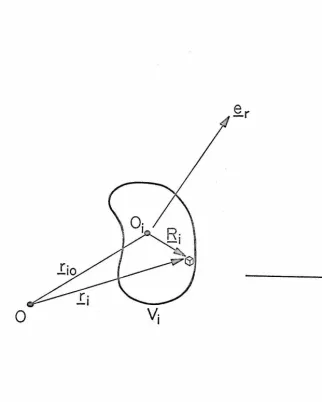
randomness m - r sc-position of the particles we split r. as follows (figure 3)
- 1
Thus we have
and
r.
=
r.+
R. -1 -10 -1r. • e
=
r. • e+
R .. • e -1 - r -10 - r -1 - rz.
=
r. • e=
z.+
Z.l - 1 -z LO l
Substituting 3. 1. 4 and 3. 1 • 5 into 3. 1. 2 we get
E (1 )i(r)
=
- s c-w26x. ikr -ike • r. ikz.
l {e Xe XE ) - 4 e e - r -1oe 10
---=2- - r - r - o irr c
- r - 1 l
S
-ike •R. ikZ.X e e dVi
v.
l
{3.1. 3)
(3.1.4)
(3.1. 5)
{3.1. 6)
We will temporarily drop the index i. Now we want to evaluate e • R
- r
-and e • R = Z in terms of the Eulerian angles a 1(31 y the polar angles
z
-El ,<p and the coordinates characterizing the shape of the body. If we
0
Fig. 3.
er
- - - J C >
The splitting of r. c r. + R . •
~ ~o ~
r.
'4..0 characterizes the random position of a dielectric particle, whereas
izes the random orientation.
R.
racter-with 0. the center of the ith particle we can view the x'y'z 1 system
l
as one obtained from xyz by an appropriate rotation, i.e.
-1 I R
1. = (M ) .. R. lJ J (i, j
=
1 , 2, 3; repeated indices aresummed)
where i,j are indices signifying the cartesian components of
R=R.e. =R!e!,
i-1 J.-l
-1
and M is the inverse rotation matrix given by:
cos -y cos (3 - cos a sin (3 s in y - s in )' cos
f3 -
cos a sinf3
cos y s in a - s inf3
M-1
=
cos-ysin(3+cosacos(3sin)' -sin)'sin(3+cosacos(3cosy -sinacos(3and
Now
sinasin-y sinacosy
We now write:
-1 I e • R = (e ).R.'= (e ).(M ) .. x. - r - - r l l - r l lJ J
e • R
=
Z=
x3 z--1 I
=
(M )3J J .x.
(e )
=
(e )=
sin ~ sine
- r y - r 2
(e ) = (e ) = cos
e
- r z - r 3
cos Ct
I
2 ikrE ( 1) ( r)
= -
wz
6x
.
(
e Xe XE ) ! : _ _4 exp ( - ike • r.
+
ikz. ) - s c - i - r - r - o 1Tr - r - 1 0 lO. c l
S[
exp '-ik(e )n(8,<pXM-1)n (a.,f3.,-y.)x1 \ - r .x. .x.n l i l nv.
l
To simplify 3. 1. 7 we define
K.(a .•
!3 .•
-y.;e ,'/>) l l l ldx' dx'
2 3
(3. 1. 7)
(3. 1. 8)
The time-average radiated power per unit solid angle is given by:
I_ dP
- an
= r 2 1z:
Re (E X H • ~r)*
In the far zone of a localized source we have:
therefore
2
=
11.
IE I
eV
µ.o - - r/Ji
dP 2 1 2
I
= -
=
r - ReI
EI
If we substitute 3. 1. 7 into 3. 1.
9
we getXI\
w22
6x.exp{-ike ·r. +ikz. )K.{a.,13.,"Y.;e,cp}l 2
L
l - r - 1 0 10 l l l l. c
{3.1.10}
l
To make the computation of 3.1.10 easy to handle we assume that all the particles have the same shape, same size, and same susceptibility. Then we have:
K.{a.
,!3 .•
"Y.;9,<p)=
K{a. ,13. •"Y·;9,<p}l l l l l l l
i.e. we drop the index i from K because the functional form will be the same for any particle if all have the same shape and size.
Next we write k
=
k + ik. to take into account the losses of - r l mthe medium. If we now call -k e • r. + k z. = <p., 3.1.10 becomes r-r - 1 0 r 10 l
X
I \'
e i<p i exp /k. { e - e ) • r. ) K {a. ,l3. ,
"Y.;e ,
<p) /2
L
\'.
l m - r - z - 1 0 l l l {3.1.11}i
We will no·w treat <p. as a random variable {due to randomness
l
( l \
L
eicpiexp fk.\
(e - e }• r . . ) K{a. ,13. ,-y.;0,cp} /2)
im - r -z - 1 0 1 1 1i
= N Vi
S
exp { 2k. { e - e ) • a) d V\ im-r -z
-v
1 s21T
s
2irs
1T 2 .X
-2 jK{a,13,-y;0,cp)j sinadadl3d-y
Sir -y=O 13=0 a=O
{3. 1. 12)
where a is the radius vector from the origin to any point, N the
number of particles and V the volume occupied by the particles.
To estimate the importance of the losses we evaluate
J=
..!..
S
exp/k.
(e -e )•~)
dV for an orthogonal parallelopipedV \'. im-r -z
-v
L ,L ,L •
x y z
L L L
2
_y_
21
S
2 2k. e xs
2 2k. e ys
2 2k. {e -1)zJ = v L e im rx d x L e im ry d Y L e im rz
_ 2
_
_y_
_ 2
2 2 2
1 1
= -V
3 sinh {k. L e )sinh (k. L e )
k. e e { e _ 1} im x rx im y ry
im rx ry rz
X s inh [ k. L { e - 1 } ]
im z rz
dz
{3.1.13)
Notite that for
e
=0, i.e. forward scattering, J = 1. If we expand3 x
sinh x = x
+ TI +
we can easily show that 3. 1. 13 gives:J
=
1+
O(Lk. ) 2im (3.1. 14)
Thus J is independent of the loss es, if (k. L) 2
<<
1.im
1 -1
20 m , therefore a example k. for water can be as low as
im
For
region V with L < 2 m will make (k. L) 2 ::= 1
%
im and J
=
1 with anerror of 1
%.
However, our theory does not allow L to get so sviall-5 ifthe wavelength is inthe visible range. Thus if A.
0 = (4X10 •••
7X 10⁻⁵) cm and n
=
1. 33 then the min L is obtained for ka=
1, mi.e. (see 2. 2. 21a)
A.
0
min L
=
18 rrnm
5.3 m ••• 9.3m
If for example min L
=
5. 3 m then (k. L)2=
7% and we make an imerror larger than the accuracy of the problem if losses are neglected.
The use of smaller wavelengths can reduce L, also k. = k. (A.) and
im im
then losses can be neglected. If the medium is not too lossy, i.e.
1 -1
kim ;S
100 m then we require L
,2:
10 m and losses can be neg-lected for visible wavelengths and ka of the order unity ~or larger.We have not worried about the effect of losses on the integral
over a,
l3,
-y for the following reason. If we do the integration we will find a function ofe,
cp and ka. Now k. a will in general be muchim
smaller than unity since a is about the same order as the wavelength.
For example if the medium is water kim::::: 1
-+
~O
m-1 and for the largest k. , k. a ..., 10-7 if A. is in the visible range, whereasi m i m
k a..., 1. If losses are taken into account we can easily see that they r
tend to reduce the forward scattering.
(3. 1. 13)
where
F(9)
=
~S
2
'1TS
2'1T
s'IT
IK(a,(3,)';9,cp)l2sina da d(3 d)' (3.1.14)8'1T -y=O {3=0 a=O
We have written F(9) and not F(9, cp) because the averaging procedure
will eliminate the cp dependence no matter what the shape of the
particles is, provided there are no losses.
Next we compute l!:rX!:rX E
0 1
2
for an elliptically polarized
incident wave. We have
- e Xe XE = component of E perpendicular to e
- r - r - o - o - r
-io
-io
Now E
=
E e- o x
x
e
-x
+
E y e Ye -y We know thatThus
and
e
.
e =-
sin cp e.
e = cos cp-x
-cp -y -cpe
.
!:e = c.os e cos cp e
.
!:e = cos e sin cp-x
~y-io
x
-io
-e X e XE = (- E e sin cp
+
E · e- r - r -o x y
-io
-io
Y coscp}e
-cp
+
(E cos 9 cos cpe x+
E e y cos 9 sin cp}!:e-io -io
=
I -
E e x s in <p+
E e Y cos <p j2x
y
-io -io 2
+
I
E c 0 s e c 0 s <p e x + E c 0 s e s in <p e yI
x
y
-i{o -o )
=
I -
E e x Y sin <p + E cos <pI
2x
y
-i(o -o)
+ cos2ejE e x Y cos<p+E sin<pj2
x
y
= (E cos<p-E cos(o -5 )sin<p)2+cos29(E sin<p+E cos(o -o )cos<p)2
y x x y y x x y
Two special cases are of interest
-io i) E. linearly p.olarized E.
=
E e xe-inc -inc o -x
-io ii) E. circularly polarized E.
= E
1e x(e ± ie ).
-inc -inc o -x -y
The plus corresponds to a right-handed and the minus to a left-handed wave.
i) (3.1.16)
The scattered power per unit solid angle is then
(1) 2 2 2 2 2
(I )
a:NE~(
w2
Jt:.xi)
(sin <p +cos 9 cos <p)F{8) cand the intensity pattern of the scattered wave is
1"1")
I
~r ~rx
x
_E 12 E'2I
±iir/2 .+
J 20
=
0 e s1n <p cos <p2 12
= (
1 +cos 8)E0
I.P. ex: {1
+
cos28)F(8)(3.1.18)
Notice, the intensity pattern is independent of
cp
as i t should be sincethe incident wave is circularly polarized,therefore the time average
radiated power per unit solid angle cannot depend on <p. This would
not be true if the collection of the particles exhibited a cp-dependence
on the average.
3. 2. Polarization of the Scattered Wave
Recall equation 3. 1. 7 for the first order total scattered field:
E(l)(r) s c
-'\"' 6 X . exp ( - ike • r. +ikz . ) K. (a. ,
13. ,
y. ; 8 , <p)3. 2. 1 can be rewritten as
(3. 2. 2)
where the meaning of jF(9,<p,r) leig(S,<p,r) is obvious.
The polarization properties of E(i)(r} entirely depend upon
s c
-the vector e Xe XE which is independent of the material medium,
- r - r - o
the shape, size, orientation and susceptibility of the particles. This
will cease to be true for higher order scattered fields.
-io -io
If E has the form: E e xe
+
E e Ye then we saw in-o x -x y -y
section 3. 1 that
-io -io
-e Xe XE
- r - r - o =(-Ee x xsin<p + E e
y
Y cos<p)e -<p-io -io
+(E cos9cos<pe x+E e Yeas 8sin<p}~
0
{3.2.3)x
y
0It is obvious from 3. 2. 3 that the total scattered wave is elliptically
polarized. However, for
e
= Tr /2 the polarization is linear sincecos
e
=o.
To determine the polarization ellipse it is necessary to cast
e X e X E into the following form:
- r - r - o
-io -io
9
- e X e
x
E=
E<pe <p~cp
+ E
0 e~a
- r - r _o o (3.2.4)
It is shown in Appendix C how one can draw the polarization
ellipse if E<p,E
9, o<p, 08 are known. The computation of these
E cos 6 = -E cos 6 sin <p
+
E cos 6 cos <p<p <p x x y y
E s in 6
= -
E s in 6 s in <p+
E s in 6 cos <p<p <p x x y y
and
E 2 = E2 . 2 sin <p + E2 cos 2 <p etc.
<p x
y
The cases of interest are:
-io
i) E. linearly polarized, i.e. E. = e x{E e
+
E e )-inc -inc x-x y-y
-io
ii) E. circularly polarized, E.
=
E' e x{e ± ie )-inc -inc o -x -y
i) 3. 2. 3 gives:
-io
- e X e X E = e x
{< -
E s in <p+
E cos <p) e- r - r -o x y -<p
The scattered wave is obviously linearly polarized.
ii) 3. 2. 3 gives:
-io
E E ' x( . . )
- e X e X
=
e - s in <p ± i cos <p e- r - r - o o -<p
-io
+cos 9
E~e
x(cos <p ±sin<p)~
8
-i{
o
w>
I X=
E0 e {cos 9 e -
e
± i e ) -<pThe scattered wave is. elliptically polarized with an inclination angle
ljJ
=
O. However, for 9=
rr/2 is linearly polarized which is true ine
=
1T (back scattering) the scattered wave is circularly polarized.Thus if the incident wave is right-handed circularly polarized then
-e Xe XE - r - r - o
r -i(ox-cp)
=
E e (cose
e0
+
i e )0 - -cp
e
=
o
=
r -i(o +cp) .
E e x . e l7T( ee- . le )
0 - -cp
e
=
1TIf we take into account the correspondence {x,y,z)~(9,cp,r) we understand that the back-scattered wave is circularly polarized but of opposite handedness than the incident wave whereas the forward
scattered wave is circularly polarized and of the same handedness.
If the incident wave is left-handed circularly polarized then we can easily see that the back-scattered wave is again c.p. but of
opposite handedness whereas the forward scattered wave is c. p. and
of the same handedness as the incident wave.
We can easily understand the above results if we recall that the observer who decides about the sense of rotation of the electric
IV. SECOND ORDER SCATTERING
4. 1. Intensity of the Scattered Wave
Equation 2. 2.
6
gives if the self-interaction terms are neglected:= { w 2
2 )
2
6 X .
s
I'( r; r .} • { \ 6 X .s
I'( r.; r.} • E. ( r.) d V. } d V. \ c l y .= -
- 1.L.
J=
- 1 -J -inc -J J 11 J#l V.
J
(4. 1. 1)
We have assumed that the interaction between the particles involves far
zone fields only. Therefore, we can use the simplified form for
I'(r.;r.}
= -1-J
I'(r.;r.}
= -1-J
ikr. - ike • r.
1 - r i -J
~ (u- e e } _e _ _ e _ -r.-r. 4irr.
- l l l
(4.1.2)
If
Ei.
for any particle is measured from a common origin, say the center of the volume occupied by the particles, then 4. 1. 2 is a badapproximation for particles for which r .- e • r . is close to zero.
1 - r i -J
There are, however, two reasons for using 4. 1. 2. a) The majority
of the particles in pairs satisfies 4. 1. 2 to a good degree of accuracy.
b) Any fine details which would result from an accurate form of
I'(r.;r.) will be completely washed out by.the final averaging procedure.
= -i-J
The scattered field E(2}i(r) is a far zone field, therefore
- S C
-r(r;r.} takes the simplified form 4. 1. 2.
=--1
in the following form
-4 ikr
s
-ike • r.=
w 6 e ( ) - r -i.4
Xi 4rrr ~- ~~r • ec
-v.
l.ikr. e l.
-ike •r.+ikz.
{l S
- r i -J (u-e e )•E-- -r.-r. - o 4rrr.
- l. l. l.
j:;Ci
J .6 X· e
J
v.
J
dV. }dV. J l.
(4. 1. 3)
To take account of the randomness in position of the particles we do the same splitting as we did in section 3. 1, i.e.
r.
=
R.+
r. -i. -i. -i.owhereupon 4. 1. 3 becomes
r . = R.
+ r.
-J - J -JO4 ikr - ike • r.
r
= ~.6.x.-e--(u-e e )·e - r -i.oj(u-e 4 i. 4rrr _ - r - r _ -r.
c - - l
v.
l
-ike r. +ikz.
e )
- r . l
. e ikri -ike • R. - r - 1
{l
·E - - e x.e
J
-rcJo JO - o 4rrr.
l j:;Ci
-ike • R. "kZ
s
e - r i -J / j dVj}v.
J
(4. 1. 4)
When we do the integration over the volume of the ith particle we can replace e by its average value e • The reason is the
- r . - r .
following. e
- r .
l
l. 10
particle is situated near the origin then any other particle lies at a
distance much greater than a wavelength. On the other hand the linear
dimensions of the particles are of the order of a wavelength, therefore
the change in the direction of e over the volume of the ith particle - r.
l
is really negligible for all the particles but the one situated near the
origin. However the error we make by ignoring the particle near the ikr. origin is really negligible if N is large. Next we will replace e
ikr.
l/r.
l
by e 10 /r. which again is O. K. for all the particles away from the
10
center.
We can now write 4. 1. 4 as follows:
(u-e e )•E
- - r. - r . -o
- 10 lO
e
ikr. lO
4-rrr.
10
{s
exp (-ike • R.) - r - 1
v.
l
{ "\:"'
.!.._;
6x.exp(-ikJ -r. -JO e •r. +ikz. JO )Sexp(-ike -r. -J ·R.+ikZJ .) dVJ. }.=/:. 10 V lO
J l j
(4.1. 5)
If we now recall definition 3. 1. 8 and use 4.1. 5 we get for the total
scattered field:
4 ikr
I
=
~ _e _ _ (u - e e )· 6X .{u - e e ) 4 4-rrr - - r - r l _ - r. - r.c - . - 10 10
l ikr.
10
• E exp(-ike • r. ) e
4 L.(a.
,13
.
,'f.; 9 ,<p) - o - r - 1 0 rrr. l l l llO
{l
j
exp ( -ike • r. + ikz. ) K. (a. ,
13.
,
'Y. ; 9. , <p. ) }where we have defined
L.(a.,13.,y.~8,<p)
=
Sexp(-ike •R.) dV.l i l l - r - 1 i
v.
i
To make 4. 1. 6 look simpler we define
(4.1.6a)
)~
.cix. exp(-ike ·r. +ikz. )K.(a.,!3.,y.;8. ,<p. )= A1(8. ,<p.)
L I J - r
1.0 -JO JO J J J J lO lO lO lO j:i"i
Next we drop the index o as redundant and 4. 1. 6 becomes
4 ikr
E(Z)(r)
=
w _e _ _ (u - e e ) - s c - c r 4lTr=
- r - rikr.
• { \ .6 X. ( u - e e ) • E exp ( - ike • r.) e
1
~ i = -ri-ri - o - r - 1 4lTri l
L.(a.,!3.,y.;8,cp)A
1(8.,cp.)l
l l l l l l J
It is shown in Appendix D that if E = E(i)
+ E(Z)
+ • • •
then -sc -sc - s c*
<
- s c - s c E ·E•!<)=
(E(i).E(- s c - s c 1))+
(E(Z).E(z)•!<) - s c - s c+ •••
i.e.
(4. 1. 7)
(4.1.8)
The above relations say that the fields of the several orders are "orthogonal" to each other when the appropriate averaging is done.