3373
Potential Developmet Based On Rural Area In
Southern Region Of East Java Province (Study In
Jember Regency)
Herman Cahyo Diartho, Endah Kurnia Lestari, Duwi Yunitasari, Agus Luthfi, Fivien Muslihatinningsih
Abstract: Rural development becomes important as an effort to minimize disparities between regions . The purpose of this study is to analyze the economic potential in rural areas and design policies in Jember Regency, especially in the Southern Region. The method used to analyze data is Location Quotient (LQ) analysis, MRP analysis, Overlay Analysis and AHP. Sampling data taken in 6 districts in Jember Regency. The Jember Regency was chosen because it was included in the largest food granary in East Java. The analysis shows that each sub-district has a superior sector each, namely certain commodities that have a competitive advantage compared to other districts.
Index Terms: Economic Potential, LQ, MRP, overlay, AHP, Policy, Southern Region.
—————————— ——————————
1.
INTRODUCTION
Rural development will be increasingly challenging in the future with the regional economic conditions that are becoming more open and more democratic in politics. But the village until now, still has not moved from the old profile, which is backward and poor. Therefore, rural development should be a top priority in Indonesia's development strategy and policy plans. If not, then the gap between city and village will be higher, especially in terms of the economy. (Bappenas, 2016). Inequality in urban and rural areas and poverty in rural areas encourage development efforts in rural areas. However, the approach to developing rural areas is often separated from urban areas. This resulted in the occurrence of an urban bias process, namely the development of rural areas which was originally intended to improve the welfare of rural communities, resulting in the opposite, namely the siphoning of the potential of rural to urban areas in terms of human, natural, and even capital resources (Djakapermana, 2003: 4). Rural development policies so far have been prepared with the aim of improving the welfare of rural communities and accelerating rural industrialization. According to Pradhan (2003) rural development can only be sustainable if the available infrastructure and facilities can stimulate and encourage production and market activities in rural areas. Rural areas as suppliers of agricultural products in the form of primary products must be encouraged to become villages that are capable of producing processed materials or industrial agricultural products so that they become areas of local economic growth (Gamma Epsilon, 2014). Industrial development, which is mostly located in urban areas, grew rapidly for almost 30 years. However, the development of the agricultural sector and its processed industries, which are almost entirely located in rural areas, are growing slowly. The
agricultural sector is a comprehensive system which is related to producers and consumers. This system is related to the storage, yield processing, production and marketing sub system (CIDA, 2003). As a result of disparity between urban and rural areas, the interaction between the two is not mutually reinforcing, but rather weakens one another. Thus, rural development policies so far have not been able to provide significant changes to improving community welfare, so the development policy approach so far needs to be rethought.
Zeng and Sui (2011) state that this is a phenomenon that is common in various developing countries in the world. Rural development through agribusiness-based development is expected to provide the right solution to overcome and answer these problems. The Regional Inflation Control Team mentioned that Jember Regency is one of the barns of food security in East Java Province (2017). The designation of the area explains the existence of a potential based on the region's natural resources so that this becomes a phenomenon to be developed in development studies. The development of rural areas also has relevance to the Nawa Cita program of the President of the Republic of Indonesia, which is to move regional development with the starting point of the periphery as the epicenter of economic development. The outlying area that is the location of this study is the southern part of the East Java Province, precisely the Jember Regency. Potential natural resources that are the main food producers in Jember Regency include rice, corn, peanuts, soybeans, cassava and sweet potatoes. Jember Regency is the largest rice supplier in East Java, in 2017 with an area of 165,697 hectares with a harvest area of 166,081 hectares and productivity of 59.16 kw / ha. Potential of corn commodity produces production of 427,064 kw in 2015, amounting to 402,031 in 2016 and amounting to 370,973 kw in 2017 with an area of 65,687 ha. Potential for soybeans has an area of 7,523 hectares with an average production of 5,240 kw. Potential of Cassava has a land area of 1,058 hectares with an average production of 20,377 kw, while the potential of Sweet Potato commodities with an area of land of 233 hectares can on average produce Sweet Potatoes of 5,135 kw. Jember Regency has a role in encouraging community economic improvement. Among the potential for agriculture, fisheries, livestock is a source of income for most people. In addition, agricultural management, which is a leading sector in the region, is ————————————————
Herman Cahyo Diartho, Faculty of Economic, University of Jember, Indonesia (e-mail: [email protected])
Endah Kurnia Lestari, Faculty of Economic, University of Jember, Indonesia (e-mail: [email protected]).
Duwi Yunitasari, Faculty of Economic, University of Jember, Indonesia e-mail: [email protected])
Agus Luthfi, Faculty of Economic, University of Jember, Indonesia (e-mail: [email protected])
3374 integrated with productive agricultural and plantation
management and fisheries in order to be distributed in the concept of community economic development. Rural areas in Jember Regency basically have agricultural potential to be developed and various innovations that have been carried out are closely related to internal and external factors that are owned by villages. The GDRP value of the agricultural sector was 18,885 in 2016 in billions of rupiah. The internal factors in question consist of strengths and weaknesses that are owned by the village while the external factors are related to opportunities and threats. It is expected that by knowing the economic potential in each sector in Jember Regency can find out which sectors are superior or not superior sectors, for the sustainability of resource management or further potential possessed by the Regency of Jember and subsequent efforts can be made planning in regional development rural areas, especially in the Jember Regency.
2 LITERATURE OVERVIEW
Regional Planning is a development planning process that is intended to make changes towards a better development direction for a community, government, and environment in a particular region, by utilizing the various available resources, and must have a comprehensive, complete orientation, sticking to on the priority principle (Riyadi and Bratakusumah, 2003). Regional Planning is the only open way to increase Gross Domestic Product (GDP), reduce income inequality and increase employment opportunities (Jhingan, 2000). Regional Development Planning is "A systematic effort from various actors, whether public (public) or government, private, or other community groups at different levels to deal with interdependence and interrelationships of physical, social, economic and other environmental aspects. in a way:
1. Continuously analyzing the conditions and implementation of regional development;
2. Formulating regional development goals and policies; 3.Develop a concept of strategy for solving problems
(solutions), and
4. Implement it using available resources so that new opportunities to improve the welfare of local communities can be captured in a sustainable manner ”(Solihin, D, 2005).
The ability to cause the growth of a region is very dependent on the excellence or competitiveness of economic sectors in the region. The strategic value of each sector in an area is the prime driver (prime mover) of regional economic growth is different. The main representative of export-base theory was Douglas C. Nort (1920) who in the 1950s refused gradualist theories of regional development, which advocateda gradual transfer between primitif forms of economy to developed forms. The theory put an emphasis particularly on the development of export sectors which has the role of amultiplier and other fields in the region are more or less subject to the export field and secure its activities
(Adamcik, 2002). Export is everything which is exported beyond the bordersof regionalmarket, particularly abroad (Vystoupil, 2003). The economic basis approach is based on the opinion that what needs to be developed in an area is the ability to produce and sell these products efficiently and effectively. This model further explains the economic structure of a region over sectors. The economic sector of a region can be divided into two groups, namely:
1. Base sectors, namely sectors or economic activities that serve both the regional / regional domestic market and the market outside the region / region.
2. Non-base sector, namely sectors or activities that are only able to serve the regions themselves and the regional export capacity has not been developed.
According to Chenery and Syrquin, development can be seen as a multidimensional transition process that reflects the relationships between various processes of change within a country. The process of multidimensional change is characterized by structural change. Structural changes are characterized by economic structures that are reflected by changes in sectoral contributions (shift share) in national income (Arsyad, 2010: 12-17). Shift Share AnalysisAccording to Tarigan (2004), shift share analysis compares the different growth rates of various sectors in the regions with the national territory. Arsyad (1999), said that this analysis contains data on economic performance in 3 interrelated fields:
1. Regional economic growth is measured through an analysis of sectoral aggregate changes and compared to changes in the same sector in the economy that are used as a reference;
2. Propotional Shift measures the relative changes, changes or decreases in the region compared to the larger economy as a reference. Where this measurement makes it possible to find out a regional economy concentrated in industries that are growing faster or not compared to the reference economy;
3. Differential Shif) helps in determining how far the competitiveness of the regional industry and the economy is used as a reference.
3 MODEL SPESIFICATION AND DATA
3375
4 METHOD AND FINDINGS
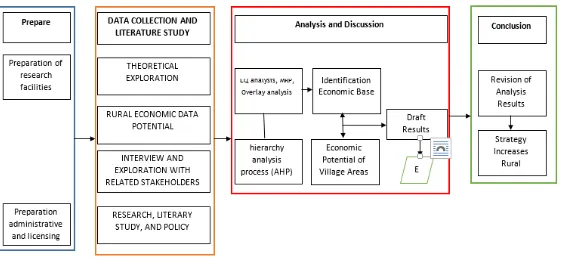
Analysis of the data used in this study is based on the formulation of the problem so the data analysis method used is as follows:
Table 4.1 Data analysis methods
No Research purposes Metodh Data Source
1
Analyzing the economic potential and its sustainability in rural areas towards the economic independence of villages in Jember Regency.
LQ Analysis and DLQ Shift Share analysis and
MRP
1.
Questionnaire 2. FGD
2
Analyze the policies that can be carried out to increase the development of economic potential that is suitable for rural areas in Jember Regency.
Hierarchical Process Analysis
1.Interview 2.
Questionnaire 3. FGD
Location Quotient Analysis (LQ)
LQ analysis is an analysis tool to show the economic base of a region, especially from the contribution criteria. From the formula above there are 3 categories of the results of the Location Quotient (LQ) calculation in the regional economy, namely:
LQ = ... (3.1)
Information :
: Value GDRP sector i in Jember Regency
: Total GDRP in Jember Regency
: Value GDRP sector i in Jember Regency
: Total GDRP in East Java Province
If the LQ value> 1, then the sector concerned in the study area is more specialized than the reference region. That is, categorized as a base sector.
If the LQ value is <1, then the sector concerned in the study area is less specialized than the reference region. The sector is categorized as a non-base sector.
If the value of LQ = 1, then the sector concerned both in the study area and the reference area has increased.
Shift Share Analysis
Shift Share Analysis is a technique in analyzing the economic growth of a region as a change or increase in an indicator of economic growth in a region in a certain period of time.
According to Soepomo (in Taufik, 2011), shift share analysis can be formulated as follows:
... (3.2)
If the analysis is applied to income, which is denoted by y, then:
... ` (3.3)
... (3.4)
... (3.5)
, , dan representing regional growth rates and national growth rates, each of which is defined as:
... (3.6)
... (3.7)
... (3.8)
Superscript * shows revenue in the final year of analysis. Information :
: GDRP sector i in Jember Regency : GDRP sector i in East Java Province Analysis of Growth Ratio Models (MRP)
This analysis model is derived from the initial equation of the main components in the Shift Share analysis, namely Differential Shift or Regional Share and Proportionality Shift or Industrial Mix (Wafiyulloh, 2016). Growth Ratio Study Area ( )
It is a comparison between sector i income growth (GDRP) in the study area and sector i income growth (GDRP) in the reference region.
Reference Area Growth Ratio ( )
It is a comparison of average income growth (GDRP) of sector i in the study area with revenue growth (GDRP) of sector i in the reference region.
Overlay Analysis
This Overlay Analysis is intended to determine potential economic sectors or activities based on growth criteria and contribution criteria by combining the results of the Growth Ratio Method ( ) and Location Quotient (LQ) (Wafiyulloh, 2016).
Analytichal Hierarchy Process Method
AHP is an analysis used in decision making with a systems approach, where decision makers try to understand a system condition and help make predictions in making decisions.
5 EMPIRICALRESULT
LQ Analysis
3376 1, goat livestock by 1.72 and sheep livestock by 1.2. each of
the three livestock commodities each has a LQ value> 1, meaning that it has the potential to be developed. Tempurejo Subdistrict also has an LQ value> 1 for beef cattle commodities of 5.27 and sheep commodities with an LQ value of 1.2> 1. The Poultry Subsector in Jember Regency is superior to the Subdistrict of Wuluhan. Non-racial poultry commodities with a LQ value of 3.55, race poultry commodities with an LQ value of 1.09, and broiler commodities of 5.35> 1, which means that these three poultry commodities have potential to be developed. However, for non-racial poultry commodities (superior) by Tempurejo sub-district with an LQ value of 13.6> 1, meaning that it is very potent to be developed and for Puger Sub-district race poultry commodity is more superior than Tempurejo sub-district with a LQ value of 4.5> 1, meaning potential to be developed. This shows that from the agriculture sector, the livestock sector and the poultry sub-sector, in each sector there is a superior potential that has a pretty good role in the Jember Regency. Where according to Rahman (2016) an area that is able to meet its own needs in its area coverage and sectors can potentially be exported outside the region at least with adjacent districts can increase economic value growth in the district. As well as the base sector and have a cooperative advantage, then the sector needs to be pursued by both the government and the private sector to be developed again so it can boost the regional economy (Amalia, 2017).
Analysis of Growth Ratio Models (MRP)
MRP analysis is used to identify which economic sectors in Jember Regency are potential by looking at the growth ratio, namely the comparison between the GRDP growth of an economic sector in Jember Regency with the GRDP growth of the economic sector in East Java Province or called the Study Area Growth Ratio (RPs). In Jember Regency is included in the first classification which shows that the sector has prominent growth both at the Jember Regency level and in East Java Province, where this activity is called dominant growth. It shows the Mining and Quarrying sector with a value of RPr (1.12) and a value of RPs (1.24) . This means that the value of RPs> 1 indicates the Mining and Quarrying sector is higher than the growth of the same sector in East Java, and the value of RPr> 1 shows the growth of the Mining and Quarrying sector in the East Java region higher than the growth of the total GRDP of the same region . The third classification, the sector has a prominent growth in Jember Regency but less prominent at the provincial level in East Java. This means that the value of RPs> 1 shows the agriculture, forestry, and fisheries sector, processing industry, electricity and gas procurement, water supply, waste management, waste and recycling, construction, wholesale and retail trade; Car and Motorcycle Repair, Transportation and Warehousing, Provision of Accommodation and Food and Beverage, Information and Communication, Financial Services and Insurance, Real Estate, Corporate Services, Government Administration, Mandatory Defense and Social Security, Educational Services, Health Services and Social Activities and Services others in Jember Regency were higher than the growth of the same sector in the East Java region, and the value of RPr <1 shows that these sectors in the East Java region were lower than the growth of the same total regional GDRP. It can be concluded that the Mining and
Quarrying sector is a potential sector owned by Jember district, but in absolute value its value always increases but this sector is very affected by the willingness of nature to provide its resources and the increase in demand for this sector is limited. So that the agility of the mining and quarrying sector is easily bypassed by the secondary and tertiary sectors. From the results of the previous LQ analysis, there are several basic sectors in the southern region of Jember Regency. In this analysis the criteria used are the average for the 2015-2017 period. With the results obtained in the economic sector in Jember District, most of them had prominent growth, although most were only in the Province of East Java. According to Ayubi (2014) if most economic sectors have prominent growth, the growth can be said to be quite good.
Overlay Analysis
Overlay analysis is used in identifying potential economic sectors both in terms of growth and in terms of their contribution. This analysis is seen from the combined RPr, RPs and LQ during the research period from 2015 to 2017. In Jember District shows the Agriculture, Forestry and Fisheries sector, Information and Communication sector, Government Administration sector, Defense and Mandatory Social Security, Education Services sector and the Health Services and Social Activities sector shows that in Jember District these sectors are the dominant sectors both from growth and contribution. Whereas in Jember the sectors whose growth activities were dominant but whose contribution was small so that their contribution needed to be increased were the Agriculture, Forestry and Fisheries sector, the Information and Communication sector, the Government Administration sector, the Mandatory Social Security and Defense sector, the Education Services sector and the Health Services sector and Social activities. The Agriculture, Forestry and Fisheries Sector which has the potential to be developed in Jember Regency in the period of 2015-2017 reflects a significant growth. From the Agriculture, Forestry and Fisheries Sector, the average growth rate was 5.52 percent. If the sector developed as a base sector can support it is expected to support the growth of other sectors so that the contribution to the GRDP can increase and the potential sector can vary (Erawati, 2011).
Project Hierarchy Analysis
3377 provision of adequate infrastructure facilities and
infrastructure in Jember Regency as in the RPJMD aimed at equitable distribution of income and poverty alleviation aimed at creating a conducive environment for economic activities, to expand employment opportunities, price stability and economic growth. Aspects of regional marketing with a weight of 8.10%, the strategy used in the development of regional promotion is expected to disseminate information about leading sectors and the potential possessed by Jember Regency, so that it can be known by other regions and can be realized The dual track strategy model contained in the development plan Jember Regency. Which model will continue to be developed, which on the one hand seeks to realize economic growthquality and sustainability, and on the other hand endeavors to realize the fulfillment of people's basic needs, such as the right to food, health services, education, clean water and sanitation, employment and so on. The aspect of increasing cooperation with financial institutions weighs 5.33%, and the aspect of developing the quality of human resources has a weight of 4.69%.
6 CONCLUSION
The results of LQ, MRP and overlays show the economic potential and its sustainability in rural areas towards the economic independence of villages in Jember Regency, among others from the Agriculture, Forestry and Fisheries Sector, if the sector developed as a base sector can support it is expected to support the growth of other sectors so that contributions to GDRP can increase and the potential sector can vary. The policies that can be taken to improve the development of economic potential that is suitable for rural areas in Jember Regency which are prioritized are related to the regional master plan, namely the aspect of infrastructure development supporting infrastructure development is expected to be consistently directed to improve the balance of economic growth and equitable development in order to be able to solve problems social fundamentals, especially unemployment and poverty, and maintaining economic stability.
REFERENCES
[1] J Arsyad, S. 2010. Konservasi Tanag dan Air. Edisi Kedua, IPB Press: Bogor.
[2] Arsyad, L. 1999. Pengantar Perancanaan dan Pembangunan Ekonomi Daerah. Edisi Pertama. BPFE:Yogyakarta.
[3] Ayubi, a. A. 2014. Analisis Potensi Ekonomi Kabupaten Banyuwangi. Jurnal Ekonomi Pembangunan. Vol 12, No.1.
[4] Bappenas. 2016. Modul I. Kerangka Pemikiran Reformasi Perencanaan dan Penganggaran. Badan Perencanaan Pembangunan Nasional (Bappenas). Direktorat Alokasi Pendanaan Pembangunan.
[5] BPS. 2019. Kabupaten Jember dalam Angka, Publikasi. Provinsi Jawa Timur.
[6] Djakapermana, R. D. 2003.Pengembangan Kawasan Agropolitan Dalam Rangka Pengembangan Wilayah Berbasis Rencana Tata Ruang Nasional (RTRW). Dirjen Penata Ruang. Departemen Pemukiman dan Prasarana Wilayah R.I. Jakarta.
[7] Douglas, C. N. 1955. Location Theory and
Regional Economic Growth. Chicago: The University of Chicago Press Journal. Vol 63 No.3. [8] Jhingan, M. L. 2000. Ekonomi Pembangunan dan
Perencanaan. PT. Raja Grafindo Persada. Jakarta. [9] Pradhan, P. K. 2003. Manual for urban rural lingkage and rural development analysis. Nepal: New Hira Books Enterprises.
[10] Riyadi dan Bratakurumah. 2003. Perencanaan Pembangunan Daerah: Strategi Menggali Potensi dalam mewujudkan Otonomi Daerah. Gramedia Pustaka Utama. Jakarta.
[11] Solichin, A. 2008. Pengantar Analisis Kebijakan Publik. Malang: UPT Penerbitan Universitas Muhammadiyah Malang.
[12] Taringan, R. 2004. Perencanaan Pembangunan Wilayah. PT. Bumi Aksara: Jakarta.