Android Application for Passwordless Login for
Web Applications
Aakash R Kanvinde Swapnil A Panchal
UG Student UG Student
Department of Information Technology Department of Information Technology K.J Somaiya Institute of Engineering & Information
Technology, Sion (East), Mumbai:-400022
K.J Somaiya Institute of Engineering & Information Technology, Sion (East), Mumbai:-400022
Shamini V Palrecha Prof. Reena Lokare
UG Student Assistant Professor
Department of Information Technology Department of Information Technology K.J Somaiya Institute of Engineering & Information
Technology, Sion (East), Mumbai:-400022
K.J Somaiya Institute of Engineering & Information Technology, Sion (East), Mumbai:-400022
Abstract
Passwordless Login for Web Application’ is an android application, will be used to access online internet accounts of distinct web applications and web services. The user would register with pre-requisite credentials primarily like, an email id, primary mobile number, and a unique username and a secondary mobile number. After successful registration, the user would be required to enter its registered username only. After submitting the registered username, a unique QR code will be popped up on the website. The user would scan the QR code using his/her android mobile phone. After successful scanning of QR code, the authentication and authorization procedure will be performed thereby granting secure access.
Keywords: QR code, SMS, Android mobile phone, passwordless, RSA
_______________________________________________________________________________________________________
I. INTRODUCTION
Internet and technology has grown leaps and bounds within few years. Every traditional approach of our day to day life has been advanced and made online. Right from sending emails or messages to shopping online, booking a cab for travel to booking movie tickets and related number of activities [5]. It is therefore required to maintain accounts with unique usernames and
passwords to access and use these kinds of services. But to memorize these numbers of passwords is painstaking and exacting [9].
We are often prone to forget passwords or misinterpret them with different accounts. This often leads to lose access to our account or getting our account compromised [5][9]. Hence, our idea of precluding the practice of submitting passwords would be
an efficient solution to access the online accounts by just entering a username and getting access to the same [10].
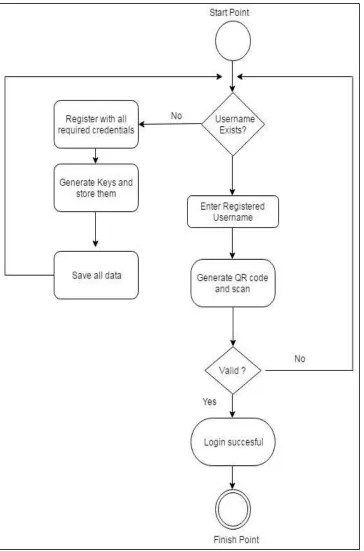
Passwordless Login for Web Application is an android application to access online internet account by entering username and scanning the QR code. There is no need to enter any password for accessing the online account. The registration for the app would be done on the android mobile by entering valid credentials.
After successful account generation, the user is required to enter the registered username and submit it. Thereafter, the login button is required to be clicked, and after scanning the generated QR code, access to the required account will be granted.
II. PROPOSED SYSTEM
Our system consists of an Android Application which would be linked to a database server. This database server would be linked with the online website for which a user desires to get access to:
The application would work as follows:
Module 1:
Website module: The website here, we have considered for our conceptual explanation is an e-commerce website. It can be of any category right from social networking sites to online gaming or free email account providers like Gmail, Yahoo, etc. The user is just expected to submit only the registered username on the login page thereby getting access by means of its android application after popping up QR code for specific user.
credentials. The database is mutually accessed by the website and the android application. But the authority to write is only pertained onto the android application and the website can just read and verify the data.
Module 3:
Android Application module:
The Android application would be used as a gateway pass or token to access the linked websites. The first and foremost registration procedure is to be performed on the android application. After successful registration, the data is passed and stored in the database server. The QR scanner is deployed in this android application, which is used to scan user specific QR code; decode it and pass it to the database server.
Module 4:
Authentication and Authorization Module:
The data forwarded to the database server from the android application and the user input on the website are simultaneously verified whether such an association exists or not. If an exact association among two sources exists, then using RSA algorithm, the user is granted valid access.
Fig. 1.1: Sequence diagram of the proposed system
In existing systems, there is a constant need to keep record of distinct usernames and passwords [2]. There may occur instances
where same username criteria cannot be achieved for varied accounts or applications. So keeping an accurate log of usernames and passwords linked with all the user’s account is a painstaking experience [3]. Also, the user is also vulnerable to lose
appropriate username, eventually losing access over its account [5]. It may be a minor loss when the lost account would be of a
III. IMPLEMENTATION
Website Module:
Start Page
Home Page:
Page after valid log-in
Android Application Start Page:
Registration Page
Recovery Page
Recovery Page incase of loss of mobile
Characteristics of Each Module:
Our system consists of an Android Application which would be linked to a database server. This database server would be linked with the online website for which a user desires to get access to:
The application would work as follows: Module 1:
Website module: The website which the user desires to have access with should be linked with the database of the android application which will be further shared by all the linked websites as future scenario. The user would submit its pre-registered unique username on the website’s login page and submit it. After successful submission, a QR code would pop up and further steps should be forwarded through android application thereby granting valid access.
Module 2:
Database: A database will be created providing mutual access to both the website as well as the android application. The primary tables required to store are the unique username, mobile phone number, public key, private key as well as random number required for generation of unique QR code.
Module 3:
V. CONCLUSION
The application is very useful in case we forget our password of various accounts. To maintain and access distinct email ids (username) & passwords is a hectic experience. One needs to memorize distinct credentials and passwords to access one’s online account. Users are often succumbed to forget these credentials and lose their authority over these accounts. It also leads to compromising of their accounts leading to loss of information or any other important data. This problem can be countered if a simple mode of accessing one’s account is developed and implemented. Our project can let an individual access its online account and consume the provided service with few simple steps. After successful registration, the user should follow few steps to access its account. Also, these steps just offer the user to enter the username which was being entered at the time of registration, and no password is required.
ACKNOWLEDGMENT
We wish to express our sincere gratitude to Prof. Reena Lokare, Project Guide for providing us an opportunity to do our project work in Android domain. We sincerely thank Mr. Uday Rote, HOD of IT Department and Mr. Harsh Bhor, Project Coordinator for their guidance and encouragement in carrying out this project work. We also wish to express our gratitude to the officials and other staff members of K.J. Somaiya Institute of Engineering and Information Technology, who rendered their help during the period of our project work.
REFERENCES
[1] Bo Zhu, Xinxin Fan and Guang Gong. Loxin – A Solution to Password-less Universal Login. 2014 IEEE INFOCOM Workshops: 2014 IEEE INFOCOM Workshop on Security and Privacy in Big Data.
[2] Mohammad Shirali-Shahreza, Sajad Shirali-Shahreza. Passwordless Login System for Mobile Phones Using CAPTCHA. 49th International Symposium ELMAR-2007, 12-14 September 2007, Zadar, Croatia
[3] Kirit Sælensminde, Prof. Veera Boonjing. A simple password less authentication system for web sites. 2010 Seventh International Conference on Information Technology
[4] L. Von Ahn, M. Blum, N. Hopper, and J. Langford, “Captcha: Telling humans and computers apart automatically,” in Proceedings of Eurocrypt, 2003 [5] E. H. Spafford, “OPUS: Preventing Weak Password Choices,” Computers & Security, vol. 11, pp. 273–278, 1992.
[6] K. Zetter, “Weak Password Brings ’Happiness’ to Twitter Hacker,” January 2009. [Online].
[7] L. von Ahn, M. Blum, J. Langford, “Telling Humans and Computers Apart Automatically”, Communications of the ACM, Vol. 47, No. 2, February 2004, pp. 57-60.
[8] M. Shirali-Shahreza, S. Shirali-Shahreza, “Collage CAPTCHA”, Proceedings of the 20th IEEE International Symposium Signal Processing and Application (ISSPA 2007), Sharjah, UAE, February 2007.
[9] J. Bonneau, C. Herley, P. C. van Oorschot, and F. Stajano. The quest to replace passwords: A framework for comparative evaluation of web authentication schemes. In IEEE Symposium on Security and Privacy, SP 2012, 21-23 May 2012, San Francisco, California, USA, pages 553–567, 2012.