Int. J. of Engg. Sci. & Mgmt. (IJESM), Vol. 2, Issue 3: July-Sep.: 2012, 328-333
INTERNATIONAL JOURNAL OF ENGINEERING SCIENCES
&
MANAGEMENT
PERFORMANCE AND GEOMETRY ANALYSIS OF ANTENNA ARRAY
*Vikas Mishra, 1Prof. Sudha Nair
*,1 RKDF Institute of Science and Technology , Bhopal (M.P), India
ABSTRACT
The radiation pattern of an antenna array depends strongly on the weighting method and the geometry of the array. Selection of the weights has received extensive attention, primarily because the radiation pattern is a linear function of the weights. However, the array geometry has received relatively little attention even though it also strongly influences the radiation pattern. The reason for this is primarily due to the complex way in which the geometry affects the radiation pattern. The main goal of this paper is to determine methods of optimizing array geometries in antenna arrays. An adaptive array with the goal of suppressing interference is investigated. It is shown that the interference rejection capabilities of the antenna array depend upon its geometry. Side-lobe level is an important metric used in antenna arrays, and depends on the weights and positions in the array. A method of determining optimal side-lobe minimizing weights is derived that holds for any linear array geometry, beam-width, antenna type and scan angle.
Keywords: Radiation pattern, Antenna arrays, Linear array geometry
INTRODUCTION
An antenna array is a set of N spatially separated antennas. Put simply, an array of antennas does a superior job of receiving signals when compared with a single antenna, leading to their widespread use in wireless applications. Arrays in practice can have as few as N=2 elements, which is common for the receiving arrays on cell phone towers. In general, array performance improves with added elements; therefore arrays in practice usually have more elements. Arrays can have several thousand elements, as in the AN/FPS-85 Phased
Corresponding Author*
Email- [email protected]
Int. J. of Engg. Sci. & Mgmt. (IJESM), Vol. 2, Issue 3: July-Sep.: 2012, 328-333 representing 1s and 0s. The information is
still encoded into the amplitude and phase of these symbols; however, the amplitudes and phases now take on a discrete set of values.
REVIEW
The first articles on improving array performance via geometry optimization dates back to the early 1960s. Unz studied linear arrays in 1960 and noted that performance improvement could be obtained by holding the weights constant and varying the element positions. In 1960, King proposed eliminating grating lobes via element placement in an array. In 1961, Harrington considered small element perturbations in an attempt to synthesize a desired array pattern.
The concept of ‘thinned arrays’ was introduced in the early 1960s as well. It was noted that in large, periodically spaced antenna arrays, removing some of the elements did not noticeably degrade the array’s performance. This method of altering an array’s geometry was introduced by Skolnik et al. and was first studied deterministically – attempting to systematically determine the minimum number of elements required to achieve a desired performance metric. For large arrays, the problem was tackled in a statistical fashion to avoid the excessive amount of computation time required to determine an optimal thinned array.
Stutzman introduced a simple method of designing non uniformly spaced linear arrays that is based on Gaussian-quadrature that involves fairly simple calculations. In addition, he showed that by appropriate scaling of the element spacings, some of the elements will lie in the region where the ideal source has a small excitation, and thus can be omitted from the array (another method of array thinning).
Array geometry plays a critical roll in the direction-finding capabilities of antenna
arrays. Pillai et al. shows that for linear aperiodic arrays, there exists an array that has superior spatial-spectrum estimation ability. Gavish and Weiss compared array geometries based on how distinct the steering vectors are for distinct signal directions; they proposed that larger distinctions lead to less ambiguity in direction finding. Ang et al. also evaluated the direction-finding performance of arrays by varying the elements’ positions based on a genetic algorithm.
Int. J. of Engg. Sci. & Mgmt. (IJESM), Vol. 2, Issue 3: July-Sep.: 2012, 328-333 planar array synthesis in minimizing
side-lobes, along with null-placement. Tennant et
al. used a genetic algorithm to reduce
side-lobes via element position perturbations. The authors demonstrate side-lobe minimization by choosing geometry based on the Ant Colony Optimization (ACO) method.
In addition to geometry considerations, the minimum possible side-lobe level for an array is of interest. For linear, equally spaced arrays, the problem of determining the optimal weights was solved by Dolph and published in 1946. This method is known as the Dolph-Chebyshev method, because Dolph uses Chebyshev polynomials to obtain the excitation coefficients. The method returns the minimum possible null-to-null beam-width for a specified side-lobe level (or equivalently, the minimum possible side-lobe level for a specified null-to-null beam-width). This method has an implicit maximum array spacing for a given beam-width. Riblet showed that for arrays with inter-element spacing less than λ / 2 , there exists a set of weights that give a smaller nullto-null main beam than Dolph’s method. However, Riblet only derives the results for arrays with an odd number of elements. The Dolph-Chebyshev method produces side-lobes that have equal amplitudes. A more generalized version of Dolph’s algorithm (called an equi-ripple filter) is also frequently used in the design of Finite Impulse Response (FIR) filters in the field of signal processing.
In 1953, DuHamel extended the work of Dolph to end fire linear arrays with an odd number of elements. Dolph’s work was also considered for the case of non-isotropic sensors; the problem was not solved for the general case. The optimum side-lobe minimizing weights for broadside, non-uniformly spaced symmetric linear arrays with real weights can now be found using
linear programming. The authors attempt to simultaneously optimize the weights and the positions of a 25-element linear array using a Simulated Annealing (SA) algorithm. They make no claim that their results are optimal, but do show the side-lobes lowered via the optimization method. Adaptive antenna arrays began with the work of Bernard Widrow in the 1960s. Optimizing an adaptive antenna array’s geometry was performed in with regards to suppressing interference; this work is the subject of Linear Arrays.
PROBLEM STATEMENT AND SOLUTION
Int. J. of Engg. Sci. & Mgmt. (IJESM), Vol. 2, Issue 3: July-Sep.: 2012, 328-333 scaling allowed for better analysis of the
side lobes and their characteristics.
Fig. 1: Main lobe with high side beams. 15 elements were placed an equal distance
dB apart.
SIMULATION AND RESULT
Fig. 2: Linear steering array
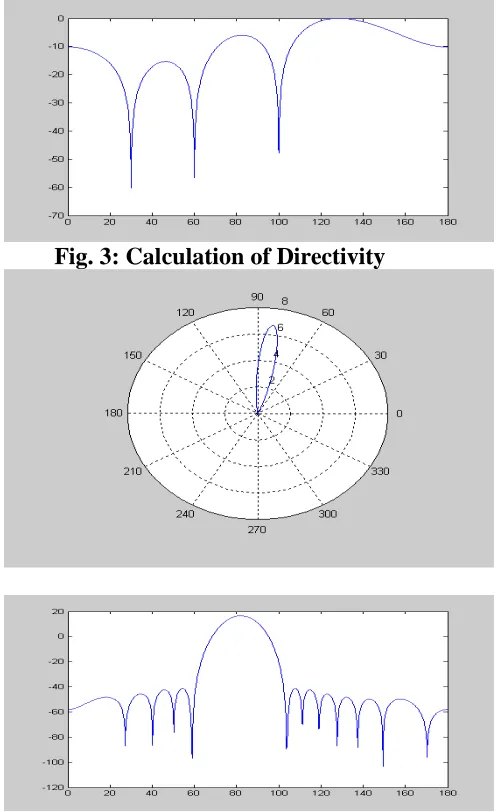
Fig. 3: Calculation of Directivity
Fig. 4: Linear DBF transmitter
DISCUSSION
Int. J. of Engg. Sci. & Mgmt. (IJESM), Vol. 2, Issue 3: July-Sep.: 2012, 328-333 arrays adapted their radiation or reception
pattern based on the environment they were operating in. This again significantly contributed to the capacity available in wireless communication systems.
CONCLUSION
The goal of this paper has been to show the effect of an array’s geometry on metrics of interest. These metrics include side-lobe level, interference rejection. Because of the difficulty in analyzing an array’s geometry, the geometry is often chosen to be a standard geometry in practice. However, this work has shown that gain in performance can be achieved via suitable optimization of the array geometry.
REFERENCES
[1] L. Coe, Wireless Radio: A History. New York: McFarland & Company, 2006.
[2] L. W. Alvarez, Alvarez: Adventures of a
Physicist. New York: Basic Books, 1987.
[3] H. Unz, “Linear arrays with arbitrarily distributed elements,” IEEE Trans. Antennas
Propag., vol. 8, pp. 222-223, Mar. 1960.
[4] D. King, R. Packard and R. Thomas, “Unequally spaced, broad-band antenna arrays, ”IEEE Trans. Antennas Propag., vol. 8, pp. 380-384, Jul. 1960.
[5] R. Harrington, “Side lobe Reduction by Non uniform Element Spacing,” IEEE
Trans. Antennas and Propag., vol. 9, pp.
187-192, Mar. 1961.
[6] M. Skolnik, G. Nemhauser, and J. Sherman, “Dynamic programming applied to unequally spaced arrays,” IEEE Trans.
Antennas and Propag., vol. 12, pp. 35-43,
Jan.1964.
[7] M. Skolnik, J. Sherman and F. Ogg, Jr., “Statistically designed density-taperedarrays,” IEEE Trans. Antennas and
Propag., vol. 12, pp. 408-417, July 1964.
[8] W. L. Stutzman, “Shaped-beam synthesis of non uniformly spaced linear arrays,”IEEE Trans. Antennas Propagat., vol. AP-20, pp. 499-501, July 1972.
[9] S. U. Pillai, Y. Bar-Ness, and F. Haber, “A new approach to array geometry for improved spatial spectrum estimation,”
IEEE Proc., vol. 73, pp. 1522-1524, Oct.
1985.
[10] M. Gavish and A. J. Weiss, “Array geometry for ambiguity resolution in direction finding,” IEEE Trans. Antennas
and Propag., vol. 44, pp. 889-895, June
1996.
[11] C. W. Ang, C. M. See, and A. C. Kot, “Optimization of array geometry for identifiable high resolution parameter estimation in sensor array signal processing,” in Proc. Int. Conf. Inf.,
Commun. Signal Process., Singapore, Sep.
1997, pp. 1613-1617.
[12] A. Goldsmith, Wireless Communications. New York: Cambridge
University Press, 2005.
[13] B. P. Kumar and G. R. Branner, “Design of unequally spaced arrays for performance improvement,” IEEE Trans.
Antennas Propag., vol. 47, pp. 511-523,
Mar.1999.
[14] B. P. Kumar and G. R. Branner, “Generalized Analytical Technique for the synthesis of unequally spaced arrays with linear, planar, cylindrical or spherical geometry,” IEEE Trans. Antennas Propag., vol. 53, pp. 621-633, Feb. 2005.151
[15] P. Jarske, T. Sramaki, S. K. Mitra, and Y. Neuvo, “On the properties and design of non uniformly spaced linear arrays,” IEEE
Trans. Acoust., Speech, Signal Processing,
vol.36, pp. 372-380, Mar. 1988.
[16] T. H. Ismail and M. M. Dawoud, “Null steering in phased arrays by controlling the element positions,” IEEE Trans. Antennas
Propag., vol. 39, pp. 1561-1566, Nov.
Int. J. of Engg. Sci. & Mgmt. (IJESM), Vol. 2, Issue 3: July-Sep.: 2012, 328-333 [18] N. Petrella, et. al., “Planar array
synthesis with minimum side lobe level and null control using particle swarm optimization,” Int. Conf. Microwaves, Radar, Wireless Comm., pp. 1087-1090,
May, 2006.
[19] A. Tennant, M. M. Dawoud, and A. P. Anderson, “Array pattern nulling by element position per turbations using a genetic algorithm,” Electron. Lett., vol. 30, no. 3, pp. 174-176, Feb. 1994.
[20] O. Quevedo-Teruel and E. Rajo-Iglesias, “Ant colony optimization in thinned array synthesis with minimum side lobe level,” IEEE Trans. Antennas Propag.
Letters, vol. 5,pp. 349-352, 2006.
[21] C. L. Dolph, “A current distribution for broadside arrays which optimizes the relationship between beam width and side-lobe level,” Proc. IRE, vol. 34, pp. 335-348,June 1946.
[22] C. A. Balanis, Antenna Theory:
Analysis and Design, 3rd ed. New York:
Wiley,2005.
[23] H. J. Riblet, “Discussion of Dolph’s paper,” Proc. IRE, vol. 35, pp. 489-492, May1947.
[24] J. G. Proakis and D. G. Manolakis,
Digital Signal Processing, 3rd Ed. New
Jersey:Prentice Hall, 1996.
[25] R. H. DuHamel, “Optimum patterns for end fire arrays,” Proc. IRE, vol. 41, pp. 652-659.
[26] G. Sinclair and F. V. Cairns, “Optimum patterns for arrays of non-isotropic sources,”
Trans. IRE, PGAP-1, pp. 50-61, Feb. 1952.
[27] S. Holm and B. Elgetun, “Optimization of the beam pattern of 2D sparse arrays by weighting,” Proc. IEEE Ultrasonics Symp., Cannes, France, 1995.152
[28] V. Murino, A. Trucco and C. S. Regazzoni, “Synthesis of unequally spaced
arrays by simulated annealing,” IEEE Trans.
Signal Processing, vol. 44, pp. 119-123, Jan.
1996.
[29] B. Widrow, P. E. Mantey, and L. J. Griffiths, “Adaptive antenna systems,” Proc.
IEEE, vol. 55, pp. 2143-2159, Dec. 1967.
[30] P. Bevelacqua and C. A. Balanis, “Optimizing antenna array geometry for interference suppression”, IEEE Trans.
Antennas Propag., vol. 53, pp. 637-641,
Mar.2007.
[31] A. A. Abouda, H. M. El-Sallabi and S. G. Haggman, “Effect of antenna array geometry and ULA azimuthal orientation on MIMO channel properties in urban citystreet grid,” Progress in Electromagnetics Research, PIER 64, pp. 257-278, 2006.
[32] X. Li and Z. Nie, “Effect of array orientation on performance of MIMO wireless channels,” IEEE Antennas Propag.
Letters, vol. 3, pp. 368-372, 2004.
[33] F. T. Ulaby, Fundamentals of Applied
Electromagnetics. New Jersey: PrenticeHall,
2001.
[34] C. A. Balanis, Advanced Engineering
Electromagnetics. New York: Wiley, 1989.
[35] W. L. Stutzman and G. A. Thiele,
Antenna Theory and Design, 2nd Ed. New
York: Wiley, 1998.
[36] J. D. Kraus and R. J. Marhefka,
Antennas, 2nd Ed. New York:
McGraw-Hill,2001.
[37] M. Skolnik, Introduction to Radar
Systems. New York: McGraw-Hill, 2001.
[38] B. Sklar, Digital Communications:
Fundamentals and Applications, 2nd Ed.
NewJersey: Prentice Hall, 2001.