SCITECH
Volume 3, Issue 1
RESEARCH ORGANISATION
May 22, 2015
Journal of Research in Business, Economics and Management
www.scitecresearch.com
Oil – Motif and Weapon in Armed Conflicts
Author: Mirela Costianu
Institution: Doctoral School of Bucharest University of Economic Studies
Abstract
Natural resources have always played a key role in the conflicts and wars that already took place and they always will. These fights are often caused by the scarcity and huge value of the resources such as diamonds, copper, gold, water, wood, arable lands and oil. Among them, the oil is a vital resource for industry and national economies and, because of the global influences, as Yergin said [1], the oil history has always been associated to the history of fights and wars.
Billon [2] thinks that the natural resources have always been a critical motif of conflicts and wars and the politic and economic vulnerabilities of the nations addicted to them are the main reason in starting wars. From this point of view, the geopolitical thinking in the west, regarding the resources, has established a strong and equal relation between power, trade and war that have also related to the maritime navigation and resources overseas.
Keywords:
Oil, War, Conflict, Oil Production.Introduction
Oil is the world‘s most important resource and it proved its importance especially through the key role played during the First and Second World War. Also, it has been shown the vulnerability of this resource, the cold war being, after all, focused on the ―vulnerability of rising resource supply dependence‖ [2].
The specialty literature that treats the oil supply interruptions has developed a unanimously accepted list of historical events that are characterized as ―major disturbances‖:
1. The Suez Crisis
2. The 6 Days War
3. The Yom Kippur War
4. The Iraq-Iran War
5. Invasion Of Kuwait by Iraq
6. The Intervention of the Coalition Led by USA in Iraq.
Among these, the first two have affected the global oil supply mainly because of the fact that, during their duration, the Suez Canal was closed, for a short period of time in the first case and for a longer period in the second case.
1.
The Suez Crisis
production from Middle East decreased in November 1956 with 1.7 million barrels per day, this representing 10.1% of the global oil production in that time, which is more than any other decrease from the next oil shocks.
These events had immediate economic consequences over Europe, which was based upon Middle East for 2/3 of its oil necessity. Below we have an extract from an article in New York Times, which illustrates these consequences [3]: „LONDON, December 1-- Europe‘s oil shortage resulting from the Suez Canal crisis was being felt more fully this week-end. . . . Dwindling gasoline supplies brought sharp cuts in motoring, reductions in work weeks and the threat of layoffs in automobile factories. There was no heat in some buildings; radiators were only tepid in others. Hotels closed off blocks of rooms to save fuel oil. . . . [T]he Netherlands, Switzerland, and Belgium have banned [Sunday driving]. Britain, Denmark, and France have imposed rationing. Nearly all British automobile manufacturers have reduced production and put their employees on a 4-day instead of a 5-day workweek. . . . Volvo, a leading Swedish car manufacturer, has cut production 30%. In both London and Paris, long lines have formed outside stations selling gasoline. Last Sunday, the Automobile Association reported that 70% of the service stations in Britain were closed.‖
In a few months, the production outside Middle East compensated a big part of the missing production. For example, the US exports of crude oil and refined products grew to one third of millions of barrels per day in December [4]. Until February, the global oil production got back to the level from October. The Middle East production got back to the levels before the crisis in June 1957. After the first semester of the 1957, the US exports of products and services started to decrease, getting the next year to a decrease of 18%. This decline of the exports was one of the reasons that contributed to the third post-war US recession that started in August of that year.
2.
The 6 Days War
The 6 days war occurred in June 1967, between 5th and 10th of June. Israel said that the war was a preventive military effort in order to prevent an imminent attack of the Arabian countries that surrounded Israel. The 6 days war was initiated by the General Moshe Dayan, the Israeli Defense Ministry, against Egypt, Syria and Jordan. After the Suez crisis, the United Nations established their presence in the Middle East, especially in the areas of sensitive borders.
On 14th of May 1967, the Israeli intelligence informed that Nasser, the Egyptian president, deployed considerable military forces in the Sinai Desert. The concentration of Egyptian forces in Sinai was a provocative act and the Israelis considered this as a proof that Egypt is preparing for an attack against Israel. On 22nd of May, Nasser closed the Tiran narrow for the Israeli ships. The blockage cut off the only supply route of Israel from Asia and stopped the oil supply from the main supplier, Iran. The blockage was also breaking the Convention of Territorial Sea and the Contiguous Zone, adopted by UN on 27th of April 1958. The second day after initiating the blockage, Nasser declared defiantly: „The Jews threaten to make war. I reply: Welcome! We are ready for war.‖The Arabian response was followed by the mobilization of Arabian forces [5].
Israel attacked Egypt on 5th of June 1967, at 07.45 am. The Egypt‘s response was minimum, as the majority of Egyptian planes have been destroyed by the two waves attack of the Israeli fighting airplanes. Also, in the same day, have been destroyed the air forces of Jordan, Syria and Iraq. Until the 7th of June the majority of the Egyptian tanks have been destroyed in the Sinai Desert and the Israeli forces reached the Suez Canal. In the same day, the west side of the Jordan River has been ―cleaned‖ of the Jordan forces.
The oil embargo started a day after starting the war, on 6th of June 1967, following an Arabian common decision with the purpose of preventing any country from supporting Israel from military point of view. A few countries in Middle East limited their transports, some imposing an embargo only for USA and UK, while others suspended totally the oil exports. The oil embargo didn‘t lead to a significant decrease of the available oil quantity for US or any other country in Europe mainly because of the lack of solidarity and uniformity in applying the embargo of certain countries. The embargo ended on September 1st, 1967, at the issuance of Khartoum Resolution.
During the 9th and 18th of June, during the Conference of Oil Ministers in Baghdad, a few Arabian countries issued a bulletin that two resolutions have been unanimously voted:
“ Arab oil shall be denied to and shall not be allowed to reach directly or indirectly countries committing aggression or participating in aggression on sovereignty of any Arab state or its territories or its territorial waters, particularly the Gulf of Aqaba”;
“The involvement of any country, directly or indirectly in armed aggression against Arab states will make assets
of its companies and nationals inside the territories of Arab countries subject to the laws of war. This includes the assets of oil companies.” [6]
The Khartoum Resolution, issued on September 1st, permitted the oil producing countries (Kuwait, Saudi Arabia and Libya) to restart their oil exports. In exchange, they have agreed to give an annual help to the ―Zionist aggression‘s victims‖, meaning 266 million dollars for Egypt and 112 million dollars for Jordan. [6]
The oil scarcity was due rather to the limited availability of the capacity of oil tanks than to the oil scarcity itself. The 6 days war and the long period in which the Suez Canal was closed led to the apparition of VLCC – very large crude carriers – and of the ULCC - ultra-large crude carriers – for sailing around the African continent.
3.
The Yom-Kippur War
On October 6, 1973, on Yom Kippur Day (the Redemption Day, the most important day of fasting for Jewry), Syria and Egypt led a surprise armed attack on Israel, the attacking forces crossing the lines of fire cease from Peninsula Sinai and respectively from the Golan Plateau, the territories conquered by Israel during the 6 days war (1967). On October 17, the Arabian members of OPEC announced the embargo of oil exports to the countries that were considered to support Israel, followed by significant decreases in the total oil production of OPEC. In November, the production of OPEC members dropped with 4.4 million barrels per day compared to the level from September, representing 7.5% of the global production at that moment [7]. The raise of production in other countries, such as Iran, compensated only a small part of this decrease.
Some aspects of the embargo were successful. The total oil supply on global market has been cut off and the effects were seen immediately in local insufficiencies and raise of oil prices in most of the importing countries.
The most profited countries were the countries members of OPEC and other exporters such as Canada and Soviet Union, advantaged from the oil price raise. The biggest losses were seen in the countries from the third world that weren‘t producing oil or other raw materials, especially India, Bangladesh, Sri Lanka and the poor countries from Africa or Latin America, where the lack of oil for fertilization and irrigation pumps threatened the food production. In US, the energy supply (including oil, coal, and gas both from national production and from imports) has been estimated to have dropped with 2.4%, compared to 2.8% in Japan and 5.6% in West Germany, being thus less vulnerable to the embargo effects compared to other developed countries.
But the embargo wasn‘t as efficient as it was hoped. The oil has been traded between companies and inside companies so as the Arab oil that couldn‘t be sent to US or Holland has been replaced with oil from non-Arab oil without restrictions regarding the destination. So, all the oil importing countries have equally suffered, even if they supported the Arab states or Israel.
More important than the embargo was the oil price raise. In September 1973, the government royalty for one barrel of oil in Persian Gulf was 1.77$. After the proclamation on October 17 of the embargo by the Yamani Sheik, the royalty became 3.50$ and after the initiative of the Shah rose to 7.01$ on January 1st 1974 [7]. These dramatic raises have been followed by negotiation rounds between the oil exporting countries and companies. Countries such as Libya, Iraq and Iran insisted for the OPEC members not to negotiate with companies but to simply establish their own price, very high. Others such as Saudi Arabia supported the oil price establish by OPEC, but opposed to the raise of price sustained by the first countries. The two groups met in December 1973 and reached an agreement. The price has been established four times higher than the medium crude oil price of OPEC one year before.
Barsky and Kilian [8] [9] pointed out as an explanation for the embargo more the economic motifs than the Arab-Israeli war itself. They said that the Arab oil producers discussed before the war the possibility of an embargo and that the embargo was ended without achievement of political objectives. Although the energetic crisis is remembered as a result of using oil as weapon in the war from October 1973, it started months or even years before.
James Hamilton argued that, though the economic considerations have been very important, also the geo-politic factors also played a role: „If economic factors were the cause, it is difficult to see why such factors would have caused Arab oil producers to reach a different decision from non-Arab oil producers. Second, the embargo appeared to be spearheaded not by the biggest oil producers, who would be expected to have the most important economic stake, but rather by the most militant Arab nations, some of whom had no oil to sell at all.‖ [10]
whose full output can eventually bring the price down to 50 cents per barrel, most of the producers would see virtue in agreeing to a price four or five times as high, but still six times lower than present prices. This being the ultimate goal, there is one feasible target: Saudi Arabia‖ [11].
Only two months before publishing the article, on January 1st 1975, the state secretary Henry Kissinger declared that the military force shouldn‘t be used “in the case of a dispute over price” but should be considered “where there is some
actual strangulation of the industrialized world.” [12]. Kissinger didn‘t mention what he meant using the word strangulation. In May that year, the Defense Secretary James R. Schlesinger made even more waves of threatening, declaring “ we might not remain entirely passive to the imposition of [another oil] embargo. I’m not going to
indicate any prospective reaction, other than to point out that there are economic, political, and conceivably
military measures in response” [13].
In 1977, the US President Jimmy Carter issued an order to the US army in order to create a Rapid Deployment Force (RDF)1. The idea of such a force was to give the government the ability of sending rapidly a substantial force of invasion in different parts of the world. After Iranian Shah‘s fall in 1979, RDF became interested in Persian Gulf. The analyst Earls Ravenal [14] estimated in 1985 the CENTCOM budget to 59 billion dollars, out of which 47 billion, he said, were only for the Gulf War. At that date, this represented 1% of the US GDP. In January 1980, after the Russian federation invaded Afghanistan in the previous month, President Carter announced the ―Carter Doctrine‖. The most relevant phrase is this: „ Let our position be absolutely clear: An attempt by any outside force to gain control of the Persian Gulf region will be regarded as an assault on the vital interests of the United States of America, and such an assault will be repelled by any means necessary, including military force‖.
The direct effect of war over oil supply was actually insignificant: the Egyptian reserves in Sinai continued to produce during the Israeli occupation between 1967 and 1973 and the production disturbance was minimal.
4.
The Iraq – Iran War (The First Gulf War)
The Iranian government, under the prime-minister Mohammad Mossadeq, nationalized the Iranian oil in 1951. This was quite unusual for Middle East because there was only one company, BP. Fearing that the nationalization success would be an example for other states oil exporters from Middle East, the British and American governments cooperated in order to destabilize and finally to overthrow the Mossadeq regime. Bringing back the Shah as the head of the state in 1953 led tgyhujklalso to putting back the foreign companies as managers of nationalized Iranian oil company. Still, instead of putting BP back to its initial state of unique owner, the Iranian government adopted the Kuwait‘s solution. The shah invited the non-British participants in National Iranian Oil Company (NIOC). When it was reorganized, to the American companies and to the national French oil companies have been given 60% of the shares and BP remained with 40%.
The war started on 22nd of September 1980, when the Iraqian troops entered Iran‘s territory, and ended on 20th of August 1988. It‘s pretty clear that oil played an important role in the war inasmuch as it gave the two opponents the necessary means to continue the battle for such a long period. If the two belligerents would have had diversified economies, one or the other or both would have collapsed much earlier because of the war. In exchange, the access to incomes from oil and the authoritarian nature of politic leadership on both sides led to extraordinary human costs.
Because of oil‘s importance as economic and financial foundation for leading the war, one is not surprised that each country repeatedly tried to interrupt the oil exports of the other country. It‘s remarkable that both countries failed: the exports continued at a level that can be considered ―normal‖, taking into consideration the decline in international demand and the OPEC‘s attempts to rationalize production.
All the three principal oil producing countries from OPEC suffered a substantial decline al production level, as a response to the decline of OPEC‘s participation to the international oil market because of the war.
Figure 1: Oil production in the selected Persian Gulf countries, 1970-1989 (source: BP Statistical Review of World Energy 2013 [15])
If we consider the period 1970-1978, we can see that Iran produced in medium 5.31 million barrels per day, Iraq 2.04 million barrels per day, Kuwait 2.65 million barrels per day and Saudi Arabia 7.22 million barrels per day.
During 1982 and 1987, Iran produced in medium 2.25 million barrels per day (42% of the previous level), Iraq 1.51 million (74%), Kuwait 1.10 million (41%) and Saudi Arabia 4.98 million (69%). Thus, Iraq faced a smaller decrease than Saudi Arabia and Kuwait has the weakest evolution of all, although the last two countries weren‘t belligerents. Iran ―did‖ weaker than Iraq, but Iran‘s production decreased the most between 1978 and 1980 because of the revolution, not because of the war. The war‘s impact seems to have been the most significant only between 1980 and 1981, when the production both in Iran and Iraq was extremely low, while Saudi Arabia pumped at an extraordinary high level.
In the first days of war, Iran attacked the pumps through which Iraq was exporting oil to the Mediterranean Sea along Syria and Turkey. By the end of November 1980, Iraq resumed its exports through Turkey at an estimated level of 400,000 million barrels per day. In the same time, Iraq attacked the Iranian export installations and caused o big disorganization but in one month Iran was exporting again at a level of 300,000 – 400,000 million barrels per day.
The war had the most severe impact over oil production at the beginning of hostilities. In the same time, both sides maintained oil production levels much higher despite the growing intensity of attacks over oil installations. This shows that the oil installations are less vulnerable than usually assumed and the emergency procedures can be very efficient in maintaining a minimum operation level.
The Iraqi exports to the Mediterranean Sea via Syria continued until April 10 1982, when the pipeline was closed not because of the Iranian attacks but because of the unilateral actions of Syrian government. In the previous month, Iran‘s planes repeatedly attacked the pipeline, but Iraq was able to repair the damages very fast and these attacks didn‘t affect the level of Iraqi exports. This suggests that using battle planes for attacking the targets that could be rapidly fixed offered a very suspicious rate costs/ benefits. Actually, not even Syria‘s action couldn‘t prevent Iraqi exports from growing in 1982 compared to the previous year‘s level.
Probably as a rematch for closing the pipeline along Syria, Iraq first attacked Kharg, the main Iranian loading terminal on 25th August 1982, initially causing a decrease of export flows. But only after one week, the level of oil exports has been recovered at the level of July: 1.8 million barrels per day. The Iraqi military actions didn‘t prevent Iranian exports from growing in 1982 compared to the previous year‘s level.
After shutting down the pipeline along Syria, the line‘s capacity along Turkey grew rapidly and Iraq built a new pipeline along Saudi Arabia. It was taken into consideration even a pipeline to Aqaba along Jordan, but the idea was abandoned because of the Iranian proximity. We could speculate that the Iraqi government would have taken the chance, but because of the production share imposed by OPEC Iraq couldn‘t hope of raising oil exports too much over the current debit.
Basing on the functional pipelines from Turkey and Saudi Arabia, Iraq managed to reach a level of oil exports of 3.2 million barrels per day, which is pretty much considering the super-saturation of international oil market.
Generally, the war experience shows us that the oil transportation on land through pipeline is more resistant compared to the naval transportation and marketplace. While the Iranian petroleum terminal from Kharg Island could continue its activity (even if much under the theoretical maximum capacity), its much-promoted anti-aircraft system couldn‘t stop the substantial damages.
Iraq increased the attacks on Kharg in the spring of 1984 and again in August 1985. Even these attacks have been more efficient from an economic point of view than the physic obstruction of exports. The insurances for petroleum tanks rose, for those who dared to load Iranian oil, forcing Iran to decrease a lot the price in order to compensate these costs. Actually, the Iranian exports from 1985 were higher than those in the previous year. Iran responded by successfully conducting the naval operations between Kharg Island and Sirri, loading oil for export in the latest (which is at the entrant into the Gulf).
In 1986, while the pressure on the Iranian export operations grew, the volume of exports decreased with 7.3% compared to the previous year. Again, the physic decline of exports was less important than the collapse of oil price.
Iran tried to compensate the Iraqi attacks by drilling in the waters of Persian Gulf and by searching tanks crossing the Hormuz strait. These actions triggered the international intervention, but it didn‘t have any effect on the exports of other countries uninvolved in the war.
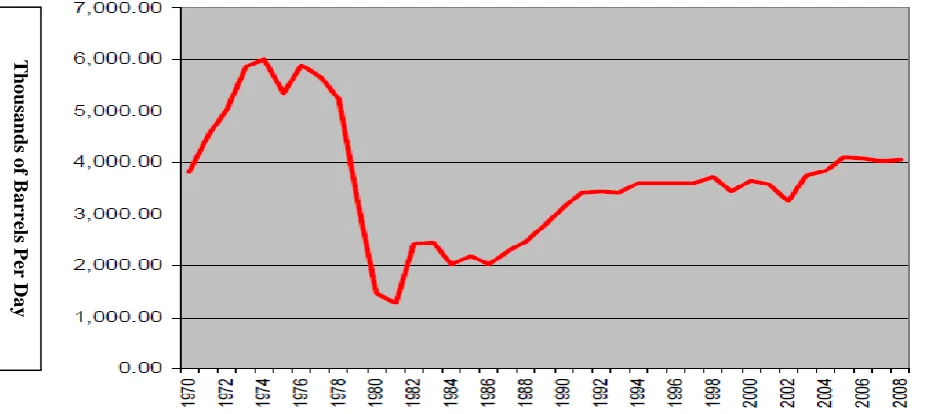
The effects of war and of sanctions over Iranian production are harder to estimate. For Iran, the war stopped in 1988 and the country is at peace ever since (the peace, of course, is different from having good relations with the international community). Still, the Iranian oil production didn‘t recover by far compared to the level reached in 1972 and 1975. The initial decline owed mainly to the revolution rather than to the war and it was, in a certain extent, deliberated. The painful decrease at 4 million barrels per day can be attributed to the combination of external sanctions, internal fights and lack of pragmatism, which seriously prevented the potential from attracting external investments. Shortly, the weak production is due to the Iranians themselves.
Figure 2: Iranian Crude Oil Production (Source: BP Statistical Review of World Energy)
T
ho
us
a
n
ds
o
f B
a
rr
els P
er
Da
5.
Invasion of Kuwait by Iraq (The Second Gulf War)
Invasion of Kuwait by Iraq is closely related to the result of the first Gulf War, which left Iraq seriously weakened from political point of view, but still at the command of a military machine much stronger than any of its neighbors (except Israel).
Figure 3: Daily Medium Production of Crude Oil of Kuwait (Source: BP Statistical Review of World Energy
2013 [15]
For Iraq, the economic problems, that included huge debts to foreign banks, including Kuwait and other states, were quite pressing. It was convenient to turn to Kuwait in order to fix their problems. As many other conflicts in Middle East, this one had oil at stake too. Saddam‘s problems needed a rapid infusion of cash. His diplomatic researches during the six months before the invasion convinced him that there is no power to stop him and to intervene if he invaded Kuwait and took what he needed. His expectancies that including the population of Kuwait would approve his actions and that a quick victory would help convinced him that the attack over Kuwait won‘t have the same result as the one over Iran. Saddam brought into attention an oil revisionist claim of the previous Iraqi governments and invaded Kuwait, which he added as Iraqi province.
Bush and Thatcher, who happened to be in America at that date, reacted rapidly, transmitting an ultimatum to Iraq not to continue the advance and occupy the oil reserves of Saudi Arabia and developed in the Gulf a war fleet for the second time in three years. Probably Iraq had no intention of invading Saudi Arabia, but the US had interest to find any excuse in order to send troops to protect the oil reserves of Saudi Arabia. From 1950, these were reserved to the Americans. After a deal with Saudi Arabia‘s king, the European oil companies were excluded, while the US ones, grouped as ARAMCO, had the monopole. Preparing for war, Bush applied the Carter doctrine from 23rd January 1980, which stated that any attempt of any force to control the Persian Gulf region will be seen as an attack to the US interests and will be rejected by any means, including military force.
Bush explained that the Persian Gulf has a strategic importance because it contains two thirds of the world exported oil and because, due to the Hormuz Strait, it a navigable way through which the free world‘s oil must ―flow‖.
In Great Britain, the Sunday Times (12 August 1990) was equally honest: „The reason why we will shortly have to go to war with Iraq is not to free Kuwait, though that is to be desired, or to defend Saudi Arabia, though that is important. It is because President Saddam is a menace to vital Western interests in the Gulf, above all the free flow of oil at market prices, which is essential to the West's prosperity‖.
When the international coalition formed for freeing Kuwait launched the offence, the Iraqi troops set on fire more than 600 Kuwaiti oil wells. The main destructions were thus made not by the hostilities themselves but by the deliberate sabotage from the Iraqi retiring troops. The last fire was extinguished on November 6, 1991, but it took until middle of 1991 for the Kuwait‘s production to get back to the levels before invasion.
The president of the US, Bush senior, declared that his military action in the Persian Gulf due partly to ―access to energy resources that are key…to the entire world‖. Bush said that, if Saddam Hussein would have had a bigger control over the oil reserves from Middle East, he would have been capable of threatening the American‘s jobs and the American way of life [16]. James A Baker III, state secretary in that period, said that Saddam Hussein, by controlling the most of the world‘s oil reserves, „could strangle the global economic order, determining by fiat whether we all enter a recession, or even the darkness of a depression‖ [17].
The war was important mainly because of the lessons learned. Firstly, it was clear that the international community and the main west powers wouldn‘t tolerate major revisions of politic map of the region. Now it is very clear that any attempt of eliminating an independent nation existing on the map would not be accepted.
Secondly, the war confirmed that, when modern military forces are involved and advanced weapons are available, the conflict is very probable to be short and with a clear winner. From this point of view, the war Iraq-Iran, which got back to the way of leading battles that reminds of the European First World War, was an exception because both parties had limited access to advanced weapons. A short war is less probable to lead to an attack of oil installations for depriving the enemy from the oil collection, this having effects only on long term.
Thirdly, it was revealed that the only way of causing extended damages over the oil installations – especially to the oil extracting installations – is to cause damages to each well. Only a force that controls the territory may cause major destructions although normally, if the enemy is in control, wouldn‘t gain anything destructing them. What happened in Kuwait was sabotage from a retiring army and, finally, got no benefit to Iraq.
6.
The Intervention of Coalition Led by USA for Changing the Regime in Iraq (The Third Gulf War)
The end of hostilities in the second Gulf War didn‘t also mean the end of conflict. The sanctions continued for 12 more years against Iraq, until the coalition led by the USA was formed in order to overthrow Saddam Hussein and his regime. The sanctions had an impact on crude oil‘s availability in the world and there are very few doubts that Iraq could have produced more than allowed for the international companies and conclude contracts during the ‗90s (although there can be argues that, in the lack of sanctions, these contracts weren‘t available). We may say that the sanctions imposed by importers had a significant impact over oil production, much more than the majority of conflicts, terrorism and ―resource nationalization‖.
Production‘s decrease, because of the sanctions, presented little interest from USA and Europe until the beginning of 2000‘s, because the global market was well stocked and the prices were low (or gradually decreasing). This situation changed at the beginning of century. When the coalition was launched in 2003, many have thought that the main objectives of changing regime should be the oil production‘s growth in Iraq and demolition of oil nationalization [18]. If this was an important objective, it hasn‘t been accomplished, neither were other important objectives.
Iseri [19] asserted that Iraq became important for Bush and Cheney administration because of the vast undeveloped oil reserves, even bigger than those of Saudi Arabia: „the Iraqi oil reserves were too large and too valuable to be left to the control of Iraqi state-owned companies, hence, a regime change in Iraq was required‖. In this context, Yazdani and Hussain [20] said that the royalties from Iraqi oil are deposited even in the ―Development for Iraq Fund‖ controlled by US, so as the Iraqi government couldn‘t use them without the US permission.
In November 2000, Iraq started to trade its oil in euro, giving up on the generally accepted standard accepted after the Second World War and on the American dollar as international currency. This gesture was seen at that moment by many as a bizarre act of politic defiance, but it was proven that it was beneficial for Iraq, because euro strengthened compared to the dollar with almost 25% in 2001. It was foreseen that at least two other OPEC countries (Iran and Syria) wanted to change to euro and that ultimately this would be the entire OPEC‘s intention.
Thus, the war in Iraq may be seen as an attempt of the Bush administration of preventing other OPEC countries from switching to euro, establishing this way a new standard for the currency of oil transactions. In order to prevent this from happening, it is necessary that US gain geostrategic control over Iraq, together with its biggest oil reserves.
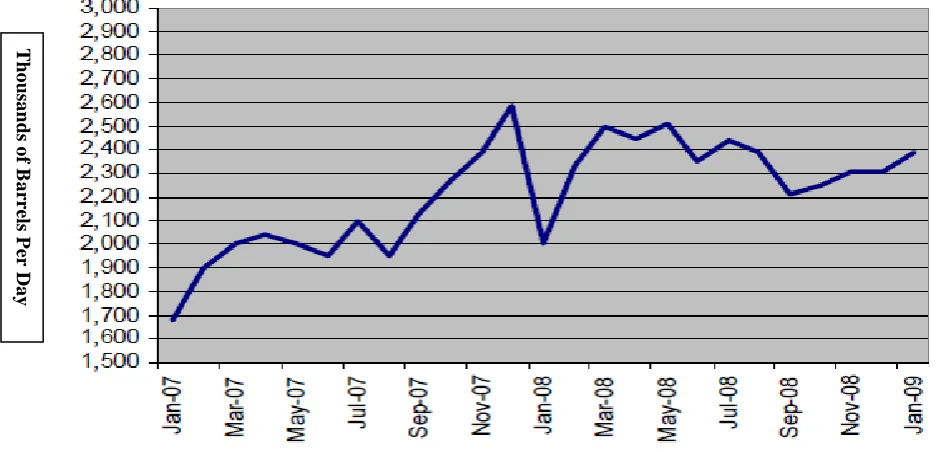
As the figure below shows, the Iraqi oil production grew significantly at the end of the ‗90s after the program ―Oil for Food‖ was introduced. Still, the deterioration of politic situation and the intervention of the coalition‘s forces have caused a new sudden drop of the production‘s level and only starting with 2008 the production grew again to a medium over 2 million barrels per day.
The military operations of the coalition‘s forces didn‘t last long; they started on March 20 2003, and effectively ended on April 15 2003. On 1st May 2003, President Bush addressed to the nation from de deck of USS Abraham Lincoln, claiming ―mission accomplished‖.
Figure 4: Iraq’s Oil Production between 1970 and 2008 (Source: BP Statistical Review Of World Energy)
What can be said is that in 2008 the situation within the country improved, and the central government was more able to exercise control. In that year, the production grew in medium with 250,000 barrels per day compared to the previous year.
Figure 5: Iraq’s Monthly Oil Production (Source: Middle East Economic Survey)
T
ho
us
a
n
ds
o
f B
a
rr
els P
er
Da
y
T
ho
us
a
n
ds
o
f B
a
rr
els P
er
Da
Still, if we take into consideration the data of monthly oil production and the difference between the minimum point (January 2007) and the biggest record production (December 2007), we may say that the security disturbances have cost Iraq 1 million barrels per day.
Singh [21] showed two reasons for which the Persian Gulf will remain vital for the global oil market. The first is that the Persian Gulf region is both a major producer and exporter of oil and petroleum products. According to Singh, the production in the Persian Gulf in 2003 was of approx. 609 million tons of oil and 96.5 million tons of petroleum products, representing approx. 20.6% of the global consume. Because of this, any decline in oil exports from this region, even of 1.5 million barrels per day, would destabilize the global oil market. Also, Singh approximates that the oil reserves from Persian Gulf are of 725.2 billion barrels, representing 63% of the world‘s oil reserves. The second reason is represented by the major reserves of natural gas concentrated in this region, approx. 70 trillion cubic meters.
According to Klare [22], the American invasion in Iraq was a normal extension of the Carter Doctrine. The US president, Carter, emphasized that the access to oil deposits from Persian Gulf is essential for the health and survival of American economy. From this point of view, any obstruction of this access can be considered an attack on the vital US interests and these can be accomplished through military for or any other means.
Conclusions
Wars are rarely for nation security, as politic leaders claim. In reality, wars are most of the times for economic reasons. The war in Iraq means actually Europe and US shoulder to shoulder for economic supremacy. And, while the evaluation and oil sells is not a frequently discussed subject in mass-media, its importance is definitely understood by governments.
Oil and gas installations seem to be much more resistant during the armed conflicts that normally thought. The major damages appear only in cases in which the hostilities took place in immediate neighborhood of installations or when one party has control over installations and decides to sabotage them, but this happens rarely.
Still, it is obvious that the government‘s disability to overcome or to resorb the violent opposition discourages the investments from international oil companies, even if the violence don‘t affect the area near the oil or gas installations. Discouragement doesn‘t mean the same thing as complete prevention; the investment projects would be much more expensive if they are made in a country that can‘t guarantee the security. Still, if the expected profits are high enough, the projects will be continued. The oil companies show different attitudes towards risk: some are willing to take the risk some aren‘t.
The inter-states conflicts may discourage the oil and gas investments for big periods of time. From this point of view, the inter-states conflicts can be added to the accidents, natural disasters, corruption and investment preventing through non-violent politic conflicts, in order to form a category of obstacles that can be more or less predicted from statistical point of view and, in any moment, they can prevent the oil and gas production from reaching its theoretical optimum or ―desired‖ level.
The current energy security system was created as a response to the Arab oil embargo in 1973, in order to guarantee the coordination of industrialized countries in case of disturbances in oil supply and to prevent using oil as weapon by exporters. According to Yergin, in order to maintain the energetic security, the states must respect a few principles [163]. The first is supply diversification, principle asked also by Winston Churchill: „Safety and certainty in oil lie in variety and variety alone‖. A second principle is the elasticity, a safety limit in the energy supply system that ensures a buffer against shocks and eases the recover after disturbances (creating of sufficient strategic reserves, stocking capacities adequate on the entire supply chain, plans of response in case of disturbances that can affect vast regions). From this, Yergin sends us to the third principle, recognition of integration reality. There is only one oil market, a global and complex system that moves and consumes approx. 86 million barrels per day. A fourth principle is the information importance that is vital for the good functioning of markets.
References
[1] Yergin, D. – The Prize: The Epic Quest For Oil, Money & Power, Ed. Simon & Schuster, New York, 1991, ISBN 978-1-4391-1012-6
[2] Le Billon, P. – The geopolitical economy of resource wars, 2004
[3] The New York Times - EUROPE REDUCES HEAT AND DRIVING IN OIL SHORTAGE; Auto Plant Lay-Offs Due-- Black Market Is Reported --Horses Relied On Again Rationing in Denmark Paris Subway Load Rises EUROPE REDUCES HEAT AND DRIVING Anti-Black Market Squad Prices Are Going Up, 2 December 1956 [4] Bureau Of Mines, Division Of Minerals – Mineral Yearbook, 1957, p. 453
[5] Abba Eban – An Autobiography, 1977, p. 330
[7] Hamilton, J.D., - Historical Oil Shocks, National Bureau of Economic Research, Cambridge, February 2011, http://www.nber.org/papers/w16790
[8] Barsky, R.B., Kilian, L. – Do We Really Know that Oil Caused the Great Stagflation? A Monetary Alternative, in B.S. Bernanke
[9] K. Rogoff – NBER Macroeconomics Annual 2001, Cambridge, MA: MIT Press, 2001
[10] Hamilton, J.D. – Historical Oil Shocks, Department of Economics University of California, San Diego December 22, 2010
[11] Henderson, D.R. – Do We Need to Go to War for Oil?, The Independent Institute, 2007, ISBN 1-59813-016-1 [12] Business Week – Kissinger on Oil, Food, and Trade, January 13, 1975
[13] U.S. News & World Report – Now a Together U.S.: Interview with James R. Schlesinger, Secretary of Defense, May 26, 1975
[14] Ravenal, E.C. – Defining Defense: The 1985 Military Budget, Cato Institute, 1984, p.17 cited in Isenberg, D. – The Rapid Deployment Force: The Few, the Futile, the Expendable, Cato Policy Analysis nr. 44, November 8, 1984
[15] BP Statistical Review of World Energy 2013 http://www.bp.com/en/global/corporate/about-bp/energy-economics/statistical-review-of-world-energy-2013/statistical-review-1951-2011.html
[16] Harwood, R. – War – or Folly –in the Gulf?, Washington Post, September 2, 1990
[17] Seib, G. F., Greenberger, R.S. – Bush Wants U.S. to Forgive Egypt Debt; Prolonged Presence in Gulf Is Indicated, Wall Street Journal, September 5, 1990
[18] P. Hanelt, G. Luciani, F. Neugart, Regime Change in Iraq: the Transatlantic and Regional Dimensions, EUI and Bertelsmann Stiftung, 2004
[19] Iseri, E. – The US Grand Strategy and the Eurasian Heartland in the twenty-first century. Geopolitics, 14: 26-46, 2009
[20] Yazdani, E., Hussain, R. – United States’ policy towards Iran after the Islamic Resolution: An Iranian perspective, International Studies, 43(3): 267-289, 2006
[21] Singh, K.R. – Energy insecurity and military misadventures in the Persian Gulf region, International Studies, 44(4): 283-304, 2007
![Figure 1: Oil production in the selected Persian Gulf countries, 1970-1989 (source: BP Statistical Review of World Energy 2013 [15])](https://thumb-us.123doks.com/thumbv2/123dok_us/8680263.1733272/5.595.69.522.87.316/figure-production-selected-persian-countries-statistical-review-energy.webp)
![Figure 3: Daily Medium Production of Crude Oil of Kuwait (Source: BP Statistical Review of World Energy 2013 [15]](https://thumb-us.123doks.com/thumbv2/123dok_us/8680263.1733272/7.595.70.502.160.352/figure-medium-production-kuwait-source-statistical-review-energy.webp)