Volume 2008, Article ID 393727,14pages doi:10.1155/2008/393727
Research Article
Fast Macroblock Mode Selection Algorithm for
Multiview Video Coding
Zongju Peng,1, 2Gangyi Jiang,1Mei Yu,1and Qionghai Dai3
1Faculty of Information Science and Engineering, Ningbo University, Ningbo 315211, China 2Institute of Computing Technology, Chinese Academy of Science, Beijing 100080, China 3Broadband Networks & Digital Media Lab, Tsinghua University, Beijing 100084, China
Correspondence should be addressed to Gangyi Jiang,[email protected]
Received 1 March 2008; Revised 7 August 2008; Accepted 14 October 2008
Recommended by Stefano Tubaro
Multiview video coding (MVC) plays an important role in three-dimensional video applications. Joint Video Team developed a joint multiview video model (JMVM) in which full-search algorithm is employed in macroblock mode selection to provide the best rate distortion performance for MVC. However, it results in a considerable increase in encoding complexity. We propose a hybrid fast macroblock mode selection algorithm after analyzing the full-search algorithm of JMVM. For nonanchor frames of the base view, the proposed algorithm halfway stops the macroblock mode search process by designing three dynamic thresholds. When nonanchor frames of the other views are being encoded, the macroblock modes can be predicted from the frames of the neighboring views due to the strong correlations of the macroblock modes. Experimental results show that the proposed hybrid fast macroblock mode selection algorithm promotes the encoding speed by 2.37∼9.97 times without noticeable quality degradation compared with the JMVM.
Copyright © 2008 Zongju Peng et al. This is an open access article distributed under the Creative Commons Attribution License, which permits unrestricted use, distribution, and reproduction in any medium, provided the original work is properly cited.
1. INTRODUCTION
With the advancement in camera and display technologies, a wide variety of three-dimensional (3D) video applications, including free viewpoint video, free viewpoint television, 3D television, 3D telemedicine, 3D teleconference, and surveil-lance, are emerging. It has been widely recognized that mul-tiview video coding (MVC) is one of the core technologies of 3D video applications [1–4]. The amount of multiview video data is tremendous because it is proportional to the number of cameras by which the multiple viewpoint video signals are captured simultaneously at different positions and angles. In order to transmit and store these signals for practical use, they must be effectively compressed.
The straightforward solution for MVC is to encode all the video signals independently by using state-of-the-art video codec such as H.264/AVC [5–7]. However, multiview video signals contain a large amount of inter-view dependencies, since all cameras capture the same scene from different viewpoints simultaneously [8]. Hence, various exquisitely designed view-temporal prediction structures, such as Hier-archical B Pictures (HBPs), KS IPP, KS PIP, and KS IBP [9],
are proposed. These structures efficiently exploit not only the temporal and spatial correlations within a single view, but also the inter-view correlations among different views. Kaup and Fecker analyzed the potential gains from the inter-view prediction [10]. Merkle et al. comparatively analyzed the rate distortion (RD) performances of these prediction structures [9,11]. Flierl et al.investigated the RD efficiency of motion and
disparity-compensated coding for multiview video[12,13].
Standardization of MVC is investigated by Joint Video Team(JVT) formed by ISO/IEC MPEG and ITU-T VCEG. Currently, JVT is developing a joint multiview video model (JMVM), based on the video coding standard H.264/AVC [14]. The JMVM serves as a common platform to research on MVC, and uses HBP prediction structure to exploit both temporal and inter-view correlations. In the JMVM, different macroblock modes, including SKIP, Inter16×16, Inter16×
each reference frame consumes considerable search time. According to statistics, the motion and disparity estimation consumes approximately 70% of the entire encoding time [15].
Hence, it is necessary to develop a fast algorithm to reduce computational complexity of MVC. The computa-tional burden can be lessened by reducing the search frames or the times of macroblock mode matching. Some fast motion and disparity estimation algorithms for MVC have been proposed [16,17]. In [16], Y. Kim et al. proposed a fast motion and disparity estimation algorithm to reduce the number of searching points by adaptively controlling a search range considering the reliability of each macroblock. In [17], Ding et al. proposed a new fast motion estimation algorithm which makes use of the coding information such as motion vector of the coded views.
In addition, fast macroblock mode selection algorithm can also be used to accelerate the encoding speed for MVC. Many fast macroblock mode selection algorithms for single-view video coding have been proposed [18–22]. In [18], Yin et al. proposed a coding scheme which jointly optimized motion estimation and mode decision. With this scheme, 85–90% complexity reduction can be achieved versus the H.264/AVC joint model with peak signal-to-noise ratio (PSNR) loss less than 0.2 dB and bit rate increase less than 3% regarding to common intermediate format (CIF) test sequences. In [19], Kuo and Chan proposed a fast macroblock mode selection algorithm in which the motionfield distribution and correlation within a macroblock are taken into account. In [20], Kim and Kuo proposed a feature-based intra-/intermode decision algorithm. The algorithm decided the macroblock mode by the expected risk of choosing the wrong mode in a multidimensional simple feature space. It achieved a speedup factor of 20–32% without noticeable quality degradation. In [21], Choi et al. proposed a fast algorithm utilizing early SKIP mode decision and selective intramode decision. The algorithm reduced the entire encoding time by about 60% with negligible coding loss. In [22], Yin and Wang proposed a fast intermode selection algorithm. It reduced the encoding time of quarter CIF test sequences by 89.94% on average by making full use of the statistical feature and correlation in spatiotemporal domain.
The fast algorithms for single-view video coding cannot be used directly for MVC because the prediction structures for MVC are different from those of single-view video cod-ing. In this paper, a hybrid fast macroblock mode selection algorithm is developed for MVC. Under the framework of the proposed algorithm, two methods are given to reduce computational complexity of macroblock mode selection in MVC with HBP prediction structure. The first method uses three dynamic thresholds to halfway stop the mode search process of the nonanchor frames in the base view. The second one which is originated from the inter-view and intraframe mode correlations is used for the nonanchor frames in the other views. Full-search algorithm, the same as the JMVM, is used for encoding anchor frames of all views to guarantee the RD performance. The experimental results show that the proposed algorithm promotes the encoding speed greatly
without noticeable quality degradation compared with the JMVM.
This paper is organized as follows.Section 2depicts the framework of the hybrid fast macroblock mode selection algorithm, including two fast mode selection methods for nonanchor frames of the base view and the other views, respectively. These two methods will be described in detail in Sections3and4. Experimental results are given inSection 5 and the work is concluded inSection 6.
2. FRAMEWORK OF THE PROPOSED HYBRID FAST MACROBLOCK MODE SELECTION ALGORITHM
In JMVM, motion and disparity estimations are performed for each macroblock mode, and macroblock mode decision is made by comparing the RD cost of each mode. The mode with minimal RD cost is then selected as the best mode for interframe coding. The RD cost is calculated as
Js,c,MODE|λMODE
=SSDs,c,MODE|QP+λMODER
s,c,MODE|QP, (1)
wheresandc denote the source and reconstructed signals, respectively, andMODEis the candidate macroblock mode. QPis the macroblock quantization parameter.λMODEis the Lagrange multiplier for mode decision and given by
λMODE=0.85×2QP/3, (2)
whereRs,c,MODE| QPreflects the number of bits pro-duced for header(s) (including MODEindicators), motion vector(s), and coefficients. SSDs,c,MODE | QPis the sum of square differences, which reflects the distortion between the original and reconstructed macroblocks and is calculated by
SSDs,c,MODE|QP=
B1,B2
i=1,j=1
s[i,j]−ci−vx,j−vy
2 .
(3)
The full-search algorithm in the JMVM can obtain the best RD performance. Unfortunately, it consumes too much computational time. Based on the analysis of the macroblock mode selection process of the JMVM, a hybrid fast macroblock mode selection algorithm is proposed to lessen the computational burden.
In JMVM, HBP is used as prediction structure.Figure 1 shows an example of HBP prediction structure with eight views, whereSn denotes the individual view and Tn is the consecutive time instant. For example, S0T6 represents the
frame locating at the 6th time instant in the view 0. The frames of all views, from T0 to T7, are the first group of
I0
B3
B2
B3
B1
B3
B2
P0
B3
B2
B3
B1
B3
B2 B1
b4
B3
b4
B2
b4
B3 B1
b4
B3
b4
B2
b4
B3
B3 b4 b4 B3
I0 B1 B1 P0
P0
B3
B2
B3
B1
B3
B2
B3
P0
P0
B3
B2
B3
B1
B3
B2 B1
b4
B3
b4
B2
b4
B3
B3 b4
P0 B1
P0
B3
B2
B3
B1
B3
B2
B3
P0
S0 S1 S2 S3 S4 S5 S6 S7
. . .
. . .
. . .
. .
. ... ... ... ...
T0
T1
T2
T3
T4
T5
T6
T7
T8
View
Ti
m
e
C1
C2
C3
C4
Figure1: Illustration of frame classification in HBP prediction structure.
C1 C2 C3 C4
Class(f)?
Select the optimal mode by full search method provided by
JMVM
Select the optimal mode by multithreshold fast
macroblock mode selection method Compute average
RD costR
Obtain GDV by global disparity estimation
Select the optimal mode by full search method provided by
JMVM.
Select the optimal mode by fast macroblock mode
selection method based on mode
correlations
Figure2: Block diagram of the hybrid fast macroblock mode selection algorithm.
frames.S0is the base view within which the frames do not
have any inter-view reference frames. All the frames in HBP prediction structure are categorized into four types, that is,
C1,C2,C3, andC4 shown by different colors inFigure 1.C1
denotes the anchor frames in the base view without any reference frames,C2is nonanchor frames in the base view, C3andC4are the anchor frames and nonanchor frames in
other views, respectively. For the GOP shown inFigure 1, the proportions of C1,C2,C3, and C4 are 1/64, 7/64, 7/64, and
49/64, respectively.
The block diagram of the proposed algorithm is given in Figure 2. Here, class(f) denotes the type of the current frame f. If class(f) is C1 or C3, the optimal macroblock
mode is decided by full search which is the same as the JMVM. Since the frames with typeC1 orC3are located in
Table1: Statistical results of macroblock modes in the frameS0T6of Ballroom.
Category {SKIP} {Inter16×16} {Inter16×8} {Inter8×16} {Inter8×8, Inter8×8Frext} Other modes
P(Category) 3531.08 5875.08 8275.58 8999.61 14675.85 12983.78
N(Category) 65.75% 14.33% 5.33% 5.83% 3.83% 4.93%
selection methods of nonanchor frames. If class(f) is C2
or C4, the macroblock mode will be selected by the fast
macroblock mode selection methods which will be discussed in detail in Sections3and4, respectively.
3. MULTITHRESHOLD FAST MACROBLOCK MODE SELECTION METHOD
In this section, we investigate the full-search process of macroblock mode selection under the JMVM firstly, and find some regularity in the macroblock mode distribution and RD cost of various macroblock modes. Then, a fast macroblock mode selection method forC2 frames is given
and analyzed theoretically in terms of RD performance. Finally, a dynamical updating method of multiple thresholds is devised.
3.1. Analyses of macroblock mode selection process of the JMVM
Before designing the fast macroblock mode selection method, we selected the frame S0T6 of Ballroom test
sequence provided by Mitsubishi Electric Research Laborato-ries (MERL, Mass, USA) to investigate the full search method of the JMVM. During the encoding process of the frame, the optimal mode and the RD cost of each traversed mode of every macroblock are recorded. According to the proportion of macroblock mode and RD cost, we find that there are some statistical features in macroblock mode selection. In order to analyze them, two variablesN(M) andP(M) are defined to represent proportion and average RD cost of the macroblock mode category M, respectively. They are calculated by
N(M)=
H×V g=1 φ(g,M)
H×V ,
φ(g,M)= ⎧ ⎨ ⎩
0, m /∈M, 1, m∈M,
(4)
P(M)=
H×V g=1
φ(g,M)×Rd(g,m) H×V
g=1 φ(g,M)
,
H×V
g=1
φ(g,M)=/0, φ(g,M)=
⎧ ⎨ ⎩
0, m /∈M, 1, m∈M,
(5)
where H and V are the numbers of macroblocks in horizontal and vertical directions of a frame, respectively,m is the optimal mode, and Rd(g,m) denotes the minimal RD cost of thegth macrobock.
Search the optimal mode withinM1for
current macroblock and calculate its RD cost Rd
Rd< P(M1)
Search the optimal mode withinM2for
current macroblock and calculate its RD cost Rd
Rd< P(M2)
Search the optimal mode withinM3for
current macroblock and calculate its RD cost Rd
Rd< P(M3)
Search the optimal mode withinM4for
current macroblock
Yes
Yes
Yes No
No
No
Figure3: Flowchart of multithreshold fast mode selection method.
Table 1tabulates the statistical results of different mac-robock modes in the frameS0T6of Ballroom. Obviously, it
is not balanced in proportions of macroblock modes as well as the average RD cost. Most of the macroblocks are encoded with SKIP mode whose average RD cost is the smallest within all macroblock modes. Next to the SKIP mode, Inter16×16 mode ranks the second in the proportion and its average RD cost is also the second smallest. The macroblock numbers of Inter16×8 and Inter8×16 are nearly equivalent. They are less than the SKIP and Inter16×16 in quantity, and larger in average RD cost. The other modes, such as Inter8×8, Inter8×8Frext, Intra16, Intra8, and Intra4, occupying the smallest quantity in a frame, rank highest in the average RD cost. However, these modes are indispensable to MVC. Other test sequences also have similar statistical features [23].
3.2. Multithreshold fast macroblock mode selection method
Based on the analyses above, we divide the macroblock modes into four categories,{SKIP},{Inter16×16},{Inter16
Intra8×8, Intra4×4}, denoted by M1,M2,M3, and M4,
respectively.
As tabulated in Table 1, there are great gaps between
P(M1),P(M2),P(M3), andP(M4). They can be utilized to
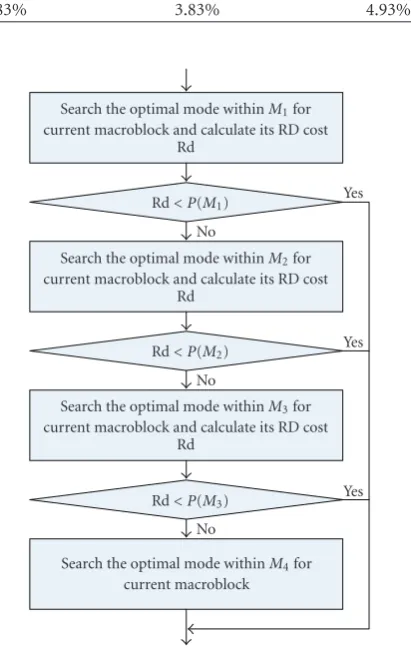
build multiple threshold conditions to halfway stop the process of macroblock mode selection if they are known in advance. Figure 3 illustrates the detailed flowchart of the multithreshold fast macroblock mode selection method. When one macroblock is encoded, the SKIP mode is probed first. If its RD cost is smaller thanP(M1), the mode selection
process is halfway stopped and the SKIP mode is selected as the optimal mode. Otherwise, the Inter16×16 is tested, and the mode selection process will be ended immediately as the RD cost is smaller thanP(M2). If RD cost is not smaller than P(M2), the modes inM3are traversed one by one, the mode
selection is halfway stopped when the RD cost is smaller than
P(M3). If RD cost is not smaller thanP(M3), the modes inM4
will be searched to find the optimal macrobock mode. The fast macroblock mode selection method may result in degradation of RD performance because not all mac-roblocks select optimal modes. The error in mode selection influences not only the RD performance of the current frame, but also that of the frames which refer the current frame directly or indirectly. For one macroblock, suppose the optimal mode selected through the full-search algorithm belongs toMiwhile the optimal mode belongs toMjunder the fast mode selection method. If error mode selection happens, it must satisfy the following conditions:
(1) j < i,
(2) Rd(k,mi)<Rd(k,mj), (3) Rd(k,ml)≥P(Ml), 1≤l < j
In the conditions (2) and (3), mi,mj, and ml are the modes with the least RD cost inMi,Mj, andMl, respectively. The conditions above are about individual macroblock. But for investigating the RD performance, it is important to statistically analyze the error mode selection of all macroblocks of one frame. To estimate the error selection probability of one frame to be encoded, we define a param-eterK to express the probability of error mode selection as follows:
K=
4
g=1
μg×N
Mg
, (6)
whereN(Mg) andμg denote the proportion of macroblock modes and the probability of error mode selection regarding
Mg.Kshould be very small becauseμg is limited by the strict condition listed above. Specially,μ1 must be zero owing to
the condition (1) of the error mode selection. In other words, if Mi equals to M1,Mj must be Mi and no error selection happens.
Based on the data of the frameS0T6 recorded in detail
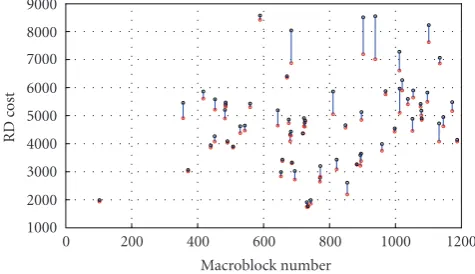
under the JMVM, the thresholds of the multithreshold fast macroblock mode selection method can be estimated. Then, the error selection macroblocks can be filtered out according to the thresholds and their RD costs of all macroblock modes. Figure 4 shows such macroblocks and their increments in
1000 2000 3000 4000 5000 6000 7000 8000 9000
RD
co
st
0 200 400 600 800 1000 1200
Macroblock number
Figure4: Increments in RD cost resulted from error macroblock mode selection in the frameS0T6of Ballroom.
RD cost. Each vertical line reflects an RD cost increment caused by an error mode selection. TheX-axis represents the number of macroblock. TheX-axis of the left line segment is 103. That is to say, the 103rd macroblock is the first one that selected the error macroblock mode. The Y-axes of the upper endpoint and the lower endpoint of the vertical line are the RD costs of the modes selected by the proposed method and the full-search algorithm, respectively. Among 1200 macroblocks in the test frame, only 64 macroblocks select error macroblock mode, namely, K = 5.33%. The average RD cost of all macroblock mode categoriesP(M1∪ M2∪M3∪M4) with respect to the proposed method only
rises 0.29% compared with the full-search algorithm. The degradation in RD performance brought by these error-selected modes can almost be ignored.
3.3. Dynamically update the thresholds
The multithreshold fast macroblock mode selection method described inSection 3.2is based on the hypothesis that the thresholds were already known. Therefore, it is vital to design a feasible threshold computing method. We found thatP(Mi) is approximately linear with Lagrange multiplier and average RD cost of all mode categories of the current frame after a lot of experiments and careful observations. Figures5 and 6show the approximately linear relationships, whereLand Rare the Lagrange multiplier andP(M1∪M2∪M3∪M4).
So, the thresholds in the proposed fast macroblock mode selection method can be calculated theoretically by
PMi
0 1 2 3 4 5 6 7 8 9 10
×104
P ( M1 ), P ( M2 )a n d P ( M3 )o f S0 T6 of B al lr o om
0 200 400 600 800 1000 1200 1400 1600 1800 Lagrange multiplier
P(M1)
P(M2)
P(M3)
Figure5: Illustration of approximately linear relationship between
P(Mi) andL.
frames, since they are intraframe encoded. InFigure 7, the average RD costs of the anchor frames of Ballroom, whose picture-order counts (POCs) are 0, 12, and 24, are more than 7500. By contrast, the average RD costs of the nonanchor frames are about 5050. Figure 8 also shows the difference of average RD costs between the anchor frames and the nonanchor frames of Exit test sequence. So, (7) is revised as
PMi
=ai×L+bi×R+ci (i=1, 2, 3), (8) whereLandRare the Lagrange multiplier and the average RD cost of the anchor frames.P(Mi) is mainly contributed by
bi×RbecauseLis smaller thanRby 10–100 times, while
ai×L+cican be used to slightly adjust the thresholdP(Mi). In the proposed method,ai,bi, andciare set as follows:
a1= −5, a2= −5, a3=30,
b1=0.55, b2=0.80, b3=0.95, c1=0, c2=0, c3=0.
(9)
These parameters are obtained from a large number of experiments. They are suitable for various multiview video sequences. So far, the thresholds are calculated and updated dynamically by the method illustrated inFigure 9. The figure is also a detailed description ofC1andC2subbranch of the
block diagram in Figure 2. The method is summarized as follows.
Step 1. Check whether the current frame is an anchor frame
or not. If it is an anchor frame then go toStep 2, otherwise, go toStep 3.
Step 2. Select the optimal mode by full search that is the
same as JMVM. Then, calculate the average RD cost of all the macroblocks by (5).
Step 3. Calculate P(Mi) by (8), select the optimal mode
based on the multithreshold fast macroblock mode selection method. 0 1 2 3 4 5 6 7 8 9 10
×104
P ( M1 ), P ( M2 )a n d P ( M3 )o f S0 T6 of B al lr o om
0 0.5 1 1.5 2 2.5 3
×104
P(M1∪M2∪M3∪M4) ofS0T6of Ballroom
P(M1)
P(M2)
P(M3)
Figure6: Illustration of approximately linear relationship between
P(Mi) andR.
4. FAST MACROBLOCK MODE SELECTION METHOD BASED ON INTER-VIEW MODE CORRELATIONS
After encoding the base view by the multithreshold fast macroblock mode selection method, the other views are to be dealt with one by one according to the HBP prediction structure. The correlations between two neighboring views may result in strong mode correlations between the current frame and the frames in the neighboring views at the same instant. When the frame with typeC4is encoded, the mode
of the current macroblock may be estimated accurately via macroblock mode correlations. Thus, the mode selection process can be accelerated by making use of mode prediction.
4.1. Fast macroblock mode selection method based on mode correlation
The spatial correlation between neighboring views may lead to strong mode correlation. In order to verify the phenomenon, S0T6 and S2T6 of Ballroom and Exit test
sequence,S0T7andS2T7of Race1 test sequence are
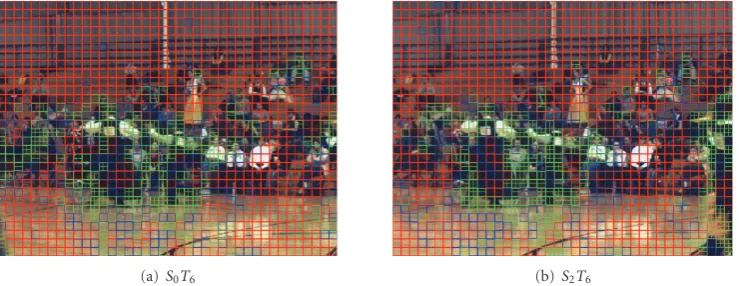
investi-gated according to the MVC common test conditions [24]. Exit and Race1 are provided by MERL and KDDI (Japan), respectively. After recording all the macroblock modes of the frames under the full-search algorithm of the JMVM, we draw the macroblock mode distribution maps illustrated by Figures10,11, and12. In these figures, the blocks with red, green, and blue borders denote the macroblocks encoded with the SKIP, Inter- and Intramodes, respectively. It is obvious that the macroblock modes are similar between the frame pairs.
The mode correlation is verified by mode similarity. Because of the mode similarity, the macroblock modes of the encoded frames at the same instant of the neighboring views can be used to predict the modes of the current frame. For example, the HBP structure in Figure 1 has predictive relationships, including view 0→view 2, view 2→
0 1000 2000 3000 4000 5000 6000 7000 8000 9000
Av
er
ag
e
R
D
co
st
0 2 4 6 8 10 12 14 16 18 20 22 24 POC
View 0 of Ballroom
Figure7: Average RD cost of the frames in Ballroom test sequence.
0 1000 2000 3000 4000 5000
Av
er
ag
e
R
D
co
st
0 2 4 6 8 10 12 14 16 18 20 22 24 POC
View 0 of exit
Figure8: Average RD cost of the frames in Exit test sequence.
view 2→view 1, view 2→view 3, view 4→view 3, view 4→
view 5, and view 6→view 5, where viewi →viewjdenotes that the macroblock modes of viewiare predictive modes of view j. So, multiview video signals are processed more quickly in the order of view 0, view 2, view 1, view 4, view 3, view 6, view 5, and view 7 due to mode similarity.
As for a frame with type C4, it is unnecessary for the
encoder to perform a full search since at least one frame at the same instant of the neighboring views has been encoded. The encoding time can be significantly reduced by only searching the macroblock mode of the corresponding macroblock in the neighboring coded views if specific RD condition is satisfied. The location of the corresponding macroblock can be decided by GDV between the current frame and the frame of the neighboring view. The GDV is measured by the macroblock size of units, and it can be deduced based on Koo’s method that has been integrated into the JMVM [25]. GDV is estimated in every anchor picture, and interpolated for nonanchor frames.
As shown inFigure 13, GDVcurdenotes the location of
the corresponding macroblock in the neighboring views on a certain POC. It is derived by
GDVcur=GDVahead+
POCcur−POCahead
POCbehind−POCahead
×GDVbehind−GDVahead
,
(10)
where GDVahead and GDVbehind are two latest GDVs of
anchor frames. POCcur, POCahead, and POCbehind are POCs
along temporal axis.
If the mode of the corresponding macroblock in the frame at the neighboring view is used directly to predict the mode of the current macroblock, the computational
complexity is greatly reduced. However, the RD performance may be degraded due to the following reasons.
(1) The global disparity is not the exact disparity between the current macroblock and the corresponding one. There is a deviation between the global disparity and the pixel-wise disparity.
(2) The inter-view mode similarity degree varies from region to region. For background or stationary regions, the macroblock mode in the current view is more similar to that of the neighboring views compared with the foreground or motion regions.
In order to eliminate the ill effects caused by the inac-curate disparity and content dissimilarity, the modes of the corresponding macroblock and its surrounding macroblocks are searched in a nonrepetitive way. For the convenience of narration, we call the macroblocks surrounding the corresponding macroblock in the frame at the same instant in the neighboring view as the corresponding neighboring macroblocks (CNMs). The locations of the current mac-roblock, the corresponding macmac-roblock, and the CNMs are shown in Figure 13. The proposed method is summarized according to above analyses and depicted byFigure 14. An RD cost will be obtained after the searching operation of the corresponding macroblock and the CNMs in a nonrepetitive way. If the RD cost is smaller than a threshold, the searching process will be stopped immediately. The threshold in the proposed method is determined by the RD cost of the corresponding macroblock and an experimental constantβ. The threshold is adopted to identify the macroblocks that cannot be predicted accurately because these macroblocks are usually located in the motion regions and their RD costs often change drastically. LetERDbe the RD cost of the
corresponding macroblock, if the RD cost is greater than the thresholdβ×ERD, the full-search method is used because of
the high risk of error mode selection. In the implementation of the proposed method,βis set as 2 empirically.
4.2. Analyses on macroblock mode correlations
Mode correlations are the basis of the method proposed above. It is clear that the performance of the proposed method is determined by two factors. The first is the degree of the inter-view mode similarity between the current frame and the view-neighboring frames, and the second is the degree of the mode aggregation of the view-neighboring frame. The first factor affects the accuracy of the mode pre-diction while the second reflects the macroblock searching times. We call the inter-view mode similarity and the mode aggregation as inter-view mode correlation and intraframe mode correlation, respectively.
Quantitative analyses on the mode correlations are help-ful to understand the validity of the proposed method. In the following, we takeS0T6andS2T6of Ballroom as an example
to investigate the mode correlations. LetS2T6be the current
encoding frame,S0T6be the view-neighboring coded frame.
The horizontal and vertical components of the GDV between
Is current frame an anchor frame?
Select optimal macroblock mode by full search method provided by JMVM, compute average RD
costR
Compute and update thresholds dynamically
P(Mi)=ai×L+bi×R+ci Select the optimal mode by
the multithreshold fast macroblock mode selection
algorithm
Yes No
Figure9: Flowchart of computing and updating multithresholds.
regions in the framesS0T6andS2T6 are marked with black
borders in Figures 15 and 16. The macroblock modes in Figures 15 and 16 are the optimal modes decided by the full-search method. In order to evaluate the accuracy of the mode prediction, we use the macroblock modes inFigure 15 as the reference ofS2T6, and the optimal macroblock modes
inFigure 16as the target which the fast macroblock mode selection method described in this section tries to achieve. In the overlapping region ofS2T6, most of the macroblocks have
one corresponding macroblock and eight CNMs. However, the macroblocks, located in the top row, the bottom row, and the right column of the overlapping region, have one corresponding macroblock and different numbers of CNMs. The quantitative variation of CNMs results in difficulty in analyzing the mode correlations. We employed two ways to simplify the discussions.
(1) We only concern the macroblocks of the current frame which have one corresponding macroblock and eight CNMs. They are the macroblocks in the overlapping region ofS2T6, excluding the top row, the
bottom row, and the right column. The number of such macroblocks is 1036.
(2) Slightly different from the multithreshold fast roblock mode selection method, we divide the mac-roblock modes into six classes here as follows:
(a) SKIP; (b) Inter16×16; (c) Inter16×8; (d) Inter8×16;
(e) Inter8×8 and Inter8×8Frext;
(f) Intra16×16, Intra4×4 and Intra8×8. Let (x,y) denote the coordinate of the current mac-roblock,g(x,y) denote the number of macroblocks among the corresponding macroblock and the eight CNMs which are encoded with the same macroblock mode class as the current macroblock selects, andh(x,y) depict the count of macroblock mode classes of the corresponding macroblock and the CNMs. Then, f(x,y) and s(x,y), representing the inter-view mode correlation of the current macroblock
and the intraframe mode correlation of the corresponding macroblock and the CNMs, can be estimated by
f(x,y)= g(x,y)
9 ,
s(x,y)=h(x,y).
(11)
The bigger f(x,y) is the stronger the inter-view mode correlation is. However, the intraframe mode correlation decreases ass(x,y) rises. Comparing the macroblock modes of the frameS0T6with that of the frameS2T6in Ballroom,
it is obvious that both the inter-view mode correlation and the intraframe mode correlation of the background regions are higher than those of the motion regions. The macroblocks at positions (4, 5) and (19, 16) in Figure 16 are located in background and motion regions, respectively. They correspond to the macroblocks at (6, 5) and (21, 16) inFigure 15according to the GDV. Modes of the macroblock at (4, 5) inS2T6, the corresponding macroblock at (6, 5) in S0T6, and the eight CNMs are SKIP. So,g(4, 5)=9,h(4, 5)=
1, f(4, 5)=1,s(4, 5)=1, and f(4, 5)=1 means that modes of current macroblock, the corresponding macroblock, and the CNMs all belong to the same class. In other words, each mode of the corresponding macroblock and CNMs inS0T6
can be used to accurately predict the mode of the current macroblock at (4, 5) in S2T6. s(4, 5) = 1 indicates that
the modes of the corresponding macroblock and the CNMs belong to the same class, so that only searching the modes in one class is enough to obtain the optimal mode for the macroblock at (4, 5) inS2T6. As far as the macroblock at
(19, 16) is concerned, f(19, 16) = 0.22, s(19, 16) = 4. Compared with the macroblock in background, the inter-view mode correlation becomes weak and more macroblock modes should be traversed in motion regions.
4.3. Discussions on performance of the proposed method
(a)S0T6 (b)S2T6
Figure10: Macroblock mode distribution ofS0T6andS2T6in Ballroom test sequence.
(a)S0T6 (b)S2T6
Figure11: Macroblock mode distribution ofS0T6andS2T6in Exit test sequence.
inS0T6. Most of the macroblocks in the background are with f(x,y) = 1. According to our statistical results, only few macroblocks are completely irrelevant to their corresponding macroblocks and the CNMs in the neighboring view. The average inter-view mode correlation in the overlapping region (exclude the macroblocks in the upper row, the lower row, and the right column) ofS2T6amounts to 0.60,
which means thatg(x,y) ofS2T6equals to 5.40 on average.
Therefore, most of the macroblock modes of S0T6 can be
used to predict the macroblock modes ofS2T6. As long as f(x,y) > 0, the optimal mode of macroblock (x,y) can be predicted accurately from the corresponding macroblock and the CNMs. So, the ratio of accurate prediction is even higher than the average inter-view mode correlation. Compared with average inter-view mode correlation with 0.60, the ratio of accurate prediction is up to 91.51% in the same region. Thus, the mode prediction of the proposed method is effective in mode decision. Figure 18 shows the intraframe mode correlation. Similar to the inter-view mode correlation, most of macroblocks in the background are with
s(x,y) = 1 whiles(x,y) is up to 6 for some macroblocks in the motion regions. In general, more macroblock modes should be searched to obtain the optimal mode in motion regions.
Table 2tabulates the statistical results of mode correla-tions. Every cell in the table gives the macroblock number/
percentage under a specific inter-view and intraframe mode correlation condition. For example, there are 357 mac-roblocks withs(x,y)=1, in which 336 macroblocks are with
f(x,y)> 0 and the rest 21 macroblocks with f(x,y) = 0. If these macroblocks are encoded by the proposed method, the theoretical times of mode searching are 336×1 + 21×
6 = 562 while 357× 6 = 2142 times are needed for the full-search algorithm. According to all intraframe mode correlation results listed in Table 2, the macroblock mode selection method based on the mode correlation can reduce mode searching times by 2.07 times. The practical speedup ratio is even higher because of the large-scale distribution of the SKIP mode and its ignorable processing time.
5. EXPERIMENTAL RESULTS AND ANALYSIS
To evaluate the performance of the proposed hybrid fast macroblock mode selection algorithm, the experiments are performed complying with the common test conditions for MVC [24]. The detailed parameters and test conditions are listed inTable 3. Figures19(a) and19(f) show the first frame in each view of the test sequences. All tests in the experiment are run on the Intel Xeon 3.2 GHz with 12 GB RAM and the OS is Microsoft Windows Server 2003.
(a)S0T7 (b)S2T7
Figure12: Macroblock mode distribution ofS0T7andS2T7in Race1 test sequence.
Table2: Statistical results of mode correlation.
s(x,y)=1 s(x,y)=2 s(x,y)=3 s(x,y)=4 s(x,y)=5 s(x,y)=6 Total
f(x,y)>0 336/32.43% 157/15.15% 150/14.48% 167/16.12 121/11.68% 17/1.64% 948/91.51%
f(x,y)=0 21/2.03% 10/0.97% 16/1.54% 31/2.99% 10/0.97% 0/0.00% 88/8.49% Total 357/34.46% 167/16.12% 166/16.02% 198/19.11% 131/12.64% 17/1.64% 1036/100%
Spatial
Te
m
p
o
ra
l
PO
Cahead
GDVahead
PO
Ccur
GDVcur
Current macroblock
Corresponding macroblock and its neighboring macroblocks
PO
Cbehind
GDVbehind
Figure13: Illustration of interpolation method of GDV.
and it is defined by
TS= TJMVM−Tproposed
TJMVM ×
100 [%], (12)
where TJMVM and Tproposed are the encoding time of the
JMVM and its modified software according to the proposed hybrid algorithm, respectively. Table 4 shows the speedup performance of the proposed two fast macroblock selection methods, respectively. In view 0, the multithreshold fast macroblock mode selection method significantly reduces the encoding time, ranging from 43.10% to 90.27%. In other views, 57.95%–90.76% of the encoding time is saved by
Search the modes of the corresponding macroblock and the CNMs in a
non-repetitive way
RD cost< β×ERD
Search the other modes to decide the optimal macroblock mode
Yes
No
Figure14: Illustration of fast macroblock mode selection method based on mode correlation.
fast macroblock mode selection method based on inter-view mode correlations. The real speedup performance of the proposed fast macroblock mode selection methods may be better because the data listed in Table 4 include the encoding time of the anchor frames which the full-search method is adopted. Figure 20 shows the encoding time comparison between the JMVM and the proposed hybrid fast macroblock mode selection algorithm. The total encoding speed is prompted by 2.37–9.97 times.
Table3: Test conditions.
Encoder Search range Basis QP DeltaLayerXQuant Prediction
structure
JMVM 4 ±64 22, 27, 0 1 2 3 4 5 HBP
32, 37 0 3 4 5 6 7
Test sequence Resolution Features Camera space(cm)
Frame rate(fps)
Property of camera array
GOP length Encoded frames
MERL Ballroom 640×480 Great disparity and 19.5 25 1D/parallel 12 49 violent motion
MERL Exit 640×480 Great disparity 19.5 25 1D/parallel 12 49
KDDI Race1 320×240 Violent motion 20 30 1D/parallel 15 61
MicrosoftBreakdancers 1024×768 Violent motion 20 15 1D/arc 15 46
Microsoft Ballet 1024×768 Great disparity and 20 15 1D/arc 15 46 violent motion
HHI Alt Moabit 1024×768 Outdoor scene 6.5 16.67 1D/parallel 15 46
Table4: Speedup performance comparison between the JMVM and the proposed algorithm.
Sequences Ballroom Exit Race1
View QP TJMVM[s] Tproposed[s] TS[%] TJMVM[s] Tproposed[s] TS[%] TJMVM[s] Tproposed[s] TS[%]
0
22 696.63 309.63 55.55 530.58 204.72 61.42 136.50 13.28 90.27
27 663.13 245.13 63.03 488.77 134.41 72.50 135.25 16.64 87.70
32 632.06 200.52 68.28 469.03 106.64 77.26 133.88 17.36 87.03
37 600.41 183.94 69.36 454.95 96.80 78.72 132.77 18.74 85.89
1–7
22 7960.74 3347.81 57.95 7519.10 2462.09 67.26 1917.17 331.17 82.73 27 7511.86 2709.00 63.93 6978.16 1970.25 71.77 1817.22 325.78 82.07 32 7056.66 2214.78 68.61 6592.98 1746.74 73.50 1709.58 327.14 80.86 37 6562.53 1894.16 71.14 6204.53 1638.94 73.58 1594.48 320.02 79.93
Sequences Breakdancers Ballet Alt Moabit
View QP TJMVM[s] Tproposed[s] TS[%] TJMVM[s] Tproposed[s] TS[%] TJMVM[s] Tproposed[s] TS[%]
0
22 2273.11 1293.36 43.10 1384.50 484.67 64.99 1337.24 321.63 75.95
27 2000.3 941.72 52.92 1312.30 375.02 71.42 1296.24 254.17 80.39
32 1797.0 737.17 58.98 1254.20 327.17 73.91 1262.75 230.72 81.73
37 1620.11 698.83 56.87 1197.19 297.61 75.14 1224.48 218.67 82.14
1–7
22 19975.47 5193.25 74.00 16885.28 3266.44 80.66 13817.16 1604.19 88.39 27 17785.75 3650.03 79.48 15591.39 2947.91 81.09 13127.58 1312.80 90.00 32 16064.52 3771.36 76.52 14389.78 2937.91 79.58 12577.98 1196.71 90.49 37 14633.30 3504.45 76.05 13309.55 2959.20 77.77 12090.08 1116.85 90.76
The speedup performances of the proposed hybrid algorithm are different for test sequences owing to their different features. Compared with other test sequences, the mode distribution in Race1 is severe imbalance, and most of the macroblocks selected SKIP as their optimal mode under the JMVM [23]. According to (6), the risk of error mode selection is very small in this case. Therefore, the performance of multithreshold fast macroblock mode selection method is more effective for Race1. Additionally, the intraframe mode correlation is higher because the modes are more aggregative, so higher speedup performance is gained under the fast macroblock mode selection method based on the mode correlation. Thus, the proposed hybrid
algorithm is more effective for Race1 in terms of the encoding time and the RD performance. As for Alt Moabit test sequence, the camera space is narrow so that the GDV is small and the overlapping region occupies large region of the frame, which means that more macroblocks can be predicted from the neighboring views. Therefore, the higher speedup performance is also achieved for Alt Moabit.
6. CONCLUSION AND FUTURE WORK
Table5: RD performance comparison between the JMVM and the proposed algorithm [dB/Kbps].
Sequences Ballroom Exit Race1
View QP JMVM Proposed JMVM Proposed JMVM Proposed
0
22 39.48/1650.24 39.45/1647.53 40.30/808.32 40.28/806.78 43.15/181.57 43.13/181.34 27 37.23/886.16 37.22/885.61 38.98/359.51 38.98/359.44 40.02/104.01 40.02/104.00 32 34.73/490.05 34.71/490.39 37.24/191.67 37.24/191.44 37.06/59.37 37.06/59.35 37 32.16/284.01 32.16/284.18 35.12/114.05 35.12/114.11 34.42/35.76 35.41/35.76
1–7
22 39.36/1532.87 39.33/1540.11 40.01/920.17 39.97/919.54 43.39/121.76 43.34/121.51 27 37.19/756.09 37.16/761.28 38.52/382.33 39.49/382.96 40.27/66.04 40.23/66.01 32 34.58/394.37 34.54/397.66 36.65/192.38 36.62/192.63 36.98/36.20 36.96/36.25 37 31.83/221.90 31.80/223.13 34.34/110.78 34.31/110.73 34.10/22.25 34.09/22.43
Seqences Breakdancers Ballet Alt Moabit
View QP JMVM Proposed JMVM Proposed JMVM Proposed
0
22 38.80/1839.84 39.79/1840.22 41.32/649.03 41.32/648.16 40.65/1099.35 40.64/1096.74 27 37.59/729.02 37.59/729.09 40.27/309.33 40.27/309.56 38.95/599.77 38.95/599.67 32 36.28/369.06 36.27/369.01 38.70/178.38 38.70/178.52 36.52/341.77 36.51/341.80 37 34.52/213.84 34.52/213.65 36.63/109.00 36.63/109.02 33.86/202.40 33.86/202.57
1–7
22 39.23/1472.68 39.21/1487.22 41.35/564.19 41.31/562.20 41.08/773.89 41.02/779.71 27 38.00/569.15 37.97/574.23 40.27/257.80 40.24/257.81 39.29/352.70 39.21/356.27 32 36.50/283.06 36.47/285.43 38.55/143.72 38.52/143.62 36.62/172.69 36.57/175.16 37 34.50/161.55 34.46/162.18 36.28/86.57 36.26/86.56 33.95/95.99 33.93/98.00
(6, 5)
(21, 16)
Figure15: Illustration of overlapping region of the frameS0T6.
(4, 5)
(19, 16)
Figure16: Illustration of overlapping region of the frameS2T6.
The current fast macroblock mode selection algorithms for the traditional single-view video coding cannot be applied directly to MVC due to the different prediction structures. After careful observations and detailed analyses,
1 0.8 0.6 0.4 0.2 0
f
(
x
,
y
)
0 5 10
15 20 25 30 35 40
x
0 5 10 15 20 25 30
y
1 0.9 0.8 0.7 0.6 0.5 0.4 0.3 0.2 0.1 0
Figure17: Illustration of inter-view mode correlation.
6 4 2 0
s
(
x
,
y
)
0 5
10 15 20 25 30 35 40
x
0 5 10 15 20 25 30
y
6 5 4 3 2 1
Figure18: Illustration of intraframe mode correlation.
(a) Eight views of Ballroom sequence
(b) Eight views of Exit sequence
(c) Eight views of Race1 sequence
(d) Eight views of Breakdancers sequence
(e) Eight views of Ballet sequence
(f) Eight views of Alt Moabit sequence
Figure19: Multiview video test sequences.
0 5000 10000 15000 20000 25000
Enc
o
ding
time
(s)
JMVM Proposed JMVM Proposed JMVM Proposed JMVM Proposed JMVM Proposed JMVM Proposed
Ballroom Exit Race 1 Breakdancers Ballet Alt Moabit
22 27
32 37
Figure20: Encoding time comparison between the JMVM and the proposed algorithm.
The proposed hybrid fast macroblock mode selection algorithm consists of two methods, multithreshold fast macroblock mode selection method for nonanchor frames in the base view and the fast macroblock mode selection method based on mode correlations for nonanchor frames in the other views. The first method accelerates the encoding by halfway stopping the mode selection process via the thresholds which are updated for each frame. The second
method utilizes the modes of the frame in neighboring views to predict the modes of the frame in the current view. The mode searching time is reduced because of the mode aggregation. Experimental results show that the proposed algorithm promotes the encoding speed by 2.37∼
Our current work is focusing on fast macroblock mode selection algorithm for MVC. If the proposed algorithm goes collaboratively with the other fast encoding algorithm, such as fast disparity and motion estimation, they can complement with each other to speedup the encoding process. There are many literatures about fast disparity and motion estimation for MVC. It is an interesting future work to design an integral algorithm to incorporate fast disparity and motion estimation algorithm into our current work for overall performance promotion.
ACKNOWLEDGMENTS
This work was supported by Natural Science Foundation of China (Grants 60472100, 60672073, 60872094), the Program for New Century Excellent Talents in University (NCET-06-0537), Natural Science Foundation of Ningbo (2007A 610037), and Scientific Research Fund of Zhejiang Provincial Education Department (20070954).
REFERENCES
[1] A. Smolic, K. M¨ueller, N. Stefanoski, et al., “Coding algorithms for 3DTV: a survey,”IEEE Transactions on Circuits and Systems for Video Technology, vol. 17, no. 11, pp. 1606–1620, 2007. [2] A. Vetro, S. Yea, M. Zwicker, W. Matusik, and H. Pfister,
“Overview of multiview video coding and anti-aliasing for 3D displays,” in Proceedings of the 14th IEEE International Conference on Image Processing (ICIP ’07), vol. 1, pp. 17–20, San Antonio, Tex, USA, September 2007.
[3] A. Smolic, K. M¨ueller, P. Merkle, et al., “3D video and free viewpoint video—technologies, applications and MPEG standards,” inProceedings of IEEE International Conference on Multimedia and Expo (ICME ’06), pp. 2161–2164, Toronto, Canada, July 2006.
[4] M. Tanimoto, “Free viewpoint television—FTV,” in Proceed-ings of Picture Coding Symposium, pp. 289–294, San Francisco, Calif, USA, December 2004.
[5] ITU-T Rec. H.264-ISO/IEC 14496-10 AVC, “Advanced video coding for generic audiovisual services,” ITU-T and ISO/IEC Joint Video Team, 2005.
[6] T. Wiegand, G. J. Sullivan, G. Bjøntegaard, and A. Luthra, “Overview of the H.264/AVC video coding standard,”IEEE Transactions on Circuits and Systems for Video Technology, vol. 13, no. 7, pp. 560–576, 2003.
[7] G. J. Sullivan and T. Wiegand, “Video compression-from concepts to the H.264/AVC standard,”Proceedings of the IEEE, vol. 93, no. 1, pp. 18–31, 2005.
[8] Y. Zhang, G. Jiang, W. Yi, M. Yu, Z. Jiang, and Y. D. Kim, “An approach to multi-modal multi-view video coding,” inProceedings of the 8th International Conference on Signal Processing (CSP ’06), vol. 2, pp. 1401–1404, Guilin, China, November 2006.
[9] P. Merkle, A. Smolic, K. M¨uller, and T. Wiegand, “Efficient prediction structures for multiview video coding,” IEEE Transactions on Circuits and Systems for Video Technology, vol. 17, no. 11, pp. 1461–1473, 2007.
[10] A. Kaup and U. Fecker, “Analysis of multi-reference block matching for multi-view video coding,” in Proceedings of the 7th Workshop Digital Broadcasting, pp. 33–39, Erlangen, Germany, September 2006.
[11] ISO/IEC JTC1/SC29/WG11 and ITU-T SG16 Q.6, “Com-parative study of MVC prediction structures,” JVT-V132, Marrakech, Morocco, January 2007.
[12] M. Flierl, A. Mavlankar, and B. Girod, “Motion and disparity compensated coding for multiview video,”IEEE Transactions on Circuits and Systems for Video Technology, vol. 17, no. 11, pp. 1474–1484, 2007.
[13] M. Flierl and B. Girod, “Multiview video compression,”IEEE Signal Processing Magazine, vol. 24, no. 6, pp. 66–76, 2007. [14] ISO/IEC JTC1/SC29/WG11 and ITU-T SG16 Q.6, “Joint
multiview video model (JMVM) 4.0,”JVT-W207, San Jose, Calif, USA, April 2007.
[15] M.-J. Chen, G.-L. Li, Y.-Y. Chiang, and C.-T. Hsu, “Fast multiframe motion estimation algorithms by motion vector composition for the MPEG-4/AVC/H.264 standard,” IEEE Transactions on Multimedia, vol. 8, no. 3, pp. 478–487, 2006. [16] Y. Kim, J. Kim, and K. Sohn, “Fast disparity and motion
estimation for multi-view video coding,”IEEE Transactions on Consumer Electronics, vol. 53, no. 2, pp. 712–719, 2007. [17] F. Ding, P.-K. Tsung, W.-Y. Chen, S.-Y. Chien, and
L.-G. Chen, “East motion estimation with inter-view motion vector prediction for stereo and multiview video coding,” inProceedings of IEEE International Conference on Acoustics, Speech and Signal Processing (ICASSP ’08), pp. 1373–1376, Las Vegas, Nev, USA, March 2008.
[18] P. Yin, H.-Y. C. Tourapis, A. M. Tourapis, and J. Boyce, “Fast mode decision and motion estimation for JVT/H.264,” in Proceedings of IEEE International Conference on Image Processing (ICIP ’03), vol. 3, pp. 853–856, Barcelona, Spain, September 2003.
[19] T.-Y. Kuo and C.-H. Chan, “Fast variable block size motion estimation for H.264 using likelihood and correlation of motion field,”IEEE Transactions on Circuits and Systems for Video Technology, vol. 16, no. 10, pp. 1185–1195, 2006. [20] C. Kim and C.-C. J. Kuo, “Feature-based intra-/intercoding
mode selection for H.264/AVC,”IEEE Transactions on Circuits and Systems for Video Technology, vol. 17, no. 4, pp. 441–453, 2007.
[21] I. Choi, J. Lee, and B. Jeon, “Fast coding mode selec-tion with rate-distorselec-tion optimizaselec-tion for MPEG-4 Part-10 AVC/H.264,” IEEE Transactions on Circuits and Systems for Video Technology, vol. 16, no. 12, pp. 1557–1561, 2006. [22] M. Yin and H.-Y. Wang, “An improvement fast INTER mode
selection for H.264 joint with spatio-temporal correlation,” in Proceedings of International Conference on Wireless Communi-cations, Networking and Mobile Computing (WCNM ’05), vol. 2, pp. 1237–1240, Wuhan, China, September 2005.
[23] ISO/IEC JTC1/SC29/WG11 and ITU-T SG16 Q.6, “Statistical analysis of macroblock mode selection in JMVM,”JVT-Y026, Shenzhen, China, October 2007.
[24] ISO/IEC JTC1/SC29/WG11 and ITU-T SG16 Q.6, “Common test conditions for multiview video coding,”JVT-T207, Kla-genfurt, Austria, July 2006.