doi: http://dx.doi.org/10.3391/mbi.2014.5.1.01
© 2014 The Author(s). Journal compilation © 2014 REABIC Open Access
Viewpoint
Tackling Invasive Alien Species in Europe: the Top 20 Issues
Joe M. Caffrey1*, Jan-Robert Baars2, Jenny H. Barbour3, Pieter Boets4, Philip Boon5, Keith Davenport6,
Jaimie T.A. Dick3, John Early7, Lennart Edsman8, Cathal Gallagher1, Jackson Gross9, Petri Heinimaa10,
Chris Horrill11, Stéphanie Hudin12, Philip E. Hulme13, Stephen Hynes14, Hugh J. MacIsaac15, Paul McLoone1,
Michael Millane1, Toril L. Moen16, Niall Moore17, Jonathan Newman18, Ruairi O’Conchuir19,
Martin O’Farrell20, Colette O’Flynn21, Birgit Oidtmann22, Trevor Renals23, Anthony Ricciardi24, Helen Roy18,
Richard Shaw25, Johan L.C.H. van Valkenburg26, Olaf Weyl27, Frances Williams28 and Frances E. Lucy29
1Inland Fisheries Ireland, Swords Business Campus, Balheary Road, Swords, Dublin, Ireland; 2University College Dublin, School of Biology
and Environmental Science, Science Centre (West), Belfield, Dublin 4, Ireland; 3Institute for Global Food Security, School of Biological
Sciences, Queen’s University Belfast, MBC, 97 Lisburn Road, Belfast BT9 7BL; 4Ghent University, Laboratory of Environmental Toxicology
and Aquatic Ecology, Jozef Plateaustraat 22, 9000, Ghent, Belgium; 5Scottish Natural Heritage, Silvan House, 231 Corstorphine Road,
Edinburgh EH12 7AT, Scotland; 6Ornamental Aquatic Trade Association (OATA), Wessex House, 40 Station Road, Westbury, Wiltshire
BA13 3JN, U.K.;7Northern Ireland Environment Agency, Klondyke Building, Gasworks, Belfast BT7 2JA, U.K.;8Swedish University of
Agricultural Sciences, Dept. of Aquatic resources, Institute of Freshwater Research, Stångholmsvågen 2, SE-178 93 Drottningholm, Sweden;9Smith-Root, Inc., 14014 NE Salmon Creek Avenue, Vancouver, WA 98484, U.S.A.; 10Finnish Game and Fisheries Research
Institute, P.O. Box 46, 41341 Laukaa, Finland; 11River and Fisheries Trusts of Scotland, Suite 1F40, 2 Commercial Street, Edinburgh EH6
6JA, Scotland;12Natural Areas Conservancies Federation, 6 Rue Jeanne d’Arc, 45000 Orléans, France; 13Lincoln University, The
Bio-Protection Research Centre, P.I. Box 84, Lincoln 7647, New Zealand; 14National University of Galway, SEMRU (Socio-Economic Marine
Research Unit), J.E. Cairnes School of Business and Economics, Galway, Ireland; 15University of Windsor, NSERC Canadian Aquatic
Invasive Species Network II, Great Lakes Institute for Environmental Research, Windsor, ON, Canada N9B 3P4; 16Norwegian Biodiversity
Information Centre (Artsdatabanken), Erling Skakkes gate 47, N-7491 Trondheim, Norway; 17GB Non-native Species Secretariat, Sand
Hutton, York, YO41 1LZ, U.K.; 18Centre for Ecology and Hyrdology, Maclean Building, Crowmarsh Gifford, Wallingford, Oxon, OX10 8BB,
U.K.; 19Inland Fisheries Ireland, Mulkear Life, Ashbourne Business Park, Dock Road, Limerick, Ireland; 20Smith-Root Europe Ltd., 4 The
Nurseries, Avondale Road, Killiney, Co. Dublin, Ireland; 21National Biodiversity Data Centre (Ireland), WIT West Campus, Carriganore,
Waterford, Ireland; 22Centre for Environment Fisheries and Aquaculture Science, Weymouth, Dorchester, DT4 8UB, U.K.; 23Environment
Agency, Sir John Moore House, Victoria Square, Bodmin, Cornwall PL31 1EB, U.K.; 24Redpath Museum, McGill University, Montreal,
Quebec, Canada; 25CABI, Bakeham Lane, Egham, Surrey TW20 9TY, U.K.; 26National Reference Centre, National Plant Protection
Organization, P.O. Box 9102, 6700 HC, Wageningen, the Netherlands, 27Center for Invasion Biology, Grahamstown 6140, South
Africa; 28CABI, ICRAF Complex, United Nations Avenue, PO Box 633-00621, Nairobi, Kenya;29Centre for Environmental Research
Innovation and Sustainability, Dept. of Environmental Science, Institute of Technology, Sligo, Ash Lane, Sligo, Ireland *Corresponding author
E-mail: [email protected]
Received: 21 February 2014 / Accepted: 7 March 2014 / Published online: 11 March 2014
Handling editor: Vadim Panov
Abstract
Globally, Invasive Alien Species (IAS) are considered to be one of the major threats to native biodiversity, with the World Conservation Union (IUCN) citing their impacts as ‘immense, insidious, and usually irreversible’. It is estimated that 11% of the c. 12,000 alien species in Europe are invasive, causing environmental, economic and social damage; and it is reasonable to expect that the rate of biological invasions into Europe will increase in the coming years. In order to assess the current position regarding IAS in Europe and to determine the issues that were deemed to be most important or critical regarding these damaging species, the international Freshwater Invasives - Networking for Strategy (FINS) conference was convened in Ireland in April 2013. Delegates from throughout Europe and invited speakers from around the world were brought together for the conference. These comprised academics, applied scientists, policy makers, politicians, practitioners and representative stakeholder groups. A horizon scanning and issue prioritization approach was used by in excess of 100 expert delegates in a workshop setting to elucidate the Top 20 IAS issues in Europe. These issues do not focus solely on freshwater habitats and taxa but relate also to marine and terrestrial situations. The Top 20 issues that resulted represent a tool for IAS management and should also be used to support policy makers as they prepare European IAS legislation.
Key words: EU legislation, biosecurity, early warning, economic analysis, horizon scanning, knowledge exchange, rapid response, risk
Introduction
Invasive Alien Species (IAS) are a priority issue under the Convention on Biological Diversity (CBD), with Aichi Biodiversity Target 9 stating that ‘By 2020, invasive alien species and pathways are identified and prioritised, priority species are controlled or eradicated, and measures are in place to manage pathways to prevent their introduction and establishment’. However, unlike some of its trading partners, the EU lacks a comprehensive framework to address the threats posed by IAS (European Commission 2013).
IAS continue to incur significant economic costs, with annual estimates of €12 billion for the EU (Kettunen et al. 2008), £1.7 billion annually for Great Britain (Williams et al. 2010) and €261 million for the island of Ireland (Kelly et al. 2013b). IAS are recognised as damaging to native species and they can significantly impact on biodiversity, the physical environment, ecosystem functioning, recreational activities, and human and animal health (Simberloff et al. 2012; Jeschke et al. in press). Great Britain and Ireland have many high impact invasive species in aquatic and terrestrial habitats, such as Asian clam Corbicula
fluminea (Caffrey et al. 2011; Lucy et al. 2012;
Barbour et al. 2013) and the Harlequin ladybird
Harmonia axyridis (Roy et al. 2012), with other
high impact IAS predicted to arrive, particularly in freshwaters (Gallardo and Aldridge 2013). Indeed, the rate of biological invasion is increasing generally, with greater needs than ever to predict their identities and impacts (Dick et al. 2013). This increase could be exacerbated by climate change (Walther et al. 2009).
Recent legislation to address IAS has been introduced in England and Wales (Wildlife and Countryside Act 1981 (as amended)), Scotland (Wildlife and Natural Environment Act (2011)), Ireland (European Communities (Natural Birds and Habitats) Regulations 2011), and a new EU IAS Regulation is imminent. In order to address the issues posed by existing invaders and to better prepare European countries for future threats from new and potential invaders, an international conference was organised in Ireland in April 2013. The Freshwater Invasives - Networking for Strategy (FINS) conference aimed to identify the key issues relating to IAS in Europe using a horizon scanning/priority issues approach (Sutherland et al. 2008). The benefits of this approach includes: the ability to identify issues that are core to solutions or are not yet dealt with by legislation/ policy; the bringing
together of a range of stakeholders (scientists, policy makers, practitioners, journalists, stake-holders) to inform decision making; reducing time lags between problem identification and solutions; and influencing policy/funding decisions through pressure brought to bear by consensus of critical actions that are required. For example, rapid response and contingency funding for IAS threats continue to be highlighted as critical by scientists but are difficult to sell to politicians. The problem of IAS themselves have not been subject to horizon scanning or prioritization methodologies, although each of a series of such exercises for conservation, biodiversity, agriculture and food security identified IAS as priority issues (Sutherland et al. 2008, 2009, 2010, 2011, 2012a,b, 2013, 2014; Pretty et al. 2010; Ingram et al. 2013).
In this paper the Top 20 IAS issues that emerged from workshop sessions held at the FINS conference are presented. The methodology used to determine the Top 20 and a description of each is also presented. While the original focus was on freshwaters, it is clear that the outcome has relevance for IAS in other aquatic and terrestrial habitats. The application of this information for IAS policy makers and practitioners is discussed and conclusions presented.
Methods
The approach taken to deliver the Top 20 IAS issues broadly followed that of Sutherland et al. (2008) where invited policy makers and academics prioritised issues related to horizon scanning and biodiversity. A formal scheme of scoring to achieve the prioritisation was adopted in this process. At the FINS conference invited delegates representing academics, applied scientists, policy makers, politicians and stakeholder groups attended presentations and focused workshops. As with the Sutherland et al. (2008) model, a formal scoring scheme was adopted to rank the issues.
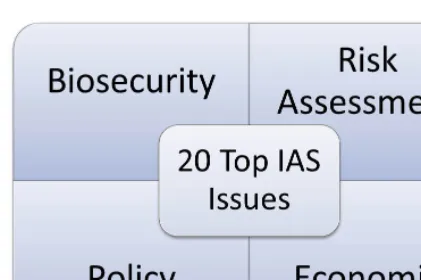
feasibility of addressing the issue (most feasible =10). They were also asked to comment on the specificity of potential strategies to address the issue, barriers that might prevent progression of the issue and to provide examples of best practice. All submissions were collated and the wide-ranging issues raised were combined into four broad pillars for the themed workshops: (1) biosecurity, (2) management and risk assessment, (3) policy and (4) economics. Further distillation of the priority issue inputs, utilising scores and comments, provided circa 10 issues, posed as statements, under each theme. These provided the focus for the workshop sessions and were distributed to invited delegates weeks prior to the meeting.
Four workshop sessions were organised to address the four designated themes. Each of the themed workshop sessions started with a 15 minute presentation by the coordinator (the keynote speaker for that theme on Day 1) where the rules and timelines were issued. A rapporteur was assigned to record the relevant proceedings. Each delegate was given a sheet with the main issues nominated for the session (Biosecurity and Economics sessions both had eight issues to address; Policy and Management + Risk Assessment had 11 each). At this time an opportunity to add to the list of issues was given to the delegates if, in their opinion, something significant had been omitted. In the following two hours, each of the issues was presented to and discussed by each group, generally comprising 45 to 60 delegates. Approximately equal time was allocated to each issue. At the end of this session each delegate was given five votes. It was not necessary for the delegate to use all five votes but a maximum of one vote per delegate per issue was permitted. The vote was private. The votes were counted and the issues were ranked based on the number of votes allocated to each. The new ranked order of issues and the reasons why the first five issues were so ranked was discussed among the delegates and agreed.
The coordinators and Scientific Committee discussed the outcomes from each of the themed workshops and prepared a ranked list of issues for presentation to the synthesis workshop session on Day 3 of the conference. A review of the top five ranked issues to emerge from each of the themed workshops revealed 11 stand-alone issues, with the remaining issues demonstrating a distinct commonality, even though they derived from different workshop themes. Following open discussion with all delegates at the synthesis
workshop, the nine issues with overlapping elements were merged to form four discrete issues. Five issues that had not been ranked in the first five from each of the four themed workshop sessions could now be promoted to the Top 20. The next three issues, those ranked 6 to 8, from each of the four themed workshops were presented to the delegates and voted on as before. This produced the five issues, in rank order, that were now included in the Top 20.
Delegates were assigned specific issues from the Top 20, as appropriate to their expertise, and requested to expand on the subject to clarify why it had emerged as a priority issue, how the issue might be resolved and to comment on the feasibility of achieving effective implementation of any suggested resolution. The results from these deliberations constitute the essence of this paper.
Results
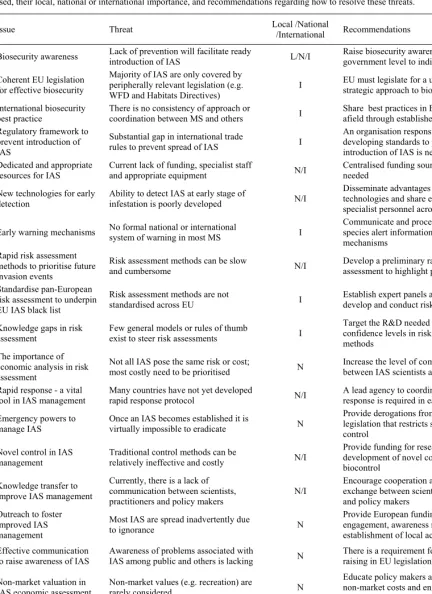
A summary description of each of the Top 20 IAS issues determined at the FINS conference workshops is presented below. These priority issues emerged from four themed workshops (biosecurity, management and risk assessment, policy, and economics) and a final synthesis workshop (Figure 1). Table 1 describes the individual issue, assesses the nature of the threat and whether it is of local, national or international importance, and offers recommendations as to how best the issue can be dealt with or resolved.
The Top 20 IAS issues that follow do not appear in any order of priority but broadly follow the three-stage hierarchical framework recommended by the Convention on Biological Diversity.
1. Biosecurity awareness
Table 1. A list of the Top 20 IAS issues determined at the FINS conference (2013) with summary description of the nature of the threats posed, their local, national or international importance, and recommendations regarding how to resolve these threats.
Issue Threat Local /National /International Recommendations
Biosecurity awareness Lack of prevention will facilitate ready introduction of IAS L/N/I Raise biosecurity awareness from government level to individuals Coherent EU legislation
for effective biosecurity
Majority of IAS are only covered by peripherally relevant legislation (e.g. WFD and Habitats Directives)
I EU must legislate for a unified EU strategic approach to biosecurity International biosecurity
best practice
There is no consistency of approach or
coordination between MS and others I
Share best practices in Europe and farther afield through established forum Regulatory framework to
prevent introduction of IAS
Substantial gap in international trade
rules to prevent spread of IAS I
An organisation responsible for developing standards to prevent the introduction of IAS is needed Dedicated and appropriate
resources for IAS
Current lack of funding, specialist staff
and appropriate equipment N/I
Centralised funding source at EU level is needed
New technologies for early detection
Ability to detect IAS at early stage of
infestation is poorly developed N/I
Disseminate advantages of new technologies and share equipment and specialist personnel across MS Early warning mechanisms No formal national or international system of warning in most MS I
Communicate and process early warning/ species alert information using agreed mechanisms
Rapid risk assessment methods to prioritise future invasion events
Risk assessment methods can be slow
and cumbersome N/I Develop a preliminary rapid risk assessment to highlight priority IAS Standardise pan-European
risk assessment to underpin EU IAS black list
Risk assessment methods are not
standardised across EU I
Establish expert panels across EU to develop and conduct risk assessments Knowledge gaps in risk
assessment Few general models or rules of thumb exist to steer risk assessments I
Target the R&D needed to increase the confidence levels in risk assessment methods
The importance of economic analysis in risk assessment
Not all IAS pose the same risk or cost;
most costly need to be prioritised N
Increase the level of communication between IAS scientists and economists Rapid response - a vital
tool in IAS management
Many countries have not yet developed
rapid response protocol N/I
A lead agency to coordinate rapid response is required in each MS Emergency powers to
manage IAS
Once an IAS becomes established it is
virtually impossible to eradicate N
Provide derogations from EU and national legislation that restricts speedy IAS control
Novel control in IAS management
Traditional control methods can be
relatively ineffective and costly N/I
Provide funding for research and development of novel control methods e.g. biocontrol
Knowledge transfer to improve IAS management
Currently, there is a lack of communication between scientists,
practitioners and policy makers N/I
Encourage cooperation and knowledge exchange between scientists, practitioners and policy makers
Outreach to foster improved IAS management
Most IAS are spread inadvertently due
to ignorance N
Provide European funding for public engagement, awareness raising and establishment of local action groups Effective communication
to raise awareness of IAS
Awareness of problems associated with
IAS among public and others is lacking N
There is a requirement for IAS awareness raising in EU legislation
Non-market valuation in IAS economic assessment
Non-market values (e.g. recreation) are
rarely considered N
Educate policy makers about existence of non-market costs and ensure their inclusion in IAS management evaluations Cost analysis in IAS
management
Commonly, cost analysis for IAS management does not include loss of benefits caused
N
Costs associated with IAS management must include both cost benefit and cost effectiveness analysis
Single responsible agency - the answer to national IAS management
Responsibility for IAS management
nationally is often fragmented N
Figure 1. A diagrammatic representation of how the four pillars of the FINS themed workshop sessions combined to produce the Top 20 IAS issues in Europe in 2013.
Politicians, officials, businesses and individuals can all contribute to prevention through their awareness and their actions. The increasing concern of governments with potential, rather than proven, harm has seen a shift in policy focus from the remediation of damage to the prediction of risk. The Sanitary and Phytosanitary (SPS) Measures Agreement is one of the more prominent examples of this trend in that it prescribes scientific risk assessment as a basis for measures dealing with risks to human, animal and plant life or health (WTO 1995). As a consequence, it is often seen as a government responsibility, usually delegated to one or more departments. Legislation is often clouded in jargon and detail and is challenging to communicate to industry or the public. Officials can become embroiled in procedures and not look at the intent of legislation or the likelihood of compliance. Penalties for contravention are often highlighted while the benefits of compliance are sometimes less readily identifiable (Secretariat of the Convention on Biological Diversity 2001). Where ignorance about the various implications of a biosecurity threat exists, this in itself should not be used as a reason for postponing or failing to take appropriate eradication, containment and control measures where serious or irreversible environmental damage may occur. Too often biosecurity is regarded as a rigid list of actions i.e. a process to be followed without thought of the intended outcome. It is important, therefore, that efforts to raise awareness that contribute to biosecurity can and must be made at all levels, from governments to actions by individuals. A broad range of stakeholder input should be
sought, not only with regard to policy changes but also in terms of reviewing the effectiveness of interventions and legislation (Wittenberg and Cock 2001). Practitioners may be able to suggest simple, efficient and cost-effective solutions that may not emerge from elsewhere. To be fully effective, as wide as possible an audience must be facilitated to understand the issue, buy in to the proposed solutions and encouraged to implement appropriate measures in their own business or lifestyle. Punitive sanctions will be required in some instances and reinforcing required behaviours must be incorporated into strategies. Awareness raising must be a fundamental action between government departments, and within government agencies, trade groups and the public (Wittenberg and Cock 2001). Enhanced “earned recognition” would facilitate this, particularly if an accreditation scheme for both training and compliance could be part of the mix. Attention to these biosecurity issues is urgent as costs increase disproportionately after invasions and secondary spread (Leung et al. 2002; Kettunen et al. 2008).
2. Coherent EU legislation for effective biosecurity
Legislation is a key element of the approach to IAS. To date, the EU has legislated in some areas of IAS (e.g. plant health – 2000/29/EC (European Union 2000a) and animal health 2006/88/EC (European Union 2006), Wildlife Trade Regulation – Council Regulation (EC) No. 338/97 (European Union 1997) and the Aquaculture Regulation – Council Regulation (EC) No. 104/2000 (European Union 2000b)). This still leaves the majority of IAS outside any coherent EU regime and only covered by peripherally relevant legislative instruments, such as the Birds and Habitats Directives (Genovesi and Shine 2004). The benefits of having a coherent regime (as per the proposed EU Regulation on IAS) are clear and include an agreed framework for risk assessments, border checks and requirements for rapid action, as well as more emphasis on identifying pathways (Kettunen et al. 2008; Shine et al. 2009).
thus lie within the scope of the WFD (Guidance Document 2003). One of the main objectives of the WFD is to achieve at least 'good ecological status' in rivers, lakes, and transitional and coastal waters by 2015, and the presence of IAS known to have severe impacts on species and habitats poses a threat to achieving this objective. The environment and conservation bodies in the UK and the Republic of Ireland are investing considerable resources in assessing the risks from aquatic IAS and, where possible, addressing their impacts. Throughout the whole of the EU, however, there is no consistent view on the best way of using the WFD to tackle the problems of IAS in aquatic ecosystems.
The lack of a unified EU strategic approach applies not merely to those species relevant to the WFD but more generally to IAS (European Commission 2013). This has led the 27 Member States (MS) to develop diverging approaches that are likely to continue as awareness of the importance of the issue grows (Shine et al. 2009). The legislative framework across the MS within the EU is already complicated, with some restricting the import of many species and others banning the sale, keeping, trade, etc. of IAS (Shine et al. 2009). In general, the legislation is not underpinned by comprehensive risk assessments and is, thus, potentially open to challenge under World Trade Organisation (WTO) rules. The need for more coherence is clear, therefore, and the most suitable level for this is the European Union.
Legislation by itself is not sufficient. There must also be enforcement of the provisions of legislation to ensure that all MS are complying. Once an IAS becomes established in one MS, it is more difficult to prevent it from spreading within the single market area (Kettunen et al. 2008; Shine et al. 2009). This may well require MS to take action against species that are not priorities for them ('solidarity action') but which may become significant for their neighbours. The lack of finance, expertise and appropriate funding mechanisms in some countries are further confounding factors that may hinder progress in carrying out risk assessments or instigating control measures (Shine et al. 2009). Lack of capacity is likely to be a particular problem for smaller MS, but even larger MS may not have the resources to implement the provisions of any EU directive or regulation (e.g. proposal for a European regulation on the prevention and management of the introduction and spread of IAS (European Commission 2013)).
3. International biosecurity best practice
Although some individual countries are acknowledged to implement effective biosecurity measures (e.g. New Zealand), there is a clear requirement to improve related strategies for co-operation, co-ordination, consistency and cohesion between countries (European Commission 2013). Utilising proven procedures on an international level could greatly increase biosecurity effectiveness and consequent reduction of spread between and within countries (Wittenberg and Cock 2001; European Commission 2013). This is especially true in Europe where the effectiveness of a continent-wide approach will depend on the weakest link in individual national biosecurity strategies (Shine et al. 2009).
The geographical contrast between implementing biosecurity on islands versus measures for intercontinental countries provides challenges for a common approach (European Commission 2013). Many differences in biosecurity protocols exist due to variation in international policy, legislation and resourcing of enforcement (Shine et al. 2009; Pyšek and Richardson 2010). In addition, related legislation for transport and trade of food and other live goods may interfere with the development of common biosecurity measures. Moreover, different national strategies towards identifying problem species could mean neighbouring countries may not share the same priority species and may act as sources of future introductions (Secretariat of the Convention on Biological Diversity 2001). Nations must be aware of the biosecurity strategies in neighbouring countries as well as trading partners (Dahlstrom et al. 2011). In Europe, a forum for organisations with responsibilities for biosecurity should be established where best practices can be shared.
4. Regulatory framework to prevent introduction of IAS
mandate to develop SPS-recognised standards to prevent the spread of IAS.
In addition to the gaps in international trade rules there is also a significant lack of international standards to address animals that are IAS but are not pests of plants. A report by an ad hoc technical expert group on gaps and inconsistencies in the international regulatory framework in relation to IAS suggested the following options to deal with this gap: (a) expansion of the mandate of the World Organisation for Animal Health (OIE) beyond a limited number of animal diseases, (b) development of a new instrument or binding require-ments under an existing agreement or agreerequire-ments, such as the CBD or other appropriate frameworks, and (c) development of non-binding guidance (CBD 2005).
In 2006 the CBD requested consultation with relevant international bodies and instruments to address the lack of international standards covering IAS, in particular animals that are not pests of plants, under the International Plant Protection Convention (IPPC). Since 2006, some progress has been made. However, there is currently still no standard-setting body with a mandate to develop SPS-recognised standards to prevent the spread of IAS.
The experience with trade rules aimed at the prevention of trans-boundary spread of animal diseases has demonstrated that the spread of animal pathogens still occurs despite a comprehensive regulatory framework. This includes diseases listed by OIE (and therefore specifically controlled), but also new and emerging diseases. A particular challenge is how to deal with disease threats that have not yet been recognised. WTO members may use more stringent trade measures over and above those provided through WTO-recognised standard setting bodies, if they can be scientifically demonstrated as necessary to protect human, animal or plant life or health.
In the context of IAS, a comprehensive regulatory framework is missing. Therefore, it is likely that most measures to mitigate against the introduction of IAS will require targeted risk assessments to be conducted. The costs of import risk assessments are substantial and, for this reason, there are very few examples where such risk assessments have been produced. In the early phase of a new or emerging disease, insufficient data are available to underpin a risk assessment, leading to an exposure of the importing country to an unknown risk. Similar principles would apply for IAS.
It is clear that an organisation specifically charged with responsibility for developing a framework for standards to prevent the spread of IAS is needed within each MS. Suggestions as to how this may be realised were provided in the CBD expert ad hoc group report from 2005 (CBD 2005). Also, the SPS rules need to be revisited. As the substantial damages caused by IAS are very difficult to predict, greater emphasis must be placed on prevention. Once an IAS has established, it is virtually impossible to eradicate and the costs for control lie with the importing country. A shift towards prevention may impact upon free trade but would be justified by a reduction of the cost burden for control on MS.
5. Dedicated and appropriate resources for IAS
Resources to appropriately tackle IAS include suitably experienced staff and finances for equip-ment, specialist contracted staff, educational materials and research. The need for dedicated resources extends not only to tackling long established threats but also to ensure that countries are equipped to respond to and prevent newly detected invasions (Shine et al. 2009). Whilst the public profile of IAS throughout Europe has risen substantially in recent years, this has not been met with any significant increase in dedicated resources. In Ireland, legislation relating to IAS provides a framework to regulate for their introduction and intentional further spread but does not place a legislative requirement to allow for powers of access to Government officials, or agents working on their behalf, to undertake control. Nor does it always provide the legislative powers to enforce a landowner to undertake control of IAS on their land (European Communities (Birds and Natural Habitats) Regulations 2011). Historically, efforts to tackle IAS have been on
an ad hoc basis, with little or no co-ordination.
In recent years, however, there has been a significant move towards working at catchment level using funds provided by government grant aid and European funding, in addition to the creation of local partnership projects (e.g. LIFE+ CAISIE project – http://www.caisie.ie; Interreg IVA CIRB – http://www.qub.ac.uk/research-centres/cirb/.
political and public support in place to back up a response action. Their efficacy is apparent with reference to the internationally high profile cases that include the foot-and-mouth outbreak in the UK in 2001 and the recent detection of ash dieback (Chalara) in the UK in 2012. However, the legislation that regulates IAS at European level is often fragmented and, within MS, does not task a single government department or state agency with responsibility for IAS (European Commission 2013). It is recommended that, at central European level, a contingency fund should be established from which MS can request emergency funds to respond to new threats that meet agreed criteria. The EC is currently developing a dedicated Regulation to tackle the threat of IAS and this provides an opportunity to ensure that dedicated and appropriate resources are committed at European and national levels (European Commission 2013). In turn political, industry and public support to tackle the challenges posed by IAS will be required. This should be regarded as an urgent priority. It is likely that no moves will, however, be undertaken until the full scope of the pending EC Regulation is known, as this will undoubtedly direct any national action.
6. New technologies for early detection
Governments world-wide have focused efforts on prevention of IAS (e.g. Environment Canada 2004; Veitch et al. 2007; European Commission 2013). However, prevention does not always work and IAS may be introduced inadvertently - for example, via ballast water or as hitchhikers with stocked species (Carlton and Geller 1993; Ruiz et al. 2000) - or intentionally through unauthorised releases (Gertzen et al. 2008). Available evidence, mainly from terrestrial situations, indicates that success of intervention efforts are inversely related to the size of the population acted upon (Grevstad 1999; Leung et al. 2002). Therefore, detecting IAS incursions at the earliest possible time, when populations are small, provides the best opportunities for rapid response. However, our ability to detect IAS is poorly developed and often based on serendipitous finds (e.g. Caulerpa taxifolia (Vahl) Agardh in San Diego bay (Anderson 2005); Bloody-red shrimp Hemimysis anomala Sars in the Great Lakes (Pothoven et al. 2007)) and usually managers learn of new invasions at late stages, prohibiting the use of rapid response.
New technologies are available, however, and may assist with early detection. Molecular methods based on detecting DNA in water (environmental DNA or eDNA) or using DNA in organisms may greatly enhance surveillance programs (Jerde et al. 2011; Dejean et al. 2012; Zhan et al. 2013). Recent examples include detection of American bullfrogs Lithobates catesbeianus Shaw in France (Dejean et al. 2012) and Asian carp in the Great Lakes (Jerde et al. 2013). A second approach (next-generation sequencing; 454 pyrosequencing) does not survey for specific species but instead uses a traditional sample (e.g. plankton). This is processed to obtain DNA from all of the species present. The DNA sample is amplified, sequenced, and cross-referenced against online data bases (e.g. BOLD, Genbank) (Zhan et al. 2013). Optical methods may also present opportunities for early detection of IAS, whereby a library of images of key IAS is built using imaging from every possible orientation. Samples with possible IAS are then screened through a system that uses laser images to detect species in a processed stream (e.g. plankton sample). The system is, however, dependent on accumulation of library images of relevant species.
Key impediments are reluctance to readily accept new technologies and their associated costs, but the latter are declining (e.g. eDNA costs have declined ten-fold in recent years). Early adoption of such new technologies is recommended. The benefits associated with the new technologies should be widely disseminated, with assistance provided for those who might adopt them in the future and, if possible, reduce costs by sharing of equipment or personnel. Because some of the equipment is beyond the domain of regional governments, national or EU centres could be established that provide equipment and skilled personnel. Existing centres for food pathogen detection and identification might provide an appropriate model. In the short-term, samples can be sent to universities or corporate labs for processing. However, skilled bioinformatics expertise is still required to process the resultant data. Advanced early detection capabilities provide better opportunities to answer questions regarding whether rapid response should be undertaken, and how to do it.
7. Early warning mechanisms
The circulation of information through a formalised early warning system, such as alerts or notifications, has been identified as a key driver of this process (Genovesi et al. 2010; European Commission 2013). Species alerts that are processed and communicated through a formalised early warning mechanism can significantly raise the profile of the targeted species with practitioners, resource users and the general public. The availability of a formalised early warning mecha-nism as proposed in the pending EU Regulation, can also result in a) targeted surveillance of pathway introduction ‘hot-spots’ and habitats vulnerable to its invasion, b) submission (and expert verification) of first and additional sightings of the alert species, c) reporting of the verified sightings to the competent authorities for further assessment of risk and rapid response, and d) the implementation of biosecurity measures to prevent further introductions or spread. Species alerts must be communicated inter-nationally to inform horizon scanning and risk assessment for other MS.
Ideally, MS should have completed detailed risk assessments of potential non-native species introductions to determine which species would warrant a species alert.
Factors that must be considered before issuing an alert include a) when to issue the alert - is this pre- or post-border entry or when a single individual or established population is detected?; b) is the early warning system coordinated by a centralised body or multiple competent authorities? If it is the latter, there is a need for clear consistent messages; and c) who is the alert sent to? Is this the relevant authorities or should it also include relevant stakeholders and the public?
Resources are vital to support surveillance and monitoring of pathway introduction ‘hot-spots’ and habitats vulnerable to invasion. This may include development of identification materials, training in best surveillance methods and promotion of biosecurity measures. Consideration should be given to managing expectations following the issuing of the species alerts. Cognisant of these potential obstacles, it will be important for individual MS to undertake risk assessments that will inform horizon scanning and early warning, develop a formalised early warning strategy with clear lines of communication and responsibility, develop an expert registry to support species diagnosis and report verification, and provide resources for supporting early detection awareness, species identification, surveillance and biosecurity measures.
8. Rapid risk assessment methods to prioritise future invasion events
Policy makers and practitioners in conservation and IAS management often make decisions based on insufficient evidence and are limited by existing knowledge gaps. Science is often not involved sufficiently early in the policy process. The diffuse distribution, variable quality and lack of harmoni-sation of information on IAS limit the ability of managers to combat invasions (Ricciardi et al.
2000). Invasion events are often unexpected but many could be predicted. In this respect, global collaboration is essential to manage IAS. The establishment of a list in which species that pose the most significant threats are identified, prioritised and consequently prohibited for import and sale in Europe has been proposed to improve the existing legislation (European Commission 2013). The development of effective and rapid risk assessment methods supported by research-based knowledge could enhance the prioritisation of future invasion events. Current risk classifications show a high dissimilarity between countries. According to Ver-brugge et al. (2012) this may be due to differences in a) national assessment protocols, b) species-environ-ment matches in various biogeographic regions, and c) data availability and expert judgement.
There is a need for a) a European standardisation of risk assessment protocols, b) a global information system (database) on risk assessment, and c) an understanding and prioritisation of knowledge gaps, as foreseen in the proposed EU IAS Regulation. Performing a detailed risk assessment for all species would be very costly, time-consuming and unnecessary (Genovesi et al. 2010). IAS should be prioritised through a preliminary rapid risk assessment (based on expert opinion and consensus) to highlight IAS that require a detailed risk assessment.
9. Standardised pan-European risk assessment to underpin EU IAS black list
Restricting the influx of emerging IAS is essential to prevent further damage to EU biodiversity, to the economy and to the health of its membership (European Commission 2013). The availability of so-called black lists and alert lists (as foreseen by the proposed EU IAS Regulation), representing non-native species that will pose a significant risk if they gain entry to the EU, can provide a good starting point to stop the introduction of IAS (European Commission 2013). However, these lists have to be underpinned by cost-efficient, robust and transparent risk assessments (Wittenberg and Cock 2001; Verbrugge et al. 2012). Cost efficiency is needed to make it feasible to tackle the assessment procedure with appropriate resources. Robustness is needed to guarantee the quality of the result of any assessment, and transparency is required to convince the authorities and other interested parties of its objectivity. Any assessment should be performed in a two step-approach that includes a) screening of a large number of potential invasive species with a prioritisation tool (horizon scanning), and b) elaboration of detailed pest risk assessments that will be able to justify trade restriction for a short list of priority species (e.g. Kelly et al. 2013a). These species include those that are characterised by a strong capacity to rapidly spread and cause serious damage to native species or ecosystems, and have a high probability of entering into Europe through international pathways.
Any EU IAS black or alert list that is not underpinned by a standardised risk assessment process will face difficulties in being adopted and in complying with WTO SPS Agreements, when trade restriction is involved (WTO 1995; Dahlstrom et al. 2011).
It will be important to have a list of species whose entry into the EU is prohibited. But it will be equally important that all of the species on this list are risk assessed (European Commission 2013). It will be necessary to establish expert panels throughout the EU and farther afield that are familiar with the species on the list and with risk assessment methodologies. These panels must include invasive species scientists, regulators and policy makers, economists and relevant stakeholders. It may be necessary also to get pan-European agreement upon a standardised risk assessment method that will be applicable to all species and countries involved. Work performed within the framework of EPPO (European and Mediterranean Plant Protection Organisation) and the PRATIQUE and IMPASSE projects is a good starting point to address adequately the issues of IAS prioritisation and risk assessment.
10. Knowledge gaps in risk assessment
A large number of case studies demonstrate that aquatic invasions can reduce native biodiversity and alter water quality, contaminant cycling, food webs and fishery yields (Ricciardi and MacIsaac 2011). Unfortunately, managers lack appropriate risk assessment methods to prioritise invasion threats because few general models or ‘rules of thumb’ exist on which to predict the occurrence and impacts of IAS. Thus, risk assessment is limited by knowledge gaps and uncertainty.
The importance of knowledge gaps and confidence limits is clear in the background requirements of the risk assessment but no provision has been made in the actual risk assessment to undertake critical R&D for gap filling. Levels of confidence in risk assessments are usually allocated low, medium or high, depending on the opinion of the risk assessor on the answer to the standard risk assessment questions. While some electronic systems exist (e.g. CAPRA http://capra.
eppo.org ) that analyse confidence limits, there
appears to be little quantitative assessment of these limits.
effects. Such events are expected to become more frequent as introduced species accumulate in aquatic systems, decreasing predictive power in highly invaded systems (e.g. Ricciardi 2001).
Furthermore, the invasiveness of a species cannot be used as an indicator of its potential damage, as there appears to be no relationship between the ecological impact of an introduced species and its ability to spread (Ricciardi and Cohen 2007). Highly successful invaders do not necessarily cause the greatest local impacts, whereas poor colonisers can be highly disruptive where they are established. Thus, risk assessments are limited by the quality of information available for both colonisation and ecological impact. Similarly, impact data are often scarce, even for species that are deemed to be major invasion threats (Kulhanek et al. 2011). This is a major impediment to risk assessment.
The R&D that is needed to complete the basic risk assessment or to increase the confidence level in the recommendation of the risk assessment must be targeted. Confidence limits should be based on (at least) semi-quantitative systems (e.g. using the number of published studies related to questions answered). In addition, actively managed databases with sufficient quantitative data on all IAS are needed to make impact information readily accessible to scientists and managers.
11. The importance of economic analysis in risk assessment
Risk assessments allow decision makers to determine the priority species that warrant intensive prevention, control and/or other management efforts. Economic considerations should form part of these assessments so that species that are more likely to cause an economic problem, for example by disruption of ecosystem services or reduction in recreational benefits to the general public, can be given a higher priority. While multiple species can make their way into an ecosystem, not every species poses the same level of risk or cost. Recognising that time and money are limited means that allocating resources to priority areas requires an understanding of the economic risks associated with various species. Attempts to incorporate economic analysis into risk assessment should examine the risk level at which the priority species are to be examined and evaluated for their potential harm. The economic resources allocated to prevention, control and various manage-ment strategies should reflect the relative risks associated with different species, with priority
given to the most harmful species. Economic meta-analysis could be used, based on other species with similar attributes in similar ecosystems, since new data for species-specific risk assessment are unlikely to be easily or quickly compiled.
A serious limitation is the lack of data that are readily available for use in economic analyses of the potential costs of new IAS introductions. Meta-analysis is still viewed with suspicion by some, relating to the tendency of research to be narrowly case-focussed. Given that time and money is scarce, broadening the metrics towards creating data for a meta-analysis is likely to represent a low priority. Another limitation is the low level of communication between invasive species scientists and economists, with the two groups working in parallel rather than collaboratively. This lack of collaboration can also reduce the effectiveness of management options and allocation of resources.
Risk assessment studies should be conducted so that standard summary statistics and data are compiled in a consistent manner to allow cross-comparison. For early stage invasions, an economic risk assessment could be conducted using meta-analysis to provide an early indication of economic damages. This would also foster collaboration between economists and invasive species scientists. Education regarding the capabilities of meta-analysis should be more widely disseminated.
12. Rapid response – a vital tool in IAS management
Prevention is preferable and less costly than the management of IAS. However, where prevention is not possible, early detection and rapid response are the next most cost effective lines of approach. Effective early detection and rapid reaction increase the likelihood that a response will be effective, while also preventing the further spread and the ecological and economical damage caused by IAS (Genovesi 2005).
Rapid response protocols and procedures have been developed in many countries throughout the EU. Most agree that within MS a lead agency or coordinating body, with the authority and resources to act, is required to steer the process. This lead agency will oversee the implementation of the rapid response within that MS while also facilitating communication with government departments, environmental agencies, stakeholder groups and the public. Talking, planning and consensus-making should be conducted before the introduction of the IAS. Once an introduction occurs, a system must be in place that allows for rapid decision making, allocation of resources, and immediate deployment.
In a number of European countries rapid response protocols are not developed or, if processes are in place, are inadequately resourced and seldom activated (Genovesi et al. 2010). Rapid response protocols should ensure and facilitate the availability of trained personnel, equipment, licences/permits and other resources to contain and potentially eradicate newly detected IAS.
Each MS should establish a lead or responsible agency with the capacity and authority to deliver an agreed rapid response protocol. This agency should receive input from government departments, environmental agencies, industry/academic and other stakeholder or volunteer groups in order to develop effective rapid response protocols. Each of these groups should have a designated point of contact responsible for coordinating activities and conveying information to the lead agency.
To save time and resources, it may be prudent to seek preapprovals for any authorisations, licences or consents that may be needed in order to legally undertake action. Furthermore, advocacy and education at all levels within each country will be required to develop the political and societal will to commit sufficient funds for rapid response emergencies.
13. Emergency powers to manage IAS
The benefits (both economic and ecological) from eradication of a known IAS early in the invasion stage, or in a pre-release stage, are obvious. The cost-benefit ratio of removal of small numbers of IAS is probably in the order of 100,000s to 1 over time. For example, the current (2013) cost to control Ludwigia grandiflora in the UK is circa £75,000, whereas if the species was left uncontrolled for between 5 and 10 years, the
cost is estimated to rise to circa £80 million (Williams et al. 2010). Ludwigia is not an expensive species to control, but with submerged macro-phyte species, fish species and invasive mollusc species the costs are considerably higher, resulting in cost-benefit ratios of early intervention in the order of 10,000 to 1 (Williams et al. 2010). The lack of herbicides for use in aquatic situations has resulted in excessive costs for treatment of many submerged macrophyte and algal species. The requirements for monitoring and assessment prior to control have often resulted in population explosions of IAS that are now difficult to control or manage effectively (e.g. Lagarosiphon major
in Lough Corrib, Ireland (Caffrey et al. 2011)
and Hydrocotyle ranunculoides in the UK
(Duenas and Newman 2010)). It is important that effective management tools are made available to IAS managers to limit spread or eradicate IAS where possible.
The primary obstacles to rapid action are restrictions on the use of tools by the EU (e.g. Plant Protection Products Regulation 2012, European Food Safety Authority (EFSA), WFD, etc.). The intention of primary water legislation has been to improve water quality, but it has precluded the use of many effective management tools (e.g. aquatic herbicides for use on submerged weeds). There are many conflicting pieces of legislation that countries are required to comply with. The WFD requires all watercourses to be of at least good ecological status by 2015. Unfortunately, the presence of IAS can stop a water body achieving this. Other legal obligations prevent the control or management of IAS and so, inevitably, many waters in most EU countries could fail to achieve good ecological status because of conflicting legislation. The organisations capable and willing to undertake IAS control exist in most countries, but are hampered by legislation designed for other purposes. It is hoped that the enactment of the pending EU Regulation on IAS (European Commission 2013) will assist the management of nuisance IAS by simplifying national approaches to the control of such species.
14. Novel control in IAS management
Most current IAS control strategies rely on traditional technologies including removal by hand, net or machine, chemical application of pesticides or biocides, electricity, and structural barriers. These are all fairly low-tech and there is a need to embrace innovative control techniques to maximise control efficacy and minimise economic and environmental management costs. Some tried and tested techniques, such as weed biocontrol, are considered innovative in Europe and are underutilised despite their routine use elsewhere in the world (Sheppard et al. 2006). In most European countries, where the use of chemicals is extremely limited by legislation, physical removal of aquatic weeds is common practice (Caffrey et al. 2011). In fisheries manage-ment there are primarily only two chemical tools applied, the piscicide rotenone and copper-based molluscicides. Traditionally, fish are controlled and managed primarily by netting and electrical applications. For invasive mussel control, physical removal is conducted by divers or using heavy industrial equipment. Such operations can incur high labour and infrastructure costs. Very little biocontrol technology has been developed for fisheries other than using triploidy in some fish.
Examples of innovation and highly effective IAS control methods in current use include: the use of specific biological control agents from the country of origin of the targeted IAS; the use of non-chemical approaches to macrophytes, such as inert dyes (McNabb 2003) and electromagnetism; alarm pheromones as management tools for invasive amphibians (Hagman and Shine 2009); encapsulated particles that contain poisons to target specific filter-feeding bivalves (Costa et al. 2011; Calazans et al. 2013)); selective naturally-derived biocides for zebra mussel control (Meehan et al. 2013); sound/pressure waves to deter or eradicate invasive fish (Gross et al. 2013); electrical fields as barriers or deterrents to IAS (Rahel 2013) and electric fields to control crustaceans, molluscs and amphibians; as well as integrated management using novel combinations of herbicide and pathogen to target invasive alien weeds (Weaver et al. 2007a,b).
Perhaps the single-most important future challenge to developing novel control methods and implementing them on a broad scale is the lack of funding for primary research. Commonly, control/management of IAS is viewed as a public-good activity and, consequently, funding is limited as there is little return for a would-be
investor. In addition, legislation and policy may unintentionally impede the development and use of novel approaches. It is vitally important to fully research and implement novel techniques, including biocontrol, as their availability will restrict the use of inappropriate and occasionally dangerous control techniques. Adequately funded, sustained research is required, including technology transfer from primary research to commercialisation by the business sector. All potential interventions should be clearly described and available for land managers (whether private or government) to act upon based on both economic and environmental criteria.
15. Knowledge transfer to improve IAS management
Knowledge transfer between those engaged in research, policy and management is of the utmost importance if successful IAS management initiatives are to be implemented. These initiatives must inform society’s perception of IAS and take into account the demands of stakeholders from all sectors. They must also carefully utilise the resources that are available. Due to the magnitude of the IAS problem in the EU, it is important to encourage cooperation and knowledge transfer between scientists of various disciplines (e.g. ecology, economy, geography, geology, climato-logy) (Eisworth and Johnson 2002; Hibbard and Janetos 2013) as well as management practitioners and policy makers (Wainger and Mazzotta 2011). It is also important that the flow of knowledge goes in both directions, with managers and policy makers informing researchers, and vice versa. Each field of expertise has its own strengths, approaches and knowledge concerning IAS, but each also has its own limitations. Collaboration, cooperation and knowledge transfer helps to achieve a synergistic approach, which should improve the level of success achievable in IAS management.
16. Outreach to foster improved IAS management
The CBD recognises prevention as the most cost-effective element of IAS management. Prevention may involve recognising and managing pathways of invasion or changing public behaviour to prevent IAS from entering the wild. A key factor in influencing behavioural change is ensuring that all sectors of the population are aware of the issue, feel engaged and are encouraged to actively contribute to solving the problem.
The public are generally receptive to awareness campaigns and are often keen to engage in IAS control programmes, once they understand the associated impacts. Over the last 15 years, public engagement with IAS in Great Britain has given rise to over 80 Local Action Groups (LAGs). LAGs vary in their composition and remit. Groups often begin with control of an invasive species, then progress onto awareness raising and making contributions towards national eradication campaigns. This has included the delivery of national biosecurity awareness campaigns. In addition to providing a means for the public to actively contribute to invasive species management, they also provide a forum for relevant public bodies, NGOs and landowners to share resources and coordinate their work.
The provision of appropriate funding is the greatest impediment to delivering local action. It is also important that there is coherence and consistency in the terminology and message being delivered through IAS awareness campaigns. The promotion of biosecurity for the prevention and spread of IAS remains a key challenge, particularly with industry.
European funding to assist with public engagement, awareness raising and local action should be made available through LIFE+, Horizon 2020, INTERREG or other funding streams. To date, corporate sponsorship has been an under-utilised area of funding. Opportunities for cooperation between LAGs across Europe should be encouraged and facilitated. Likewise, cooperation between LAGs and industry should be encouraged and supported by government. It is vital that industry and the commercial sector become more engaged in implementing preventative biosecurity measures.
17. Effective communication to raise awareness of IAS
It is essential to maintain and enhance the profile of IAS with the public, policy makers and other stakeholders to achieve appropriate surveillance, early warning and rapid response. Recent
publications that down-play the importance of IAS as environmental pressures have undermined the profile of invasive species (Richardson and Ricciardi 2013). Effective communication of clear messages is essential to raise awareness of the real threat posed by IAS. Such communication should be centred on species, habitats and invasion biology. There are excellent examples of successful awareness raising campaigns such as “Check, Clean, Dry” and “Be Plant Wise” (e.g.
http://www.nonnativespecies.org), but it is
important to reiterate key messages regularly to ensure appropriate and effective responses. However, all this relies on appropriate information delivered in a non-technical and accessible format.There is a possibility that people become complacent with respect to IAS and, therefore, it is critical to maintain interest through continued effort. Raising awareness successfully relies on a multitude of traditional and innovative approaches from printed materials, press releases and public events to social media and other web-based applications, but resources are required for publication and dissemination of materials. It is also critical that relevant information can be displayed in appropriate locations, for example at points of entry to a country - such as ports and airports. There should, therefore, be an explicit requirement for raising of IAS awareness to be embedded within legislation, highlighting the economic benefits of early warning and rapid response.
Stakeholder Engagement Programmes for Invasive Species Management” also provides specific and targeted guidance for stakeholders on this issue (Inland Fisheries Ireland 2013). Rapid and effective implementation of strategies will be essential to underpin all priority issues in relation to IAS. Measures of success can be difficult to determine for communication campaigns but priority should be given to evaluation. It is important to review and adapt communication mechanisms on a regular basis to maximise efficacy.
18. Non-market valuation in IAS economic assessment
Freshwater ecosystems provide many valuable services to society (Carpenter et al. 2011). While the value of some of these services (e.g. water for domestic use, wild fish and aquaculture for direct consumption) are easier to quantify as they tend to be traded in established markets, the value of many other services are rarely captured. These non-market values include carbon seque-stration, waste assimilation, habitat conservation value and recreation opportunities provision. Without incorporating the value of these services into the decision making process, their loss due to the occurrence of an IAS may be ignored or underestimated, resulting in a net loss to society. Economic costs of IAS are usually associated with: a) production loss, b) preventing introductions, c) monitoring existing populations, and d) conducting control or eradication schemes. The total cost tends to ignore the loss of non-market ecosystem services that may result. When monetary values are assigned to the loss of non-market ecosystem services, the estimate of the total costs significantly increase (Williams et al. 2010). Many of the impacts resulting from the loss of non-market service can be valued through an approximation known as ‘willingness to pay’ for changes in the provision of the service. Methods developed to estimate the value of these services range from revealed preference (based on consumer actions) to survey-based stated preference methods (Hanley and Barbier 2009).
The main limitations to including non-market values in an economic assessment of freshwater IAS are the difficulty of generating estimates of these non-use values and disagreements over the best quantitative methods. There are further difficulties in predicting the nature and magnitude of impacts. Moreover, lack of uniformity in method-logies can make it difficult to compare the cost of invaders across catchments or regions.
It will be important that economic analysis investigates the value, in monetary terms, of the loss in non-market goods and services rather than just report the financial price of production loss and invasive management. Policy makers need to be educated about the existence of associated non-use costs. Adopting standard valuation methodologies across impact studies related to the same IAS would also greatly improve the usability and comparability of non-market valuation exercises in making policy decisions. A database of non-market estimates related to water bodies should also be compiled. Benefit transfer (BT) can be used where the values of an ecosystem service from another already completed study site can be applied to the policy site of interest.
19. Cost analysis in IAS management
Costs associated with IAS management must be justifiable, as they are commonly significant. To justify these costs two economic approaches can be taken. Cost-benefit analysis (CBA) will determine the value of benefits over costs while cost effectiveness analysis (CEA) will quantify and compare the cost of different management options. Benefits that should be included in a CBA include values associated with the existence and production of native species, ecosystem services provided by the affected species, and employment opportunities created by them. Costs must include loss of benefits caused by the IAS, as well as expenditure on their control and eradication. Other costs include reduced recreational activity opportunities, increased pest damage and decreased productivity. Utilising CBA or CEA enables managers to justify their spending on IAS management by demonstrating that the most effective control methods are being used, or that there is an economic benefit to justify the costs.
of a new IAS threat. Species prioritisation will be required as it is unlikely that sufficient resources will exist to carry out a CBA or CEA for all IAS. A CEA is less costly because only direct costs of each management option are included.
As cost is the main constraint to carrying out CBA and CEA, appropriate funding must be included in annual budgets of MS. This will only happen, however, when budget makers understand both the related importance and need for these in the IAS management decision making process.
20. Single responsible agency – the answer to national IAS management
Pending EU legislation on IAS should provide controls to limit the spread of listed invasive species from nations trading into the EU, while also offering a mechanism to control the spread of these species between MS. In order to effectively manage IAS in the EU it is critical that MS with shared borders collaborate and communicate fully, and share common expertise, information and responsibility relating to IAS. Island MS are well positioned to control the import of invasive species at their borders, but need to share IAS lists and alerts with other MS and even countries outside the EU.
In order to develop a coherent and co-ordinated national approach to IAS, it is necessary to identify clear lines of responsibility that will support coordination between national agencies and government departments. Furthermore, a robust approach to IAS management will require expertise and support from diverse interests including specialists, stakeholders, government departments, regulators and administrations. It is considered that a single and appropriately resourced group or agency with a clear national responsibility for IAS is required to facilitate the coordination required to spearhead this national approach.
The management of IAS at MS and EU levels is uncoordinated, with responsibilities split between different MS and among various national agencies and government departments. Further-more, some governments do not fully recognise the threats posed by IAS and have not considered the business case for investment in prevention. MS must proactively work to develop a robust and informed EU IAS Regulation and must implement the agreed actions once the Regulation has been enacted. In addition, the EU must support MS in controlling the spread of listed IAS from trading
blocks outside the EU. A single agency with a clear national responsibility for IAS is required within each MS. In addition, a coordinated approach to the control and spread of IAS to island states, which have a unique control advantage, is required.
Discussion
The FINS workshop undertook to identify the Top 20 IAS issues by using the expertise of academics, applied scientists, policy makers, practitioners and key stakeholder groups. This was the first step in the FINS process that, during the course of the exercise, determined the principle threats posed by IAS and, furthermore, provided recommendations for each of the 20 issues. Although the workshop sessions were divided into four distinct pillars of (1) biosecurity, (2) risk assessment, (3) policy and (4) economics, there were several cross-cutting themes, which form the basis for this discussion.
Knowledge exchange requirements
Knowledge requirements identified in the Top 20 can be broadly categorised under two headings, training and networking, each of which have associated resource issues.
Resource issues
Resource issues were identified on both the national and international levels of scale. FINS delegates explicitly demanded that a centralised funding source is needed at EU level to remediate the current lack of funding, specialist staff and appropriate equipment needed for IAS management. Outreach programmes also require EU financial resourcing for public engagement, awareness raising and the establishment of local action groups. Funding is also required for the research and development of novel control methods (e.g. biocontrol). In order to leverage funding, effective cost analysis and non-market evaluations must become part of IAS management. Evidence of the total pecuniary and societal costs of invasions allows for better decision making in IAS management. Financial resourcing is also needed to target the research and development needed to increase the confidence levels in risk assessment methods. It is clear that funding is required for all of the Top 20 issues. However, investment in networking (that informs management), outreach (that mitigates accidental spread), new technologies (for control) and cost analysis (that informs priorities for management decisions) will reduce the economic and ecological long-term costs of invasions.
Developing common strategies
Common strategies were a cross-cutting theme in all the four distinct pillars of (1) biosecurity, (2) risk assessment, (3) policy and (4) economics. In particular, there is no consistency of approach or co-ordination to biosecurity between EU member states and other countries. This is unacceptable as biosecurity activities start offshore or pre-border in order to reduce the risks of invasion. The workshop recommended that we must share best practice in Europe and further afield via
established fora (e.g. New Zealand Bio-Protection Research Centre; South Africa Centre for Invasion Biology; Australian Dept. Agriculture, Food and Fisheries; Great Britain Non-Native Species Secretariat). These could also be used to develop standards to prevent the introduction of IAS and to provide an international system for early warning mechanisms. A lead organisation is required at
national level within each MS to co-ordinate rapid response. Expert panels are required to develop and conduct risk assessments. The responsi-bility for IAS management is often fragmented at national level. This can blur the clear lines of responsibility between national and government agencies. Highly variable governance structures within different countries make the development of a common approach problematic. These issues appear to indicate that a single responsible agency, with representation from the Member States, will provide a mechanism to achieve effective national IAS management within the EU.
Regulatory framework
The EU must legislate for a common approach to prevent and manage the introduction and spread of IAS in its territory. Currently, the majority of IAS are only covered by peripherally relevant legislation (e.g. the Habitats Directive and the Water Framework Directive). In 2013 the European Commission published a proposal for a Regulation on IAS. The proposal aims to establish a framework for action to prevent, minimise and mitigate the adverse impacts of IAS on biodiversity and ecosystem services. The outcomes from the FINS Workshop fully support the need for such European legislation on IAS and highlight the issues that need to be addressed by this legislation. The narrative that accompanies each of the issues in this paper should serve to assist and guide the policy makers and legislature in the implemen-tation of this important and urgently needed Regulation.
Conclusion