
INTERNATIONAL RESEARCH JOURNAL OF PHARMACY
www.irjponline.com
ISSN 2230 – 8407
Research Article
APPLICATION AND EVALUATION OF MULTIPLE EXTRACTION TECHNIQUES
(BIOPHARMACEUTICAL RECYCLING) FOR OPTIMIZATION OF KHADIRA KWATHA; AN AYURVEDIC FORMULATION
Shingadiya RK *1, Bedarkar PB 1, Patgiri BJ 1, Prajapati PK 2, Harisha CR 3, Shukla VJ 4
1Department of Rasashastra and Bhaishajya Kalpana including drug research, IPGT & RA., GAU, Jamnagar, India
2Department of Rasashastra and Bhaishajya Kalpana including drug research, AIIA, New Delhi, India
3Department of Pharmacognosy, IPGT & RA., GAU, Jamnagar, India
4Department of Pharmaceutical Chemistry, IPGT & RA., GAU, Jamnagar, India
*Corresponding Author Email: [email protected]
Article Received on: 17/06/17 Approved for publication: 16/07/17
DOI: 10.7897/2230-8407.087114
ABSTRACT
In Ayurvedic pharmaceutics and therapeutics, heartwood of several precious plants is used. Increasing global demands of the Ayurvedic formulations containing heartwood may lead to damage or destroy the plants. With aim to develop some alternative pharmaceutical methods, repeated extraction process was applied on Acacia catechu heartwood. Coarse powder of Acacia catechu heartwood (group A), dry residue after its first decoction (group B) and dry residue after second decoction (group C) were analysed by pharmacognostical and physicochemical tests including pH, loss on drying, ash value, acid insoluble ash, water soluble extractive, methanol soluble extractive and tannin content, qualitative, colorimetric and HPTLC analysis. Pharmacognostic characteristic like oil globules, crystalline fibres, fibres passing through medullary rays, simple fibres, calcium oxalate crystals, Group of pitted scleroids, border pitted vessels, starch grains, prismatic crystals, yellowish or brown contents, lignified fibres etc were found in all the three samples; but the intensity of the characters was found decreasing respectively.In physicochemical tests except Tannin and Loss on drying, more than 75% and 65% extraction values were unchanged in group B and C respectively with compare to group A. Tannin and Protein were absent in group C, while alkaloids, flavonoids, saponins, steroids, carbohydrates were present even after extraction for third time. Residue of drug after preparation of decoction for two times may be considered for reutilization and should be studied for pharmacological activities.
KEY WORDS: Ayurveda, extraction, HPTLC, Khadira, Repeated decoctions
INTRODUCTION
There are at least 18664 different species of vascular plants in India, among them 26.8% are endemic.1 The estimate of gross deforestation was 0.43% in India and 0.6% in global for 2009– 2011.2 Traditional system of medicine (Ayurveda) is depending upon the wild or cultivated medicinal plants. Globalization and scientific validation of the traditional system has been received commercial attention that will ultimately lead to overharvesting and risk of extinction of many medicinal spices.3 In Ayurveda, average 30% of medicinal preparations are prepared from roots, 14% from bark, 16% from whole plants and 3% from heartwood or sapwood.4 Collection and use of these plants may lead to damage or destroy them. Hence, it is the need of hour to think in a way to cultivate these valuable plants, to use them properly and to find some alternative pharmaceutical methods. The concept of recycling of residual part in drug preparation may be an alternative measure to optimize its utilization in therapeutics. In Ayurvedic literature, some references are found regarding repeated immersion with prolong duration of immersion to facilitate better extraction of the heartwood of Khadira (Acacia catechu willd., Family Leguminosae).5 In Ayurveda, heartwood of Acacia catechu is used in various medicinal formulations internally as well as externally.6 It shows proven pharmacological actions such as anti-mycotic7, antibacterial8,
hepatoprotective activities.13 It is also reported as endangered species in Nepal.14 Pharmacognostical characteristics of Acacia
catechu willd. have been already reported, but the changes in its characteristics due to repeated decoction are not reported till date. So, it was planned to find out the difference in macroscopic, microscopic and analytical parameters between
Acacia catechu heartwood and its dry residues after repeated decoctions and in view of consideration of the usage of repeated decoction for medicinal purpose.
MATERIAL AND METHODS Procurement of raw plant material
The heartwood of Acacia catechu was procured from the village named Motipanchasara situated in Saurashtra region of Gujarat, India in the month of December, 2013. It was identified with the help of their taxonomy from various floras and research articles and was authenticated by the Department of Pharmacognosy, I.P.G.T. and R.A., Gujarat Ayurved University, Jamnagar.
Sample preparation
prepared by reducing 1/8th on mild heating. The residual coarse powder of the decoction was shade dried and named as a Sample B. Same procedure was repeated on Sample B and its residual coarse powder was taken as sample C. Three batches of each group were prepared and were taken for pharmacognostical, analytical and HPTLC evaluations.
Pharmacognostical study
It includes macroscopic, powder microscopic, preliminary phytochemical and physicochemical studies. For macroscopic study, organoleptic features like colour, odour, taste, and texture of the untreated powdered drugs were noted. Examination of the colour was done under diffuse daylight. In all samples, texture, Surface and fracture characteristic were examined. Softness or hardness was decided by touch and rubbing. Odour strength (none, weak distinct, strong) and odour sensation (aromatic, musty, mouldy, etc.) were assessed. Taste was perceived carefully by taking fixed quantity of the powdered material. For powder microscopy, fine powder of the samples was done in 60 no. mesh size and stored well separately in air tight glass bottles. All the samples were individually spread on glass slides and observed under microscope at different magnifications. For the detection of lignified tissues (stone cell, scleroids, xylem vessel, etc.) the powder was stained with phloroglucinol and
hydrochloric acid and to observe the starch grains the powder was stained with iodine solution. 15
Physicochemical investigation
Different physicochemical investigations of Khadira heartwood powder and its reused forms were carried out using standard pharmacopoeial methods, including pH, loss on drying, ash value, acid insoluble ash, water soluble extractive, methanol soluble extractive and tannin contents were carried out as per standard methods.16 Qualitative analysis of various functional groups was carried out on methanol soluble extractives of the samples.17 Infusion and decoction of all three samples were analysed by colorimetric analysis.
HPTLC analysis
All the samples of Acacia catechu were individually dissolved in methanol to get standard solutions having concentration of 1 mg/ml. silica gel GF 254(E.Merk) coated TLC plates were taken as a Stationary phase and the combination Toluene: Ethyl acetate: Formic acid (7:2:0.5 v/v/v) was taken as Mobile phase. 5μl Sample volume was taken. Vaniline sulfuric acid and Dragendorff’s reagent were used as Spray reagents.
Table 1: Comparative organoleptic characters of three groups
Parameters Group A Group B Group C
Colour Brick Red Cream Light brown
Taste Taste-less Taste-less Taste-less
Odour Characteristic- Woody Characteristic- Woody Characteristic- Woody
Consistency Fine smooth Smooth with fibres Smooth with more fibres
Table 2: Comparative Physicochemical characterization of three groups (Mean ± S.D., n=3)
Characteristic Group A (%) Group B (%) Group C (%)
Loss on drying at 110º C 8.84 ±0.151 12.37 ±0.460 11.27 ±0.4
Total ash 8.83 ±0.862 7.73 ±0.378 7.33 ±0.23
Acid insoluble ash 0.68 ±0.02 0.60 ±0.005 0.60 ±0.015
Water soluble extractive 14.78 ±0.588 11.67 ±0.416 10.27 ±0.50
Methanol soluble extractive 13.11 ±0.136 10.64 ±0.348 9.28 ±0.249
pH of Water extract 5.24 ±0.0814 5.99 ±0.070 6.65 ±0.090
Quantitative estimation of tannin 7.3 ±0.529 3.05 ±0.181 0.46 ±0.178
Table 3: Determination of presence of various functional groups in three groups
Sr. No. Parameters Group A Group B Group C
1 Alkaloid + + +
2 Flavonoids + + +
3 Starch - - -
4 Tannin + + -
5 Saponin + + +
6 Steroid - - -
7 Carbohydrate + + +
8 Protein + + -
Table 4: HPTLC profile (254 nm and 366 nm) of different groups of Acacia catechu
Groups Visualizing Condition (254 nm) Visualizing Condition (366 nm)
No. of spots Rf Value No. of spots Rf Value
Group 1 10 0.02, 0.14, 0.23, 0.32, 0.36, 0.52, 0.65,
0.71, 0.79, 0.88
07 0.01, 0.08, 0.20, 0.32, 0.37, 0.43, 0.66
Instrumental conditions
Sample was developed in Camag twin trough chamber under Camag linomat V mode. Chamber saturation time and development time was 30 min for each while development distance was 7 cm. Sample was scanned in Camag scanner III under linear mode at 254 nm and 366 nm. Camag reprostar was used for photo documentation, while deuterium and tungsten lamp were used for detection. Oven U.V. Spectrum 200 nm to 700 nm was used as drying device.
Statistical Analysis
Measures of central tendency (Mean) and standard deviation (SD) were applied for the measurement of physicochemical parameters. Win cats software was used to generate and analysed the HPTLC data.
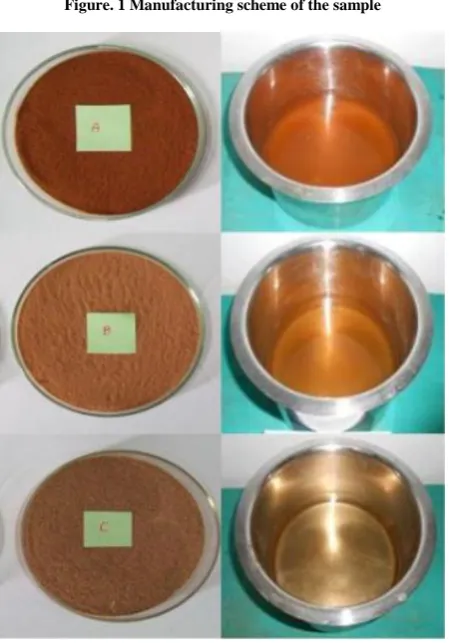
Figure. 1 Manufacturing scheme of the sample
Figure. 3 Powder microscopy of Group A : (a) Calcium oxalate crystals, (b) Group of crystaline fibres, (c) Fibres passes through medullary rays, (d) Border pitted vessels, (e) Oil globules, (f) Brown
content, (g) Group of pitted scleride, (h) Simple fibres
Figure. 4 Powder microscopy of Group B : (i) Calcium oxalate crystals, (j) Group of crystaline fibres, (k) Fibres passes through medullary rays, (l) Border pitted vessels, (m) Oil globules, (n) Brown
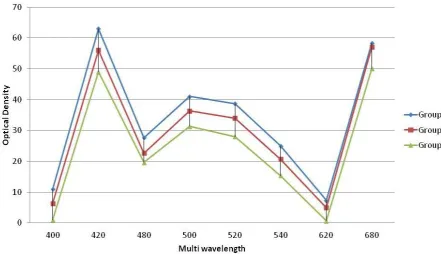
Figure. 6 Colorimetri chart for the infusions of all the groups
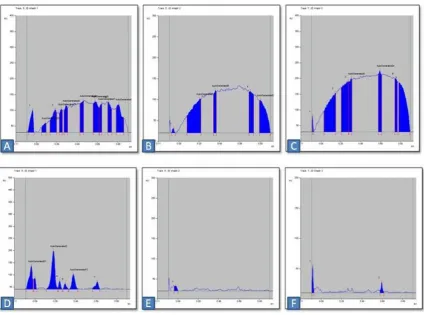
Figure. 8 HPTLC finger prints of Acacia catechu and its reused forms at 254 nm after derivatization (A) Group A, (B) Group B, (C) Group C; at 254 nm after derivatization (D) Group A, (E) Group B, (F) Group C.
RESULTS AND DISCUSSION Macroscopic features
While comparing the organoleptic characteristic of the powders, some changes were observed in colour and consistency. Colour changed from brick red to creamish and creamish to light brown in the samples respectively. Decoctions of the samples were also became lighten in colour respectively. Consistency changed from fine to fibrous powder respectively. (Table 1) (Figure 1)
Microscopic features
Diagnostic powder microscopic characters of heartwood of
Acacia catechu are oil globules, crystalline fibres, fibres passing through medullary rays, simple fibres, calcium oxalate crystals, Group of pitted scleroids, border pitted vessels, starch grains, prismatic crystals, yellowish or brown contents, lignified fibres etc.18 All above characters were found in all the three samples; but the intensity of the characters was found decreasing respectively. (Figure 2-5) Colour of dark yellowish brown contents turned to light yellowish brown. Amount of oil globules was also found decreased in sample B and C. Group of pitted scleroids and border pitted vessels were filled with brownish matter in group A, which were found with decreased
Physicochemical investigation
Loss on drying was more in group B and C in comparison to group A because in group B and C, the residue was shade dried after squeezing the decoction. Ash value, water soluble extractives and alcohol soluble extractives were decreasing in respective groups. Group A showed acidic pH, Group B showed mild acidic pH, while Group C was found almost neutral in pH value. Quantitatively tannin was found decreased in group B which is more than half to the value of group A. In group C value of tannin was negligible. (Table 2)
In qualitative estimation of various functional groups, starch and steroids were found absent in all the groups. (Table 3) Alkaloids, Flavonoids, carbohydrates and saponin were present in all three groups. Protein and tannin were present in group A and B, while they were found absent in group C. Similar heat stress may results in the denaturation of existing proteins.19
group A and group C shows more spots than group B. under 366 nm visualized condition, 7, 1 and 2 spots were found in respective groups. (Table 4) (Figure 8)
Comparatively more number of spots in chromatographic study reveals presence of newer peaks which raise the possibility formation of new chemical moieties due to processing. Similar processes like further heating of Kwatha (Khadira sara) and prolonged immersion of Khadira Kwatha (Arishta, Bhavana etc) are done in Ayurvedic pharmaceutical processes.
Data of area under curve of observed peaks reveals that it has been significantly reduced in both the samples B and C as that of A, which is suggestive of extraction of maximum extractives in first processing which is further supported by comparatively more and significant reduction in Total Tannin content of Samples B and C respectively as that of sample A. Tannins in Acacia catechu being non hydrolysable (condensed) tannins, are less likely to undergo hydrolysis as cause of newer peaks and less percentage in subsequently treated samples B and C. These tannins have high temperature of degradation (ca. 190 °C) and a high glass transition temperature (ca. 140 °C), further nullifying the possibility of thermal degradation.
CONCLUSION
In view of probable scarcity of drug source, presence of significant quantity of water soluble and methanol soluble extractives, generation of new peaks in samples B and C, it can be concluded that, residue of drug after preparation of decoction for two times may be considered for reutilization and should be studied for pharmacological activities.
REFERENCES
1. Available from (http://rainforests.mongabay.com/
deforestation/archive/India.htm on 23th June 2016 12.38 PM)
2. C. Sudhakar Reddy, Kalloli Dutta, C. S. Jha. Analysing the gross and net deforestation rates in India. Current science 2013;105:1492-1500.
3. Emily Roberson. Nature’s Pharmacy, Our Treasure Chest: Why We Must Conserve Our Natural Heritage. Tucson: Center for Biological Diversity; 2008:1-16.
4. Threatened species of medicinal plants of India, Traditional
treatment health center. (Available from
http://www.indiahomeclub.com/botanical_garden/endangere d_medicinal_plants_in_india.html on 23th June 2016 12.55 PM)
5. Sharma S, Ashtanga Samgraha Sutra Sthana 6/10-16; Dravadravya Vidnyaniya: Chapter 6, Verse 10-16, Chowkhambha Sanskrit Series first edition Varanasi, 2006. p.37-38.
6. Shingadiya RK, Dhruve K, Shukla VJ, Prajapati PK. Standard manufacturing procedure and quality parameters of
Kanakbindvarishta, International Journal of Herbal Medicine 2015; 3(1):33-36.
7. Anitha Roy, Geetha R.V, Lakshmi T. In Vitro Evaluation of Anti Mycotic Activity of Heartwood Extract of Acacia
Catechu Willd, journal of pharmacy research
2011;4(7):2010-2011.
8. Lakshmi T, Geetha R.V, Anitha roy. In vitro evaluation of anti bacterial activity of heart wood extract of acacia catechu willd on enteric pathogens, International Journal of Drug Development & Research 2011;3(3):328-334.
9. Negi et al, in vitro antimicrobial activity of Acacia catechu and its phytochemical analysis, Indian journal of microbiology 2010;50:369-374.
10.Ismail S. et al, Immunomodulatory activity of Acacia catechu, Indian Journal of Physiology and Pharmacology 2009;53(1):25-33.
11.Hirraganahalli DB et al, Hepatoprotective and antioxidant activity of standardized herbal extracts, Pharmacognosy magazine 2012;8(30):116-123.
12.Khatun M, Talukder D, Hye A. Insecticidal activity of Acacia catechu bark extract against four stored product pests. International journal of sustainable crop production 2011; 6(1):1-5.
13.Ray D. et al, Antipyretic, antidiarrhoeal, hypoglycaemic and hepatoprotective activities of ethyl acetate extract of Acacia catechu Willd. in albino rats, Indian Journal of Pharmacology 2006;38(6):408-413.
14.Monica garzuglia, Threatened, endangered and vulnerable tree species: a comparison between fra 2005 and the IUCN red list. Forest Resources Assessment Programme Working Paper 108/E, Rome, 2006.
15.Wallis TE, Text book of Pharmacognosy, 5th Ed., New Delhi: CBS Publishers & Distributors, 2002. p.571-578. 16.Lohar DR. Protocol for testing of Ayurvedic, Siddha and
Unani medicines. Ghaziabad: Pharmacopoeial Laboratory for Indian Medicine, AYUSH. Ministry of Health and Family Welfare. Government of India; 2011. p.20.
17.Kokate CK, Purohit AP, Gokhale SB. Pharmacognosy. United States: CBS Publishers and Distributors; 2005. p.169.
18.Dhruve K, Harisha CR, Prajapati PK. Pharmacognostical evaluation of Acacia catechu willd. heartwood with special reference to tyloses. International Journal of Green Pharmacy 2011;5:336-341.
19.Craita E. Bita, Tom Gerats. Plant tolerance to high temperature in a changing environment: scientific fundamentals and production of heat stress-tolerant crops. Frontiers in Plant Science 2013;4:273.
Cite this article as:
Shingadiya RK et al. Application and evaluation of multiple extraction techniques (biopharmaceutical recycling) for optimization of Khadira kwatha; An Ayurvedic formulation. Int. Res. J. Pharm. 2017;8(7):35-41 http://dx.doi.org/10.7897/2230-8407.087114
Source of support: Nil, Conflict of interest: None Declared


![Bis(μ pyridazine 3 carboxylato κ2O:O′)bis[aquadioxido(pyridazine 3 carboxylato κ2N2,O)uranium(VI)] dihydrate](data:image/gif;base64,R0lGODlhAQABAIAAAP///wAAACH5BAEAAAAALAAAAAABAAEAAAICRAEAOw==)