IJEDR1701052
International Journal of Engineering Development and Research (www.ijedr.org)336
Development of Rotary Electrode attachment and
parametric optimization of EDM, A Review and the
Design
Ankit Kayastha Hitesh Raiyani
1M.E (CAD-CAM) Research Scholar, L.J.I.E.T , GTU
2Assistant Professor, Mechanical Engineering, CAD CAM, L.J.I.E.T, GTU
________________________________________________________________________________________________________
Abstract - Electrical discharge machining (EDM) is one of the most accurate non traditional manufacturing processes available for creating tiny apertures, complex or simple shapes and geometries within parts and assemblies.In the current work, an independent machining unit has been designed and developed for performing Rotary EDM process on an existing die sinking EDM. The unit has been designed to satisfy the basic requirements for Rotary EDM. Being difficult to cut material, Hastelloyc276 suffers poor machinability for most cutting process using traditional machining method. It has excellent resistance to localized corrosion. it has wide application in flue gas desulfurization systems, pharmaceutical and food processing equipment, marine engineering, Pollution control stack liners, ducts, dampers, scrubbers, stack-gas reheaters, fans and fan housings, Chemical processing components like heat exchangers, reaction vessels, evaporators, and transfer piping etc. Comparison will be taken on Rotary EDM & Non- Rotary EDM by parametric optimization. This paper reports research on EDM relating to improvement in MRR along with some insight into Rotary mechanism of material removal. In the end of the paper THE DESIGN & scope for future research work has been outlined.
Key words - EDM, design, development of Rotary attachment, Parametric Optimization, comparison
________________________________________________________________________________________________________
I.INTRODUCTION
Electrical discharge machining (EDM), also known as spark machining, spark eroding, burning, die sinking, wire burning or wire erosion, is a manufacturing process whereby a desired shape is obtained by using electrical discharges (sparks). Material is removed from the workpiece by a series of rapidly recurring current discharges between two electrodes, separated by a dielectric liquid and subject to an electric voltage. One of the electrodes is called the tool-electrode, or simply the "tool" or "electrode," while the other is called the workpiece-electrode, or "workpiece." The process depends upon the tool and workpiece not making actual contact[12].
IJEDR1701052
International Journal of Engineering Development and Research (www.ijedr.org)337
II. RESEARCH APPROACHES ON THE EFFECT OF DIFFERENT PARAMETERS ON EDMPushpendra S bharti, S. Maheshwari, C. Sharma[1] carried out that MRR increases with the increase in discharge current and pulse-on-time. MRR increases initially, attains a maximum value and further decreases with increase in gap voltage. SR increases with the increase in discharge current and pulse-on-time. TWR increases with the increase in discharge current and flushing pressure. TWR increases initially with the increase in pulse-on-time but after certain value it decreases. ANOVA has been applied to find the level of influence of input parameters on performance measures. Discharge current is found the most influential input parameter on each performance measure. Higher discharge current increases MRR, deteriorates surface finish and leads for more tool electrode loss. Discharge current and pulse-on-time are identified as common influencing parameters for MRR, SR and TWR Muhammad Pervej Jahan & Yoke San Wong & Mustafizur Rahman[2] examined the thermal properties of the work materials
were found to have significant influence on the quality and accuracy of the microholes. Cemented tungsten carbide (WC-Co) was found to be better capable of producing burr-free and less heat affected microholes with good surface quality at the rim, good circularity, and lower hole expansion compared to austenitic stainless steel (SUS 304). In case of MRR, the WC-Co exhibits better machinability compared to SUS 304,due to low thermal conductivity, high work hardening tendency, and high ductility at elevated temperature limit.
Kun Liu, Eleonora Ferraris, Jan Peirs, Bert Lauwers and Dominiek Reynaerts[3] had resulted the influence of the process
parameters on MRR, RTW, machining accuracy and surface quality are thoroughly investigated at semi-finishing and finishing regime. Due to the strict requirements of surface integrity, they have examined semi-finishing conditions and finishing conditions. At semi-finishing conditions, the increase in the open circuit voltage and discharge current has a significant effect on the increase of the MRR and the decrease of the RTW. At finishing conditions, the increase of the open circuit voltage and the discharge Current input affects the surface quality of the EDM layer.
Reyad Mehfuz & Mohammad Yeakub Ali.[4] investigates the influence of three micro electro discharge milling process
IJEDR1701052
International Journal of Engineering Development and Research (www.ijedr.org)338
B. B. Pradhan & M. Masanta & B. R. Sarkar & B. Bhattacharyya[5] studied the influence of machining process parameterssuch as peak current, pulse-on-time, dielectric flushing pressure, and duty ratio on performance criteria like MRR, TWR, overcut (OC), and taper while machining Ti-6Al-4V by EDM machining technique have been examined, from this experiment, They were come to know that TON is the most influencing factor of micro-EDM process has the maximum percentage of contribution on MRR, OC, and taper whereas peak current, Ip has the maximum percentage of contribution on TWR Overcut of the machined micro-hole is mostly affected by the peak current and on-time and increased with increase in Ip and Ton.
B. H. Yan, C. C. Wang, W. D. Liu and F. Y. Huang [6]conclude electrical parameters significantly affect the EDM machining process more than the non-electrical parameters do, Except for the circumferential speed. The polarity of EDM largely affects the MRR. The peak current of EDM mainly affects the EWR and REWR. The polarity, the peak current, the pulse duration, and the circumferential speed of EDM mainly affect the SR.
K. D. Chattopadhyay & P. S. Satsangi & S. Verma & P. C. Sharma[7] conclude that Rotary electrical discharge machining in
induced magnetic field produced higher material removal rate and decreases electrode wear rate as compared with machining in a non-magnetic field. Signal-to-noise ratio confirmed that positive polarity is the most optimized level to produce higher MRR and lower EWR. ANOVA results with 95% confidence interval projected that the peak current and electrode rpm are the influencing parameters for MRR whereas peak current and pulse on time are the influencing parameters for EWR
Adrian Iosub, Eugen Axinte, Florin Negoescu[8] examined the EDM process is used to drill an AL/SiC hybrid composite material
using brass electrodes. The author used thermal erosion theory for mathematical model for evaluating Material removal from electrodes during EDM process .To analylyses the complex erosion process ,spark of discharge was selected for analysing the phenomena, The author used a Pareto diagram to see the main effects of input variables on material removal rate from a Pareto diagram, they observed, the material removal rate increases significantly when intensity increases and, this increase is more pronounced when the value of pulse – off time decreases. the author used the regression analysis for developing the mathematical model of MRR,and electrode wear
S. Bigot, J. Valentinčič, O. Blatnik, M. Junkar[9] focuses on the optimization of machining parameters for rough and fine
machining in micro-EDM. Tool P20 as work piece material and tungsten carbide cylinder rod having 0.170mm dia using synthetic oil as dielectric. They suggest that negative polarity is most preferable for the roughing and finishining operation
D. T. Pham, A. Ivanov, S. Bigot, K. Popov and S. Dimov[10] concentrate to study of micro electrode wear during EDM drill with
micro rod and micro tube electrodes. The author proposed a simple method for volumetric wear ratio estimation in EDM drilling based on geometrical information derived from the process. The author used tool steel p20,brass and aluminium as a work piece material and tungsten carbide having 170µm dia tube and road form. They suggest soft material should be adopted to avoid side sparking on the electrode and ensures good finishing
O. Blatnik, J. Valentinčič, M. Junkar[11] concluded that the optimal value of the current depends on the electrode size. They give
relation that greater the electrode, higher the working and ignition current and longer the discharge duration.
III. CONCLUSION
No. of papers have been reviewed to get idea of Parameters affecting the EDM process. Where it had to come to know that Electrical parameters affects more than Non Electrical parameters except circumferential speed. Discharge current & TON are identified as common influencing parameter for MRR, SR, TWR. Where the thermal properties of the work materials were found to have significant influence on the quality and accuracy of the microholes. Among all Discharge current affects more on TWR, MRR, SR
where –ve polarity is most preferable for roughing & finishing and soft material should be adopted to avoid side sparking on the
electrode and ensures good finishing.
IV. DESIGN & DEVELOPMENT OF ROTARY ATTACHMENT
To enable performing the Rotary EDM process on existing dies sinking EDM machines a rotary electrode unit attachment has been designed and developed. The rotary EDM unit along with the Z-NC EDM machine on which it is mounted. The unit has been designed to fulfill the basic requirements of rotary EDM: rotating tool. Additionally, the entire arrangement is in the form of an independent unit which can be attached to existing EDM machines to perform rotary EDM without any modifications in the existing machines. The rotary electrode EDM unit comprises a spindle shaft supported by two supporting frame (upper and lower supporting frame-plate) support through a pair of roller bearings. The shaft can rotate relative to the machine head. A Tool holder (hand drill chuck) is mounted at the other end for holding electrode tools. The motor for Spindle rotation is mounted on the support frame and power is transmitted from the motor through a belt-pulley system.
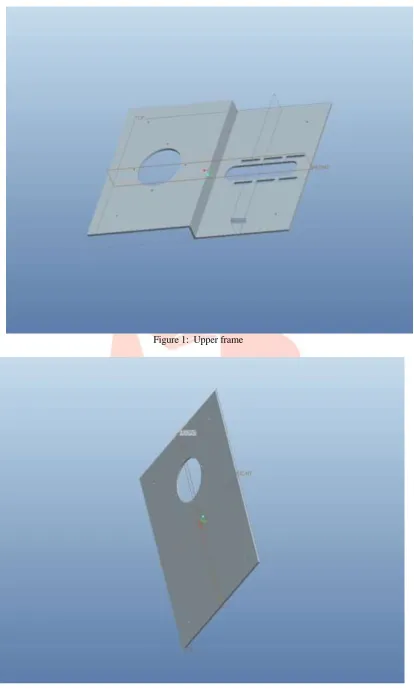
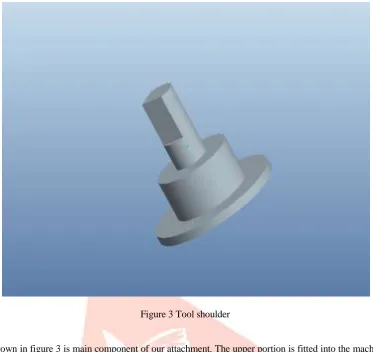
The rotary electrode EDM attachment can be functionally divided into six units. The functional units are: 1. Two support frame
2. Tool shoulder 3. Spindle shaft 4. Drive unit
5. Tool holding device 6. Bearing house 1. Two support frame:
IJEDR1701052
International Journal of Engineering Development and Research (www.ijedr.org)339
Figure 1: Upper frameIJEDR1701052
International Journal of Engineering Development and Research (www.ijedr.org)340
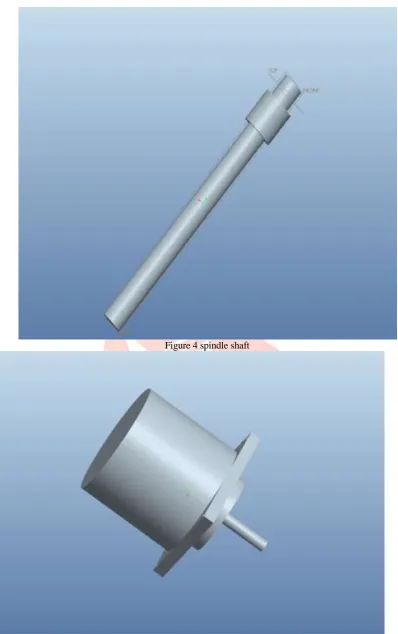
Figure 3 Tool shoulder2. Tool shoulder
Tool shoulder as shown in figure 3 is main component of our attachment. The upper portion is fitted into the machine head. The lower portion consisting bearing house to support the spindle house.
3. Spindle shaft:
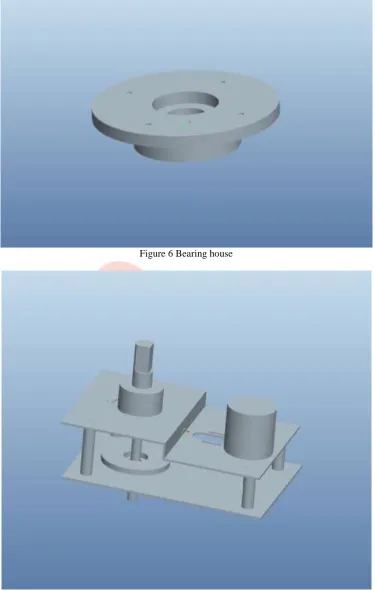
The shaft is rotated relative to the machine spindle. The electrode tool is mounted at the lower end of the shaft through the hand drill chuck. The spindle shaft is shown in figure 4
4. Drive unit:
IJEDR1701052
International Journal of Engineering Development and Research (www.ijedr.org)341
Figure 4 spindle shaftFigure 5 D.C motor
5. Tool holding device
The tool electrode is held in a hand drill chuck. It is fitted with spindle shaft 6. Bearing house
IJEDR1701052
International Journal of Engineering Development and Research (www.ijedr.org)342
Figure 6 Bearing houseFigure 7 Complete assembly of rotary electrode attachment
Figure 7 shows the complete assembly for rotary electrode attachment, which is directly fitted in the machine head of EDM.
V. REFERENCES
[1] Pushpendra s bharti, S. maheshwari, c. Sharma “Experimental investigation of Inconel 718 during die-sinking electric discharge machining” International Journal of Engineering Science and Technology, Vol. 2(11), 2010, 6464-6473.
[2] Muhammad Pervej Jahan & Yoke San Wong & Mustafizur Rahman “A comparative experimental investigation of deep hole
micro-EDM drilling capability for cemented carbide (WC-Co) against austenitic stainless steel (SUS 304)” International
IJEDR1701052
International Journal of Engineering Development and Research (www.ijedr.org)343
[3] Kun Liu, Eleonora Ferraris, Jan Peirs, Bert Lauwers and Dominiek Reynaerts “Micro-EDM process investigation of Si3N4–TiN ceramic composites for the development of micro-fuel-based power units” International Journal of Manufacturing Research, Vol. 3, No. 1, 2008
[4] Reyad Mehfuz & Mohammad Yeakub Ali. “Investigation of machining parameters for the multiple-response optimization of micro Electro discharge milling” International Journal of Advance Manufacturing Technology (2009) 43:264–275 DOI 10.1007/s00170-008-1705-0
[5] B. B. Pradhan & M. Masanta & B. R. Sarkar & B. Bhattacharyya Investigation of electro-discharge micro-machining of titanium super alloy International Journal of Advance Manufacturing Technology (2009) 43:264–275 DOI 10.1007/s00170-008-1705-0
[6] 6. B. H. Yan, C. C. Wang, W. D. Liu and F. Y. Huang Machining Characteristics of Al2O3/6061Al Composite using Rotary EDM with a Disk like Electrode The International Journal of Advanced Manufacturing Technology (2000) 16:322–333, 2000 Springer-Verlag London Limited
[7] K. D. Chattopadhyay & P. S. Satsangi & S. Verma & P. C. Sharma Analysis of rotary electrical discharge machining characteristics in reversal magnetic field for copper-en8 steel system. International Journal of Advanced Manufacturing Technology (2008) 38:925–937 DOI 10.1007/s00170-007-1149-y
[8] Adrian Iosub, Eugen Axinte, Florin Negoescu A study about micro-drilling by electrical discharge method of an Al/sic hybrid composite International journal of academic research vol. 2. no. 3. may 2010
[9] S. Bigot, J. Valentinčič, O. Blatnik, M. Junkar Micro EDM parameters optimization Imrc,Cardiff university, Publication Sustainable Technology
[10] D. T. Pham, A. Ivanov, S. Bigot, K. Popov and S. Dimov An Investigation of Tube and Rod Electrode Wear in Micro EDM Drilling International Journal of Advanced Manufacturing Technology(2007)33:103-109,DOI 10.1007/s00170-006-0639-7 [11] O. Blatnik, J. Valentinčič, M. Junkar Comparison of optimal machining parameters of sinking EDM and micro EDM processes
Multi-material Micro Manufacture W. Menz & S. Dimov C) 200X. Published by Elsevier Ltd.