INTRODUCTION
Meat and leather processing industries produce sizeable quantities of keratin wastes, their further utilisation is quite small at present and is mostly limited to produce energy (incinerating). Sheep wool unsuitable for processing in the textile industry belongs to most important keratin wastes. The most typical indicator of proteins of keratin group is high content of amino acids cystine, cysteine and methionine. Total content of sulphur in keratin ranges from 2 to 5 % (related to dry matter). High content of sulphurous amino acids is a consequence of disulphide bonds content; for this reason keratins are water-insoluble, resist action of diluted acids, alkalis and enzymes 1-4.
Due to its non-reactive character and strong resilience, keratin can be processed only with
www.orientjchem.org
CODEN: OJCHEG 2011, Vol. 27, No. (4): Pg. 1303-1309
Est. 1984
An International Open Free Access, Peer Reviewed Research Journal
Producing Keratin Hydrolysates from Sheep Wool
PAVEL MOKREJS
*, ONDREJ KREJCI
and PETR SVOBODA
Tomas Bata University, Faculty of Technology, Department of Polymeric Engineering, Nam. TGM 275, 762 72 Zlin, The Czech Republic.
*Corresponding author: E-mail: [email protected] (Received: September 01, 2011; Accepted: October 05, 2011)
ABSTRACT
Manuscript describes producing keratin hydrolysate from sheep wool through two-stage technology whose principle consists in first having wool processed in an alkaline environment during the first stage, and then effecting hydrolysis in the second stage through the action of proteolytic
enzyme. Experiments were planned in accordance with factor schemes of 23 types in which factors
under study were influence of first stage hydrolysis duration (6-24 hours), duration of hydrolysis second stage (6-24 hours) and quantity of added proteolytic enzyme (1-5 %) on quantity of decomposed wool.
Key words: By-products, Enzyme hydrolysis, Keratin hydrolysate, Wool, 2-stage hydrolysis.
great difficulty; for this reason it has to be partly hydrolysed. Many different procedures and methods can be applied to obtain keratin hydrolysates. Breakdown of keratins by means of hydroxides has been known quite long; alkalis applied most are NaOH, KOH and Ca(OH)2 5, 6. Gousterova et al decomposed wool in a solution of KOH and NaOH and heated the obtained mixture by microwave technique 7. Abouheif et al broke down wool and feathers by employing a 3 % solution of boiling NaOH 8.
hydrolysates; nevertheless, they have a number of disadvantages – employment of chemicals in high concentrations or quite drastic breakdown conditions. Lately, breakdown of keratin has rather utilised enzymes (mostly produced by keratinolytic bacteria) but current proteinases may also be employed 11. Evangelou et al broke down wool in an environment of NaHCO3 (pH = 8.1) with addition of proteinase for 7-14 days at 50 oC, and the mixture was stirred every 12 hours 12. Breakdown of wool and feathers employing keratinolytic bacteria was described by Hood and Healy 13. Degreased and dried wool was placed in fermenting tub, a bacterial culture was added and the mix in fermenting tub was kept for prescribed time at 28 oC. A similar approach was also described by Grazziotin et al who decomposed keratin from feathers using Vibrio bacteria at 30 oC 14, 15.
Keratin hydrolysates, owing to their high protein content (up to 80 %), may be used as a supplement for cattle feed 16. In the cosmetics industr y, keratin hydrolysates are applied as additions to shampoos and other preparations for hair and fingernails as well as to creams. Keratin fragments bind to damaged hair structures better and aid regeneration 17, 18. Keratin hydrolysates may be similarly used in medicine for producing preparations to aid healing of wounds 19. Hydrolysates of keratin can be applied as carriers for aromatic substances and other food additives or as protective films and coatings for foodstuffs. They may also be used to treat fibres and wood 20. The objectives of this contribution
1. Processing sheep wool by combined 2-stage alkaline-enzymatic hydrolysis into keratin hydrolysate.
2. Investigating influence of technological conditions (duration of first and 2nd hydrolysis stage and addition of enzyme) on efficiency of sheep wool decomposition.
3. Proposing optimum conditions for hydrolysis. 4. Characterising basic properties of selected keratin hydrolysates. Employed enzyme was currently available proteinase Esperase 6.0 T (supplied by Novozymes, Denmark). Favourable efficiency of this enzyme was confirmed already earlier with hydrolysis of waste collagen raw materials 21.
MATERIAL AND METHODS
Raw sheep wool was supplied from slaughterhouses in the Czech Republic; first analyses were performed by standard methods 22-24. Composition of raw sheep wool was as follows: dry matter content = 91.6 %; in dry matter: nitrogen content = 12.2 %, fat content = 8.2 %, sulphur content = 2.5 %, ash content = 2.3 %. Raw sheep wool was first washed several times in a sufficient excess of warm water; the water was mechanically squeezed out and wool was dried in a drier for 48 hours at 50 oC. Wool was then degreased by means of enzyme Lipex 100 T (Novozymes, Denmark) through the procedure as follows. Wool was mixed with water in ratio 1:50, pH level was adjusted to 8±0.2 with added NaOH solution (1 % conc.), 1 % enzyme was added (related to mass of dry wool) and degreasing proceeded in an incubator for 24 hours at 40±2 oC; during the first 12 hours of degreasing, the contents were shortly mixed in 1-hour intervals. After degreasing, the mix was filtered through a sieve; wool was washed with adequate water and dried in a hot-air drier to constant mass at 103±2 oC. Dried wool was finally ground to a particle size of 1 mm and prior to breakdown experiments proper was kept in a desiccator (over dried silica gel) at room temperature.
Apparatus and equipment: knifing mill Fritsch Pulverisette 19 (Germany), water bath GFL 1003 (Germany), shaft stirrer Heidolph RZR1 (Germany), drier WTB Binder E/B 28 (Germany), incubator WTC Binder B53 (Germany), electronic balances KERN 770/GS/GJ (Germany), rotary vacuum evaporator Laborota 4000 (Germany), pH-meter WTW pH526 (Germany), mineralization apparatus Hach Digesdahl (USA), muffle furnace Nabertherm L 9/S 27 (Germany), Parnas-Wagner distillation apparatus, Soxhlet extraction apparatus, PA cloth (pore diameter 150 µm), low-density filter paper. Chemicals: powdery proteinase Esperase 6.0 T, powder y lipase Lipex 100 T (Novozymes, Denmark). Ca(OH)2 and HCl were supplied by IPL, the Czech Republic.
of keratin wastes from poultry farms 25-27. The principle of this processing method consists in having keratin material during the 1st stage incubated in an alkaline environment (pH H≈ 11.5), thus bringing about its swelling. In the 2nd stage, during which setting optimum conditions (pH and temperature) is essential for maximum efficiency of proteolytic enzyme, easy diffusion of enzyme into the keratin matrix takes place in swelled keratin material, thus splitting the –S–S– and –CONH– bonds of molecules and producing a soluble product (hydrolysate).
In order to sur vey the influence of investigated factors during hydrolysis (mainly duration, temperature, additions of chemicals) on assessed quantity (hydrolysis efficiency expressed as percentage of decomposed starting material), so-called factor tests are often employed when detailing work. It was decided in our case to carry out sheep wool breakdown trials in accordance with factor schemes of 23 types (3 studied factors on two levels – minimal and maximal) with 2 center points. As for investigated factors following technological conditions of breakdown were selected:
factor A – hydrolysis 1st stage time: bottom limit 6 h, upper limit 24 h
factor B – hydrolysis 2nd stage time: bottom limit 6 h, upper limit 24 h
factor C – quantity of added enzyme (related to mass of dry wool): bottom limit 1 %, upper limit 5 %.
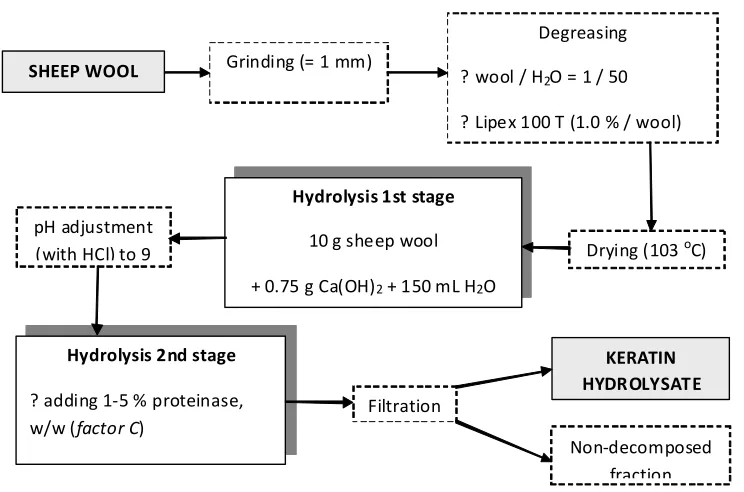
Processing of degreased and dried (103 oC) sheep wool into keratin hydrolysate (also see scheme in Fig. 1) proceeded in accordance with the following working procedure. In the first processing stage, 10 g wool was weighed into an Erlenmayer flask, 0.75 g Ca(OH)2 was added and also 150 mL distilled water pre-heated to 80±0.5 oC. The flask was placed in a pre-heated water bath (80±0.5 oC) and the mixture was stirred with a shaft stirrer for a time corresponding to a quarter of the overall planned duration of hydrolysis first stage (factor A). When this time passed, flask was enclosed and static incubation continued at same temperature for the remaining 3/4 of hydrolysis first stage overall duration. On finishing incubation, contents in flask were cooled to 60±0.5 oC, flask
was placed in a pre-heated water bath (60±0.5 oC) and pH of the mix was adjusted to 9.0±0.2 with added HCl (5 % solution). Processing of sheep wool continued in the second stage, planned quantity of enzyme Esperase was added in accordance with factor C – 1 % (w/w) enzyme at bottom limit (corresponding to 0.1 g enzyme) or 5 % enzyme at upper limit (corresponding to 0.5 g enzyme). The mix was stirred with shaft stirrer at 60±0.5 oC for a time corresponding to a quarter of the overall planned duration of hydrolysis second stage (factor B). When this time passed, flask was enclosed and static incubation continued at same temperature for the remaining 3/4 of hydrolysis second stage overall duration. When hydrolysis finished, keratin hydrolysate was separated from residual non-decomposed wool fraction by filtering through PAD cloth (pore diameter 150 µm) folded twenty-fold. Keratin hydrolysate was then again filtered through low-density filter paper. Non-decomposed wool fraction (on PAD cloth and filter paper) was dried in drier at 103±2 oC to constant mass and after cooling in desiccator (filled with dried silica gel) the quantity of non-decomposed wool was deter mined by gravimetr y. Keratin hydrolysate (including washing water) was heated to 85±2 oC and kept there for 10 min, thus inactivating employed enzyme. Keratin hydrolysate was then thickened on vacuum evaporator at 60±2 oC to about a half of its volume, then poured on Teflon desks and dried at 103±2 oC for 12 hours. Dried thin film of keratin hydrolysate was ground to powder.
RESULTS AND DISCUSSION
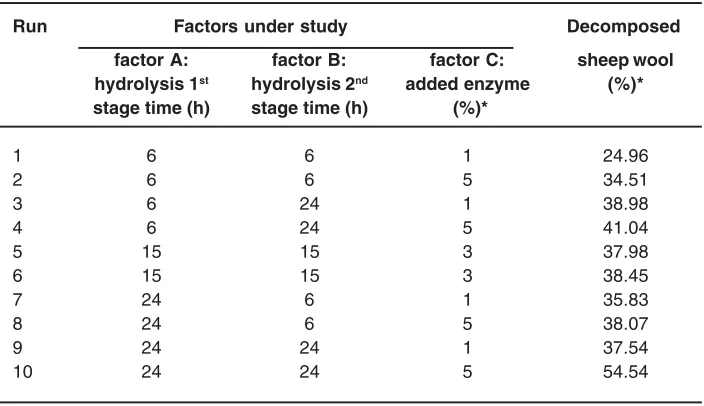
Table 1: Results of sheep wool breakdown through two-stage alkaline-enzymatic hydrolysis
Run Factors under study Decomposed
factor A: factor B: factor C: sheep wool
hydrolysis 1st hydrolysis 2nd added enzyme (%)*
stage time (h) stage time (h) (%)*
1 6 6 1 24.96
2 6 6 5 34.51
3 6 24 1 38.98
4 6 24 5 41.04
5 15 15 3 37.98
6 15 15 3 38.45
7 24 6 1 35.83
8 24 6 5 38.07
9 24 24 1 37.54
10 24 24 5 54.54
* related to mass of dry wool
Table 2: Composition of raw sheep wool and selected keratin hydrolysates
Parameter* Raw Keratin hydrolysate produced in sheep accordance with experiment No
wool 1 10
Nitrogen 12.2 10.1 11.0
Ash 2.3 19.9 15.3
Sulphur 2.5 1.8 3.2
* based on dry matter
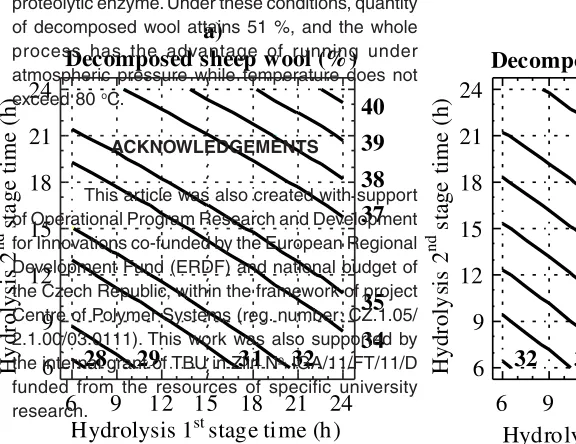
With a view to surveying the influence of factors studied in hydrolysis on hydrolysis efficiency (quantity of decomposed wool), measured data were processed in statistic program Statgraphics 6.0 (Manugistic Inc, USA, 1992). The processing resulted in contour graphs (Fig. 3) indicating the influence of hydrolysis first stage time (factor A, x-axis) and hydrolysis second stage time (factor B, y-axis) on quantity of decomposed wool at minimum (1 %, see Fig. 3a) and maximum (5 %, see Fig. 3b) quantity of added enzyme (factor C). As is obvious in graphs, quantity of broken down wool is quite significantly affected by mutual combinations of factors A and B. In case 1 % enzyme was added (Fig. 3a), and factors A and B were at their minimum
(6 and 6 hours), 28 % wool was decomposed, whereas at their maximum levels (24 and 24 hours) that quantity reached as much as 40 % wool. In case 5 % enzyme was added (Fig. 3b), difference between minimum and maximum quantities of decomposed wool was even higher and maximum breakdown efficiency was about 51 %.
SHEEP WOOL
Degreasing
? wool / H2O = 1 / 50
? Lipex 100 T (1.0 % / wool) Grinding (= 1 mm)
Drying (103 oC)
Hydrolysis 1st stage
10 g sheep wool
+ 0.75 g Ca(OH)2 + 150 mL H2O
Hydrolysis 2nd stage
? adding 1-5 % proteinase,
w/w (factor C)
pH adjustment (with HCl) to 9
Filtration
KERATIN HYDROLYSATE
Non-decomposed fraction
w/w = weigh related to mass of dry wool
Fig. 1: Block diagram of two-stage hydrolytic processing of sheep wool into keratin hydrolysate
23
28
33
38
43
48
53
58
26
30
34
38
42
46
50
54
predicted efficiency (%)
o
b
ser
v
ed
ef
fi
ci
ency
(%
)
Fig. 2: Diagnostic plot - comparison of observed and predicted values of wool
breakdown efficiency in %
6
9 12 15
18
21 24
6
9
12
15
18
21
24
28
29
31
32
34
35
37
38
39
40
a)
Decomposed sheep wool (%)
Hy
d
ro
lys
is
2
nd
st
a
g
e t
ime
(
h
)
Hydrolysis 1
ststage time (h)
6
9
Hydroly
6
9
12
15
18
21
24
32
3
Decompo
Hy
dr
ol
y
si
s
2
nd
st
ag
e
t
im
e (
h
)
Fig. 3: Influence of hydrolysis first stage time and hydrolysis second stage time on quantity of decomposed wool; (a) 1 % added enzyme, (b) 5 % added enzyme
CONCLUSION
Processing sheep wool into keratin hydrolysate proceeded through two-stage technology whose principle consists in having starting material processed in the first stage in an alkaline environment (pH H≈ 11.5) thus effecting its swelling, which facilitates easy action by proteolytic enzyme in the second stage where splitting of disulphide and peptide bonds of protein takes place. It was found that processing time during both stages of the technological procedure significantly affects overall process efficiency; the same is true of quantity of added enzyme. Optimum conditions for processing sheep wool into keratin hydrolysate: processing starting material during first stage for 24 hours at 80 oC in an environment of Ca(OH)
2, continuing in the second stage (after adjusting pH to 9) for 24 hours at 60 oC with a 5 % addition of
proteolytic enzyme. Under these conditions, quantity of decomposed wool attains 51 %, and the whole process has the advantage of running under atmospheric pressure while temperature does not exceed 80 oC.
ACKNOWLEDGEMENTS
This article was also created with support of Operational Program Research and Development for Innovations co-funded by the European Regional Development Fund (ERDF) and national budget of the Czech Republic, within the framework of project Centre of Polymer Systems (reg. number: CZ.1.05/ 2.1.00/03.0111). This work was also supported by the internal grant of TBU in Zlin No. IGA/11/FT/11/D funded from the resources of specific university research.
REFERENCES
1. Blazej A., Galatik A., Galatik A.Jn. and Mladek M., Technology of hides and furs, SNTL, Prague, 61 (1984).
2. Brandelli, A., Food Bioprocess Technol., 1:
105 (2008).
3. Meyers, M., Chen, P., Lin, A. and Seki, Y., Prog. Mater. Sci., 53: 1 (2008).
science and technology, Woodhead Publishing, Cambridge, 130 (2002). 5. Coward-Kelly, G., Chang, V.S., Agbogbo, F.K.
and Holtzapple, M.T., Bioresour. Technol., 97: 1337 (2006).
6. Coward-Kelly, G., Chang, V.S., Agbogbo, F.K. and Holtzapple, M.T., Bioresour. Technol., 97: 1344 (2006).
7. Gousterova, A., Braikova, D., Goshev, I., Christov, P., Tishinov, K., Vasileva-Tonkova, E., Haertle, T. and Nedkov, P., Lett. Appl. Microbiol., 40: 335 (2005).
8. Abouheif, M.A., Basmaeil, S., Metwally, H. and Masoud, S., Anim. Feed Sci. Technol., 13, 215 (1995).
9. Kurbanoglu, E.B. and Algur, O.F., Food Control, 17: 238 (2006).
10. Schrooyen, P., Feather keratins: modification and film formation, Ph.D. Dissertation, University of Twente, Enschede, the Netherlands (1999).
11. Onifade, A.A., Al-Sane, N.A., Al-Musallam, A.A. and Al-Zarban, S., Bioresour. Technol., 66: 1 (1998).
12. Evangelou, M.W.H., Ebel, M., Koerner, A. and Schaeffer, A., Chemosphere, 72: 525 (2008). 13. Hood, C. M. and Healy, M.G., Conserv.
Recycl., 11: 179 (1994).
14. Grazziotin, A., Pimentel, F.A., de Jong, E.V. and Brandelli, A., Anim. Feed Sci. Technol., 126: 135 (2006).
15. Grazziotin, A., Pimentel, F.A., Sangali, S., de Jong, E.V. and Brandelli, A., Bioresour.
Technol., 98: 3172 (2007).
16. Dalev, P.G., Bioresour. Technol., 48: 265 (1994).
17. Secchi, G., Clin. Dermatol., 26: 321 (2008). 18. Karthikeyan, R., Balaji, S. and Sehgal, P.K.,
J. Sci. Ind. Res., 66: 710 (2007).
19. Van Dyke M.E., Blanchard Ch.R., Timmons S.F., Siller-Jackson A.J. and Smith R.A., Soluble Keratin Peptide, U.S. Patent 6270791 (2001).
20. Kawahara, Y., Endo, R. and Kimura, T., Text. Res. J., 74: 93 (2004).
21. Kupec, J., Dvorackova, M., Rudlova, S., Ruzicka, J. and Kolomaznik, K., J. Am. Leather Chem. Assoc., 97: 349 (2002). 22. Davidek J., Hrdlicka J., Karvanek M., Pokorny
J., Seifert J. and Velisek, J. Handbook of Food Analysis, SNTL, Prague, 115 (1985). 23. AOAC 955.48, Microchemical Determination
of Sulfur, Official Methods of Analysis of AOAC International, (1998).
24. AOAC 960.52, Microchemical Determination of Nitrogen, Official Methods of Analysis of AOAC International, (1998).
25. Kolomaznik, K., Mladek, M., Langmaier, F., Janacova, D. and Taylor, M.M., J. Am. Leather Chem. Assoc., 95: 55 (2000).
26. Langmaier, F., Kolomaznik, K., Sukop, S. and Mladek, M., J. Am. Leather Chem. Assoc., 83: 187 (1999).