INTRODUCTION
Some of the transition metals act as micronutrient and perform various biological functions in plants and animal kingdom. Micronutrients are elements which are essential for plant growth , but are required in much smaller amounts than those of the primary nutrients ;nitrogen, phosphorus and potassium. The micronutrients are Boron(B), Copper(Cu), Iron(Fe), Mangnese(Mn,) Molybdenum(Mo), Zinc(Zn) and Chloride(Cl)1,2. The co.ordination chemistry has developed into a full fledged branch of chemistry during 19th century. The co.ordination compounds
www.orientjchem.org
Est. 1984
An International Open Free Access, Peer Reviewed Research Journal CODEN: OJCHEG 2013, Vol. 29, No. (2): Pg. 807-812
Structural and Biological Studies of Complexes
Containing Metals With Micronutrient Properties
GULREZ NIZAMI, POONAM GARG and SHAMIM AHMAD
Department of Chemistry Jauhar College of Engineering and Technology, Rampur - 244 901, India. *Corresponding author E-mail: [email protected]
(Received: January 18, 2013; Accepted: March 16, 2013)
ABSTRACT
The complexes of some micro-nutrient metals [Fe(III) , Mn(III) and Mn(II)] were prepared with thiosemicarbazide, 4-aminoantipyrine, methylacetophenone and 2-hydroxy5-chloro acetophenone , having general formula formula [Fe (C9H10N3SCl)2 2H2O]3Cl, [Mn (C9H10N3SCl)2 H2O]3Cl [Fe (C20H20N3O2)2.]Cl; [Mn (C20H20N3O2)2.] Cl .and [Mn (C20H20N3O2)2.] . These adducts have been characterized on the basis of elemental analyses, molar conductance, infrared, visible spectra, magnetic susceptibility measurements and TGA . The complexes prepared were screened for biological studies at IVRI Bareilly.The ligand behaves in bidentate manner. The complexes of Fe(III), Mn(III) and Mn(II) of 5-methyl2-hydroxyacetophenoneantipyrine and Fe(III),Mn(II) of 2-hydroxy5-chloroacetophenonethiosemicarbazone) are paramagnetic in character and have octahedral geometry . The complexes of Mn(III) of 5-methyl 2-hydroxy5-acetophenonethiosemicarbazone is also paramagnetic in nature and has square pyramidal geometry .
Key words: Square pyramidal geometry, Octahedral geometry, Molar conductance.
The Schiff bases contain azomethine linkage which is obtained by the condensation of amino and carbonyl compounds. The amino compounds to be used were 4-amino antipyrine and thiosemicarbazide, which are biologically potent. Hence the complexes of biologically active ligands are formed with the Micro-nutrient metals(FeIII, MnIII and MnII) .
MATERIALS AND METHODS
The carbonyl compounds and the compounds of amino group used for the preparation of Schiff bases were of AR grade or equivalent purity. The carbonyl compound 5-chloro2-hydroxyacetophenone and 5-methyl2-hydroxyacetophenone are used while amino compounds Thiosemicarbazide and 4-Amino antipyrine were used for the preparation of Schiff base. The metal salts used were FeCl3 MnCl2 and MnCl3 (Glaxo). Other chemicals like ethanol, methanol (Glaxo), DMF (Rankem), DMSO (Fluka) etc were of highest purity and used as such.
Infrared spectra and elemental analyses were carried out at CDRI (Lucknow). The magnetic susceptibility was measured by GOUY method. CuSO4 .5H2O was used as calibrant. U.V-visible
spectra were recorded with the help of Beckmans-DU at Chemistry Deptt. Bareilly College Bareilly. The conductivity measurement was carried out at room temperature and 10-3M dilution using conductivity bridge model 910. The thermo gravimetric analysis was carried out at G.N.D. University Amritsar. Anti bacterial and anti fungal activities were carried out at IVRI Izzat Nagar Bareilly.
EXPERIMENTAL Preparation of ligands
The ligands (Schiff bases) were prepared by the condensation of Carbonyl compounds and compounds containing amino group. 0.91gm of Thiosemicarbazide was dissolved in Ethanol and refluxed on water bath for half an hour. Then 1.70 gm 5-methyl 2- hydroxy acetophenone was added to it and refluxed for about five hours.
Preparation of complexes
All the metal complexes were synthesized by adding respective metal salts solution as Ferric chloride(Rankem), MnCl3(Fluka) and MnCl2(BDH) dropwise to the solution of the ligands (5- Chloro 2-hydroxy acetophenone thiosemicarbazone and 5-m e t h y l 2 - h y d r o x y a c e t o p h e n o n e a n t i p y r i n e ) prepared. The precipitate obtained was filtered and washed with suitable solvents (DMSO and DMF) and dried in vacumm desiccator over fused P4O10 .
RESULTS AND DISCUSSION
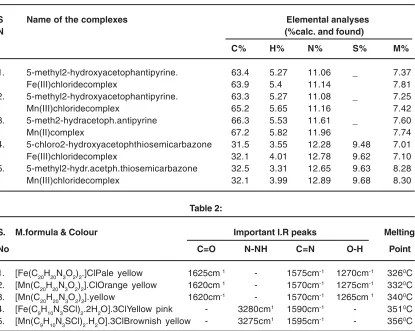
The analytical data is indicative of 1:2 metal-ligand stoichiometry of the complexes .On the basis of the molecular formula of the chelate comes out to be [Fe(C9H10N3SCl)2.2H2O]3Cl, [Mn (C9H10N3SCl)2.H2O]3Cl, and [Fe(C20H20N3O2)2.]Cl; [Mn (C20H20N3O2)2.]Cl . [Mn (C20H20N3O2)2.] for 5-Chloro 2- hydroxy acetophenone
thiosemi-carbazone and 5-methyl 2-hydroxyacetophenone-antipyrine respectively. The vast difference in the melting points of the ligands and their corresponding complexes suggested the formation of the adduct .
The values of molar conductance in DMF and DMSO at 10-3 M dilution (250C) indicated 1:3 electrolytic nature of the complexes of Fe(III) and Mn(III) in 5-chloro2-hydroxyacetopheno-nethiosemicarbaz onechloride complexes .While 1:1 electrolytic nature is found in Mn(III) and Fe(III) complexes of 5-methyl2-hydroxyacetophe-noneantipyrine chloride complexes. The Mn(II) complex of respective ligand shows non electrolytic nature.
The magnetic susceptibility was measured by Gouy method and the spin only value of the magnetic moments were calculated from this
Table 2:
S. M.formula & Colour Important I.R peaks Melting
No C=O N-NH C=N O-H Point
1. [Fe(C20H20N3O2)2.]ClPale yellow 1625cm 1 - 1575cm-1 1270cm-1 3260C 2. [Mn(C20H20N3O2)2].ClOrange yellow 1620cm 1 - 1570cm-1 1275cm-1 3320C 3. [Mn(C20H20N3O2)2].yellow 1620cm-1 - 1570cm-1 1265cm 1 3400C 4. [Fe(C9H10N3SCl)2.2H2O].3ClYellow pink - 3280cm1 1590cm-1 - 3510C 5. [Mn(C9H10N3SCl)2.H2O].3ClBrownish yellow - 3275cm1 1595cm-1 - 3560C
Table 1:
S Name of the complexes Elemental analyses
N (%calc. and found)
C% H% N% S% M%
1. 5-methyl2-hydroxyacetophantipyrine. 63.4 5.27 11.06 _ 7.37
Fe(III)chloridecomplex 63.9 5.4 11.14 7.81
2. 5-methyl2-hydroxyacetophantipyrine. 63.3 5.27 11.08 _ 7.25
Mn(III)chloridecomplex 65.2 5.65 11.16 7.42
3. 5-meth2-hydracetoph.antipyrine 66.3 5.53 11.61 _ 7.60
Mn(II)complex 67.2 5.82 11.96 7.74
4. 5-chloro2-hydroxyacetophthiosemicarbazone 31.5 3.55 12.28 9.48 7.01
Fe(III)chloridecomplex 32.1 4.01 12.78 9.62 7.10
5. 5-methyl2-hydr.acetph.thiosemicarbazone 32.5 3.31 12.65 9.63 8.28
Where M= Fe(III),Mn(III) and Mn(II)
(a) 5-methyl 2-hydroxyacetophenoneantipyrineMn(III)chloride complex (b) 5-methyl 2-hydroxyacetophenoneantipyrineMn(II) complex (c) 5-methyl 2-hydroxyacetophenoneantipyrineFe(III)chloride complex
Scheme 1: Where M= Fe(III),Mn(III)
(d) 5-chloro2-hydroxyacetophenonethiosemicarbazoneFe(III)chloridcomplex (e) 5chloro2-hydroxyacetophenonethiosemicarbazoneMn(III)chloride complex
value of magnetic susceptibility which came out to be 5.95 BM in Fe(III)12, 4.93 BM in Mn(III) 12 and 5.70BM for Mn(II) chloride complexes13 .Which suggested the paramagnetic nature and octahedral environment around the metal ion Fe(III) and Mn(II) but in Mn(III) the value is in agreement with the reputed value of square pyramidal for Mn+3 complexes .
The electronic spectrum of the 2-hydroxychloroacetophenone thiosemicarbazone and 5-methyl2-hydroxyacetophenone Mn(III) complexes
showed bands at 13600, 16500 and 18000cm-1 which may be due to 5B
1 → 5B
2, 5B
1 → 3A
1 and 5B
1 ’! 5E transitions respectively suggesting square pyramidal geometry of the complex14.
The electronic spectra of the Fe(III) complexes exhibited three bands at 11225, 21730 and 27770 cm-1 corresponding to 6A
1g → 4T
1g, 6A
1g
→4T 2g and
6A 1g→
4E
The electronic spectra of the Mn(II) complexes exhibit three bands at 17000, 24000 and 28000cm-1 corresponding to the transitions to 6A
1g → 4T
1g,(v1), 6A
1g → 4T
1g(v2) and 6A
1g → 4E
g (v3) 16.
The comparison of the IR spectra of the ligands and complex 2-hydroxy5-chloroacetophenone thiosemicarbazone revealed bidentate nature of the ligand . IR spectra of the free ligand exhibited characterstic bands at 3280, 1610,830,1045 and 1690cm-1 due to νN-NH , VC=N ,νC=S , coupled vibrations of νC=S with vN-N and -N-C-N- deformation respectively17. A comparative study of IR spectra of the ligand and its complexes showed that the bands due to vN-H disappeared in the IR spectrum of the complex indicating elimination of the proton from this group. The band due to vC=S was absent from its position in the ir spectrum of the complex indicating change in character of this moiety on co-ordination of sulphur atom with the metal ion18,19 .The bands in the free ligand at 3440 and 3320 cm-1 assignable to asymmetric and symmetric mode of –NH2 group respectively remain at the same position in the IR spectrum of the complex suggesting non involvement of this group in co.ordination20.
The fore said co.ordination pattern is further supported by the appearance of non ligand band in the IR spectrum of the chelate at the range of 435-450 and 250-300cm-1 which may be assigned to vM-O and vM-N vibrations.
The IR spectrum of the complexes exhibited two new bands at the range of 3370-3410 and 870-890 cm-1,which suggested the presence of co.ordinated water molecule. This is also indicated by thermogram which shows the percent weight loss at 150-170°C corresponding to the loss of two water molecules and presence of one water molecule in their respective complexes21.
The analytical data indicated 1:2 metal-ligand ratio for the 5-methyl2-hydroxyacetophenoneantipyrine Fe(III) ,Mn(III) and Mn(II) chloride complexes. Hence the M.F formula of the adduct may be written as[Fe(C20H20N3O2)2.]Cl and [Mn(C20H20N3O2)2].Cl and [Mn(C20H20N3O2)2.] respectively . The m.p of the metal complexes was found to be much higher than that of the ligand
which indicated the formation of the adduct. The I.R. spectra of the complexes of 5- methyl2-hydroxyacetophenoneantipyrine on comparison with that of ligands indicated co-ordination through cyclic C=O, phenolic oxygen and azomethine nitrogen. This indicated monobasic tridentate nature of the ligand. The band due to íOH present at 3500 cm-1 which disappeared on complexation and appearance of new band at 1250 to 1270 cm-1 which indicated the bonding of ionized phenolic oxygen to the metal ion22. The strong band at 1590 cm-1 characterstics of the azomethine group in the free Schiff base has shifted to lower frequency of 1560-1570 cm-1 in the complexes indicating that azomethine N is one of the co-coordinating atoms in schiff base. The band observed at 1656 cm-1 characterstics of the cyclic carbonyl group of the pyrazolone ring of free Schiff base has shifted to lower frequency in the i.r range of 1610-1620 cm-1 in the complexes, indicated the co-ordination of the above group with metal ion23. This is further supported by the formation of new bands in i.r spectrum of the complex at 460-475 cm-1 and 410-415 cm-1. Which are due to υ M-O and υM-N bands respectively .
Biological studies
The ligands and the complexes were screened for antibacterial and antifungal activities. The antifungal activity was done against Macrophomia Phaseolina and Fusarium oxysporum using a procedure using for testing new chemicals23.
The linear growth of the fungus was recorded by measuring their diameter of the fungus colony after 96 hours and the percentage inhibition was calculated by the formula 100x(dc-dt)/dc where dc and dt are the diameters of fungus colony in the control and the test plates respectively.
Antibacterial activity was tested against Bacillus substilis and Salmonella species using the paper disc plate method24.
CONCLUSION
(5-methyl2-hydroxyacetophenoneantipyrine) and square pyramidal geometry for Mn(III)complex(2-hydroxy5-chloroacetophenonethiosemicarbazone). All these complexes were found to possess some antibacterial and antifungal activities. Hence the
structures of these complexes are as follows
ACKNOWELDGEMENTS
I am highly thankful to my parents for their continuous encouragement and support.
REFERENCES
1. Arnon D.I Microelements in culture-sol. Exp. With higher plants , AM.J. Bot. 25: 322-325 (1938).
2. Arnon ,Daniel I. Cu enzymes in isolated chloroplast. Polyphenoloxidasein Beta Vulgaris . Plant physiol. 24: 1-15 (1949). 3. Jeewor th, T.Wah, H.L.K. Bheon,
M.G.Ghoorhoo D.Baburam synyh. React. Inorg. Met-org chem.. 30: 1023 (2000). 4. L.J.Bellamy and R.F.Branch, J. Chem. Soc.
4491 (1954).
5. G.B.Deacon and R.J.Phillips Coord. Chem.. Rev. 33: 227 (1980).
6. J.B.pilmoor, J.K.Gaunt Prog. Pestic Biochem 1: 147 (1981).
7. Majje and A.K.Kumar, Coll. Czech chem.. commun. 51: 1100 (1987).
8. S.Carpel, J. Am. Chem. Soc. 116: 6037 (1994). 9. Kamalendu Dey, Bijali Prakash Bhaumik and Saikat Sarkar, Ind. J. Chem. 43A: 773-777 (2004).
10. Chohan, Z.H.Sheazi, S.K.A. Synth. React. Inorg. Met. Org. Chem. 29: 105 (1999). 11. Jayabalakrishnan.C.,Natrajan.K., Synth.
React Inorg. Met. Org. Chem. 301023 (1999). 12. P.R Mandlik ,S.R Aswale & A.S Aswar J.ind.
Chem. Soc., 79: 689-692 (2002).
13. P.S.Mane, S.S Gural, B.RArbad and T.KChondekar, Ind. J. Chem. 40A: 648 (2001). 14. R.Mukhopadhyay, S.Bhattacharjee and
R.Bhattacharjee and R.Bhattacharya Proc. Egypt J. Chem. Soc. Dalton Trans 2799 (1994).
15. A .M .Karampurwala , A. Ray and R.P Patel , Synth. React, Inorg. Metal Org. Chem., 19: 219 (1989).
16. Zoeb A.Filmwala, Sanjay M.Nandavadekar and Raju M.Patil,As.J.chem., 19(6): 4697-4703 (2007).
17. Fahmi N & Singh RV, Trans Met chem., 20: 185 (1995).
18. Soumitra K.Sengupta, Om P.Pandey, Akhilesh K.Srivastava, Mahendra Kr. Mishra & Chandra M. Tripathi J.Ind. chem..Soc., 85: 247-251 (2008).
19. Mukhopadhyay R , Bhattacharjee S and Bhattacharya R , J. Chem. Soc., Dalton Trans 2799 (1994).
20. M.M Al Ajaily & A.A Maihub As. J. of chem 19(7): 5098-5107 (2007).
21. Carrano C.J and Bonadis J.A, J. Am. Chem. Soc., 108: 4088 (1986).
22. Chakravarty J, Dutta S, Dey A and Chakravorty A, J. Chem. Soc. Dalton Trans, 557 (1994).
23. Method for evaluating plant fungicides and bactericides (Am. Phytopathol soc., Minnisota, USA ) (1978).