DISTANCE TEXTS – PILLARS OF ELECTRONIC EDUCATION QUALITY Jana Magdolenová
Žilinská univerzita v Žiline, Univerzitná 8215/1, 01 026 Žilina, Slovak Republic
Abstract
Electronic learning as a distance form of study is the integral part of education at universities. Its quality is dependent upon the quality of preparation of study materials. The most important study material is the distance text, which must meet special requirements and certain criterions so that the e - Learning can be equal to standard methods of education.
Key words: distance learning, e-learning, study materials, distance text
1 INTRODUCTION
Use of new and modern forms of education including e-learning, which is now definitely one of them, is becoming a common part of learning process at universities. It is an inevitable consequence of rapidly changing conditions of life due to the fact that scientific and technical progress and present demands change significance and mission of current education. Great support of implementation of e-learning into teaching practice with an objective to stop being in use of information and communication technologies in teaching process is also represented in government development resolutions.
Slovakia is heading up towards the information society. Informatization of the society is understood as a process of maximum use of the potential provided by information and communication technology in all relevant areas of life. The most important benefit from informatization of the society is increase of life quality for every citizen and creation of conditions for building knowledge industry. One of the ways how to reach this goal is to use electronic education which is now becoming a part of education process at universities. This mostly applies to a distance form of study. Both: e-education combined with the presence form of study or the individual form as a specific multimedia form of managed self-instruction organized by an education institution bring material changes to the area of traditional and well-proven teaching methods, rules, and testing including students‘ work assessment.
2 DISTANCE LEARNING AND E-LEARNING
Distance education is based on individual study of students who receive self-study materials from a teacher (a tutor). The students are able to have a discussion with a teacher (in a particular form and time) and they preliminary give (or send) him assigned presentations (check tests, projects, essays, seminar works). The teacher can preliminary assess his students based on their activity and presentation or possibly based on their final work or through the final exam conducted in person. Communication is an important part of teaching process. However, it is usually a weak point of other forms of distance education. The internet offers unique opportunity of intensive communication not only with a teacher but with classmates, too. It is done, for example, through discussions in discussion and chat groups which create positive influence on the social atmosphere of the whole course. In addition, it enables mutual confrontation of opinions and thus makes the whole upbringing and education process more effective. This opportunity of mutual cooperation among students is closely connected to it. Not only the internet enables exchanging experience and materials but provides room for online cooperation within various projects, too. This cooperation, especially in international programmes, may be beneficial not only for studying a particular problem in various geographical and cultural conditions but from a social point of view as well.
Distance education with combination of the internet and computers provides really big epistemological pluralism. Thanks to computers today information are more accessible in various ways which helps education for people with special needs – people with physical disabilities, people with learning disabilities and people with various learning styles. Connection through the internet creates ideal conditions for cutting differences among learners, room for an individual approach and creation of virtual classroom with secured equality of opportunities – for example in mutual communications. Many people, for example, feel exam fever in live discussions. They are not able to express their opinions fast and they do not have courage to present themselves before audience. These people tend to prefer distance study because its asynchronous form of communication provides enough room for preparation and possible correction of their performances.
E-learning comes in many forms. It can be taken one or two forms of e-learning: (Horton 2013) - Standalone courses – courses taken by the solo learner,
- Virtual classroom courses – online class structured much like a classroom course,
- Learning games and simulations – learning by performing simulated activities that require exploration and lead to discoveries,
- Embedded e-learning – e-learning included in another system, such as a computer program, a diagnostic procedure, or on line Help,
- Blended learning – use of various forms of learning to accomplish a single goal, - Mobile learning – learning from the world while moving about in the world,
- Knowledge management – broad uses of e-learning, on-line documents, and conventional media to educate entire populations and organizations rather than just individuals.
Blended learning has come to be the phrase use to describe combination of e-learning with other means of delivery. Vaguer definitions have suggested that it describes any situations where learners are disconnected for at least some part of the course in time and space from each other and from the course tutors. (Rogers 2007)
3 E –LEARNING – PROS AND CONS
Today the question is not: “E-learning, yes or not? “. Now e-learning is modern and prospective type of distance education using advantages provided by information and communication technologies, mainly internet. Its breakthrough into education is an inevitable process which we may influence with our positive or negative attitude towards it.
3.1. Advantages of Distance Forms of Education
The main advantage of the distance form of study is its time and place asynchrony – a student spends studying only amount of time he precisely needs and in a place he wants. He can individualize a major part of his study i.e. adjust to his learning needs. This type of learning where a student manages a process of his own learning is usually called as “self-directed learning“. It appears that in this type of study students are able to implement their acquired knowledge to other situations in real life better. Students are for the most part responsible for themselves therefore other type of motivation than in the traditional learning is predicted. In this view, distance form of education can be considered more suitable for adults or students with more mature personality. It is an ideal way for e.g. education of working adults because they are neither bound to a certain time nor a place.
Except this the distance education has many other advantages from which we want to mention at least some:
- larger involvement of a student in learning process, - opportunity for self-reflexion through a quiz, - less stress when taking tests,
- more freedom for a student when choosing a teacher, - less financial costs for a student and a tutor,
- easier availability for the disabled students (using support disability equipment and aids), - decentralization of education – it enables to study at home and thus it supports regional
development of less urban areas.
3.2. Disadvantages of Distance Forms of Education
Obviously the distance learning comes along with numerous disadvantages and possible risks. The most significant disadvantage is its lower intensity of social contacts which is a very important factor in education because the positive social atmosphere significantly influences on study results – especially with younger people. Of course, amount of communication depends on technology being used, e.g. in the area of using ICT we see the trend leading to better cooperation and open discussion. Not only with use of text communication (e-mail, discuss groups, news, chat, etc.) but through video conferences or making phone calls through internet, as well.
Another weak point of the distance education is testing knowledge of students because a teacher cannot easily check if a student works on an assignment/test individually and within a certain time given. Unfortunately, in our conditions inner responsibility usually fails and fair approach of students and cheating in exams is common practice. If a teacher stands upon individual and time limit task solving, usually a personal meeting with a student is required and testing of knowledge is carried out in a traditional way i.e. directly with a student. However, the internet also brings new opportunities here – in the area of time synchrony between a student and an examiner and in the area of checking of testing process. The most complex tool for this purpose is a video conference which is otherwise technically more difficult and more demanding for hardware equipment (camera, microphone, speakers) as well as for quality internet connection.
Many of the above mentioned disadvantages can be removed with use of the internet or at least reduced. On the contrary, this creates some new disadvantages. Generally, they all relate to use of the internet, for example: demands for technical equipment, insufficient credibility of all material on the internet, etc. Use of the internet and ICT generally helps to solve many problems of distance forms of education. It brings bigger interactivity and supports better communication and mutual cooperation between a teacher and students as well as among students themselves.
Previous experience using e-learning makes it, without any doubt, a leader when we compare it with other forms of distance education simply because use of internet gives many advantages. First of all, it is extremely fast and effective means of communication – it enables to send text, visual and audio information in real time. It makes space for use of other forms of study materials – from texts and pictures through animations and audio records, to multimedia interactive applications. Use of hypertext typical for computer systems and www internet service can be a significant support to the learning process.
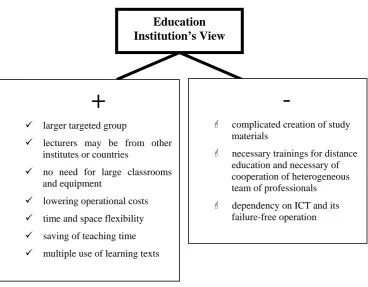
Among many advantages e-learning it has some disadvantages either. Let‘s have a look at them from view of a student as well as an education institution:
Figure 1 Advantages and disadvantages of e-learning from view of a student
Figure 2 Advantages and disadvantages of e-learning from view of a education institution
Student’s View
+
time and space flexibility choice of individual study pace understanding subject self-check discussion with students and a teacher lowering travel costs
not only teaching quality depends on teacher’s quality but on self-study materials and support learning system, too
enabling study to the disabled
for many teaching is done in modern and attractive method
-
need of high level of responsibility and motivation
possible feeling of isolation when studying
possible helplessness in some parts of studying
Education
Institution’s View
+
larger targeted group
lecturers may be from other institutes or countries
no need for large classrooms and equipment
lowering operational costs time and space flexibility saving of teaching time multiple use of learning texts
-
complicated creation of study materials
necessary trainings for distance education and necessary of cooperation of heterogeneous team of professionals
dependency on ICT and its failure-free operation
The question is if and how the above stated negatives can be eliminated or possibly removed completely. Dependency on information and communication technologies is unavoidable and a teacher does not have a chance to influence it. He may only rely on the fact that fast development in this area always brings improvement in computer technologies and lowering its failures. The same applies that this form of education requires cooperation and mutual coordination of more participated parties, e.g. a teacher (a tutor), a mentor (a person responsible for organizational and technical running of distance education), a guarantee of the study, ITC professionals (a portal administrator, a server administrator) and so on. It is necessary that a specific person was responsible for mutual cooperation of works in the study project (e.g. a mentor or a guarantee) and if their mutual cooperation works well, the team cooperation may make work of an individual easier. In this way negativity becomes positivity.
Almost all other disadvantages of e-learning have one joint name – study materials. Only quality and professionally well prepared study materials can remove weak sides of e-learning.
4 DISTANCE TEXTS - PART OF E-STUDY MATERIALS
In broader sense study materials mean all study and information sources specifically made and used in e-form of education. As mentioned before, e-learning form of education enables to use various forms of study materials – from texts, pictures, animations and audio and video recordings, to multimedia interactive applications (online tests, games, simulations, virtual laboratories, etc.). However, the key study material (or study material in narrow sense) are distance texts whose creation belongs to one of the most important stages in preparation of study programme. These are text files accessible on e-portals which may be used in the print form, too. Actual experience proves that some of the advantages of print texts may be characterized as follows: (Drozdová 2006)
- reading a print text is faster than e.g. listening, enables memorizing a larger number of words and expressions,
- study material enables to use a whole kinds of learning and techniques for better memorizing – from underlining, making notes, filling in, making basic tasks up to possibility to return to the specific topic at any time,
- no special technical equipment is needed for this study,
- mobility of study material enables to read study and repeat the text at any time and any place. Despite ongoing development of modern technology, study texts represent the essential study material in e-learning education. All other above mentioned study materials may be considered as a suitable addition to make it more live and enriched, helps to better memorize the subject which makes the whole study more interesting and attractive.
In creation of distance texts it is necessary to realize that they must meet certain criteria considering the fact that a student studies the text without direct contact with a teacher. Geographical distance and isolation of students cause that there is not a direct feedback between a student and a teacher, and a student is not able to ask a question to a teacher directly as he can do at a lecture or seminar class. Consultations with a teacher are done electronically, a time shift is made between asking a question and getting an answer and finally a written communication may sometimes cause misunderstanding of the subject being discussed. Therefore, it is essential that a distance text maker takes all these aspects into consideration already in the stage of its preparation.
A distance text cannot be indentified with a textbook or a duplicated textbook designed for the presence form of study. A distance text has a harder position here. While textbooks in regular full time study enable students to complete, repeat or to summarize presence learning and extend knowledge acquired through regular lectures and seminars, the job of distance texts is primarily to replace the presence form of learning. However, it has no ambitions to replace textbooks or duplicated textbooks. This task lies on other supplementary study materials and recommended study literature.
Study texts should be self-instructional – they should give a student (a reader) motivation to meet study programme objectives and structured so that they stimulate to continuous study, however they should be appropriately extensive, comprehensive and active.
At first glance the texts are significantly different from the traditional ones used in the presence form of education, for example, division of text, its graphic arrangement, relief due to many pictures, pictograms and symbols are very obvious in them. More details about the structure of distance texts are provided in the following part.
Although we mention positivity of print form of distance texts, a suitable combination and smart use of the whole range of study materials enabling a student to use all senses leads to better learning results and overall quality of e-learning.
Animation is another essential e-learning element which brings activation into education. It enables to present more information through static pictures free of extra requirements for the system size. We distinguish several types of animations: (Mikuš 2003)
- picture oriented animation - layer oriented animation
- animation of individual element of a picture.
Audio plays an important role in multimedia titles. Effectively used audio supports interaction of a title with a user in many levels. In comparison with text applications the multimedia applications provide more information in shorter time. Use of different visual effects combined with precise and subject audio guide enables to cover and explain even complicated questions.
We can say that distance texts should be: - motivational
- clearly arranged - easy to understand - brief
- with easily understandable content
Motivation towards the study should be a “drive engine“ of every student and this motivation should come out of his inner need to reach a certain objective. However, the reality is often different and the task to motivate and activate students usually lies in a teacher. In case of e-learning this burden is shifted to a distance text. Its motivational function is filled with questions, work tasks and other activities given by a teacher. In the distance text we distinguish several types of questions:
1. Rhetorical questions – they attract attention to certain places in the text and make its reading more attractive.
2. Self-assessment questions - they are usually at the end of the text - questions not requesting a written answer,
- questions requesting a written answer. Types of answers vary, e.g. o multiple choice
o completing missing words and information o a brief answer given by own words. 3. Questions and a teacher assess their answers.
Clear arrangement of a distance text can be achieved by a well chosen structure of the text. Each text should be divided into chapters with the same organization. Main organization of each chapter is the
same as in other types of written texts e. i.: introduction, explanation part and conclusion. The introduction may be divided to a content and a mission. In some texts, for example, a short vocabulary of unknown expressions, key words and task explanation, is suitable. So, for example, arrangement of a distance text can be as follows:
Content
In case the chapter is divided into sub-chapters, it is suitable to give them names and make orientation outline for a reader stating a number of pages for each part.
Mission
This answers the question what the objectives of the text are, what area the student must learn, what knowledge the student should acquire after studying the text, what time the student needs for study or possibly how he should use the text.
Explanation Part
Explanation of the topic is divided into parts (sub-chapters) and each of them should refer to one important topic or event only. It should be brief and restrict to explanation of essential knowledge. Other less important details should be presented e.g. in supplementary or recommended literature. Sentences should be short, if possible not to use long complex sentences and less known or unfamiliar words. One problem can be explained in more ways. Explanation should include enough pictures and suitable examples especially from real life. It may contain simple charts and graphs. Such drawn text is easily understandable and its content is clearly apprehensible.
Summary
Brief and clear verbal summary of the whole text or in the form of a scheme. Self-Assessment Questions
Several simple questions based on which a student is able to assess himself how much he understood the topic.
Vocabulary
It is appreciated in texts with unknown terms used. It contains definitions of unknown expressions used in the text.
Literature
References to books, articles, publications or web pages a student can use as supplementary sources.
5 CHECK-UP DURING SEMESTER AND TESTING STUDENTS
Traditional forms of checks in study programmes throughout the duration of instructional period of a semester are preliminary tests such as semester work assignments, written tests, individual work assignments, reports, etc. and a semester exam. Objective of the semester exam is to test acquired knowledge in an actual subject and student‘s ability to use it. This exam may be written or oral, or possibly their combination.
Testing students taking an e-learning course must be specific one. In case of traditional presence form of study a teacher can easily assess a student. Attendance or absence, activity or non-interest and passivity of students at lectures and seminars help a teacher to responsibly observe and assess
student’s work throughout the whole semester. However, this is different in the e-learning form of education. The fact that it is distance education which means a geographical separation between a teacher and a student, does not enable a teacher to observe a student in such way and therefore preliminary testing throughout a semester is more important than in case of the presence form of education. Student’s motivation is also another significant aspect in case of distance education. Due to the fact that e-learning is based on self-study mainly, a student should be in a positive sense “forced“ to study continuously through testing and grading works throughout a semester. In terms of time and subject, we distinguish the following individual stages of assessment:
• Questions, topics to think about, small size case studies, examples, supplementary texts in study materials, etc.
• Consultation and discussions between a teacher and students. Because student’s work is not discussed here such communication may help a teacher in his final assessment.
• Assignment of individual works. A written report which enables a teacher to observe if a student handles a certain part of curriculum.
• Examination in a actual subject. It takes place at the end of a semester.
When we talk about distance education it is not suitable to completely exclude a contact between a teacher and students. Completion of at least two tutorials (initial and final) during a semester is desirable for students’ assessment. In addition, personal attendance of a student in examination, even if it is done electronically through the internet, is necessary.
Even though distance forms of education, beyond any doubt, have many advantages we need to remind that when we use modern ICT in learning we simply should not too extensively orientate and rely on the technology. This is called “techno centrism“. Nowadays, the role of technology in the learning process neither can be underestimated nor overestimated and when we use it we need to pay a great deal of attention to development of emotional and character features of a student.
6 SUMMARY
Today the distance education in Slovakia is still seeking its solid position. However, from experience abroad we can say that it will not take long and online courses will have many supporters. It is one of the consequences of globalization of the society. On the other hand it helps to regional development and decentralization because people do not have to relocate to get educated.
Form of writing a text is also important aspect influencing quality of study material. Very important are - size and thickness of letters, changing various fonts, suitable spacing between lines, placing tables and graphs, various pictograms, cartoons and so on. Just like in presence based learning quality depends on a level of lectures and exercises, the quality of e-education depends mainly on study materials the student is using. If we want to offer a student quality and valuable education we must pay close and enough attention to processing distance texts.
A computer did not remove books from our lives and so e-learning cannot replace schools commonly based on direct interaction of a teacher ↔ a student, either. Prepared combination of contact education and electronic education however may make studying easier, more attractive and adjust it to the time we currently live in.
REFERENSES
Horton, WI 2011, E - Learning by design, Pfeiffer - A Wiley Imprint, San Francisco.
Mikuš, ĽU 2003, ‘Skúsenosti s vytváraním elektronických vzdelávacích kurzov’, Proceedings of the Conference E Learn 2003, EDIS, Žilina, pp. 37-8.
Rogers, JE 2007, Adults Learning. Open University Press, Berkshire.
Drozdová, MA 2006, ‘Tvorba obsahov pre e-learning’, Proceedings of the Conference E Learn 2006, EDIS, Žilina, pp. 58-5.