THE VALUE OF NATIONAL ACCREDITATION ON INTERNATIONAL PROGRAMMES – A CASE STUDY
Josephine S H Jim
Hong Kong University School of Professional and Continuing Education
Hong Kong
Abstract
Changes in the landscape of higher education in Hong Kong have impinged on the international degrees offered by external providers. National accreditation of international programmes offered in collaboration with university partners by local education authority is considered desirable by institutions in Hong Kong, to maintain their competitive edge and move into the market for students from mainland China. The aim of this study is to examine the value against investment on national accreditation of international programmes in Hong Kong through a case study at The Hong Kong University School of Continuing and Professional Education (HKU SPACE). Interesting and positive findings have been attained so far, but the value against investment warrants further investigation due to various debatable factors, critical evaluation, and the changing landscape of higher education in the region.
Key words: national accreditation, local accreditation, higher education, international programmes, non-local programmes, education in Hong Kong, HKU SPACE
1. Introduction
The world’s higher education sector is changing due to globalization and increased competition among graduates worldwide. Hong Kong Government Administration has the goal of establishing the city to be a regional education hub, and to internationalise its local institutions in order to meet the challenges of globalization (HKSAR, 2009-10). In 2012/13, the Government in Hong Kong approved public spending on education amounted to HK$79.1 billion (US$10.1 billion), representing 18.9 per cent of the total public expenditure (HKSAR, 2013 a). Apart from funding support, the Government also plays the role of a regulator, regulating the growth in all sectors of education: primary, secondary, and tertiary education. Hong Kong is known for its open economy and has successfully established itself as a globally competitive, service-based knowledge economy (Education Commission, 2000). This macro-environment encourages and supports the growth of self-financing education, especially in the tertiary sector, thus education services become one of the six major industries in Hong Kong (HKSAR, 2009-10) .
1.1 Education in Hong Kong – at a glance
Education in Hong Kong is overseen by the Education Bureau (EDB), there were changes after its return to Chinese sovereignty in 1997 where new policies was introduced to expand post-secondary education opportunities. Children attend one year of pre-kindergarten and 3 years of kindergarten before going to primary school. With the revamp in 2008, the majority of students are now receiving 12 years of free education from primary to senior secondary school, they then sit for the Hong Kong Diploma of Secondary Education (HKDSE) examinations. Based on the HKDSE results, students may enter post-secondary, vocational and tertiary courses offered by a variety of institutions. Under the revamped system Hong Kong universities now offer 4 year programmes (HKSAR, 2013 a).
There are 17 local degree-awarding higher education institutions in Hong Kong, eight of them are funded through the University Grant Council (UGC), and hence are public universities, while others are not. Fewer than 20,000 students out of 72,620 HKDSE graduates are offered places funded by the government every year (HKSAR, 2013 a) (HKEAA, 2012). Consequently, students who can afford would go to universities in overseas countries to continue their studies, such as in UK, Australia, USA, Canada, Taiwan and some may go to China in recent years. Some students would look for transnational education (TNE) opportunities in Hong Kong where overseas universities delivering their programmes in partnership with a local operator. TNE programmes are leading to the same award equivalent to students studying in the home university and these local operators are self-financing, they are usually the continuing education arm of a public university.
Education in Hong Kong – At a Glance
1.2 Expansion of transnational education in Hong Kong
Transnational education (TNE) composed of international programmes has been in Hong Kong for some 50 years, it has expanded rapidly due to continuing market demand from young people who have strong aspiration to attain a degree qualification, from sub-degree graduates who have the desire to further their studies; and in general young people in Hong Kong today believe a degree is only a minimum, pursuing Masters and even PhDs qualifications are becoming increasing common (Johanna Waters, 2012).
There is only eight degree-awarding institutions funded by the UGC, these public universities can merely provide 15,000 first year first-degree places, which are sufficient to cater for 18 per cent of each cohort (Katherine Forestier, 2013). With very limited funded tertiary education available, TNE
Lifelong Learning
Post-graduate Studies
1st year degree course at local universities (4 years)
Senior Secondary (3 years)
Junior Secondary (3 years) *Top Up degree by
overseas university partner (2 years)
Associate Degree course (2 years)
*Top Up degree by overseas university partner (2 years)
Higher Diploma course (2 years)
Primary (6 years)
Kindergarten (3 years)
Pre-kindergarten (1 year)
*Overseas universities collaborate with local university continuing education arms to offer
alternate route for students who cannot access local universities.
and other self-financing education opportunities offer alternatives for young people and adult learners who wish to realize their dream in getting a degree qualification(s).
In 2011, there were 38,300 Hong Kong students enrolled in non-local higher education and professional courses (Census and Statistics Department, 2012). In March 2014, a total of 1,170 non-local programmes registered with the Non-Local Courses Registry under the EDB (EDB, 2014 a). According to the information from the EDB, the United Kingdom is the largest provider of non-local courses, followed by Australia and the United States of America (EDB, 2014 a). Non-local courses in Hong Kong are in diverse disciplines and from levels of bachelors, top up degrees, to master and doctoral levels.
Overall, Hong Kong provides multiple and flexible pathways for local students to pursue post-secondary education. Self-financing local operators forming partners with overseas universities to offer international (non-local) programmes has broadened the opportunities and choices for further education (Legislative Council Secretariat, 2011-12).
1.3 Regulations in self-financing higher education
Hong Kong Government has put in place a robust quality assurance mechanism for the self-financing sector. All self-financing higher education institutions are subject to the quality assurance mechanism of the Hong Kong Council for Accreditation of Academic and Vocational Qualifications (HKCAAVQ) to ensure that its governance structure, academic standards and quality, teacher quality, quality assurance mechanisms and financial condition meet the requirements. Subsequently, every degree programme that a registered post-secondary college proposes to offer is subject to a separate Programme Validation (PV) process to ensure that its academic standard is up to degree level, and benchmarked against, the Hong Kong Qualifications Framework (QF) (Legislative Council Secretariat, 2011-12).
Given that many of the programmes offered in the self-financed sector are in partnership with overseas institutions leading to non-local higher and professional qualifications, these programmes have to meet the registration criteria stipulated in the Non-local Higher and Professional Education (Regulation) Ordinance (CAP 493) which has been in place since 1998. The HKCAAVQ also advises the Registrar whether a registered non-local course continues to meet the registration criteria through annual reassessments (Legislative Council Secretariat, 2011-12).
Other regulatory mechanisms in place are: the Education Ordinance, the Post-Secondary Colleges Ordinance and the various University Ordinances which govern their continuing education arms (Ngok Lee, 2011). With rapid growth in education services industry, consumer protection is put in place (Cribbin, 2002). The newly enacted Competition Ordinance also oversees the conduct in publicity and promotion of education programmes to the community at large (Legislative Council HKSAR, 2013).
1.4 Accreditation of international (non-local) academic programmes in Hong Kong
According to the Accreditation of Academic and Vocational Qualifications Ordinance (Cap 592) enacted in 2008, the HKCAAVQ is empowered by the Government to conduct accreditation activities for academic and vocational operators and their learning programmes. Under this Ordinance, non-local programmes are also being regulated via accreditation, which comprises two stages initially. The first stage is Initial Evaluation (IE) for collaborative provision to determine whether the partnership is able to achieve its objectives and to operate the programmes that meet the claimed Qualification Framework (QF) standards. The second stage is Programme Validation (PV) which is an overall evaluation of the non-local programme(s) under the partnership. The purpose is to determine whether the programme meets the required standards to achieve its claimed objectives and deliver the intended learning outcomes. Accreditation is undertaken with reference to standards that have been
benchmarked both locally and internationally through a process of peer review, against Hong Kong’s education system, including the Hong Kong QF.
(HKCAAVQ, 2011 a)
1.5 Why seek international academic programmes accreditation?
International (non-local) academic programmes accredited by the HKCAAVQ enjoy similar status to locally-accredited courses, and their qualifications can be placed on the Qualification Register (QR) and recognized under the QF. If achieved accreditation, this allowed the programmes to enjoy policy benefits available to local providers, including the provision of financial assistance for their students, and other funding schemes, and the possibility in the future of recruiting students from mainland China, subject to the immigration policy of the Hong Kong Special Administrative Region (HKSAR).
In a recent study on undergraduate student perceptions on TNE in Hong Kong, it was found that: students linked the lack of local recognition of the programme with quality issues; they were concerned that without local recognition, their awards would not be recognized for civil service recruitment; students’ factors in choosing a top-up degree course included but not limited to duration of the course and affordability, brands of both the local partner and overseas university. These findings impose challenges to TNE providers and their partners for sustaining their developments and competitiveness in the higher education market in Hong Kong. (Katherine Forestier, 2013)
Therefore, seeking accreditation is one of the ways to enhance the competitiveness of international (non-local) programmes resulting in their local recognition, and their students would have access to financial assistance from the government as those publicly funded programmes.
2. Scope of the case study and methods of monitoring
This case study reported the accreditation project of international (non-local) programmes taking place at HKU SPACE from 2011 to present. The report covers the rationale for HKU SPACE to participate in the accreditation activity, the planning and preparatory work throughout the exercise, a review on the investments, achievements in progress and the way forward. The report specifically reflects on the values gained by various stakeholders during the accreditation process and the benefits after attaining the accreditation status. It is an on-going case at HKU SPACE to be monitored by annual progress reports, update proposals, feedbacks from working groups and stakeholders at all levels.
Local context has been used in the case study, such as local accreditation which is equivalent to national accreditation, non-local programme which is equivalent to international programme. Values and benefits reported in the case study were a collection of feedbacks from the working groups which included staff at HKU SPACE and the university partners, via formal meetings and informal sharing sessions. Feedbacks were also collected from teaching staff, students and other external members such as industry representatives in various meeting occasions. Factual accuracies were checked with internal meeting records and progress reports.
2.1 About Hong Kong University School of Professional and Continuing Education (HKU SPACE)
HKU SPACE, the continuing education arm of the Hong Kong University, is the leading local provider in continuing education in Hong Kong. It succeeded the Department of Extra-Mural Studies of the University of Hong Kong and offers learning programmes range from certificate to postgraduate levels. Since the mid 1980s, the School has responded to the growing local demand for professional and degree courses and has provided them mostly in collaboration with overseas partners. It has over 60 overseas institutions partners from China, UK, USA and Australia, with some of them being in relationships for over 50 years. HKU SPACE has a vision in extending lifelong education opportunities for the community and it strives to become a centre of excellence for the provision of
professional and continuing education serving Hong Kong, mainland China and the region. (HKU SPACE, 2014 a)
2.2 Background and planning of the accreditation project
Several changes in higher education in Hong Kong may impinge on the degrees offered by external providers. Under the revamped education system first degree programmes have been lengthened from 3 to 4 years, with students spending one less year at high school (EDB, 2014 b). Continuing education is becoming more challenging and dynamic as more self- financing providers begin to offer degree programmes. Accreditation of international (non-local) academic programmes by the HKCAAVQ is considered desirable by HKU SPACE, to maintain their competitive edge and move into the market for students from mainland China. HKU SPACE is aiming at attaining accreditation of its popular non-local academic programmes offered in collaboration with key university partners by HKCAAVQ by the year 2015.
2.3 Preparation for the accreditation project
Since 2010, HKU SPACE has been liaising with six (6) key university partners in UK and Australia on a plan of attaining accreditation of thirty (30) of its non-local academic programmes offered in collaboration with these partners by HKCAAVQ by the end of 2015. For every partner and every discipline, there would be tremendous workload incurred due to the accreditation project, which would pose great challenge to the programme teams given that most of the partnership programmes are grandfather programmes with limited documents available at HKU SPACE and college levels, time taken to prepare the IE and PV documents would be long, and colleges have to form working groups to work on such preparation on top of their regular duties. There is very limited room at college level to implement manpower redeployment for the accreditation project. With these limitations, the project leader submitted applications to the Finance Committee (FC) of the School in 2011 to seek funding support; and to the Human Resources Department to seek new headcounts to ease the workload anticipated.
In addition, according to requirements by HKCAAVQ, each college will have to go through a revalidation process of the accredited programmes in a 5-year time interval. Therefore, the accreditation project is on a recurrent base and on-going coordination and liaison with internal academic, quality assurance and administrative units as well as external units in overseas university partners is essential to the continuity of the project.
A sample of preparation workflow on college level at HKU SPACE and one of its university partner’s partnership Initial Evaluation (IE) and Programme Validation (PV) is demonstrated hereunder. A time span of 12 months was spent starting from liaison with the university partner to completion of accreditation of its non-local programmes by the HKCAAVQ.
Key Dates Event
Mid-2011 Liaison with university partner by Programme Team (Teams)
Late 2011 Service of Intent signed by HKUSPACE and university partner
Late 2011 Application to the Finance Committee of the School for funding support via School Project Development Fund
Mid-Nov 2011 Teams to prepare the draft IE, PV documents and QF1 Form in collaboration with university partner
End-Nov 2011 Review by QA Team
Mid-Dec 2011 Review of the IE and PV documents (with appendices) by Senior
Management of HKU SPACE and university partner
Late Dec 2011 Finalising IE and PV documents based on comments from Senior Management of HKU SPACE and university partner
Early Jan 2012 Printing and compilation of IE and PV documents
Mid-Jan 2012 Submit IE and PV documents to the HKCAAVQ
Feb 2012 Draft On-site Visit Programme from HKCAAVQ
EarlyMar 2012 Initial Comments from the HKCAAVQ Panel
Late Mar 2012 Submit Response to Initial Comments of the HKCAAVQ Panel
End Mar 2012 Internal meeting with university partner on preparation for the On-site Visit by HKCAAVQ panel
Early Apr 2012 Final Preparatory Meetings
Mid- Apr 2012 HKCAAVQ On-Site Visit
End Apr 2012 Receipt of interim report from HKCAAVQ
Mid-Jul 2012 Checking of factual accuracy of the draft report
End Jul 2012 Receipt of Final Accreditation Report
Table 1 – Timeline in preparing for non-local academic programmes accreditation by HKCAAVQ (HKU SPACE, 2011).
2.4 Accreditation on-site visit
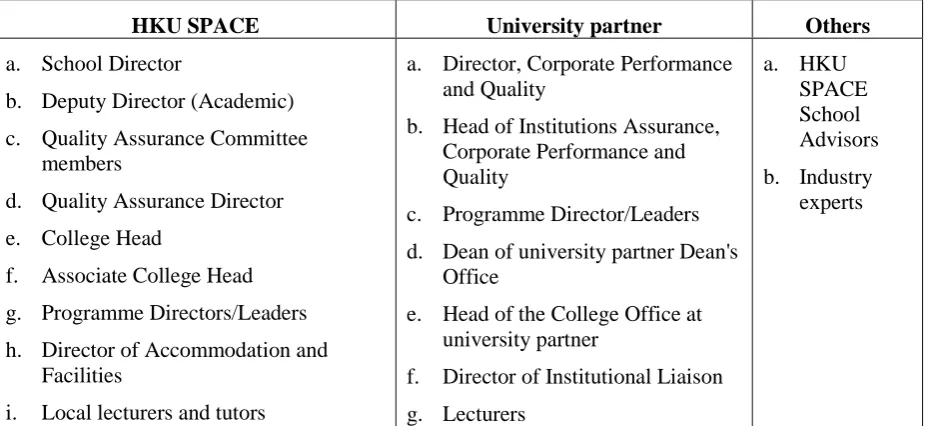
Coordination of the accreditation on-site visit took a long time to completion due to the challenges in meeting the schedules of various panel members invited from overseas institutions by the HKCAAVQ. Stakeholders involved in the accreditation on-site visit from HKU SPACE and university partner have to meet the HKCAAVQ requirements. Representatives of the local and non-local operators should be persons with decision-making authority and be familiar with the non-local programmes in the collaboration. There were 11 stakeholders from HKU SPACE, 7 stakeholders flying in from overseas and 2 stakeholders from the field, as illustrated by the table below:
HKU SPACE University partner Others
a. School Director
b. Deputy Director (Academic)
c. Quality Assurance Committee members
d. Quality Assurance Director
e. College Head
f. Associate College Head
g. Programme Directors/Leaders
h. Director of Accommodation and Facilities
i. Local lecturers and tutors
a. Director, Corporate Performance and Quality
b. Head of Institutions Assurance, Corporate Performance and Quality
c. Programme Director/Leaders
d. Dean of university partner Dean's Office
e. Head of the College Office at university partner
f. Director of Institutional Liaison
g. Lecturers
a. HKU SPACE School Advisors
b. Industry experts
j. Students
k. Local administrative supporting staff
Table 2 – Stakeholders involved in an accreditation on-site visit at HKU SPACE (HKU SPACE, 2013).
2.5 Investment on the accreditation project
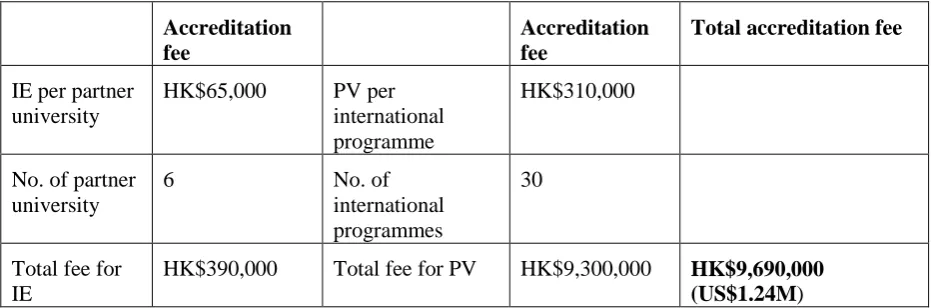
According to the HKCAAVQ Fee Schedule, for programmes at QF Level 5-7 (bachelor to master degree levels) the fee for IE is HK$65,000 and that for PV per programme is HK$310,000. HKCAAVQ may consider a fee discount for a PV exercise covering several programmes of the same partnership, but the discount mechanism may vary. Therefore, the anticipated accreditation fee for HKU SPACE to attain its accreditation project in the period of 2011-2015 is as per table below:
Accreditation fee
Accreditation fee
Total accreditation fee IE per partner
university
HK$65,000 PV per international programme
HK$310,000
No. of partner university
6 No. of
international programmes
30
Total fee for IE
HK$390,000 Total fee for PV HK$9,300,000 HK$9,690,000 (US$1.24M) Table 3 – Accreditation fee schedule (HKCAAVQ, 2011 b).
To support the anticipated accreditation fees and the associated resources to implement the accreditation project successfully in the coming years, an application has been submitted by the project leader to the Finance Committee (FC) of the School in 2011, seeking support from Project Development Fund. After several months of stringent vetting by the FC, funding is being approved on an annual basis which included accreditation fees payable to HKCAAVQ, new contract staff recruitment, and local operation costs on the accreditation project. The funding support in subsequent years is very much depending on the annual evaluation of the project by FC members through new proposal and progress report submitted by the working groups.
2.6 Achievements, work-in-progress and the way forward
a. In 2011-2013, HKU SPACE has attained local accreditation on partnerships with three (3) key university partners and programme validation of fifteen (15) non-local academic programme at various QF levels as below:
i. IE with two (2) key university partners at QF level 6
ii. IE with one (1) key university partner at QF level 5
iii. PV of three (3) non-local Postgraduate programmes at QF level 6
iv. PV of eleven (11) non-local Bachelor programmes at QF level 5
v. PV of one (1) non-local Diploma programmes at QF level 4
(HKU SPACE, 2013) (HKU SPACE, 2014 b)
b. In 2013-2014, HKU SPACE has already been preparing for the accreditation project in full swing as below:
i. IE with University IV and V at QF level 5
ii. PV of four (4) non-local Bachelor programmes offered in collaboration with university partners at QF level 5
(HKU SPACE, 2014 c)
c. In 2015, HKU SPACE has an accreditation plan in the pipeline as follow:
i. IE with University VI at QF level 5
ii. PV of three (3) non-local bachelor programmes at QF level 5
By the end of 2015, HKU SPACE would have accomplished accreditation status for six (6) key university partners and twenty-two (22) non-local academic programmes at a cost of about HK$9.7M (US$1.24M) before discount, on top there would be significant time and manpower resources invested by both HKU SPACE and its university partners.
3. Values gained in the accreditation process
To attain the IE status, the partnership has to demonstrate they can meet the threshold standards of criteria in organizational management, financial and physical resources, staffing and staff development, and quality assurance, by providing sufficient and appropriate documentary evidence in the accreditation process (HKCAAVQ, 2011 a).
3.1 Partner relations
The partnerships between HKU SPACE and its key university partners have been established for at least 10 to 50 years. These partners have witnessed the changes in the higher education landscape in Hong Kong and realized the necessity to adapt. Liaison for the participation in the accreditation process brought the partner relations to a new level of closeness, from the senior management of the institutions, to finance and administration department, human resources department, quality assurance team and the programme teams. For example the faculty management of both institutions exchanged visits in the liaison process; the corporate performance team of university partners had made several visits to Hong Kong to work closely with HKU SPACE working groups to ensure the sources of evidence of the partnerships are in good order.
This degree of enhancement in partner relations would not have happened without the two partners walking through the local accreditation process together. The spirit of collaboration has been the highest ever in order to attain a goal which would bring mutual benefits to the partnerships. This spirit is desirable as IE status would not expire if the partnerships continue to have non-local academic programme(s) validated within the range of the approved QF level(s) (HKCAAVQ, 2013 a).
3.2 Organisational management
When preparing for the accreditation documents the partnerships are required to enclose documents and evidence that they have been using on a daily operational basis and/or for planning and decision-making purposes. In order to meet the threshold standard of the criteria – organizational management, the accreditation panel would explore into the legitimacy of the partnerships at institutional and partnership levels, taking into account the university partner’s home provision as well as that in Hong Kong. The panel would also look into the design of the collaboration and its implementation.
Evidence to submit to the HKCAAVQ include but not limited to: risk register, contingency arrangement for students, how these contingency arrangements are being communicated to all stakeholders, facilities offered through the collaboration, budgets and estimates, resources deployment agreement and plans for the collaboration. Through the process of collating these evidence, organizational management of the partnerships become more transparent than ever to the working groups of the accreditation project. Thereby institution management, faculty management, programme management and other levels of management could get an update and holistic picture of the partnerships through referencing to the accreditation documents and prepare themselves for the on-site visits by the accreditation panel.
These updates and understandings of the partnerships would be desirable for programme(s) revalidation in order to uphold the accreditation status, which is in the mutual interests of the partnerships.
3.3 Staff training and development
Before 2011, the internal stakeholders at HKU SPACE have not had any experience in non-local programme accreditation. There was a steep learning curve for the working groups comprising representatives from administration, quality assurance and programme teams. Learning elements include but not limited to:
a. Ensure all stakeholders have a common understanding on the guidelines set up by the HKCAAVQ through back and forth communications and clarifications
b. Collation of evidence and supporting documents in an orderly manner
c. Preparing for accreditation documents according to the guidelines set by the HKCAAVQ
d. Validating the established documents
e. Continuing liaison and communications with counterparts at university partners
f. Continuing collaboration with different stakeholders to ensure working deadlines are met at all levels
g. To educate, train and mentor other staff about accreditation project at school level
During the management of the accreditation project, staff have gained treasurable experiences from walking through the following training and development process:
a. Leadership skills development for project and team leaders
b. Coaching and mentoring skills training for programme leaders and managers
c. Project management skills development for the working groups
d. Enhancement of communication and interpersonal skills for all staff involved in the project
e. Increased exposure to international partners network for the working groups
f. Attaining local accreditation knowledge and skill set for all stakeholders at the school
There may be other skill sets gained from the process which have not been identified at the time of reporting. All the above skill sets and values would become lifelong assets for the staff in their personal and professional developments.
3.4 Knowledge and skills transfer
After the first year of accomplishment in 2011-2012, the first working group resumed their regular duties, while a new working group came on board in 2012-2013 to take lead on the accreditation project in collaboration with another university partner, and so on so forth. The knowledge, skills and experience gained by the first working group would be readily transferred and shared with the succeeding group, these transfers and sharing have become a common practice within and in between colleges of the school, as well as in between different teams in the quality assurance department.
The HKCAAVQ has also been going through a learning curve. Through on-going consultation with internal and external stakeholders, as well as collecting feedback from panel members at local and international levels, the HKCAAVQ has revised its guidelines set in 2011 to a more streamline and efficient set distributed in 2013. HKU SPACE staff have taken advantages of these communication opportunities with external stakeholders to strengthen their knowledge in accreditation and academic policies, which have evolved to fit in the changing landscape of higher education in Hong Kong (HKCAAVQ, 2011 a), (HKCAAVQ, 2013 a).
In preparing for the accreditation exercise and documents, there have been increased face-to-face meetings and communications with overseas university partners in these years. HKU SPACE programme teams have been learning from their counterparts on academic policy development, international programme development and other new developments in overseas education markets such as U.K. and Australia. On the other hand, our partners are working more closely with us on common interests in moving into the market for students from mainland China, especially in the top-up bachelor programmes and some of the distance learning postgraduate programmes.
4. Values gained after attaining accreditation status 4.1 Economic returns
With accreditation status, HKU SPACE can market the non-local programmes as locally accredited awards which will appeal to students in Hong Kong, mainland China and other geographical locations. Students would be able to apply for a visa to stay in Hong Kong and full-time students would be able to apply for government subsidy.
Upon successful accreditation, the qualifications of relevant non-local programmes may be entered into the Qualification Register (QR) for recognition under the QF, in accordance with the terms and procedures stipulated by the QR Authority. Such qualifications attained by individual students will be recognised as meeting the standard of particular qualifications obtained in Hong Kong. The Government Financial Assistance Scheme and Non-means Tested Loan Scheme for post-secondary students extend to eligible full-time students enrolled in tertiary-level non-local programmes accredited by the HKCAAVQ.
There has been significant increase in both application numbers and enrolment numbers for most of the non-local programmes which have attained accreditation status, and the table below demonstrates the positive picture at HKU SPACE as of March 2014. The economic returns from the increase in enrolment number are encouraging though their sustainability remains to be seen.
Increase by percentage after attaining accreditation status
Application number
Enrolment number
University Partner I Bachelor programme I +101% +103%
Bachelor programme II +91% To be seen in
September 2014
University Partner II
Bachelor and Diploma programmes
Improved sustainability of the programmes
Master programme I (part-time) +37% +68%
Master programme II (part-time) +22% +43%
University Partner III
Bachelor programme I +30% No change
Bachelor programme II To be seen in mid-2014
To be seen in September 2014
Table 4 – A snapshot of the changes in application and enrolment numbers before and after attaining accreditation status at HKU SPACE (as of March 2014).
4.2 Competitive edge
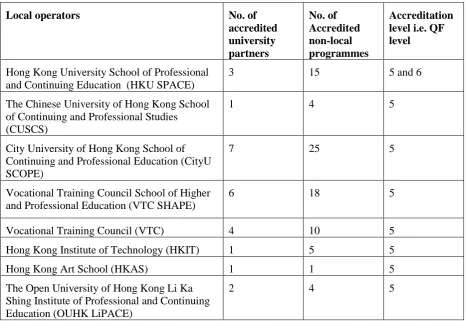
Most of the other local operators have already begun their accreditation project on the non-local programmes offered in collaboration with their university partners and are hoping to get the same benefits. If HKU SPACE does not participate in the accreditation project efficiently, it will lose its competitive edge in the market leading to subsequent loss in market share and student enrolments. As such, HKU SPACE has already designed a strategy in its accreditation planning in the coming years. Competitors’ activities in non-local programmes accreditation in the past two years can be summarized in the table below:
Local operators No. of
accredited university partners
No. of Accredited non-local programmes
Accreditation level i.e. QF level
Hong Kong University School of Professional and Continuing Education (HKU SPACE)
3 15 5 and 6
The Chinese University of Hong Kong School of Continuing and Professional Studies (CUSCS)
1 4 5
City University of Hong Kong School of Continuing and Professional Education (CityU SCOPE)
7 25 5
Vocational Training Council School of Higher and Professional Education (VTC SHAPE)
6 18 5
Vocational Training Council (VTC) 4 10 5
Hong Kong Institute of Technology (HKIT) 1 5 5
Hong Kong Art School (HKAS) 1 1 5
The Open University of Hong Kong Li Ka Shing Institute of Professional and Continuing Education (OUHK LiPACE)
2 4 5
Table 5 – Number of accredited non-local programmes on the Qualifications Register in Hong Kong (EDB, 2014 c).
4.3 Standing of HKU SPACE
As a leading local provider in continuing education in Hong Kong, HKU SPACE has been a pioneer in advocating transnational education in compliance with regulation and policies set by the EDB of the HKSAR. With the changes in the landscape of higher education and the continuing expansion of the self-financing education market, the government is taking stringent but cautious steps to uphold the quality of the non-local programmes by bench marking them to the Hong Kong QF, HKU SPACE is taking lead in responding to every initiative, and participating actively in all consultation exercises conducted by EDB and the HKCAAVQ.
After the first year of implementing the accreditation exercise where there was a learning curve for both local operators and the HCAAVQ, a series of consultative meetings had been held by the HKCAAVQ to seek feedbacks from local operators on how to perform the exercise more efficiently and effectively, and HKU SPACE played a critical role in these meetings. Overseas university partners from UK and Australia are working very closely with HKU SPACE in attaining the recognition of their international programmes by HKSAR, some partners from mainland China have indicated their interest in working with HKU SPACE to seek accreditation of their non-local programmes to be launched in Hong Kong. If successful, this would be a very significant project enhancing the standing of both HKU SPACE and the HKCAAVQ.
4.4 Benefits to students at HKU SPACE
Students at HKU SPACE are able to attain accredited non-local qualifications which are being recognized as meeting the standard of particular qualifications obtained in Hong Kong. Full-time students enrolled in these accredited programmes are eligible for the Government’s Financial Assistance Scheme and Non-means-tested Loan Scheme for post-secondary students. Finally, students attaining accredited awards would be recognized for civil service recruitment.
(HKCAAVQ, 2014)
5. Critical evaluation on the accreditation exercise 5.1 Time and resources
Starting from liaison with university partners, collation of documentations, on site visits, fulfillment of conditions and recommendations to receipt of the full accreditation report from the HKCAAVQ, an accreditation exercise can span from a period of 9 to 14 months and is therefore a very time consuming activity. The manpower involved in a local operator starts from senior management, finance and administration, quality assurance, programme management, clerical staff, to teachers and students, likewise for the overseas university partner, these man hours can be overwhelmingly expensive. The accreditation fees payable to the HKCAAVQ, though with some discounts and subsidy from the government, amounts to huge sum of money, and these are recurring costs as IE and PV have to be revisited by the HKCAAVQ in a defined period in order to maintain the accreditation status of the partnerships and the programmes offered in collaboration.
QF Level Programme revalidation fee
4 HK$173,000 (US$22,179)
5 HK$290,000 (UD$37,179)
6 HK$290,000 (US$37,179)
Table 6 – Accreditation fee schedule (HKCAAVQ, 2011 b).
5.2 Limitations
Once a non-local programme is being accredited and listed in the Hong Kong QR, any changes associated with entry requirements, approved student enrolment numbers, class size, content of the syllabus, modes of delivery, change of programme management personnel, and others have to be reported to the HKCAAVQ for approval. Therefore, when making changes in an accredited programme in response to feedbacks from students, academics, employers, new market needs and academic policy updates in overseas university partners, there would be more procedural documentations to complete and process (HKCAAVQ, 2013 b).
All local operators and university partners that seek accreditation service of the HKCAAVQ have to adopt and comply with new guidelines for promoting accredited programmes. These guidelines come into effect on 1 February 2012, and are intended to provide guidance to, and promote good practices among, operators and university partners who would like to promote their programmes accredited by the HKCAAVQ (HKCAAVQ, 2013 c).
5.3 Return on investment and uncertainties in the future
After the investments on accreditation project starting from 2011, the return is perceived to be positive at the time of reporting. The increase in student applications, enrolments and the subsequent economic benefits brought by the accredited non-local programmes described in section 4.1 are encouraging, but the sustainability of these benefits remains to be seen. The uncertainties in the future may be aggravated by the continuing changes in the landscape of higher education in the region, the rate of expansion of transnational education in Hong Kong, and the market demand from students from mainland China. Other critical factors are the local government’s immigration policy in granting student visa for overseas students, the negotiations between Hong Kong and mainland regulatory authorities, the capacity in supporting full-time overseas students in terms of accommodation, administration and in coping with a new cultural environment, given Hong Kong is a very vibrant and small city of 1,104 square kilometers (HKSAR, 2013 b) overcrowding by a population of 7.2 million (Census and Statistics Department, 2013).
6. Discussion
It can be seen from section 4.2 that leading local operators have been very active in accreditation activities while smaller scale local operators has very limited participation, which is partly due to the lesser number of non-local programmes they have, and partly due to their limitation on resources. It is extremely challenging for a small operator to justify for the costs that have to be invested on an accreditation exercise as described in sections 2.5 and 5.1. Though there may be discounts offered by the HKCAAVQ and subsidy from the government, the time and manpower to be spent as demonstrated in sections 2.3 and 2.4 are highly stretching for small scale operators. Along the same line, it may happen that at the end only large local operators can sustain their competitiveness, and a fair play in the market may be jeopardized. Therefore, it is necessary for the government to monitor the trend of development in non-local programmes accreditation, keep seeking feedback from all stakeholders such as the operators and their partners, students and their parents, and to provide special funding support to small scale operators when necessary.
In addition, publicity campaigns to advocate the benefits of local accreditation may be strengthened in order to enhance its awareness by the general public, which can be achieved through joint efforts of the EDB, local operators and overseas university partners. One of the key objectives for both local operators and their partners in attaining accreditation status for the programmes offered in collaboration is to recruit students from mainland China. But at the time of reporting, the improvement made in overseas students recruitment to accredited programmes remain slow, though on the rise. Further and deeper internationalisation is still a goal for both the publicly funded and self-financing post-secondary sectors (EDB, 2011).
Hong Kong is a gateway to mainland China, the success in establishing a renowned local accreditation authority helps in enhancing the quality and professionalism of education in the city, which China officials are looking upon. Over the years, the HKCAAVQ accredited non-local programmes in diverse disciplines such as Business, Tourism, Hospitality, Accountancy and Finance, Visual Communication and Fine Arts, involving participation of local operators and overseas partners from Australia and the United Kingdom. If partners from mainland China could also seek accreditation status for their non-local programmes by the HKCAAVQ successfully, it would certainly enhance HKCAAVQ’s standing as accreditation authority in the region, and raise the position of Hong Kong being a regional education hub.
Finally, HKSAR government’s success as a regulator in higher education would only be achieved with the cooperation and compliance from local institutions and their overseas university partners. And this tri-partite relationship is critical to sustaining the development of TNE in Hong Kong and the region.
7. Conclusion
Hong Kong Government Administration has the goal of establishing the city to be a regional education hub, and to internationalise its local institutions in order to meet the challenges of globalization (HKSAR, 2009-10). The establishment of a local accreditation authority, the HKCAAVQ, strengthens the academic accreditation and audit status of the programmes offered in the city, and has the aim to ensure that the expansion of post-secondary opportunities will be paralleled by an equal emphasis on quality. As an extension arm of the University of Hong Kong in providing lifelong learning opportunities for the community, HKU SPACE advocates quality and sustainability in education, and seeks to become a world-class centre of excellence for the provision of professional and continuing education serving Hong Kong, mainland China and the region (HKU SPACE, 2014 a).
HKU SPACE is committed to increase its student enrolment in all its programmes in the long run, by maintaining their competitive edge and moving into the market for students from mainland China. Gaining accreditation status for its international academic programmes is an important milestone in attaining its long term goal.
This case study has provided an overview of the reasons for seeking national (local) accreditation on international (non-local) programmes and the values attained during and after the accreditation exercise at HKU SPACE. While there are uncertainties in the long term benefits, such as economic returns; other sustainable values have been gained, such as the strengthening of partner relations, increasing transparency in organizational management, enhancement of knowledge and skill set at staff level, gaining competitive edge in the market, enhanced standing of the school, and last but not least there are immediate financial benefits to the students. The case also reported the learning and experience gained by the HKCAAVQ, the values and benefits gained by the government in establishing an accreditation authority in Hong Kong overseeing the quality of international (non-local) programmes offered in town.
Finally, in order to attain a full audit of values against investment in accreditation, it warrants further investigation involving other local operators, further address on the debatable factors and the critical evaluation made on the accreditation process, as well as a close monitoring on the changing landscape of higher education in Hong Kong and the region.
Notes
1. All names of institutions and degree courses have been changed or avoided to preserve anonymity.
2. International programmes are known, locally, as non-local programmes.
3. National accreditation is known, locally, as local accreditation.
Appreciation
The author thanks HKU SPACE management for their approval and support for this case study.
References
Census and Statistics Department, 2012. Hong Kong annual digest of statistics, 2012 edition, Hong Kong: Government of the Hong Kong SAR, Retrieved 6 June 2013, from
http://www.statistics.gov.hk/pub/B10100032012AN12B0100.pdf.
Census and Statistics Department, 2013. Hong Kong Statistics, Hong Kong: Retrieved 16 March, 2014 from http://www.censtatd.gov.hk/hkstat/sub/bbs.jsp.
Cribbin, J., 2002. Competition and collaboration: Hong Kong providers and partners. In J. Cribbin & P. Kennedy (Eds.). In: Lifelong learning in action: Hong Kong practitioners' perspectives. Hong Kong: HKU Press.
EDB, 2011. Education Bureau, Legislative Council Brief, Higher Education Review, Hong Kong: File Ref.: EDB(HE)CR 4/21/2041/89.
EDB, 2014 a. Education Bureau. Non-local higher and professional education statistical information., Hong Kong: Retrieved 16 March, 2014, from
http://www.edb.gov.hk/en/edu-system/postsecondary/non-local-higher-professional-edu/stat-info/index.html.
EDB, 2014 b. Education Bureau, Education Reform Highlights, Hong Kong: Retrieved 16 March 2014, from http://www.edb.gov.hk/en/about-edb/policy/edu-reform/index.html.
EDB, 2014 c. Education Bureau, Hong Kong Qualification Register, Hong Kong: Retrieved 16 March, 2014, from http://www.hkqr.gov.hk/HKQR/welcome.do.
Education Commission, 2000. Learning for life, learning through life. Hong Kong: Hong Kong SAR Government Publisher.
HKCAAVQ, 2011 a. The Hong Kong Council for Accreditation of Academic and Vocational Qualifications, Guidelines On Accreditation of Non-local Learning Programmes Version 1.2, Hong Kong: Retrieved 15 May 2011, from http://www.hkcaavq.edu.hk/en/services/accreditation/non-local-learning-programmes.
HKCAAVQ, 2011 b. The Hong Kong Council for Accreditation of Academic and Vocational Qualifications, Fee Schedule for Accreditation Services under the Pilot Exercise of Non-local Programmes, Hong Kong: Retrieved May 2011, from
http://www.hkcaavq.edu.hk/files/services/accreditation/non-local-learning-programmes/Fee_Schedule_for_NLP_e.pdf.
HKCAAVQ, 2013 a. The Hong Kong Council for Accreditation of Academic and Vocational Qualifications, Guidelines On Accreditation of Non-local Learning Programmes Version 1.3, Hong Kong: Retrieved 16 March 2014, from http://www.hkcaavq.edu.hk/en/services/accreditation/non-local-learning-programmes.
HKCAAVQ, 2013 b. The Hong Kong Council for Accreditation of Academic and Vocational Qualifications, Guidelines on Substantial Change to Accreditation Status (Version 2.0), Hong Kong: Retrieved 16 March 2014, from http://www.hkcaavq.edu.hk/files/services/accreditation/non-local-learning-programmes/Guidelines_on_Substanital_Change_to_Accreditation_Status_20130726.pdf.
HKCAAVQ, 2013 c. The Hong Kong Council for Accreditation of Academic and Vocational Qualifications. Guidelines for Promoting Accredited Programmes, Hong Kong: Retrieved 16 March 2014 from
http://www.hkcaavq.edu.hk/files/services/accreditation/non-local-learning-programmes/Guidelines_for_promoting_accredited_programmes_e_20130731.pdf.
HKCAAVQ, 2014. The Hong Kong Council for Accreditation of Academic and Vocational Qualifications. Why seek NLP accreditation?, Hong Kong: Retrieved 16 March 2014, from http://www.hkcaavq.edu.hk/en/services/accreditation/non-local-learning-programmes.
HKEAA, 2012. Hong Kong Examinations and Assessment Authority, 2012 Results Statistics, Hong Kong: Retrieved16 March 2014, from
http://www.hkeaa.edu.hk/DocLibrary/HKDSE/Progress_promote_HKDSE/Local_Education_Agencie s_2012_7_24_PPT.pdf.
HKSAR, 2009-10. Hong Kong Special Administrative Region, 2009-10 Policy Address Breaking New Ground Together, Hong Kong: Retrieved 16 March 2014, from http://www.policyaddress.gov.hk/09-10/eng/highlights.html.
HKSAR, 2013 a. Hong Kong Special Administrative Region Government. Hong Kong: The Facts, Hong Kong: Information Services Department, retrieved 16 March 2014 from
http://www.gov.hk/en/about/abouthk/factsheets/docs/education.pdf.
HKSAR, 2013 b. Hong Kong Special Adminstrative Region, Hong Kong - The Facts, Hong Kong: Retrieved March 2014 from http://www.gov.hk/en/about/abouthk/facts.htm.
HKU SPACE, 2011. Application for Project Development Fund for Accreditation of Non-local Academic Programmes by the Hong Kong Council for Accreditation of Academic and Vocational Qualifications-Project Appraisal Form - Project Appraisal Form 2011/13, Hong Kong: The University of Hong Kong, School of Professional and Continuing Studies.
HKU SPACE, 2013. Non-Local Programme Accreditation 2011/12 Progress Report, Hong Kong: The University of Hong Kong, School of Professional and Continuing Education.
HKU SPACE, 2014 a. About HKU SPACE, Hong Kong: Retrieved March 2014, from http://hkuspace.hku.hk/about-us/facts-figures.
HKU SPACE, 2014 b. Non-Local Programme Accreditation 2012/13 Progress Report, Hong Kong: The University of Hong Kong, School of Professional and Continuing Education.
HKU SPACE, 2014 c. Application for Project Development Fund for Accreditation of Non-local Academic Programmes by the Hong Kong Council for Accreditation of Academic and Vocational Qualifications - Project Appraisal Form 2014/16, Hong Kong: The University of Hong Kong, School of Professional and Continuing Education.
Johanna Waters, M. L., 2012. Young People and the Reproduction of Disadvantage Through Transnational Higher Education in Hong Kong. Sociological Research Online, 17, 3(6).
Katherine Forestier, J. I. S. C. J. C., 2013. Transnational education in Hong Kong: Undergraduate student perceptions. International Journal of Continuing Education and Lifelong Learning, 6(1), pp. 57-82.
Legislative Council HKSAR, 2013. Competition Ordinance in Hong Kong, Hong Kong: Retrieved 16 March 2014 from http://www.legco.gov.hk/yr11-12/english/ord/ord014-12-e.pdf.
Legislative Council Secretariat, 2011-12. Self-financing Post-secondary Education Sector, Hong Kong: Research Division, Updated background brief submitted to the Panel on Education of the Legislative Council on 20 April 2012. LC Paper No. CB(2)1694/11-12(08).
Ngok Lee, J. C., 2011. Lifelong Learning in Hong Kong: Marketisation and personalisation of lifelong education. International Journal of Continuing Education and Lifelong Learning, 4(1), pp. 49-71.