STRATEGY OF LINKING OF THE UNIVERSITY WITH THE SOCIO-ECONOMIC CONTEXT AS A TRAINING STUDENT WAY
Jaime A. Castillo, Nivia Alvarez, Jorge A. Cúpich
Universidad Autónoma de Nuevo León, Facultad de Ingeniería Mecánica y Eléctrica Av. Universidad S/N Ciudad Universitaria San Nicolás de los Garza N.L. México
Abstract
Currently one of the fundamental processes in public and private universities is the linking process with the socioeconomic context as an important way to train professionals that society requires. While more efficient it is, greater advantages and benefits are for the different stakeholders, particularly students. The linking at the Faculty of Mechanical and Electrical Engineering (FIME) of the University of Nuevo León State (UANL) of Mexico with industry and society in general is a process that, since its conception in 1960, has served as a driver process for important achievements, although, as a dynamic and multifactorial process requires constant improvement. This improvement must be based on knowledge of its actual state. The aim of this paper is to analyze the current situation and perspective of that process in order to develop strategies that give advantage to the integral training that favors the interrelation of personal and professional training of the future engineers.
The methodology used for this study combines methods and techniques of the empirical and theoretical levels such as: analysis, synthesis, historical and logical, and surveys of employers, teachers and students.
Key words: University, linking, undergraduate students, companies, professors, government
INTRODUCTION
The linking between universities and society isn’t new, since the Middle Ages it was expected that universities gave real value to money, meeting the vocational needs of society (Cobban 1990). Likewise, collaboration between higher education and industry has a long way; what has changed through time is the base, purpose and degree of such relationship. (Matthews & Norgaard 1984). Therefore, partnership is perceived since immemorial times as a necessary practice on universities to meet industry needs as well as its own; thus, it has been changing in time according to the requirements and characteristics of context, technological and scientific progress and consequently, the type of actions.
Despite its long history, this topic needs improvement. In agreement with Campos and Sánchez Daza (2005), the partnership between the Latin American university and its respective productive environments is a pending task. Universities cannot stay without an approach to the productive aspects and the outreach of knowledge. Nowadays, is required to be aware that currently you cannot say no to the linking, but under what methods and rules have to be determined (Llomovatte 2006).
In Mexican universities, it’s evident that the practice of linking does not have the reach those using the American model would want, with some universities functioning with high budgets resulting from the business relations between companies or foundations. The negative aspect of this model is the perception of the university as a company. However, according to the posture of this paper, every action and resource obtained and derived from linking must have an impact on its main social function – personal training of people – that are going to live and change society as a whole.
The linking had to contribute to the personal training of students, being the reason of these institutions, and at the same time the result of a series of action such as: a) strategies previously stipulated in the curriculum and b) the extension, outreach and business relations programs (Ruiz 2009); these
programs complement technical knowledge, thus making graduates to actively participate and change social development.
It is nonetheless true that the linking between universities, government and companies in Mexico has tried to impact on social development, based on establishing alliances between the three parties but not finding a proper way for an efficient collaboration; this could be affected by the fact that Mexican universities look for a way to approach industry parting from an insufficient knowledge of the scope, functions and operability of the linking, basing it on the model of a university that is distant from social change and the new needs of society (De la Herrán, Torres & Álvarez 2009).
The environments of competitiveness and globalization that have hit Mexican companies make the linking between the educational and productive sectors an important topic, thus making a balance between labor supply and demand as a result of the suitable understanding among the interested parts. In addition, with a long term vision that guarantees the development of competitive advantages as a lasting and sustainable strategy (Morales, Martínez & Bastar 2007).
From the precedents of the lacks in the process of linking in the Mexican universities and the possibilities of achievement, at the FIME this activity is carried out across different schemes and routes.
The above-mentioned information demonstrates that the FIME is located in a resource-generating context that makes possible the labor insertion of the engineering graduates. This is an important strength to consider in the integral development process of the student body, if the existing crisis is taken into account according to the worldwide labor supply scenario. In the majority of countries, including Mexico and its different regions, a high unemployment rate exists. In turn, these conditions derive in a higher level of competitiveness that accentuates the constant need of refinement in the development of graduates, both in the personal and professional aspects.
The achievement of competent professionals constitutes a challenge, both for the global insertion of the economies and for the progress of the knowledge society, in which frame human capital is constituted in competitiveness and this depends in good part of a good management of linking in universities.
The former implies a suitable coherence between the urge to deliver high quality graduates from the faculty and the well-remunerated labor supply that grants productive occupation to such. Of there that it turns out the analysis of the structure and characteristics of the possible labor market of future engineering graduates and the qualities, capacities and values that are needed of them is vital. The labor stage constitutes a qualitatively superior stage of the formative process in the university, since the specialist can apply in a practical and productive way the skills developed during their university education.
Therefore, universities have to promote the systematic linking with the industry and the society that surrounds them. This contributes to the integral training of the student, parting from their active involvement with real, professional problems that allow them to develop the necessary skills of their profession, giving each of their projects designs and characteristics of their own effort. But nowadays, it still happens that universities develop collaborations with governments and companies with the almost absolute goal to generate economic resources and to develop competitive skills that allow students to continue advancing in the goals they dictate as higher education institutions (Castillo, Álvarez & Torres 2013).
Parting from this analysis, in agreement with Castillo and Cols (2013, p. 62), “resources generated by the diverse schemes of partnership means are used on universities to attend the needs that contribute to their mission”. However, not all of this potential is used to better influence undergraduate students in their professional training.
For the exposed reasons, the scope of this paper is to analyze the current situation and perspective of the process of linking at the FIME, in a such way that there could be created new strategies that benefit the integral training where taken into account the interrelation of the personal and professional
training of future engineering graduates. Data from positive experiences as well as aspects that require refinement is shown.
USED METHODOLOGY
The process of linking at FIME, UANL consists of a set of actions, coordinated by established functions, entailed to obtaining results that benefit the infrastructural development in general as well as the formative process of the students. The present study shows some of the results obtained in the first stage of research (2010-2013).
The parties involved in the process are: undergraduate students, university managers, government civil servants, and entrepreneurs. For this research in general, the sample consists of companies, the government and the FIME. For the accomplishment of the diagnosis over of the current condition of the process of linking, the sample was stratified intentionally, taking advantage of the conditions of the regional context and the interrelationship between the different parties. The size of the sample (“n”) was acquired using the following formula for proportions:
pq
Z
N
d
pq
NZ
n
2 22
)
1
(
α α+
−
=
Where:N = size of the population Z = level of trust
p = probability of success or estimated proportion q = probability of failure
d = precision or maximum admissible error in proportion terms
The studied population was composed of 1389 subjects: 606 were undergraduate students, 518 were professors, 64 were managers of the university, 81 were government civil servants and 120 were company executives. The definitive sample was formed by 123 subjects, corresponding to the above mentioned categories: students (62), professors (26), managers of the university (10), government civil servants (10) and company executives (25).
Qualitative and quantitative methodologies, surveys and diverse statistical techniques have been combined. Among the theoretical techniques used are: analysis-synthesis, induction-deduction, and historical-logical that allowed setting up the antecedents of the topic, the essential and transcendental aspects as well as the analysis of the obtained data.
DISCUSSION OF THE RESULTS
1. Some results of the diagnosis about the process of continuous education as an essential activity of linking, at FIME
With the purpose of knowing the aspects that favor the integral training of students across the partnership, a survey was applied to undergraduate students, managerial teachers, businessmen and civil servants of governments. Below is shown some interesting data.
As far as the university-government-company collaboration is concerned, the FIME, as part of the industrial context within the State of Nuevo León, is conscious about the linking actions that can influence on the integral training of future engineering graduates. However, there exist some rooms for improvement that must be taken into account.
At first glance, it becomes apparent that the general perception of companies about the education received by the students at the faculty is positive. As the Graph 1 shows, 90% of surveyed executives consider the education process is of good quality and just the 10% evaluates it as regular (Graph 1). This positive evaluation has been materialized in favor of the business relations with companies. In addition, the social contributions of these actions have been observed thanks to the systematic collaboration between university, government and companies.
Graph 1. Evaluation of entrepreneurs over the education of the students of FIME.
Source: Personal production
In general, the vast majority of surveyed students and managers evaluate the education as good as a function of the development of better suited professionals (Graph 2).
Graph 2. Evaluation over the education of the students of FIME (according to students and university managers).
Source: Personal production taking into account survey results.
The obtained results exhibit difficulties as for the participation of the different parties in the process of linking. 48.4% of undergraduate students consider their participation to be low, meanwhile the companies and government consider its own as average (45% and 100%, respectively). In contrast, 66.7% consider their participation as high. However, this result looks to be an aspiration more than a reality (Graph 3).
Graph 3. Involvement of the parties in the process of a partnership.
Source: Personal production taking into account survey results.
On (Graph 4) it is observed that the different parties demonstrate different criteria about the influence of linking over the education of students. Both the students and the companies consider this influence to be average or low. Nevertheless, a large number of civil servants and professors consider the influence as “very much”.
Graph 4. Influence of linking over the integral training of students.
Source: Personal production taking into account survey results.
Regarding the evaluation of the parties about the process of linking and the integral training process, the results shown on (Graph 5) admit that the four sample groups consider as “high” such relation. This means that, although there are difficulties in practice, at least there is an adequate evaluation of the former. However, the given arguments are considered poor or deficient (Y-axis variables).
Graph 5. Evaluation over the relation between partnership and integral training of students.
Source: Personal production taking into account survey data.
The obtained results demonstrate achievements and weaknesses in the process of partnership and they are of great usefulness to obtain the best results that constitute the aspiration of any academic institution, especially for the UANL and the FIME.
2. Experiences about the linking process as a function of the integral training of students.
At FIME, different schemes of partnership that favor the professional education of the future engineering graduate are developed, such as:
1. Project Assignation Programs, where professional, real-world projects are designed. 2. Internships on a working environment.
3. Hybrids of the above mentioned, internships + project assignations.
Through the mentioned schemes, internship projects are made, promoting the interaction with the real world within a labor context, answering the needs of society. In collaboration with the industrial sector, the satisfaction of the demands and development of the region is the ultimate goal. Between the used procedures there are:
• Project Subjects (Project I, Project II)
• Internships
• Business Linking Academic Projects
• Research & Development Projects
By means of the mentioned procedures it is managed to contribute to the integral training of students with their active participation in activities related to professional, real-world problems that they pay for the development of the skills needed by their profession. Each of the above mentioned procedures contributes to the student on its own way, and in turn they complement each other since they possess common-but-still-different goals. Next is a description of every procedure.
Project Subjects
They are included in the curriculum by the purpose of developing specific skills and expertise, integrating themselves in each one of the curricula of the specific major. They are taken in the last two semesters when the student possesses the preparation necessary for his their assimilation.
Internships
Integral and educational development procedures that allow the student to work either on the public or private sectors, using specific functions their major. They contribute to the development of the professional skills required by the different areas.
Specific features of internships:
- 480 hours (6 months working on either private or public sectors). - They have a value of 15 credits in the transcript of grades. - Roughly equivalent to 20 hours a week in a period of 6 months. - The student can apply from their fifth semester of major. - They are celebrated through internship contracts.
- It is a monitored process.
Internships guarantee students real world interactions with the labor market on a permanent basis by a short amount of time unlike Project Subjects where there is not a sense of continuity. They are required by the collaboration between the faculty and companies to increase the outreach, likewise by the awareness of employers about their own importance on the development of the student.
Business Linking Academic Projects
These projects were born from an initiative of FIME about the business partnership internship. They are described as partnership activities that involve the soon-to-be-graduate student in real world projects, with the goal of establishing their skills within the different contexts of their profession. The fundamentals of a Business Linking Academic Project are:
- To contribute to the integral development of the student through the contrast between theoretical knowledge and practical knowledge based on real world applications.
- To manage that students develop skills to diagnose, plan, evaluate and intervene on the problem solving their profession requires.
- To contribute to the information to improve courses and subjects.
- To consolidate the partnership of the FIME and the UANL with the social and productive environments.
The actions composing Business Partnership Academic Projects are:
- Linking between the FIME and the business sector to seek the possibility of joint projects by using Academic Projects as a mean.
- To select the undergraduate students that fulfill the requirements of the projects of the companies partnering with the faculty.
- Assignation of consultants, fundamentally professors of the faculty, who assume the responsibilities of guiding students through the execution of projects. A consultant from the company is also assigned to guide students.
- Reunite students and consultants assigned to each one of the projects. - Initiation of activities of projects.
- Evaluation of the advances in the project monthly at the company.
- Delivery and discussion of the concluded project.
It is recommended for the teams of a Business Linking Academic Project to consist of 5 students selected according to their abilities and skills required by the company.
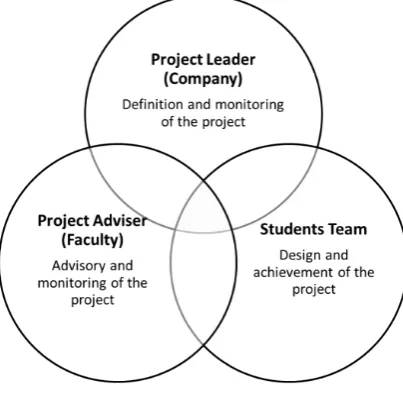
The selected students must be regular, soon-to-graduate students who deal with Project Subjects, since these subjects must execute projects related to the profession. In turn, these students answer to the rules of an Internship, so the company must fulfill the steps to enable them as interns with their corresponding economic remuneration. The roles of the participants are described on (Figure 1).
Figure 1. Participant and their roles on a Business Linking Academic Project.
Source: Personal production.
Research & Development Projects
Collaboration between undergrad students, professors, researchers and companies. They produce a benefit for the faculty, the company and the participants. In the particular case of students, they contribute and, in turn, acquire a better preparation for their future work in areas like collaboration, teamwork, etc.
During 2010, professors and students of the faculty took part in 137 Research & Development Projects, which shows an increase of 30% with regard to the previous year and near 250% with regard to 2002, an increase of the relation being revealed between the FIME and the industrial sector of the region. Next is a list of highlights from both companies and government organizations:
- METALSA, S.A. DE C.V.
- OWENS CORNING, S.A. DE C.V. - PROLEC GE, S.A. DE C.V. - FRISA FORJADOS, S.A. DE C.V.
- CONACYT (National Council of Science and Technology)
- PAICYT UANL (Scientific and Technological Research Support Program) - FOMIX-CONACYT (Mixed Fund for CONACYT)
- PROINOVA (Development and Innovation Program for Forerunner Technologies)
The above information demonstrates that the FIME is focused on the region, the faculty, the professorate and the student body’s needs which have allowed the faculty to introduce a greater number of graduates in a suitable working environment. This data was confirmed by studies performed to graduates from the different majors recently.
In a general sense good results have been obtained in the educational programs of the faculty on having met the requirements of the market, since more than 70% of graduates surveyed agree that the acquired training has served them to find work where there is the combined satisfaction of their personal needs and those of the context. On the other hand, majors are evaluated systematically by certifying organizations with international recognition, contributing to society, the country and the environment. Among these organizations are: CIEES and CACEI.
The FIME offers 10 engineering majors: System Administration Engineer, Administration and Mechanical Engineer, Electrical and Mechanical Engineer, Electronics and Automation Engineer, Electronics and Communications Engineer, Materials Engineer, Manufacturing Engineer, Mechatronics Engineer, Aeronautics Engineer, Software Technology Engineer. The first eight have been evaluated by the above mentioned organizations; the last two were of recent creation.
The obtained results indicate rising levels on the improvement of the linking process. Although it is true that the development of the student body and the acceptance of the labor market are positive, it is imperative to continue seeking for new strategies according to the actual scientific development. 3. Proposal of a strategy of linking between the university and the context.
In analysis of the theoretical sources, the realized diagnosis and the obtained experiences on the FIME about the linking process, the following strategy has been elaborated. Its fundamental characteristics are:
1. Stimulator of the management of a formative linking process: directed to favor the development of the students in their university term.
2. Generator of a dynamic and purposeful collaboration between the different partnering parties: the collaboration between the different parties, that is, university, government, companies and society, is maximized through clear roles, goals and schemes between them.
3. Provider of resources that contribute to the progress of the faculty, the professorate and the student body: it promotes the generation of economic resources through different linking plans, in turn developing those involved.
Principles in which the strategy is sustained
The principles that sustain the strategy reflect the fundamental regularities that are present in the process of linking.
Governing character of the university over the partnership with companies and the government: the collaboration of the university with the corporate and governmental sectors brings benefits that are reflected in the quality of the formation of graduates, in the update of the plans and study programs, in the quality of infrastructure, in the generation of resources, in a major presence on society, etc. It must stimulate the scientific production; the above mentioned incentives must incline for policies for the international mobility of researchers, support and funds in the construction of networks and the relational capital, as well as the formation of PhD’s in the needed areas to stimulate the economy of the country.
Entrepreneurs must show opening towards the academy: it is necessary to recover the mutual confidence between entrepreneurs and professors, in order that entrepreneurs propose their problems to the universities, and in turn, universities make offers on the demands of the entrepreneurs.
Management of the linking process as a formative process: linking on universities contributes to the integral education of students, since it is one of two areas that are considered for the development of their professional profile, the above mentioned areas are: a) the strategies previously stipulated in the curriculum, and b) the extension, outreach and business relations programs (Ruiz 2009). In agreement
with the above mentioned, the student, having been included in activities of personal development across different areas of linking, achieves an additional complementary value in their preparation that enhances their social contribution.
Attention to the cultural diversity of the context: the university, according to its nature and purpose, across its main functions, must form professionals, lay out alternatives of solution to the most urgent problems, extend culture and offer services, in benefit of the society of which it is part. Although the institutional actions center principally on teaching, and also very importantly on research; through the actions of linking, the social responsibility of the university is materialized.
Identification and use of resources through linking: faced with a global environment, new management mechanisms denominated academy-government-company clusters have been put into motion; the above mentioned mechanisms were initially proposed in the United States during the decade of the nineties. In Mexico, it has begun with a strategy closer to the interaction between the academy-government-company to contribute major benefits to the participants of such clusters. The resources generated through linking are used in the universities on infrastructure, academic mobility, improvement of academic and administrative processes among other concepts, all of them related to the process of personal development of the student.
Roles of the collaborating parties in linking
University: as the governing body in the collaboration between the other parties, it leads the joint efforts for a greater interrelation to achieve a major influence on social development through the improvement of the formative and management processes to enhance the results obtained by the linking.
Company: its role must be participative as for the strengthening of the interrelationship, the potential that has in the industry to make to come to the means and mechanisms for the process of students' formation, it complements itself with the participation of the students in the company, and this in turn could grant the necessary spaces for a major incorporation in the university community across job, services and businesses opportunities, creating new ways to contribute to the development of society. Government: its role has to be regulative and of promotion of the relation between parties to stimulate the growth of the nation, by means of policies and projects of integration, providing the link between the parties and stimulating the participation.
Society: it is the context where the collaboration between the companies, the government and the university takes place to affect favorably in its growth and development. Across its own institutions it can exercise a notable influence in this process.
Fundamental objectives of the strategy:
• Improve the management process of linking with emphasis in the faculty as a guiding principal. • Strengthen the interrelation of the different stakeholders involved in linking and management; • Contribute to the improvement of the management process of linking at the FIME.
Phases comprising by the strategy
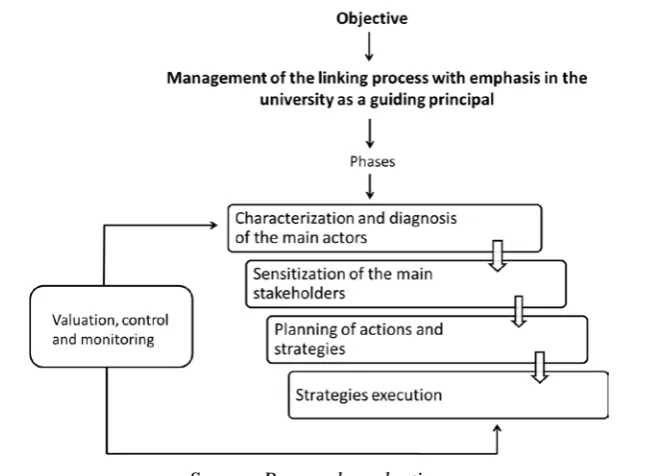
Taken into account the planed objectives, this is the breakdown structure of the strategy by phases (Figure 2).
Figure 2. Breakdown structure of the strategy of the linking process in function of the student training.
Source: Personal production.
The following describes each of the phase, as well as its objectives, actions and recommendations. I.- Characterization and diagnosis of the main stakeholders.
Objective: Determine the strengths, weaknesses, opportunities and threats that exist in the management of the linking process to achieve favorably affect the training process of the student and the management of resources for their social contribution.
Actions:
- Development of the state that holds the interrelation of the different stakeholders in linking - Development of the SWOT Analysis;
- Determination of the schemes of linking which count.
- Impact evaluation of linking in the social training and social contribution.
Recommendations to its implementation. It is suggested to take into account the following elements: a) University-Government-Companies interrelation analysis from the perspective of the strategy objective;
b) Strengths analysis of the management of linking process;
c) Analysis of the different schemes and/or linking ways and their results; d) Impact analysis of the linking process in the students training;
e) Social contribution analysis of the linking. II.- Sensitization of the stakeholders.
Objective: Reach in the stakeholders: university, government, companies, the recognition of the importance of the interrelation, its roles and scopes based on the needs of society and the benefits each brings and gets.
Actions:
1. Determination of the roles that linking stakeholders have developed as well as the recommended to perform.
2. Measurement of the activities running by each stakeholder in relation to the linking; 3. Linking contribution evaluation to each stakeholder;
4. Measurement of the benefits got it by the participation of each stakeholder.
Recommendations for it implementation: The priority elements suggested for this phase are the next: a. Analysis of each linking stakeholder role;
b. Analysis of the participation of each linking stakeholder;
c. Impact evaluation of the contribution of each linking stakeholder;
d. Benefits provided by the linking to the stakeholders and its social context. III.- Actions and strategies planning.
Objective: Establish an action plan to the interrelation of stakeholders in the linking which being established the scope, responsibilities and goals that have to be reached to favor the management of the linking process.
Actions:
1. Clarify the scope of the interrelation between the linking stakeholders; 2. Define the scopes of the linking;
3. Establish the meeting goals of the interrelation; 4. Structuring the action plan under the definitions; 5. Diffusion of the action plan between the stakeholders.
Recommendations for it implementation: In the present phases realize the next actions are suggested: a. Analysis of the contribution of each stakeholder to the improvement of the linking;
b. Determination of tools for design, development and monitoring of the work plans; c. Impact analysis of the diffusion media.
IV. Strategy execution.
Objective: Integrate the divers elements of the previous phases to the execution of the strategy, accordance with the goals set out with a clear definition of activities, times and sequences.
Actions:
1. Include the raised elements in each previous phase;
2. Communication of the activities, times and responsible of the action plan; 3. Execute the plan of action according to its definition.
Recommendations to its implementation: The priority elements suggested for this phase are the next: a. Elements analysis of the previous phases to this one;
b. Action plan to the strategy;
c. Media evaluation to the delivery of responsibilities for plan activity to responsible. V. Valuation, control and monitoring.
Objective: Monitoring and determining compliance with the targets set in the action plan in order to measure the impact of the management strategy.
Actions:
1. Monitoring of the activities outlined in the action plan; 2. Measuring compliance with established goals;
3. Impact evaluation of the strategy in terms of influence on student training and resourcing;
Recommendations for implementation: The actions to ensure compliance with the objectives of this phase are:
a. Evaluation of achievement of the objective of the strategy; b. Evaluation of the action plan of the strategy;
c. Applying tools for satisfaction levels on linking.
CONCLUSION
The analysis of sources that address the issue of linking evokes the search for new proposals that address this process from all possible dimensions. linking has a presence in different projects, the recognition of its importance, its main objectives, functions, etc., but in practice it does not always have the required systematization, neither its full potential is explored in terms of the integral training of the undergraduate.
Educational practice at FIME indicates that the schemes and routes for linking become more efficient when appropriate interaction is achieved within a context that promotes synergy between all the factors involved to promote a real, objective and comprehensive development of future graduates for insertion into the workforce.
At the Faculty of Mechanical and Electrical Engineering, the partnership is linked to the strategic projects of the UANL, being the basis for the implementation of measures aimed to the ongoing education for professional development. The linking process presents a conception according to the social, industrial and the own faculty’s demands. Nevertheless, there is still room for improvement in terms of the search for formalization in undertaken actions, rigorous monitoring and feedback.
The data obtained by surveying different groups (undergraduate students, managers, entrepreneurs, government officials) shows that there are positive aspects and at the same time weaknesses that must be overcome. Among weaknesses are the insufficient amounts of undergraduate students participating in the different schemes and methods of the partnership process, as well as the limited acknowledgement of the influence of the former in the integral development of professionals.
It is presented as a possible solution for the improvement of the linking process a strategy that allows the increase of efficiency between the factors involved on it, focused on the personal training of the undergraduate student. The application of the above mentioned strategy makes possible to guarantee a suitable premeditation of the linking process as well as the organization and systematization required as essential conditions for the success of this activity.
REFERENCES
Campos, G. y Sánchez, D G. 2005, ‘La vinculación universitaria: Ese oscuro objeto del deseo’, Revista Electrónica de Investigación Educativa, consultado el 26 de marzo de 2012, <http://redie.uabc.mx/vol7no2/contenido-campos.html>
Castillo, J, Álvarez, N, Torres, A 2013, ‘La vinculación de las universidades mexicanas con el entorno: expresión de responsabilidad social’, Transformación, vol.9, no.2, pp. 1-13.
Castillo y Cols 2013, La vinculación y formación integral del estudiante de ingeniería, 1ra edición, PEARSON, México.
De la Herrán, A, Torres, A y Álvarez, N 2009, ‘Formación Creativa vs. Formación Parcial: un reto para la educación universitaria’, Revista Circunstancia del Instituto Universitario de Investigación Ortega y Gasset, vol.7, no.20, Sección Miscelánea.
Morales, R., Martínez, E., y Bastar, S. 2007, ‘La Vinculación Universidad-Empresa en La Industria de las Artes Gráficas en México’. VIII Congreso Nacional de Red de Investigación y Docencia sobre Innovación Tecnológica, consultado el 05 de marzo de 2012,
<www.uasnet.mx/ridit/Congreso2007/m3p18.pdf>
Ruíz, L. 2009, ‘La vinculación en las instituciones de educación superior’, Revista Electrónica Vinculación en Red de la Red Nacional de Vinculación, año 1, no. 2, consultado el 05 de marzo de 2013, <http://es.cyclopaedia.net/wiki/Integral-(revista)> .