THE KSAU STUDENTS OF MANAGEMENT EDUCATION QUALITY IMPROVEMENT Nikolay V. Tsuglenok, Lyudmila V. Fomina
Krasnoyarsk State Agrarian University
Russia, Krasnoyarsk, 90, Mira Avenue
Abstract
One of the most important problems of any higher education institution is competitiveness improvement, both on Russian, and the international market. Competitiveness level improvement is promoted by an independent education quality assessment, in particular, by the international accreditation. In 2014 the international accreditation of the educational program in the training direction "Management" has been carried out in the KSAU. The commission of the Council of Europe on a business education confirmed compliance of this educational program to the international and European quality standards. One of the most important problems of any higher education institution is competitiveness improvement, both on Russian, and the international market. Competitiveness level improvement is promoted by an independent education quality assessment, in particular, by the international accreditation. In 2014 the international accreditation of the educational program in the training direction "Management" has been carried out in the KSAU. The commission of the Council of Europe on a business education confirmed compliance of this educational program to the international and European quality standards.
Key words: the main educational programs, descriptors, competences the graduate, the quality management system, public accreditation, certificates
INTRODUCTION
The Russian high education nowadays faces the task to take the merited and advantageous place on the international market of education services what is possible to implement within the Bologna declaration.
The Bologna declaration from one side has drawn a line under the efforts being undertaken during 50 years and directed at the European sphere of education consolidation, and from the other side gave a start to the energetic actions for building the integral European educational space.
With development of processes of globalization and economy and business internationalization the higher education faces new goals - training of the highly qualified personnel capable to effectively work in the changed conditions of the global market.
At present we observe the tendency of the rapid International market of the educational services economy sector development which central elements are the international marketing of educational institutions and a purposeful enrolment of foreign students. Integration of the Russian higher education institutions into integral European educational space is impossible without the corresponding quality of educational services.
One of the most important quality criteria is independent public accreditation, especially the international one. The international accreditation is carried out by any international agency for the purpose of the Russian training programs compliance detection with the international and European quality standards. Several parties are interested in public accreditation: entrants, their parents, employers, investors, higher education institution.
Development of the international inter-university cooperation allows to organize joint research projects, students and teachers exchange programs, special programs for foreign students. The
majority of modern higher education institutions is involved in the international activity, but it is, as a rule, the simplest, ordinary level of internationalization. At higher level, the internationalization of the higher education can be considered as process of systematic integration of the international component into education, research and public work of higher educational institutions.
This article is devoted to education quality improvement problem in the Krasnoyarsk State Agrarian University, in particular, to carrying out the international accreditation of an educational program in the training direction "Management". The commission of the Council of Europe on a business education confirmed compliance of this educational program with the international and European quality standards. It should be noted that the international accreditation doesn't conduct to leveling of national and high school peculiarities.
THE KSAU STUDENTS OF MANAGEMENT EDUCATION QUALITY
The Krasnoyarsk State Agrarian University has in its structure 16institutes (among them- educational ones 11), 65 chairs. The University educated about 18 thousand students, employs 1240 teachers and employees. About 70% students study on the budgetary basis. The KSAU structure includes: 2 branches (Achinsk, Abakan), training center for education and professional development of the Agro-Industrial Complex of the Republic of Tyva (Kysyl), 6 representative’s offices (Kansk, Minusinsk, Dudinka, Shushenskoye, Taimyr, Zaozerny), three training farms (training farm “Minderlinskoye”, experimental field “Borsky” and training and hunting farm “Kaltayak”). Training in the University is done in 9 directions of master degree course; in 31 directions of bachelor degree course; in 34 specialties of higher professional education; in 5 specialties of specialised professional education; in 33 specialties of postgraduate study; on 3 programs of vocational training; in 5 working professions.
The quality management system is a basis of continuous improvement of processes and is intended for practical implementation of the University strategy for education quality improvement for the purpose of increase of satisfaction of consumers. Bringing into reality provisions of the Bologna agreement, KSAU is actively integrating into world educational system and successfully cooperates with foreign educational institutions and the organizations of such countries, as Vietnam, Slovenia, Bulgaria, Mongolia, Georgia, Cyprus, the People's Republic of China, France, Japan, the USA, Great Britain, Sweden, Turkey, Serbia in many directions of educational activity. In total, the University conducts work on 58 contracts and agreements.
One of the six basic principles of formation of the European system of the higher education according to the Bologna declaration is ensuring quality of education.
The quality management system of university was developed according to requirements and recommendations of ISO 9001-2008, standards and the directives ENQA and Rosobnadzor Quality Standard' typical model, introduced and is productively applied for design, development and implementation of educational, scientific and innovative activity.
The international standard on quality ISO-9001:2008 "Quality management system. Recommendations" gives developers the right to choose a way of quality management system (QMS) development that is to define a network of the processes necessary for a quality control system in the organization. The register of processes and kinds of activity of KSAU includes:
1. Management activity in QMS
2. The basic processes of QMS
3. The supporting processes of QMS
4. Measurements, analysis and improvement within the basic and supporting processes.
In 2008 the university passed certification (including the international one) of quality management system of educational activity, scientific research and developments for compliance with the requirement of the state standard specification RISO 9001-2008, received the Russian certificate No. ROSS RU.IF27. K00036 of 01.12.2011, the International certificates on compliance with ISO
9001:2008 standard requirements, namely, Qqualityaustria (No. 07509/0 of 25.11.2011), IQNET "International Certification Network" (2008-11-27, AT07509/0 of 25.11.2011), EVROCERT (No. 1374/02 of 24.11.2011). Annually in KSAU, during certificates validity period, planned inspection control in the field of quality management system [2] is carried out. Besides, in an education system of Russia there is carried out transition to complex assessment of higher education institutions activity on the basis of the approved list of the accreditation indicators, including, in particular, an indicator of efficiency of intra high school system of ensuring quality of education .
In compliance with standards and the directives of ENQA, one of requirements is "The approval, monitoring and periodic assessment of programs and qualifications" . At university there has been developed the official mechanism for the approval, periodic assessment and monitoring of implemented programs and given qualifications - KSAU-QMS-P-5.5 -2013 "Provision on the main educational program of higher professional education". Licensing of new educational programs is annually carried out; implementation and development of new educational programs of bachelors and masters taking into account features of profiles of preparation in higher education are carried out; standard documentation on the organization of educational process with use of test units is developed; the rating assessment of knowledge of students is carried out.
The main educational programs (MEP) implemented by the University including ones of the training direction "Management", conform to standards of "the third generation" - FSES HPE, have the expressed competence-based character, their fundamental parts with no component structure are integrated on the basis of a community, labor input instead of an hour equivalent is presented in the form of test units. The standard term of MEP mastering of the bachelor on full-time tuition makes up 4 years. Labor input makes up 240 test units.
The area of professional activity of graduates includes the organizations of any organizational - legal form, bodies of the public and municipal administration, the organization of own business. Objects of professional activity of the bachelor are management processes of the organizations of various organizational and legal forms, processes of the public and municipal administration. Within MEP mastering graduates are prepared for organizational administrative, information- analytical and entrepreneurial kinds of activity [3].
The FSES HPE structure includes 3 educational cycles: humanitarian, social and economic; natural-science and professional. Each cycle has base and variable unit. Besides, mastering of 3 sections is provided: physical culture, educational and production probation, final state attestation.
Peculiarity of these educational standards is that the main attention is paid to results of training of students through formation of common cultural and professional competences, thus is ensured the competence-based and qualification characteristic of the graduate, as ENQA standards and the directives requirement implementation for the development and the publication of the planned results of training.
EDUCATION QUALITY IMPROVEMENT
Training of the bachelor in the direction "Management" provides formation of 22 common cultural and 50 professional competences. Results of training have to have a certain structure: to know, to be able, to master. The description of training result that is what a person has to know, to understand and be able at completion of the training program is called a descriptor [3].
The passport consisting of 2 parts is developed for each competence: general characteristic of competence and this competence formation program at students. The all-European approach to results of training, according to a technique of Southern English consortium on accumulation and the conversion of the credits (credit hours), provides 3 levels of competence formation: basic, advanced and high. Besides, one allocates 4 groups of competence formation: knowledge and understanding, cognitive/intellectual skills, key/transferable skills, practical skills [4].
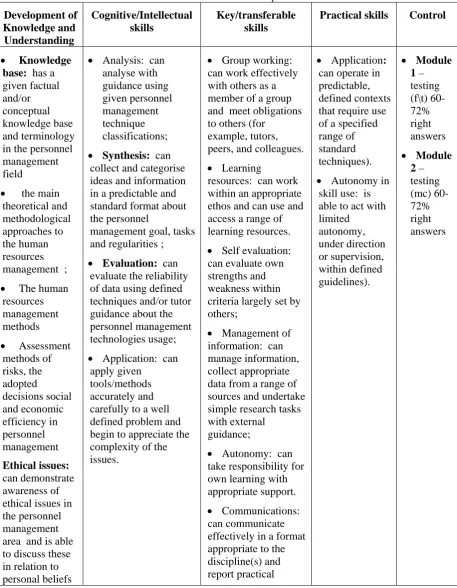
Level of competence shows complexity of the tasks solved by students. The basic level provides an obligatory, threshold minimum for the graduate at completion of MEP mastering. Managers are capable to solve the known, low-factorial, wide-spread problems which don't have far-reaching consequences, within standards. Basic level descriptors of competence PK-14 MEP mastering by the bachelor-manager are presented in Table 1.
Table 1- base level descriptors
Development of Knowledge and Understanding Cognitive/Intellectual skills Key/transferable skills
Practical skills Control
• Knowledge base: has a given factual and/or conceptual knowledge base and terminology in the personnel management field
• the main theoretical and methodological approaches to the human resources management ; • The human
resources management methods • Assessment
methods of risks, the adopted decisions social and economic efficiency in personnel management Ethical issues: can demonstrate awareness of ethical issues in the personnel management area and is able to discuss these in relation to personal beliefs
• Analysis: can analyse with guidance using given personnel management technique classifications; • Synthesis: can
collect and categorise ideas and information in a predictable and standard format about the personnel
management goal, tasks and regularities ; • Evaluation: can
evaluate the reliability of data using defined techniques and/or tutor guidance about the personnel management technologies usage; • Application: can
apply given tools/methods accurately and carefully to a well defined problem and begin to appreciate the complexity of the issues.
• Group working: can work effectively with others as a member of a group and meet obligations to others (for
example, tutors, peers, and colleagues. • Learning
resources: can work within an appropriate ethos and can use and access a range of learning resources. • Self evaluation: can evaluate own strengths and weakness within criteria largely set by others;
• Management of information: can manage information, collect appropriate data from a range of sources and undertake simple research tasks with external
guidance;
• Autonomy: can take responsibility for own learning with appropriate support. • Communications: can communicate effectively in a format appropriate to the discipline(s) and report practical
• Application: can operate in predictable, defined contexts that require use of a specified range of standard techniques). • Autonomy in
skill use: is able to act with limited autonomy, under direction or supervision, within defined guidelines).
• Module 1 – testing (f\t) 60-72% right answers • Module
and values). procedures in a clear and concise manner; • Problem solving: can apply given tools/methods accurately and carefully to a well defined problem and begin to appreciate the complexity of the issues in the
discipline.
The second level by complexity degree – the advanced one- assumes excess of the minimum characteristics of competence formation by the graduate. Managers are capable to solve the known, wide-spread problems which don't have far-reaching consequences, beyond standards. Descriptors of the advanced level are presented in Table 2.
Table 2- advanced level descriptors
Development of Knowledge and Understanding Cognitive/Intellectual skills Key/transferable skills
Practical skills Control
• Knowledge base: has a detailed knowledge of the personnel management techniques and awareness of a variety of ideas, contexts and frameworks). • Ethical issues: is aware of the wider social and exogenous ideas at the personnel management techniques usage and is able to debate issues in relation to more general ethical perspectives).
• Analysis: can analyse a definite range of information with minimum guidance using given
classifications/principles and can compare
alternative methods and techniques for the personnel management); • Synthesis: can reformat a range of ideas and information at the personnel management methods selection ; • Evaluation: can select appropriate techniques of evaluation and can evaluate the relevance and
significance of the data collected at the personnel management );
• Application: can Application: can identify key elements
• Group work: can interact effectively within a team / learning group, giving and receiving information and ideas and modifying responses where necessary at the managerial situations analysis ;
• Learning resources: can manage learning using resources for the discipline. Can develop working relationships of a professional nature within the
discipline(s). • Self- evaluation:
can evaluate own strengths and weakness, challenge received opinion and
• Application of skills: can operate in situations of varying complexity and predictability requiring application of a wide range of techniques; • Autonomy
in skill use: able to act with increasing autonomy, with reduced need for supervision and direction, within defined guidelines.
of the personnel management
techniques usage and choose appropriate methods for their resolution in a considered manner).
develop own criteria and judgments; • Management of
information: can manage information; can select appropriate data from a range of sources and develop appropriate research strategies;
• Autonomy: can take responsibility for own learning with minimum direction; • Communications:
can communicate effectively in a manner appropriate to the discipline(s) and report practical procedures in a clear and concise manner in a variety of formats;
• Problem-solving: can identify key areas of problems and choose appropriate tools / methods for their resolution in a considered manner.
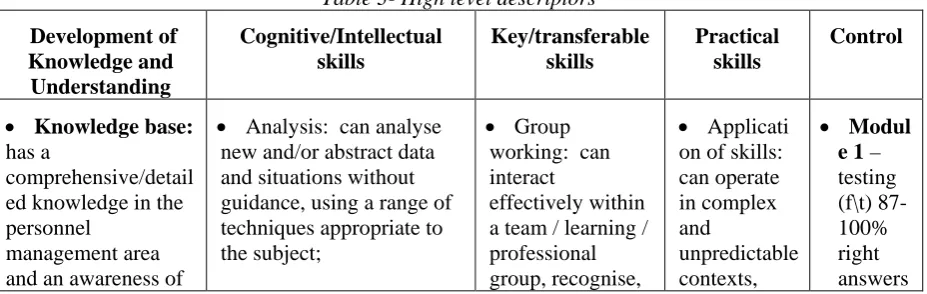
The third level by complexity degree – high, assumes the greatest possible expressiveness of competence formation of the graduate and is qualitative criterion for self-improvement. Managers are capable to solve known problems with several groups of interested parties, with the local consequences, beyond standards. Descriptors of the advanced level are presented in Table 3.
Table 3- High level descriptors
Development of Knowledge and Understanding
Cognitive/Intellectual skills
Key/transferable skills
Practical skills
Control
• Knowledge base: has a
comprehensive/detail ed knowledge in the personnel
management area and an awareness of
• Analysis: can analyse new and/or abstract data and situations without guidance, using a range of techniques appropriate to the subject;
• Group working: can interact
effectively within a team / learning / professional group, recognise,
• Applicati on of skills: can operate in complex and
unpredictable contexts,
• Modul e 1 – testing (f\t) 87-100% right answers
the provisional nature of knowledge): • The personnel management service role evaluation in the organization;
• Personnel management methods; • Personnel management techniques
(selection, allocation, adaption ,
development , assessment , release) Ethical issues: is aware of personal responsibility and professional codes of conduct and can incorporate a critical ethical dimension into the personnel management).
• Synthesis: with minimum guidance can transform abstract data and concepts towards a given purpose and design novel solutions at the personnel management);
• Evaluation: can critically evaluate evidence to support
conclusions/recommendati ons, reviewing its
reliability, validity and significance. Can investigate contradictory information/identify reasons for contradictions. • Application: is
confident and flexible in identifying and defining complex problems and can apply appropriate
knowledge and skills for personnel management.
support or be proactive in leadership, negotiate in a professional context and manage conflict; • Learning
resources: with minimum guidance can manage own learning using full range of resources for the
discipline(s). Can work
professionally within the discipline.
• Self evaluation: is confident in application of own criteria of judgment and can challenge received opinion and reflect on action. Can seek and make use of feedback). • Information
management: can select and manage information, competently undertaking reasonably straight-forward research tasks with minimum guidance. • Autonomy:
can take
responsibility for own work and can criticise it.
• Communicatio ns: can engage effectively in debate in a
professional manner and produce detailed and coherent project reports. • Problem
solving: is confident and flexible in identifying and defining complex problems and the application of appropriate knowledge, tools / methods to their solution.
For the purpose of educational services quality improvement the institute of the international management and education of KSAU voluntary passed public accreditation in the training direction "Management". The State hasn't established requirements to education quality independent assessment process. The international accreditation of an educational program in the University was carried out by the Commission of the European Council for Business Education. EСBE is the independent, non-profit organization registered in Belgium. The board of directors elected from members of the accredited organizations, coordinates organization work.
Mission of the European Council for Business Education consists in business education advance and quality support on a global scale. Main objective of the organization — improvement of quality business education in the world. Accreditation process takes place in ECBE in three stages. At first higher education institutions or programs are assessed by students, administration and teachers. Then by members of the commission of ECBE. At the final stage compliance of higher education institution or the program to the ECBE standards is defined.
The accreditation essence in ECBE consists in business programs quality assessment and their compliance with general education standards of the European countries. Accreditation in ECBE is based on an independent assessment of the higher education programs by group of professional experts which includes experts in the area of business [5].
The commission which carried out accreditation in KSAU included 3 persons: the chairman – Robert T. M. Rietbroek (Netherlands), members of the commission – Perry Haan (USA) and Polona Tominc (Slovenia). It confirmed compliance of this educational program to the international and European quality standards. By results of work the corresponding certificates were issued, what promotes increase of the status and competitiveness of the University as a whole.
References
• Azarova, R.N. The competences passport development: methodical recommendations for organizers of project works and the faculties of higher education institutions [Razrabotka pasporta kompetentsij: metodicheskie rekomendatsii dlya organizatorov proektnykh rabot i professorsko-prepodavatelskikh kollektivov vuzov] First edition by Azarova, R.N., Zolotareva, N.M., Moscow, Issledovatelskij tsentr problem kachestva podgotovki spetsialistov. koordinatsionnyj sovet uchebno-metodicheskikh obedinenij i nauchno-metodicheskikh sovetov vysshej shkoly. [Research
center of problems of quality of training of specialists. Coordination council of educational and methodical associations and scientific and methodical councils of the higher school], 2010, 52 pp. • The KSAU official site: URL:// http://www.kgau.ru.
• FSES HPO in the bachelors training direction 080200. 62«Management», approved by the Ministry of Education and Science of RF order on May, 20, 2010, № 544, 31pp.
• ECBE Credit Level Descriptors using SEEC Higher Education Credit Level Descriptors,SEEC Southern England Consortium f
• or Credit Accumulation and Transfer. - 2002. – 11 pp. • The ЕСВЕ official site: URL: http://www.ecbe.eu