AN ANALYSIS OF THE EMERGENCY SERVICES AND RESPONSE IN PAKISTAN Zarmina Akbar, Naeem Shahzad, Syed Hassan Farooq
National University of Sciences and Technology, Pakistan
Abstract
Pakistan has experienced an increased frequency of natural disasters in the recent past. Owing to her diverse terrains ranging from mountains to deserts, the country is vulnerable to many natural disasters including floods, earthquakes, droughts etc. This article deals with the subject of Emergency Services while keeping its focus on the Response mechanism related to our environment and conditions. The initial part highlights the stages for controlling damage from various types of disasters. Furthermore, an emphasis on requirements of sound organization for providing essential services and responses required during disasters is viewed upon. The mid part takes a wholesome view of our Services and responses required during disasters in case of emergencies. Finally, there is an overview of Additional steps which should be taken for providing emergency services and relief in order to cope within the situation building a vision of safety culture to enhance the coping capacities in terms of contingency planning, equipment required and provided, information and communication, role of media and most important damage assessment.
Key words: disaster, susceptible, emergency services, response, contingency planning, damage assessment
1. INTRODUCTION
Disaster can be defined as “any unplanned event, occurrence or sequence of events that may have unpredictable and undesirable consequence” [1]. It is a Universal Truth that disaster strike countries irrespective of the fact whether they are developed or developing. The magnitude of devastation however varies owing to the preparedness and mitigation methods adopted by those countries. Disasters usually cause huge human and economic losses having a significant impact on national economies. Diverse global geo-climatic conditions lead to different types of natural disasters like floods, droughts, earthquakes, cyclones, landslides, and volcanoes etc. may strike according to the vulnerability of the area. Due to the increased instances of natural and man-made disasters experienced in the recent past, a well developed and effective response system, that may ensure synergetic application of all limbs of the society at all tiers, is the need of the hour [1].
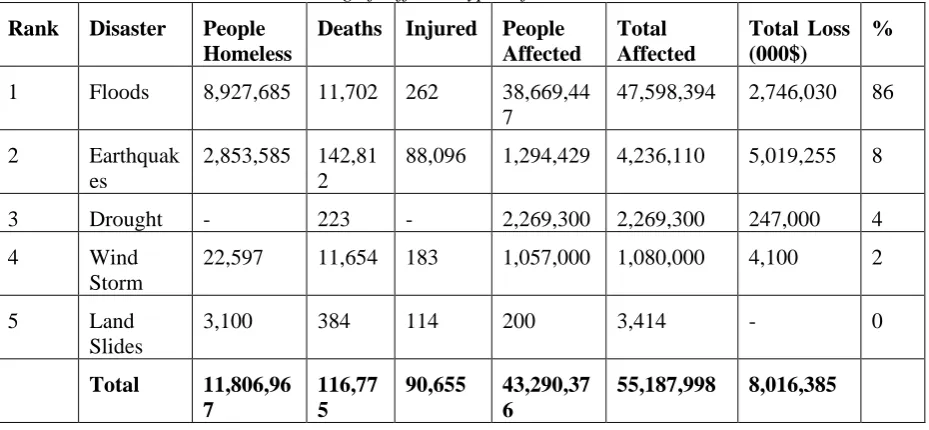
Pakistan, due to its diverse range of terrain, is susceptible to wide ranging hazards from droughts to floods and earthquakes to cyclones. Pakistan had suffered from a major drought from 1995-2000. Pakistan has suffered almost every year from floods. Monsoon rains cause rivers to overflow. Besides we have had losses from non-natural and terrorist activities [2]. Pakistan has also experienced earthquakes ranging from moderate to severe in intensity. Table 1 shows different types of disasters which have affected Pakistan [3].
Table 1. Ranking of different types of disasters in Pakistan
Rank Disaster People Homeless
Deaths Injured People Affected
Total Affected
Total Loss (000$)
%
1 Floods 8,927,685 11,702 262 38,669,44 7
47,598,394 2,746,030 86
2 Earthquak es
2,853,585 142,81 2
88,096 1,294,429 4,236,110 5,019,255 8
3 Drought - 223 - 2,269,300 2,269,300 247,000 4
4 Wind
Storm
22,597 11,654 183 1,057,000 1,080,000 4,100 2
5 Land
Slides
3,100 384 114 200 3,414 - 0
Total 11,806,96 7
116,77 5
90,655 43,290,37 6
55,187,998 8,016,385
Despite all these hazards, Pakistan is yet to formulate a viable Disaster Management System, to respond to and recover from disasters befittingly. In addition, the limited capability of the civil administration to deal with the disasters and their eventual reliance on the Army is likely to force employment of Army for disaster management in the future as well. Operation ‘Lifeline’ is the recent example of such employment. The outcome of this paper would be how to enhance coping capacities in time of emergency services and responses required during disaster.
2. STAGES FOR CONTROLLING DAMAGE FROM VARIOUS TYPES OF DISASTERS Figure 1 shows the different stages for controlling the various types of disasters. The process starts from identification of a hazard leading to possible preventive or mitigation measures to control the losses. It further leads to manifestation of disaster resulting into damage control which is practically possible when the disaster strikes.
182 DAMAGE
DAMAGE
CON
CON
MANIFESTATION
MANIFESTATION
PREVENTION
PREVENTION
IDENTIFICATION
IDENTIFICATION
Figure 1. Possible stages for controlling disasters
3. REQUIREMENTS OF SOUND ORGANIZATION FOR PROVIDING ESSENTIAL SERVICES AND RESPONSES REQUIRED DURING DISASTERS
Most of the disaster management organizations developed by different countries have a number of commonalities and no system has proven to perform perfectly [4]. Nevertheless, the following conclusions from the study of the selected organizations are drawn:
• Simplicity and flexibility are the key features of any Disaster management organization.
• Standby trained specialist should be kept in reserve.
• Organization should be structured in layers, having definite terms of reference and responsibility.
• International as well as non-governmental organizations can contribute for disaster management and can only be integrated with the operation on requirement basis.
• Because of limited resources, it becomes very difficult for developing countries to afford dedicated facilities / organizations to face the disasters. To overcome this shortage the existing facilities to be identified and integrated into the system when required.
• In all reviewed systems armed forces play a predominant role beyond the capacity of civil organizations because they have readily available trained manpower, resources and proven command structure. Nevertheless they are always in a subordinate role only. Any disaster management system should include involvement of armed forces.
• Disaster management system should form nucleus with the potential to expand to handle bigger challenges.
• Incorporation of volunteers from communities in operations like disaster relief and reconstruction is crucial. Through motivation and campaigning the leaders at all tiers should motivate community participation and endeavor to bring a change in the mind-set of the people in this regard.
• Research on disaster prevention technology is necessary. Developing countries may benefit from the research results of developed countries which might be adopted in regional cooperation of with the help of international programs.
• Current data on infrastructure, inventory of equipment that can be used for rescue purposes, digital detailed maps and other relevant information must be readily available with the respective disaster management agency.
• Preparedness and reaction to emergencies must be trained and evaluated by large scale exercises.
4. SERVICES AND RESPONSES REQUIRED DURING DISASTERS
Following Emergency services and responses should be provided by a state to its people [5]:-
a. General Assistance
• Cordoning of site of accident against looting.
• Working parties for collecting luggage.
• Rubble clearance and rescue operations.
• Traffic control in case of roadblocks.
• Supply and transport.
• Fire fighting.
• Medical services to include evacuation of casualties.
• Provision of food and clothing.
• Establishment of centre for displaced children, women and old people.
• Identification and disposal of dead bodies.
• Provision of intelligence cover in case of manmade disasters
• Close cooperation with police and other law enforcing agencies for investigation.
b. Technical Assistance
• Recovery facilities like armoured recovery vehicles, cranes and Electrical and Mechanical Engineers wreckers, dozers and excavators.
• Facilitating and acquiring steel cutting facilities in the area.
• Necessary machinery to lift large concrete pieces, blasting (where necessary).
• Clearance of roads and railway track for other trains.
c. Medical Services
• Hospital services to include ambulances (military and civil) in the near vicinity of incident.
• Life saving drugs.
• Blood donation and transfusion facilities.
• De-infection and sanitization of the area and epidemic control measures.
5. DEVELOPED COMMUNITY TO SUPPORT INITIAL EMERGENCY SERVICES AND RESPONSES
Elaborate community development programme should focus on the following steps:-
• Building a resilient community requires creating awareness through disaster education, training and information dissemination [6].
• Community based approach followed by most NGOs and Community Based Organizations should be incorporated in the disaster management system as an effective vehicle of community participation.
• There is a need to identify more vulnerable groups like women, children, aged, infirm and physically challenged people who need special care and attention especially during disaster situations. Efforts are required for categorizing such vulnerable groups and providing special assistance in terms of evacuation, relief, aid and medical attention to them [7].
• Media must be used to fullest for educating the community in terms of what could be the nature of disasters and what could be expected of them.
6. EQUIPMENT
The varying types, magnitudes and levels of disasters make it imperative for us to identify the vulnerabilities, assess and analyse the risks and devise a strategy for risk management. Unless we follow the chain of disaster risk management, it would be very difficult to suggest an inventory of equipment for varying terrain and nature of crises and disasters.
7. CONCLUSIONS
The response and performance of the nation in disaster relief operations can improve manifolds if we can capitalize on our experience of past disasters that we have been through. Though a new Natural Disaster Management system is in place in Pakistan that is intricate, detailed and will prove to be
responsive, but still the role of the military will in any future disaster be high profile and very vital to the lives and safety of our citizens. This is in keeping with global trends towards OOTW (operations other than war) and a major shift in the role of militaries that has taken place, Worldwide.
REFERENCES
1. Asif, J. R. (2013). “Crisis and Disaster Management”, Hilal, 50 (4), 2-3.
2. Nazi, O. (2012). Implications of terrorism in Pakistan. http://www.cssforum.com.pk/505191-post1.html. Accessed on 28-12-13
3. http://www.ndma.gov.pk. NDMA, Annual Report (2010). Accessed on 12-12-13
4. National Disaster Risk Management Framework Pakistan.
http://unportal.un.org.pk/sites/UNPakistan/OneUN/DRM%20Documents/NDRM%20Framework%20 Pakistan.pdf. Accessed on 02-01-14
5. FEMA’s Preparedness for the Next Catastrophic Disaster, OIG-08-34. (2008). http://www.dhs.gov/xoig/assets/mgmtrpts/OIG_08-34_Mar08.pdf. Accessed on 04-01-14.
6. Manash, R. B., Mujibuddaula, S. K., Rabiul, I. (2013). Empowering Communities to Cope with Disaster Risks through Community Based Disaster Management. Proceedings of International Conference on Regional Climate-CORDEX 2013, Brussels, Belgium.
7. Kamal, T. (2005). Disaster Management through Panchayati Raj. Concept Publishing Company, New Delhi, India.pp.429.