© 2018 IJSRST | Volume 4 | Issue 2 | Print ISSN: 2395-6011 | Online ISSN: 2395-602X Themed Section: Science and Technology
Opportunities and Challenges in Cloud-Based E-Learning
Shri U. L. Patel1, Shri Dilipkumar N. Padhiar2
1Assistant Professor, C. U. Shah Science College, Ahmadabad, Gujarat, India
2Assistant Professor, M. B. Patel Science College, Anand, Gujarat, India
ABSTRACT
Education and learning continue to be expanded a step-by-step, and each section of education has improved gradually. The popularity of education using the web and the development of the immaculate online learning condition has turned out to be one of the hot concentrates on exploring remote education. Cloud computing is rapidly developing, having nearly any discipline application. By offering benefits to education, it is very important to enhance the quality of education in order to fulfil the essential performance, such as offering negligible effort, flexibility, diversity, cooperation and convenience. The cloud services and programs enable clients to store and get to their nearby info on the remote server farm by utilizing their PCs or smart phones by means of the web. Cloud-based E-learning is the technique to cut down expenses and intricacy of data dealing with, which controlled by third party services. Conventional E-Learning strategies joined with cloud computing advancement to offer huge favourable circumstances to the academic users but it compromises in security perspectives. This study explains advantages of E-learning in education and describes different types of attacks in service delivery models of E-Learning proposed by different researchers.
Keywords : E-learning, Cloud Computing, SaaS, PaaS, IaaS
I. INTRODUCTION
Education or learning is an important part of life and any person cannot live properly without education. At present, there are various models for getting knowledge or learn something. One of the most encouraging paradigms for education is E learning. E learning is typically alluding to the deliberate use of
networked information and communications
technology (ICT) in teaching as well as learning. Also, another term used to illustrate this mode of teaching and learning, including web-based education, virtual education or delivered education. The spreading out of learning is especially known for the reach of ICT expansion, and in addition, its' diminishing costs. The capability of ICT to aid multi-media resource-based learning and teaching can also highly relevant to the developing enthusiasm for E-Learning. Cloud
computing is one of the innovation inclines liable to significantly affect the educating and learning
conditions. [1] Cloud computing is definitely a new
universities, schools, and organizations. The cloud system in institutions’ campuses offers effective infrastructure and deployment model for their energetic demands. Some great benefits of cloud computing support, education institutions to ascertain a portion of the ordinary difficulties, such as cost diminishment, brisk and persuasive correspondence, security, versatility, and accessibility. In addition, it makes it possible for users store their important data and access it on-demand from anywhere anytime via
the internet. [2] The cloud e-learning innovation is
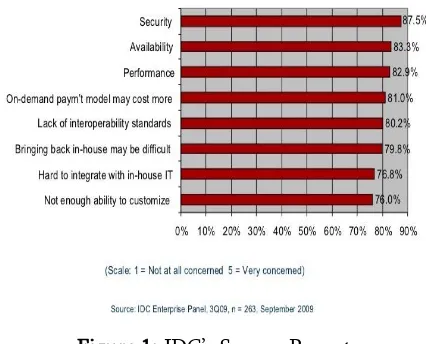
recognized as an effective alternative technology over conventional e learning. The security is the major concern in this technology. In September 2009, reviewed by 263 IT executives manage by the IDC, security has been separated from 87.5% as shown in Figure 1. [3]
Figure 1: IDC’s Survey Report
II. E-LEARNING FUNDAMENTALS
E Learning is one of the ways that is bridging the gap
between traditional and smart education. [4] The
Internet has a significant influence on education, today’s education is reshaping because of Internet. The adoption of the Internet in education has entirely re-structured the learning and training model. A new concept of ubiquitous type learning exists that
supported by several technologies, especially
Information and Communication Technology (ICT) and Web Technology. The fundamental concept
behind e learning is to promote learning through up-to-date, studying materials, without worrying about the bounding of time, space, gender, nationality cast and origin. Just using Internet availability, higher education might be achieved. Actually, the internet supported technologies that provide essential knowledge and increase learning efficiency is called e learning. The e learning offers students decent services of speedy, anywhere and anytime learning, particularly for those who have a very hectic schedule, do not have enough time to attend classroom and learn. Some popular e-learning aspects are textual content, image, picture, animation; audio and video, which have an excellent effect on learning, but if these aspects misuses, the e-learning may possibly, lose its usability. Many professionals commenced believing that e learning may be one of the most effective growing industries in the future and that is reason different massive educational institutions are applying their educational system from traditional to e-learning system. It is noticed that complete e learning setup usually required enormous resources in the form of big servers, highly furnished infrastructure, big data storage equipment, skilled manpower, hi-tech strategies regarding security and fault tolerance. The shifting from traditional to e-learning technique is the most significant concern specifically for those institutions or university that have limited resources; less technical personnel, inappropriate network infrastructure, and poor economic status. The cloud computing innovation could be one of the most effective alternatives for these challenges. [5][6]
III. CLOUD SYSTEM
In an October 2009 presentation titled “Effectively
and Securely Using the Cloud Computing Paradigm,”[7]
by Peter Mell and Tim Grance of the National Institute of Standards and Technology (NIST)
Information Technology Laboratory, Cloud
a model for enabling ubiquitous, convenient, on-demand network access to a shared pool of configurable computing resources (e.g., Networks, servers, storage, applications, and services) that can be rapidly provisioned and released with minimal management effort or service provider interaction.” “This cloud model promotes the availability and is composed of five essential characteristics, three
service models, and four deployment models.”[8],
which is shown in figure 2.
Figure 2: Cloud Computing Characteristics, Service Models and Deployment Models
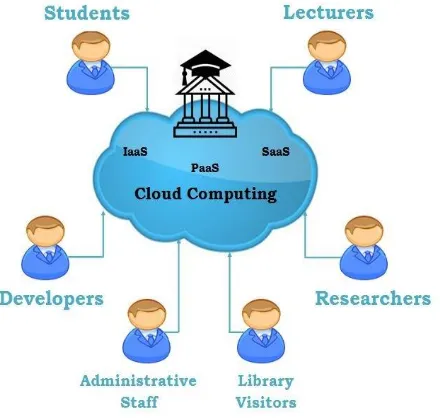
In the modern education system, the main partners of cloud computing are shown in figure 3. In advanced educational institutions, the partner term refers to those who have had access to educational services, such as students, faculties, researchers, employees, etc.
Figure 3 : Partners of cloud in an educational institution
IV. WHY CLOUD COMPUTING FOR E-LEARNING?
Partners who use cloud property and services in advanced education institutions can certainly sort the important benefits of cloud computing in the education system.
4.1 Benefits for Educational Institutions:
There are numerous positive aspects may be granted when implementing cloud computing technology in advanced education institutions. There are different focal points might be conceded while receiving cloud computing innovations in advanced education institutions. Generally, there are different points of interest might be admitted while achieving cloud computing innovations in advanced education institutions. Some universities have accepted cloud computing in their programs for economic purposes, while some other institutions use the cloud to provide
scalable and acceptable IT administrations. [9]
4.2 Benefits for students:
the Internet, enable students to execute lab assignments from anywhere and by a minimal effort by individual gadgets. Therefore, students are no longer required to purchase expensive equipment or install special software. Students have the opportunity to get the platform easily whenever for getting programs on the net, go to the online assessment and upload their assignments and project through the cloud to the instructors. A student can collaborate themselves with other students as a group or with their instructors. Students can collaborate themselves with other students.
4.3 Benefits for faculty:
The faculty also can get numerous benefits through
cloud-based applications. [10] Cloud technology
provides an easy and adaptable stage to set up their materials, presentations, meetings, articles and so on for educators. To overcome the lack of expertise in some faculty members, they can exchange experiences by creating a remote seminar. If offers an opportunity for instructors to work from home and complete assignments, prepare online tests, assessing and planning with their own devices. Cloud accommodates experts a discussion area along with ease of access to global computing resources and satisfactory stockpiling limit.
V. LIMITATIONS IN CLOUD SERVICE MODELS
Even, the enormous features of utilizing cloud computing in educational institutions, there are a few complications that prevent the wide scale reception of this development in different areas of the university. This section focuses about several restrictions discovered with cloud service models, which deserve adopting cloud computing in advanced educational institutions. [11][12][13][14] This research intends to deal
with the key security challenges of implementing cloud computing in advanced educational institutions.
5.1 Limitations in SaaS:
Two main important constraints may affect conveying applications under SaaS model are information locality and reliability. Normally, the user fails to be aware of the geographical location where the cloud service provider stores user’s data and how can be assured that cloud service provider follows a Service Level Agreement or not. Lack of trust between users and cloud service providers is a serious concern that ought to be snapped while using the SaaS. Therefore, to prevent data spillage in the academic institutions the computer department in the organizations may host the SaaS software programs on its own private server or deploy it on infrastructure services supplied by reliable and trusted service provider, such as Google, Amazon, Sales force etc. Therefore, almost all the academic institutions associated with this evaluation are utilizing a private cloud rather than the public or hybrid cloud.
5.2 Limitations in PaaS:
5.3 Limitations in IaaS:
When compared with first two service models, IaaS accommodates cloud user more effective handle on security related challenges. Security and safety compulsions of the IaaS model can be shared among service providers and their customers. The provider’s responsibility consists of primary security controls such as physical as well as virtual environment protection. Therefore, the cloud user is responsible for implementing the suit security controls associated with software programs such as operating system, developed applications and data. Virtualization technique is often a crucial IaaS model. In the virtualization domain, when cloud users are employing contributed infrastructure resources, they can lead to cross-based attacks. In these cases, the attacker gains root-level access and then penetrates most of the tenant’s accounts in the cloud.
VI. SECURITY CHALLENGES AND RISKS:
Organizers in the education section are desperate to utilize cloud services, which have been profoundly less than just as if that service that totally monitoring inside their own focuses. Nonetheless, they are actually facing the scope of numerous new problems. This section seems towards the basic security and privacy-related issues and hazards in cloud computing.
VII.CLOUD INFRASTRUCTURE:
This section consists of problems recognized with the physical devices used as a backbone for cloud infrastructure and additionally the virtual program employed to operate cloud resources. The cloud infrastructure consists of key elements of cloud service models and is especially associated with virtualization environment. Virtualization is the key innovation used by cloud vendors to complete multi-tenant
architecture, where it splits the cloud server's
computing resources into various execution
environments. The virtualization-based cloud is not secure because of multi-user distributed environment, where every virtual instance is on a single physical machine. Among the list of virtualization security issues encounters cloud system is a lack of VM safety, because several VMs located on a similar PC, we cannot place a hardware protection device such as a firewall between them. A dynamic environment causes one more problem where VMs are carried out, ended or moved to elsewhere for that reason, which marks difficult to screen activity and decide whether the attack is accumulating. Primary attacks that may debilitate cloud infrastructure are Theft-of-Service, DoS, Cross-VM Side Channel, Phishing, Malware Injection, Botnets and VM rollback attack.
VIII. CONCLUSION
Be sure that IT manager able to manage and deal with cloud’s products and services while finishing the contract concurrently with the service provider. A concurrence by having an outsider to accomplish evaluations constantly to screen the execution and compliance from the service provider to contract terms. Keep track of regularly the efficiency of available cloud services and resources, which have been poured and roll out a noticeable difference as required. This tactic may minimize security risks and threats. This research paper primarily focuses on the investigation of the use of cloud computing and
advantages of E-learning in the E-learning
cloud computing will not end its pace to continue. As the cloud computing technologies turn out to be more refined and the uses of cloud computing, turn out to be progressive across the board, E-Learning will surely introduce another period of cloud computing.
REFERENCES
[1] E. Tuncay, "Effective use of Cloud computing in
educational institutions," Procedia Social Behavioral Sciences, p. 938–942, 2010.
[2] Khalil H. A. Al-Shqeerat, Mohammad Ali A.
Hammoudeh, Mohammad Ijaz Abbasi. (2016). Design and Analysis of an Effective Secure Cloud System at Qassim University. International Journal of Computer Science and Information Security (IJCSIS). 14 (8), August 2016, pp.
[3] Source IDC Enterprise Panel, 3Q09, n=263,
September 2009
[4] A Hossain Masud, X Huang, “An E-learning System
Architecture based on Cloud Computing” World Academy of Science, Engineering and Technology, Vol: 62, 2012
[5] Pocatilu.P.Alecu.F.&Vertici,M.,(2009). "Using
Cloud Computing for E-Learning Systems." Recent Advances on Data Networks, Communications,
Computers, ISBN:978-960-474-134-2.
[6] U.J.Bora and M.Ahmed, "E-Learning using Cloud
Computing," International Journal of Science and Modern Engineering, vol 1, no. 2, (2013), pp.9-12
[7]
Csrc.nist.gov/groups/SNS/cloud-computing/cloud-computing-v25.ppt
[8] (http://csrc.nist.gov/groups/SNS
/cloud-computing/cloud-def-v15.doc)
[9] Niall Sclater. (2010). Cloud Computing in
Education. Published by the UNESCO Institute for Information Technologies in Education. Available: http://iite.unesco.org/pics/publications/en/files/321467 4.pdf.
[10] Poonam R.Maskare, Sarika R. Sulke. (2014).
Review Paper on E-learning Using Cloud Computing. International Journal of Computer Science and Mobile Computing. 3 (5), pp. 1281-1287.
[11] Wesam Dawoud, Ibrahim Takouna, Christoph
Meinel. Infrastructure as a Service Security: Challenges and Solutions. In Proc. The 7th
International Conference on Informatics and Systems (INFOS), 2010, pp. 1-8.
[12] S. Subashini, V.Kavitha. (2011). A Survey on
Security Issues in Service Delivery Models of Cloud Computing. Journal of Network and Computer Applications. 34, pp. 1-11.
[13] Rajarshi Roy Chowdhury. (2014). Security in Cloud
Computing. International Journal of Computer Applications. 96(15), pp. 24-30.
[14] Chetan M Bulla1, Satish S Bhojannavar, Vishal M