© 2017 IJSRST | Volume 3 | Issue 7 | Print ISSN: 2395-6011 | Online ISSN: 2395-602X Themed Section: Science and Technology
An Introduction to Fuzzy Logic Controller and its Applications
Tohida Rehman
Assistant Professor, Department of Computer Science, Surendranath College (C.U), M.G Road, Kolkata, India
ABSTRACT
This paper presents the nature of fuzziness and how the fuzzy operations are performed and how fuzzy rules can incorporate the underlying knowledge to develop a fuzzy logic controller or simply a fuzzy controller. Fuzzy logic is a way to make machines more intelligent to deal with uncertain, imprecise or qualitative decision making problems like humans. This paper also provides some applications of fuzzy controller in a simple and easy to understand manner.
Keywords:Fuzzy Set, Fuzzy Logic, Linguistic Variable, Fuzzy Controller, Fuzzy Inference System
I.
INTRODUCTION
Fuzzy logic could be used successfully to model situations in which people make decision in an environment that is so complex and it is very hard to develop a mathematical model [1] [2]. Based on the nature of fuzzy human thinking, Professor Lotfi A Zadeh originated the “Fuzzy set theory” in 1965 and that time it has been the subject of much controversy and debate [4]. But in recent years, it has found many applications in a variety of fields [7]. So in this paper I will try to define the basic architecture of fuzzy controller’s i.e. how fuzzy logic has been employed in handling inexact and vague information because of its ability to utilize natural language in terms of linguistic variables.
The lateral section of this paper is designed as follows 2-Fuzzy sets and fuzzy logic –the basis for fuzzy control.
II.
FUZZY SETS AND FUZZY LOGIC –THE BASIS
FOR FUZZY CONTROL
(a) FUZZY SETS
The characteristic function of a crisp set assigns a value of either 1 or 0 to each individual in the universe set,
thereby discriminating between members and
nonmembers of the crisp set under consideration. This function can be generalized such that the values assigned to the elements of the universal set fall within a specified range and indicate the membership grade of these elements in the set. Larger values denote higher degrees of set membership. Such a function is called a
membership function, and the set defined by it a fuzzy set.
The most commonly used range of values of membership functions is the unit interval [0, 1]. Each membership function maps elements of a given universal set X, which is always a crisp set, into real number in [0,1]. Two distinct notations are most commonly employed to denote membership functions [9] [10]. In one of them, the membership function of a fuzzy set A is denoted by µA; that is µA : X → [0, 1].
In other one, the function is denoted by A and has form:
A: X → [0, 1]
Let us consider your family member and their ages Grandfather(80),Grandmother(75),papa(50),mama(45),u ncle(40),aunty(38),brother(24),sister(10)
From the above data you can easily defined a set of male members
A= {Grandfather, papa, uncle, brother}
But if you want to defined a set of young members? Then how can you define this set using the conventional set theory? Then you have to use the fuzzy set. In fuzzy logic everything is a matter of degree [10].
(B) OPERATIONS ON FUZZY SETS
As there are basic operations on crisp sets – union, interaction and complement, there are also various operations in fuzzy logic. Suppose there are two fuzzy sets A and B on the universe X for a given element x.
iii. INTERSECTION(AΛB) µ (AΛB)(x) =
min{µA(x), µB(x)}
iv. COMPLEMENTATION(A') µ (A')(x) = 1- µ (A)(x)
v. EQUALITY(A=B) µA(x) = µB(x)
vi. INCLUSION(A) µA(x) ≤ µB(x)
vii. PRODUCT (A.B) µA.B(x) = µA(x).
µB(x)
viii. DIFFERENCE(A-B=A ∩ B') µ (A-B)(x) =
min{µA(x), 1-µB(x)}
(C) FUZZY ARITHMETICS
Each linguistic variable the states of which are expressed by linguistic terms interpreted as specific fuzzy numbers is defined in terms of a base variable, the values of which are real numbers within a specific range [5] [6].
Example: Let x be a linguistic variable with the label “speed of a car”. Terms of this linguistic variable, which are fuzzy sets, could be “very slow”, “slow”, and “fast”, “very fast” from the term set.
T= {very slow, slow, fast, very fast}
Each term is a fuzzy variable defined on the base variable, which might be the scale from 0 to 100. (D)FUZZY LOGIC
Fuzzy Logic (FL) is a multi-valued logic that allows intermediate values to be defined between conventional evaluations like true/false, yes/no, high/low, etc [3] [8].
Connectives: In daily conversation and mathematics, sentences are connected with the words and, or, if-then (or implies), and if and only if. These are called connectives.
Several rules: If rule base contains several rules we combine them assuming a logical or between rules. For example
R1: If speed of a car is very slow and distance is close then brake power is light
R2: If speed of a car is fast and distance is very close then brake power is heavy
Then the combined rule R will be R = R1 V R2 In general R=V Ri
a)
Implication: The rule If speed of a car is very slow and distance is close then brake power is light is called implication, because the value of speed and distance implies the brake power in the controller.There are two interpretations in case of fuzzy rules implication:
1) By Mamdani µ (P(x) →Q(y)) = min {µ (P(x)), µ (Q(y))}
2) By Zadeh µ (P(x) →Q(y)) = max {min [µ (P(x)), µ (Q(y))], 1- µ (P(x))}
III.
FUZZY CONTROLLER
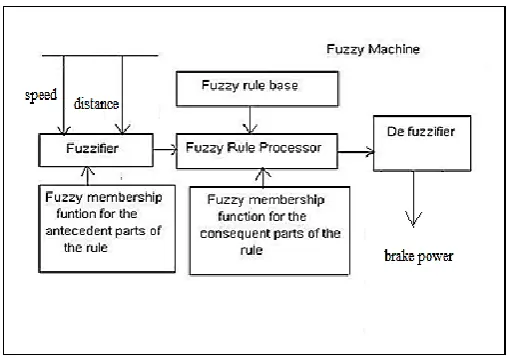
Fuzzy controllers are special expert systems. Each employs a knowledge based, expressed in terms of relevant fuzzy inference rules, and an appropriate inference engine to solve a given control problem. A general fuzzy controller consists of four modules: a fuzzy rule base, a fuzzy inference engine and Fuzzification/Defuzzification Modules.
Figure 1. fuzzy controller for car driving braking system
Fuzzy Inference Mechanism/System (FIS)
If there is a system, achieving input/output mapping with the help of fuzzy logic then it is called Fuzzy Inference Mechanism/system.
Steps of a fuzzy inference system
1) Fuzzification of the input values
2) Applications of fuzzy operators on the antecedent part of fuzzy rules
3) Evaluation of the fuzzy rules
5) Defuzzification of the aggregate fuzzy set to obtain the crisp output values
Step 1. Fuzzification of the input values
The inputs to a FIS are a number of crisp values corresponding to some parameters. For each input we have to determine the degree to which it belongs to each appropriate fuzzy set through membership function. Every element in the universe of discourse is a member of the fuzzy set to some grade, may be even zero. The function that ties to each element x of the universe is called the membership function μ(x).There are several function for Fuzzification such as Gaussianmembership function, Triangular membership function, Trapezoidal Function etc.
Step 2. Applications of fuzzy operators on the antecedent part of fuzzy rules
When the antecedent of a given rule has more than one parts we need to apply appropriate fuzzy operators (AND, OR), so that a single number representing the result of the entire antecedent is obtained. The input to fuzzy operator is two or more membership values from the fuzzified input variables and output is a single truth-value. This single truth-value is applied to the fuzzy rule to obtain the resultant fuzzy set corresponding to that rule.
Representation of fuzzy rules
In the field of artificial intelligence, there are various ways to represent knowledge. Perhaps the most common way to represent human knowledge is to form it into natural language expressions of the type.
IF premise (antecedent) THEN conclusion (consequent). This type of expression, commonly referred to as the IF-THEN rule based form. It typically expresses an inference such that if we know a fact (premise or antecedent) then we can infer or derive, another fact called a conclusion (consequent).
a) Single antecedent
R: IF Pressure is High THEN Volume is Low.
The above rule contains two linguistic variables such as Pressure and volume. High and Low are defined as the linguistic values of the corresponding linguistic variables.
The above rule can write by using the following predicate logic statement as given below
High (P) → Low (V)
High (P) means “Pressure is High” Low (V) means, “Volume is Low”
The above statement can be looked upon as a fuzzy relation between two fuzzy sets High and Low and that can be written as:
R(x, y) =µR (High (x) → Low (y))
b) Multiple conjunctive antecedent
R: IF x is A1 and A2 and A3 and A4 …………and AL
THEN y is Bs
Assume a new fuzzy subset As for the multiple
conjunctive antecedent part of the above rule.
As= A1∩A2 ∩A3 ∩ A4 ∩……….∩AL
………(1)
Thenthe compound rule may be written as: IF AS THEN BS
There are two way to find out the membership values of the equation (1)
(1) µ AS (x) = min {µ A1 (x), µ A2 (x) , µ A3 (x)
………. µ AL (x)}
(2) µ AS (x) = µ A1 (x) * µ A2 (x) * µ A3 (x)
………..…....* µ AL (x)
c) Multiple disjunctive antecedent
R: IF x is A1 or A2 or A3 or A4 …………or AL THEN
y is Bs
Assume a new fuzzy subset As for the multiple
disjunctive antecedent part of the above rule.
As= A1 VA2 VA3 V A4 ……….V AL
………(2)
Thenthe compound rule may be written as: IF AS THEN BS
The membership values of the equation (2) can be find out by using the following method that is given below:- µ AS (x) =max{ µ A1 (x) , µ A2 (x) , µ A3 (x) …..……. µ AL (x)}
Step 3. Evaluation of the fuzzy rules
Fuzzy rules are evaluated by employing an implication process. Then the input to the implication process is the number provided by the antecedent and its output is a fuzzy set.
Step 4. Aggregation of fuzzy sets across the rules
implication process as its input and produces one fuzzy set for each output variable as the output.
Step 5. Defuzzification of the aggregate fuzzy set to obtain the crisp output values
Defuzzification is a process of converting the aggregate output sets into one crisp number for each output variable this is the last step in fuzzy inference variable .The final desired output for each variable is generally a single number. Since the aggregate of the number of fuzzy sets is itself, a fuzzy set. There are several Defuzzification methods, such as - Centroid method, Centre of sum method (COS), Min of maximum method (LOM) etc.
a) Centroid method
Defuzzified value is computed as the Centroid of the whole area. If the total area under the aggregate output is partitioned into disjoint segments into A1, A2, A3 ….Ak
and corresponding centroids are C1,C2,C3……Ck, then
the centroid of the whole area is obtained by, k
∑ Ai *Ci
i=1 x=
k ∑ Ai
i=1 Fuzzy logic algorithm:
1 Define linguistic variables and terms 2 Construct the membership function 3 Construct rule base
4 Convert crisp data to fuzzy values using the membership function
5 Evaluate rule in the rule base 6 Combine the result of each rule
7 Convert output data to non fuzzy values
IV.
EXAMPLE OF A FUZZY CONTROLLER
Consider the case of driving a car, here speed of the car and the distance is the input of fuzzy controller and brake power is the output. Term values are Speed of the car {slow, medium, fast, and very fast} and distance {very near, near, far, very far} and brake power {very light, light, heavy, very heavy}
Choose any type of fuzzy membership function and scale of range of each linguistic variable
To define the Rule base use heuristic knowledge such as
1. If (speed is slow) and (distance is verynear) then (braking_power is light)
2. If (speed is slow) and (distance is near) then (braking_power is light)
3. If (speed is slow) and (distance is far) then (braking_power is verylight)
4. If (speed is slow) and (distance is very_far) then (braking_power is verylight)
5. If (speed is medium) and (distance is verynear) then (braking_power is heavy)
V.
EXAMPLE OF A FUZZY CONTROLLER
Consider the case of driving a car, here speed of the car and the distance is the input of fuzzy controller and brake power is the output. Term values are Speed of the car {slow, medium, fast, and very fast} and distance {very near, near, far, very far} and brake power {very light, light, heavy, very heavy} Choose any type of fuzzy membership function and scale of range of each linguistic variable
To define the Rule base use heuristic knowledge such as
1. If (speed is slow) and (distance is verynear) then (braking_power is light)
2. If (speed is slow) and (distance is near) then (braking_power is light)
3. If (speed is slow) and (distance is far) then (braking_power is verylight)
4. If (speed is slow) and (distance is very_far) then (braking_power is verylight)
5. If (speed is medium) and (distance is verynear) then (braking_power is heavy)
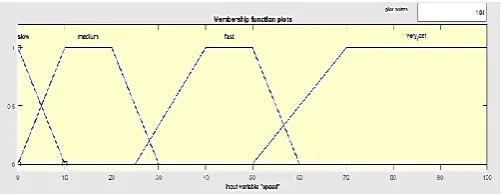
Figure 2. Membership function for input variables speed
triangular and trapezoidal membership function and selecting the scale of range as [0,100]
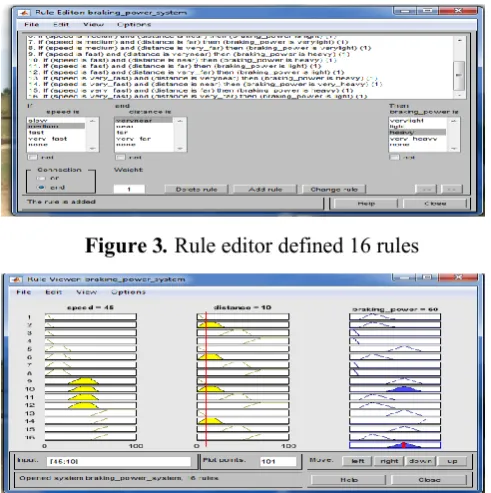
Figure 3. Rule editor defined 16 rules
Figure 4. Rule Viewer defined result
VI.
APPLICATION OF FUZZY LOGIC
The applications of fuzzy technologies fall mainly into two categories
The first category consist of these fuzzy control applications, which are often rather simple but very efficient fuzzy rule-based systems, such as auto focusing systems in cameras, washing machines, automobile transmissions, subway control, or even handwriting recognition. In these applications, fuzzy logic is used as a powerful knowledge representation technique that allows to hide unessential details and to handle uncertain data. However, their efficiency depends also heavily on the use of sensors and effectors, thus their success should really be explained by the interaction of these various parts.
The second category consists of those much more complex systems that aim at supporting or even replacing a human expert. Such applications are exemplified by medical diagnosis systems, securities funds and portfolio selection systems, traffic control systems, fuzzy expert systems, and fuzzy scheduling systems. In this category, there are still many problems that remain to be addressed, and there is an equally
pressing need for a better understanding of how to deal with knowledge-based systems in which knowledge is both uncertain and imprecise.
VII.
FUTURE SCOPE
First of all this research can be used further as an automatic car driving system. Secondly more number of input parameters can be added to evaluate more accurate result.
VIII.
CONCLUSION
Fuzzy Logic provides a completely different, unorthodox way to approach a control problem. This method focuses on what the system should do rather than trying to understand how it works. It uses an imprecise but very descriptive language to deal with input data more like a human operator. Fuzzy logic represents hence a valuable tool which can lead to innovation in research and industrialization with applications to the area of materials and processing technologies.
IX.
REFERENCES
[1]. G. Hayward and V. Davidson "Fuzzy Logic Applications" analyst.128,1304-1306
[2]. Lotfi A Zadeh "Fuzzy sets. Information and control" 8, 338-353 in 1965
[3]. Ajith Abraham "Adaptation of fuzzy inference system using neural learning".fuzzy System Engineering:Theory and Practice. N. Nedjah Ed et al Berlin, germany: Springer-Verlag, 3, 53-83(2005).
[4]. J. M. Mendel "Fuzzy logic systems for engineering" a tutorial. Proceedings of the IEEE, 83(3):345{377, Mar 1995.
[5]. Ajith Abraham. "Rule-Base Expert System," Oklahoma State University,OK, USA. Handbook of Measuring System Design, edited by Peter H. Sydenham and Richard Thorn © 2005 John Wiley and Sons, Ltd. ISBN: 0-470-02143-8, pp. 910-912.
[7]. George J. Klir And Bo Yuan" Fuzzy Sets And Fuzzy Logic (Theory and Application)" .
[8]. An Intelligent Advisor for an Interactive Learning Environment by Akira Takeuchi,Tomoyuki Fujita(Dept. of Artifi cial Intelligence Kyushu Institute of Technology, Japan) and Kazuko Ishibashi, Hiroyuki Yoshida(Kyushu Multimedia System Research Laboratory Matsushita Electric Industrial Co., Ltd., Japan).
[9]. Kevin M. Passino , Department of Electrical Engineering The Ohio State University,Stephen Yurkovich Department of Electrical Engineering The Ohio State University, "Fuzzy Control" An Imprint of Addison-Wesley Longman, Inc.with ISBN 0-201-18074-X
[10]. Tohida Rehman "Fuzzy Rule Based Candidate Selection Evaluator by Political Parties" International Journal of Advanced Research in Computer Science, Volume 8, No. 3, March - April 2017 with ISSN No. 0976-5697.
[11]. J.S. Roger Jang and Ned Gulley "MATLAB Fuzzy Logic Toolbox".
[12]. MATLAB Online Documentation,
http://www.mathworks.com MATLAB