
Abstract— super-resolution techniques alter a set of low-resolution images to a set of high-low-resolution ones. In the last decades different super-resolution methods have been propounded and most of them try to increase the quality and velocity of super-resolution methods. In this paper we have achieved a proper procedure to produce frames with high resolution by combining shift&add method with optical flow in [1] and iterative back-projection method in [2] so that we can use this system for super resolution of videos that have movements for several objects and high speed movements of objects. Our proposed system achieves maximum PSNR of 29.4 and 24.82 respectively for FOREMAN and NEWS video tests and increases resolution of video image sequences (VIS) , eliminates noises and keeping sharp edges as well.
Index Terms—super-resolution; shift&add; iterative back projection; PSNR; video image sequences.
I. INTRODUCTION
According to Fig.1 [1], low-resolution images which are captured of same scenes are discretized as a mathematical model by following:
𝑌𝑘= 𝐷𝑘
𝐻
𝑘𝑐𝑎𝑚𝐹𝑘𝐻
𝑘 𝑎𝑡𝑚𝑋 + 𝑉𝑘
𝐸𝑞(1)
These images are blurred both by camera lens and atmospheric turbulences which are showed by 𝐻𝑎𝑡𝑚 and 𝐻𝑐𝑎𝑚 in (1). We consider only 𝐻𝑐𝑎𝑚[3], [4], [5]
. We describe this model by following:𝑌𝑘 = 𝐷𝑘𝐹𝑘𝐻𝑘𝑋 + 𝑉𝑘
𝐸𝑞(2)
D is a down-sampling matrix. Each camera is down-samples from a scene and the rate of this downsamling can be assumed as a constant. Matrix 𝐹𝑘 describes motion of camera or object, which is different from one frame to reference one. 𝑉𝑘shows noise effects and we assume that as white Gaussian noise. Between different VIS super resolution techniques, the amount of calculation and velocity, and the quality of output results are two main factors to choose a proper technique. In this paper we more focus on quality of output images. Super resolution is the procedure of noisy and blurred low-resolution images combination to achieve a higher resolution images. SuperSaeidFazli,Research Institute of Modern Biological Techniques University of Zanjan, Zanjan , Iran.
HamedFathi, Department of Electrical Engineering, University of Zanjan, Zanjan , Iran.
ShimaPouyan, Department of Electrical Engineering, University of
Zanjan, Zanjan , Iran.
resolution can be studied in two main domains: frequency domain [1, 2] and spatial domain. However frequency domain algorithms are simple but the usage of them are limited because they are sensitive to model errors. This paper is discussed about multi frame super resolution in spatial domain.
In this paper we use shift&add method with iterative back projection for reconstruction.
A High Performance Video Image Sequence
Super Resolution Based on Combined
Shift&Add and Optical Flow
Saeid Fazli , Hamed Fathi, Shima Pouyan
Fig.1. Block diagram representing process of low resolution images production
Real Word Scene
X
Motion Effect Camera Blur Effect Down-Sampling Effect Noisy, Blurred, Down-sampled, Color-Filtered Outcome Noise EffectV
Y
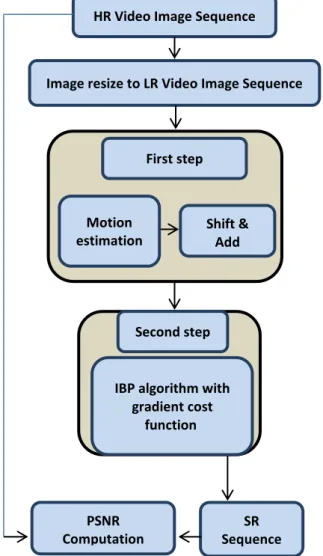
Fig. 2 shows the block diagram of our proposed system. As we show in this figure, we make low resolution video image sequence by resizing frames of the video and these low resolution sequences are the input of super resolution system. Then we obtain motion estimation and we use that for shift&add method. In next step we use iterative back projection algorithm with a cost function and the final outputs are super resolution video sequences.
Fig.2 block diagram of our proposed method The organization of paper is as follows:
In section 2 we explain super resolution algorithm. Section 3 presents our proposed method which we use in this paper. Section 4 defines the experimental results and section 5 concludes our algorithm in this paper.
.
I. PROPOSED ALGORITHM
Assume equation
𝐸𝑞. (2)
. At first we calculate matrix Z=HX. Then we obtain the final image. We can divide this algorithm into two main steps:1. Producing primary blurred super resolution image. 2. Getting final high resolution image.
In [2] matrix Z which is blurred image is obtained by super resolution method using maximum likelihood (ML) technique but in our proposed algorithm we use shift&add method for super resolution of images. The difference of these two methods is in the algorithm of motion estimation.
In [2] motion estimation is between frames but in our algorithm motion estimation is between pixels.
In our method the first step is obtaining image Z and obtained by super resolution shift&add method using optical flow technique. Using this technique is for implementation of equation
𝐸𝑞. (2)
and we use direct method for that [2]. This method works as follow:Motion estimation is the start point. For each pixels of optical flow method, we calculate motion vectors which are transformation vectors from one pixel to another. In optical flow method, second frame’s pixels corresponding motion vectors are transferred to the first up-sampled frame. Next we use shift&add. Second up-sampled frame is transferred to the first one and replaced by that in.
To get the final high resolution image for second step we use iterative back-projection method. In this method we optimize the cost function of image Z which is obtained from previous step. The optimization is as follow: we make the cost function of image closer to the desired image in each iteration. Simultaneously we estimate matrix X from matrix Z and to do this we use following function similar to equation
𝐸𝑞. (2)
.𝑋̂ = 𝐴𝑟𝑔𝑀𝑖𝑛 [ ∑ 𝐴‖𝐻𝑋−𝑌
𝑚‖
2 𝑁𝑚=1
− 𝜆𝛾(𝑋)] 𝐸𝑞. (3)
Matrix A shows each pixels of reference merged frame fills with pixels of other frames several times. This shows the power of pixel in image estimation with high super resolution.
Cost function:
In
(𝑋)
,𝜆
are regularization parameters and𝛾(𝑋)
is regularization cost function. The cost function which is used in our proposed algorithm is total variation (TV) method.The TV method eliminates noise of image and edges are reconstructed [7]-[9] and this cost function defines as follow:𝛾
𝑇𝑉(𝑍) = ‖∇𝑍‖
𝑬𝒒. (𝟑)𝛾
𝑇𝑉(𝑍) = ∑ ∑ ∝
|𝑚|+|𝑙| 𝑃 𝑚=0 𝑃 𝑙=−𝑃⏟
𝑙+𝑚≥0‖𝑍 − 𝑆
𝑥𝑙𝑆
𝑦𝑚𝑍‖
𝑬𝒒. (𝟒) In equation 𝑬𝒒. (𝟒)𝑆
𝑥𝑙و 𝑆
𝑦 𝑚shifts Z vertically and horizontally by l and m pixels. The scalar weight
∝
is between 0 and 1, and determines the effects of the gradient. According to the horizontal and vertical directions we can achieve to equation𝐸𝑞. (6)
from equation𝐸𝑞. (4) which
is offered in [6] as a valid and calculable to the TV
prior.
𝑄
𝑥= 𝐼 − 𝑆
𝑥𝑄
𝑥= 𝐼 − 𝑆
𝑦𝐸𝑞. (5)
𝛾
𝑇𝑉(𝑍) = ‖𝑄
𝑥𝑋‖ + ‖𝑄
𝑦𝑋‖
𝐸𝑞. (6)
Next we derivate from equation
𝐸𝑞. (3)
and with iteration algorithm we get the following equation:Shift & Add HR Video Image Sequence
Image resize to LR Video Image Sequence
PSNR Computation
First step
SR Sequence IBP algorithm with
gradient cost function Second step Motion
In implementation of this algorithm with matlab, first we calculate motion vector between reference pixel and other ones. Then we apply these movements to frames of after reference frame by using shift&add method. The number of frames is chosen corresponding to the type of video and the moving speed. After doing so we achieve to the blurred image. Next we give the result of previous step to equation
𝐸𝑞. (7)
and after a few repetitions we get desired result and make final image.This algorithm increases the process quality because of optical flow method usage. In the following we use this algorithm for two sets of video tests: NEWS and FOREMAN, and we evaluate the performance of this super resolution algorithm.
II. EXPERIMENTAL RESULTS
The sets of video tests which are used in this paper have CIF formats. We apply proposed super resolution algorithm to test videos. For calculating system’s performance in each test frames we use RMS and PSNR as measurements gauge and they are defined as follow:
RMS=√ 1 𝑚∗𝑛(𝐼𝐻𝑅− 𝐼𝑆𝑅) 2 m, n=size (𝐼 𝐻𝑅)
𝐸𝑞. (8)
PSNR= 10 ∗ log10(𝑚𝑎𝑥𝐼𝐻𝑅(𝑖,𝑗) 𝑅𝑀𝑆 ) 2𝐸𝑞. (9)
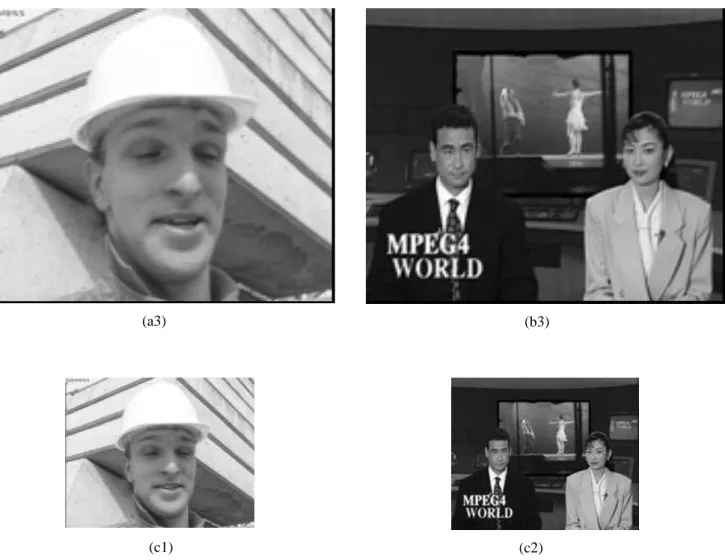
Fig.3 shows the results of applying our proposed approach to twenty frames of FOREMAN and NEWS video tests. 𝑋̂𝑛+1= 𝑋̂𝑛− 𝛽 { 𝐻𝑇𝐴𝑇𝑠𝑖𝑔𝑛(𝐴𝐻𝑋̂ 𝑛− 𝐴𝑍̂) + 𝜆′ ∑ ∑ 𝛼|𝑚|+|𝑙| 𝑃 𝑚=0 𝑃 𝑙=−𝑃 ⏟ 𝑙+𝑚≥0 [𝐼 − 𝑆𝑦−𝑚𝑆𝑥−𝑙]𝑠𝑖𝑔𝑛(𝑋̂𝑛− 𝑆𝑥𝑙𝑆𝑦𝑚𝑋̂𝑛) } 𝐸𝑞. (7) (a1) (b1) (a2) (b2)
Fig.4 shows these results for proposed algorithm of [2].
(a3) (b3)
(c1)
Fig. 3. The results of proposed algorithm. (a1) and (b1) show PSNR of FOREMAN and NEWS. (a2) and (b2) show RMS of them.in (a3) and (b3) super resolution frames of FOREMAN and NEWS are shown. The low resolution frames of these test frames are shown in (c1) and (c2).
(a1) (b1)
(a2) (b2)
(a3) (b3)
(c1)
Fig. 4 the results of proposed algorithmbrought in [2]. (a1) and (b1) show PSNR of FOREMAN and NEWS. (a2) and (b2) show RMS of them.in (a3) and (b3) super resolution frames of FOREMAN and NEWS are shown. The low resolution frames of these test frames are shown in (c1) and (c2).
(a2)
As can be seen in results, ranges of PSNR for FOREMAN video test is between 28.6and29.4 for our proposed algorithm. This range is between 4 and 19 in [2]. For NEWS video test this range is between 24.78 and 24.82 for our algorithm and between 15.32 and 15.44 in [2]. The comparison shows clearly that our method’s results are better and the resulting images are more desirable and the range of changes is small.
III. CONCLUSION
In this paper our proposed method the increases the quality of super resolution according to resulting PSNR and RMS, because of using optical flow. Besides that, using iterative back-projection and cost function, results elimination of edges and noises. This system is proper for any videos with any movements even when the movements of objects in a video are in different directions because optical flow method considers about effects of each movements.
We used two video test sets: News and Foreman. The resolution of these videos is improved with our proposed method. With optical flow motion estimation algorithm we achieved maximum PSNR of 29.4 for 20 first frames of FOREMAN video test and 24.82 for 20 first frames of NEWS video test.
We also achieved minimumRMS of 8.5 for FORMAN and 14.36 for NEWS and for 20 first frames of both video tests. In this paper we used both shift&add super resolution with optical flow and iterative back-projection algorithm with gradient cost function, and we achieved high resolution output image which can keep edges of them and remove noises.
REFERENCES
[1] Super-Resolution of Color Images,” IEEE Transactions on Image Processing”, vol. 15, no. 1, pp. 141-159, Jan. 2006.
[2] S. Chen, B. Mulgrew, and P. M. Grant, “A clustering technique for digital communications channel equalization using radial basis function networks,” IEEE Trans. on Neural Networks, vol. 4, pp. 570-578, July 1993.
[3] M. Elad and Y. Hel-Or, “A fast super-resolution reconstruction algorithm for pure translational motion and common space invariant blur,”IEEE Trans. Image Processing, vol. 10, pp. 1187–1193, Aug. 2001.
[4] N. Nguyen, P. Milanfar, and G. H. Golub, “A computationally efficient image superresolution algorithm,” IEEE Trans. Image Processing, vol.10, pp. 573–583, Apr. 2001.
[5] A. Zomet, A. Rav-Acha, and S. Peleg, “Robust super resolution,” in Proc. Int. Conf. Computer Vision and Patern Recognition, vol. 1, Dec.2001, pp. 645–650.
[6] Y. Li and F. Santosa, “A computational algorithm for minimizing totalvariation in image restoration,” IEEE Trans. Image Processing, vol. 5,pp. 987–995, June 1996.
[7] A. Bovik, Handbook of Image and Video Processing. New York: Academic, 2000.
[8]L.Rudin,S.Osher,andE.Fatemi, “Nonlinear total variation based noiseremoval algorithms” , Phys. D, vol. 60, pp. 259–268, Nov. 1992 [9] T. F. Chan, S. Osher, and J. Shen, “The digital TV filter and nonlinear
denoising”, IEEE Trans. Image Processing, vol. 10, pp. 231–241, Feb. 2001.
![Fig. 4 the results of proposed algorithmbrought in [2]. (a1) and (b1) show PSNR of FOREMAN and NEWS](https://thumb-us.123doks.com/thumbv2/123dok_us/8219207.2179149/5.892.69.821.92.1024/fig-results-proposed-algorithmbrought-a-psnr-foreman-news.webp)
