TRIzol-based RNA Extraction: A Reliable Method for Gene
Expression Studies
M. Heidary
1, M. Pahlevan Kakhki
1, 2*1 Department of Basic Sciences, Faculty of Medicine, Gonabad University of Medical Sciences, Gonabad,
Islamic Republic of Iran
2
Department of Genetics, Faculty of Biological sciences, Tarbiat Modares University, Tehran, Islamic Republic of Iran
Received: 10 January 2014/ Revised: 22 February 2014/ Accepted: 13 March 2014
Abstract
RNA extraction is a prerequisite technique for gene expression studies, analyzing
the etiology and disease progression, treatment effects, as well as designing the
diagnostic methods. Although many RNA extraction kits have been commercialized,
but these kits are expensive and are not accessible in some countries. Many studies
have shown that TRIzol is an applicable material for the RNA extraction from
various biological samples. In this study, evaluation of the initial TRIzol volume and
-20˚C temperature on the purity and solubility of RNA, which followed by
measurement of
IL-1B
expression shows that TRIzol based RNA extraction is a
“reliable” method for gene expression studies.
Keywords: RNA; TRIzol volume; Purity; Gene expression, IL-1B.
*
Corresponding author: Tel: +989105130416; Fax: +985337372712; Email: [email protected]
Introduction
The genetic complexity of many diseases such as cancer and neurological disorders provides an ideal platform for gene expression studies. These studies are performed to analyze the etiology of diseases, treatment effects, disease progression, and as well as diagnostic methods. Previously a number of methods were used for measurement of the mRNA expression, including Northern Blot, RNase protection assays, in situ hybridization, and quantitative reverse transcription– polymerase chain reaction (qRT–PCR). However, extraction of high-quality RNA, which is essential in many quantitative methods, remained a challenge for many researchers. Whereas expression studies are
samples [4]. Studies have shown that TRIzol based isolation of miRNAs is a robust and reproducible method [5, 6]. The procedure of RNA extraction using TRIzol reagent is described by Chomczynski et al. [7]. Usefulness of TRIzol for extraction of different types of RNA molecules increases its application in molecular researches, but only few studies conducted to investigate the major problems in this procedure. According to many troubleshooting guides, DNA contamination which affects the purity and integrity of extracted RNA and also dissolving of RNA pellets are two major problems in RNA extraction by TRIzol reagent [3]. Therefore, the aim of this study was to evaluate the role of the initial TRIzol volume on the purity of extracted RNA leading to DNA contamination. We have also assessed the role of -20˚C temperature on the solubility of RNA in DEPC-treated water.
Materials and Methods
Procedure, RNA isolation and quality assessment
Blood samples were obtained from 30 adult volunteers and collected in 5ml EDTA tubes. This study was approved by the ethics committee of Gonabad University of medical sciences according to Helsinki
Declaration and informed consent was obtained from all volunteers. PBMC isolation was performed using Ficoll-Paque solution (Sigma, St. Louis, MO, USA) and pooled for every 10 samples. Many aliquots were prepared for further investigations. RNA samples were extracted from 1×10⁷ cells using different volumes of TRIzol reagent (Isogene Laboratory, Moscow, Russia). In the first step, 500µl, 700µl, and finally 1ml of TRIzol were used in the homogenization step. The RNA extraction procedure was identical for all samples. Second, to evaluate the role of -20 ˚C temperature in the solubility of extracted RNA, five samples of three pools were run immediately after extraction on 1% agarose gel and RNA yield and purity were measured by spectrophotometry (Eppendorf BioPhotometer plus, Eppendorf, Germany). Other samples of three pools were stored for 24, 48, and 72h in -20˚C. The latter samples were run on 1% agarose gel, RNA yield, and purity were measured by spectrophotometry. We replaced the calculation of the RIN number with running on 1% agarose gel to assess the integrity of extracted RNA. All measurements were duplicated and statistical analyses were performed by paired t-test using GraphPad Prism 5 (GraphPad Software, Inc., San Diego, CA, USA).
Table1. RNA yield, purity and status after 24h in -20˚C which extracted using different volumes of TRIzol reagent
TRIzol volume RNA yield (ng/µl) RNA purity (A260/A280) After 24h in -200C qPCR result
500µl 700µl 1ml
101.8 211.6 318.5
1.16 (0.69-1.68) 1.64 (1.3-2.1) 1.96 (1.85-2)
Completely degraded Completely degraded
Completely intact and dissolved
Multiple peaks Multiple peaks One specific peak
Figure 1. DNA contamination in extracted RNA due to insufficient volume of TRIzol. All samples are extracted from 1×10⁷
RNA expression analysis
To evaluate the quality of extracted RNA for qPCR experiments, we were assessed the expression of IL-1B
mRNA (forward:
3’-AGGGACAGGATATGGAGCAACAAG-5’, reverse: 3’-CATCTTTCAACACGCAGGACAGGT-5’) using RNA samples which extracted by 1ml TRIzol. All samples were normalized to GAPDH as housekeeping
gene (Forward: CCATGAGAAGTATGACAAC
Reverse: GAGTCCTTCCACGATACC) and the fold change of mRNA was calculated by ΔΔCT method [8].
Results
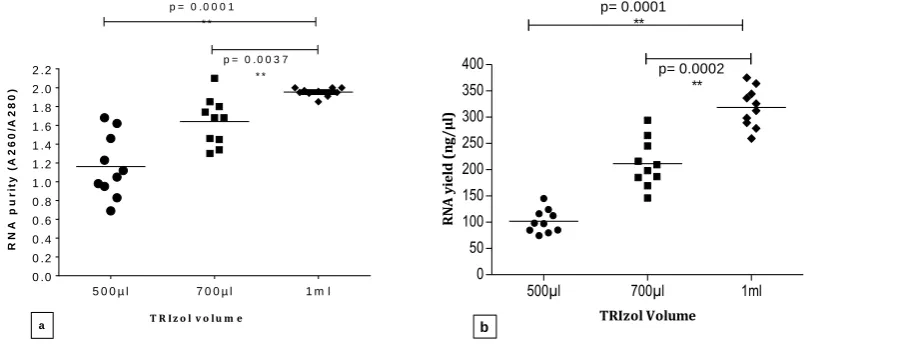
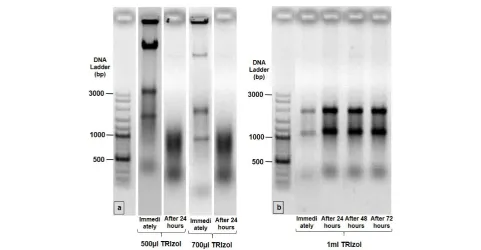
RNA samples extracted using 500µl of TRIzol had many contamination of DNA (Fig. 1a) whereas the contamination is significantly reduced when 700µl of TRIzol was used (Fig. 1b). The contamination was permanently removed by adding 1ml of TRIzol (Fig. 1c). RNA purity (Fig. 2a) (p= 0.0001 and p= 0.0037, respectively) and yield (Fig. 2b) (p= 0.0001 and
p=0.0002, respectively) in samples extracted using 1ml TRIzol are significantly increased in comparison with samples extracted using 500µl and 700µl of TRIzol. The contaminated samples were degraded completely after 24h (Fig. 3a). RNA samples which were run immediately on 1% agarose gel revealed weak bands, but the intensity of RNA bands increased after 24h in -20˚C and no changes occurred after 48 and 72h (Fig. 3b). Median and range of RNA yield, purity, and its expression status are given in Table 1. By IL-1B
expression analysis after 2 months in -70˚C, we showed that the quality of extracted RNA is suitable for gene
expression studies. qPCR specificity was verified by a single band after gel electrophoresis on 12% polyacrylamide gel.
Discussion
This study showed that an insufficient volume of TRIzol in the homogenization step of RNA extraction can play a crucial role in DNA contamination of extracted RNA and significantly affects the RNA purity, yield, and stability. Also, even if the pelleted RNA in the procedure of extraction is dried completely, to dissolve the extracted RNA in DEPC-treated water, at least an overnight or 24h in -20˚C is required. In the homogenization step, the integrity of RNA preserved, while the cells and cell components disrupted completely [2]. Insufficient volume of TRIzol resulted in incompletely dissolving of cell components such as DNA and proteins. Increasing the initial volume of TRIzol decreased the intensity of DNA contamination while increased the intensity of RNA. RNA quality plays a critical role in qPCR experiments. Parallel to the other methods for the RNA extraction, TRIzol is a common solution that extracts good quality and highly concentrated RNA. Despite the significant interest in the expression profiling platforms, only a few studies have focused on the isolation and storage of the RNA samples [9-11]. Kang et al. [12] have recently shown that after the RBC removal of blood samples, TRIzol preserved RNA quality efficiently. They have also shown that TRIzol is suitable for RNA extraction from long-term stored samples. Whereas some studies revealed that the expression of inflammatory cytokines
5 0 0 µ l 7 0 0 µ l 1 m l 0 .0 0 .2 0 .4 0 .6 0 .8 1 .0 1 .2 1 .4 1 .6 1 .8 2 .0 2 .2
T R Iz o l v o lu m e
R N A p u r it y ( A 2 6 0 /A 2 8 0 )
p = 0 . 0 0 0 1 * *
p = 0 . 0 0 3 7 * *
a TRIzol Volume
R N A yi el d (n g/µ l)
500µl 700µl 1ml
0 50 100 150 200 250 300 350
400 p= 0.0002
** p= 0.0001 **
b
Figure 2. Changes in the purity and yield of extracted RNA using different volume of TRIzol reagent. The RNA purity and yield
are affected by sample quality and storage [12, 13], the analysis of IL-1B mRNA expression representing only one specific band, confirms the high specificity in the qPCR experiment Moreover, minimal decreases in RNA quality may result in significant changes in the final results of gene expression patterns in clinical tissue samples. In addition to total RNA, TRIzol can extract small RNAs such as microRNAs, which are regarded in a new field in expression studies. Mraz et al. [5] compared reproducibility and efficiency of TRIzol-based RNA isolation with the mirVana Isolation kit (Ambion) and RNeasy kit (Qiagen) and found that TRIzol-based miRNA extracted samples are very stable for qPCR experiments. Many other factors may affect the stability of TRIzol-based RNA extraction that should be evaluated to dissolve any problem in the procedure of this available method. Finally, based on our findings, using 1ml TRIzol resulted in a pure RNA with proper concentration for qPCR experiments. Moreover, our results suggest that storing the extracted RNA overnight in -20 ˚C can increase the concentration and integrity of the final RNA products. Therefore, we introduce an optimized TRIzol based RNA isolation procedure as a “reliable” method for RNA extraction.
References
1. Fleige S. and Pfaffl M. W. RNA integrity and the effect on the real-time qRT-PCR performance. Mol Aspects
Med. 27(2): 126-39 (2006).
2. Simms D., Cizdziel P. E. and Chomczynski P. TRIzol: A new reagent for optimal single-step isolation of RNA. Focus. 15(4): 532-5 (1993).
3. Rio D. C., Ares M., Hannon G. J. and Nilsen T. W. Purification of RNA using TRIzol (TRI reagent). Cold
Spring Harb. Protoc. (2010)
http://dx.doi.org/10.1101/pdb.prot5439
4. Kakhki M. P., Nikravesh A. and Kokhaei P. MicroRNAs as Diagnostic and Therapeutic Targets in Multiple Sclerosis. Adv Neuroimmune Biol. 4(1): 67-76 (2013). 5. Mraz M., Malinova K., Mayer J. and Pospisilova S.
MicroRNA isolation and stability in stored RNA samples. Biochem Biophys Res Commun. 390(1): 1-4 (2009).
6. Bravo V., Rosero S., Ricordi C. and Pastori R. L. Instability of miRNA and cDNAs derivatives in RNA preparations. Biochem Biophys Res Commun. 353(4): 1052-5 (2007).
7. Chomczynski P. and Sacchi N. The single-step method of RNA isolation by acid guanidinium thiocyanate–phenol– chloroform extraction: twenty-something years on. Nat protoc. 1(2): 581-5 (2006).
8. Livak K. J. and Schmittgen T. D. Analysis of Relative Gene Expression Data Using Real-Time Quantitative PCR and the 2− ΔΔCT Method. Methods. 25(4): 402-8 (2001).
9. Botling J., Edlund K., Segersten U., Tahmasebpoor S., Engström M., Sundström M., Malmström P.-U. and Micke P. Impact of thawing on RNA integrity and gene expression analysis in fresh frozen tissue. Diagn Mol Pathol. 18(1): 44-52 (2009).
Figure 3. Analysis of extracted RNA for integrity and its solution in DEPC-treated water. (a): RNA samples which extracted using
D. and Freedman R. Biological stability of mRNA isolated from human postmortem brain collections. Biol Psychiatry. 33(6): 456-66 (1993).
11. Van Deerlin V. M., Gill L. H. and Nelson P. T. Optimizing gene expression analysis in archival brain tissue. Neurochem Res. 27(10): 993-1003 (2002). 12. Kang J.-E., Hwang S.-H., Lee J. H., Park D. Y. and Kim
H.-H. Effects of RBC removal and TRIzol of peripheral blood samples on RNA stability. Clin Chim Acta.
412(19): 1883-5 (2011).