R E S E A R C H A R T I C L E
Open Access
Towards a patient journey perspective on
causes of unplanned readmissions using a
classification framework: results of a
systematic review with narrative synthesis
R. G. Singotani
1, F. Karapinar
2, C. Brouwers
1, C. Wagner
1,3and M. C. de Bruijne
1*Abstract
Background:Several literature reviews have been published focusing on the prevalence and/or preventability of hospital readmissions. To our knowledge, none focused on the different causes which have been used to evaluate the preventability of readmissions. Insight into the range of causes is crucial to understand the complex nature of readmissions.
With this review we aim to: 1) evaluate the range of causes of unplanned readmissions in a patient journey, and 2) present a cause classification framework that can support future readmission studies.
Methods:A literature search was conducted in PUBMED and EMBASE using“readmission”and“avoidability”or “preventability”as key terms. Studies that specified causes of unplanned readmissions were included. The causes were classified into eight preliminary root causes: Technical, Organization (integrated care), Organization (hospital department level), Human (care provider), Human (informal caregiver), Patient (self-management), Patient (disease), and Other. The root causes were based on expert opinions and the root cause analysis tool of PRISMA (Prevention and Recovery Information System for Monitoring and Analysis). The range of different causes were analyzed using Microsoft Excel.
Results:Forty-five studies that reported 381 causes of readmissions were included. All studies reported causes related to organization of care at the hospital department level. These causes were often reported as preventable. Twenty-two studies included causes related to patient’s self-management and 19 studies reported causes related to patient’s disease. Studies differed in which causes were seen as preventable or unpreventable. None reported causes related to technical failures and causes due to integrated care issues were reported in 18 studies.
Conclusions:This review showed that causes for readmissions were mainly evaluated from a hospital perspective. However, causes beyond the scope of the hospital can also play a major role in unplanned readmissions. Opinions regarding preventability seem to depend on contextual factors of the readmission. This study presents a cause classification framework that could help future readmission studies to gain insight into a broad range of causes for readmissions in a patient journey.
In conclusion, we aimed to: 1) evaluate the range of causes for unplanned readmissions, and 2) present a cause classification framework for causes related to readmissions.
Keywords:Hospital readmission, Avoidability, Preventability
© The Author(s). 2019, corrected publication 2019.Open AccessThis article is distributed under the terms of the Creative Commons Attribution 4.0 International License (http://creativecommons.org/licenses/by/4.0/), which permits unrestricted use, distribution, and reproduction in any medium, provided you give appropriate credit to the original author(s) and the source, provide a link to the Creative Commons license, and indicate if changes were made. The Creative Commons Public Domain Dedication waiver (http://creativecommons.org/publicdomain/zero/1.0/) applies to the data made available in this article, unless otherwise stated.
* Correspondence:[email protected]
1Amsterdam UMC, Vrije Universiteit Amsterdam, Department of Public and Occupational Health, Amsterdam Public Health research institute, Van der Boechorststraat 7, NL-1081 BT Amsterdam, The Netherlands
Background
The definition of unplanned readmissions varies among countries, but it is most often defined as an urgent readmission within 30 days from a previous admission [1–3]. In many cases, unplanned readmissions result in potential health risks for patients, an increased workload for caregivers and excessive healthcare expenditure [4]. Reducing readmission rates is therefore considered to be of great importance. Many countries use readmission rates as a quality indicator of hospital care. However, previous research shows that unplanned readmissions are not only caused by suboptimal care provided by the hospital [5, 6]. In fact, unplanned readmissions that are considered to be potentially preventable due to suboptimal hospital care (~ 20–25% of the unplanned readmissions) often also have other underlying causes which are not related to hospital care [6,7]. This suggests that hospitals are being held accountable for unplanned readmissions, while they may not always be able to prevent them [8].
In the previous decades, studies have been performed on the prevalence and preventability of readmissions. Existing assessment tools with predefined causes (such as State Ac-tion on Avoidable RehospitalizaAc-tions (STAAR), Root-Cause Analysis Tool (PRISMA: Prevention and Recovery Informa-tion System for Monitoring and Analysis) [9] and Research Electronic Database Capture (REDcap tool) are often ap-plied or adapted in readmission studies. The variation in different sets of causes used makes comparison between studies difficult. Comparison between studies is crucial to fully understand the complex nature of readmissions.
To date, it is unclear which causes are considered in unplanned readmission studies. In particular, the causes which are not related to hospital care have not been given much emphasis so far. Hence, this systematic re-view focuses on evaluating the different causes that have been taken into consideration in studies on unplanned readmissions using patient record review. With this review
we aim to: [1] evaluate the range of causes of
un-planned readmissions in a patient journey, and [2]
present a cause classification framework that can sup-port future readmission studies.
Methods
In 2017, we conducted a systematic review on (the impli-cations of) the different methods used to assess the pre-ventability of unplanned readmissions by use of patient record review [10]. Previous studies demonstrated that health administrative databases often lack extensive infor-mation (e.g. functional status and social support) [11]. Therefore, we focused on studies which used patient rec-ord review to assess preventability of unplanned readmis-sions. The current systematic review provides an in-depth insight on the causes that have been used by the studies in the previous review.
Literature search
The literature search was applied in Web of Science, Scopus, Pubmed and Embase in December 2016, using
“readmission and avoidability or preventability” as key terms (Additional file1). A medical information special-ist was consulted for the search. All citations were imported into Endnote × 7.3.1TM.
Study selection
The 77 studies which were included in the previous re-view [10] were checked for eligibility for this review by
two researchers (CB and RS) (see Additional file 2).
Studies were included if they fulfilled to the following criteria: original data, primary focus on preventable read-missions, clear description of preventable readmissions and potential causes of preventable readmissions (the cause classification) (see Additional file3). We defined a cause classification as the description of at least three causes or synonyms for causes (e.g. (contributing) fac-tors and reasons). Studies that described the causes of preventable readmissions (≥3) were further reviewed. Studies that made no distinction in readmissions and (primary) admissions, or preventable readmissions and non-preventable readmissions, were excluded from fur-ther analysis. In case of disagreement, a senior re-searcher was consulted to reach a final selection of studies.
Critical appraisal of individual studies
We applied a validated approach to evaluate and com-pare the studies. This approach was developed by the
Cochrane Consumers and Communication Review
Data collection and classification
Preventability
Two researchers (RS and CB) collected all the causes de-scribed by the studies. Each cause was classified as pre-ventable or unprepre-ventable. In our previous review, we found that the definition of preventability varied widely among studies. Many studies did not provide a clear def-inition, but referred to a cause classification with causes that were pre-defined as preventable [10]. For instance, Williams et al. defined potential areas to avoid readmis-sions; ‘It was noted that readmission could have been avoided if more effective action had been taken in one or more of five areas: preparation for and timing of dis-charge, attention to the needs of the carer, timely and adequate information to the general practitioner and subsequent action by the general practitioner, sufficient and prompt nursing and social services support, and management of medication’ [13]. Other studies such as Ryan et al. provided a broad definition of preventability;
‘Providers were given no specific guidelines for deciding whether a readmission was preventable. This allowed use of their different backgrounds in choosing which ele-ments of the clinical record to focus on’[14].
In this study, the researchers coded whether a cause was preventable as stated by the study authors. When the study was unclear regarding the preventability of a cause, the researchers classified the cause as neutral. Causes that studies considered both preventable and unpreventable, were coded as both.
Root cause
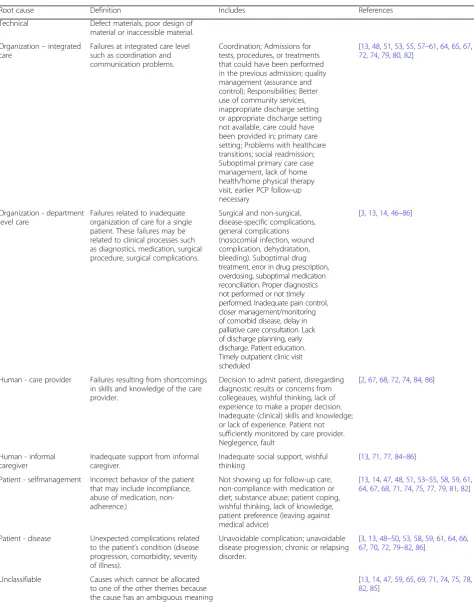
The root causes were based on the PRISMA classification scheme of Schaaf & Habraken [9]. PRISMA is an abbrevi-ation of Prevention and Recovery Informabbrevi-ation System for Monitoring and Analysis, and is often applied for root cause analyses in healthcare. Schaaf & Habraken defined four root causes: technical, organizational, human behavior and pa-tient. We adapted these categories prior to the start of the data collection based on our experience with patient record reviewing in several Dutch hospitals [91]. We sub-divided the root causes “organization, human and patient” in organization (integrated care), organization (hospital depart-ment level), human (care provider), human (informal care-giver), patient (self-management) and patient (disease). In addition, we provided examples of causes for the settings: hospital care, ambulatory care and home (care). Hospital care was defined as the complete care process from admis-sion until discharge, including outpatient visits after dis-charge. Ambulatory care was defined as medical care provided in an outpatient setting. Care at home was defined as informal care provided at home after discharge.
Two researchers (RS, MdB, CB, FK independently) al-located each cause to the root causes mentioned above. A third senior researcher performed a double check on
the final cause classification. Disagreements between re-searchers were resolved during meetings (RS, CB, FK, MdB) until consensus was reached.
A few studies combined multiple types of causes within one single cause. We separated these different causes in order to allocate each of them to the most appropriate root cause. This resulted in a higher number of causes than there were originally present in the study. Furthermore, we were not able to allo-cate all causes to one root cause because some causes lacked a clear description of the context. We classi-fied these causes as Unclassifiable. Specific categories of causes such as planned readmissions or unrelated readmissions were not considered for further analysis as these were not root causes for a readmission. After allocating all the causes, a final cause classification framework was constructed. Data collection and ana-lyses were documented in Microsoft Excel 2016.
Results
After applying the detailed inclusion and exclusion cri-teria 32 studies were excluded for this review, leaving 45 studies for further analysis (see Additional file 2b). The 32 studies were excluded because of at least one of the following reasons: no original data [16–18], no pri-mary focus on preventable readmissions [15, 19–22], no clear description of methods and results (e.g. no dis-tinction in preventability or type of admission [23–44] and no description of causes [45]. An overview of the excluded studies is shown in Additional file4.
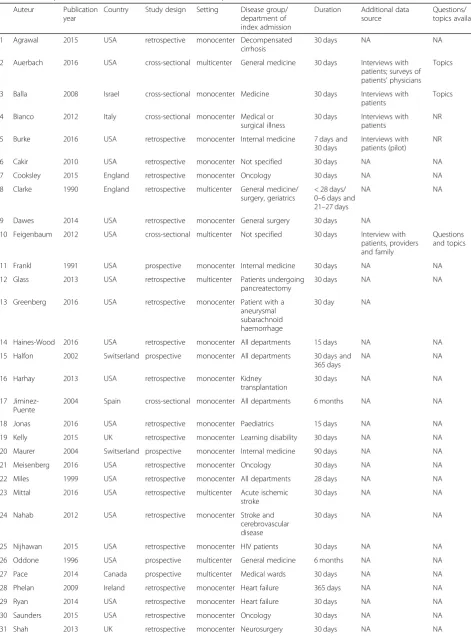
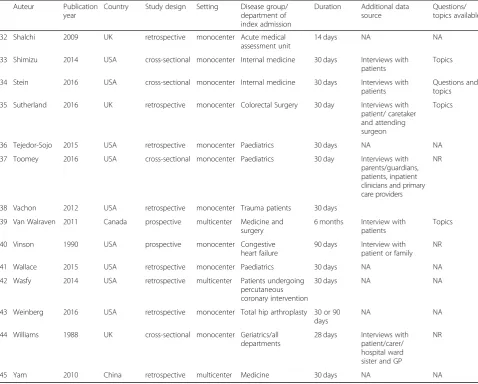
Study design and characteristics
A summary of the study characteristics is shown in
Table 1. The majority of the studies (64.4%) was
conducted in the US and all studies were performed in a hospital setting (75.6% monocenter studies). Eight
studies (17.8%) examined all-cause readmissions,
meaning that these studies included readmissions from all departments, irrespective of whether this de-partment was similar to that of the previous admission [46–53]. The majority of the studies included readmis-sions of a specific specialty (31.1%) [54–67] such as readmissions to a pediatric department. Twenty-seven percent of the studies examined readmissions of a spe-cific group to a spespe-cific specialty (26.6%) [14, 68–78] such as patients with diabetes readmitted to internal medicine. Twenty-four percent of the studies included readmissions of a specific group (24.4%), such as eld-erly [2, 3,13, 79–86]. Other studies included readmis-sions occurring to any department for a specific group (e.g. elderly to internal medicine).
Table 1Descriptive characteristics of included studies that reported causes* (n= 45)
Auteur Publication year
Country Study design Setting Disease group/ department of index admission
Duration Additional data source
Questions/ topics available
1 Agrawal 2015 USA retrospective monocenter Decompensated cirrhosis
30 days NA NA
2 Auerbach 2016 USA cross-sectional multicenter General medicine 30 days Interviews with patients; surveys of patients’physicians
Topics
3 Balla 2008 Israel cross-sectional monocenter Medicine 30 days Interviews with patients
Topics
4 Bianco 2012 Italy cross-sectional monocenter Medical or surgical illness
30 days Interviews with patients
NR
5 Burke 2016 USA retrospective monocenter Internal medicine 7 days and 30 days
Interviews with patients (pilot)
NR
6 Cakir 2010 USA retrospective monocenter Not specified 30 days NA NA
7 Cooksley 2015 England retrospective monocenter Oncology 30 days NA NA
8 Clarke 1990 England retrospective multicenter General medicine/ surgery, geriatrics
< 28 days/ 0–6 days and 21–27 days
NA NA
9 Dawes 2014 USA retrospective monocenter General surgery 30 days NA
10 Feigenbaum 2012 USA cross-sectional multicenter Not specified 30 days Interview with patients, providers and family
Questions and topics
11 Frankl 1991 USA prospective monocenter Internal medicine 30 days NA NA
12 Glass 2013 USA retrospective multicenter Patients undergoing pancreatectomy
30 days NA NA
13 Greenberg 2016 USA retrospective monocenter Patient with a aneurysmal subarachnoid haemorrhage
30 day NA
14 Haines-Wood 2016 USA retrospective monocenter All departments 15 days NA NA
15 Halfon 2002 Switserland prospective monocenter All departments 30 days and 365 days
NA NA
16 Harhay 2013 USA retrospective monocenter Kidney transplantation
30 days NA NA
17 Jiminez-Puente
2004 Spain cross-sectional monocenter All departments 6 months NA NA
18 Jonas 2016 USA retrospective monocenter Paediatrics 15 days NA NA
19 Kelly 2015 UK retrospective monocenter Learning disability 30 days NA NA
20 Maurer 2004 Switserland prospective monocenter Internal medicine 90 days NA NA
21 Meisenberg 2016 USA retrospective monocenter Oncology 30 days NA NA
22 Miles 1999 USA retrospective monocenter All departments 28 days NA NA
23 Mittal 2016 USA retrospective multicenter Acute ischemic stroke
30 days NA NA
24 Nahab 2012 USA retrospective monocenter Stroke and cerebrovascular disease
30 days NA NA
25 Nijhawan 2015 USA retrospective monocenter HIV patients 30 days NA NA
26 Oddone 1996 USA prospective multicenter General medicine 6 months NA NA
27 Pace 2014 Canada prospective multicenter Medical wards 30 days NA NA
28 Phelan 2009 Ireland retrospective monocenter Heart failure 365 days NA NA
29 Ryan 2014 USA retrospective monocenter Heart failure 30 days NA NA
30 Saunders 2015 USA retrospective monocenter Oncology 30 days NA NA
85]. Multiple studies referred to causes used in previ-ous publications [3, 50, 55, 57, 59–61, 64, 66, 67, 71, 74, 75, 79]. In particular, the studies of Clarke [59], Goldfield [87], Jiminez-Puente [49] and Oddone [74] were frequently referred to.
Cause classification
The frequencies of each root cause are listed
in Additional file 5. A total of 381 causes were
found of which 275 were reported as preventable
and 44 as unpreventable (see Additional file 5).
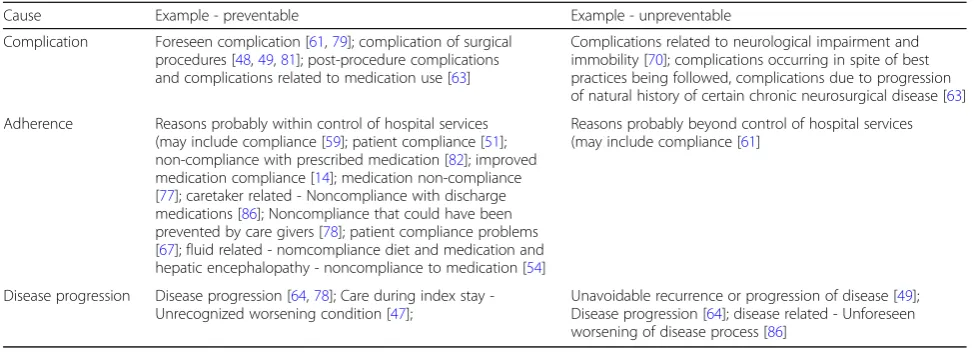
Twenty-six causes were reported as both preventable and unpreventable in a single study, and these causes were coded as both. Examples of causes that were considered differently among studies are listed
in Table 2. Other causes that were not explicitly
defined as preventable or unpreventable (n= 36)
were coded as neutral. The final cause classification framework is listed in Table 3.
Technical
None of the studies reported technical failures as a cause for preventable readmissions.
Organization–integrated care
Eighteen studies reported causes related to the
organization of integrated care [13,48,51, 53,55,57–61, 64,65, 67, 72, 74, 79, 80, 82]. Fifteen studies considered these causes as preventable [48,51,57–61,64,65,67,72, 74,79,80,82]. Social readmissions, unavailability of out-patient care and system failures were frequently consid-ered as preventable. One study reported that hospitals were partly accountable for social readmissions [48], while other studies reported that social readmissions were related to inadequate care by the caretaker/spouse [84, 86]. Two studies stated that causes related to the organization of integrated care were seen as unpreventa-ble [64,72]. For example, Jonas described the lack of alter-native resources as an unpreventable cause [72].
Table 1Descriptive characteristics of included studies that reported causes* (n= 45)(Continued)
Auteur Publication year
Country Study design Setting Disease group/ department of index admission
Duration Additional data source
Questions/ topics available
32 Shalchi 2009 UK retrospective monocenter Acute medical assessment unit
14 days NA NA
33 Shimizu 2014 USA cross-sectional monocenter Internal medicine 30 days Interviews with patients
Topics
34 Stein 2016 USA cross-sectional monocenter Internal medicine 30 days Interviews with patients
Questions and topics
35 Sutherland 2016 UK retrospective monocenter Colorectal Surgery 30 day Interviews with patient/ caretaker and attending surgeon
Topics
36 Tejedor-Sojo 2015 USA retrospective monocenter Paediatrics 30 days NA NA
37 Toomey 2016 USA cross-sectional monocenter Paediatrics 30 day Interviews with parents/guardians, patients, inpatient clinicians and primary care providers
NR
38 Vachon 2012 USA retrospective monocenter Trauma patients 30 days
39 Van Walraven 2011 Canada prospective multicenter Medicine and surgery
6 months Interview with patients
Topics
40 Vinson 1990 USA prospective monocenter Congestive heart failure
90 days Interview with patient or family
NR
41 Wallace 2015 USA retrospective monocenter Paediatrics 30 days NA NA
42 Wasfy 2014 USA retrospective multicenter Patients undergoing percutaneous coronary intervention
30 days NA NA
43 Weinberg 2016 USA retrospective monocenter Total hip arthroplasty 30 or 90 days
NA NA
44 Williams 1988 UK cross-sectional monocenter Geriatrics/all departments
28 days Interviews with patient/carer/ hospital ward sister and GP
NR
45 Yam 2010 China retrospective multicenter Medicine 30 days NA NA
Organization–hospital department level
The majority of the studies (n= 44; 97.8%) described causes related to the organization of care at hospital department level [3, 13, 14, 46–86]. Many causes were related to the coordination and planning of care. Feigen-baum et al. (2012) reported factors contributing to po-tentially preventable readmissions such as “suboptimal coordination of care during index stay” and “inadequate arrangement of supplies during discharge process” [47]. In addition, Greenberg et al. (2016) reported that a re-admission could be prevented if the disposition of plan-ning and the coordination of care would have been adequate. Forty-two studies described these causes as preventable [3, 14, 46–52,54–86]. Readmissions related to complications caused by the care provided during the previous admission were often reported as a preventable cause [2, 3, 11, 47–49, 52,54, 59, 61–64, 66,72,76, 78, 79,81,84,85].
Nine studies also described unpreventable causes related to the organization of patient care [50, 61, 63, 64, 69, 70, 72, 75, 80]. Some studies reported compli-cations related to a specific patient population [70,
72, 76]. For example, the study of Vachon et al.
(2012) focused on trauma patients and included the following complications: wounds, abdominal,
pulmon-ary, thromboembolic, central nervous system,
hematoma and other [76].
Human–care provider
Seven studies reported causes related to the care provider [2, 67, 68, 72, 74, 84, 86], such as inadequate decision making, inadequate (clinical) skills and knowledge, or lack of experience. In all cases, these causes were considered to be preventable. Examples of these causes include:‘Failure resulting from faulty task planning or performance’ and
‘Failure of an individual to apply their knowledge to a new clinical situation’[2].
Human–informal caregiver
Six studies described causes related to the informal care-giver [13, 71, 77, 84–86]. All these causes were seen as preventable. For example, Harhay and Vinson described inadequate support at home as a cause for preventable readmissions.
Patient–self-management
Twenty-one studies included causes related to self-man-agement of the patient [13,14,47,48,51,53–55,58,59, 61,64,67,68,71,74,75,77,79,81,82]. Ten studies de-scribed causes related to self-management as preventable [14,47,48,51,54,55,58, 64, 67, 68, 71,74,75,77,82]. Non-adherence was also frequently reported as a pre-ventable cause [14,51,54,59,61,67,71,74,77,82]. For example, Yam described adherence problems and patient coping as causes for preventable readmissions. In six studies, causes related to self-management were seen as unpreventable [58, 59, 61, 64, 79, 81]. For example, Burke considered causes such as adherence to discharge plan, refusal of discharge plan and substance use as unpreventable.
Patient–disease
Many studies reported causes related to the patient’s dis-ease [3,13,48–50,53,58,59,61,64,66,67,70,72,79– 82,86]. Ten studies considered disease related causes as potentially preventable causes. Clarke reported ‘ recur-rence or continuation of disorder leading to first admis-sions’ as a preventable disease-related cause [59]. Disease progression (n= 16) was frequently reported as unpreventable. Examples of the disease-related causes were; chronic or relapsing disorder [59,61, 79], unfore-seen worsening of disease progress and closely related conditions [49, 58, 72], acute myocardial ischemia and poorly controlled arrhythmias [82].
Table 2Causes that were reported as both preventable and unpreventable
Cause Example - preventable Example - unpreventable
Complication Foreseen complication [61,79]; complication of surgical procedures [48,49,81]; post-procedure complications and complications related to medication use [63]
Complications related to neurological impairment and immobility [70]; complications occurring in spite of best practices being followed, complications due to progression of natural history of certain chronic neurosurgical disease [63]
Adherence Reasons probably within control of hospital services (may include compliance [59]; patient compliance [51]; non-compliance with prescribed medication [82]; improved medication compliance [14]; medication non-compliance [77]; caretaker related - Noncompliance with discharge medications [86]; Noncompliance that could have been prevented by care givers [78]; patient compliance problems [67]; fluid related - nomcompliance diet and medication and hepatic encephalopathy - noncompliance to medication [54]
Reasons probably beyond control of hospital services (may include compliance [61]
Disease progression Disease progression [64,78]; Care during index stay -Unrecognized worsening condition [47];
Table 3Final cause classification framework
Root cause Definition Includes References
Technical Defect materials, poor design of material or inaccessible material.
Organization–integrated care
Failures at integrated care level such as coordination and communication problems.
Coordination; Admissions for tests, procedures, or treatments that could have been performed in the previous admission; quality management (assurance and control); Responsibilities; Better use of community services, inappropriate discharge setting or appropriate discharge setting not available, care could have been provided in; primary care setting; Problems with healthcare transitions; social readmission; Suboptimal primary care case management, lack of home health/home physical therapy visit, earlier PCP follow-up necessary
[13,48,51,53,55,57–61,64,65,67, 72,74,79,80,82]
Organization - department level care
Failures related to inadequate organization of care for a single patient. These failures may be related to clinical processes such as diagnostics, medication, surgical procedure, surgical complications.
Surgical and non-surgical, disease-specific complications, general complications (nosocomial infection, wound complication, dehydratation, bleeding). Suboptimal drug treatment, error in drug prescription, overdosing, suboptimal medication reconciliation. Proper diagnostics not performed or not timely performed. Inadequate pain control, closer management/monitoring of comorbid disease, delay in palliative care consultation. Lack of discharge planning, early discharge. Patient education. Timely outpatient clinic visit scheduled
[3,13,14,46–86]
Human - care provider Failures resulting from shortcomings in skills and knowledge of the care provider.
Decision to admit patient, disregarding diagnostic results or concerns from collegeaues, wishful thinking, lack of experience to make a proper decision. Inadequate (clinical) skills and knowledge; or lack of experience. Patient not sufficiently monitored by care provider. Neglegence, fault
[2,67,68,72,74,84,86]
Human - informal caregiver
Inadequate support from informal caregiver.
Inadequate social support, wishful thinking
[13,71,77,84–86]
Patient - selfmanagement Incorrect behavior of the patient that may include incompliance, abuse of medication, non-adherence.)
Not showing up for follow-up care, non-compliance with medication or diet; substance abuse; patient coping, wishful thinking, lack of knowledge, patient preference (leaving against medical advice)
[13,14,47,48,51,53–55,58,59,61, 64,67,68,71,74,75,77,79,81,82]
Patient - disease Unexpected complications related to the patient’s condition (disease progression, comorbidity, severity of illness).
Unavoidable complication; unavoidable disease progression; chronic or relapsing disorder.
[3,13,48–50,53,58,59,61,64,66, 67,70,72,79–82,86]
Unclassifiable Causes which cannot be allocated to one of the other themes because the cause has an ambiguous meaning
Unclassifiable
Twelve studies reported some causes that could not be classified into root causes [13,14,47,59,65,69, 71, 74, 75, 78, 82, 85]. Causes such as problems with services can apply to institutions, departments or individuals. For example, patient assessment was mentioned as a cause for readmission, but it was not specified who per-formed the patient assessment or what was exactly meant with it.
Discussion
Purpose of study and significant conclusions
The main objective of this systematic review was to summarize the range of causes described for unplanned readmissions and to present a cause classification frame-work for causes of readmissions. The findings of this re-view show that many studies primarily focus on causes related to organization of care at the department level. The causes were mainly evaluated from a hospital per-spective. None reported technical failures as one of the causes of (preventable) readmissions. We succeeded in classifying the majority of the causes according to the adapted PRISMA scheme and to distinguish between levels of care. We were not able to allocate causes that were ambiguous.
Key results compared to other studies
The results of this review indicate that the causes of readmissions depend on the context of the study, e.g. the inclusion of department/healthcare organization, case-mix, assessor of preventability, and definition of preventability. All studies were conducted in the hospital and several studies included causes beyond the setting of the hospital. The latter studies often identified other causes for readmissions in addition to hospital care (e.g. social support [13,71,77,84–86]). This finding is in line with the existing literature [6, 11, 88–90]. Zhou et al. (2017) reviewed studies which used prediction models for (preventable) unplanned readmissions. They identi-fied that health insurance and overall prognosis should be considered as contributors in addition to the clinical factors which are normally included in the statistical models. We also found that factors such as self-manage-ment, social support, and type of healthcare organization can play a role. Other factors beyond the scope of the hospital should be assessed in more detail to gain a bet-ter insight into the complexity behind unplanned readmis-sion and to understand where interventions can have the most impact. In addition, gaining more understanding on these factors is necessary in order to optimize the applic-ability of unplanned readmissions as a quality indicator of integrated care [11, 88]. Decreasing unplanned readmis-sions needs a holistic approach, because health care is a complex dynamic system in which patients, professionals,
health care organization are acting within the regulations of their national health care system.
Furthermore, this review highlights that studies differ in which causes are considered to be preventable. In particu-lar, complications, adherence and disease progression were seen as both preventable and unpreventable. For ex-ample, ‘foreseen complications’ were seen as preventable [61, 79]. Complications of surgical procedures were also reported as preventable in many studies [48, 49, 81]. Greenberg et al. reported complications related to neuro-logical impairment and immobility as an unpreventable cause [70]. Shah et al. considered complications as pre-ventable and unprepre-ventable. They defined the following complications: complications occurring in spite of best practices being followed, complications due to progression of natural history of certain chronic neurosurgical disease, post-procedure complications and complications related to medication use. The first two were reported as unpre-ventable, and the latter two as preventable [63]. These findings highlight that preventability can differ depending on many contextual factors and what the authors of stud-ies regard as adequate care.
The proposed classification allows researchers and pol-icymakers to further consider the complex nature of readmissions. Differences in cause classifications can be problematic for fair comparison of studies. Therefore, it is essential that studies describe the context of the re-search setting/rere-search population and elaborate on what they regard as preventable.
In addition, this review indicates that the assessment of readmissions is mainly based on data that is inputted in the hospital information system. Some studies in-cluded interviews and were thereby able to capture the patients’ experience. However, the transcripts were not available and therefore not included in this review. Fur-thermore, studies indicated that interviews with patients and/or caregivers can provide additional information on factors beyond the hospital setting which cannot be found in medical records [85]. For instance, Sutherland et al. (2016) found that the combination of patient inter-views and chart review revealed additional gaps in care [75]. In addition, Toomey et al. (2014) found in 31.2% of cases that interviews with patients and primary care pro-viders provided new information. These findings support other studies stating that increased involvement of pa-tients and other stakeholders are crucial for assessing the cause of the readmission and may contribute to the pre-vention of readmissions and to better quality of care [89].
Strengths and limitations
limitations. Firstly, the studies included were based on a set of articles which were collected for a previous review
[10]. As a consequence, we may have missed studies
which also examined the causes of unplanned readmis-sions, but did not provide information on the rate of pre-ventable readmissions. This might have limited the number of causes reported in this study and consequently the number of root causes/categories in our cause classifi-cation framework. However, we performed a cross refer-ence checking in Scopus and Web-of-Scirefer-ence and did not find additional studies. Secondly, we allocated a single cause to only one root cause. Thus, causes which con-sisted of multiple sub-causes were disentangled into separ-ate causes. This might have influenced the frequency of the themes and subthemes that were found. Thirdly, stud-ies which did not explicitly specify the context of a specific cause (ambiguous causes) were considered “
Unclassifi-able”. As a result, the number of causes related to other root causes may be underestimated. Lastly, all phases were either consensus based-driven and/or performed by at least two independent data extractors. However, using this procedure can not preclude that some amount of inter-pretation bias occurs during data collection, synthesis and interpretation.
Recommendations for policy
Since 2016, unplanned readmissions have been used as a quality indicator for hospital care in the Netherlands. To increase the comparability of causes between readmis-sion studies, we advise that the use of a standardized cause classification framework should be stimulated. The framework proposed in this review provides a broad range of causes which are most frequently observed. Re-garding hospital care at the department and institutional level this overview is rather complete, although technical causes are lacking and are becoming more relevant due to development of eHealth, mHealth and ICT supported long distance care. Causes at the patient and health care system level are still of limited detail. For example, more information on the patient experience can be collected using interviews. Insight into these causes is crucial for developing improvement opportunities.
In addition, the proposed framework may contribute to a transparent development of prediction models. In-formation on how data sources are used to calculate the readmission indicator are often lacking [11]. Current prediction models depend on a limited range of data documented in the hospital information system. Infor-mation on what happens after discharge is (often) not documented. Hence, policy makers should be careful in holding hospitals accountable for unplanned readmis-sions as long as it is unclear which percentage of these readmissions is truly preventable by preventive actions of the hospital itself. Unplanned readmission should be
viewed as adverse events occurring in a complex dy-namic system, in which patients, professionals and orga-nizations all play a crucial role, regulated by the healthcare system.
Recommendations for research
This review indicates that the causes of unplanned read-missions which are examined by the studies differ be-tween studies and are often limited to causes focused on hospital care. As a result, the multifactorial nature of readmissions is not well understood and certain contrib-uting causes might be overlooked. This limits the poten-tial impact of (patient-centered) interventions to prevent
readmissions [88]. To improve our understanding of
readmissions, all actors involved in the patient journey should be considered. The suggested framework may provide direction on which causes to include in a re-admission study and prediction models. In the future, we hope that with the use of prediction models, high-risk patients can be more easily identified and targeted for alternative management [90]. In addition, future re-search should take into account the interdependency of causes. For instance, when a patient gets readmitted due to an incorrect assessment by a physician at discharge, this readmission might be the result of how readmis-sions are handled at a department/organization. Physi-cians might not be effectively trained to ask the patient if they are ready to be discharged. Lack of skills can thus also be considered a result of suboptimal organization of care (organization department level care). Failure on organization level (e.g. missed opportunity to train phy-sicians) or care-provider level (lack of skills) are import-ant to consider. In addition, it is also possible that failure on one level might be mitigated by other levels. Each level must be considered in the study of readmis-sions. Multiple causes of readmissions - in and beyond the hospital - play a role. All these causes should be assessed to capture the complex nature of readmissions and should be considered interdependently.
Conclusion
the standardization of designing and conducting re-admission studies, and the comparability of rere-admission studies. The findings of this review may help us to understand the complex nature of readmissions and emphasize the importance of using a broad range of
causes that may occur on the patient’s journey when
examining unplanned readmissions. As described by the studies, unplanned readmissions can be caused by many factors at all levels of the health care system throughout all the phases of the patient journey.
Additional files
Additional file 1:Pubmed search strategy. (DOCX 14 kb)
Additional file 2:PRISMA flowchart reviews. (DOCX 66 kb)
Additional file 3:Flowchart Inclusion and exclusion criteria. (DOCX 25 kb)
Additional file 4:Excluded studies and reason for exclusion for review. (XLSX 23 kb)
Additional file 5:Root cause and causes as reported in articles. (XLSX 29 kb)
Abbreviations
PRISMA (flowcharts):Preferred Reporting Items for Systematic Reviews and Meta-Analyses; PRISMA (root cause analysis tool): Prevention and Recovery Information System for Monitoring and Analysis; REDcap tool: Research Electronic Database Capture; STAAR: State Action on Avoidable Rehospitalizations
Acknowledgements
We would like to thank Eva-Linda Kneepkens for her contribution to the primary selection of the studies on which this review is based.
Authors’contributions
Two researchers (RS and CB) independently screened the set of articles included in the primary selection for eligibility for this review (according to the inclusion and exclusion criteria (see: Additional file2A and 2B)). RS and CB contributed to the collection of the data. RS, MdB, CB, FK contributed to the analysis. RS, MdB, CB, FK and CW contributed to the interpretation of the data. RS, MdB, CB, FK and CW drafted the manuscript and approved the final version for publication.
Funding
This study is funded by the Dutch Ministry of Health, Welfare and Sports. This study is part of the Dutch Adverse Event Study which is carried out by VU medical center and NIVEL (Netherlands institute for Health Services research). For this review we collaborated with one researcher (FK) of Onze Lieve Vrouwe Gasthuis (OLVG). The funding body had no role in the design of the study, or the collection, analysis, interpretation of data and in writing the manuscript.
Availability of data and materials
The datasets supporting the conclusions of this article are included within the article or provided in the additional files.
Ethics approval and consent to participate
NA
Consent for publication
NA
Competing interests
The authors declare that they have no competing interests.
Author details
1Amsterdam UMC, Vrije Universiteit Amsterdam, Department of Public and Occupational Health, Amsterdam Public Health research institute, Van der Boechorststraat 7, NL-1081 BT Amsterdam, The Netherlands.2Department of
clinical pharmacy, Onze Lieve Vrouwe Gasthuis (OLVG), location West, Jan Tooropstraat 164, 1061 AE Amsterdam, The Netherlands.3Netherlands institute for Health Services research, Otterstraat 118-124, 3513 CR Utrecht, The Netherlands.
Received: 7 December 2018 Accepted: 15 August 2019
References
1. Blunt I, Bardsley M, Grove A, Clarke A. Classifying emergency 30-day readmissions in England using routine hospital data 2004–2010: what is the scope for reduction? Emerg Med J. 2015;32(1):44–50.
2. Cooksley T, Merten H, Kellett J, Brabrand M, Kidney R, Nickel C, et al. PRISMA analysis of 30 day readmissions to a tertiary cancer hospital. Acute Med. 2015;14(2):53–6.
3. Kelly CL, Thomson K, Wagner AP, Waters JP, Thompson A, Jones S, et al. Investigating the widely held belief that men and women with learning disabilities receive poor quality healthcare when admitted to hospital: a single-site study of 30-day readmission rates. J Intellect Disabil Res. 2015; 59(9):835–44.
4. Felix HC, Seaberg B, Bursac Z, Thostenson J, Stewart MK. Why do patients keep coming back? Results of a readmitted patient survey. Soc Work Health Care. 2015;54(1):1–15.
5. Benbassat J, Taragin M. Hospital readmissions as a measure of quality of health care: advantages and limitations. Arch Intern Med. 2000;160(8):1074–81. 6. Fischer C, Lingsma HF, Marang-van de Mheen PJ, Kringos DS, Klazinga NS,
Steyerberg EW. Is the Readmission Rate a Valid Quality Indicator? A Review of the Evidence. PLoS ONE. 2014;9(11):e112282.
7. Jencks SF, Williams MV, Coleman EA. Rehospitalizations among patients in the Medicare fee-for-service program. N Engl J Med. 2009;360(14):1418–28. 8. Axon R, Williams MV. Hospital readmission as an accountability measure.
JAMA. 2011;305(5):504–5.
9. Van der Schaaf T, Habraken M. PRISMA-Medical: a brief description. Eindhoven, The Netherlands: Eindhoven University of Technology; 2005. 10. Kneepkens E-L, Brouwers C, Singotani RG, de Bruijne MC, Karapinar-Çarkit F.
How do studies assess the preventability of readmissions? A systematic review with narrative synthesis. BMC Med Res Methodol. 2019;19(1):128. 11. van Walraven C. The utility of unplanned early hospital readmissions as a
health care quality indicator. JAMA Intern Med. 2015;175(11):1812–4. 12. Ryan R, Consumers C. Communication review group. Cochrane Consumers
and Communication Review Group: data synthesis and analysis 2013. 13. Williams EI, Fitton F. Factors affecting early unplanned readmission of
elderly patients to hospital. BMJ. 1988;297(6651):784–7. 14. Ryan J, Andrews R, Barry MB, Kang S, Iskandar A, Mehla P, et al.
Preventability of 30-day readmissions for heart failure patients before and after a quality improvement initiative. Am J Med Qual. 2014;29(3):220–6. 15. El-Jawahri A, Keenan T, Abel GA, Steensma DP, LeBlanc TW, Chen Y-B, et al.
Potentially avoidable hospital admissions in older patients with acute myeloid leukaemia in the USA: a retrospective analysis. The Lancet Haematology. 2016;3(6):e276–e83
16. Halfon P, Eggli Y, Pretre-Rohrbach I, Meylan D, Marazzi A, Burnand B. Validation of the potentially avoidable hospital readmission rate as a routine indicator of the quality of hospital care. Med Care. 2006;44(11):972–81. 17. Herzig SJ, Schnipper JL, Doctoroff L, Kim CS, Flanders SA, Robinson EJ, et al.
Physician perspectives on factors contributing to readmissions and potential prevention strategies: a multicenter survey. J Gen Intern Med. 2016;31(11): 1287–93.
18. Jackson AH, Fireman E, Feigenbaum P, Neuwirth E, Kipnis P, Bellows J. Manual and automated methods for identifying potentially preventable readmissions: a comparison in a large healthcare system. Bmc Med Inform Decis. 2014;14.
19. Borzecki AM, Chen Q, Restuccia J, Mull HJ, Shwartz M, Gupta K, et al. Do pneumonia readmissions flagged as potentially preventable by the 3M PPR software have more process of care problems? A cross-sectional observational study. Bmj Quality & Safety. 2015;24(12):753–63.
20. Brooks GA, Abrams TA, Meyerhardt JA, Enzinger PC, Sommer K, Dalby CK, et al. Identification of Potentially Avoidable Hospitalizations in Patients With GI Cancer. J Clin Oncol. 2014;32(6):496−+.
22. Witherington EM, Pirzada OM, Avery AJ. Communication gaps and readmissions to hospital for patients aged 75 years and older: observational study. Qual Saf Health Care. 2008;17(1):71–5.
23. Allen Liles E Jr, Moore CR, Stein J. Feedback on bounce backs: real-time notification of readmissions and the impact on readmission rates and physician perceptions. South Med J. 2015;108(6):354–8.
24. Amin D, Ford R, Ghazarian SR, Love B, Cheng TL. Parent and physician perceptions regarding preventability of pediatric readmissions. Hosp Pediatr. 2016;6(2):80–7.
25. Bell H, Povilus, J. & Yarbrough, P.M. The use of an automated notification system to identify and address early readmissions by a university hospitalist service. Hospital Practice 2015.
26. Experton B, Ozminkowski RJ, Pearlman DN, Li ZL, Thompson S. How does managed care manage the frail elderly? The case of hospital readmissions in fee-for-service versus HMO systems. Am J Prev Med. 1999;16(3):163–72. 27. Gilotra NA, Shpigel A, Okwuosa IS, Tamrat R, Flowers D, Russell SD. Patients
commonly believe their heart failure hospitalizations are preventable and identify worsening heart failure, nonadherence, and a knowledge gap as reasons for admission. J Card Fail. 2017;23(3):252–6.
28. Graham H, Livesley B. Can readmissions to a geriatric medical unit be prevented. Lancet. 1983;1(8321):404–6.
29. Hauviller L, Eyvrard F, Garnault V, Rousseau V, Molinier L, Montastruc J, et al. Hospital re-admission associated with adverse drug reactions in patients over the age of 65 years. Eur J Clin Pharmacol. 2016;72(5):631–9. 30. Hechenbleikner EM, Makary MA, Samarov DV, Bennett JL, Gearhart SL, Efron
JE, et al. Hospital readmission by method of data collection. J Am Coll Surgeons. 2013;216(6):1150–8.
31. Kirk E, Prasad MK, Abdelhafiz AH. Hospital readmissions: patient, carer and clinician views. Acute Med. 2006;5(3):104–7.
32. Lee MJ, Daniels SL, Wild JRL, Wilson TR, Grp SR. Readmissions after general surgery: a prospective multicenter audit. J Surg Res. 2017;209:53–9. 33. Levy A, Alsop K, Hehir M, Lock V, Greenwood R, Tobin G. Hospital
readmissions. We'll meet again. Health Serv J. 2000;110(5725):30–1. 34. Ludke RL, Macdowell NM, Booth BM, Hunter SA. Appropriateness of
admissions and discharges among readmitted patients. Health Serv Res. 1990;25(3):501–25.
35. McIntyre LK, Arbabi S, Robinson EF, Maier RV. Analysis of risk factors for patient readmission 30 days following discharge from general surgery. JAMA Surg. 2016;151(9):855–61.
36. Patel KK, Vakharia N, Pile J, Howell EH, Rothberg MB. Preventable admissions on a general medicine service: prevalence, causes and comparison with AHRQ prevention quality indicators-a cross-sectional analysis. J Gen Intern Med. 2016;31(6):597–601.
37. Trickey AW, Wright JM, Donovan J, Reines HD, Dort JM, Prentice HA, et al. Interrater reliability of hospital readmission evaluations for surgical patients. Am J Med Qual. 2017;32(2):201–7.
38. Volk ML, Tocco, R.S., Bazick, J, Rakoski, M.O. & Lok, A.S. Hospital Re-Admissions among Patients with Decompensated Cirrhosis. Am J Gastroenterol. 2012.
39. Yap V, Mutneja R, Metersky M. Thirty-day readmissions after pneumonia: how many are preventable? Conn Med. 2016;80(3):147–51.
40. Epstein AS, Crosbie C, Martin SC, Egan B, Goring TN, Koo DJ, et al. 30-day-or-sooner readmissions of gastrointestinal medical oncology patients following cancer center inpatient service discharge: characteristics and preventability. Hosp Pract (1995). 2014;42(5):34–44.
41. Fluitman KS, van Galen LS, Merten H, Rombach SM, Brabrand M, Cooksley T, et al. Exploring the preventable causes of unplanned readmissions using root cause analysis: coordination of care is the weakest link. Eur J Intern Med. 2016;30:18–24.
42. Gautam P, Macduff C, Brown I, Squair J. Unplanned readmissions of elderly patients. Health Bull (Edinb). 1996;54(6):449–57.
43. Hain PD, Gay JC, Berutti TW, Whitney GM, Wang W, Saville BR. Preventability of early readmissions at a children's hospital. Pediatrics. 2013;131(1):e171–81.
44. Njeim M, Chiha M, Whitehouse S, Baker-Genaw K. System-based approach to educating internal medicine residents on preventable hospital readmissions. J Grad Med Educ. 2012;4(4):505–9.
45. Koekkoek D, Bayley KB, Brown A, Rustvold DL. Hospitalists assess the causes of early hospital readmissions. J Hosp Med. 2011;6(7):383–8.
46. Cakir B, Gammon G. Evaluating readmission rates: how can we improve? South Med J. 2010;103(11):1079–83.
47. Feigenbaum P, Neuwirth E, Trowbridge L, Teplitsky S, Barnes CA, Fireman E, et al. Factors contributing to all-cause 30-day readmissions: a structured case series across 18 hospitals. Med Care. 2012;50(7):599–605.
48. Halfon P, Eggli Y, van Melle G, Chevalier J, Wasserfallen JB, Burnand B. Measuring potentially avoidable hospital readmissions. J Clin Epidemiol. 2002;55(6):573–87. 49. Jimenez-Puente A, Garcia-Alegria J, Gomez-Aracena J, Hidalgo-Rojas L,
Lorenzo-Nogueiras L, Perea-Milla-Lopez E, et al. Readmission rate as an indicator of hospital performance: the case of Spain. Int J Technol Assess. 2004;20(3):385–91. 50. Miles TA, Lowe J. Are unplanned readmissions to hospital really
preventable? J Qual Clin Pract. 1999;19(4):211–4.
51. Pace R, Spevack R, Menendez C, Kouriambalis M, Green L, Jayaraman D. Ability of nurse clinicians to predict unplanned returns to hospital within thirty days of discharge. Hosp Pract (1995). 2014;42(5):62–8.
52. Shalchi Z, Saso S, Li HK, Rowlandson E, Tennant RC. Factors influencing hospital readmission rates after acute medical treatment. Clin Med (Lond). 2009;9(5):426–30.
53. Stein J, Ossman P, Viera A, Moore C, Brubaker BA, French J, et al. Was this readmission preventable? Qualitative study of patient and provider perceptions of readmissions. South Med J. 2016;109(6):383–9. 54. Agrawal K, Kumar P, Markert R, Agrawal S. Risk factors for 30-day
readmissions of individuals with decompensated cirrhosis. South Med J. 2015;108(11):682–7.
55. Auerbach AD, Kripalani S, Vasilevskis EE, Sehgal N, Lindenauer PK, Metlay JP, et al. Preventability and causes of readmissions in a National Cohort of general medicine patients. JAMA Intern Med. 2016;176(4):484–93. 56. Balla U, Malnick S, Schattner A. Early readmissions to the department of
medicine as a screening tool for monitoring quality of care problems. Medicine (Baltimore). 2008;87(5):294–300.
57. Bianco A, Mole A, Nobile CG, Di Giuseppe G, Pileggi C, Angelillo IF. Hospital readmission prevalence and analysis of those potentially avoidable in southern Italy. PLoS One. 2012;7(11):e48263.
58. Burke D, Link N, Bails D, Fang YX, Janjigian MP. A taxonomy of seven-day readmissions to an urban teaching hospital. J Hosp Med. 2016;11(1):33–8. 59. Clarke A. Are readmissions avoidable? BMJ. 1990;301(6761):1136–8. 60. Dawes AJ, Sacks GD, Russell MM, Lin AY, Maggard-Gibbons M, Winograd D,
et al. Preventable readmissions to surgical services: lessons learned and targets for improvement. J Am Coll Surgeons. 2014;219(3):382–9. 61. Maurer PP, Ballmer PE. Hospital readmissions--are they predictable and
avoidable? Swiss Med Wkly. 2004;134(41–42):606–11.
62. Mittal MK, Rabinstein AA, Mandrekar J, Brown RD Jr, Flemming KD. A population-based study for 30-d hospital readmissions after acute ischemic stroke. Int J Neurosci. 2017;127(4):305–13.
63. Shah MN, Stoev IT, Sanford DE, Gao F, Santiago P, Jaques DP, et al. Are readmission rates on a neurosurgical service indicators of quality of care? J Neurosurg. 2013;119(4):1043–9.
64. Shimizu E, Glaspy K, Witt MD, Poon K, Black S, Schwartz S, et al. Readmissions at a Public Safety Net Hospital. Plos One. 2014;9:3. 65. van Walraven C, Jennings A, Taljaard M, Dhalla I, English S, Mulpuru S, et al.
Incidence of potentially avoidable urgent readmissions and their relation to all-cause urgent readmissions. Can Med Assoc J. 2011;183(14):E1067–E72. 66. Weinberg DS, Kraay MJ, Fitzgerald SJ, Sidagam V, Wera GD. Are readmissions
after THA preventable? Clin Orthop Relat Res. 2017;475(5):1414–23. 67. Yam CH, Wong EL, Chan FW, Leung MC, Wong FY, Cheung AW, et al.
Avoidable readmission in Hong Kong--system, clinician, patient or social factor? BMC Health Serv Res. 2010;10:311.
68. Frankl SE, Breeling JL, Goldman L. Preventability of emergent hospital readmission. Am J Med. 1991;90(6):667–74.
69. Glass CC, Gondek SP, Vollmer CM Jr, Callery MP, Kent TS. Readmission following pancreatectomy: what can be improved? HPB (Oxford). 2013;15(9):703–8. 70. Greenberg JK, Washington CW, Guniganti R, Dacey RG Jr, Derdeyn CP, Zipfel
GJ. Causes of 30-day readmission after aneurysmal subarachnoid hemorrhage. J Neurosurg. 2016;124(3):743–9.
71. Harhay M, Lin E, Pai A, Harhay MO, Huverserian A, Mussell A, et al. Early rehospitalization after kidney transplantation: assessing preventability and prognosis. Am J Transplant. 2013;13(12):3164–72.
72. Jonas JA, Devon EP, Ronan JC, Ng SC, Owusu-McKenzie JY, Strausbaugh JT, et al. Determining preventability of pediatric readmissions using fault tree analysis. J Hosp Med. 2016;11(5):329–35.
74. Oddone EZ, Weinberger M, Horner M, Mengel C, Goldstein F, Ginier P, et al. Classifying general medicine readmissions. Are they preventable? Veterans affairs cooperative studies in health services group on primary care and hospital readmissions. J Gen Intern Med. 1996;11(10):597–6057.
75. Sutherland T, David-Kasdan JA, Beloff J, Mueller A, Whang EE, Bleday R, et al. Patient and provider-identified factors contributing to surgical readmission after colorectal surgery. J Investig Surg. 2016;29(4):195–201.
76. Vachon CM, Aaland M, Zhu TH. Readmission of trauma patients in a nonacademic level II trauma center. J Trauma Acute Care. 2012;72(2):531–6. 77. Vinson JM, Rich MW, Sperry JC, Shah AS, Mcnamara T. Early readmission
of elderly patients with congestive-heart-failure. J Am Geriatr Soc. 1990; 38(12):1290–5.
78. Wasfy JH, Strom JB, Waldo SW, O'Brien C, Wimmer NJ, Zai AH, et al. Clinical preventability of 30-day readmission after percutaneous coronary intervention. J Am Heart Assoc. 2014;3(5):e001290.
79. HainesWood J, Gilmore DH, Beringer TRO. Re-admission of elderly patients after in-patient rehabilitation. Ulster Med J. 1996;65(2):142–4.
80. Meisenberg BR, Hahn E, Binner M, Weng D. Insights Into the Potential Preventability of Oncology Readmissions. J Oncol Pract. 2016;12(2):153. 81. Nijhawan AE, Kitchell E, Etherton SS, Duarte P, Halm EA, Jain MK. Half of
30-day hospital readmissions among HIV-infected patients are potentially preventable. AIDS Patient Care STDs. 2015;29(9):465–73.
82. Phelan D, Smyth L, Ryder M, Murphy N, O'Loughlin C, Conlon C, et al. Can we reduce preventable heart failure readmissions in patients enrolled in a disease management Programme? Irish J Med Sci. 2009;178(2):167–71. 83. Saunders ND, Nichols SD, Antiporda MA, Johnson K, Walker K, Nilsson R, et
al. Examination of unplanned 30-day readmissions to a comprehensive cancer hospital. J Oncol Pract. 2015;11(2):e177–81.
84. Tejedor-Sojo J, Singleton LM, McCormick K, Wrubel D, Chern JJ. Preventability of Pediatric 30-Day Readmissions following Ventricular Shunt Surgery. J Pediatr-Us. 2015;167(6):1327.
85. Toomey SL, Peltz A, Loren S, Tracy M, Williams K, Pengeroth L, et al. Potentially Preventable 30-Day Hospital Readmissions at a Children’s Hospital. Pediatrics. 2016;138:2.
86. Wallace SS, Keller SL, Falco CN, Nead JA, Minard CG, Nag PK, et al. An examination of physician-, caregiver-, and disease-related factors associated with readmission from a pediatric hospital medicine service. Hosp Pediatr. 2015;5(11):566–73.
87. Goldfield N. Strategies to decrease the rate of preventable readmission to hospital. CMAJ. 2010;182(6):538–9.
88. Shams I, Ajorlou S, Yang K. A predictive analytics approach to reducing 30-day avoidable readmissions among patients with heart failure, acute myocardial infarction, pneumonia, or COPD. Health care management science. 2015;18(1):19–34.
89. van Galen LS, Brabrand M, Cooksley T, van de Ven PM, Merten H, So RK, et al. Patients’and providers’perceptions of the preventability of hospital readmission: a prospective, observational study in four European countries. BMJ Qual Saf. 2017;26(12):958–69.
90. Zhou H, Della PR, Roberts P, Goh L, Dhaliwal SS. Utility of models to predict 28-day or 30-day unplanned hospital readmissions: an updated systematic review. BMJ Open. 2016;6:6.
91. Zegers M, de Bruijne MC, Wagner C, Hoonhout LHF, Waaijman R, Smits M, Groenewegen PP. Adverse events and potentially preventable deaths in Dutch hospitals: results of a retrospective patient record review study. BMJ Quality & Safety. 2009;18(4):297–302.
Publisher’s Note