Vol. 8, No. 2, 2015, 81-91
ISSN: 2320 –3242 (P), 2320 –3250 (online) Published on 27 August 2015
www.researchmathsci.org
A Multi-Objective Production Planning Problem Based
on NeutrosophicLinear Programming Approach
Rittik Roy1 and Pintu Das2 1
Indian Institute of Management, Kozhikode Kerala, India, 673570
Email: [email protected]
2
Department of mathematic, Sitananda College, Nandigram Purba Medinipur, 721631, West Bengal, India
Email: [email protected] 2
Corresponding author
Received 16 July 2015; accepted 25 July 2015
Abstract. Neutrosophic set is a powerful general formal framework that has been
proposed in 1995 by Smarandache. The paper aims to give a computational algorithm to solve a multi-objective linear programming problem (MOLPP) using Neutrosophic optimization method. The developed algorithm has been illustrated by a production planning problem. We made a comparative study of optimal solution between intuitionistic fuzzy optimization and Neutrosophic optimization technique.
Keywords: Neutrosophic set, single valued neutrosophic set, neutrosophic optimization
method.
AMS Mathematics Subject Classification (2010): 90C05, 90C29
1. Introduction
+ > 1, so that inconsistent beliefs are also allowed.In neutrosophic sets indeterminacy is quantified explicitly and truth membership, indeterminacy membership and falsity membership are independent. Neutrosophic set (NS) was introduced by Smarandache in 1995 [4] which is actually generalization of different types of FSs and IFSs. In 1978 a paper Fuzzy linear programming with several objective functions has been published by Zimmermann [11]. In 2007, Jana and Roy [9] have studied multi-objective intuitionistic fuzzy linear programming problem and its application in Transportation model. The motivation of the present study is to give computational algorithm for solving multi-objective linear programming problem by single valued neutrosophic optimization approach. We also aim to study the impact of truth membership, indeterminacy membership and falsity membership functions in such optimization process and thus have made comparative study in intuitionistic fuzzy and neutrosophic optimization technique.
2. Some preliminaries Definition 1. (Fuzzy set) [1]
Let X be a fixed set. A fuzzy set A of X is an object having the form = {(x, (x)), x X} where the function : X → [0, 1] define the truth membership of the element x
X to the set A.
Definition 2. (Intuitionistic fuzzy set) [3]
Let a set X be fixed. An intuitionistic fuzzy set or IFS in X is an object of the form = , , / where : X [0, 1] and : X [0, 1] define the truth-membership and falsity-membership respectively, for every element of x X ,
0 1
Definition 3. (Neutrosophic set) [4]
Let X be a space of points (objects) and . A neutrosophic set n in X is defined by a Truth-membership function , an indeterminacy-membership function and a falsity-membership function and having the form = , , ,
/ . , ) are real standard or non-standard subsets of
] 0-, 1+ [. that is
: X ] 0-, 1+ [
: X ] 0-, 1+ [ : X ] 0-, 1+ [
There is no restriction on the sum of , ), so
0-≤ sup + sup + sup ≤ 3+
Programming Approach
Let X be a universe of discourse. A single valued neutrosophic set over X is an object having the form = , , , / where : X [0, 1], : X→[0, 1] and : X [0, 1] with 0 3 for all x X.
Example 1. Assume that X = [x1, x2, x3]. X1 is capability, x2 is trustworthiness and x3 is
price. The values of x1, x2and x3 are in [0, 1]. They are obtained from the questionnaire of
some domain experts, their option could be a degree of “good service”, a degree of indeterminacy and a degree of “poor service”. is a single valued neutrosophic set of X defined by
=0.3,0.4,0.5"/x
1 + 0.5,0.2,0.3"/x2 + 0.7,0.2,0.2"/x3.%& is a single valued
neutrosophic set of X defined by %&=0.6,0.1,0.2"/x1 + 0.3,0.2,0.6"/x2 + 0.4,0.1,0.5"/x3
Definition 5. (Complement) [6] The complement of a single valued neutrosophic set
is denoted by c() and is defined by )&* = &*
)&* = 1 + &*
)&* = &* for all x in X.
Example 2. let be a single valued neutrosophic set defined in Example 1. Then, c() = 0.5,0.6,0.3"/x1 + 0.3,0.8,0.5"/x2 +0.2,0.8,0.7"/x3.
Definition 6. (Union) [6] The union of two single valued neutrosophic sets and %&is a single valued neutrosophic set -, written as -= . %&, whose truth-membership, indeterminacy-membership and falsity-membership functions are given by
) = max (,/),
)=max(,/),
) 0 min , /) for all x in X
Example 3. Let A and B be two single valued neutrosophic sets defined in Example 1.
Then, A .B = 0.6,0.4,0.2"/x1 + 0.5,0.2,0.3"/x2 + 0.7,0.2,0.2"/x3.
Definition 7 (Intersection) [6] The Intersection of two single valued neutrosophic sets A
and B is a single valued neutrosophic set C, written as C = A 4 B, whose truth-membership, indeterminacy-membership and falsity-membership functions are are given by
) = min (,/)
) = min (,/) ) = max ( , /) for all x in X
Example 4. Let A and B be two single valued neutrosophic sets defined in Example 1.
Here, we notice that by the definition of complement, union and intersection of single valued neutrosophic sets, single valued neutrosophic sets satisfy the most properties of classic set, fuzzy set and intuitionistic fuzzy set. Same as fuzzy set and intuitionistic fuzzy set, it does not satisfy the principle of middle exclude.
3. Multi-objective linear programming problem (MOLPP)
A general multi-objective linear programming problem with p objectives, q constraints and n decision variables may be taken in the following form
Maximize 56 = 76 X Maximize 58 = 78 X ………. ……….... Maximize 59 = 79 X Subject to A X : and X≥ 0
where C= (76, 78, … … … . , 7) for i=1,2,……….p. A= [aj i]q.n, X = 6, 8, … … … . , <, b==:6, :8, … … … . , :>?
<
. for j=1,2,………q; i=1,2,……….n.
4. Neutrosophic decision making
Decision making is a process of solving the problem involving pursuing the goals under constraints. The outcome is a decision which should in an action. Decision making plays an important role in an economic and business, management sciences, engineering and manufacturing, social and political science, biology and medicine, military, computer science etc. It is difficult process due to factors like incomplete and imprecise information which tend to be presented in real life situations. In the decision making process, our main target is to find the value from the selected set with the highest degree of membership in the decision set and these values support the goals under constraints only. But there may be situations arise where some values from selected set cannot support i.e. such values strongly against the goals under constraints which are admissible. In this case we find such values from the selected set with last degree of non-membership in the decision sets. Intuitionistic fuzzy sets can only handle incomplete information not the indeterminate information and inconsistent information which exists commonly in belief system. In neutrosophic set, indeterminacy is quantified explicitly and truth-membership, indeterminacy-membership and falsity-membership are independent. So it is natural to adopt for that purpose the value from the selected set with highest degree of truth-membership, indeterminacy-membership and least degree of falsity-membership on the decision set. These factors indicate that a decision making process takes place in neutrosophic environment.
Consider the multi-objective linear programming problem as
Programming Approach
Subject to AX b
where A = (aij)q .n , X= 6, 8, … … … . , <, b = =:6, :8, … … … . , :>? <
.
Now the decision set BCn, a conjunction of Neutrosophic objectives and constraints is defined as
BCn
=(D9FG6E&F) ∩D ->HG6 H= , IC*, IC*, IC*
HereIC*=min(J&
K*, J&L*, … … … . , J&M*; OK*, OL*, … … . OP* )
for QQ
IC*=min (J&
K*, J&L*, … … … . J&M*; OK*, OL*, … … . OP* )
for all
IC*=max
J&K*, J&
L*, … … … . J&M*; OK*, OL*, … … . OP* ) for QQ
where IC*, IC*, IC* are truth membership function, Indeterminacy membership function, falsity membership function of Neutrosophic decision set respectively. Now using the neutrosophic optimization the problem (1) is transformed to the linear programming problem as
Max α (2) Min β
Max γ
Such that
J&R*≥α OR* ≥α J&R* ≥γ OR* Sγ J&R*≤β
OR*≤β for k=1,2,……..p.
α +β +γ≤ 3
α≥β
α≥γ
α ,β, γ [0, 1]
5. Computational algorithm
A. Algorithm 1 (Linear membership functions)
Step 1. Pick the first objective function and solve it as a single objective subject to the
constraints. Continue the process k-times for k different objective functions. Find value of objective functions and decision variables.
Step 2. To build membership functions, goals and tolerances should be determined at
first. Using the ideal solutions, obtained in step-1 we find the values of all the objective functions at each ideal solution and construct pay-off matrix as follows:
T U U U
V 56W6586… … … … 596 56858W8 … … … … 598 … … … . .
569589… … … … 59W9 X Y Y Y Z
Step 3.From step-2 we find the upper and lower bounds of each objective functions.
[F\ = max 5F]W and ^F\ = min 5F]W where 1≤ r ≤ k
For truth membership of objectives.
Step 4. We represents upper and lower bounds for indeterminacy and falsity membership
of objectives as follows:
^F_ = ^F\ and [F_ = [F\–λ ([F\ -^F\ ) [F` =[F\ and ^F` = [F\- t ([F\+ [F\)
Here λ and t are to predetermined real number in (0, 1).
Step 5. Define truth membership, Indeterminacy membership, falsity membership
functions as follows:
F5F = abgRcdeRf
Rf deRf
0 h5 5F ^F\ h5 ^F\ 5F [F\
1 h5 5F S [F\
i
F5F = abRgcdeRj
Rj deRj
0 h5 5F ^F` h5 ^F` 5F [F`
1 h5 5F S [F`
i
F5F = agRgkdbRc
Rk deRk
1 h5 5F ^F_ h5 ^F_ 5F [F_
0 h5 5F S [F_
Programming Approach
Step 6. Now neutrosophic optimization method for MOLP problem gives an equivalent
linear programming problem as:
Max l m n (3) Such that
F5F≥α , F5F Sγ, F=5F?≤β for k=1,2, 3, ...,… p α + β +γ≤ 3,
α≥β, α≥γ α ,β, γ [0, 1] AX ≤ b, x ≥ 0,
where A = (aij)q .n , X= 6, 8, … … … . , <, b = =:6, :8, … … … . , :>? <
. k=1,2,…….p; j=1,2,……..q
which is reduced to equivalent linear-programming problem as
Max l m n (4) Such that
5F – ([F\ + ^F\) .αS ^F\ 5F – ([F` + ^F`) .γS ^F` 5F + ([F_ + ^F_) .βS [F_
α + β +γ≤ 3 α≥β
α≥γ
α ,β, γ [0, 1] AX ≤ b, x ≥ 0,
where A = (aij)q .n , X= 6, 8, … … … . , <, b = =:6, :8, … … … . , :>? <
. k=1,2,…….p; j=1,2,……..q.
B. Algorithm 2 (Non-linear membership function) Repeat steps 1 to 4 and construct pay off matrix.
Step 5. Assume that solutions so far computed by algorithm follow exponential function
for Truth membership, hyperbolic function for Falsity membership and exponential function for Indeterminacy membership function given as
F5F =a1 + op q+rbgRcdeRf
Rf deRfs
0 h5 5F ^F\ h5 ^F\ 5F [F\
1 h5 5F S [F\
i
F5F = aop tbgRcdeRj
Rj deRju
0 h5 5F ^F` h5 ^F` 5F [F`
1 h5 5F S [F`
F5F = v68
1 h5 5F ^F_ 68wx tyFgRkzeRk
8 + 5Fu h5 ^F_ 5F [F_ 0 h5 5F S [F_
i
where Ψ, δk are nonzero parameters prescribed by the decision maker.
Step 6. Now neutrosophic optimization method for MOLP problem with the exponential
Truth membership, hyperbolic Falsity membership and exponential indeterminacy membership functions gives the equivalent linear programming problem:
Max l m n (5) Such that
F5F≥α , F5F Sγ,
F=5F?≤β
α + β +γ≤ 3 α≥β
α≥γ
α ,β, γ [0, 1] AX b
where A = (aij)q .n , X= 6, 8, … … … . , <, b = =:6, :8, … … … . , :>? <
. For solution convenience the above problem is transformed to
Maximize θ + ξ – η (6)
Subject to 5F- {gRf|deRf≥^F\ 5F - ~}
R ≥
gRkzeRk 8
5F- ξ[F`+ ^F`≥^F`
where θ = - log (1- α), ξ = log γ, η = - wxd6 (2β -1), Ψ =4, yF = g
RkdeRk θ + ξ +η≤ 3
θ≥ξ
θ≥η
θ,ξ, η [0, 1] AX b
where A = (aij)q .n , X= 6, 8, … … … . , <, b = =:6, :8, … … … . , :>? <
.
5. Illustrated example
Production planning problem
Programming Approach
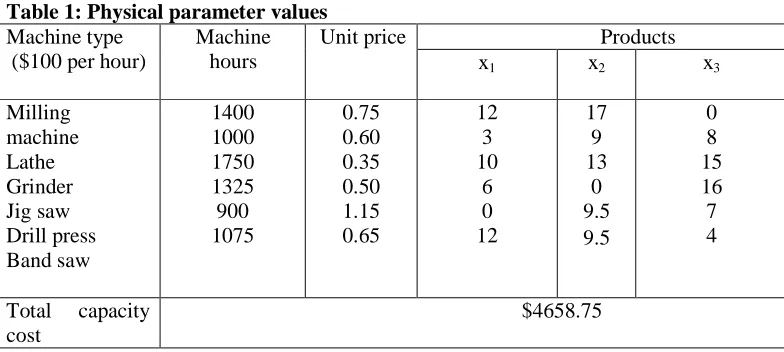
Table 1: Physical parameter values
Let x1, x2, x3 denote three products, then the complete mathematical formulation of the
above mentioned problem as a Multi-objective Linear Programming problem is given as: Max 56= 50x1 + 100x2 + 17.5x3(profit)
Max 58 92x1 + 75x2 + 50x3(quality)
Max 5 25x1 + 100x2 + 75x3(worker satisfaction)
Subject to the constraints 12x1 + 17x2≤ 1400
3x1 + 9x2 +8x3≤ 1400
10x1 + 13x2 + 15x3≤ 1750
6x1 + 16x3≤ 1325
x1, x2, x3≥ 0.
Table 2: Positive ideal solution
56585
Max 56 8041.14 10020.33 9319.25 Max 58 5452.63 10950.59 5903.00 Max 5 7983.60 10056.99 9355.90
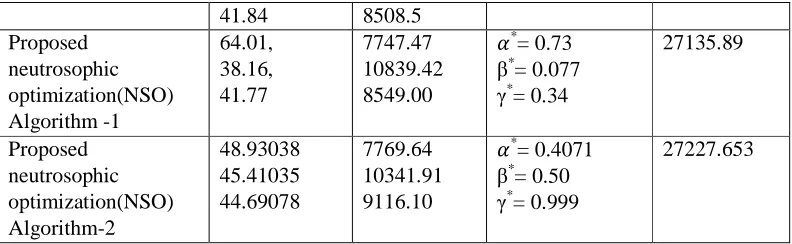
Table 3: Comparison of optimal solutions by IFO and NSO technique.
Optimization techniques
Optimal Decision Variables
6W,8W,W
Optimal Objective Functions
56W, 58W,5W
Aspiration levels
of truth, falsity and
indeterminacy membership functions
Sum of
optimal objective values
Intuitionistic fuzzy optimization(IFO)
62.82, 38.005,
7673.2 10721.81
l* = 0.75
β* = 0.056
26903.51
Machine type ($100 per hour)
Machine hours
Unit price Products
x1 x2 x3
Milling machine Lathe Grinder Jig saw Drill press Band saw 1400 1000 1750 1325 900 1075 0.75 0.60 0.35 0.50 1.15 0.65 12 3 10 6 0 12 17 9 13 0 9.5 9.5 0 8 15 16 7 4
Total capacity cost
41.84 8508.5 Proposed
neutrosophic optimization(NSO) Algorithm -1
64.01, 38.16, 41.77
7747.47 10839.42 8549.00
l*= 0.73
β*= 0.077
γ*= 0.34
27135.89
Proposed neutrosophic optimization(NSO) Algorithm-2
48.93038 45.41035 44.69078
7769.64 10341.91 9116.10
l*= 0.4071
β*= 0.50
γ*= 0.999
27227.653
Table 3 shows that Neutrosophic optimization gives better result than Intuitionistic fuzzy optimization.
5. Conclusions
In this paper, we presents simple Neutrosophic optimization approach to solve Multi-objective linear programming problem.it can be considered as an extension of fuzzy and intuitionistic fuzzy optimization .Also lower and upper bounds for the indeterminacy membership functions are defined. The empirical tests show that optimal solutions of Neutrosophic optimization approach can satisfy the objective function with higher degree than the solutions of fuzzy and intuitionistic fuzzy programming approach. The results thus obtained also reveal that neutrosophic optimization by proposed algorithm- 2 using non-linear Truth, Indeterminacy, Falsity membership functions give a better result than neutrosophic optimization by proposed algorithm- 1 using linear Truth, Indeterminacy, Falsity membership functions.
REFERENCES
1. L.Zadeh, Fuzzy sets, Inform and Control., 8 (1965) 338-353.
2. I.Turksen, Interval valued fuzzy sets based on normal forms, Fuzzy Set and Systems, 20 (1986) 191-210.
3. K.Atanassov, Intuitionistic fuzzy sets, Fuzzy Set and Systems, 20 (1986) 87-96. 4. F.Smarandache, Unifying field in logics Neutrosophy: Neutrosophic probability, set
and logic, Rehoboth, American research press.
5. K.Atanassov Interval valued intuitionistic fuzzy sets, Fuzzy Set and Systems, 31 (1989) 343-349.
6. H.Wang, F.Smarandache, Y.Zhang and R. Sunderraman, Single valued neutrosophic sets, Review 10, Google Scholar.
7. F.Smarandache, A generalization of the intuitionistic fuzzy set, International Journal
of Pure and Applied Mathematics, 24 (2005) 287-297.
8. S.K.Bharatiand S.R. Singh, Solving multi-objective linear programming problems using intuitionistic fuzzy optimization: a comparative study, International Journal of
Programming Approach
9. B. Jana and T.K. Roy, Multi-objective intuitionistic fuzzy linear programming and its application in transportation model, NIFS, 13(1) (2007) 1-18.
10. G.S.Mahapatra, M.Mitra, and T.K.Roy, Intuitionistic fuzzy multi-objective mathema- tical programming on reliability optimization model, International Journal of Fuzzy
Systems, 12(3) (2010) 259-266.
11. H.J.Zimmermann, Fuzzy linear programming with several objective functions, Fuzzy