PARTHENIUM WEED COMPOST: AN ENVIRONMENT FRIENDLY WAY OF ITS CONTROL AND TO HARNESS ITS ALLELOPATHIC
EFFECT
Wiqar Ahmad1 *, Sadiq Hussain1, Wasiullah Malik1, Ijaz Ahmad2,
Mushtaq Ahmad Jadoon3, Fazal Munsif4, Imran Khan5 and Rizwan Ullah
Shah6
ABSTRACT
Profitable and environment friendly management of parthenium weed through composting and subsequent utilization as nutrient option alone or in combination with other nutrient sources was studied on chili crop in District Nowshera, Pakistan during 2013 crop season. Six treatments; the control, N:P2O5:K2O (60:60:30 kg ha-1), Farmyard manure (FYM, 10 t ha-1), parthenium weed compost (PWC, 10 t ha-1), 50% FYM+50% NPK and 50% PWC+50% NPK were arranged in randomized complete block design (RCBD) with 2 m2 treatment plot size each one replicated three times. Results showed that initially (40 days after transplant) weed density decreased with nutrients application from all sources and amongst the organic sources, the parthenium weed compost (PWC) showed 72% and farmyard manure (FYM) showed 23% reduction in weed density over the control. At the middle of the growth period of the crop (80 days after transplant), FYM recorded 53% higher weed density over the control and 46% higher over the PWC. At maturity of the crop (120 days after transplant), weed density in FYM was again the maximum (23% higher over the control). On the other hand, PWC showed 39 and 13% and 50% PWC + 50% NPK showed 37 and 12% reduced weed density over the FYM and the control, respectively). Weed fresh and dry biomass were initially higher in the control but at the middle of the growth stages of the crop and at maturity, the FYM showed fresh biomass by 89, 62 and 110% and dry biomass by 123, 76 and 79% higher over the PWC, 50% PWC+50% NPK and the control, respectively. At maturity of the crop, same trend for fresh and dry weed biomass was observed but the chili total yield was observed to be 4 times higher in 50% PWC+50% NPK and 2.4 times higher in the PWC treatments over the
1Dept. of Soil and Environmental Sciences, 2Dept. of Plant Breeding
and Genetics, 4Dept. of Agronomy, The University of Agriculture, Peshawar, AMK Campus, 23200, Mardan, Pakistan
3Dept. of Rural Sociology, 5Dept. of Soil and Environmental Sciences, 6Institute of Biotechnology and Genetic Engineering, The University of
Agriculture, 25130-Peshawar, Pakistan
FYM. The study concluded that 50% PWC+50% NPK showed significant reduction of weeds as well as increase in chilli fruit yield and is recommended as a nutrient source and profitable management strategy of parthenium weed.
Key words: Chilies, growth, parthenium, weed compost, weeds, weed density.
Citation: Ahmad, W., S. Hussain, W. Malik, I. Ahmad, M.A. Jadoon, F. Munsif, I. Khan and R.U. Shah. 2015. Parthenium weed compost: an environment friendly way of its control and to harness its allelopathic effect. Pak. J. Weed Sci. Res. 21(4): 505-516.
INTRODUCTION
Chili (Capsicum annum L.) is a semi-perennial crop but it is grown as annuals by the conventional farmers in Pakistan. They are a good source of carbohydrates, vitamin A and vitamin C (Burt et al., 2005). In Pakistan, two varieties of chilies namely; Capsicum annum and Capsicum frutescence are important vegetable, used both as salad and as dried condiments (Govt. of Pakistan, 2006-07). It average cropping occupies 73.8 thousand hectare in Pakistan with total production of 90,000 tonnes thereby providing 1.5% share in the country’s GDP (Govt. of Pakistan, 2008-09).
There are some reasons due to which chilli crop yield is low in Pakistan but most of our farmers are unaware regarding such limitations (Qureshi and Bhatti, 2001). Weed infestation is one among them which compete with the crop plants for food, moisture; sun light, CO2 and space, as well as many weeds also possess allelopathic effects
against crops. Different environmental conditions in different regions determine the specific weed spectrum, composition and population (Memon et al., 2007). Reduction in yield due to weed crop competition mainly depends on weed species and their densities as well as crop types. As the distribution and infestation intensity of each varies, the extent of reduction in crop yield mainly depends on the number and kind of weeds found in the field (Frisbie et al., 1989).
Jayachandra 1980; Tefera 2002). It grows luxuriously in wastelands, agricultural areas and roadsides (Tefera, 2002), and in areas where the annual rainfall is greater than 500 mm. The allelo chemicals released from parthenium are sesquiterpene lactones and phenolics (Swaminathan et al., 1990). Parthenin is the major sesquiterpene lactone whereas caffeic, vanillic, ferulic, chlorogenic and anisic acids are the major phenolics (Kanchan and Jayachandra, 1980; Batish et al., 2002; Singh et al., 2002). These two synergistically acting groups of allelo chemicals significantly decrease the germination and growth in many crops (Batish et al., 2005a; Singh et al., 2003). Deducing from the results of these previous workers, it was hypothesised that parthenium weed incorporation in soil as part of compost, might retain the same allelopethic properties for other weeds and its incorporation is soil could be a profitable option as nutrient source as well as in weeds management. Due to lack of sufficient information on the effectiveness of parthenium weed compost, the present study was designed with the objective of testing the parthenium weed compost for its effectiveness as nutrient source as well as weeds management option in chili crop.
MATERIALS AND METHODS
The experiment was conducted farmer’s field to study the effect of parthenium weed compost in comparison with farmyard manure (FYM) and NPK on the occurrence of weed biota and yield parameters in chilies (Capsicum annum L.) A farmer’s field with a history of low chillies fruit yield was selected for the study in village Zande Banda Chail, (34° 07' 684" N, and 71° 54' 253" E) Kheshgi Bala, Nowshera (Khyber Pakhtunkhwa, Pakistan) during 2013. The experiment was laid out in randomized complete block design (RCBD) with a 2 m2 sub-plot
size each one replicated three times. A total of six treatments namely 1) Control, (2) N: P2O5:K2O (60:60:30 kg ha-1), (3) Farmyard manure
(FYM, 10 t ha-1), (4) parthenium weed compost (PWC, 10 t ha-1), (5)
50% FYM+50% NPK and (6) 50% PWC+50% NPK were studied. Young healthy chilli seedlings were transplanted in March 2013 with plant to plant distance of 30 cm and row to row distance of 60 cm. The sources inorganic fertilizers for N, P2O5 and K2O were Urea, DAP and Murat of
Potash (MOP), respectively. The FYM obtained from a local farmer whilst parthenium weed compost was prepared in the Palattoo research farm of the University of Agriculture, Amir Muhammad Khan Campus Mardan and both these organic sources were applied 15 days before transplantiion of chillies seedlings. Plants were irrigated as and when needed. The following parameters were recorded.
treatment at equal interval of 40, 80 and 120 days after transplanting (Khan et al., 2012). Chilies yield was also measured in each treatment with the help of electronic balance throughout the season when fruits developed to the maximum (Khan et al., 2012). Plant fresh and dry biomass was also measured after 120 days of transplant when plants were uprooted using electronic balance as was done by Deore et al. (2010).
Statistical analysis
The data was analyzed through analysis of variance (ANOVA) procedure for randomized complete block design (Gomez and Gomez 1984) using MSTATC, MS Excel and Statistix softwares and the variations amongst the treatments were compared through LSD-test of significance at the p level of p<0.05 and p<0.01 (Steel and Torrie, 1980).
RESULTS AND DISCUSSION Weeds density
Weed density (WD) was significantly (P<0.05) different among the treatments at all three intervals (40, 80 and 120 days) after transplanting of chili seedlings (Table-4). Results showed that initially (40 days after transplanting) WD was the highest (49.33 m-2) in
control treatment and the application of nutrients from different sources recorded a reduced WD by 97, 72, 23, 44 and 10% in the NPK, parthenium weed compost (PWC), farmyard manure (FYM), 50% PWC+50% NPK and 50% FYM+50% NPK treatments, respectively. At the same time PWC recorded 72% while 50% PWC+ 50% NPK recorded 44% reduced WD over the control. Surprisingly and as against Arif et. al. (2013), the lowest WD during the initial growth stages was observed in the NPK alone treatment (25 m-2) that was
97% lower over the control. The plausible reason for this might be the immediate availability of NPK nutrients to the crop plants in the NPK treated plots helping in their establishment and luxurious growth and causing the suppression of weeds under their shading effect. Results further showed that FYM manure treatments showed the minimum reduction in weed density that were 23 and 10% in the sole FYM and 50% FYM+50% NPK, respectively over the control probably due to poor crop growth in these treatments. At the middle of the growth stage (80 days after transplanting), the FYM alone treatment recorded the highest WD (132 m-2) that was 53% higher over the control, 46%
FYM treated plots. Arif et al. (2013) support these results stating that FYM application increased weed infestation in wheat crop. Contrary to FYM, the PWC could have a two fringed action on weeds i.e inactivation/burning of their seeds due to high temperature during composting process and the herbicidal and allelopat hic action of the parthenium component therein. When measured at maturity of the crop (120 days after transplanting), the highest WD (117.67 m-2) was
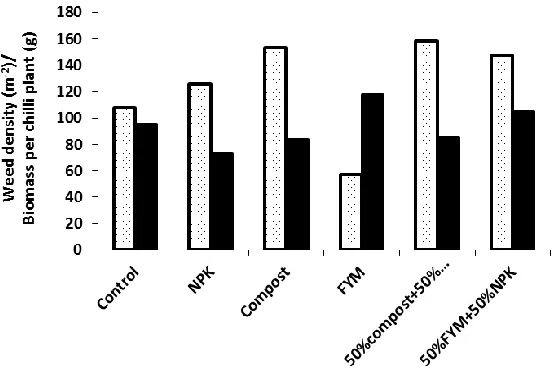
noted in the FYM alone (Arif et. al., 2013), which was 40, 62, 38, 12 and 23% higher over the plots treated with the PWC, NPK, 50% PWC+ 50% NPK, 50% FYM+ 50% NPK and the control , respectively. Similar to these findings, Ambasta and Kumari (2013) also showed a 40% reduction in WD due parthenium weed compost application. These results correlate well with the poor performance of the crop in the raw FYM manure treated plots (Figure 1) resulting in poor shadowing effect and profuse weed growth.
Table-1. Weeds density at 40, 80 and 120 days of transplanting
Treatment 40 days 80 days 120 days
Control 49.3 a 086.3 d 095.3 c
NPK 25.0 e 109.7 c 072.7 e
Compost 28.7 e 090.3 d 084.0 d
FYM 40.0 c 132.0 a 117.7 a
50%compost+50%NPK 34.3 d 112.3 c 085.0 d 50%FYM+50%NPK 44.7 b 121.7 b 104.7 b
Figure 1. Weed density and biomass per plant as affected by nutrient sources
Figure 2. Correlation between weed density and chili plant canopy
Weed biomass yield
Statistical analysis of the data showed that treatment effect on both weeds fresh biomass (WFB) and weeds dry biomass (WDB) was highly significant (P<0.01) at the 40, 80 and 120 days after transplant. At the 40th day after transplant, the control treatment
produced the highest WFB (213.5 kg ha-1). Application of nutrients
162, 128, 51, 32 and 13% reduction in the NPK, PWC,, 50% PWC+50% NPK, 50% FYM+50% NPK and the FYM alone treatments, respectively (Table-2). These results indicated that application of nutrients have improved the crop stand that have either directly suppressed the weeds under their shadowing effect or indirectly through their root proliferation. Therefore, the maximum reduction in WFB is evident in the NPK treated plots followed by PWC and 50% PWC+50% NPK. The minimum reduction in WFB in FYM treatment is attributed to poor crop stand thereby allowing maximum weed growth. The same trend was observed for WDB after 40 days of transplant which showed 138, 95, 55, 36 and 13% reduction in the NPK, PWC, 50% PWC+50% NPK, 50% FYM+50% NPK and the FYM alone treatments, respectively, over the control (Table-2) and therefore, confirming the results obtained on WFB at 40 days interval after transplant.
At the 80th day after transplant, the lowest WFB (6.32 t ha-1)
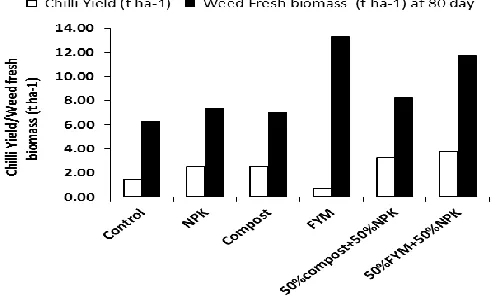
was recorded in control treatment which might be due to the exhaustion of available nutrients as compared to other treatments that were applied with nutrients either in one form or the other. Results showed the highest WFB in the FYM alone plot which was 110 % higher over the control. This might be due to t wo reasons; a number of unfermented weed seeds applied along with FYM and the nutrients availability to weed from FYM decomposition for a longer time. The plots treated with NPK, PWC, 50% PWC+50% NPK and 50% FYM + 50% NPK recorded 79, 89, 62 and 13% lower WFB yield over the FYM alone indicating the superiority of PWC either alone or in combination with NPK in the reduction to WFB thereby ensuring improved chili yield as compared to other treatments (Fig. 3). Similar trend in WDB was observed after 80 days of transplant where the PWC recorded 123% lower WDB as compared to the maximum in FYM alone treatment (4.63 t ha-1). In the FYM treated plot, WDB was 80% higher over the
Table-2. Weeds fresh and dry biomass at 40, 80 and 120 days of transplanting in kg ha-1
Treatment
Fresh
wt dry wt Fresh wt dry wt Fresh wt dry wt
40 days 80 days 120 days
Control 213 a 75 a 6316 b 2575 b 4620 b 1270 c
NPK 81 d 31 b 7410 b 2945 b 4146 b 1223 c
Compost 93 cd 38 b 7025 b 2080 b 4248 b 1468 bc
FYM 188 ab 66 a 13286 a 4628 a 6006 a 1760 ab
50%compost+
50%NPK 141 bc 48 ab 8216 b 2625 b 4631 b 1351 c
50%FYM+
50%NPK 161 ab 55 ab 11751a 4536 a 5695 a 1910 a
LSD (p<0.05) 12.0 6.2 738.3 215 212.8 92.8 Wt: weight
At the 120 days after transplant, it was observed that lowest WFB (4.15 t ha-1) was recorded in the plot treated with NPK which
might be due to the exhaustion of all the nutrients applied in the NPK plots by that time. Following the NPK treatment, the compost showed the second lowest in WFB (4.25 t ha-1) which might be due the
allelopathic effect of the parthenium component in the compost. These results are in line with those of Ambasta and Kumari (2013) stating that parthenium weed compost reduced the weed growth by 40% in maize due to allelopathic effect. Here again the highest WFB (6 t ha-1)
was recorded in plots treated with FYM alone which was 45, 41, 30 and 29% higher over the NPK, PWC, 50% PWC+50% NPK and the control treatments, respectively, and only 5.4% higher over the 50% FYM+50% NPK treatment. At the 120 days after transplanting significantly (P<0.05) low (1.22 t ha-1) WDB was recorded in NPK treated plot which gave an evidence that by the 120th day, all of the applied NPK had been exhausted. On the other hand, the highest WDB (1.9 t ha-1) was recorded in the 50% FYM+50% NPK which was 36%
higher over NPK treatment and this gave an evidence that raw FYM, being a source of weed seeds, might be a source of nutrients for nourishing these weeds upto the end of crop seasons.
Chilies yield
Statistical analysis of the data showed that nutrients application through different sources significantly (P<0.01) affected chillies yield. Results (Fig. 3) showed that the highest chilli fruits yield (3626.7 kg ha-1) was recorded in plots treated with 50% PWC+50% NPK, which
lowest chilies yield (736.7 kg ha-1) whilst the PWC alone treatment
recorded 2.4 times higher chili fruits yield over the FYM alone treatment. Chavan et al. (1997) found that combined application of nitrogen through FYM and urea was more beneficial as compared to fertilizer alone in order to increase the yield and quality of chilies. Yet he also recommended that the inorganic fertilizer (NPK) in combination with bio compost is suitable for better production of chilies that might increase soil fertility and this integrated approach could contribute to improve crop production. Kale and Bano (1994) observed in sunflower (cv.EC 68415 and Morden) that at par seed yields were obtained by the application of both 50% vermicompost with 50% recommended dose of chemical fertilizers or full dose of FYM and vermicompost. But these two treatments were significantly superior over application of lower dose of FYM or vermicompost with reduced dose of chemical fertilizers. According to Subbaiah et al. (1982), the combined application of organic and inorganic fertilizers was highly beneficial in increasing the yield level of chilies as compared to fertilizers alone. This increased yield level is attributed to the solubilisation effect of plant nutrients due to the addition of FYM. Subbaiah et al. (1985) observed that the combined application of FYM and inorganic fertilizers to improve the yield of tomato and brinjal was the best combination of 30 t ha-1 FYM and 100:100:100 NPK kg ha-1. Damke et al. (1988)
observed highest chillies yield with application of FYM at 9 t ha-1 along
with 50 kg ha-1 each of N, P
2O5 and K2O. Similarly, Surlekov and
Rankov (1989) reported significantly higher chillies yield with the application of FYM along with 100:80:100 kg ha-1 NPK when compared
to control. Inorganic nutrients enhanced fertilizer use efficiency and economy at lower application levels, while organic nutrients showed such effect at higher levels. Khan et al. (2012) also emphasized on weed management in vegetable by using organic approaches.
CONCLUSION
Figure 3. Effect of parthenium weed compost in comparisons with other nutrient sources on weed fresh biomass and chili yield
REFERENCES CITED
Ambasta, S. K. and S. Kumari. 2013. A scientific approach of conversion of hazardous parthenium weed into eco-friendly product by compost making. Intl. J. Geology, Earth and Environ. Sci. 3(1):90-94.
Arif, M., K. Ali, M.S.U. Haq and Z. Khan. 2013. Biochar, FYM and nitrogen increases weed infestation in wheat. Pak. J. Weed Sci. Res. 19(4): 411-418.
Batish, D.R., H.P. Singh, R.K. Kohli, D.B. Saxena and S. Kaur. 2002. Allelopathic effects of parthenin against Avena fatua and Bidens pilosa. Environ. Exp. Bot. 47: 149-155.
Batish, D.R., H.P. Singh, J.K. Pandher and R.K. Kohli. 2005. Allelopathic interference of Parthenium hysterophorus residues in soil. Allelopathy J. 15: 267-273.
Burt, J., P. South and O. Development. 2005. Department of agriculture and food farm note. No. 64/99.
Chavan, P.J., Syedimaiz, Rudraksha, G.B. Malewar and G. Baig. 1997. Effect of various nitrogen levels through FYM and urea on yield, uptake of nutrients and ascorbic acid content in chili (Capsicum annuum L.). J. Indian Soc. Soil Sci. 45(4):833-835.
Damke, M.M., V.J. Kawarkhe and C.V. Patil. 1988. Effect of phosphorus and potassium on growth and yield of chili. Punjab Agric. Univ. J. Res. 12 : 110-114.
(Capsicum annum L.). Asian J. Exp. Biol. Sci., 1: 15-19. Asian J. Exp. Biol. Sci., 1: 15-19.
Frisbie, R. E., K.M. EI-Zik and L.T. Wilson. 1989. Integrated pest management system and cotton production. Bulletin of Entomological Research, 81 (1): 121-122. Copyright © Cambridge University Press 1991. http://dx.doi.org/10.1017/S0007485300053359" \t "_blank, Published online: 10 July 2009.
Gomez, K.A. and A.A. Gomez. 1984. Statistical procedures for agricultural research (2nd ed). Wiley, New York. pp. 680. Govt. of Pakistan. 2006-07. Fruits, vegetables and condiments
statistics of Pakistan. Ministry of Food, Agric. & Livest. Federal Bureau of Statistics, Islamabad, Pakistan.
Govt. of Pakistan. 2008-09. Fruits, vegetables and condiments statistics of Pakistan. Ministry of Food, Agric. & Livest. Federal Bureau of Statistics, Islamabad, Pakistan.
Kale, B.D. and K. Bano. 1994. Consolidated technical report on ICAR adhoc scheme “Promotion of vermicomposting for production of organic fertilizer”, p. 74
Kanchan, S. D. and Jayachandra. 1980. Allelopathic effects of Parthenium hysterophorus L. Part IV. Identification of inhibitors. Plant Soil. 55: 67-75.
Khan, A., M. Sajid, Z. Hussain and A.M. Khattak. 2012. Effect of different weed control methods on weeds and yield of chilies (Capsicum annuum L.) Pak. J. Weed Sci. Res. 18(1): 71-78, Khan, M.A., Umm-e-Kalsoom, M.I.Q. Khan, R. Khan and S.A. Khan.
2011. Screening the allelopahic potential of various weeds. Pak. J. Weed sci. Res. 17(1): 73-81.
Khan, M.A., K. B. Marwat, A. Amin, A. Nawaz and H. Khan. 2012. Soil solarization: an organic weed management approach in cauliflower. Comm. Soil Sci. Plant Analy. 43 (13): 1847-1860.
Memon, R. A., G. R. Bhati, S. Khalid, R. Soomro and S. Ahmad. 2007. A survey of weeds found in cotton fields of the Khairpur district, Sindh, Pakistan. Pak. J. Bot. 39(7): 2265-2274.
Naz, S., M. Akbar, Anjum and I. Ahmad. 2006. growth of chili (Capsicum annuum L.) F1 hybrid sky line-2 in response to different ages of transplants. J. Res. 17(2): 91-95.
Qureshi, R. and G.R. Bhatti. 2001. Determination of weed communities in wheat (Triticum aestivum L.) fields of district Sukkur. Pak. J. Bot. 33(1): 109-115.
Singh, H.P., D.R. Batis, J.K. Pandher and R.K. Kohli. 2003. Assessment of allelopathic properties of Parthenium hysterophorus residues. Agric. Ecosyst. Environ. 95: 537-541.
Singh, H.P., D.R. Batish, R.K. Kohli, D.B. Saxena and V. Arora. 2002. Effect of parthenin a sesquiterpene lactone from Parthenium hysterophorus on early growth and physiology of Ageratum conyzoides. J. Chem. Ecol. 28: 2169-2179.
Steel, R.G.D., and J.H. Torrie. 1980. Principles and procedures of statistics. A biometrical approach Mc Graw Hill. New Yark, N.Y. 2nd (ed).
Subbaiah, K., J. Helkaih, V.R. Kumar and R. Gopal. 1982. Effect of combined application of organic and inorganic fertilizers on the yield and nutrition uptake of MDU chili. South Indian Hortic. 30 : 45-47.
Subbaiah, K., S. Sundararajan, S. Muthuswami and R. Perumal. 1985. Responses of tomato and brinjal to varying levels of FYM and macronutrients under different fertility status of soil. South Indian Hortic. 33: 198-205.
Surlekov, P. and Rankov. 1989. The effect of fertilization on capsicum productivity and soil agro-chemical and biological properties in monoculture. Pp. 46-52.
Swaminathan, C., R.R.S. Vinaya and K.K. Sureshi. 1990. Allelopathic Effects of Parthenium hyterophorus L. on germination and seedling growth of a few multipurpose tress and arable crops. Int. Tree Crops J. 6: 143-150.