Enhanced photo-efficiency of immobilized TiO
2
catalyst via
intense anodic bias
Nir Baram
a, David Starosvetsky
a, Jeana Starosvetsky
b, Marina Epshtein
b,
Robert Armon
b, Yair Ein-Eli
a,*aDepartment of Materials Engineering, Technion-Israel Institute of Technology, 32000 Haifa, Israel bEnvironmental and Civil Engineering, Technion-Israel Institute of Technology, 32000 Haifa, Israel
Received 1 February 2007; received in revised form 26 February 2007; accepted 14 March 2007 Available online 23 March 2007
Abstract
Global environmental pollution is recognized as a serious problem that motivates the development of new technologies and mitigation of emissions from current ones. The civilian, commercial, and defense sectors of most advanced industrialized nations are facing prob-lems related to remediation of hazardous wastes, contaminated soils and groundwater. In this communication, we describe results of a study indicating that the photo-efficiency of electrochemically grown porous TiO2-catalyst can be dramatically enhanced by an electro-chemical approach that enables the development of a highly efficient water purification system. The dramatic efficiency enhancement of this process arises from deep understanding of the nature of TiO2-catalyst; intense and extreme electrochemical polarization would totally eliminates electron/hole pair recombination process, which is primary factor affecting photo-catalysis efficiency. Elimination of more than 99.9999% ofE.colibacteria (5–6 orders of magnitudes of inactivation) within 6 h was achieved by the use of this approach. It was found that immobilized grown porous TiO2-catalyst can repeatedly be used, achieving extremely high efficiency, without any need for regeneration or highly advanced filtration techniques for the removal of the TiO2such as in the powder technology.
Ó2007 Elsevier B.V. All rights reserved.
Keywords: Photocatalysis; Anodization; Anodic bias;E. coli
1. Introduction
Over the past decade, the applications of advanced physicochemical processes utilizing semiconductor photo-catalysis to destroy or transform hazardous chemical wastes have been intensively investigated [1–13]. In most cases, complete mineralization (decomposition) of the organic compound was reported. Still, enhancing photo-catalytic process efficiencies remain a challenge and a sub-ject of extensive research.
TiO2 acts as a sensitizer for light-induced redox
pro-cesses, due to its electronic structure. Under suitable illumi-nation, photons (hm) strike the semiconductor surface,
causing electrons to be elevated from the valence band to the conduction band, leaving holes in the valence band
[14]. Electrons and holes can either recombine, trapped in surface states, or react with electron donors/acceptors adsorbed at the semiconductor surface. The holes are con-sidered to be powerful oxidants, while the electrons are considered to be good reductants. In the absence of suit-able electron and hole scavengers, recombination occurs within a few nanoseconds. The remainder uncombined holes can migrate to the surface and participate in reactions as a part of a closed catalytic cycle. In the aqueous phase, these holes react with surface adsorbed H2O, producing
OH radicals. The hydroxyl radical is a strong oxidizing agent and is considered to be reactive compound, responsi-ble for the degradation of organic molecules[15–17].
In this communication we describe for the first time the use of extreme anodic bias for both growing the TiO2oxide
1388-2481/$ - see front matter Ó2007 Elsevier B.V. All rights reserved.
doi:10.1016/j.elecom.2007.03.017 *
Corresponding author.
E-mail address:[email protected](Y. Ein-Eli).
and during bacteria elimination. This novel approach is taken in order to achieve a physically grown and immobi-lized photocatalyst on a metal conductive substrate. This would eliminate the need for advanced filtration tech-niques, applied for dispersed titania powder, subsequent to the catalytic water purification process. In addition, it is important to note that a drastic decrease in electron – hole recombination rate is to be expected at applied extreme anodic bias, leading to dramatic increase in the catalytic process efficiency. In this short communication we show, for the first time, that application of high anodic bias (up to 20 V) on electrochemically grown and immobi-lized titania achieves highly promising results in total elim-ination ofE-coli bacteria.
2. Experimental
2.1. Anodization of the Ti
Titanium foils (99.2% purity, Alfa Aesar) 0.5 mm of thickness were polished then etched in a HF: HCl: HNO3
solution followed by rinsing with deionized water. For elec-trochemical experiments, the samples were attached to a stainless steel holder with a known surface area which was the working electrode. The counter electrode was made also from pure titanium rod. The electrolyte was made from molten sodium nitrite and sodium nitrate (50:50 molar ratios). The temperature during the experiments was 280°C. Immobilized titania was grown on the working electrode in voltages between 0 V and 80 V in various cur-rent densities for 0.5–4 h. The morphology of the TiO2was
characterized using high resolution scanning electron microscopy (HRSEM). HRSEM was conducted on a LEO 982 Gemini microscope equipped with a field emis-sion gun (FEG–SEM). A dual-beam focused ion beam (FIB) (FEI Strata 400-S) was used to prepare cross-section specimens. X-ray diffraction measurements were acquired in order to determine the TiO2phase using a conventional
X-ray powder diffractometer (Philips X’Pert Diffractome-ter, Eindhoven, The Netherlands) with a CuKatube, oper-ated at 40 mA and 40 kV.
2.2. Electrochemical polarizations and microbiology studies
Electrochemical and microbiology studies were carried out in suspension ofE.colibacteria (strain CN13) prepared in 0.01% NaCl solution. Microorganisms were grown on nutrient broth at 36°C for 24 h. Prior to each experiment one-day bacterial culture was added to suspending medium (saline) in a ratio of 1 ml of culture to 100 ml of saline. Starting concentration of bacteria was 106–107cells/ml. During experiments all tested solutions were stirred. Mea-surements were conducted in three Petri dishes (140 mm diameter and 20 mm height) containing 150 ml of bacterial suspension. One of them was used as electrochemical cell: Ti/TiO2 electrode (working electrode) fully illuminated,
with a surface area of 25 cm2, platinum (counter electrode)
and SCE (reference electrode) were placed in this Petri dish. Anodic potential of 1–15 V (SCE) value was applied poten-tiostatically for 6 h. Second and third dish (without elec-trodes) were used as control. Bacterial suspension in the second dish was illuminated the same time as first dish con-taining titanium electrode. UV lamp (30 W UV lamp was mounted over both Petri dishes with light intensity of 3 mW/cm2). The dishes were treated both with UV light illumination (k= 360 nm) and application of anodic poten-tial at the working Ti/TiO2 electrode and anodic current
stabilization for 100 s. Third Petri dish contained initial bacterial suspension was exposed to the same experimental
0 50 100 150 200 250
0 20 40 60 80 100 120
5mA/cm2
30mA/cm2 50mA/cm2
Potential [V]
Time [min]
5mA/cm2
30mA/cm2 50mA/cm2
20 30 40 50 60 70 80
anat anat
2θ
D
C
B
A ruti
ruti
Ti ruti
Ti
ruti Ti
Ti
anat Ti
[image:2.595.322.551.240.687.2]time as previous dishes without any UV illumination. Peri-odically probes of bacterial suspension were taken from each dish.E.coliconcentration was counted by TPC (total plate count) method.
3. Results and discussion
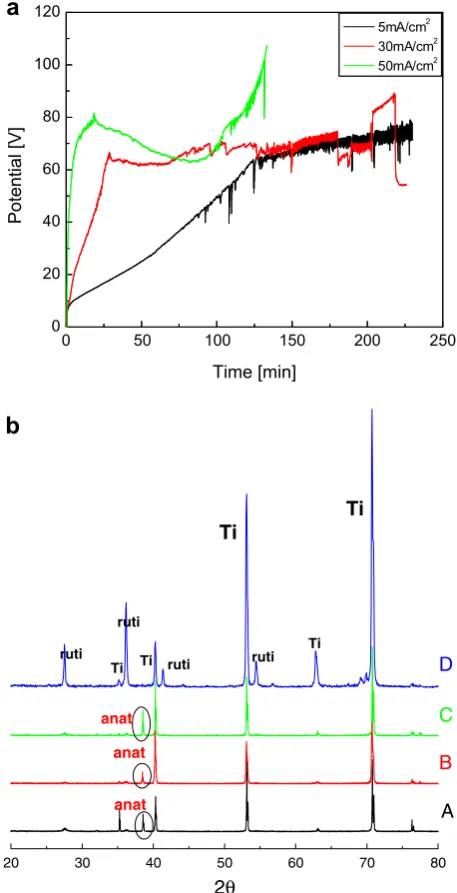
Potential vs. time curves are shown inFig. 1a for three different current densities, revealing two steps in the anod-ization process. Initially, a steep rise is detected, indicating a rapid growth of the oxide under high electric field condi-tions. In the second step, observed for a bias of 65 V, a moderate increase in the recorded bias with small fluctua-tions in the voltage is observed, caused by oxide phase transformation from anatase to rutile and destruction and rebuilding of the oxide layer.
XRD measurements (Fig. 1b) indicate that subsequent to the first electrochemical step for all three current densi-ties, anatase TiO2(indicated as ‘‘anat’’ inFig. 1b) is formed
(Ti peaks originate from the substrate). On the other hand, at the end of the anodization process, only rutile TiO2 is
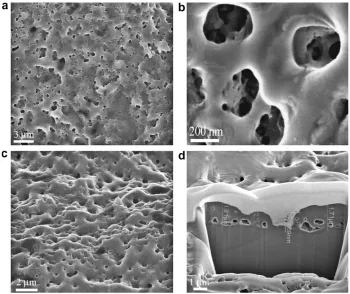
present (indicated as ‘‘ruti’’ in Fig. 1b). Anatase converts irreversibly to rutile in high temperatures (200–600°C) and in high potentials due to strong local heating, leading to local break-downs in the high electric fields [18,19]. The anodization process results in the formation of a thick porous oxide layer with pore-size distributions of 50– 200 nm, as can be seen in the high resolution scanning
elec-tron microscope micrographs presented in Fig. 2. Although, the thickness of the oxide layer is not uniform, it is larger than 1.5lm (Fig. 2d). Top and cross-section views indicate that the pores have a ‘‘wormlike’’ structure with sub-pores nanochannels. Electrical breakdown occurs inside repassivated primary pores would form new nanop-ores[20].
[image:3.595.116.467.428.722.2]Semiconductor electrochemistry suggests that electron-hole recombination could be suppressed more effectively under electrochemical polarization[21,22]. A large space-charge region (from several hundreds of Angstroms to a few microns, depending on the carrier concentration and the applied potential) is formed in a semiconductor under polarization[21,22]. If the electron and hole are generated by irradiation in the space charge region, they will move in opposite directions under the action of the electric field (electro-migration). During a positive bias, holes are trans-ported to the electrode surface and are taking part in the electrode reactions, while the electrons are forced to move to the semiconductor bulk. Therefore, electron-hole recom-bination could be significantly suppressed inside the space-charge region by means of anodic polarization. The carriers generated outside the space-charge region travel, during their lifetime, only a small distance (approx. the diffusion length). Therefore, the holes generated beneath the space charge region will recombine before reaching the electrode surface. Consequently, they do not contribute to the over-all photocurrent. An increase in the anodic potential
enhances the depth of the space-charged region and, conse-quently, increases the number of holes participating in the photo-catalytic reactions. Previous studies by Vinodgopal et al. showed that a low bias 0.6 V applied to a conductive glass coated with titania increased the photocatalytic deg-radation of hazardous chemical [23]. Christensen et al. recently reported on application of moderate anodic bias of 1.3 and 3 V to thermally oxidized titanium in solution containing E-coli bacteria [24]. The authors reported on successes in measuring very low survival rates under these conditions.
Taking all the above considerations into account, one would anticipate that with the use of extremely high anodic polarization and by optimizing the TiO2structure into
por-ous structure, the electron-hole recombination can be strongly suppressed, increasing the concentration of holes at the electrode surface, and consequently, significantly increasing the efficiency of the photocatalysis process. Photo-electrochemical characteristics of Ti/TiO2electrode
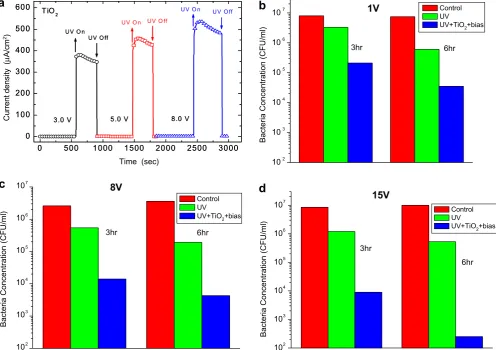
anodized in molten salt were measured in DI water con-taining 100 ppm chloride-ions. UV light (360 nm wave-length) was used as a light source for electrode irradiation in these studies (Fig. 3a). Very low anodic
cur-rent was detected in a wide potential range without irradi-ation. The observed increase in anodic current with irradiation can be attributed to the appearance of photo-induced carriers in the space charge region. Anodic shift in applied potential under irradiation increases the anodic current, indicating enhanced migration of hole-carriers to the electrode surface, i.e. a decrease in electron/hole recom-bination with the application of high anodic polarization.
The capabilities of the produced Ti/TiO2 substrates in
eliminating bacteria (E. coli) were studied. Samples were illuminated with UV light (k= 360 nm) and also sustained anodic bias of 1–20 V for 6 h. The system contained two Petri dishes with E. coli bacteria in a buffer phosphate (pH7). Ti/TiO2electrodes were placed in the first Petri
dish and were illuminated and polarized with anodic bias. On the second dish, only UV illumination was applied. In addition, the bacteria were also placed in a control dish, without UV illumination and anodic bias. The results obtained under different anodic bias for 3 and 6 h are shown inFig. 3b–d. Application of illumination and ano-dic bias reveals that after 6 h the concentration of E. coli
was reduced by 5–6 orders of magnitude compared to con-trol samples. In addition, the use of 15 V anodic bias
102
103
104 105 106 107
Bacteria Concentration (CFU/ml)
Control UV
UV+TiO2+bias
1V
3hr 6hr
102 103
104
105 106
107
Bacteria Concentration (CFU/ml)
Control UV
UV+TiO2+bias
8V
3hr 6hr
102 103 104 105 106 107
Bacteria Concentration (CFU/ml)
Control UV
UV+TiO2+bias
15V
3hr
6hr
0 500 1000 1500 2000 2500 3000
0 100 200 300 400 500 600
U V O ff U V O n
8 .0 V 5 .0 V
3 .0 V T iO
2
U V O n
0 500 1000 1500 2000 2500 3000
0 100 200 300 400 500 600
U V O ff U V O ff
U V O ff U V O n
8 .0 V 5 .0 V
3 .0 V T iO
2
U V O n
Current dens
ity (
μ
A/cm
2)
Time (sec)
[image:4.595.53.550.358.708.2]decreases bacteria concentration by more than 2 orders of magnitude once compared with the results obtained from application of 1 V anodic bias. This would mean that the amount of surviving bacteria is less than 20 units, which cannot be pronounced in percent (or even fraction of per-cent) of survivals. Comparison to results obtained by other research groups utilizing titania films[24,25], demonstrates that total bacteria elimination is feasible with the use of this reported novel technology.
It is important to note that in order to evaluate the effect of the applied potential, studies were conducted only with applied anodic bias on Ti/TiO2electrode, without UV
illu-mination. Under these conditions, no significant change in the bacteria concentration was observed. Thus, the anodic bias by itself has no influence on bacteria inactivation, but rather causes water splitting only. These results demon-strate the superiority of the electrochemically embedded grown titania; not only that no powder is being used and thus the need for regeneration and slurry handling is no longer exist, the efficiency and rate of bacteria elimination are potential (bias) controllable. As the anodic bias increases more efficient bacteria elimination is achieved.
4. Conclusions
Extreme anodic polarization capable of producing both TiO2-catalysts and to reducing electron/hole pair
recombi-nation process is proven to be highly efficient. Combina-tion of immobilize, electrochemically grown titania (which can be repeatedly used and easily removed), and application of extremely high anodic bias on the Ti/TiO2
electrode and UV illumination led to a dramatic improve-ment in E. coli decomposition, inactivating more than 99.9999% of E. colibacteria.
Acknowledgement
This work was supported by ‘‘NATAF’’ program at the Israeli Ministry of Industry and Trade, Chief Scientist Of-fice. The authors wish to thank Prof. Brad Chmelka for his assistance.
References
[1] M.R. Hoffmann, T.M. Scot, C.H. Wonyong, D.W. Bahnemann, Chem. Rev. 95 (1) (1995) 69–96.
[2] Y. Paz, Z. Luo, L. Raberberg, A. Heller, J. Mater. Res. 10 (11) (1995) 2842–2847.
[3] Y. Paz, A. Heller, J. Mater. Res. 12 (10) (1997) 2759–2766. [4] A. Fujishima, K. Hashimoto, T. Watanabe, TiO2 Photocatalysis,
Fundamentals and Applications, BKC, Inc., Tokyo, 1999, pp. 173. [5] R.J. Watts, S. Kong, M.P. Orr, G.C. Miller, B.E. Henry, Wat. Res. 29
(1) (1995) 95–100.
[6] N. Laot, N. Narkis, D. Bilanovic, R. Armon, J. Adv. Oxid. Technol. 3 (1998) 145–150.
[7] K.E. Karakitsou, X.E. Verykios, J. Phys. Chem. 97 (1993) 1184–1189.
[8] A.J. Bard, M.A. Fox, Accounts Chem. Res. 28 (1995) 141. [9] M. Nair, Z.H. Luo, A. Heller, Ind. Eng. Chem. Res. 32 (1993) 2318–
2323.
[10] U. Stafford, K.A. Gray, P.V. Kamat, Heterogen. Chem. Rev. 3 (1996) 77.
[11] F.L. Zhang, J.C. Zhao, T. Shen, H. Hidaka, E. Pelizzetti, N. Serpone, Appl. Catal. 15 (1998) 147.
[12] K. Ikeda, K. Hashimoto, A. Fujishima, J. Electroanal. Chem. 437 (1997) 241.
[13] S. Sitkiewitz, A. Heller, New J. Chem. 20 (1996) 233.
[14] J. Tseng, C.P. Huang, Chem. Oxid. Technol. Nineties 1 (1993) 262– 277.
[15] C. Kormann, D.W. Bahnemann, M.R. Hoffmann, Environ. Sci. Technol. 22 (1988) 798–806.
[16] A. Makowski, W. Wardas, Curr. Top. Biophys. 25 (1) (2001) 19. [17] K. Sunada, Y. Kikuchi, K. Hashimoto, A. Fugishima, Environ. Sci.
Technol. 32 (1998) 726–728.
[18] A.M. Ruiz, G. Sakai, A. Cornet, K. Shimanoe, J.R. Morante, N. Yamazoe, Sensor. Actuat. B 103 (2004) 312.
[19] M. Aggour, T. Dittrich, A. Belaidi, I. Sieber, J. Rappich, Phys. Stat. Sol. 9 (2005) 3344.
[20] J. Choi, R.B. Wehrspohn, J. Lee, U. Gosele, Electrochim. Acta 49 (2004) 2645.
[21] J.O’M. Bockris, S.U.M. Khan, Surface Electrochemistry, Plenum Press, New York, 1993.
[22] Yu.V. Pleskov, Yu.Ya. Gurevich, Semiconductor Photoelectrochem-istry, Consultant Burea, New York, 1985.
[23] K. Vinodgopal, S. Hotchandani, P.V. Kamat, J. Phys. Chem. 97 (1993) 9040–9044.
[24] P.A. Christensen, T.P. Curtis, T.A. Egerton, S.A.M. Kosa, J.R. Tinlin, Appl. Catal. B 41 (2003) 371–386.