R E S E A R C H
Open Access
Could drought conditions trigger Schmallenberg
virus and other arboviruses circulation?
Mattia Calzolari
1*and Alessandro Albieri
2Abstract
Background:In 2011, a new orthobunyavirus, named the Schmallenberg virus (SBV), was discovered in Europe. Like the related Shamonda virus, SBV is an arbovirus (arthropod-borne virus). After its discovery, the virus was detected in a wide area in north-western Europe, an unexpected finding in a territory where climatic conditions would not seem ideal for arbovirus transmission. This sudden expansion suggests the effect of 2011 drought as a key factor that may have triggered SBV circulation. The possible influence of drought, recorded in north-western Europe in early 2011, on virus circulation was evaluated.
Methods and results:The locations of SBV detections in Europe until April 2012 were obtained, and area of virus circulation was evaluated by kernel density estimation. Precipitation data in SBV circulation area, summarized by the 3 month precipitation indexes of May, were compared with precipitation data outside that area, confirming driest conditions in that area.
Conclusions:The onset of drought conditions recorded in the SBV detection area in early 2011 may have
promoted the circulation of this virus. A correlation between circulation of some arboviruses and drought has been reported elsewhere. This was mainly explained by an effect of water deficit on the environment, which altered the relationships between vectors and reservoirs, but this correlation might be also the result of unknown effects of drought on the vectors. The effect of drought conditions on arbovirus circulation is most likely underestimated and should be considered, since it could promote expansion of arboviruses into new areas in a global warming scenario.
Keywords:Drought, Arbovirus, Standardized precipitation index, Schmallenberg virus, Usutu virus, West Nile virus
Background
The Schmallenberg virus (SBV) causes congenital mal-formations and stillbirths in cattle, sheep, and goats. Clinical signs of infection in adult animals are either ab-sent or non-specific, but fever, loss of appetite, reduction in milk yield, and diarrhoea have been recorded in cattle [1,2]. Therefore, even if this virus does not represent a risk for humans [3], it could result in significant eco-nomic losses in farming [4].
The expansion of SBV in north-western Europe was the second event of spread of an arbovirus in this area, after the unexpected arrival of Blue tongue virus 8 (BTV-8) in 2006 [5]. While these two viruses are not
related (BTV belongs to Reoviridae family), both share the same vectors: culicoids (Culicoides spp.), which are biting midges of the Ceratopogonidae family [2,4]. The surveillance efforts performed in northern European countries to monitor BTV-8 did not previously detect the SBV. Together with the available epidemiological data, this allows the onset of SBV circulation to be esti-mated as May 2011 [2]. The geographical spread of SBV over this short period was impressive, and much faster than that of BTV-8; it was probably promoted by the ab-sence of immunity in the local population of domestic ruminants. Several factors may have influenced the SBV circulation, but one key factor, which occurred in 2011, stands out as possibly enabling this expansion: drought.
In Italy, an enhancing influence of drought was reported in mosquito circulation of the Usutu virus (USUV) [6], a flavivirus belonging to the Japanese en-cephalitis complex. The first detection of this virus in * Correspondence:[email protected]
1Laboratorio Entomologia Sanitaria, Istituto Zooprofilattico Sperimentale della
Lombardia e dell’Emilia Romagna“B. Ubertini”, Via Pitagora 2, 42100, Reggio Emilia, Italy
Full list of author information is available at the end of the article
Europe dates back to 2001 in Austria [7], but it now seems to be endemic in several European countries [8]. This virus is transmitted by mosquitoes, mainly of the Culex genus, and has its main reservoirs in wild birds [9], although the possible involvement of other verte-brates in its cycle has been hypothesized [6].
The influence of drought conditions was previously reported for the circulation of other two flaviviruses that, similarly to Usutu, are maintained by a bird-mosquito transmission cycle: St. Louis encephalitis virus (SLEV) [10,11] and West Nile virus [10,12-14] (WNV). In 2012, drought conditions were also recorded in the Balkans and northern Italy, where a large number of human cases of WNV disease were reported [15], and several counties in the United States were affected by both drought and a WNV outbreak, with a large increase of human cases [16]. While the medical importance of USUV is not fully understood [8,17], risks of WNV and SLEV for human health are well recognized. In Africa, an association with unusually dry, warm conditions was recorded for the circulation of chikungunya virus (CHIKV) [18,19], a mosquito-transmitted alphavirus. Human beings could be reservoirs for CHIKV, which represents a major health problem in the world [20].
The epidemiology of culicoid-borne viruses is not well known as the mosquito-borne viruses one, because of the gaps in knowledge of biting midge taxonomy and biology [21], nevertheless an enhancing effect of drought was suggested on epizootic hemorrhagic disease (EHD),
caused by a virus (EHDV) closely related to BTV, in United States cervids [22]. Moreover, severe drought conditions did not prevent outbreaks of congenital defects in domestic ruminants in Australia, caused by Akabane virus [23], which is closely related to SBV [4].
Interestingly, in 2011, an event of drought, character-ized by the greatest deficit in accumulated rainfall in May, was recorded in north-western Europe, particularly in areas in which SBV was subsequently reported [24]. The possible influence of this event on SBV circulation was tested by comparing precipitation data in the esti-mated area of SBV circulation with precipitation data outside that area.
Results and discussion
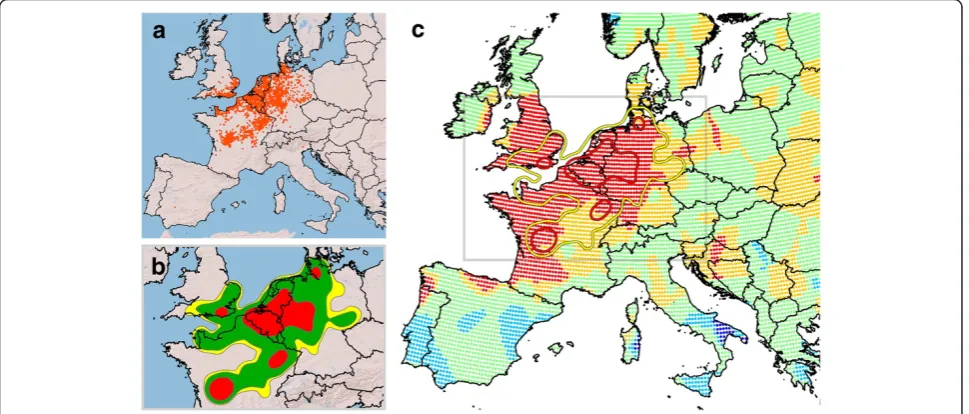
A dataset of 3,309 SBV positive sites was obtained (Figure 1a), with an average distance of 6,381 meters be-tween sites (minimum distance 1 m, maximum distance 628,774 m). The average nearest neighbour analysis (ANNA) confirmed the clustering of SBV locations (p<0.01, Z-Score= − 66.47). The kernel density estima-tion (KDE) produced a single SBV circulaestima-tion area, dif-fused from Germany to England and France (Figure 1b).
The average of the 3 month standardized precipitation indices (SPI3s) inside the obtained 95% KDE volume contour was −2.7 (±0.8 s.d., n 1,069) and the average outside of the contour was −0.2 (±1.0 s.d., n 22,951) (graphically represented in Figure 1c, yellow line). This means that more intense drought conditions occurred in
the estimated SBV circulation area during the quarter from March to May 2011, with rainfalls that deviated by
−2.7 units from the seasonal average, while outside of this area, a deviation of only−0.2 units was recorded.
A more restrictive contour was obtained by the 50% of the KDE, which produced four areas of more intensive circulation (Figure 1b, red). The largest of these areas–
between Belgium, Germany and the Netherlands –
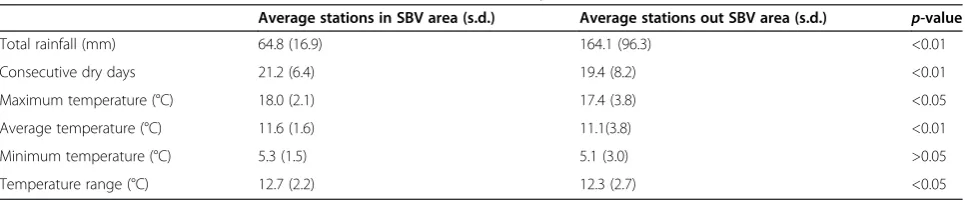
includes the site in which the virus was discovered and the area of the first recording of the related disease symptoms [1,2,4], indicating that it was probably the ini-tial area affected by the virus. Interestingly, the average of the SPI3 indexes in that area was −3.4 (±0.4 s.d., n 208) (graphically represented in Figure 1c, red line), lower than that of the 95% KDE contour. The occur-rence of drought conditions inside the SBV circulation area, in the same three-month period, was confirmed by the low rainfall and largest number of consecutive dry days respect to the surrounding area (Table 1). Additionally, the extent of the average and maximum temperature was higher inside the SBV circulation area (Table 1). Indeed, the lack of rain affects the environmental moisture, which affects the temperature, so it is difficult to discern, during drought conditions, the specific effects of these factors on virus circulation.
Moreover, the possible influence of livestock density on the SBV distribution was evaluated, although the low-density areas seem to slow down the spread of the virus, a strict correlation between the animal density and SBV diffusion was not found (Additional file 1).
These results strongly suggested that the drought con-ditions recorded in early 2011 had an enhancing effect on the spread and circulation of the SBV.
The apparent effect seems counterintuitive: drought con-ditions generally have negative effects on the vector density [9,11], and a decrease in virus circulation would logically be expected. However, this expected response does not con-stantly occur and a high density of vectors does not invari-ably mean higher viral circulation [4]; other factors come into play, such as host preferences of vectors, the density, availability and immunity level of the reservoirs, and may strongly influence the arboviral load in the environment.
The hypothesis made to support the action of drought on the arbovirus circulation is mainly based on the
decrease in food resources and suitable habitats caused by drought. This decrease could have forced vectors and vertebrate hosts into limited areas, thereby increasing the possibility of vector-host contact and viral circula-tion. In previous studies, the reported influence of drought on WNV and SLEV circulation was explained by a spatial congregation of vectors and hosts in limited suitable areas, which promoted viral circulation between reservoirs and vectors [11,13], or by an effect of decreas-ing abundance of mosquito predators and competitors [25]. The hypothesis presented for CHIKV, which does not require an enzootic amplification to produce epi-demics, was that drought increased the importance of domestic water storage in vector breeding, with a subse-quently more probable vector-human contact [19]. Al-ternatively, a habitat change could have increased the density of larval breeding sites of the mosquito vectors [18]. However, these ecological explanations do not match the observations for the SBV, as the congregation of live-stock that could act as reservoirs of this virus was not affected by drought, since the water sources for livestock are artificial, therefore not strictly rainfall-dependent. In addition, the breeding sites for culicoids are not as de-pendent on water as are those of mosquitoes.
Consequently, other mechanisms, not yet investigated, could exist, and a direct effect of drought on the vectorial competence of the insects could be hypothesized, as has been proposed for the widely described action of tem-perature on the virus susceptibility of mosquitoes [26,27] and culicoids [28,29]. Adverse conditions, like drought, could affect mosquito bionomics, as demonstrated by the decrease in egg production in theCulex pipiensmosquito following repeated bouts of dehydration [30]. In a similar way, drought could facilitate infection of the insects or in-fluence the extrinsic incubation period length, a factor im-portant in the vector capacity. Alternatively, the infected insects may have an unknown advantage during drought conditions over those not infected.
Conclusions
To the best of our knowledge, a possible direct effect of drought on arbovirus vectors has never been specifically investigated, and further studies are needed to confirm the extent of this phenomenon. However, the obtained
Table 1 Evaluation of differences in weather conditions recorded by climatic stations in/out the SBV circulation area
Average stations in SBV area (s.d.) Average stations out SBV area (s.d.) p-value
Total rainfall (mm) 64.8 (16.9) 164.1 (96.3) <0.01
Consecutive dry days 21.2 (6.4) 19.4 (8.2) <0.01
Maximum temperature (°C) 18.0 (2.1) 17.4 (3.8) <0.05
Average temperature (°C) 11.6 (1.6) 11.1(3.8) <0.01
Minimum temperature (°C) 5.3 (1.5) 5.1 (3.0) >0.05
results and literature indications highlight a possible drought association with viral circulation, and on the ability of drought to potentially enhance the circulation of arboviruses in a territory. Therefore, drought condi-tions could act very significantly on the arbovirus econ-omy, and might have played a crucial role in the recent emergence of some of these viruses.
If this effect is confirmed, and given the probable in-crease in drought events in the near future [31] due to global warming, an unexpected and marked expansion of some arboviruses may occur in areas previously con-sidered to be immune to this problem.
Methods
The European precipitation data from February to May, 2011, summarized by the SPI3, interpolated to a decimal degree quarter grid, were provided by the European Drought Observatory. The SPI3 is a statistical indicator of drought and compares the total precipitation received at a particular location during 3 months with the long-term rainfall distribution for the same period of time at that location. The accumulated precipitation is standar-dized to allow the statistical comparison of wetter and drier climates, and the SPI results are given in units of standard deviation from the long-term mean of the stan-dardized distribution [24].
Data from European meteorological stations, in the interval 43°N–57°N of latitude and 11°W–20°E of longi-tude, were downloaded from site of European Climate Assessment & Dataset project (ECA&D) [32]. The aver-age of daily temperature (minimum, maximum, averaver-age), the average of temperature range, the maximum number of consecutive dry days and the precipitation sum in the three-mount period, from March to May 2011, for avail-able stations were obtained. The differences between average of indices from stations inside and outside the SBV circulation area (95% volume contour area of SBV KDE) were evaluated byttest.
The 2011 total number of bovine animals, sheep and goats were obtained for European territorial units (NUTS) available in the Agriculture database of statistical office of the European Union (Eurostat) [33]. Livestock density was obtained for every NUTS dividing the total number of ani-mals by the entire NUTS area.
The locations of SBV detections were obtained from the EMPRES Global Animal Disease Information System [34]. The SBV activity in the 2012 season was excluded by considering only cases reported until April 2012. Data that were lacking from Belgium [35] were added to this database. The pattern of spatial data was characterized by conducting ANNA on the SBV locations.
KDE was performed using ESRI ArcGIS 9.3 and the Spatial Analyst extension and was applied to this dataset to evaluate the area of virus circulation (Figure 1b). The
KDE is a geospatial technique based on the kernel func-tion (a bivariate probability density funcfunc-tion) used to create a surface to indicate the intensity of the events of a phenomenon [36]. A bandwidth size of 100 km was chosen, considering the ability of culicoids to spread the virus this distance [2,5]. The area of SBV circulation was estimated by the 95% and 50% volume contour of the SBV KDE, which represents the boundary of the area that contains 95% and 50% of the volume of the obtained KDE (Figure 1b, yellow).
Additional file
Additional file 1:Livestock density and Schmallenberg virus (SBV) circulation area in 2011.The 2011 livestock densities (bovine animals, sheep, goats), obtained for the different European territorial units, are shown with the overlaying of the 95% and 50% volume contours of KDE of SBV (yellow line and red line respectively).
Abbreviations
SBV: Schmallenberg virus; BTV: Blue tongue virus; USUV: Usutu virus; SLEV: St. Louis encephalitis virus; WNV: West Nile virus; CHIKV: Chikungunya virus; ANNA: Average nearest neighbor analysis; KDE: Kernel density estimation; SPI3: 3 month standardized precipitation index.
Competing interests
The authors declare that they have no competing interests.
Authors’contributions
MC performed the analysis and drafted the manuscript. AA analysed data in geographic information system. Both authors read and approved the final manuscript.
Acknowledgements
We acknowledge Alfred De Jager (European Drought Observatory) for providing SPI3 indexes, and the data providers in the ECA&D project. We thank Arianna Puggioli and Cinzia Carboni for reviewing the text.
Author details
1Laboratorio Entomologia Sanitaria, Istituto Zooprofilattico Sperimentale della
Lombardia e dell’Emilia Romagna“B. Ubertini”, Via Pitagora 2, 42100, Reggio Emilia, Italy.2Centro Agricoltura Ambiente“G. Nicoli”, Via Argini Nord 3351, 40014, Crevalcore, Italy.
Received: 9 November 2012 Accepted: 21 January 2013 Published: 14 February 2013
References
1. Hoffmann B, Scheuch M, Höper D, Jungblut R, Holsteg M, Schirrmeier H, Eschbaumer M, Goller KV, Wernike K, Fischer M, Breithaupt A, Mettenleiter TC, Beer M:Novel Orthobunyavirus in Cattle, Europe, 2011.Emerg Infect Dis2012,18:469–472.
2. European Food Safety Authority:“Schmallenberg”virus: analysis of the epidemiological data and Impact assessment.EFSA Journal2012,10:2768. 3. Ducomble T, Wilking H, Stark K, Takla A, Askar M, Schaade L, Nitsche A,
Kurth A:Lack of evidence for Schmallenberg virus infection in highly exposed persons, Germany, 2012.Emerg Infect Dis2012,18:1333–1335. 4. Garigliany MM, Bayrou C, Kleijnen D, Cassart D, Jolly S, Linden A, Desmecht
D:Schmallenberg virus: a new Shamonda/Sathuperi-like virus on the rise in Europe.Antivira Res2012,95:82–87.
5. European Food Safety Authority:Epidemiological analysis of the 2006 bluetongue virus serotype 8 epidemic in north-western Europe. [http://www.efsa.europa.eu/en/efsajournal/doc/34r.pdf]
Mosquito, bird and human surveillance of West Nile and Usutu viruses in Emilia-Romagna Region (Italy) in 2010.PLoS One2012,7:e38058. 7. Weissenböck H, Kolodziejek J, Url A, Lussy H, Rebel-Bauder B, Nowotny N:
Emergence of Usutu virus, an African mosquito-borne flavivirus of the Japanese encephalitis virus group, central Europe.Emerg Infect Dis2002, 8:652–656.
8. Vazquez A, Jimenez-Clavero M, Franco L, Donoso-Mantke O, Sambri V, Niedrig M, Zeller H, Tenorio A:Usutu virus: potential risk of human disease in Europe.Euro Surveill2011,16:19935.
9. Hubálek Z:Mosquito-borne viruses in Europe.Parasitol Res2008,103:S29–S43. 10. Epstein PR:West Nile virus and the climate.J Urban Health2001,78:367–371. 11. Shaman J, Day JF, Stieglitz M:Drought-induced amplification of Saint
Louis encephalitis virus, Florida.Emerg Infect Dis2002,8:575–580. 12. Reisen WK, Meyer RP, Presser SB, Hardy JL:Repeated West Nile virus
epidemic transmission in Kern County, California, 2004–2007.J Med Entomol2009,46:139–157.
13. Shaman J, Day JF, Stieglitz M:Drought-induced amplification and epidemic transmission of West Nile virus in southern Florida.J Med Entomol2005,42:134–141.
14. Wang G, Minnis RB, Belant JL, Wax CL:Dry weather induces outbreaks of human West Nile virus infections.BMC Infect Dis2010,10:38.
15. European Center for Disease Prevention and Control:West Nile virus Maps. http://www.ecdc.europa.eu/en/healthtopics/west_nile_fever/west-nile-fever-maps/Pages/index.aspx.
16. PromedMail:West Nile virus - USA (04): national. Archive Number: 20120816.1246423. 2012.
17. Calzolari M, Gaibani P, Bellini R, Bonilauri P, Albieri A, Pierro A, Maioli G, Rossini G, Defilippo F, Tamba M, Cavrini F, Natalini S, Sambri V, Angelini P, Dottori M:Usutu virus in Emilia-Romagna Region (Italy): implications for the public health.G Ital Med Trop2011,16:57–63.
18. Anyamba A, Chretien JP, Small J, Tucker CJ, Linthicum KJ:Developing global climate anomalies suggest potential disease risks for 2006–2007.
Int J Health Geogr2006,5:60.
19. Chretien JP, Anyamba A, Bedno SA, Breiman RF, Sang R, Sergon K, Powers AM, Onyango CO, Small J, Tucker CJ, Linthicum KJ:Drought-associated chikungunya emergence along coastal East Africa.AmJTrop Med Hyg 2007,76:405–407.
20. Weaver SC, Reisen WK:Present and future arboviral threats.Antiviral Res 2010,85:328–345.
21. Borkent A:The Biting Midges, the Ceratopogonidae (Diptera). InBiology of Disease Vectors. 2nd edition. Edited by Marquardt WC. Burlington, San Diego and London: Elsevier Academic Press; 2004:113–126.
22. Dubay SA, deVos JC Jr, Noon TH, Boe S:Epizootiology of hemorrhagic disease in mule deer in central Arizona.J Wildl Dis2004,40:119–124. 23. Murray MD:Akabane epizootics in New South Wales: evidence for
long-distance dispersal of the biting midgeCulicoides brevitarsis.Aust Vet J 1987,64:305–308.
24. European Drought Observatory: [http://edo.jrc.ec.europa.eu]
25. Chase JM, Knight TM:Drought-induced mosquito outbreaks in wetlands.
Ecol Lett2003,6:1017–1024.
26. Kilpatrick AM, Meola MA, Moudy RM, Kramer LD:Temperature, viral genetics, and the transmission of West Nile virus byCulex pipiens mosquitoes.PLoS Pathog2008,4:e1000092.
27. Turell MJ:Effect of environmental temperature on the vector competence ofAedes taeniorhynchusfor Rift Valley fever and Venezuelan equine encephalitis viruses.AmJTrop Med Hyg1993,49:672–676.
28. Carpenter S, Wilson A, Barber J, Veronesi E, Mellor P, Venter G, Gubbins S: Temperature dependence of the extrinsic incubation period of orbiviruses inCulicoidesbiting midges.PLoS One2011,6:e27987. 29. Wittmann EJ, Mello PS, Baylis M:Effect of temperature on the
transmission of orbiviruses by the biting midge. Culicoides sonorensis.
Med Vet Entomol2002,16:147–156.
30. Benoit JB, Patrick KR, Desai K, Hardesty JJ, Krause TB, Denlinger DL: Repeated bouts of dehydration deplete nutrient reserves and reduce egg production in the mosquitoCulex pipiens.J Exp Biol2010, 213:2763–2769.
31. Field CB, Barros V, Stocker TF, Qin D, Dokken DJ, Ebi KL, Mastrandrea MD, Mach KJ, Plattner GK, Allen SK, Tignor M, Midgley PM (Eds):Managing the Risks of Extreme Events and Disasters to Advance Climate Change Adaptation. Cambridge and New York: Cambridge University Press; 2012.
32. Klein Tank AMG, Coauthors:Daily dataset of 20th-century surface air temperature and precipitation series for the European Climate Assessment.Int J Climatol2002,22:1441–1453.
33. Eurostat. Your key to European statistics: [http://epp.eurostat.ec.europa.eu/ portal/page/portal/eurostat/home/]
34. EMPRES Global Animal Disease Information System: [http://empres-i.fao.org] 35. Federal Agency for the Safety of the Food Chain:Virus Schmallenberg.
[http://www.fasfc.be/santeanimale/schmallenberg/#e]
36. Bailey TC, Gatrell AC:Interactive Spatial Data Analysis. London: Longman; 1995.
doi:10.1186/1476-072X-12-7
Cite this article as:Calzolari and Albieri:Could drought conditions trigger Schmallenberg virus and other arboviruses circulation?. International Journal of Health Geographics201312:7.
Submit your next manuscript to BioMed Central and take full advantage of:
• Convenient online submission
• Thorough peer review
• No space constraints or color figure charges
• Immediate publication on acceptance
• Inclusion in PubMed, CAS, Scopus and Google Scholar
• Research which is freely available for redistribution