R E S E A R C H
Open Access
Measuring change in trials of physical
activity interventions: a comparison of
self-report questionnaire and accelerometry
within the PACE-UP trial
Elizabeth S. Limb
1, Shaleen Ahmad
1, Derek G. Cook
1*, Sally M. Kerry
2, Ulf Ekelund
3, Peter H. Whincup
1,
Christina R. Victor
4, Steve Iliffe
5, Michael Ussher
1, Julia Fox-Rushby
6, Cheryl Furness
1, Judith Ibison
1,
Stephen DeWilde
1and Tess Harris
1Abstract
Background:Few trials have compared estimates of change in physical activity (PA) levels using self-reported and objective PA measures when evaluating trial outcomes. The PACE-UP trial offered the opportunity to assess this, using the self-administered International Physical Activity Questionnaire (IPAQ) and waist-worn accelerometry. Methods:The PACE-UP trial (N= 1023) compared usual care (n= 338) with two pedometer-based walking
interventions, by post (n= 339) or with nurse support (n= 346). Participants wore an accelerometer at baseline and
12 months and completed IPAQ for the same 7-day periods. Main outcomes were weekly minutes, all in≥10 min
bouts as per UK PA guidelines of: i) accelerometer moderate-to-vigorous PA (Acc-MVPA) ii) IPAQ moderate+vigorous PA (IPAQ-MVPA) and iii) IPAQ walking (IPAQ-Walk). For each outcome, 12 month values were regressed on baseline to estimate change.
Results:Analyses were restricted to 655 (64%) participants who provided data on all outcomes at baseline and 12 months. Both intervention groups significantly increased their accelerometry MVPA minutes/week compared with control: postal group 42 (95% CI 22, 61), nurse group 43 (95% CI 24, 63). IPAQ-Walk minutes/week also increased: postal 57 (95% CI 2, 112), nurse 43 (95% CI -11, 97) but IPAQ-MVPA minutes/week showed non-significant decreases: postal -11 (95% CI -65, 42), nurse -34 (95% CI -87, 19).
Conclusions:Our results demonstrate the necessity of using a questionnaire focussing on the activities being altered, as with IPAQ-Walk questions. Even then, the change in PA was estimated with far less precision than with accelerometry. Accelerometry is preferred to self-report measurement, minimising bias and improving precision when assessing effects of a walking intervention.
Trial registration: ISRCTN,ISRCTN98538934. Registered 2 March 2012.
Keywords:Walking, Intervention, Primary care, MVPA, Accelerometry, IPAQ, GPPAQ
* Correspondence:[email protected]
1Population Health Research Institute, St George’s University of London, Cranmer Terrace, Tooting, London SW17 ORE, UK
Full list of author information is available at the end of the article
© The Author(s). 2019Open AccessThis article is distributed under the terms of the Creative Commons Attribution 4.0
International License (http://creativecommons.org/licenses/by/4.0/), which permits unrestricted use, distribution, and
Background
Adults who participate in regular physical activity (PA) and remain fit and active into later life have fewer chronic health conditions, and are better able to main-tain a healthy weight [1]. WHO, UK and US aerobic PA guidelines for adults recommend at least 150 min weekly of moderate-to-vigorous-physical-activity (MVPA) in bouts of at least 10 min, or 75 min of vigorous PA, or a combination. Brisk walking (3 miles/hr. or 5 km/hr) counts as MVPA [2] and for most people approximates to 1000 steps in 10 min [3].
Self-report questionnaires are a quick, easy way to as-sess PA. Population surveys such as the Health Survey for England (HSE) [4] and Sport England’s“Active Lives Survey”[5] use self-completed questionnaires and report estimates that around 60% of participants aged 16+ meet PA guidelines. However, individuals often over-estimate their PA, particularly walking, on questionnaires com-pared with accelerometry measures of MVPA [6–8]. Self-report questionnaires can thus lead to inflated esti-mates of“active”individuals [9].
The International Physical Activity Questionnaire (IPAQ) short form [10] assesses 7-day recall of PA in ≥10 min bouts based on intensity (separating vigorous, moderate and walking activity) and duration (days per week and minutes per day). The shorter General Practice Physical Activity Questionnaire (GPPAQ) [11] does not provide a continuous measure of PA, but categorises in-dividuals as active or not. GPPAQ is used in the UK Na-tional Health Service (NHS) primary care cardiovascular health checks [12]. Individuals classified as less than“ ac-tive” are assumed not to be meeting PA guidelines and are offered advice. In contrast, accelerometry is an ob-jective PA measure, providing information on step-counts and time spent in different PA intensities and is increasingly being used in cross-sectional studies to study PA [13,14]. Although accelerometers e.g. Acti-graph are not a gold standard for measuring PA, they have been shown to correlate well with doubly labelled water to measure activity energy expenditure [15]. For the Actigraph GT3X accelerometer, standard cut-points for accelerometer counts per minute (CPM) for different PA intensity categories have also been defined, thus lead-ing to assessment of time spent in different PA inten-sities: light 101–1951 CPM; moderate 1952–5724 CPM; vigorous≥5725 CPM [16].
Longitudinal studies and trials which examine PA changes over time need valid, reliable PA assessment methods. Both IPAQ-Short and accelerometry have been used separately to measure PA change over time, [17– 20] but only a few small studies have used both and compared change in minutes of PA [21,22]. Other stud-ies have compared self-report PA minutes with either pedometer steps [23, 24] or accelerometry counts [25]
which are not directly comparable. The PACE-UP trial offers the opportunity to directly compare change in PA minutes from accelerometry and IPAQ within a large trial dataset. This study had the following objectives: to compare the trial treatment effects at 12 months (differ-ence between intervention and control groups in the change in PA) using (i) accelerometry minutes of MVPA and IPAQ minutes of moderate+vigorous activity and walking; (ii) the percentage of“active” individuals classi-fied by accelerometry, IPAQ and GPPAQ.
Methods
Background to the PACE-UP study
The PACE-UP study is a three-arm parallel groups ran-domised controlled trial comparing a 3-month pedometer-based walking intervention, delivered by post or with nurse support, to usual care [26]. Ethical ap-proval was given by the London Research Ethics Com-mittee (Hampstead) (12 L/LO/0219), trial registration ISRCTN 98538934. Adults aged 45–75 years from seven South-West London (UK) General Practices (family practices) who self-reported as inactive were invited to take part. Following a baseline assessment to assess eligi-bility, 1023 participants gave informed written consent and were randomised into one of three groups: the Con-trol group (n= 338) received usual care; the Postal group (n= 339) received a pedometer, a 12-week personalised walking plan including behaviour change techniques (e.g. goal setting, self-monitoring) designed to increase their walking and a step-count diary through the post; the Nurse group (n= 346) received these and were add-itionally offered three individual practice nurse PA con-sultations. Randomisation was carried out at household level allowing couples to take part together. The main trial outcomes were changes in accelerometry measured average daily step-count and total weekly time in MVPA in≥10 min bouts between baseline and 12 months. 956/ 1023 (93%) provided at least 1 day of accelerometry data at 12 months, > 90% provided at least 5 days wear. The postal and nurse groups both significantly increased their objective PA levels (step count and time in MVPA) compared with the control group, with no difference be-tween intervention groups at 12 months [27].
Equivalents (METs)) [16]. When assessing≥10 min bout, the default “drop time”of 2 min was used, which allows for a 2 min interruption in bout activity. At baseline, all participants provided≥5 days of≥540 min accelerometer wear-time. To limit attrition bias, those providing≥1 day of≥540 min accelerometer wear time at 12 months were included in analyses. IPAQ questions focus on time spent being physically active in the previous 7 days in at least 10 min bouts, including PA at work, home, travel-ling and leisure. For each of vigorous and moderate PA and walking, there are questions on the number of days and the duration on each of these days. GPPAQ ques-tions ask about PA at work and the type and weekly dur-ation of leisure PA (physical exercise/sport, cycling, walking, housework/childcare and gardening/DIY). Dur-ation categories are None, < 1 h, 1–3 h,≥3 h.
Study outcomes
Accelerometry
The main accelerometry outcome was total weekly mi-nutes of MVPA in≥10 min bouts; a secondary outcome was total weekly minutes of MVPA, including MVPA in < 10 min bouts. Binary variables were generated for each MVPA outcome to indicate 150 min of activity.
IPAQ
Total weekly minutes spent in each of vigorous PA, moderate PA and walking were calculated, capped at a maximum of 3 h/day or 21 h/week, as recommended by the IPAQ coding guidelines [28]. Two self-report PA measures were derived: total weekly minutes of vigorous + moderate PA in bouts of ≥10 min, excluding walking (IPAQ-MVPA) and total weekly minutes of walking in bouts of ≥10 min (IPAQ-Walk). We also report an
add-itional outcome, IPAQ-Total (IPAQ-MVPA +
IPAQ-Walk), conceptually the same construct as accel-erometry MVPA in≥10 min bouts. Binary variables were generated for each of these to indicate 150 min or more per week of activity.
GPPAQ
The GPPAQ Physical Activity Index is a 4-level index ranging from“Inactive”through to“Active”.“Active” in-dividuals are achieving ≥3 h (180 min) of MVPA per week including work PA and leisure PA from physical exercise and cycling, but not including PA from walking, housework/childcare or gardening. We defined a binary outcome, GPPAQ, to identify those individuals classified as “Active” by the GPPAQ score. However, adults who are retired or not working and who do no sport or cyc-ling can never be classified as active, although they may achieve MVPA guidelines through walking. Thus, a modified index, GPPAQ-Walk, was also derived, where those who reported walking briskly for at least 3 h per
week were classified as “active”. Previous analysis of GPPAQ showed this modified index had improved sensi-tivity at identifying active individuals compared with accelerometry data, but lower specificity in adults aged 60–75 years [29].
Statistical analyses
Analyses were carried out using Stata 14 [30]. Multi-level regression models estimated treatment ef-fects for accelerometer, IPAQ and GPPAQ outcomes. The 12-month outcome was regressed on baseline value, treatment group, age, gender, practice and month of baseline accelerometry as fixed effects and household as a random effect in the multi-level model. (i) Linear re-gression was used for weekly minutes of accelerometer MVPA, IPAQ-MVPA, IPAQ-Walk and IPAQ-Total; (ii) logistic regression was used for the binary variables“ ac-tive”from accelerometry, IPAQ and GPPAQ. The distri-butions of change in PA for the four continuous outcomes were reasonably normally distributed, as were the distributions of residuals from the models, allowing this method of analysis. Analyses were restricted to those with complete data for all outcomes being com-pared: 833 at baseline and 655 for the longitudinal re-gression models. This ensured direct comparisons of the same group of participants for each outcome. Sensitivity analyses used ≥180 min of accelerometer MVPA and IPAQ outcomes, as the GPPAQ outcome is based on ≥180 min per week.
Results
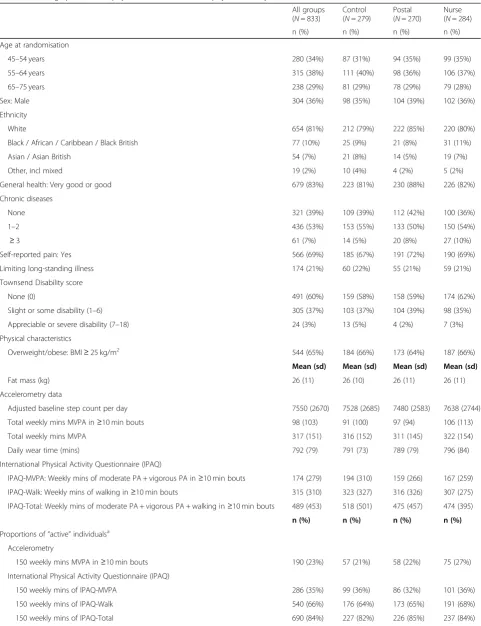
Table 1Demographic, health, physical characteristics and physical activity at baseline
All groups (N= 833)
Control (N= 279)
Postal (N= 270)
Nurse (N= 284)
n (%) n (%) n (%) n (%)
Age at randomisation
45–54 years 280 (34%) 87 (31%) 94 (35%) 99 (35%)
55–64 years 315 (38%) 111 (40%) 98 (36%) 106 (37%)
65–75 years 238 (29%) 81 (29%) 78 (29%) 79 (28%)
Sex: Male 304 (36%) 98 (35%) 104 (39%) 102 (36%)
Ethnicity
White 654 (81%) 212 (79%) 222 (85%) 220 (80%)
Black / African / Caribbean / Black British 77 (10%) 25 (9%) 21 (8%) 31 (11%)
Asian / Asian British 54 (7%) 21 (8%) 14 (5%) 19 (7%)
Other, incl mixed 19 (2%) 10 (4%) 4 (2%) 5 (2%)
General health: Very good or good 679 (83%) 223 (81%) 230 (88%) 226 (82%)
Chronic diseases
None 321 (39%) 109 (39%) 112 (42%) 100 (36%)
1–2 436 (53%) 153 (55%) 133 (50%) 150 (54%)
≥3 61 (7%) 14 (5%) 20 (8%) 27 (10%)
Self-reported pain: Yes 566 (69%) 185 (67%) 191 (72%) 190 (69%)
Limiting long-standing illness 174 (21%) 60 (22%) 55 (21%) 59 (21%)
Townsend Disability score
None (0) 491 (60%) 159 (58%) 158 (59%) 174 (62%)
Slight or some disability (1–6) 305 (37%) 103 (37%) 104 (39%) 98 (35%)
Appreciable or severe disability (7–18) 24 (3%) 13 (5%) 4 (2%) 7 (3%)
Physical characteristics
Overweight/obese: BMI≥25 kg/m2 544 (65%) 184 (66%) 173 (64%) 187 (66%)
Mean (sd) Mean (sd) Mean (sd) Mean (sd)
Fat mass (kg) 26 (11) 26 (10) 26 (11) 26 (11)
Accelerometry data
Adjusted baseline step count per day 7550 (2670) 7528 (2685) 7480 (2583) 7638 (2744)
Total weekly mins MVPA in≥10 min bouts 98 (103) 91 (100) 97 (94) 106 (113)
Total weekly mins MVPA 317 (151) 316 (152) 311 (145) 322 (154)
Daily wear time (mins) 792 (79) 791 (73) 789 (79) 796 (84)
International Physical Activity Questionnaire (IPAQ)
IPAQ-MVPA: Weekly mins of moderate PA + vigorous PA in≥10 min bouts 174 (279) 194 (310) 159 (266) 167 (259)
IPAQ-Walk: Weekly mins of walking in≥10 min bouts 315 (310) 323 (327) 316 (326) 307 (275)
IPAQ-Total: Weekly mins of moderate PA + vigorous PA + walking in≥10 min bouts 489 (453) 518 (501) 475 (457) 474 (395)
n (%) n (%) n (%) n (%)
Proportions of“active”individualsa
Accelerometry
150 weekly mins MVPA in≥10 min bouts 190 (23%) 57 (21%) 58 (22%) 75 (27%)
International Physical Activity Questionnaire (IPAQ)
150 weekly mins of IPAQ-MVPA 286 (35%) 99 (36%) 86 (32%) 101 (36%)
150 weekly mins of IPAQ-Walk 540 (66%) 176 (64%) 173 (65%) 191 (68%)
IPAQ-Total respectively. GPPAQ classified 12% of par-ticipants as active which increased to 28% when walking was included.
i) Comparison of estimated treatment effects using minutes of physical activity
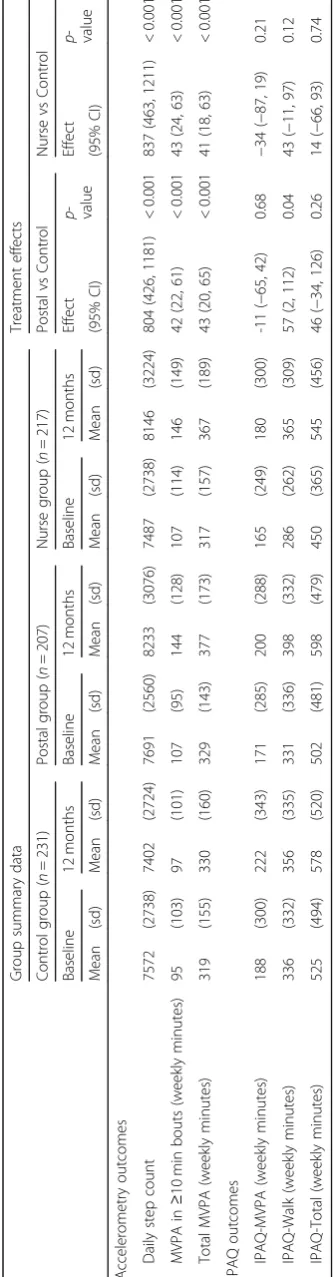
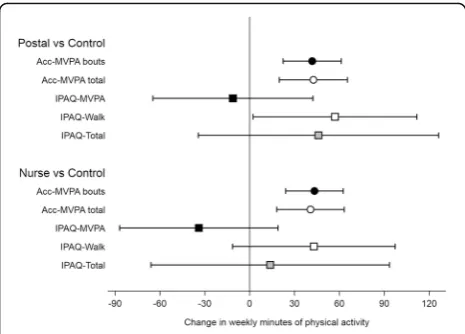
Both intervention groups showed statistically significant increases in accelerometer-MVPA, both in bouts and total, compared with controls. Increases in accelerometer-MVPA bouts: postal group 42 min/week (95% CI 22 to 61), nurse group 43 (95% CI 24 to 63) (Table 2 and Fig. 1a); increases for total accelerometry MVPA were almost identical to accelerometer-MVPA in bouts but with wider confidence intervals (Table 2 and Fig.1). Repeating the analysis using the IPAQ outcomes, IPAQ-Walk showed positive increases, similar in magni-tude to accelerometer-MVPA in the nurse group, but with wider confidence intervals indicating less precision: postal group 57 min (95% CI 2 to 112), nurse group 43 (95% CI -11 to 97). IPAQ-MVPA showed non-significant decreases and IPAQ-Total showed non-significant in-creases. The distribution of residuals from the regression models were normally distributed for MVPA in bouts [27] and IPAQ outcomes (data not shown).
ii) Comparison of estimated treatment effects using the binary variable“active”
Similar patterns were found for the binary variable “ ac-tive” for the different outcomes. Odds ratios (ORs) for being “active” at 12 months (achieving ≥150 weekly mi-nutes of MVPA in ≥10 min bouts) conditional on base-line “active” status were statistically significant for accelerometry-MVPA: postal group 3.7 (95% CI 1.8 to 7.5) and nurse group 2.9 (95% CI 1.5 to 5.7) (Table 3). IPAQ-Walk showed statistically significant OR for the postal group, 2.1 (95% CI 1.2 to 4.0) and borderline for the nurse group, 1.7 (95% CI 1.0 to 3.0). Results were conclusive for IPAQ-MVPA and IPAQ-Total had in-creased ORs for both intervention groups, but only statistically significant for the nurse group. ORs for the two GPPAQ outcomes were close to 1.0 suggesting that GPPAQ was unable to identify changes in the propor-tion classified as “active” (Table 3). Sensitivity analyses
using ≥180 min of the accelerometer and IPAQ out-comes gave similar results.
Discussion
The PACE-UP study was a walking intervention de-signed to increase individuals’ PA through a 3-month programme, in particular MVPA in≥10 min bouts in line with current UK, WHO and US PA guidelines [31–33]. We found statistically significant increases between base-line and 12 months in accelerometer measured MVPA in ≥10 min bouts for both intervention groups compared with control. IPAQ-Walk showed a significant increase in the postal group and a non-significant increase in the nurse group compared with control, but with less preci-sion than with accelerometry. IPAQ-MVPA showed non-significant decreases and IPAQ-Total non-significant increases in intervention groups compared with controls. When considering the proportion of “active” individuals, only accelerometry showed statistically significant in-creases for both intervention groups versus controls. IPAQ-Walk and IPAQ-Total showed statistically signifi-cant increases for one intervention group compared with controls (postal for IPAQ-Walk and nurse for IPAQ-Total), but borderline effects for the other interven-tion group compared with controls. Neither IPAQ-MVPA nor GPPAQ identified any change in the proportions cate-gorised as “active” in intervention versus control groups. Therefore, in terms of overall construct validity for asses-sing change in walking in a walking intervention study, accelerometry has the greatest validity, followed by IPAQ-Walk. The other measures have considerable disad-vantages: IPAQ-MVPA and GPPAQ have very poor con-struct validity; IPAQ-Total is measured with substantial imprecision and is unsuitable for assessing a walking inter-vention as it includes IPAQ-MVPA.
Our study had several strengths. It was based on a large population-based sample of adults from seven south-west London (UK) general practices (family prac-tices), predominantly classified as inactive at baseline. Accelerometry is an objective PA measure and measures walking accurately. We used standard cut-points to de-fine the different intensities of accelerometry activity and were thus able to identify those bouts of walking which can be classified as MVPA. The main PACE-UP analysis
Table 1Demographic, health, physical characteristics and physical activity at baseline(Continued)
All groups (N= 833)
Control (N= 279)
Postal (N= 270)
Nurse (N= 284)
n (%) n (%) n (%) n (%)
General Practice Physical Activity Questionnaire (GPPAQ)
GPPAQ:“Active”≥180 mins PA per week 101 (12%) 38 (14%) 33 (12%) 30 (11%)
GPPAQ-Walk:“Active”≥180 mins PA per week including walking at brisk/fast pace 229 (28%) 82 (30%) 71 (27%) 76 (27%) a
[27] showed that the increase in weekly steps in inter-vention groups relative to control group was equivalent to the increase in weekly minutes of MVPA and this was all in ≥10 min bouts, thus demonstrating the effective-ness of the PACE-UP walking intervention. The two self-completed questionnaires, IPAQ and GPPAQ, are standard questionnaires used to assess PA, and were completed for the same 7 days as for accelerometry, thus providing directly comparable estimates of effect. The study achieved 93% accelerometry follow-up at 12 months, > 90% of these with ≥5 days wear-time. Total weekly minutes of MVPA and total weekly minutes of walking (not including MVPA) were easy to extract from IPAQ and provided a direct comparison with minutes of accelerometer-MVPA. The increases in IPAQ-Walk mi-nutes are similar to those for accelerometer-MVPA sug-gesting that IPAQ can identify changes in walking minutes, although the wider confidence intervals show the loss of precision from using IPAQ. At baseline, aver-age IPAQ-Walk minutes were similar to averaver-age total
accelerometer-MVPA minutes rather than
accelerometer-MVPA in ≥10 min bouts. This is perhaps unsurprising, as the IPAQ walking questions ask for number of days walking and duration on each day, and people may find it easier to report walking minutes as a rounded number e.g. 30 or 45 min per day and which may include relative short walks of < 10 min. GPPAQ is commonly used in UK general practice to assess an indi-vidual’s PA. However, it can underestimate PA amongst those not working or those whose main PA is walking, and this study provided a further opportunity to evaluate our modified GPPAQ–Walk index [29]. We were also able to estimate how well GPPAQ could identify individ-uals moving from“not active”to“active”(assumed to be achieving PA guidelines). Finally, our method of analysis, regressing outcome at 12 months on baseline values
focusses on individual changes in activity while allowing for regression to the mean. Cross-sectionally, the distri-butions of accelerometer-MVPA and IPAQ measures are highly skewed leading many to present medians and interquartile ranges of activity at different time points. However, change in activity is usually symmetric and reasonably normally distributed, which our approach ex-ploits. We were thus able to present mean changes in activity and associated confidence intervals for both accelerometry and questionnaire measures, thus allow-ing for a more informative comparison.
The study also had some important limitations. All of the PA measures (accelerometry, IPAQ and GPPAQ) only measured PA levels for 7 days and it may be that participants were more likely to be active or report being active in the week that their PA was being assessed, ra-ther than at ora-ther times. However, any such tendency would potentially affect all of the PA measures and would be true for control participants as well as for those in the intervention group. IPAQ is difficult to complete and thus unreliable if an individual’s PA varies by day across the week. Although we had high return rates at baseline and 12 months for the IPAQ and GPPAQ, 97% and 92% respectively, each IPAQ outcome at baseline and 12 months had 20–25% missing or in-complete answers. Participants’comments on the ques-tionnaires described their confusion over how to interpret and answer the questions and many questions were left blank. This reduced our sample size to 655 for comparisons with accelerometry although this is still large compared with other studies [21–23]. The propor-tions of missing data were similar across the three groups, but those with missing IPAQ data had lower mean accelerometry-MVPA at baseline and 12 months than those with complete data. The accelerometry effect sizes reported here (42–43 min) are also larger than for the full cohort (33–35 min) [27]. The limited options on GPPAQ for duration of PA, led to using ≥3 h (180 min) for GPPAQ“active” whereas the PA guidelines are≥150 min. However, ORs from sensitivity analyses using≥180 min for accelerometry and IPAQ outcomes were similar to those using ≥150 min. Although neither of our
methods of measuring PA are considered a
gold-standard, accelerometry has the advantage of pro-viding an objective time-stamped record of PA that does not rely on recall. It has been validated as a measure of activity energy expenditure using doubly labelled water [15] and we used standard cut-points in counts per mi-nute to define MVPA. [16] Our findings that accelerometer-MVPA and IPAQ-Walk provide similar estimates of change clearly support results from the PACE-UP intervention which is aimed at increasing walking, but it is unknown if these findings would be generalisable to other PA interventions.
Participants in the postal and nurse intervention groups were encouraged to increase their MVPA through walking and the nurse group in particular were taught to recognise and classify different PA intensities – vigorous, moderate, light, and sedentary. Thus they may have been more likely to accurately report their PA on IPAQ at follow-up i.e. with less over-estimation of their PA levels, which could explain the non-significant decreases in the treatment groups for IPAQ-MVPA from the modelling.
Comparison with other studies
Our baseline data agree with other studies that individ-uals tend to over-estimate their PA on self-report ques-tionnaires compared with objective accelerometry, both time spent being physically active [6] and proportions achieving PA guidelines [7]. Studies which have found better correspondence between IPAQ and accelerometry cross-sectionally [34] have used total accelerometer MVPA rather than MVPA in≥10 min bouts and a simi-lar pattern is seen in our data where baseline total accelerometer-MVPA minutes are similar to IPAQ-Walk minutes. However, IPAQ questions ask about vigorous and moderate PA in≥10 min bouts and UK, WHO and US PA guidelines are based on ≥150 min of MVPA per week in≥10 min bouts. In our trial, whilst total accelero-metry MVPA was much higher than acceleroaccelero-metry MVPA in≥10 min bouts, changes in both measures were almost identical.
To our knowledge, this is the largest population-based trial to make direct comparisons of accelerometry and self-report questionnaires to assess an individual’s change in minutes of PA after an intervention. There are limita-tions with all five studies we identified [21–25] which have attempted to compare longitudinal changes in PA mea-sured using IPAQ compared with objective measures. Three studies recruited less than 100 subjects [21–23]. One study was observational [21], one had no control group [22] and one was a weight loss intervention rather than PA intervention [24]. One study was comparing IPAQ with pedometer steps [23] and another with acceler-ometer counts [25] making direct comparison of minutes of physical activity between IPAQ and accelerometry diffi-cult. Whilst our study compares measures using different constructs, we were able to compare time spent in MVPA and time spent walking, both in minutes per week. Three studies present distribution of PA measures at baseline and follow-up, but provided no estimate of the distribu-tion of change [21, 24, 25]. Our findings do agree with two of the small studies. Nicaise et al. [22] followed up one group of women, but with no control group, and found median changes in IPAQ Walking minutes were similar to median changes in accelerometer MVPA mi-nutes. Baker et al. [23] compared IPAQ PA minutes with
pedometer steps, and argue that the increase in step counts in the intervention group was comparable to the increase in leisure time walking reported on IPAQ, al-though they report mean differences for pedometer steps and median differences for IPAQ data.
GPPAQ is used in UK primary care to help identify those not achieving PA guidelines during UK NHS Health Checks [12]. GPPAQ guidance recommends re-peating it annually on those at increased cardiovascular risk [11], but our study suggests that it is poor at identi-fying those individuals who have increased their PA to current guideline levels. In addition, the binary nature of this outcome fails to recognise modest, but important, increases in PA made by inactive individuals. We have also confirmed our previous findings [29] that, com-pared with objective accelerometry, GPPAQ underesti-mates the proportion of “active” individuals and our modified index GPPAQ-Walk classifies slightly more as “active”.
Conclusions
We have demonstrated that neither GPPAQ nor IPAQ-MVPA provide a valid estimate of change in a walking intervention trial compared with accelerometry measures. Moreover, we have shown that although IPAQ-Walk produces an estimate of change comparable with that from accelerometry MVPA in ≥10 min bouts, the IPAQ-Walk estimate had considerably less precision. Missing data were also an issue with the self-report IPAQ. This has implications for future trials. Studies may need to use IPAQ to assess changes in walking if they are not able to use accelerometry. If this is the case, they should focus particularly on the walking questions and will need to be larger to be adequately powered, al-though they will still lack information on intensity of any changes that occur. In conclusion, accelerometry is preferred to self-report measures in assessing the effects of a walking intervention, as it avoids recall bias and im-proves precision.
Abbreviations
95% CI:95% Confidence Interval; GPPAQ: General Practice Physical Activity Questionnaire; IPAQ: International Physical Activity Questionnaire; MVPA: Moderate-to-vigorous physical activity; NHS: UK National Health Service; OR: Odds ratio; PA: Physical activity; sd: Standard deviation
Acknowledgements
We would like to thank the South-West London (UK) general practices, their practice nurses who supported this study, and all the patients from these practices who participated: Upper Tooting Road Practice, Tooting; Chatfield Practice, Battersea; Wrythe Green Practice, Carshalton; Francis Grove Practice, Wimbledon; Putneymead Practice Putney; Heathfield Practice Putney; and Cricket Green Practice, Mitcham.
Funding
Technology Assessment (DOIhttps://doi.org/10.3310/hta22370). The funders had no role in study design (beyond the commissioned call outline), data collection and analysis, decision to publish, or preparation of the manuscript.
Availability of data and materials
There are restrictions on the availability of the data for this study due to the signed consent agreements around data security, which only allow access to external researchers for research monitoring purposes. Requestors wishing to access the data for the purposes of replicating or checking analyses can
apply to Research Data Management at St George’s University of London
Disclaimer
The views and opinions expressed therein are those of the authors and do not necessarily reflect those of the Health Technology Assessment (HTA) Programme, National Institute for Health Research (NIHR) National Health Service, or the Department of Health.
The results of the study are presented clearly, honestly and without fabrication, falsification or inappropriate data manipulation.
Authors’contributions
TH, DGC, ESL and SA conceived the idea for the paper. TH, DGC, SMK, CRV, PHW, MU, SI, UE and JFR were trial investigators and designed and were awarded funding for the trial. TH was trial Principal Investigator and had overall responsibility for the execution of the project. JI and SDW recruited general practices to the trial. CF was trial manager and oversaw data collection for the trial. ESL and DGC designed the analyses and ESL conducted the analyses for this paper. The manuscript was prepared by TH, ESL and DGC with input from all of the other authors. All of the author team reviewed and approved the manuscript prior to submission.
Ethics approval and consent to participate
Ethics approvals were obtained from NRES Committee London–Hampstead
REC reference: 12/LO/0219. Written consent was obtained from all participants.
Consent for publication
Not applicable.
Competing interests
The authors declare that they have no competing interests.
Publisher’s Note
Springer Nature remains neutral with regard to jurisdictional claims in published maps and institutional affiliations.
Author details
1Population Health Research Institute, St George’s University of London, Cranmer Terrace, Tooting, London SW17 ORE, UK.2Pragmatic Clinical Trials Unit, Queen Mary’s University of London, London E1 2AT, UK.3Department of Sport Medicine, Norwegian School of Sport Sciences, PO Box 4014, 0806 Oslo, Norway.4Gerontology and Health Services Research Unit, Brunel University, London UB8 3PH, UK.5Research Department of Primary Care & Population Health, University College, London NW3 2PF, UK.6Present address: Department of Population Health Sciences, King’s College London, London SE1 1UL, UK.
Received: 27 March 2018 Accepted: 6 December 2018
References
1. Lee IM, Shiroma EJ, Lobelo F, Puska P, et al. Effect of physical inactivity on
major non-communicable diseases worldwide: an analysis of burden of
disease and life expectancy. Lancet. 2012;380(9838):219–29.
2. Morris JN, Hardman AE. Walking to health. Sports Med. 1997;23(5):306–32.
3. Tudor-Locke C, Craig CL, Brown WJ, Clemes SA, et al. How many steps/day
are enough? For adults. Int J Behav Nutr Phys Act. 2011;8:79.
4. The Health and Social Care Information Centre, Health survey for England
2016. 2017.
5. Sport England. Active lives survey 2015-16. UK; 2017. Available fromwww.
sportengland.org/media/11498/active-lives-survey-yr-1-report.pdf. Accessed 10 Aug 2017.
6. Lee PH, Macfarlane DJ, Lam TH, Stewart SM. Validity of the international
physical activity questionnaire short form (IPAQ-SF): a systematic review. Int J Behav Nutr Phys Act. 2011;8:115.
7. Troiano RP, Berrigan D, Dodd KW, Masse LC, et al. Physical activity in the United
States measured by accelerometer. Med Sci Sports Exerc. 2008;40(1):181–8.
8. The Health and Social Care Information Centre, Health survey for England
2008. 2009.
9. Harris TJ, Owen CG, Victor CR, Adams R, et al. A comparison of
questionnaire, accelerometer, and pedometer: measures in older people.
Med Sci Sports Exerc. 2009;41(7):1392–402.
10. The IPAQ group. International physical activity questionnaire. Available from:
https://sites.google.com/site/theipaq/home. Accessed: 21 Jan 2014.
11. Department of Health, General practice physical activity questionnaire
(GPPAQ). 2013.
12. NHS. NHS Health Check. [Accessed: 13 Oct 2017]; Available from:http://
www.healthcheck.nhs.uk/.
13. Sardinha LB, Magalhaes JP, Santos DA, Judice PB. Sedentary patterns,
physical activity, and cardiorespiratory fitness in association to glycemic control in type 2 diabetes patients. Front Physiol. 2017;8:262.
14. Chudyk AM, McKay HA, Winters M, Sims-Gould J, et al. Neighborhood
walkability, physical activity, and walking for transportation: a cross-sectional study of older adults living on low income. BMC Geriatr. 2017;17(1):82.
15. Plasqui G, Westerterp KR. Physical activity assessment with accelerometers:
an evaluation against doubly labeled water. Obesity (Silver Spring). 2007;
15(10):2371–9.
16. Freedson PS, Melanson E, Sirard J. Calibration of the computer science and
applications, Inc. accelerometer. Med Sci Sports Exerc. 1998;30(5):777–81.
17. Fassier P, Zelek L, Partula V, Srour B, et al. Variations of physical activity and
sedentary behavior between before and after cancer diagnosis: results from the prospective population-based NutriNet-Sante cohort. Medicine (Baltimore). 2016;95(40):e4629.
18. Barr-Anderson DJ, Flynn JI, Dowda M, Taverno Ross SE, et al. The modifying
effects of race/ethnicity and socioeconomic status on the change in physical activity from elementary to middle school. J Adolesc Health. 2017;
61(5):562–70.
19. Demeyer H, Louvaris Z, Frei A, Rabinovich RA, et al. Physical activity is
increased by a 12-week semiautomated telecoaching programme in patients with COPD: a multicentre randomised controlled trial. Thorax. 2017;
72(5):415–23.
20. Ekelund U, Kolle E, Steene-Johannessen J, Dalene KE, et al. Objectively
measured sedentary time and physical activity and associations with body weight gain: does body weight determine a decline in moderate and
vigorous intensity physical activity? Int J Obes. 2017;41(12):1769–74.
21. Horne D, Kehler DS, Kaoukis G, Hiebert B, et al. Impact of physical activity
on depression after cardiac surgery. Can J Cardiol. 2013;29(12):1649–56.
22. Nicaise V, Crespo NC, Marshall S. Agreement between the IPAQ and
accelerometer for detecting intervention-related changes in physical activity
in a sample of Latina women. J Phys Act Health. 2014;11(4):846–52.
23. Baker G, Gray SR, Wright A, Fitzsimons C, et al. The effect of a
pedometer-based community walking intervention“walking for wellbeing in the west”
on physical activity levels and health outcomes: a 12-week randomized controlled trial. Int J Behav Nutr Phys Act. 2010;7:51.
24. Fuller NR, Williams K, Shrestha R, Ahern AL, et al. Changes in physical
activity during a weight loss intervention and follow-up: a randomized
controlled trial. Clin Obes. 2014;4(3):127–35.
25. Opdenacker J, Boen F, Vanden Auweele Y, De Bourdeaudhuij I. Effectiveness
of a lifestyle physical activity intervention in a women's organization. J
Women’s Health (Larchmt). 2008;17(3):413–21.
26. Harris T, Kerry SM, Victor CR, Shah SM, et al. PACE-UP (pedometer and
consultation evaluation--UP)--a pedometer-based walking intervention with and without practice nurse support in primary care patients aged 45-75 years: study protocol for a randomised controlled trial. Trials. 2013;14:418.
27. Harris T, Kerry SM, Limb ES, Victor CR, et al. Effect of a primary care walking
intervention with and without nurse support on physical activity levels in 45- to 75-year-olds: The pedometer and consultation evaluation (PACE-UP) cluster randomised clinical trial. PLoS Med. 2017;14(1):e1002210.
28. The IPAQ group. Guidelines for data processing and analysis of the
[Accessed: 15 Oct 2015]; Available from:https://sites.google.com/site/ theipaq/scoring-protocol.
29. Ahmad S, Harris T, Limb E, Kerry S, et al. Evaluation of reliability and validity
of the general practice physical activity questionnaire (GPPAQ) in 60-74 year old primary care patients. BMC Fam Pract. 2015;16:113.
30. StataCorp. Stata Statistical Software: Release 14: StataCorp LLC; 2015.http://
www.stata.com/
31. Department of Health, Start active, stay active: a report on physical activity
for health from the four home countries’chief medical officers. 2011,
https://www.gov.uk/government/uploads/system/uploads/attachment_ data/file/216370/dh_128210.pdf.
32. World Health Organisation. Global Recommendations on Physical Activity
for Health. Geneva: World Health Organisation; 2010. p. 58.
33. US Department of Health and Human Services. 2008 Physical activity
guidelines for Americans. Washington: Office of Disease Prevention and Health Promotion; 2008. p. 76.
34. Ekelund U, Sepp H, Brage S, Becker W, et al. Criterion-related validity of the
last 7-day, short form of the international physical activity questionnaire in