121
Volume-4, Issue-1, February-2014,ISSN No.: 2250-0758 International Journal of Engineering and Management Research
Available at:
Page Number: 121-127
Secured Efficiency Decryption Based on Random bits (Rbits)
P.Penchalaiah1, K. Ramesh Reddy2
1
Research Scholar, Department Of Computer Science, V.S University, Nellore, A.P, INDIA
2
Senior Scale Assistant Professor, Department Of Computer Science, V.S University, Nellore, A.P, INDIA
ABSTRACT
This paper aimed on strengthening secured communication by introducing a new cipher Rbits (Random bits). Rbits cipher uses two algorithms, a Key
Exchanging Algorithm and a Random Bit Generation algorithm.
In brief the Rbits cipher is more complex in nature of attackers view. This algorithm generates random bits at the both ends these random bits are used to encrypt and decrypt, these random bits are not carried along with message, only the seed is exchanged which used to generate random bits at both ends. By this way Rbits minimizes the unbearable communication overheads to zero. Here we are presenting the encryption/decryption process and inner workings of Rbits Cipher, which was not covered in my early papers. For implementation of this cipher we are used RSA, BBS algorithms, (RSA as Key Exchanging and BBS as Random bits) and computer programming language Java.
Keywords: Cryptography, Rbits Cipher [1], One-Time Pad, Key Exchange, Random Bits, RSA, BBS, Encryption, Decryption
We can only talk about OTP if four important rules are
followed. If these rules are applied correctly, the one-time
pad can be proven to be unbreakable.
I. INTRODUCTION
One well-known realization of perfect secrecy is
One-Time Pad (OTP). Here we aimed on strengthening
secured communication by introducing a new cipher Rbits
(Random bits) and here we are presenting the development
of One-Time Pad encryption with optimal communication
overheads while transmission of message from/to
source/destination..
The Four Rules are...
Rule 1: The key is as long as the plaintext.
[11]
Rule 2: The key is truly random
Rule 3: There should only be two copies of the key:
one for the sender and one for the receiver
Rule 4: The keys are used only once, and both
sender and receiver must destroy their key after
use.
Fig1 shows unbearable Key overheads. (In One hand Message and other hand Key of same length)
Requirements for new Cipher
The services of OTP is limited to short message
only, since of its key size.
The major drawback of OTP to apply on lengthy
message is Rule 1, which says, “The key is as long
as the plaintext”, one of the four rules listed above.
122 The Rule 1 causes unbearable communication
overheads while transmission of message from/to
sender/receiver.
A. Rbits Cipher
Rbits Cipher makes OTP free from Rule 1 by using a Key
Exchanging Algorithm (KE) and a Random Bit Generation
algorithm (RG) and follows all four rules that are listed
above.
In Rbits Cipher Random bits are generated at the both ends,
but not carried along with message unlike legacy One Time
Pad (OTP), which avoids transmission overheads. Seed ‘S’
is only transmitted instead of long key (random bits). This
feature frees up the communication parties from carrying
large key along with the cipher text and causes a reduced
traffic in the channel.
B. Design Parameters of Rbits Cipher
Block size: Larger block sizes mean greater security. But
reduced encryption/decryption speed is Indirect proportional
to Block size. Block size of 64 bits has been considered a
reasonable trade-off and was nearly universal in block
cipher design
Key size: Larger key size means greater security but may
decrease encryption/decryption speed. Greater resistance to
brute-force attacks and greater confusion achieves the
greater security. Key sizes of 64 bits or less are now widely
considered being inadequate and 128 bits has become a
common size.
Complexity: As the Random bits are unique for each chunk
the generated cipher stream contains no statically
relationship with the plain text. So Rbits Cipher does not
have an easily analyzed functionality, which makes more
difficult to cryptanalysis.
Speed: There are no heavy computational requirements to
encrypt/decrypt (like RSA, DES, and AES where major part
of the algorithms are involved in generation of ‘n’ keys for
‘n’ rounds and requires heavy exponential computations
which reduces the performance by consuming more time)
Ease of analysis: The entire strength of this Rbits cipher
depends up on the KE and RG.
A. Key Exchanging Algorithm (KE)
II. REQUIREMENTS OF Rbits
Rbits Cipher has two basic selection requirements for its implementation.
1. Key Exchanging Algorithm (KE) and
2. Random Bits Generation Algorithm. (RG)
[1]
Alice/Bob can use any Key Exchanging Algorithm (KE)
(like RSA, Diffie-Hellman, etc) to send the seed “S” to
Bob/Alice.
B. Random Bits Generation Algorithm (RG) [1]
Alice/Bob selects Random seed “S” which will be used for
Random Bits Generation. The Random Bit Generation (RG)
algorithm must be such way that it must generate same
sequence of random bits for the same seed “S”. Both Alice
and Bob must follow same RG.
123 Alice (Sender) End
Pa -Plaintext
Ba -Binary Stream of P
Sa -large Random Seed
KEa -Key Exchanging algorithm
RGa -Random Bit Generation algorithm
Rbitsa -Random Bits generated using RGa
Bob (Receiver) End
KEb -Key Exchanging algorithm (=KEa)
Sb - Large Random Seed Received from Alice
(=Sa)
RGb -Random Bit Generation algorithm (=RGa)
Encryption
C= E (Ba, Rbitsa)
Decryption
P= D (C, Rbitsb)
C. Rbits Algorithm
Let us assume Alice trying to initialize the communication
with bob. Alice first selects a Random Key or Seed ‘S’, and
exchanges the “S” with bob using RSA.
D. Encryption
Once the seed “S” has exchanged, Alice initiates encryption
process.
Encryption Algorithm:
Step 1: Alice converts plain text in to binary stream.
Step 2: The binary stream is divided in to fixed size of chunks for effective system performance.
Step 3: A chunk of binary stream is XOR with the same length of Random Bits, generated using seed
“S” with a RG.
Step 4: Step 3 is continued until last chunk.
Detailed explanation can be found in earlier paper [1].
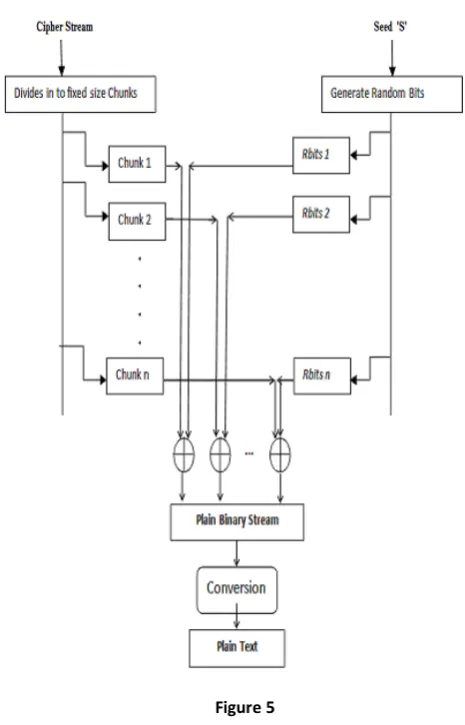
E. Decryption
As Bob aware of the Random bit generation seed “S’, Bob is
also able to generate same random bits. Bob decrypts’ each
chunk of stream by XOR operation with the random bits by
using the same seed “S’” and same RG algorithm. Bob
continues until the last chunk of cipher stream. Once all
chunks are decrypted the resultant binary stream again
converted to plain text, which is in readable format.
Once the Bob receives cipher text “C”, Bob initiates
decryption process.
Decryption Algorithm:
Step 1: Bob divides the cipher stream into fixed size of chunks.
Step 2: Generates random bits using seed “S” with RG.
Step 3: Each cipher stream chunk is XOR by the random bits.
Step 4: Steps 2 and 3 are continued until last chunk.
Step 5: Bob converts binary stream into plain text.
Decryption of ith chunk
As described above, the implementation of Rbits
Cipher starts with by selecting KE and RG. We used java1.6
for the following implementation.
III. IMPLEMENTATION
Encryption C= E (Ba, Rbitsa)
Decryption P= D (chunki , Rbitsb)
RGi
S
Decryptio n Process
C Ch Pi
124 Selection of KE and RG
In my previous paper[1] we described Rbits Cipher
Encryption process, by selecting RSA as KE and BBS as
RG. So for better understanding in this paper we are going
to use same KE and RG, RSA as KE and BBS as RG.
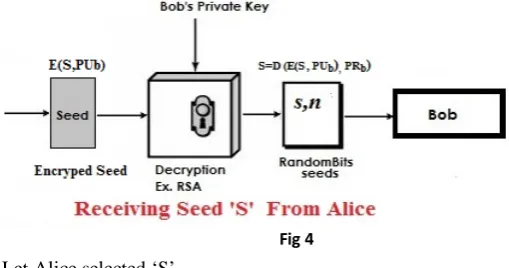
Receiving BBS Seed set S={s, n}
Alice selects seeds ‘S” for BBS random bit generation, i.e.
S={s, n}.
Let Alice selected ‘S’.
Prior to exchanging of seed ‘S’ both Alice and Bob
generates their own pair of keys.
Alice Keys= {PUa, PRa}
Bob Keys= {PUb, PRb
Alice and Bob follow RSA encryption/Decryption process.
Alice encrypts the seed set ‘S’ by accessing Bob’s public
key from Alice and sends the resultant key to Bob. Bob
decrypts the encrypted seed set ‘S” by his private key PR }
b
and retains it with him for BBS random bit generation.
Where
D- RSA Decryption Process E- RSA Encryption Process
S-
Seed set {s, n}
Now Both Alice and Bob having the seed set S={s, n}.
Decryption
Bob applies decryption process on cipher stream ‘C’
received from Alice.
The cipher stream ‘C’ undergoes to sizing process[1]. Block
size of 64 bits has been considered a reasonable.
The sizing process for decryption is just reverse process of encryption sizing.
Bob divides the cipher stream “C” into L fixed size of
chunks (Chunk1, Chunk 2, Chunk 3…Chunk i. …Chunk n
).
C= {Chunk1, Chunk 2, Chunk 3…Chunk i. …Chunk n}
Chunk #
.
Stream Chunk# Stream
Chunk1 10100000 Chunk2 10001010 Chunk3 10011100 Chunk4 10000110 Chunk5 10010000 Chunk6 10000010 Chunk7 10011000 Chunk8 10000010 Chunk9 10010010 Chunk10 10000010 Chunk11 1001000
Table 1 List of chunks After sizing S=D (E(S, PUb
)
, PRb)
125
The following example shows the sizing process, here ‘C’
cipher stream, which was produced in Rbits encryption
process.
C=”101000001000101010011100100001101001000010000
010100110001000001010010010100000101001000”.
Rbits cipher produced the above chunks and statistics (Table
1 and Table 2) using java.
In the example ‘C’ has the length of 87bits. So C will be
sized in to ‘10’ chunks (Table 1) and each chunk has 8bits
(as Bz=8).‘C’ is not a multiple of ‘8’, so it has br having 7
bits (table 2 chunk11).
By using BBS, random bits are generated
Rbits
i
, as samelength of a chunk in question.
Decryption function can be any decryption technique. For
Simplicity, here we are using XOR operation as decryption
function since encryption process followed XOR
operation[1].
Note : All Rbitsi(S)) are unique in nature. Rbits Cipher -Decryption Run Log.
We used Java 1.6 to develop Rbits cipher Decryption
algorithm. Machine implementation of Rbits Cipher
Decryption produced the following log during its execution
under windows 2007 Operating System, Duel core
processor.
---LOG START---
BOB Is Ready....
Press Any Key To Receive BBS SEEDS.... STREAM SIZE Init..128
BOB :Accessing BBS SEEDS.
BOB :BBS SEEDS Decryption Started. BOB :BBS S-SEEDS Decryption Started.
Accessing S....
968774809821647066226630283047342517226630283 047342517514336968403885357450534509827223159 021403940076536623685226630283047342517514336 968403885357422663028304734251722663028304734 2517
BOB :BBS S-SEEDS Decryption Done. BOB :BBS N-SEEDS Decryption Started.
Accessing n....
50534509827223159025143369684038853574232922257313
54497761403940076536623685505345098272231590243556 48873290978884968774809821647066114655404381869617
41403940076536623685140394007653662368596118504573 25430501146554043818696174140394007653662368550534 50982722315902232922257313544977651433696840388535
74435564887329097888413215923209859021051433696840 388535745053450982722315902
BOB :BBS N-SEEDS Decryption Done. BOB :Sending Request to BBS...
Figure 6
126
The Value Of BBS N is 13401928005801439631
The Value Of BBS S is 2773107377
BOB :Accessing Cipher Stream Init.. Receiving Cipher Text....
BOB: Cipher Stream Received..
00101110010111010001111010100111110011011101010010 10011100011101101101110010110101111101100001110011 11110010101001100110001011010001010001010001100101 00111010111101011101011110011101010111110100101001 01110111111001011100100100101111001110101111101000 10110100001100011111010011010010011011110110010101 11001111111100011101101101110010111101011111011000 1110111101100101101100001000101101000001000001011
BOB :Rbits Cipher Decryption Started.. BOB :Generating Random Bits...
10000110100011011101010001000011000001111001010000 11010111111011111101111010111100111101000000111110 00011111000010100010011011011000011010001101110101 00010000110000011110010100001101011111101111110111 10101111001111010000001111100001111100001010001001 10110110000110100011011101010001000011000001111001 01000011010111111011111101111010111100111101000000 11111000011111000010100010011011011000011010001101 11010100010000110000011110010100001101011111101111 11011110101111001111010000001111100001111100001010 001001101101
BOB :Rbits Cipher Decrypted Bin Stream
10101000110100001100101001000000100100101110011001 00000011000010010000001000010011011110110001001101 10100100000010010010110111000100000011101000110100 00110010100100000010000110110111101101100011011000 11001010110011101100101001011100010000001000101011 11000011100000110110001101111011001000110010101110 01100100000010000000011000100110000001011100011001 100110000001000000100000101001101
BOB :Rbits Cipher Decryption Finished.. BOB :Plain Text
There Is A Bomb In The College, Explodes @10.30 AM
---LOG END---
This is in continuation to my earlier paper
IV.
CONCLUSION
[1] ,
Here we come to the point that Rbits Cipher scheme is very
strong and secure and is more simple for user point of view
but very difficult for attacker point of view. Here we are
following four rules of OTP[11], if these rules are applied
correctly, the one-time pad can be proven to be unbreakable.
There are no heavy computational requirements to
encrypt/decrypt, which reduces the performance by
consuming more time. The entire strength of this Rbits
cipher depends up on the selection of KE and RG.
In my earlier and current papers we presented how
Rbits cipher encrypts and decrypts the given messages and
the way Rbits cipher minimizes the unbearable
communication overheads to zero. In my forth coming
papers I am going to present the performance analysis of
Rbits cipher by comparing with well known and
predominant ciphers like RSA, DES, AES etc. on the factors
Running Time, speed, Accuracy, complexity, resource
utilization, cryptanalysis, brut force attacks, etc.
.
V.
FUTURE PAPERS
REFERENCES
[1]. P.Penchalaiah , K. Ramesh Reddy “Efficient and
Secure Encryption Schema based on Random bits
(Rbits)” International Journal of Advanced Research
in Computer Science and Software Engineering”
Volume 3, Issue 10, October 2013 PP. 1026-1032.
[2]. Sharad Patil Ajay Kumar “Implemented Encryption
Scheme (One Time Pad ) using 9’S Complement”
International Journal of Advanced Research in
Computer Science Volume 1, No. 2, July-August
2010 PP 48-50
[3]. Md. Mizanur Rahman “Any File Encryption by
Translating ASCII Value of Characters”
International Journal of Advanced Research in
Computer Science Volume 3, No. 2, March-April
2012 PP 41-43
[4]. Dr. S. Udaya Kumar , Ravindra Babu Kallam “An
Enhanced RSA Public key Cryptographic
Algorithm” International Journal of Advanced
Research in Computer Science Volume 2, No. 5,
Sept-Oct 2011 PP 497-499
[5]. Information Technology Journal 4(3): 204-221,
2005
[6]. Neal R. Wagner “The Laws of Cryptography:
127
[7]. Avanish Kumar Singh, Amit Kumar Pathak
“Encryption Techniques as Security Tools: A
Technical Review” International Journal of
Advanced Research in Computer Science Volume 3,
No. 7, Nov-Dec 2012 PP 269-2073
[8]. Ayushi, (2010), A Symmetric Key Cryptographic
Algorithm, International Journal of Computer
Applications (0975 - 8887) Volume 1. No. 15.
[9]. Bruce Schneier, “Beyond Fear”, Springer-Verlag,
New York, 2006
[10].Saikat Ghosh Sukalyan Som A Survey of
Traditional or Character Oriented Symmetric Key
Cryptography Volume 2, No. 4, July-August 2011
International Journal of Advanced Research in
Computer Science PP 147-151
[11].Claude Shannon's “Communication Theory of
Secrecy Systems