ASSAMESE TRANSLATION SYSTEM
Shayanika Hazarika, Poonam Suryawanshi, Nikita Shinde
Prof. Monika Dangore
Department Of Computer Engineering, Dr. D. Y. Patil School Of Engineering,
Pune, India
Abstract: Automatic Speech Recognition is the method in which speech signals are translated into the related sequence of characters into text (word). The research on speech recognition has been done for many years ago. After a lot of research work we got the idea of RNN (Recurrent Neural Network) algorithm is more effective and helpful algorithm for speech recognition. The Recurrent Neural Network is the type of Neural Network techniques in which we observe the difference of alphabet. The application or purpose of the RNN is to make people comfortable for the use of Hindi, English and Assamese languages. With the help of this research, people can easily understand languages and get its insight. Languages pose different challenges for speech recognition. This paper discusses about the use of RNN and Statistical Machine Translation algorithms that can be used for translation systems.
Keywords: Recurrent Neural Network, Language Model, Translation Model, Statistical Machine
Learning.
1. INTRODUCTION
Speech-to-speech translator systems are developed over the decades, the main motive is to
bridge the gap between communication for people who speaks their native language.
Suchsystem has been broken in such a way that the Recurrent neural network to hide the
background processing i.e. the hidden layer, statistical machine translation method Like
deep learning for speech translation. The text-to-text as well as speech-to-speech synthesis
for the translation of such language is implemented in our system. Here the Direct Speech to
speech translation of the Hindi to Assamese is accomplished. This system which maintains
the sequence or the flow to translate the sentence from Hindi Language to Assamese Journal homepage: www.mjret.in
Language. Here we have used the the Assamese dialects for the translation purpose. This
system is depend on the RNN where the output of the previous process is given to the next
process as a input for further processing. This system does processing by first training the
model and then predicting the output of the given test dataset. The speech model can wait
for 14 sec time span to record your voice, until and unless you speak the further output
cannot be predicted. The voice or the speech which needs to be translated should be clear,
with such accurate input the output you get will be accurate.
2. MOTIVATION
Human beings are able to communicate with each other and it is the most fundamental part.
Worldwide there are around 7000 different languages. As the world is getting connected,
language translation helps in bridging different cultures and economy between people from
different countries and groups.
The motivation behind taking up this project is that different Indian languages have Google
translators as well as Microsoft translators but languages like Assamese , Konkani etc. are
resource scarce language they do not have APIs available for translation. Therefore we tried
developing an application as well as web based translator for Hindi to Assamese as well as
English to Assamese text as well as Speech translator.
3. EXISTING SYSTEM
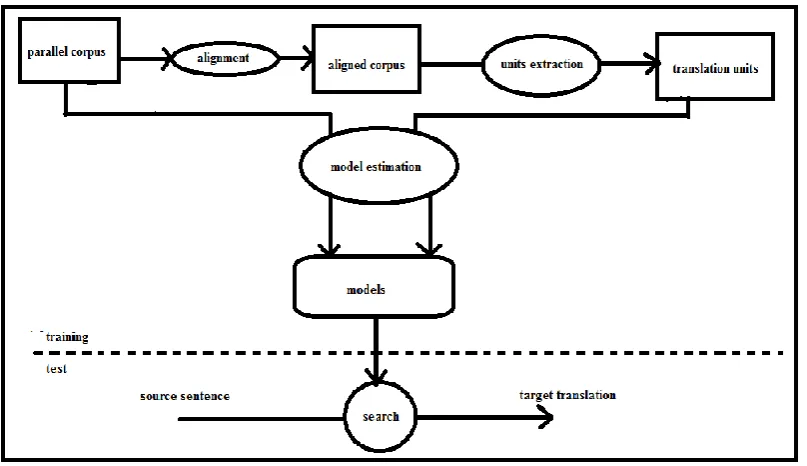
Statistical Machine Translation : Machine translation investigates how to automatically
translate text or speech across normally human languages. Machine translation can use a
method based on dictionary entries, which means that the words will be translated as a
dictionary does – word by word, usually without much correlated of meaning between them.
In this paper we are going to discuss about dictionary based machine translation. Dictionary
based machine translation is basically suitable for the translation of long phrases but not for
sentences level. Statistical machine translation probabilistic models P(T|S) estimated from
parallel corpora.
Parallel Corpora: Parallel corpora are collections of texts available in two languages.
Alignment levels: documents, sentences, words
Alignment:Parallel corpora typically aligned at sentence level. But in order to extract pairs of
Fig 1. Statistical Machine Translation
4. PROPOSED SYSTEM
To translate a corpus of English text to Assamese, we need to build a recurrent neural
network (RNN).
Recurrent Neural Network:
I
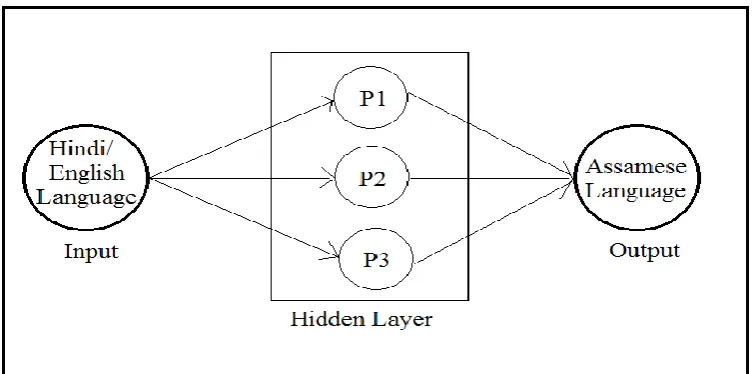
n the Neural Networks, the Out of the First process is given asas Input to next process is known to be Recurrent Neural Network. In the standard
processing of neural network, the all processes which are executing are independent of each
other. In some scenario, the next processing requires the output for the previous process for
prediction, so the previous word needed so the system has to remember the previous
processing output. For such issues the RNN is discovered. The RNN solves this type of
issues Which has the middle layer which is Hidden Layer. Here the Hidden layer needs
information of a sequence. The RNN has a memory, it stores all the information for all the
previous calculation. The same parameter is used in all processing’s or the Middle layer
which is hidden to produce output. The RNN specially reduces the tension for the
Fig 2. Recurrent Neural Network
The Main Advantage of the RNN , It Remember all the information for every step to step
prediction . This feature is unique for RNN. It is a Long Short Term Memory.
Hardware Requirements:
System: Pentium IV 2.4 GHz.
Hard Disk :1 TB.
Ram: 4GB (min).
Software Requirements:
Operating system :
Windows XP/7.
Coding Language: JAVA, Python.
IDE : Spyder, AndroidStudio.
Front End:
JSP, CSS etc.
5. ADVANTAGES
Business: international trade, investment, contracts, finance
Commerce: travel, purchase of foreign goods and services, customer support
Media: accessing information via search, sharing information via social networks, localization
of content and advertising
Education: sharing of ideas, collaboration, translation of research papers
6. CONCLUSION
The travellers can use this model to communicate with the local people. This will reduce the
burden of learning new language and will make communication easier. This model translates
English as well as Hindi text and speech to Assamese text as well as speech. This model is
built using RNN(Recurrent Neural Network) with LSTM(Long Short Term Memory).
7. FUTURE SCOPE
This System is used by the people who are travelling to Assam for different purposes, and
who are travelling from Assam to all over the India. In future The same type of application
will be developed for different resource scarce languages. In Hindi language there is
Ambiguity issue, example: Main Hu Aam Aadmi (मैं ह ूं आम आदमी'). The meaning of “Aam” is
Common and the other meaning of “Aam” is mango, so these types of Ambiguity can be
solved in future development of such models.
ACKNOWLEGEMENT
It gives us great pleasure in presenting the paper on “Assamese Translation System”. We
would like to take this opportunity to thank our guide Prof. Monika Dangore and Dr. Pankaj
Agarkar(HOD Computer, DYPSOE) for giving us all the help and guidance we need with
indispensable support, suggestions and motivation during the course of the Project. We are
really grateful to him. His valuable suggestions were insightful.
REFERENCES
[1]. Mani Bansal, Goonjan Jain, “Improvement of English-Hindi Machine Translation using ConceptNet”, 2017.
[2]. SameerBansal, HermanKamper, Adam Lopez, Sharon Goldwater, “Towards Speech-to-text Without
Speech Recognition”, April 2017.
[3]. N. D. Londhe, IEEE Senior Member, M. K. Ahirwal, P. Londha, ”Machine Learning Paradigms for Speech Recognition of an Indian Dialect”, International Conference on Communication and Signal Processing, April 6-8, 2016.
[4]. ShahramKhandiviand Herman Ney, Senior Member,IEEE “Integration of Speech Recognition and
Machine Translation in Computer-Assisted Translation ” IEEE TRANSACTIONS ON AUDIO,SPEECH, AND LANGUAGE PROCESSING, VOL.16,NO.8, NOVEMBER 2008
[5]. Bowen Zhou ,Senior Member, IEEE “ Statistical machine translation for speech: A Perspective on Structure, Learning and decoding ” Proceeding of the IEEE , Special Issue: Speech Information Processing
[6]. Alex Graves, Abdel- rahman Mohamed and Geoffrey Hinton ”speech recognition with deep recurrent neural networks”
[7]. WojciechZaremba, IlyaSutskever, Oriolvinyals “recurrent neural network regularization”Under review as a conference paper at ICLR 2015
[8]. Dr.R.L.K.venkateswardu, Dr.R. VasanthaKumari, G. VaniJayaSri “Speech recognition by using recurrent